

Archivos de Ciencia e Investigación(ADCI)
ISSN: 3068-014X | DOI: 10.33140/ADCI

Review Article - (2025) Volume 1, Issue 2
Hylomorphism, Persistence and Identity of Objects
Received Date: Sep 04, 2025 / Accepted Date: Oct 10, 2025 / Published Date: Oct 15, 2025
Copyright: ©2025 Henrique de Morais Ribeiro. This is an open-access article distributed under the terms of the Creative Commons Attribution License, which permits unrestricted use, distribution, and reproduction in any medium, provided the original author and source are credited.
Citation: Ribeiro, H. D. M. (2025). Hylomorphism, Persistence and Identity of Objects. Arch Cienc Investig, 1(2), 01-07.
Abstract
The present work aims to propose an analysis of the metaphysical problem of identity and persistence of physical objects based on the hylomorphic doctrine, that is to say, the doctrine according to which the physical objects are mereological compositions of the elements named form and matter. After introducing the discussion about the problem of identity and persistence of the physical objects we shall propose a formulation of the mereological hylomorphism based on the work by Micheal Wedin on Aristotle Ìs theory of substance.
Keywords
Identity, Persistence, Mereology, Parts, Whole
Introduction
How do physical objects persist over time through the natural changes of their constituent parts? This question is one of the cen- tral questions of contemporary metaphysics. It was indicated by the famous example of the ship of Theseus. Theseus' ship walks on the sea and has its parts replaced as the journey progresses. Then it arrives at its destination with all or a set of its parts replaced. How can we say that the ship that arrived is the same ship that left? Another example is the river of Heraclitus; The waters of the river flow over time, so can we bathe in the same river twice?
There are arguments to explain the persistence and identity of objects with their changes over time. Such arguments are for or against two well-defined theses: endurantism and perdurantism. They seek to answer the question: how does a material object persist over time? We have four answers to consider here; There are others of course, but these four are the ones that touch us the most. Perdurantists of the perdurantist thesis consider that materi- al objects are extended in four dimensions (three spatial and one temporal) and are composed of temporal parts. In this case, per- sistence over a time interval is a matter of being partially present at different times in such an interval. Endurantists of the endurantist thesis consider the material object to be an extensive entity in three dimensions (all spatial). Persistence over a time interval is a matter of being localized at different times in that interval (that is, being multi-localized in a series of non-simultaneous three-dimensional regions). Stage -theorists consider the persistent material object to be an extended entity in three dimensions (all spatial). In this case, persistence over a time interval is a matter of having certain coun- terpart relations concerning other objects located at different times in that time interval. Regionalists of the regionalist thesis consider a persistent material object to be an entity extended in four dimen- sions (three spatial and one temporal) but remain neutral about whether or not it has commitments to parts of its own (whether spatial or temporal). In this case, persistence over a time interval is a matter of bearing a location relation concerning a region that intersects more than one time, that is, the region containing points in more than one hyperplane of the block that remains the object in question. Lewis puts the main theses of endurantism and perdu- rantism as follows [1].
The question of the intertwining of worlds parallels the mundane problem of identity across time; and our problem of accidental in- trinsics is parallel to the problem of temporal intrinsics, which is the traditional problem of change. Let's say that something persists if and only if, in one way or another, it exists at various times; this is the neutral word. Something endures if and only if it persists by having different temporal parts, or stages, at different times, al- though no part of it is fully present at more than one time, whereas it endures if and only if it persists by being fully present at more than one time. what a while. Perdurance corresponds to the way a road persists through space; part of it is here and part of it is there, and no part is fully present in two different places. Endur- ance corresponds to how a universal if such things exist, would be fully present wherever and whenever it is instantiated. Enduration involves intertwining: the content of two different tenses has the endurant thing as a common part. Duration does not.
Thus, according to the endurantist thesis, physical objects persist and are identical through time, being three-dimensional and being fully present in space. According to the perdurantist thesis, also called four-dimensionalist, objects have a temporal dimension and, therefore, are only present temporally according to their parts. A widely debated aspect is the relationship between endurantist and perdurantist change with Leibniz's principle of identity. In mereological terms of proper parts of a physical object, Leibniz's principle can be described as follows, according to Varzi [formula 27] [2].

in which, for example, PPxy is interpreted in natural language as `x is a proper part of y' and says that two physical objects x and y are identical if and only if they have the same proper parts PP. Now, change can contradict Leibniz's principle because an object can change in time with its temporal parts and remain identical to itself. Having seen the definitions of the varieties of endurantism and perdurantism presented, let us now consider the negative ar- guments of these varieties in the context of the debate about the identity and persistence of objects in metaphysics.
Arguments Against Endurantism and Perdurantism
Endurantism can have varieties to avoid contradiction with Leib- niz's principle, but the solutions have been problematic with the problem of temporary intrinsics. Perdurantism or four-dimension- alism, according to some objections in the literature, seems to be counter-intuitive because the objects of common experience in common sense have three dimensions. So it appears that, based on current discussions, another solution appears to be required to deal with the problem of object persistence and identity. Let us consider further the objections to endurantism and perdurantism. As Costa explains [3]:
The first serious objection against endurantism that goes back to ancient philosophy comes from change. In its simplest form, the objection sounds as follows. Change seems to require difference: if something has changed, it is different from how it was. But if it is different, it cannot be identical, under penalty of contradiction. Well, endurantism requires that something that changes be iden- tical throughout the change, so, the objection goes, endurantism is false. In this simple form, the objection has a simple answer, which is based on the distinction between qualitative and numeri- cal identity outlined. The kind of difference required by change is qualitative difference (not being perfectly identical), not numerical difference (being two instead of one). Therefore, in a change, you can be the same as before (numerical identity) as well as different from before (qualitative difference), without this being contradic- tory.
Thus, endurantism can face the objection and explain the change of qualitative properties over time. Perdurantism also has an inter- esting objection relevant to our purposes, as Costa continues [3]. First, we should wonder: why is endurantism supposed to be more intuitive than perdurantism? What aspects of perdurantism are supposed to be counterintuitive? Perdurantism implies that when we see a tree or talk to a friend, what we have in front of us would not be the whole tree or the whole friend, but only parts of it. This also implies that objects are extended in time just as they are ex- tended in space and just as an event is supposed to be. These mere- ological and locative consequences of perdurantism are supposed to be counterintuitive; Intuitively we would say that what we have in front of us in the cases described are a whole tree and a whole person and that we are extended in time as in space or as the events are supposed to be.
Thus, perdurantism can be objected to as being counterintuitive to the common sense that objects have three dimensions. We can highlight here two responses to the problem of persistence and identity of objects. A hylomorphism or substantial doctrine and a doctrine of processes. Let us briefly consider each.
Regarding process theory, Seibt states that [4]:
Ontological process theory differs fundamentally from any famil- iar process-based scheme. In this theory, called DMT ( Dynam- ic Mass Theory ), all entities exist as four-dimensional or less four-dimensional activities and are more or less geometric, as in the limiting case. The main examples of mass dynamics are `sub- jectless' activities, that is, activities not performed by a subject, whether animate or inanimate, as is the case of an electromagnetic wave traveling in space... These complexes of subjectless activity and parts of such complexes are the ontological categorizations for the denotations of our familiar discourse about different types of changes and entities that change; generations, destructions, loco- motions, activities linked to subjects, actions, forms, phenomenal qualities, masses, collections, things and people, etc.
Thus, Seibt's theory opposes Aristotle's theory of substance to a classical ontology and adopts a perdurantist or four-dimensional dynamic ontology of processes [5]. But we saw that four-dimen- sional or perdurantist theories are subject to the objection of being counter-intuitive and such a theory would only explain the change in accidental properties of substances.
There are Aristotle, in the famous Metaphysics, books, and, as well as in the intensional mereology of occurrences and continuants, which are objects whose parts change over time, some important elements for understanding the persistence of objects over time. Initially, we can highlight that the concepts of form and matter of physical objects would support a view that these are constitutive parts of objects and can be a reference to raise and confirm the hypothesis that mereological hylomorphism, according to which objects are supposedly made up of formal and material parts, is capable of solving the problem of the persistence and identity of objects.
The substance theory of neo-Aristotelian mereological hylomor- phism, in our view, still has the advantage over Seibt's dynamic mass theory for actually explaining the persistence and identity of objects in a way that does not contradict the common sense that objects are fully present in the space and present an essential form that captures the persistence and identity of objects. In our view and as we intend to detail throughout the development of this article, the dynamic mass theory would only explain the change in accidental properties of objects.
Thus, the present article consists fundamentally of raising and confirming the hypothesis of mereological hylomorphism togeth- er with the essentialist supplementary hypothesis as a solution to the problem under study that overcomes the aforementioned lim- itations of endurantism and perdurantism previously highlighted, since our hypothesis is based on the notion of property of the es- sential form of the substance and not merely in the change of com- mon properties of objects as presupposed by endurantism and per- durantism. Our research contribution to the debate on persistence and identity constitutes the presentation of a theory of persistence and identity in the direction pointed out by the works of Koslic- ki and thus offering a more detailed mereological treatment of neo-Aristotelian mereological hylomorphism and applied to the problem in question [6]. study. We intend to point out that there are gaps in Koslicki's work that can be remedied with a more complete mereological analysis and with the formulation of mereological essentialism with a new solution to the problem under examination in this article.
Hylomorphism, Mereology, Endurantism and Perdurantism
The problem of persistence and identity of objects presupposes the notion of time. We can then consider the relations between mere- ology and time, that is, temporal mereology. According to Imagu- ire’s explanation [7]:
A mereological theory can integrate the dimension of time into its analysis in two distinct ways. Firstly, consideration can be given to the analysis of entities that have an intrinsically temporal nature, such as events in general. As such entities persist through time, they are technically called "enduring" ( perdurants ) or “occur- ring” ( occurents ). Occurrences are events, processes, and states or phases. Some examples have already been mentioned: a football match, a person's life, and a war. The parts of an occurrence are equally temporal occurrences (the first term of the match, the first year of life, the last battle).
After introducing the first temporal aspect, Imaguire introduces the second aspect saying that it is possible to analyze entities that do not have an essentially temporal nature, but that have an exis- tence over time [7]. As such entities have a continued existence over time, they are technically called “continuants ". Imaguire then cites examples of continuants that would be: a human being, a tree, and a ship (Theseus' famous ship is one of the preferred examples of a continuant, whose problem can be solved very elegantly in mereological theory. In general, continuants last for some time in- terval, although extreme cases of entities that exist only for some instant are possible (a ray, for example). Furthermore, although most continuants have a continuous existence in time, it is possible to imagine cases of continuants with intervals of existence. , such as Poland or the Pink Floyd group.
Constants and occurrences require an intentional mereological treatment in which the dimension of time is considered. Still, as Imaguire explains, continuants change parts throughout their exis- tence [7]. For continuants, therefore, what Aristotle realized aboutsubstances is valid: they can have distinct and contradictory prop- erties throughout their existence. To account for this fact, the most obvious formal solution is the addition of a temporal indexical: x
Thus, the classical extensional mereology relevant for our purposes of defining mereological hylomorphism must be expanded with intentional notions to include time as follows:
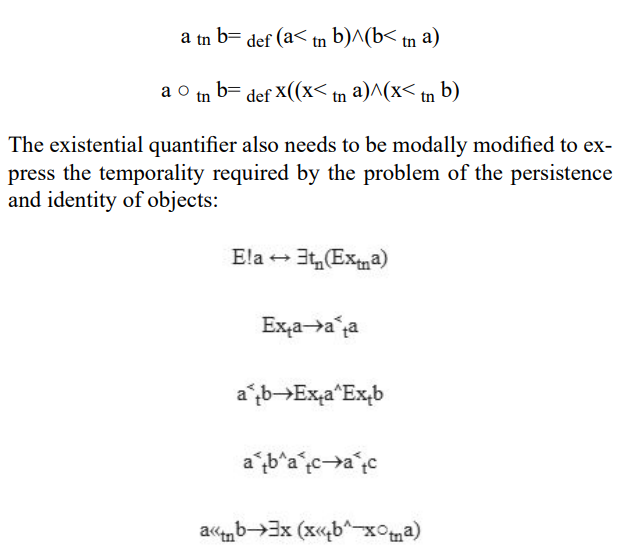
The first axiom represents the expression in natural language ac- cording to which “there exists” if and only if there is some moment in which it existed. It is important to highlight that some theo- rems can be deduced from the axiomatic system presented above representing variations in composition to explain the identity and persistence of objects.
Once the fundamental axioms of temporal mereology have been introduced, it is worth noting with Lewis that [1]:
The question of the intertwining of worlds parallels the mundane problem of identity across time; and our problem of accidental in- trinsics is parallel to the problem of temporal intrinsics, which is the traditional problem of change. Let's say that something persists if and only if, in one way or another, it exists at various times; this is the neutral word. Something endures if and only if it persists by having different temporal parts, or stages, at different times, al- though no part of it is fully present at more than one time, whereas it endures if and only if it persists by being fully present at more than one time. what a while. Perdurance corresponds to the way a road persists through space; part of it is here and part of it is there, and no part is fully present in two different places. Endurance cor- responds to how a universe if such a thing exists, would be fully present wherever and whenever instantiated. Enduration involves intertwining: the content of two different tenses has the endurant thing as a common part. Duration does not.
And so Lewis's explanation continues with the further claim that enduring through time is analogous to the transmundane identi- ty of intertwined common parts of the world and that enduring through time is analogous to transmundane identity if it can be called that. a trans-mundane individual composed of distinct parts of non-intertwined mutes.
Lewis also adds to the debate about the persistence and identity of objects in which endurantism and perdurantism are opposed. Once the considerations about endurantism and perdurantism that define the debate have been made, let us next consider the clas- sic question of temporary intrinsics and their relationship with the aforementioned debate.
Related Question: Temporary Intrinsic
He explains that the main and decisive objection against endu- ration, as an approach to the persistence of ordinary things like people and puddles, is the problem of temporary intrinsics. Per- sistent things change their intrinsic properties. There would then be three possible solutions to this problem. One solution is that, contrary to what one might think, shapes are not intrinsic proper- ties. They are disguised relationships, which an enduring thing can exhibit over time. The same endurant can exhibit the double form relation at times, and the straight form relation at other times. In itself and considered independently of its relations to other things, it has no form at all. Lewis further states that the same can be said about all other temporary intrinsics; they must all be reinterpreted as relations that something with an invariable nature exhibits at different times. The solution to the problem of temporary intrin- sics is that there are no temporary intrinsics at all. This is, in the opinion of Lewis, absolutely incredible, if we are talking about the persistence of ordinary things [1]. If we know what a form is, we know that it is a property and not a relation.
Thus, as Lewis explains, endurantism is defended by perdurantism by claiming that there are no temporary intrinsic properties. As Lewis further explains, two other solutions seem to reject endur- antism. A second possible solution that can be defined is to state that the only intrinsic properties of a thing are those that it has at the present moment. Other times are like false stories: they are ab- stract representations, composed from the materials of the present, that represent, for better or worse, the way things are. When it only has different intrinsic properties according to one of these tenses that Lewis calls ersatz, that is, it does not mean that this, or any part of it, or anything else, just has them; no more so than when a man is dishonest according to the Times or honest according to the News. This is a solution that rejects enduration because it rejects persistence entirely. And this, as mereologists still explain, is even less credible than the first solution. Saying that there are no other times, as opposed to false representations of these, goes against what is commonly believed. No man, unless he is at the moment of his execution, believes that he has no future; even less does anyone believe that it has not passed.
The second solution is called presentism for the current philos- ophy of the persistence and identity of objects. Yet a third solu- tion would be possible. Different forms and different temporary intrinsics generally belong to different things. Enduration must be rejected in favor of perduration. We endure, we are made of tem- poral parts and our intrinsics are properties of these parts, in which they differ from each other. There is no problem at all about how different things can differ in their intrinsic properties. After this article, we will return to the parallel issue of temporary intrinsics and argue that mereological hylomorphism seems to offer a solu- tion to this problem.
In the final considerations of this work, we will briefly return to the issue of temporary intrinsics and offer a position on this issue based on an axiomatic formulation of mereological hylomorphism. Having considered the question of intrinsics, we will now focus on the related question of the relevance of the debate on endurantism and perdurantism.
Related Question: About the Relevance of the debate be- tween Perdurantism and Perdurantism
Some authors offer a more precise characterization of the debate over perdurantism and endurantism. According to Sider and Magi- dor, it can be said that x is an instantaneous temporal part (PTI) of y if and only (i) exist in, but only in t; (ii) x is part of y at t; (iii) x intertwining in everything that is part of y in t. Second, let endurantism be the view that for every object x and for every time t at which x exists, there is a PTI of x at t [8]. Finally, let endur- antism be the negation of endurantism. The literature on the topic of endurantism and perdurantism consists of a wide variety of ar- guments and counterarguments in favor of each view. The typical form of an argument for perdurantism is to present some apparent challenge to which perdurantism, it is argued, has a direct answer, while endurantism has more problems in responding. Endurantists then typically respond to such arguments either by reducing the problem (by showing that there is no problem in the first place), or by arguing that they also provide a satisfactory answer to the prob- lem. Mutatis mutandis for the arguments in favor of perdurantists. Some authors comment that much of the debate between enduran- tism and perdurantism is misinterpreted. It is widely recognized that those who accept perdurantism typically also accept a niche of other claims that strictly speaking do not follow perdurantist doc- trine. One example is the doctrine of universal fusion. The other claim is that for every collection S of space-time points that are occupied by matter, there is an object that occupies all points of S and not other points (call this liberalism). Similarly, endurantism typically endorses claims that do not strictly follow endurantism. For example, the denial of universe fusion and the denial of liber- alism. Unfortunately, when it comes to the debate between endur- anism and perdurantism, little care has been taken to distinguish between the role of the doctrines in question in the arguments, and the role played by these additional claims that usually accompany the two doctrines.
One possible position for the debate is to assert that most (perhaps even all) of the central arguments of the endurantist/perdurantist debate crucially rest on these orthogonal claims and so the argu- ments do not directly target the doctrines they are allegedly used to support. And some authors try to prove they are right. Consid- er a typical argument for the perduratist. As some authors note, this argument consists of a challenge or problem that endurantists allegedly have difficulty formulating, and to which perdurantism has a direct answer. There is a version of endurantism that mimics the perdurantist response. That is to say, endurantism can offer the same or at least a highly analogous answer to what perdurantism offers. Mutatis mutandis for the pro-endurantist arguments. To be clear, the position is not merely that endurantism or perdurantism has some satisfactory way of responding to the arguments. Putting the position better is that endurantists/perdurantists can provide essentially the same answer as the opposing view. This shows that the original argument cannot be plausibly interpreted concerning the doctrine of endurantism/perdurantism per se.
According to other authors, it can be said that the debate has been in vain. But it certainly isn't. For a start, to the extent that the ar- guments in the debate are successful, they serve to support some of these orthogonal claims. Nor are the arguments in the debate irrelevant to defending either endurantism or perdurantism per se. They may still play a role in that debate, albeit a much more indi- rect role than they are considered to play.
The debate on endurantism/perdurantism has received more crit- icism. It is usual to say that something persists and only if it is located more than one time. This neutral term gives us a way to frame the question. How does something persist? One answer is to say that the persistence of the thing involves its perdurance. What makes something last? It has generally been held that perdurance evolves by persisting by having temporal as well as spatial parts. And what is it for something to last? It is often put in terms of a thing being fully present every time it exists. Again, sometimes the enduration/perduration distinction is put in terms of differences be- tween strict identity and a looser unity sometimes called geniden- tity. On this understanding, a thing persists or endures if and only if for whatever time the thing is located, there exists something identical to that thing. A thing persists or endures if and only if the time in which it is located is represented in different temporal parts in those times in which it maintains the relationship of genidentity between them. The distinction between perdurantism and enduran- tism also seems to be problematic. Hopefully, the above descrip- tion gives the reader some sort of sense of what the endurantism/ perdurantism distinction might look like. Unfortunately, none of the above suggestions seems adequate to capture the distinction between endurantism and perdurantism. For example, the idea of the enduration of a thing being captured in terms of being fully present in all times in which it is located has been shown by some authors in the literature to be problematic. It is commonly said that an endurantist partition is an irreducibly temporally relative matter. Contrast the situation of induration with that of perdura- tion. We can establish without temporal indexation what parts a lasting thing has. What parts a lasting thing has, this one has them simpliciter. These parts have the further property of being locat- ed at various times. On the other hand, we cannot establish what parts an enduring thing has without mentioning the relative times to which this thing has those parts.
Thus, the distinction between endurantism and perdurantism ap- pears to be problematic in some cases, according to some objec- tions in the literature. MacKinnon for example questions the core of the distinction between induration and perduration through con- sideration of the notion of temporal part [9]. He then introduces the notion of the temporal part:
What is a temporal part? Those who believe in temporal parts take them to be among the parts of persistent things. As such, they are located at instants and over intervals of time. Let's start by focus- ing on the instantaneous temporal parts. Plausibly, x is an instan- taneous temporal part located at t of y if and only if (i) x is part of y; (ii) x is located only at t and, (iii) x entangles every spatial part of y that is located at t.
Alluding only to temporal parts without reference to parts, the definition given above reduces to: (PT) x is an instantaneous tem- poral part at t of y if and only if (i) x is a part of y, (ii) x is located only in t (iii) x intertwines every part of y that is located in t. Based on the definitions presented, it is possible to offer a distinction be- tween induration and perduration by stating that (E) x endures if and only if, (b) x has no temporal parts, and (c) for any time in which x is located, there exists a set whose members make up x at that time. Two other complementary definitions would be: (P) it has temporal parts that last; (EP) x endura/perduras if and only if it has at least one enduring temporal part.
Thus, at the heart of the distinction between induration and per- duration, the notion of the temporal part seems to be presupposed The perdurantist endurantist debate appears to involve three main issues: (1) Debates over moderatism and perdurantism (or three- and four-dimensional) typically deal simultaneously with several issues concerning persistent objects. Three interconnected issues at the center of current debates are: (DIM) Whether objects are three-dimensional or four-dimensional; (TP) Whether or not the object has its temporal parts. (PART) Whether objects last only in partition relations relative to time. Perdurantists tend to claim that persistent objects are four-dimensional, that every persistent object has a temporal part for each moment through which it persists, and that objects endure in timeless partition relations. Endurantists tend to claim that all objects are three (or less) dimensional and lose temporal parts of their own.
There is a division in the debate regarding endurantism. The stan- dard endurantist position on PART depends, to some extent, on whether the endurantist is an eternalist (believing that all times, and objects present at those times, are equally real) or a presentist, believing that only current time and current present objects are real. In addition to this division, it is still possible to character- ize the relevance of the debate on endurantism and perdurantism with an example. Let's say that an object persists through time if and only if it exists at multiple times. Today, many philosophers agree that objects persist through time. Still, they disagree about how they do it that way. The core of their disagreement is whether or not such objects have temporal parts. So-called perdurantists think they have, so-called endurantists think they don't. The con- flict between endurantists and perduratists is made up of several well-known arguments against enduratism. Perdurantists think that temporal parts are necessary to explain phenomena such as change, mereological coincidence, and vagueness. For their part, endurantists insist that they can explain such phenomena just as well without temporal parts. And so they think that any idea that objects have temporal parts is unmotivated, if not per se implau- sible.
Another characteristic of the debate between endurantism and per- durantism can be highlighted. Yet another challenge for the endur- antist concerns the main definition of his vision. Perdurantism may be based on a prima facie implausible principle, yet it has a clear and positive feature: according to it, persistent objects have tempo- ral parts. On the other hand, endurantism is often characterized in purely negative terms, such as the thesis that objects have no tem- poral parts. Endurantism is sometimes defined in positive terms, with the thesis that objects are fully present at various times. Still, this definition rests on the notion of being fully present, which many consider unclear. What does it mean that x is fully present at time t? This does not mean that every part x has at any time is part of x at t, otherwise, it would be impossible for x to change its parts over time. Nor does it mean that every part that x has at t is a part of x at t because that is a trivial legacy that the perdurantist would like to maintain as well. Perhaps this just means that x has no temporal parts in t. But in this case, being fully present several times would only mean persisting without having temporal parts,in such a way that enduratism would become defined in purely negative terms.
We thus see that there are several aspects of the relevance of the debate between endurantists and perdurantists. In the final consid- erations of this work, we will define the axioms of mereological hylomorphism and take a position on the related question of the relevance of the aforementioned debate.
Final Considerations
With the elements of the discussion presented in this article, we can now make some final considerations that define mereological hy- lomorphism. Mereological hylomorphism is the doctrine accord- ing to which the persistence and identity of physical objects can be considered relative to the formal and material parts that make up the objects. We have to consider that the persistence of objects throughout their changes of part in time can be explained based on the notion of the formal essence of the substance, while the change of temporal parts occurs based on the accidental properties of the substance. Now, mereological hylomorphism was proposed by Ar- istotle who in Metaphysics, book Z, 1035b, defined that: "A part, then, can be part of the form – by form I understand the essence – or of the concrete whole composed of form and matter, or of matter itself..." Thus, following the Aristotelian tradition, physical objects can be considered as compositions of form and matter or hylomor- phic compounds, in which the essence existing in the object guar- antees its persistence over time, and also that physical objects are composed of parts of matter that they are merely logically variable over time. As considered by Wedin:
...this is supported by the proposal that form guarantees the identi- ty of c-substances. Since the c-substances are such that they must remain the same while enduring several changes, including the change of temporal parts. In this view, a certain ship, say T 1, can over time undergo replacement of all its material parts and remain the same ship. And this is so, according to Frede, even when the original plates and screws are later assembled to produce T 2, a replica of T 1 . Because the identity of T 1 must be told by its form or its matter and because the matter has been completely replaced, it must be the form that must explain the identity of the ship. This, in turn, suggests that form is at the heart of the particular vessel T 1.
The c-substance that Wedin refers to in the passage above is the individual concrete substance that is mentioned by Aristotle in the book of Categories. Thus, we see that also according to the work of Frede form is at the heart of the individual concrete substance of common objects and therefore must constitute their persistence over time [10]. Here are some considerations about mereological essentialism. Along with the tensioned or modalized notion of time in the mereology of the temporal matter of the substance, we must also consider the question of its essence and here we must consid- er mereological essentialism. There would then be a principle of mereological essentialism according to which, being formalized, it states that for all x, if x has y as one of its parts, then y is part of x in every possible world in which x exists. y is then an essential part of x.
Once the proposition of Aristotelian hylomorphism according to Wedin and Frede has been defined for mereological hylomorphism and the corresponding notions of mereologically variable material accidental part and mereological essentialism with the notion of essential part or mereologically constant form, we can Now return to the related question of temporary intrinsics posed by several au- thors, including Lewis, which we considered in section 3 [11]. The position pertinent to the doctrine of mereological hylomorphism is that there are no temporary intrinsics since the formal part pertains to all possible worlds of relevance and therefore the intrinsic prop- erties are of the order of the essence of physical objects and thus cannot be temporary. Only the material properties of objects are mereologically temporary, but in this case, they are extrinsic prop- erties of the objects. It is important to add that only all substantials are capable of being considered for mereological essentialism. The essential parts are mereologically continuants or simply continu- ants of intentional mereology, while the material parts of objects are mereologically the occurrence of intentional mereology.
As for section 4 on the relevance of the debate as a related issue, we can state that the doctrine of hylomorphism presented is an in- termediate position between endurantism and perdurantism since the essential parts of objects are endurants and the material parts of objects are in turn, lasting and variable as temporal parts of objects. Therefore, the doctrine of mereological hylomorphism is a contemporary relevant position for the debate on the persistence and identity of objects [12,13].
References
- Lewis, D. (1986). On the plurality of worlds (Vol. 322). Blackwell: Oxford.
- Varzi, A. (2022). Mereology . Entry from the Stanford Ency- clopedia of Philosophy. Accessed in October.
- Costa, D. (2022) Persistence in Time. In: The Internet Ency- clopedia of Philosophy. Accessed in October.
- Seibt, J. (1997). Existence in time: From substance to process. In Perspectives on time (pp. 143-182). Dordrecht: Springer Netherlands.
- Aristotle. Metaphysics. In: The Perseus Digital Library.
- Koslicki, K. (2006). Aristotle's Mereology and the Status of Form. The Journal of Philosophy, 103(12), 715-736.
- Imaguire, G. (2006) Mereology: The Whole and its Parts. In:Contemporary Metaphysics. Ed. Vozes.
- Magidor, O. (2016). Endurantism vs. perdurantism?: A debatereconsidered. Noûs, 50(3), 509-532.
- McKinnon, N. (2002). The endurance/perdurance distinction. Australasian Journal of Philosophy, 80(3), 288-306.
- Frede, M. (1985). Substance in Aristotle’s metaphysics. Aris- totle on nature and living things, 17-26.
- Frede, M. (1987). Essays in ancient philosophy. U of Minne- sota Press.
- Simons, P. (1986) Pars: A Study in Ontology. Oxford Univer- sity Press, Oxford.
- Wasserman, R. (2016). Theories of persistence. Philosophical Studies, 173(1), 243-250.