

Journal of Marine Science Research and Oceanography(JMSRO)
ISSN: 2642-9020 | DOI: 10.33140/JMSRO

Impact Factor: 1.8

Research Article - (2025) Volume 8, Issue 2
How Does the Thermal Noise of the Sar Receiver Affect the New Doppler Spectrum Estimate?
Received Date: Apr 21, 2025 / Accepted Date: May 14, 2025 / Published Date: May 23, 2025
Copyright: © 2026 This is an open-access article distributed under the terms of the Creative Commons Attribution License, which permits unrestricted use, distribution, and reproduction in any medium, provided the original author and source are credited.
Citation: Kanevsky, M. B. (2025). How Does the Thermal Noise of the Sar Receiver Affect the New Doppler Spectrum Estimate?. J Mari Scie Res Ocean, 8(2), 01-03.
Abstract
The issue of how the new spectral estimate works taking into account the thermal noise of the SAR receiver is considered.
Introduction
The issue of how the new spectral estimate works taking into account the thermal noise of the SAR receiver is considered.
In recent work [1] we proposed a new Doppler spectrum estimate for spaceborne SAR operating over the ocean. According to [1], the result of applying this estimate is a smoothing of the simple estimate obtained by using an FFT to the SAR signal realization, while preserving the Doppler centroid position. However, this result was obtained for the case where the influence of thermal noise of the SAR receiver can be neglected, which is not always the case in real situations. The last paragraph of [1] only qualitatively describes this influence, but here we will give a quantitative consideration.
We will start with following formula of the Doppler spectrum shape factor:
Here: â??ðÂÃÃÂ??ÂÃÂ?ÂÂ??ðÂÃÃÂ??ÂÃÂ?ÂÂÂÃÃÂ??ÂÃÂ?´ðÂÃÃÂ??ÂÃÂ?ÂÂ?? is the SAR nominal azimuthal resolution; ðÂÃÃÂ??ÂÃÂ?ÂÂ?? ≅ 8 ðÂÃÃÂ??ÂÃÂ?ÂÂ??ðÂÃÃÂ??ÂÃÂ?ÂÂ??/ðÂÃÃÂ??ÂÃÂ?ÂÂ? is the speed of SAR carrier; ðÂÃÃÂ??ÂÃÂ?ÂÂ??0 = 2ðÂÃÃÂ??ÂÃÂ?ÂÂ??ðÂÃÃÂ??ÂÃÂ?ÂÂ?£ÃÃÃÂ????ðÂÃÃÂ??ÂÃÂ?ÂÂ??ðÂÃÃÂ??ÂÃÂ?ÂÂ??ðÂÃÃÂ??ÂÃÂ?ÂÂ??, and ðÂÃÃÂ??ÂÃÂ?ÂÂ?£ÃÃÃÂ????ðÂÃÃÂ??ÂÃÂ?ÂÂ??ðÂÃÃÂ??ÂÃÂ?ÂÂ??ðÂÃÃÂ??ÂÃÂ?ÂÂ?? is the regular part of velocity radial component on the ocean surface. The added (compared to [1]) second term on the right-hand side of (1) takes into account the thermal noise of the SAR receiver; σ0 and σðÂÃÃÂ??ÂÃÂ?ÂÂ??ðÂÃÃÂ??ÂÃÂ?ÂÂ??ðÂÃÃÂ??ÂÃÂ?ÂÂ?? respectively denote the radar cross section, which depends on the state of the ocean surface, and the pedestal due to the thermal noise (see[2] for details). Naturally, the lower the thermal noise level (i.e. the lower the pedestal), the better the SAR can see the ocean surface.
Of course, when solving the problem posed in [1], it would be more logical to start with formula (1). However, this leads to calculations that, although elementary, are quite tedious. But then the ease with which the very transparent formula for the new estimate was obtained in [1], is lost. Therefore, from a methodological point of view, it seems advisable to first obtain this formula in a simple way, and then show what effects its use leads to in a real situation, for which it was still necessary to return to formula (1) and go through a somewhat tedious path.
The calculations presented below are given in a somewhat abbreviated form; the omitted details can be reconstructed by the interested reader with not too much effort.
The shape factor of the simple spectral estimate is written as follows:
Here ((ðÂÃÃÂ??ÂÃÂ?ÂÂ??) and (th.n (ω) are the random multipliers describing fluctuations of the spectral component itself and of the above - mentioned pedestal, respectively. We will assume that each ((ðÂÃÃÂ??ÂÃÂ?ÂÂ??) and (th.n (ω) has delta-correlation functions: ðÂÃÃÂ??ÂÃÂ?ÂÂ??( = ðÂÃÃÂ??ÂÃÂ?ÂÂ??2ðÂÃÃÂ??ÂÃÂ?ÂÂ?¿(ðÂÃÃÂ??ÂÃÂ?ÂÂ??′ − ðÂÃÃÂ??ÂÃÂ?ÂÂ??′′) and ðÂÃÃÂ??ÂÃÂ?ÂÂ??(.th.n =
Next, we perform the matched filtering operation, where the shape factor of the Doppler spectrum itself is taken as the reference function
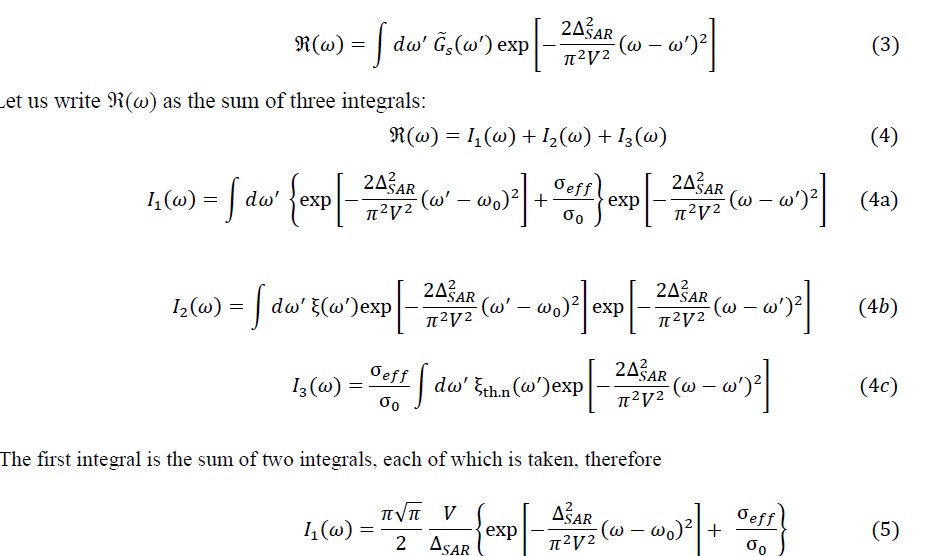
Let us find the mean square of the sum (4). When raising the right-hand side to the square, the cross terms after averaging vanish since the mean values of the functions ((ðÂÃÃÂ??ÂÃÂ?ÂÂ??) and (th.n (ω) are equal to zero and, in addition, these functions are independent of each other. Therefore
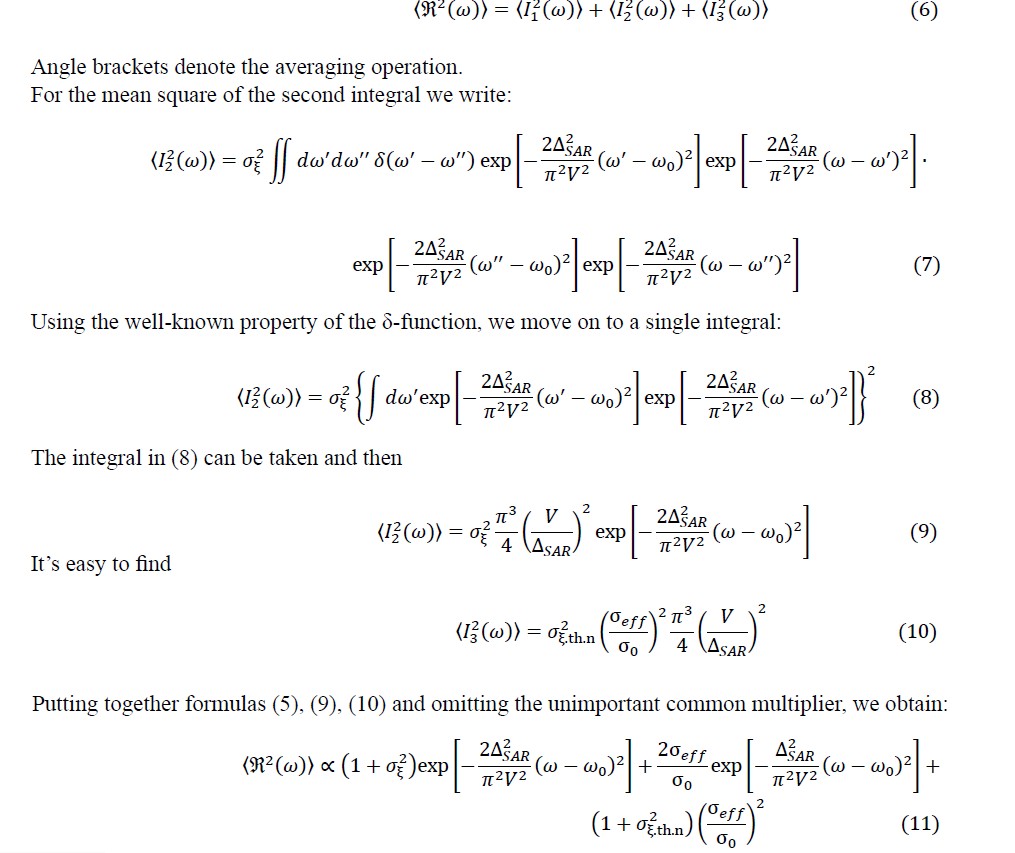

on average, causes a pedestal and, at a relatively low level of thermal noise, a slight slowdown in the roll-off of the spectrum at its edges. The position of the Doppler centroid remains unchanged. As the thermal noise intensity increases, the new estimate will produce an increasingly stretched spectrum at an increasingly higher pedestal, but the centroid position will not change.
References
- Kanevsky, M. B. (2025). A new estimate for Doppler spectrum when operating space-based SAR over the ocean. J Mari Sci Res Ocean, 8(2), 01-02.
- Alpers, W., & Hasselmann, K. (1982). Spectral signal to clutter and thermal noise properties of ocean wave imaging synthetic aperture radars. International Journal of Remote Sensing, 3(4), 423-446.