



Review Article - (2026) Volume 4, Issue 1
High-Quality Management of Soil Water Resources and Agriculture High-Quality Development
2Institute of Soil and Water Conservation, Chinese Academy of Science and Ministry of Water Resources, yangling, China 26 Xinong Road, Yangling, Shaanxi Province712100, P. R., China
Received Date: Jan 07, 2026 / Accepted Date: Feb 09, 2026 / Published Date: Feb 19, 2026
Copyright: ©©2026 Zhongsheng Guo. This is an open-access article distributed under the terms of the Creative Commons Attribution License, which permits unrestricted use, distribution, and reproduction in any medium, provided the original author and source are credited.
Citation: Zhongsheng, G. (2026). High-Quality Management of Soil Water Resources and Agriculture High-Quality Development. J Water Res, 4(1), 01-09.
Abstract
Soil water resources are the most important part of nature resources. As plant grow, the plant water relationship changed from equilibrium relation to non-equilibrium relationship, which led to severe soil and water loss, led to soil drought, soil and vegetation degradation, crop failure or waste of soil water in most of water-limited regions. In order to solve these questions and improve environment and realize the sustainable utilization of soil water resources and the high-quality sustainable development of social economy. After a couple of years research, the results showed that it is necessary to apply the vegetation carrying capacity in critical period of plant resources relationship regulation to adjust the plant water relationship to obtain the maximum yield and benefit to carry out sustainable use of soil water resources and agriculture high-quality development.
Keywords
Soil Water Resources, Goods and Services, Water-Limited Area, Plant Water Relationship, Soil Water Resource use limit by Plants, Soil Water Vegetation Carrying Capacity, Sustainable Utilization of Soil Water Resources, Agriculture High-Quality Development.
Introduction
Soil water resources are the most important part of nature resources. The goods or the products that people need, such as food, fiber and fuel wood and services, such as improving environment and soil and water conservation produced by plant ecology system is the power by which Human society can be promoted fast in high quality way.
Terrestrial Plants usually absorb water by their roots, and other kinds of water resources must be translated into soil water resources and then absorbed by plants in water-limited regions. The soil water is the most important factor influencing plant growth in water-limited regions because underground water is deep and soil water mainly from precipitation without irrigation in some of the water-limited regions, such as Chinese loess plateau.
Most of the goods and services that people in the world enjoy are produced by vegetation. To meet people’s needs, most of old forest changed into non-native vegetation and changed the relationship between plant growth and soil moisture, leading to soil dry, soil degradation and vegetation decline in dry years or waste soil water resources in rainy yeas.
For example, along with plant growth, soil drought occurred, resulting in soil degradation and vegetation decline in most of soil and water conservation forest in water limited regions (Li, 2001) because the soil water supply mainly from precipitation and cannot meet the water needs of plants in dry year or wastes because the soil water supply from precipitation surpasses the water needs of plants in a rainy year Chinese loess plateau [1-7].
As consequence, vegetation degrades and eventually soil degrades in the artificial perennial grassland and woodland areas of the Loess Plateau (Li, 2001) or soil water resources wastes in rain years [2,3]. This, in turn, affects soil quality, non-native vegetation growth and its economic and ecological benefits. This is not desirable for the sustainable use of soil water resources and high quality and sustainable development of vegetation.
To keep healthy growth of non-native vegetation and get its maximum produce and ecological benefits, water-plant relationship must be regulated by reducing plant density or lop a fruit tree in order to increase soil moisture supply, reduce evapotranspiration and maintain soil moisture balance and the stability of artificial vegetation ecosystem, to prevent soil drying and soil degradation or soil water waste.
The rationale for regulation water-plant relation is that theory of Soil water resource use limit by plants and the theory of Soil Water Vegetation Carrying Capacity, especially Soil Water Vegetation Carrying Capacity in the key period of plant water relation regulation. The purpose of the paper is to introduce the theories of Soil water resource use limit by plants, the theory of Soil Water Carrying Capacity for Vegetation and the critical period of plant resources relationship regulation to carry out Sustainable utilization of soil water resources and agriculture high-quality development in water-limited regions.
Materials and Methods
Site Description
This study was conducted at National Demonstration area of high-quality red plum apricot, which is located at the Shanghuang Eco-experiment Station in the semiarid Loess hilly region (35°59′- 36°02′ N, 106°26′- 106°30′ E) in Guyuan, Ningxia Hui Autonomous Region of China, Institute of Soil and Water Conservation of Chinese Academy of Sciences, with the altitude of the station ranges from 1,534 m to 1,824 m, see fig 2. Precipitation here is absent in the periods from January to March and from October to December, and the rainfall from June to September makes up more than 70% of the annual precipitation. Mean rainfall measured between 1983 and 2001 was 415.6 mm with a maximum of 635 mm in 1984 and a minimum of 260 mm in 1991. The frost- free season is 152 days. The Huangmian soil having developed directly from the loess parent materials, consists mainly of loamy porous loess (Calcaric Cambisol, FAO1988) with wide distribution in the semiarid hilly region of the Loess Plateau. Red plum apricot tree is a kind of fine variety apricot (Armeniaca vulgaris Lam.). The experiment was conducted in 1~4-year-old young caragana shrubland sowed in 2002 and 16-19-year-old caragana shrubland planted in 1986, 1~3-year-old red plum apricot garden planted in 2018 and 23~25-year-old red plum apricot garden planted in 1996.
Rainfall Measurement
Rainfall at the study site was measured with standard rain gauges placed in the center of the National first-class high-quality red plum apricot Demonstration area, which was about 50 m from the Shanghuang Eco-experiment weather station, as a part of Guyuan Eco-experiment weather station under Institute of soil and water conservation of Chinese Academy of Sciences. The study also included the determination of the soil moisture con-tent, plant root distributions, and other plant growth parameters.
Physical Characteristics of Soil
Caragana shrub is a good shrub in the loess plateau, See fig.1). The experimental plots located in 1~4, 11-13-year-old young caragana shrubland sowed in 2002 and 16~19-year-old caragana shrubland and then in the 23~25-year-old red plum apricot forest planted in the bench terrace in 1996 and 1~3-year-old red plum apricot forest planted in the bench terrace in 2018. The sampling pits (soil profile) was dug in red plum apricot forest at the experimental site for investigating soil profile and sampling purposes, whose dimensions were 1m×2m × 4 m depth on the red plum apricot forest in April, 13, 2018. The undisturbed soil samples were collected for 3 times at the depth of 0 to 5, 20 to 25, 40 to 45, 80 to 85, 120 to 125, 160 to 165, 200 to 205, 240 to 245 and 395 to 400 cm with cutting rings (a 5 cm in high, 5 cm in inner diameter and 100 cm3 in cubage). At the same time, the disturbed soil of about 100g at each depth was collected for determination of soil structure at the State Key Laboratory of Soil Erosion and Dryland Farming on the Loess Plateau.
Cutting ring was used to measure the bulk density, total porosity, capillary porosity, saturation moisture content. The core samples (undisturbed soil sample) collected were used with cutting rings to measure the soil bulk density, capillary porosity and noncapillary porosity. The bulk density was determined by oven-drying the cores at 105-110â??, and the total porosity was calculated as 1-bulk density/soil particles density, assuming that the density of soil particles was 2.65g/cm3. Noncapillary porosity was the difference between total porosity and capillary porosity. Soil particles were measured with master sizer 2000 laser particle analyzer and grain size were graded on the USA standard. Soil water contents at different soil suctions (0.1, 0.2, 0.4, 0.6, 0.8, 1.0, 2.0, 4.0, 6.0 bar, 1 bar = 1.0×10⁵ Pa) were measured by a HITACHI centrifuge, made by Instrument Co., Jappan. Because Huangmian soil had been contracted when measuring with a centrifuge, the researchers measured the shrink amount of soil samples in the cutting ring by vernier callipers at different soil suctions and then calculated the volumetric soil water content.
Soil Water Measurement
Select 1~4, 11-13-year-old young caragana (Caragana korshenskii) shrubland sowed in 2002 and 16~19-year-old caragana shrubland planted in 1986 and 1~2-year-old and 23~24-year-old red plum apricot tree with average height and canopy as the sample of study. Two holes with 5.3 cm in diameter were made by holesaw in the place about 40cm cm apart from the 1-year-old red plum apricot tree, and two 4-m long aluminum access pipes were placed in the holes with an interval of 1 m between them. Another two holes with 5.3 cm in diameter were made by holesaw in the middle of the radius of red plum apricot tree canopy, about 2 m away from the tree base (centre) to the exterior margin of the canopy in the 23-year-old red plum apricot tree planted in the bench terrace in 1996. The interspaces between access pipes and soil were filled with some fine earth in case water might flow through the interspaces. A neutron probe, CNC503A (DR), made by Beijing Nuclear Instrument Co., China, was used for long-term monitoring of the field soil water content because of its high precision in situ [4,8,9]. Before measuring the volumetric soil water content (VSWC), the neutron probe was calibrated for the soil in the study area by using standard methods (Hauser 1984). The calibration equation for this soil at the site is y = 55.76 x + 1.89, where y is VSWC, and x is the ratio of the neutron count in the soil to the standard count. The measuring depth ranged from 0 to 400 cm in the period from April to October, in 2018 and 2019. Measurements were made with 15-day intervals in time and 20 cm intervals in depth. Measurements were made every 15 days to a depth of 4 m in increments of 20 cm starting at the 5 cm depth. When measuring soil water content at different soil depth, first put the probe into the aluminum access pipes and change the measuring line of the neutron probe to confirm the weather or not the soil depth equal planned depth of determination according to the display device of soil depth. Secondly, press the start button and then read and record the numbers of soil water content at different soil depth on the display screen of the neutron probe. The soil water content obtained for each measuring depth was taken to be representative for the soil layer that included the measuring point ± 10 cm depth, apart from that for the 5 cm depth, which was taken to represent the 0 to 10 cm soil. The measurements were also made before and after each rain event in the caragana shrub and red plum apricot orchards (Guo and Shao, 2004, 2019) [4,10-14].
Plant Growth Measurement

Figure 1: Caragana shrub (Caragana korshenskii) planted in 1986 in Guyuan China
Height, diameter at the base and size of the canopy of 1~4, 11-13-year-old young caragana shrubland and 16~19-year-old red plum apricot tree growing on the plots were investigated and measured, and estimate the maximal infiltration depth and Soil Water Resources Use Limit by Plant. the relationship between the colour of leaf or the size of fruit and the soil water was investigated and estimate the suitable amount of leaf and vimen when the soil water resources in the maximal infiltration depth is approach to or smaller than Soil Water Resources Use Limit by Plant in 23-year-old red plum apricot tree. The measurements of red plum apricot tree growth were carried out in the period from mid-April to October, and the measurements of precipitation and soil water were carried out from January to December in 2018 to 2020.
Results
Depth of Infiltration and Maximal Infiltration Depth
Two curves method was found by Guo in 2004, and used to estimate the depth of infiltration (Guo and Shao, 2004), and named by Guo in 2020 [15,10]. In this study, two curves method was used to estimate the depth of infiltration and soil water supply for a rain event or some daysâ?»and a series of two curves methods for used to estimate the depth of infiltration for a long- time infiltration process, such as the time period from mid-April to October in 2018 and 2019.
When estimating the depth of infiltration and soil water supply for a rain event or some days, first put the probe into the aluminum access pipes and change the longth of measuring line connected with the neutron probe sensor to the measuring soil depth according to the display device of soil depth in the neutron probe and measure and record soil water content at different soil depth and then draw the change of soil water content with soil depth before a rain event and after the rain event (two continuous soil water distribution curves or a series of soil water distribution curves of soil water with soil depth at the same aluminum access pipes and there is a cross location in the coordinate system in the soil profile before a rain event and after the rain event (or an infiltration process) .The depth of infiltration during a rain event is equal to the distance from the surface to the joint location between two soil water distribution curves with soil depth . The MID, short for maximal infiltration depth is equal to the distance from the surface to the deepest joint lo-cation between two contiguous soil water distribution curves with depth in the soil profile at the beginning and the end of a period [4,5,15].
The Change of Wilting Coefficient with Soil Depth
Because Gardner empirical formula can better describe the relationship between soil water content (w) and soil water suction (S), the wilting coefficient can be estimated by the Gardner empirical formula w=a × S – b [15].First the Gardner empirical formula was transformed into ln (w)=a × ln (S)+b, and then used to fit the relationship be-tween soil water suction (S) and volumetric soil water content (w) at different soil depth, and then established the relationship between ln (w) and ln (S) by the least square method, and then estimate the wilting coefficient, which is the volumetric soil water content (w) at 1.5Mpa.
Soil Water Resources Use Limit by Plants
The mathematical model for calculating SWRULP was showing as following: SWRULP=Ê? Ow×dh Here, SWRULP is Soil Water resources Use Limit by Plant, expressed in mm. MID is maximum infiltration depth. Ow is wilting coefficient at Layer i soil. The Symbol i is layer i soil and D is the thickness of the soil at layer i soil.
Statistical analysis
With the help of ANOVA coupled with SPSS 13.0 software, an analysis was made concerning the significance of influence of the planting density on all the parameters measured and the effect of pipe position, planting density and soil depth on soil water content. A regression analysis was then made to determine the different relationships, such as the soil water content and moisture suction relationship, the relationship between the root density and soil depth using the least square method. Data were transformed when it is necessary to gain a linear relationship.
Soil Water Resource Use Limit by Plants (Swrulp)
1. Soil Water Resources
To understand Sustainable utilization of soil water resources and agriculture high-quality development in water-limited Regions, first we have to master the soil water resources because Soil water resource is the basis of understanding the theory of soil water resource use limit by plants and the theory of Soil Water Carrying Capacity for Vegetation, Sustainable utilization of soil water resources and high-quality development in water-limited Regions.
Soil water resources is the sum of water stored in the soil body, which are renewable water resources and components of water resources. Soil water resources can only be used by plants and then converted into plant products and services for people to use. The concept of Soil Water Resources first put forward by Budagovski in 1985 after Lvovich proposed the concept of overall soil moistening in 1980 [16, 17]. There are generalized soil water resources and narrow sense soil water resources. Generalized soil water resources can be defined as the water stored in the soil from the surface soil to the water table, commonly used in geology or architecture, and narrow soil water resources is the water stored in the root zone, commonly used in forestry, grassland and agriculture. In addition, there is a dynamic soil water resources, which is the antecedent soil water resources plus the soil water supply from precipitation in the growing season for deciduous plants, or over a year for evergreen plants. Soil Water Resources change with rainfall, soil evaporation, plant transpiration and soil water moving in the soil in most of the water-limited regions because underwater is deep and without irrigation [18].
2. Plant Root Vertical Distribution
Root lives in soil body and is the most important organ for terrestrial life plant to suck soil water and nutrient even though stoma in a leaf and a stem can suck a little water when air humidity is high, such as raining. Root vertical distribution depth is an important index to estimate soil water deficit criteria because plant absorbs soil water in the root zone. Soil water resources are good indicator to express the effect of soil moisture on plant growth because plant roots are vertically distributed in soil and suck soil water in certain soil body. Sometime the root depth is more than tree height.
3. Variation of Soil Water Content With Soil Water Suction
Before estimating soil water suction at different soil depth, we must take undisturbed soil sample and measure the soil water suction of undisturbed soil where plant live and wilting. Generally, the sampling pits (soil profile) was dug in the experimental site for investigating soil profile and sampling purposes, whose dimensions were 1m2 × 4 m depth. The undisturbed soil samples were collected for 3 times at different soil depth with cutting rings (a 5 cm in high, 5 cm in inner diameter and 100 cm3 in cubage). Soil water contents at different soil suctions were measured by centrifuge method, generally using a HITACHI centrifuge, made by Instrument Co., Jappan, or Pressure Chamber method made in USA.
Because Gardner empirical formula can better describe the relationship between soil water content w and soil water suction S, the wilting coefficient can be estimated by the Gardner empirical formula w=a â?? S–b [15].
Generally, the wilting coefficient is assumed to be the soil water content when the soil water suction is 1.5 mPa because soil water potential at wilting ranged from -1.0×10⁵ to -2.0×10⁵ mPa, with an average of approximately -1.5×10⁵ mPa (15 bar) [19]. The wilting coefficient varies with soil depth, see the Figue 2.

Figure 2. The changes of soil water content with soil water suction at different soil depth in caragana shrubland of semiarid loess hilly region, Guyuan, China. 0, 20, 40, 80 expresses soil depth of 0cm,20cm,40cm and 80 cm respectively.
Infiltration and Infiltration Depth
Infiltration is the process of water entering the soil in a certain time. After the infiltration process, there are two vertical soil water characteristics cures left on the soil profile. We can use the two vertical soil water characteristics cures to estimate infiltration depth. Before estimating infiltration depth, a neutron probe (CNC503A (DR), Beijing Nuclear Instrument Co., China) was used to monitor the changes of field volumetric soil water content (VSWC) with soil depth before a rain and after the rain event because of its high precision (Wang et al., 2003) [9,5]. If we estimate the changes of soil water content with soil depth at starting time and then ending time of infiltration process in the soil profile, there is a starting vertical distribution curve of soil water before an infiltration process and an ending vertical distribution curve of soil water after the infiltration process. Two curves method was found by Guo in 2004, and used to estimate the depth of infiltration of Caragana shrubland by Guo and Shao in 2009 and Guo in 2014, and named by Guo in 2020. There are two vertical distribution curve of soil water after one. The two vertical distribution curve of soil water before and after the infiltration process can be used to determine infiltration depth and soil water supply. The infiltration depth for one rain event or a given time was equal to the distance from the surface to the crossover point between the two soil water distribution curves with soil depth before a rain event and after the rain event, and MID could be estimated by a series of two-curve methods, a set of two-curve methods [5].
Soil Water Resource Use Limit by Plants (Swrulp)
Natural resources are limited, and so are plants’ use of them. The limit is the limit of plant’s use of resources. The resource use limit by plants includes space resources use limit by plants in soil water and nutrient rich regions; soil water resources use limit by plants in water-limited regions and soil nutrient resource use limit by plants in soil nutrient limited regions [6,7]. The soil water resources resource use limit by plants is the water storage in given soil depth. The amount of soil water resources changes with soil depth, weather condition, plant growth and soil water movement in the soil. To understand the sustainable use of soil water resources, there should be a sustainable use indicator of soil water resources, that is the soil water resources use limit by plant (SWRULP) (Guo, 2010) and soil water carrying capacity and the kay period of plant water relationship regulation [6,7].
Plant root cannot suck soil water unlimitedly in water-limited regions. There is a limit plant use soil water. There are some soil water deficit indices, such as crop water index, soil water deficit index, evapotranspiration deficit index, plant moisture deficit index (Shi et al. 2015) [20]. Because most of the drought indices are based on meteorological variables or on a moisture balance equation, they do not indicates water deficit accumulation or soil water storage (soil water resource) in root zone, they cannot act as a suitable index for distinguishing severe drying of soil in the water- limited regions because soil drought is a nature phenomenon, a water deficit accumulation or a decrease in soil water storage in the root zone soil plant root distribute [21,22].
The SWRULP can be defined as the soil water resources in the MID when the soil water content within the MID equals the wilting coefficient. The wilting coefficient is expressed by the wilting coefficient of an indicator plant, which change with soil depth (Guo,2010) [5-7,10].
Because the soil content changes with soil water suction at different soil depth, and the variation of soil water content with soil water suction accords with the Garden equation, so we can use the Garden equation to fit soil water content and soil water suction data and establish the soil water characteristics curve and then estimate the wilting coefficient at different soil depth [4,6,7,11,12,15].
Soil Water Vegetation Carrying Capacity
The concept of carrying capacity first comes from Malthus’s paper on the principle of population, which is the one of the cores of sustainable use of soil water resources and agriculture high- quality development. Vegetation carrying capacity include space vegetation carrying capacity in soil water and nutrient rich regions; Soil Water vegetation carrying capacity in water limited regions and soil nutrient vegetation carrying capacity in soil nutrient limited regions [6,7,11-14,23].
In the early summer of 2000, the author studied the ability of soil water resources to carry vegetation to solve the problems of soil drought, led to soil degradation, vegetation decay and agriculture failure in water limited region, which determine the reasonable limits of soil water resources and vegetation restoration. The author put forward the concept of soil water vegetation carrying capacity.
The concept first appeared in a paper submitted by the author to the 7th soil physics symposium on soil physics and ecological environment construction held by the Soil Physics Committee of Soil Society of China in Yang Ling, Shaanxi, China in December 2000 and then defined soil water vegetation carrying capacity as the ability of soil water resources to carry vegetation [6,7,23-25].
The soil water vegetation carrying capacity (SWVCC) is the capacity of soil water resources to support vegetation, which is the maximum amount of density expressed by indicator plants in a plant population or plant community that soil water resources of a unit area can sustain and allow to grow healthily at a given period and place (Guo and Shao 2004; Jia et al, 2020) [5-7,10,18,26]. The SWVCC in a plant community is expressed by indicator plant because vegetation is made up of different plants and includes different communities in a nation or a district or watershed and change with plant species, time scale and location [10]. An indicator plant is the constructive species for natural vegetation or main tree species for afforestation for non-native vegetation.
The SWVCC can be estimated by classical carrying capacity equation and plant density - soil water model. According to the classical soil water carrying capacity equation, soil water carrying capacity for vegetation is equal to available soil water resources dividing by individual plant water requirement [6,7,10-12,27].
Because plant water requirement changes with weather condition, plant growth stage and soil water condition and there is not a unified definition of plant water requirement, these factors influence the application of classical soil water carrying capacity equation. According to plant density-soil water model, soil water supply reduces with plant density, at the same time, the relationship between soil water consumption and soil density is a quadratic parabola under All other factors being equal. Simultaneous solution of soil water supply and soil water consumption - plant density relation, the positive solution of the equations is the soil water vegetation carrying capacity, see fig.3 (Guo and Shao,2004) [6,7,10].
Critical Period of Plant Water Relationship Regulation
After a seed germinates or buds, as the plant grows, it blooms, bears, matures, and eventually leaves fall off and enter a dormant period. After finishing all these stages, plant finished a growth cycle in a growth season or about a year. The plant-water relationship in a growth season can be divided into two stages: the sufficient period of soil moisture, in which the soil water resources within the maximum infiltration depth (MID) is more than the soil water resource use limit by plants (SWRULP) and the soil moisture is sufficient for plant growth and plant grow in healthy way, which ensure the sustainable use of soil water resources, and the period of insufficient soil moisture in which the soil water resources within the maximum infiltration depth (MID) is smaller than the soil water resource use limit by plants, which influence the plant growth, cause vegetation decline and did not ensures sustainable use of soil water resources.
Drought affects plant growth at all stages of the plant growth cycle, especially at the critical period of plant water relationship regulation because this stage decides the maximum yield and benefits of forest vegetation. The plant water relationship changes with soil water supply and soil water condition. The plant water relationship is good relation when the soil water resources in the MID is more than SWRULP and the plant grow well. When the soil water resources in the MID is less than SWRULP, drought affects plant growth severe. The plant–water relationship in the soil can be improved by reducing the degree of closed canopy, leaf area index and productivity by cutting or thinning trees or lopping a fruit tree based on the soil water vegetation carrying capacity (SWVCC) when the soil water resources within the
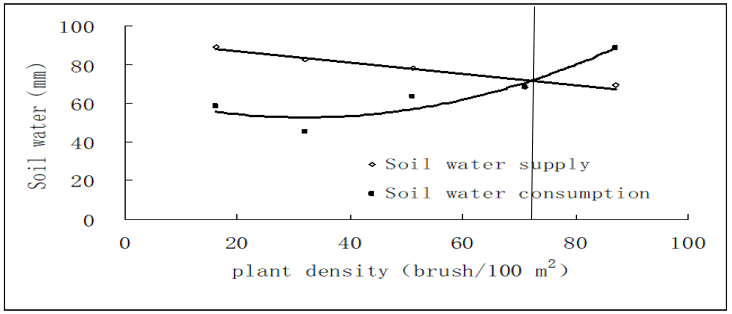
Fig.3. The plant density and soil water supply or consumption relationship and SWVCC in the critical period of plant water relationship regulation in Caragana shrubland, Guyuan, China
infiltration depth (MID) equal the soil water resource use limit by plants (SWRULP) in most of water limited region because of the weak self-regulation ability of exotic plants, the relationship between their growth and soil moisture supply and consumption cannot be regulated by self-thinning to adapt to severe soil drought and have to regulate the relationship , so it is necessary to use external force to adapt to severe soil drought.
Based on a three-year study of red plum apricot forest in the 2018 to 2020, the volumetric water content in the 0 to 290cm soil profile is more than the wilting point, and the soil water resources in the MID is more than the soil water resources use limit by plant. The 23- to 25years-old red plum apricot tree grow well and red plum apricot mature, see fig. 3.
Because Low Spring Temperature, frost and heart-eating harm affect the number of flowering fruit and fruit quality in the Spring, when plant density is equal to the soil water vegetation carrying capacity, the number of leaves and flowers or young fruit is less than the number of leaves and flowers or young fruit when planting density is equal to carrying capacity, so we have to control impact of low temperature and frost on the amount leaf and flowers and peach fruit moth (Carposina sasakii Matsumura) harm on apricot fruit using low-toxicity and high-efficiency cypermethrin and then keep the amount leaf and flowers is equal to or more than the suitable amount flowers or young fruit when plant density equals soil water carrying capacity for vegetation. as for corn or wheat and other crop, we can increase sowing amount to ensure the plant density equals soil water carrying capacity for vegetation.
When the plant density is equal to the soil water vegetation carrying capacity, the amounts of leaves and flowers or young fruit is the appropriate amounts of leaves and flowers because the water-plant relationship of the fruit trees generally is regulated by lopping fruit trees, therefore, it is necessary to estimate the right amount of fruit and flowers before regulating. The peach fruit moth (Carposina sasakii Matsumura) harm on apricot fruit can be controlled by using low-toxicity and high-efficiency cypermethrin.

Figure 3: Flowers and fruits of red plum apricot in the semiarid loess hilly region, Guyuan, China
Critical Period of Plant Water Relationship Regulation
Although we can estimate soil water vegetation carrying capacity at different time in theory, but soil water vegetation carrying capacity at different time have different meaning for high-quality production because plant water relationship changes with plant grow. The most important soil water vegetation carrying capacity is the soil water vegetation carrying capacity in the critical period of plant-water relationship regulation because which is the most important period and decide the maximum yield and effect in the growing season [5-7,10-14].
The starting time of the critical period of plant-water relationship regulation is the time at which the soil water resources within the MID is equal to the SWRULP. The ending time of the critical period of plant water relationship regulation is the ineffective time of plant water relationship regulation, which is the last day on which we can regulate the plant water relationship based on soil water vegetation carrying capacity r and get maximum yield and benefits. The last day of the critical period of plant-water relationship regulation is July 15 for red plum apricot because on which the red plum apricot fruit stops expanding and the end of September for Caragana shrub because raining season finish and soil and water conservation Caragana shrub stops serve. The last day of the critical period of plant-water relationship regulation can be determined by thinning method. Soil degradation and vegetation degradation cannot be controlled by reducing plant density or branches after a critical period of regulation of plant water relationship.
Sustainable Use of Soil Water Resources and Agriculture High-Quality Development in Water-Limited Regions
Drought-tolerant plants generally have some ability of self- regulation. If the drought lasts less than critical period of plant- water relationship regulation, the water-plant relationship does not need to be regulated. Otherwise, to get the maximum yield and benefit in water limited region, we must estimate the soil water resources use limit by plants, soil water vegetation carrying capacity in the critical period of plant-water relationship regulation to regulate the water-plant relationship based on SWVCC in the critical period of plant-water relationship regulation. As for fruit and crop, Vegetative growth and reproductive growth should be regulated according to the suitable leaf when plant density in the critical period of plant-water relationship regulation is equal to SWVCC and the leaf and fine fruit relation to get agriculture high- quality development (Guo 2024) [6,7,11,12,12,14].
Conclusion
Soil water resources are important part of water resources and important for plant growth and agriculture high-quality development in water-limited regions. The sustainable use of Soil water resources is the base of agriculture high-quality development.
When soil water resources in maximum infiltration depth of forest, grass or crops land reduce to soil water resources use limit by plants, the plant water relationship enters the critical period of plant-water relationship regulation and the ending time of the critical period of plant water relationship regulation is the ineffective time of plant water relationship regulation, soil dry in the critical period of plant- water relationship regulation severely influences plant growth, quality, maximum yield and benefit. At this time, the plant-water relationship should be regulated on SWVCC in critical period of plant-water relationship regulation to realize the sustainable use of soil water resources, high-quality and sustainable development of grassland and forest, and Agriculture high-quality development.
It is necessary to master the change of plant water relation and regulate the plant water relation relationship using soil water resources use limit by plants and SWVCC in critical period of plant-water relationship regulation of water-limited regions to ensure plant grow well and get the maximum yield and benefit to carry out sustainable use of soil water resources and agriculture high-quality development [28-33].
Acknowledgements
This project once is supported by National key Research & Development planï¼?Project No. 2016YFC0501702ï¼?and the National Science Foundation of China (Project No: National Science Foundation of China42077079ï¼?41071193).
Additional Information
Competing Financial Interests statement: There are not Competing Financial and non-financial interests.
References
- Yang, W. Z., & Yu, C. Z. (1992). Regional management and evaluation in the Loess Plateau.(2026).
- Guo, Z. S., Shao, M. A., Zhang, Y. P., & Wu, Q. X. (2002). ALayer-dividing method to soil water in forest land. Proceedings of Soil Physics and Ecological Environment Construction; Shao, MA, Ed, 75-79. (2026).
- Chen HS, Shao MA, & Li Y.(2008). Soil desiccation in the Loess Plateau of China Geoderma. 143: 91-100.
- Guo, Z., & Shao, M. (2013). Impact of afforestation density on soil and water conservation of the semiarid Loess Plateau, China. Journal of Soil and water conservation, 68(5), 401- 410.
- Guo, Z. (2020). Estimating method of maximum infiltration depth and soil water supply. Scientific Reports, 10(1), 9726.
- Guo, Z. S. (2021). Soil water carrying capacity for vegetation.Land Degradation & Development, 32(14), 3801-3811.
- Guo, Z. (2021). Soil hydrology process and rational use of soil water in desert regions. Water, 13(17), 2377.
- Wang, G. Y., Shi, X. P., Zhang, J. H., & Liang, W. L. (2000). Astudy on the comparison of measuring soil water content with TDR, neutron probe and oven dry. Chin. J. Agr. University of Hebei, 23, 23-26.
- Evett, S. R., Schwartz, R. C., Casanova, J. J., & Heng, L. K. (2012). Soil water sensing for water balance, ET and WUE.Agricultural Water Management, 104, 1-9.
- Guo, Z. S. (2014). Theory and Practice on soil water carrying capacity for vegetation. Chinese Science Press, 104, 216-241. (2026).
- Guo, Z. (2023). Forest restoration, resources sustainable use and high-quality sustainable management. Glob J Ecol, 8(1), 007-010.
- Guo ZS (2023) Use limitation on soil water resource by red plum apricot. Int J Agric Sc Food Technol 9(1): 001-009.
- Guo ZS. (2025). Sustainable Use of Soil Resources and Agriculture High-Quality Development. World J Agri & Soil Sci. 9(3): 2025. WJASS.MS.ID.000713.
- Guo ZS. (2025). “Innovation China” agricultural high-quality production industry service group, Chinese scientific and technological achievements.
- Guo ZhongSheng, G. Z., & Shao MingAn, S. M. (2009). Soil water infiltrating process in afforested land on slopes of the semiarid region of Loess Plateau.
- Budagovski, A. I. (1985). Soil water resources and water supplies of plant cover. Vodnye. Resursy, 4, 3-13.(2026).
- Lvovich, M. I. (1980). Soil trend in hydrology/L’importance du sol dans l’hydrologie. Hydrological Sciences Journal, 25(1), 33-45.
- Guo ZhongSheng, G. Z. (2011). A review of soil water carrying capacity for vegetation in water-limited regions.
- Richards, L. A., & Weaver, L. R. (1943). Fifteen-atmosphere percentage as related to the permanent wilting percentage. Soil Science, 56(5), 331-340.
- Palmer, W. C. (1968). Keeping track of crop moisture conditions, nationwide: The new crop moisture index.
- McKee, T. B., Doesken, N. J., & Kleist, J. (1993, January). The relationship of drought frequency and duration to time scales. In Proceedings of the 8th Conference on Applied Climatology (Vol. 17, No. 22, pp. 179-183).
- Martínez-Fernández, J., González-Zamora, A., Sánchez, N., & Gumuzzio, A. (2015). A soil water based index as a suitable agricultural drought indicator. Journal of Hydrology, 522, 265-273.
- Guo Z. High-quality development of agriculture Encyclopedic Forrum.2022, (01):64-66. (2026).
- Guo, Z. S., & Shao, M. A. (2003). Carrying capacity of soil water for Vegetation in the Loess Plateau. Water— Saving Agriculture and Sustainable Use of Water and Land Resources; Shaanxi Science and Technology Press: Xian, China, 704-711.(2026).
- Wang, Y., Yu, P., Xiong, W., Shen, Z., Guo, M., Shi, Z., ... & Wang, L. (2008). Waterâ?Yield Reduction After Afforestation and Related Processes in the Semiarid Liupan Mountains, Northwest China 1. JAWRA Journal of the American Water Resources Association, 44(5), 1086-1097.
- Xia, Y. Q., & Shao, M. A. (2008). Soil water carrying capacity for vegetation: a hydrologic and biogeochemical process model solution. Ecological Modelling, 214(2-4), 112-124.
- Cohen, J. E. (1995). Population growth and earth’s human carrying capacity. Science, 269(5222), 341-346.
- Yushan, L. (2001). Effects of forest on water circle on the Loess Plateau. Journal of natural resources, 16(5), 427-432.
- Mishra, A. K., & Singh, V. P. (2010). A review of drought concepts. Journal of hydrology, 391(1-2), 202-216.
- Ning, T., Guo, Z., Guo, M., & Han, B. (2013). Soil water resources use limit in the loess plateau of China. Agricultural Sciences, 4(5), 100-105.
- Price, D. (1999). Carrying capacity reconsidered. Population and Environment, 21(1), 5-26.
- De Steiguer, J. E. (1995). Three theories from economics about the environment. BioScience, 45(8), 552-557.
- Young, C. C. (1998). Defining the range: The development of carrying capacity in management practice. Journal of the History of Biology, 61-83.