

Advances in Bioengineering and Biomedical Science Research(ABBSR)
ISSN: 2640-4133 | DOI: 10.33140/ABBSR
Impact Factor: 1.7

Review Article - (2019) Volume 2, Issue 4
Herbal Formulation for the Treatment of Acne Vulgaris
Received Date: Nov 01, 2019 / Accepted Date: Nov 12, 2019 / Published Date: Nov 20, 2019
Copyright: ©Copyright: ©2019 A. Krishna Sailaja. This is an open-access article distributed under the terms of the Creative Commons Attribution License, which permits unrestricted use, distribution, and reproduction in any medium, provided the original author and source are credited.
Abstract
The main objective of the present article is to avoid the adverse effect of the existing synthetic acne cream by formulating an herbal acne cream for treatment of acne vulgaris. Acne vulgaris is a long term skin disease that occurs when hair follicles were blocked with dead skin cell and oil from the skin. Acne vulgaris is the most common bacteria causing chronic inflammatory skin disorder. Propioni bacterium and staphylococcus aureus are common pus forming microbes responsible for acne vulgaris. Various herbs used for the treatment of acne vulgaris such as wheat germ oil used as anti-oxidant and it is a great sources of vitamin-e, haldi helps to reduce the inflammation of acne and it act as anti-inflammatory agent, neem helps in clearing acne, scars and pigmentation, raspberry used as anti-oxidant and it is a source of vitamin c, kesar act as anti-inflammatory, anti-fungal and antioxidant. Natural herbal extracts in combination effectively utilized for the treatment of acne. Use of such products far better than the use of synthetic cream for the control of acne. Wheat germ oil which is extracted from kernel of wheat grains, haldi is extracted from rhizome; neem is extracted from leaf, raspberry (seed), kesar extracted from the stigmas of the flower part.
Keywords
Raspberry, Anti-Fungal, Staphylococcus AureusIntroduction
Acne vulgaris is a type of skin disorder that mainly affects the adolescents. Acne may be defined as a chronic skin inflammatory disorder which results in the formation of papules, pustules, nodules and finally leads to scarring [1]. Females are being affecting more in the age of 20-29years in which prevalence rate is 50%. Acne leads to residual scarring and other psychological disturbances like anxiety and depression which show a greater impact upon quality of life [2]. Generally acne is caused by the bacteria propionibacterium acnes this triggers the inflammatory mediators to cause inflammation. The primary pathogenic factors like increased sebum production by sebaceous glands, alterations in the keratinization process, follicular colonization by propionibacterium acnes, and activation of in ate immunity followed by increased inflammation [3].
Pathogenesis
Cytokines plays a major role in the pathogenesis of acne vulgaris, together with other genetic and environmental factors. Acne may result due to some factors like- release of inflammatory mediators, follicular hyperkeratinisation with follicular plugging, propionibacterium acnes colonization of the follicle, excess sebum production [4]. Acne occurs through the one of 4 major factors:
• Excess sebum production
• Follicular plugging with sebum and keratinocytes
• Colonization of follicles by Propionibacterium acnes.
• Release of multiple inflammatory mediators Acne can be classified as
• Noninflammatory: Characterized by comedones
• Inflammatory: Characterized by papules, pustules, nodules, and cysts [5].
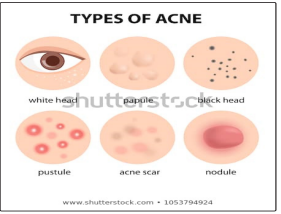
Recently a new metagenomic research suggests that acne pathogenesis may not be related to the amount, presence or absence of a bacterial strain but maybe more connected to the overall balance of the skin microbiome [6].
Symptoms and signs
Rosacea
This condition is characterized by pimples but not comedones and occurs in the middle third of the face along with redness, flushing, and superficial blood vessels which generally affects people in their 30s and 40s and older.
Pseudofolliculitis
This is sometimes called as “razor bumps” or “razor rash.” When we cut too close to the skin, growing hairs twist into the skin and produce tender bumps. This is a mechanical problem and can be treated by shaving less (growing a beard, laser hair removal). Pseudofolliculitis can occur in patients who have acne too.
Folliculitis
Pimples can occur on any parts of the body such as the abdomen, buttocks, or legs. They are not representing as acne but inflamed follicles.
Gram-negative folliculitis
Some patients who have been treated with oral antibiotics for long periods of time develop pustules filled with bacteria that are resistant to the antibiotics that are previously used. Bacterial culture tests can identify these germs which leading the doctor to prescribe different antibiotics or other forms of treatment [7].
Disadvantages of Synthetic drugs
Because they are chemically made some people can react adversely. Some drugs can even damage the organs if taken long-term. There are also few synthetic medicines that can cause addiction. Patients who need prescription drugs for short term use can find themselves being addicted to drug.
Some drugs which are used to treat insomnia and pain also double as narcotics and can risk the patient to become addicted. Manmade medications can also be misused.
When a prescription is filled out it is no longer under the doctor’s control. Some adults and teens can take prescription drugs not meant for them to experience the side effects. When these medicines are available at home, this can be shared among friends because of easy access [8].
Table 1: Some of the herbs having medicinal properties
|
Ingredients |
Parts used |
Activity |
Pictures |
|
Wheat germ oil |
Wheat grains |
Anti-oxidant |
|
|
Haldi |
Rhizome |
Anti-inflammatory |
|
|
Neem |
Leaf |
Anti-septic, Anti-bacterial |
|
|
Raspberry |
Seed |
Anti-aging |
|
|
Kesar |
Stigma |
Anti-fungal |
|


Table 2: Ingredients along with their medical benefits for the treatment of Acne
|
Ingredients |
uses |
|
Wheat germ oil |
Wheat germ oil is Rich in vitamin A and E is ideal for treating mature and dry skin. The oil fights free radical damage along with encouraging cell regeneration in the skin [9]. |
|
Haldi |
Turmeric is an effective remedy for all kinds of skin ailments. That includes: acne, blemishes, itching, and rashes; stubborn conditions such as contact dermatitis, an allergic reaction; and serious chronic conditions such as psoriasis and scleroderma” [9-10]. |
|
Neem |
Neem leaves helps to moisturise your skin and make it soft and supple. Its anti-fungal properties also helps lighten scars and pigmentation that are caused by acne. Neem leaves are also known to cure pimples on your face [11]. |
|
Raspberry |
Protect pimples from infections, balances oil production, fights acne, kills bacteria, brightens skin, minimizes pores, fades scars, regenerates healthy cells [9]. |
|
Kesar |
Saffron is an effective remedy for the treatment of acne, blemishes and blackheads. It will help get rid of acne and pimples. Basil leaves can eliminate the bacteria that cause acne and pimples [9-11]. |
Materials and Methods
Collection of herbs
All the required herbs like wheat grains, rhizome, need leaves, raspberry seed, and kesar stigma are collected.
Extraction
All the herbs are dried properly made into powder .Then from each herb powder 1g was collected and added to 50 ml solvent of in beaker keep for heating till the residue reduced to 20ml then from this required quantity is used for the preparation of cream.
Formulation of cream base
Oil phase and water phase were taken in a separate beakers and heated upto70°C. Oil phase was added to water phase with continuous stirring till oil in water emulsion was prepared.
Formulation Development of Anti acne Cream
The oil phase consists of stearic acid and other oil soluble component such as cetyl alcohol and liquid paraffin were dissolved in the oil phase. The oil phase was placed inside the beaker in the water bath. The temperature of water bath was set to 75°C during the heating time. The water soluble components and preservatives (glycerine, methyl paraben and thiethanolamine) were dissolved in the aqueous phase and heated in the same water bath at temperature 75°C. After heating, the aqueous phase was added in portions to the oil phase with continuous stirring until the cooling of emulsifier took place. Then to this required quantity of herbal extract was added to get the herbal acne cream [12].
Table 3: Oil phase composition
|
Oil phase composition |
Amount |
|
Steric acid |
10% |
|
Cetyl alcohol |
4% |
|
Liquid paraffin |
4% |
Table 4: Aqueous phase composition
|
Glycerine |
5% |
|
Methyl paraben |
0.05% |
|
Tri ethanolamine |
0.05% |
|
Distilled water |
required quantity |
|
|
|
Table 5: Herbal composition
|
Ingredients |
Amount |
|
Wheat germ oil |
1g |
|
Haldi |
1g |
|
Neem |
1g |
|
Raspberry |
1g |
|
Kesar |
1g |
Conclusion
Acne vulgaris is common skin disorder that affects virtually all individuals at least once during life. Natural herbal extracts in combination can be effectively utilised for the treatment of acne. Use of such products is far better than the use of synthetic creams for the control of acne. By using natural herbs side effects are reduced. However, there are few clinical evidences about the effectivenessand safety of these plants in the treatment of acne and other skin infections.
References
- Sanjay K Rathi (2011) Acne vulgaris treatment the current scenario. Indian journal of dermatology 56: 7-13.
- U Tan, B J Schlosser, A S Paller (2018) A review of diagnosis in the treatment of acne in adult female patients. International journal of womens dermatology 4: 56-71.
- Gabriella Fabbrocini, Sara Cacciapuoti, Giuseppe Monfrecola (2018) a qualitative investigations of the impact of acne on health related quality of life: development of a conceptual models. Dermatology and therapy 8: 85-99.
- Yasmeen Jabeen Bhat, Insha Latief, Iffat Hasan (2017) Update on etiopathogenesis and treatment of Acne. Indian journal of dermatology, venerology and leprology 83: 298-306.
- Jonette E Keri (2018) Acne Vulgaris (Acne). MSD Manual professional version.
- Yvette Brazier, Cynthia Cobb (2017) what you need to know about acne, APRN.
- Angela Palmer (2019) Acne Vulgaris Causes and Treatment Medically reviewed by a board certified physician.
- Ali Karimi, Maedeh Majlesi, Mahmoud Rafieian-Kopaei (2015) herbal drugs vs. synthetic drugs: Beliefs and facts. A Journal of Nephropharmacology 4: 27-30.
- Gary W Cole. How to get rid of Acne (pimples).
- Mahendran Sekar, Fouzia Halim (2017) a research article on Formulation and Evaluation of Natural Anti-Acne Cream containing Syzygium Samarangense fruits extract 17: 1-7.
- Mansi Doshi, Neelmani Chauhan, Janmajoy Banerjee, H. Padmalatha (2017) Formulation and evaluation of polyherbal anti acne cream world journal of pharmacy and pharmaceutical sciences 6: 1318-1336.
- Aparajita Srivastava, Sanjar Alam, Shams Shahbaaz, Megha Tiwari, Ashu Mittal, et al. (2014) formulation and evaluation of antiacne cream containing withania somnifera. Journal of Pharmaceutical and Scientific Innovation 3: 348-352.