

Advances in Theoretical & Computational Physics(ATCP)
ISSN: 2639-0108 | DOI: 10.33140/ATCP
Impact Factor: 2.6

Research Article - (2025) Volume 8, Issue 2
Grand Unifying Fields Theory of Relativity and Quantum Mechanix: The Thought Experiments
Received Date: Jan 17, 2025 / Accepted Date: Mar 24, 2025 / Published Date: Apr 14, 2025
Copyright: ©Ã?©2025 Aras Dargazany. This is an open-access article distributed under the terms of the Creative Commons Attribution License, which permits unrestricted use, distribution, and reproduction in any medium, provided the original author and source are credited.
Citation: Dargazany, A. (2025). Grand Unifying Fields Theory of Relativity and Quantum Mechanix: The Thought Experiments. Adv Theo Comp Phy, 8(2), 01-35.
Abstract
This theory is an attempt to unify general relativity and quantum mechanics by integrating: Einstein Field Equation for Gravitational Wave in General Relativity (Gravitational Constant); Schrödinger Field Equation for Quantum Wave in Quantum Mechanics (Planck Constant); Maxwell Field Equation for Photon Wave in Electromagnetism (Speed of Light); Hawking Field Equation for Radiation Wave in Black Holes (Boltzmann Constant); And Heisenberg’s Uncertainty Principle for Minimal Action (or Entropy) of Copenhagen Interpretation. This unification leads to the potential prediction of Graviton (mass, charge, spin).
Introduction
Introduction to G.U.T.: Grand Unifying fields Theory of Relativity and Quantum Mechanix
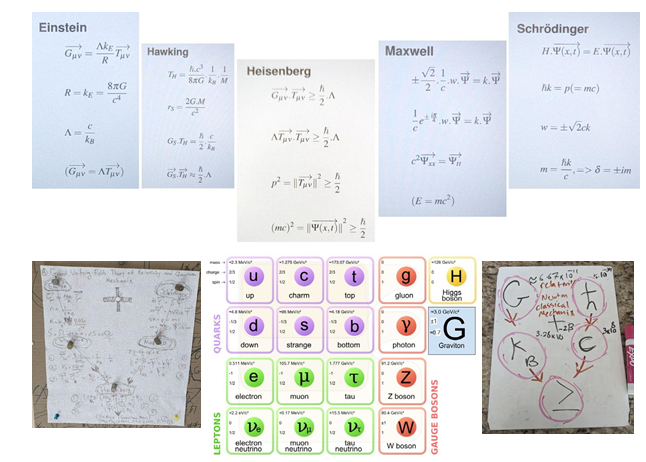
Figure 1: GUT: The Grand Unification of 5 Field Equations (Left), the Standard Model (Middle), and 5 Universal Constants (Right).
Introduction to the GUT: A New Theory of Gravity (-Entropy) (−G−µ→ν S −Tµ→ν )
Gravity (-Entropy) as the Space-Time: Gravity (-Entropy) might be (the Wave Function of) the Space-Time [1,2]. Einstein’s field equation (EFE) is imperfect. Thus, it might need some modifications and interpretations [2-4]. First of all (the first issue), gravitational wave (−G−µ→ν ) is one of the general relativity (GR) predictions [2]. If EFE (GR) gets some modifications, there might be deviations in the gravitational wave’s behavior, e.g., an extremecase: the likely gravitational wave resulting from the Big Bang (massive collision and merging) of the two most supermassive black holes remaining in the universe at the end of its lifetime [2,5-10]. Furthermore, some independent studies show that in high levels of the gravitational field (e.g. gravitational wave resulting from the Big Bang), there might be such deviations in EFE (GR) [2-4,6-9,11]. Therefore (and thereof), there is a definite need for a modified EFE (or unified EFE) to account for such deviations in the gravitational wave’s behavior in an extreme case of the Big Bang (aforementioned) [2,6,11]. The second issue (with EFE) is the cosmological constant (Λ) [2-4,7-9]. This parameter (Λ) suffers from two problems: The first problem (with the cosmological constant) is the fine-tuning problem, related to the quantum field theory (QFT) [3,4,11-13]. The second problem (with the cosmological constant) is the coincidence problem (related to the density of dark matter and dark energy) [2,3,4,14,15]. For these two problems (aforementioned), nowadays, researchers modify EFE (GR) to alleviate these two problems, which means more modification to EFE (GR) indeed [2,3,4,11]. Therefore, when one parameter (cosmological constant) has these two problems (i.e., fine-tuning and coincidence problems), it is difficult to unify GR (EFE) and quantum mechanics (QM), using Schrödinger’s field equation (SFE), within the current format (framework) of EFE (GR) since it is, indeed, Einstein’s original interpretation without the knowledge of the black holes’ existence [5] and their potential heat radiation according to Hawking’s (Hawkins) field equation (HFE) [1,2,5,7-9,16-22]. Lemaitre’s proposal of the Big Bang theory (1927) suggested that the universe might expand against the current belief [6]. Later on, Edwin Hubble’s astronomical observations independently also confirmed Lemaitre’s concept of the Big Bang [6,23]. Lemaitre’s proposal of the concept and the theory of the Big Bang (or the likely universe’s expansion) might be possibly traced back to a very pivotal point in the very fabric of space-time called: the singularity (primeval atom [24] or cosmic egg) where the explosion (or Big Bang) possibly occurred, marking the universe’s beginning (and birth) which leads to the very possibility of the inflation theory [1,2,6,21-26]. Lemaitre’s theory of the universe’s expansion (Big Bang) laid the foundation for the idea of cosmic evolution (and inflation theory by Alan Guth) [6,26,27]. Therefore, the Big Bang (or universe’s expansion) might have happened at the center of the universe (and the beginning of time) [5,6,21-24,26,27]. That is why it might be possible to assume that the (gauge-)Metric tensor bosons (gμν, β, B in equation 10) can be ignored (zeroed down) in the extreme case of the Big Bang [2,6,23,28].
Lemaitre’s theory of the Big Bang (or the universe’s expansion) became validated, especially after the discovery of cosmic microwave background radiation wave (CMB) which might be indeed the remnants of the gravitational wave ( −G−µ→ν ) resulting from the Big Bang predicted and modeled by the modified EFE (my interpretation of GR), might be detected (and detectable) nowadays as the CMB (wave) and (Photons of) light (wave) [2,5-8,23,24,26,29-31]. The gravitational waves (Gµν)might be responsible for producing the ripples (Rµν) throughout the universe in the very fabric (structure) of the space-time [1,2,6- 9,14,22,30,32]. At the very end of the universe’s lifetime, there might be two supermassive black holes remaining [5,10,22]. One of these black holes might appear static compared to the other one (the smaller one) [10]. The total mass of these two black holes might account for the entire universe’s mass [5,10,21,22]. The mass of these two supermassive black holes might be relatively equal [2,5,7,8,21,22,30]. This equality in their mass might, indeed, become interpreted as a matter and antimatter (by Dirac) [10,13,33- 38]. This interpretation might also translate to a black hole and its anti-black hole (or white hole) (by Einstein) [5,7-9]. I interpreted SFE (QM) in an extreme scenario (Big Bang) as the radiation wave
(−Tµ→ν) produced by two (super-small) black holes collision (matter-antimatter) in a thought experiment: quantum scale (Planck scale) [1,5,6,10,13,16-18,23,35,39-41]. I interpreted GR (EFE) in an extreme scenario (Big Bang) as the gravitational wave produced by two (supermassive) black holes collision (black hole and white hole) in a thought experiment: astronomical scale (relativistic scale) [2,5-10,21-23,30]. I think the misunderstanding in EFE (GR) is mainly concentrated on the cosmological constant (Λ) and Ricci scalar (R) which might be the amplitude (A) of the ripples (Rµν) in the very fabric (structure) of the space-time (spacetime) [1-4,7-9,11,14,30,32,42,43]. These two parameters (Ricci scalar and cosmological constant) are the determining factors for dark energy and dark matter [2-4,14,15]. My model is modifying EFE (GR) to find these two parameters using HFE for radiation wave (−Tµ→ν ) in Black Holes [2,5,21,22]. Heat might be initially radiated through (the Photons of) light according to my interpretation of HFE which, indeed, provides the Boltzmann (thermodynamics) constant (kB) into the EFE (GR) that is formulated on the grid-like model (graph network) of the (Cartesian) Riemann surface of the (four-dimensional) spacetime structure [1,2,5,21,22,42,44-46]. HFE might be, indeed, the modified (around-black-hole) version of EFE (GR) in the spherical model (cylindrical or angular) of the Minkowski surface of the (two-dimensional) spacetime structure (around-black-hole: Event Horizon possibly) [1-5,21,22,30,47]. Therefore, the structure (of the Schrödinger wave function) of the spacetime ( −Ψ−(−x−,→t) ) might be interpreted as the (Gravity-Entropy) model of the GUT ( −G−µ→ν S −Tµ→ν ) [1,2,16,21,30,48-53].
Literature of the GUT: State of the Art in Theoretical (Mathematical) Physics
Grand Unified Field Theory (of Relativity) [4,11,19] This paper proposes a potential theory to finish Einstein’s unfin- ished manuscript: "Grand Unified Field Theory (of Relativity)". The search for a grand unified field theory (G.U.T.) has been on- going research ever since (the 1920s) when Albert Einstein, initially, attempted to develop a grand unifying (fields) theory that would combine (unify/unite) his general theory of relativity (GR) and EM using his special theory of relativity (SR) [2-4,7-9,11,20- 23,31,35,54,55]. Therefore, this (aforementioned) ongoing search (and research) for the GUT was started (officially) by Albert Ein- stein’s initial attempt (the unfinished manuscript, aforementioned) [3,11,19,21,54,56]. However, the GUT that includes gravity (and entropy) in one single framework (i.e., GUT) has not yet been pro- posed nor observed following Einstein’s attempt [2-4,11,22]. The GUT is indeed a complete (supersymmetric) version of the cur- rent standard model of subatomic (elementary) particles that unify EM (electromagnetic forces such as Photons and gluons) with (the weak and strong) nuclear forces (W and Z bosons) into a single force (Graviton) which interacts with the Higgs field (boson) at high energies (presumably), i.e. near speed of light [11,31,54,57- 61]. The GUT describes how Hadrons (quarks) and Leptons (elec- trons and neutrinos) can interact (with each other) within one single (unified) theoretical framework (the standard model of subatomic particles) [4,11,58,62,63]. Although this unified (or unifying) force (gauge tensor boson) has not been directly observed (nor found), some of the (independently) proposed GUT models theorized about its potential existence (presumably, Graviton) [3,4,11,64]. According to GR (EFE), the very fabric of spacetime might be in- deed a 4-dimensional: 3-spatial dimension (space) and 1-temporal dimension (time) [2,7-9,20,30]. Therefore (and thereof), we can conclusively state that Albert Einstein might have (initially) coined the term GUT to unify the fundamental forces (gauge bosons) of the standard model into a single unified theoretical framework of gravity(-entropy) [2,11,16,58,64]. The discovery of neutrino os- cillations might indicate that the current standard model of sub- atomic (elementary) particles in quantum physics might be incom- plete [56,58,65]. There is no clear evidence (nor proof) that the very fabric (structure) of spacetime can be described by any of the presently proposed GUT models (e.g. M-theory, String theory, and LQG) [1,2,46,54-56,66]. In 1905, Einstein published SR (equa- tion 44) discussing the special (case) properties and relationship of mass and energy describing light within spacetime [1,2,20]. EFE (GR), though, states the general relationship between gravity and energy (entropy) creating the spacetime (structure) [1,2,5,21,30]. SR (equation 44) states that space and time are relative (space- time), and therefore all motion (in the general coordinate system of spacetime) must be relative to the independent observer’s frame of reference (as the special coordinate system) [1,2,20,40]. GR (EFE) predicted the existence of many astronomical phenomena before they were even observed, namely black holes, gravitation- al waves, gravitational lensing (dark matter-related possibly), and the universe’s expansion (inflation theory and dark energy-related possibly) [2,5-7,15,23,24,67].
M-Theory (and String Theory) [54,55]
Combining (unifying) gravity (GR) with the strong nuclear force (Z-Boson) and electroweak force (W-Boson) might lead to fundamental problems, e.g., the resulting GUT theory (model) might not be renormalizable [2,54-56,68-70]. This incompatibility of the two theories (gravity and nuclear forces) remains an outstanding problem in physics [19,46,54-56,70]. M-theory (string theory) and Loop Quantum Gravity (LQG) were two significant subsequent attempts (in this regard) after Einstein’s attempt, intending to unify (combine) GR (EFE) and QM (SFE) in the pursuit of quantum gravity but without any testable prediction so far ... M-theory, also known as string theory, is a theory that attempts to explain the (spacetime) universe and was considered one of the primary leading candidates for the (very) theory of everything (TOE) [1-5,11,16,21,22,35,39,46, 54-56,70]. M-theory
(in 11-dimensional spacetime) is a non-perturbative theory that describes superstrings (e.g., super membranes and super fivebranes) and unifies all the five (already existing) inconsistent string theories (in 10-dimensional spacetime) [11,54,55,71]. M-theory suggests that the strings (in String theory) might be, indeed, the tiny ribbons (strings) of energy (waves) that vibrate in different (wave) frequencies (Planck frequency) [41,43,54]. Edward Witten proposed M-theory after realizing that the already existing five different string theories seemed to describe the same thing (the Schrödinger Wave function of spacetime) from different perspectives in 10-dimensional spacetime [1,2,7- 9,54-56]. M-theory is considered the Mother (merger) of all (already existing) superstring theories [54-56]. Witten noticed that the different string theories might fit into a single unified (consistent with each other) theory [2,11,54,55]. According to M-theory (in 11-dimensional spacetime) containing strings and branes, compactification is the process that might explain how this extra dimension might be reduced to the four-dimensional spacetime as Einstein proposed and as we observe in the universe [1,2,7,8,21,46,54-56,72]. Witten’s proposal (M-theory) led to a spike in research activity related to the string theory known as the second superstring revolution [46,54-56,70,73]. String theory is a unifying theoretical framework that attempts to reconcile QM (SFE) and gravity (GR) [2,16,54,55]. String theory suggests that the universe might have four dimensions, with three space dimensions (3-dimensional space) and one dimension for time, and that the extra six dimensions are curled up and non-observable [1,2,7,54-56]. String theory (M-theory) was considered one of the leading candidates for the TOE, describing everything in our universe [5,21,22,54]. However, there is no empirical evidence (or alternative ideas) about how gravity might unify with the rest of the fundamental forces (and entropy) [3,4,11,45,58].
(String Theory and) Loop Quantum Gravity (L.Q.G.) [46,54,66,70]
Spacetime (structure) is defined as a network (graph/group) in the loop quantum gravity (LQG) [1,2,46,70]. In (this given version of) string theory, there might be a small loop (or segment) of an ordinary string vibrating in different frequencies (Planck frequency) which makes up the fabric (structure) of spacetime [1,2,41,46,54,55,70]. The smooth background, (Riemann surface of the spacetime) proposed by EFE (GR), is replaced by nodes and links (graph- like or grid-like) to which quantum properties (e.g., mass, charge, and spin) are assigned [1,2,42,46,58,63,70,71]. In this way, the fabric of the spacetime might be made out of discrete chunks, i.e., the fabric of spacetime is quantized and discretized into chunks (particle-like) [43,46]. In this context, continuous and unquantized is more wave-like rather than particle-like (or chunky) [43,46].
LQG studies these discrete chunks of the spacetime network [1,46]. In string theory, spacetime is ten-dimensional (nine spatial and one temporal dimension) in such discrete chunks of LQG [46,54,55]. In M-theory though, spacetime is eleven-dimensional (ten spatial dimensions, and one dimension for time) in such discrete chunks of LQG as well, hypothetically [46,54,55]. Work on formulating the fundamental principles underlying M-theory (String theory) has considerably diminished due to the lack of experimental (validation and) platform [54,55]. Bosonic string theory was eventually superseded by theories called superstring theories [54,74]. In theories of supersymmetry (or supersymmetric theories), each boson has a counterpart, a fermion, and vice versa in the standard model of subatomic particles in physics [57,58]. The strongest scientific argument in favor of string theory appears to include a theory of gravity (within it) [54-56]. In this context, M-Theory might be an encompassing (unifying) idea inside the string theory, stating that there might be strings vibrating in 11-dimensional spacetime [1,2,46,54,55,70,74]. The premise behind string theory is that everything is composed of tiny strings of energy (waves) [3,43,46,54,55,70,71,74, 75]. These strings will comprise all the matter, energy, and tiny forces (bosons) in the standard model of subatomic particles [54,55,58,63]. At the time of M-theory proposal (1984), there were already five different variations of string theory existing, but Witten proposed that each of these string theories might be the manifestation of the same thing, a single underlying building block of the universe, the Schrödinger Wave function of spacetime [1,54,55]. String theory describes how the strings of energy (waves) can propagate through the fabric (structure) of spacetime while interacting with each other (within the standard model) and Higgs field (boson) [1,2,43,45, 54,55,60,74,75]. A string might look like an ordinary particle (standard model), with its mass, charge, and other properties (e.g., spin) determined by its vibrational state [54,55,58,62]. In this way, the different elementary particles may look like vibrating strings [54,58]. One of the vibrational states of a string might give rise to the Graviton, a subatomic (quantum mechanical) particle that carries the gravitational force [11].
Pilot Wave Theory (of Particle-Wave Duality) [43]
Pilot wave theory (Bohmian mechanics), an inherently non-local hidden-variable theory, proposed by Louis deBroglie (1927) [43,75]. The more advanced version of pilot wave theory, the deBroglie–Bohm theory, interprets QM more deterministically, i.e., it might avoid wave-particle duality and instantaneous wave function collapse [40,43,75]. The (deBroglie–Bohm) pilot wave theory is one of the interpretations of (non-relativistic) QM (SFE) [16,43,75]. My theory is also an attempt (similar to Pilot Wave theory) in the pursuit of quantum gravity but with the testable prediction of Graviton (mass, charge, and spin) and its potential likely addition to the (supersymmetric) standard model of subatomic particles in (quantum) physics [11,43,55,57,58]. Pilot wave theory says that there exist waves in 3D space (3-dimensional space) that carry particles with them (Bohmian mechanics) [43,75]. The particle-wave duality nature of the subatomic particles (namely, light) might be able to explain the famous double-slit experiment [31,43,76]. According to the pilot wave theory, the (point) particle and the (matter-)wave are (actual and) distinctive physical entities of the subatomic particles [43,58]. This theory is unlike the other QM (SFE)-related GUT theories, which postulate that there are no other physical particle or wave entities (particle- wave duality) unless observed (collapsed) [4,11,16,40,43,55].
There are two main contradictory arguments (objections) to the pilot-wave theory as follows [43,75]:
(1) This theory is (too) different from ordinary (conventional and mainstream) physics but not radically different enough though to make a ground-breaking contribution [56,77].
(2) That the physics of pilot-wave theory is (after all just) the same as QM (SFE) so that it might not be able to contribute mathematically either [16,43].
Light displays a property known as polarization (ever since 1669), which might be mainly related to and indicating the possibility of the particle-wave duality nature of the photons of light [20,31,43]. Physicists found it challenging to explain this phenomenon (i.e., the polarization of light) according to the pilot wave theory [20,31,43,54,74,75]. Einstein believed light is a particle (Photon) and the flow (of photons) is a wave [2,20,43]. Photons (of light) are (the most compact possible) packets of electromagnetic energy [20,31,39,40]. This theory (of Pilot-wave particles) couldn’t explain phenomena such as black body radiation (e.g., black hole Hawking radiation) and photoelectric effect (light) [5,20,31,41,43,78]. The original double-slit experiment, by Thomas Young (1801), demonstrated that (the Photons of) light acts as a wave (and particle), revealing its quantum nature: the particle-wave duality nature of (the Photons of) light [16,20,31,36,40,43,75, 77]. The Photons of a light wave (equation 43) might have no mass but still carry energy (and momentum) [20,31]. Maxwell (1864) discovered that electric and magnetic fields travel through space moving at the same speed of light as a wave (and particle) [20,31,43,75]. Maxwell’s electromagnetic theory states that light is a propagating wave of electric and magnetic fields, describing the interaction between the electric field (electricity) and the magnetic field (magnetism) [2,31]. In theoretical (and mathematical) physics, any theory with this property (i.e. particle-wave duality) might (have the principle of) supersymmetry (SUSY) [2,43,57,79].
Copenhagen Interpretation of Quantum Mechanics (and Physics of the Wave Collapse into the Particle) [40,43,80]
The Copenhagen interpretation proposes that a system is in all of its allowable (permissible) states (and none of them) simultaneously [40,81]. The Copenhagen interpretation (of HUP) proposed that the indeterminacy in theory (i.e., randomness, stochasticity, and uncertainty) might be fundamental (in the universe) [39,40,56]. Einstein disliked many aspects of the Copenhagen interpretation (especially the idea of an observer-dependent universe) [2,20,39,40,72,75]. The criticism of the Copenhagen interpretation is mainly focused on the need for a classical domain where observers (or measuring devices) exist to see (or measurement) [39,40,59,77]. Schrödinger’s Cat (as a famous thought experiment) demonstrates this interpretation (in quantum physics) by concluding that the tiny (elementary) particles can be in two states at once until observed (i.e., wave collapses into the particle) [39,40,43,58,75,82]. In this thought experiment, the hypothetical (Schrödinger’s) cat is (simultaneously) alive and dead while being still (unobserved) in a closed box since its fate (Wave collapse) might be depending on a random (quantum) subatomic event (that may or) may not take place (particle-wave duality) [1,16-18,39-41,43,58,75,82]. In the Copenhagen interpretation, the (Schrödinger) (quantum) wave function (of spacetime) might collapse due to a (conscious and independent) observer measuring (observing), a physical system (seeing might cause wave collapse) [2,16,39-41,43,59,75]. The Copenhagen interpretation introduced the concept of wave function collapse but failed to precisely define the conditions that cause a wave collapse (or why it collapses) [13,39,40,59,76,80,81,83]. The Von Neumann–Wigner interpretation, described as consciousness causes collapse, is a (Copenhagen-related) interpretation of QM (SFE) in which consciousness (wave collapse into particle) might be found necessary (and essential) for the completion of the process of observation (quantum measurement) [16,39,40,59,80,81,83]. The Copenhagen interpretation theorizes the (spontaneous) reduction of all observers into only one final observer (similar to wave collapse) who describes the experiment from his own (independent) observer’s perspective [20,40]. The reduction, like the system’s velocity, depends on the choice of the final observation system [20]. According to the Copenhagen Interpretation, atomic and subatomic particles sometimes act like particles and sometimes act like waves: This is called "wave-particle duality" [16,40,43]. An electron, for example, when detected, is in its (localized) particle form. But between the detected (observed) positions, an electron is in its wave-like form. The many-worlds interpretation (M.W.I.) might be considered a mainstream interpretation of QM (SFE), along with the other decoherence interpretations (such as the Copenhagen interpretation) and hidden variable theories (such as Bohmian mechanics) [1,16-18,40,43,58,63,75,81]. The multiverse theory is the (MWI-derived/related) idea that multiple universes (multiverse) makes up everything that exists (in this universe) including space, time (or spacetime), matter (Fermions), energy (forces or Bosons), and information [1,2,5,21,22,63,72,81]. Inflation theory explains why the universe might be flat and smooth, and (therefore) predicts the existence of a multiverse (as many independent bubble universes), created during the (rapid) early universe’s expansion (i.e. inflation theory) [6,23,24,81]. The superposition principle (of supersymmetry) is the very idea that a system might be in all the possible states (and none of them) at the same time (simultaneously) until measured (Wave collapses into the particle) [39,40,43,57,75,81].
(The Theory of) Supersymmetry (SUSY) [57,79]
The (very) idea of supersymmetry (SUSY) was (initially) put forward by the Noether theorem, which states that every continuous symmetry of the action of a physical system with conservative particle from the class of fermions would have an associated particle in the class of bosons, and vice versa, known as a super partner [57]. A particle’s superpartner spin differs from a half-integer (0.5 or 1/2) [57]. Supersymmetry is an extension of the standard model that predicts a partner particle for each (subatomic) particle in the standard model [57,58,61]. According to SUSY, (supersymmetric) subatomic particles might appear in collision experiments at the (CERN/Cern-)LHC (Europe/EU) and Fermi-Lab (USA) [57,61]. Supersymmetry might link the two different categories of subatomic particles known as fermions (e.g., Hadrons [quarks] and Leptons [electrons and neutrinos]) and bosons (gluon, Photon, W-Boson, and Z-Boson, and Higgs fields) [57,58,63]. Subatomic (elementary) particles are classified as fermions or bosons based on a property known as spin [58]. Supersymmetry predicts that each particle has a partner with a spin (that differs by half of a unit) [57]. Fermions (standoffish) must be in a different state [58]. On the other hand, bosons (clannish) prefer to be in the same state [63]. Fermions and bosons seem different, but supersymmetry brings the two types together [57]. These are precisely the characteristics required for dark matter, thought to make up most of the matter in the universe and to hold galaxies together [15,22]. Supersymmetry is a framework with a strong foundation trying to create a comprehensive picture of our universe similar to other GUT models [2,11,39,56,57]. Noether’s theorem of supersymmetry states how spatial symmetry implies and relates to energy conservation, and temporal symmetry implies momentum [2,16,21,44,79]. In the simplest terms, Noether’s theorem might be explained as follows: For every symmetry, there might be a corresponding conservation law [44,79]. SUSY involves pairs of Hamiltonians that share a particular mathematical relationship, which is called partner Hamiltonians [57,84]. The potential energy terms that occur in the Hamiltonians are known as partner potentials, which shows that for every eigenstate of one Hamiltonian, its partner Hamiltonian has a corresponding eigenstate with the same energy values (eigenvalues) [17,18,84].
Relativistic (interpretation of) Quantum Mechanics (R.Q.M.) [30,36]
Dirac (1928) proposed the relativistic quantum mechanics (R.Q.M.) (initially) as the grand unification of SR (equation 44) and QM (SFE) [8,16,35,36]. RQM is a theory that combines QM (SFE) and SR to describe the behavior of (subatomic and elemen- tary) particles at high speeds (and high energy) (i.e., approaching the speed of light) such as (the Photons) of light [16,17,20,31,36,54 55,58,63]. RQM predicts [36]:
(1) The existence of the (matter-)antimatter pair [13,35-38].
(2) The existence of antiparticles with similar properties (e.g., positron), which carries a positive charge instead of an electron’s negative charge [58,62,63].
(3) The electron’s spin ( 1 or 0.5) as (the magnetic) moments of forces has a corresponding conservation law (thermodynamics) [44,56,79]. In theory, supersymmetry is a type of spacetime symmetry between two basic classes of particles: bosons (with an integer-valued spin and following Bose-Einstein statistics), and fermions (with a half-integer-valued spin and following Fermi– Dirac statistics) [2,7-9,13,20,30,35-38]. In supersymmetry, each fermions [62,63].
(4) Defines the fine structure constant [36,85].
(5) The quantum (electro- and chromo-) dynamics (QED and QCD) of the charged particles (e.g., quarks and electrons) in an electromagnetic field (EM); RQM can be applied to QFT as relativistic quantum field theory (R.Q.F.T.), which interprets the subatomic (elementary) particles in the standard model as the field quant [12,13,31,35,36,39,41,58,61,86,87].
This theory (RQFT) applies to massive (and massless) particles propagating at the speed of light, [20,31,87]. RQM applies to massless particles in the standard model, such as Photons and gluons [36,58]. The non-relativistic QM (non-RQM) refers to the mathematical formulation of QM (SFE) in the context of classical relativity (i.e., Newtonian classical mechanics) and quantizes the equations of classical mechanics by replacing the dynamical variables (Fermians) with tensor operators (gauge bosons) [16,36,58,63,88]. The RQM, though, is the development of the mathematical formulation of QM (SFE) in the context of Einstein’s theories of relativity (SR and GR) which quantizes the equations of QM (SFE) by replacing the dynamical variables with tensor operators (gauge tensor bosons) [2,16,20,36]. GR (EFE) considers that massive objects (i.e., objects with mass) are the indivisible masses (localized particles) in spacetime [2,43]. QM (SFE), though, views matter as a probability distribution (or density) function of waves rather than localized particles [16,43,75]. GR (EFE) predicts the definite outcomes deterministically (deterministic approach), but QM (SFE) provides only probabilities of an outcome stochastically (stochasticity or randomness) [2,16,89].
Relativistic Quantum Field Theory (R.Q.F.T.), though, refers to a relativistic-version of QFT, i.e. consistent with the main two principles of SR: Lorentz transformations (variable) and (the universality of) the speed of light in vacuum (constant) [2,20,31,36,87,90-92]. RQM describes (the finer details of) the structure of atoms and molecules (i.e., the fine structure constant), where relativistic effects become non-negligible (i.e. cannot be ignored), e.g. if a particle (with mass M), at rest, decays into two particles (whose sum rest masses (m1+m2) is more minor than M) [2,12,13,36,71,85,89,92,93]. Then the two momenta (p1 and p2) must be equal in magnitude (A) and adversarial (opposite) in direction or (phase Φ) [13,35-38]. This interpretation (RQM) says that QM (SFE) is inherently probabilistic, but Einstein speculated that QM (SFE) was probabilistic due to lack of perfect information about the (thermodynamic) system (e.g., black hole radiation) [2,5,16,36,44]. Dirac’s equation, created quantum electrodynamics (QED) to study the electrons and neutrino’s behavior in the standard model in the context of EFE (GR) [2,12,36,58,63,90].
Methodology of the GUT: Materials and Methods
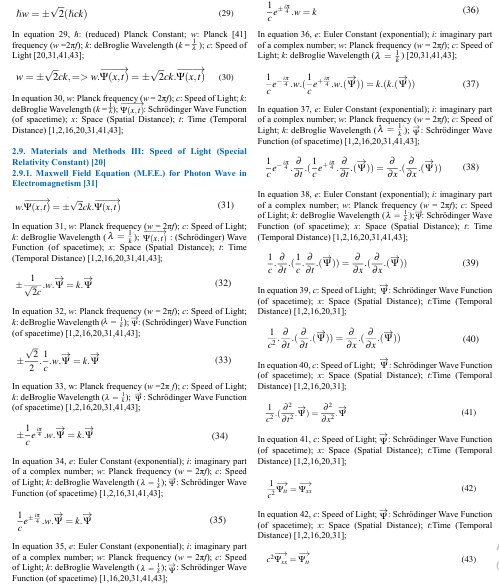
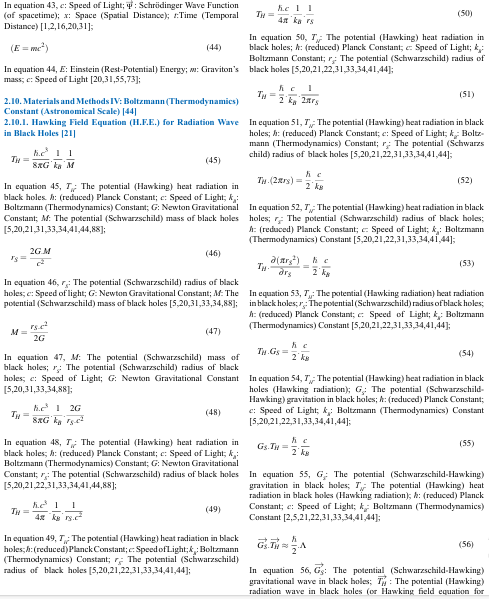
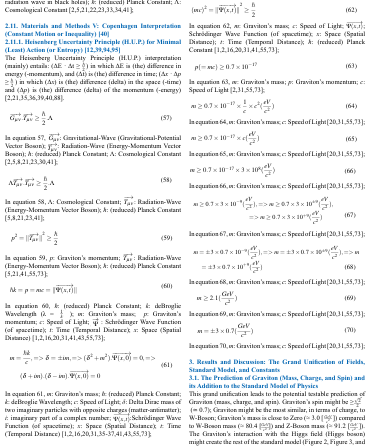
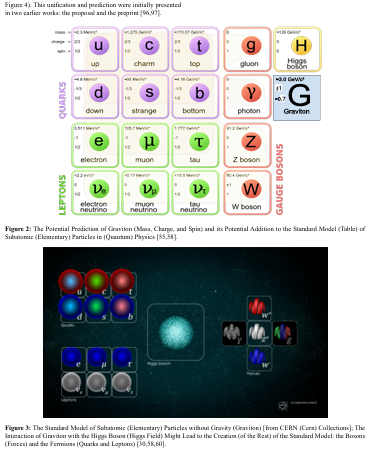
The proposed GUT methodology (framework) is illustrated in the Figure 1. The following (below) is the complete (compiled) list of symbols within the proposed GUT (methodology) framework (illustrated within the Figure 1):
Einstein Field Equation (E.F.E.) for Gravitational Wave in General Relativity (Newton Gravitational Constant)
R : Ricci Scalar [14,32,42];
kE : Einstein Constant [2];
G: Newton Gravitational Constant [88];
c: Maxwell Universal Constant for Speed of Light [20,31];
kB : Boltzmann (Thermodynamics) Constant [44];
π ≈ 3.14 (Euler God equation: 1+e iπ = 0) [89];
Schrödinger Field Equation (S.F.E.) for Quantum Wave in Quantum Mechanics (Planck Constant)
−Ψ−(−x−,→t) : Schrödinger Wave Function (of spacetime) [1,2,16];
x : Space (Spatial Distance) [1];
t : Time (Temporal Distance) [1];
H : Hamiltonian Energy [84];
â?ÂÃÃÃÃÃÃÃÃÃÂ?????????ÂÃÃÃÃÃÃÃÃÂ????????ÂÃÃÃÃÃÃÃÂ???????ÂÃÃÃÃÃÃÂ??????ÂÃÃÃÃÃÂ?????ÂÃÃÃÃÂ????ÂÃÃÃÂ???ÂÃÃÂ??ÂÃÂ? : (reduced) Planck Constant [41];
E : Planck (Kinetic-Momentum) Energy [41];
p : Graviton’s momentum [55,73];
m : Graviton’s mass [55,73];
k : deBroglie Wavelength [43];
c : Maxwell Universal Constant for Speed of Light [20,31];
w : Planck frequency [41];
δ : Delta Dirac mass of two imaginary particles with opposite charges (matter-antimatter) [13,35,36-38];
i : imaginary part of a complex number (Euler God equation: 1+eiπ
= 0) [89];
Maxwell Field Equation (M.F.E.) for Photon Wave in Electromagnetism (Speed of Light)
−Ψ−(−x−,→t) : Schrödinger Wave Function (of spacetime) [1,2,16];
x : Space (Spatial Distance) [1];
t : Time (Temporal Distance) [1];
c : Maxwell Universal Constant for Speed of Light [20,31];
k : deBroglie Wavelength [43];
π ≈ 3.14 (Euler God equation: 1+eiπ = 0) [89];
w : Planck frequency [41];
e : Euler Constant (exponential of Euler God equation: 1+eiπ = 0) [89];
E : Einstein (Rest-Potential) Energy [20];
m : Graviton’s mass [55,73];
i : imaginary part of a complex number (Euler God equation: 1+eiπ= 0) [89];
Hawking Field Equation (H.F.E.) for Radiation Wave in Black Holes (Boltzmann Constant)
TH : The potential (Hawking) Heat Radiation in Black Holes [5,21,22];
rS : The potential (Schwarzschild) Radius of Black Holes [5,33,34]; â?ÂÃÃÃÃÃÃÃÃÃÂ?????????ÂÃÃÃÃÃÃÃÃÂ????????ÂÃÃÃÃÃÃÃÂ???????ÂÃÃÃÃÃÃÂ??????ÂÃÃÃÃÃÂ?????ÂÃÃÃÃÂ????ÂÃÃÃÂ???ÂÃÃÂ??ÂÃÂ? : (reduced) Planck Constant [41];
c : Maxwell Universal Constant for Speed of Light [20,31];
G : Newton Gravitational Constant [88];
kB : Boltzmann (Thermodynamics) Constant [44];
M : The Potential (Schwarzschild) Mass of Black Holes [33,34];
−G−µ→ν: Gravitational-Rest-Potential Vector Boson (Gravitational
π ≈ 3.14 (Euler God equation: 1+eiπ = 0) [89]; Wave: Gravity) [2];
Λ: Cosmological Constant [2,23];
GS : The Potential (Schwarzschild-Hawking) Gravitation in Black Holes [21,33];
−Tµ→ν: Stress-Energy-Momentum Vector Boson (Radiation Wave:
Λ : Cosmological Constant [2,23];
G−→S : The Potential (Schwarzschild-Hawking) Gravitational Wave in Black Holes [21,33];
T−→H : Hawking Field Equation for Radiation Wave in Black Holes [5,21,22];
Heisenberg Uncertainty Principle (H.U.P.) for Minimal
Action (or Entropy) of Copenhagen Interpretation
−G−µ→ν : Gravitational-Rest-Potential Vector Boson (Gravitational Wave: Gravity) [2];
Tµ→ν: Stress-Energy-Momentum Vector Boson (Radiation Wave Entropy) [21];
â?ÂÃÃÃÃÃÃÃÃÃÂ?????????ÂÃÃÃÃÃÃÃÃÂ????????ÂÃÃÃÃÃÃÃÂ???????ÂÃÃÃÃÃÃÂ??????ÂÃÃÃÃÃÂ?????ÂÃÃÃÃÂ????ÂÃÃÃÂ???ÂÃÃÂ??ÂÃÂ? : (reduced) Planck Constant [41];
c : Maxwell Universal Constant for Speed of Light [20,31]; Λ : Cosmological Constant [2,23];
p : Graviton’s momentum [55,73];
m : Graviton’s mass [55,73];
−(−x−,→t) : Schrödinger Wave Function (of spacetime) [1,2,16];
x : Space (Spatial Distance) [1];
t : Time (Temporal Distance) [1];
The Grand Unification of Five (5) Field Equations, The Standard Model, and Five (5) Universal Constants
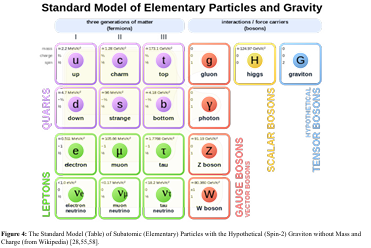
The grand unification of the standard model of subatomic (elementary) particles is showcased in Figure 1 (bottom-middle) [58]. The grand unification of the five (5) universal fields is showcased in Figure 1 (top-row and bottom-left). The grand unification of the five (5) universal constants (Figure 1: bottom-right) is (defined) as follows:
G : Newton Gravitational Constant [88];
â?ÂÃÃÃÃÃÃÃÃÃÂ?????????ÂÃÃÃÃÃÃÃÃÂ????????ÂÃÃÃÃÃÃÃÂ???????ÂÃÃÃÃÃÃÂ??????ÂÃÃÃÃÃÂ?????ÂÃÃÃÃÂ????ÂÃÃÃÂ???ÂÃÃÂ??ÂÃÂ? : (reduced) Planck Constant [41];
kB : Boltzmann (Thermodynamics) Constant [44];
c : Maxwell Universal Constant for Speed of Light [20,31];
(≥) : Universal Constant Motion (entropy S ≥ 0) or inequality [14,39,40,45];
Materials and Methods I: (Newton)88 Gravitational Constant (Relativistic Scale)36
Einstein Field Equation (E.F.E.) for Gravitational Wave in General Relativity2
Gµν + λgµν = kETµν (1)\
In equation 1, Gµν : Gravitational (Rest-Potential)2,7–9 Tensor (Boson); λ : (original)2,7–9,23 Cosmological Constant; gµν : gauge-Metric2 Tensor (Boson); kE : Einstein2,7–9 Constant (Scalar)30; Tµν : (Stress-)Energy(-Momentum)2,16,21 Tensor (Boson);
Rµν + (Λ − 1/2 R)gµν = kETµν (2)
In equation 2, Rµν : Ricci2,14,32,42 Tensor (Boson); R: Ricci14,32,42 Scalar (Constant)2,30; Λ: (modified)2,7–9,23 Cosmological Constant; gµν : (gauge-)Metric2 Tensor (Boson); kE : Einstein2 Constant; Tµν : Energy(-Momentum)2,16,21 Tensor (Boson);
Rµν − 1/2 Rgµν + Λgµν = kETµν (3)
In equation 3, Rµν : Ricci2,14,32,42 Tensor; R: Ricci2,14,32,42 Scalar; Λ: Cosmological2,23 Constant; Tµν : Energy(-Momentum)2,16,21 Tensor; gµν : (gauge-)Metric2 Tensor; kE : Einstein2,30 Constant;
Rµν − 1/2 Rgµν = −Λgµν + kETµν (4)
In equation 4, Rµν : Ricci2,14,32,42 Tensor; R: Ricci2,14,32,42 Scalar; Λ: Cosmological8 Constant; Tµν : Energy(-Momentum)2,16,21 Tensor; gµν : (gauge-)Metric2 Tensor; kE : Einstein2,30 Constant;
Rµν − 1/2 Rgµν = kETµν − Λgµν (5)
In equation 5, Rµν : Ricci2,14,32,42 Tensor; R: Ricci2,14,32,42 Scalar; Λ: Cosmological2,23 Constant; Tµν : Energy(-Momentum)2,16,21 Tensor; gµν : (gauge-)Metric2 Tensor; kE : Einstein2,30 Constant;
Rµν gµν kE Λ (6)
R − 2 = R Tµν − R gµν
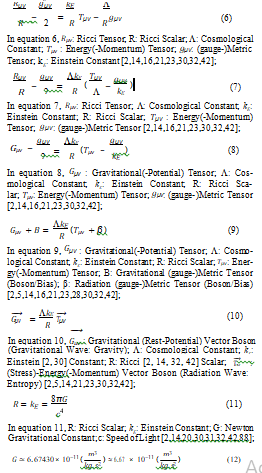
In equation 6, Rµν: Ricci Tensor; R: Ricci Scalar; Λ: Cosmological Constant; Tµν : Energy(-Momentum) Tensor; gµν: (gauge-)Metric Tensor; kE: Einstein Constant [2,14,16,21,23,30,32,42];
References
1. Schrödinger, E. (1985). Space-time structure (Cambridge University Press).
2. Einstein, A. (1922). The general theory of relativity. In The meaning of relativity (pp. 54-75). Dordrecht: Springer Netherlands.
3. Fazlollahi, H. (2023). Non-conserved modified gravity theory. The Eur. Phys. J. 83, 1-10.
4. Fazlollahi, H. R. (2024). New non-conserved gravity theory and alleviate current acceleration epoch without dark energy field. Chinese Journal of Physics, 92, 243-252.
5. Hawking, S. W. (1976). Black holes and thermodynamics. Physical Review D, 13(2), 191.
6. Lemaître, G. (2019). Learning the Physics of Einstein with Georges Lemaître: Before the Big Bang Theory. Springer Nature.
7. Einstein, A. (1915). Die feldgleichungen der gravitation. Sitzungsberichte der Königlich Preußischen Akademie der Wissenschaften, 844-847.
8. Einstein, A. (1916). Näherungsweise integration der feldgleichungen der gravitation. Sitzungsberichte der Königlich Preußischen Akademie der Wissenschaften, 688- 696.
9. Einstein, A. (1918). On gravitational waves. Proceedings of the Royal Prussian Academy of Sciences 154-167.
10. Alonso-Álvarez, G., Cline, J. M., & Dewar, C. (2024). Self-interacting dark matter solves the final parsec problem of supermassive black hole mergers. Physical Review Letters, 133(2), 021401.
11. Perelman, C. C. (2019). R⊗ C⊗ H⊗ O-valued gravity as a grand unified field theory. Advances in Applied Clifford Algebras, 29(1), 22.
12. Feynman, R. P. (2005). The principle of least action in quantum mechanics. In Feynman's thesis—a new approach to quantum theory (pp. 1-69).
13. Dirac, P. A. M. (1962). The conditions for a quantum field theory to be relativistic. Reviews of Modern Physics, 34(4), 592.
14. Raychaudhuri, A. (1955). Relativistic cosmology. I. Physical Review, 98(4), 1123.
15. Comelli, D., Pietroni, M. & Riotto, A. (2003). Dark energy and dark matter. Phys. Lett. B 571, 115-120.
16. Schrödinger, E. (1926). An undulatory theory of the mechanics of atoms and molecules. Physical review, 28(6), 1049.
17. Schrödinger, E. 2. (1926). quantisierung als eigenwertproblem. Annalen der physik 79, 361.
18. Schrödinger, E. (1926). Quantisierung als eigenwertproblem. Annalen der physik 385, 437-490.
19. Folger, T. (2004). Einstein’s Grand Quest for a Unified Theory. Discover, September.
20. Einstein, A. (1905). On the electrodynamics of moving bodies. Annalen der physik, 17(10), 891-921.
21. Hawking, S. W. (1974). Black hole explosions?. Nature, 248(5443), 30-31.
22. Hawking, S. W. (2011). The illustrated theory of everything: The origin and fate of the universe. Phoenix Books.
23. Hubble, E. (1929). A relation between distance and radial velocity among extra-galactic nebulae. Proceedings of the national academy of sciences, 15(3), 168-173.
24. Guth, A. H. (1994). The big bang and cosmic inflation. In The Oskar Klein Memorial Lectures: (Volume 2) (pp. 27-70).
25. Clarke, C. J. (1993). The analysis of space-time singularities (No. 1). Cambridge University Press.
26. Durrer, R. (2020). The cosmic microwave background. Cambridge University Press.
27. Scoville, N. (2007, October). The Cosmic Evolution Survey: COSMOS. In From Z-Machines to ALMA:(Sub) Millimeter Spectroscopy of Galaxies (Vol. 375, p. 166).
28. Jakobsen, G. U. (2020). General relativity from quantum field theory. arXiv preprint arXiv:2010.08839.
29. Pritchard, J. R., & Kamionkowski, M. (2005). Cosmic microwave background fluctuations from gravitational waves: An analytic approach. Annals of Physics, 318(1), 2-36.
30. Einstein, A. (1952). Do gravitational fields play an essential part in the structure of the elementary particles of matter?. The Principle of Relativity. Dover Books on Physics. June 1, 189- 198.
31. Maxwell, J. C. (1864). II. A dynamical theory of the electromagnetic field. Proceedings of the Royal Society of London, (13), 531-536.
32. Raychaudhuri, A. K. (2000). A New singularity theorem in relativistic cosmology. Modern Physics Letters A, 15(06), 391-395.
33. Schwarzschild, K. (1916). On the gravitational field of a point- mass, according to Einstein’s theory (Larissa Borissova and Dmitri Rabounski (2008) Trans.). The Abraham Zelmanov Journal: The Journal for General Relativity, Gravitation and Cosmology, 1, 10-19.
34. Schwarzschild, K. (1916). On the gravitational field of a sphere of incompressible fluid according to Einstein's theory. Sitzungsber. Preuss. Akad. Wiss. Berlin (Math. Phys.), 1916(arXiv: physics/9912033), 424-434.
35. Dirac, P. A. M. (1981). The principles of quantum mechanics (No. 27). Oxford university press.
36. Dirac, P. A. M. (1932). Relativistic quantum mechanics. Proc. Royal Soc. London. Ser. A, Containing Pap. a Math. Phys. Character 136, 453-464.
37. Dirac, P. A. (2005). The Lagrangian in quantum mechanics. In Feynman's Thesis—A New Approach To Quantum Theory (pp. 111-119).
38. Dirac, P. (2005). The lagrangian in quantum mechanics. Feynman’s Thesis-A New Approach to Quantum Theory. Ed. by BROWN LAURIE M. Publ. by World Sci. Publ. Co. Pte. Ltd 111-119.
39. Heisenberg, W. (1927). About the intuitive content of quantum mechanics and kinematics. Z Phys, 43, 172-98.
40. Heisenberg, W. & Bohr, N. (1958). Copenhagen interpretation. Phys. philosophy 16.
41. Planck, M. (1901). On the law of the energy distribution in the normal spectrum. Ann. Phys, 4(553), 1-11.
42. Riemann, B. (1854). On the hypotheses underlying geometry. Royal Society of Sciences and the Georg-Augustus University of Göttingen, 13, 1867.
43. De Broglie, L. (1923). Research on quantum theory (Doctoral dissertation, Ph. D. Dissertation, University of Paris (Sorbonne), Paris, France).
44. Boltzmann, L. (1978). Derivation of Stefan's law, 1. concerning the dependence of thermal radiation on temperature from the electromagnetic theory of light (Springer).
45. Davies, P. C. (1978). Thermodynamics of black holes. Reports on Progress in Physics, 41(8), 1313.
46. Rovelli, C. (2008). Loop Quantum Gravity Living Reviews in Relativity. 1. Retrieved 2008-03-13. 896-897.
47. Minkowski, H. (1908). The fundamental equations for electromagnetic processes in moving bodies. Nachr. Ges. Wiss. Gottingen, Mathematisch-Physikalische Klasse, pp53- 111.
48. Bianconi, G. (2025). Gravity from entropy. Phys. Rev. D 111,
066001.
49. Hawking, S. W. (1975). Particle creation by black holes. Communications in mathematical physics, 43(3), 199- 220.
50. Bekenstein, J. D. (1973). Black holes and entropy. Physical Review D, 7(8), 2333.
51. Carroll, S. M., & Remmen, G. N. (2016). What is the entropy in entropic gravity?. Physical Review D, 93(12), 124052.
52. Ohya, M., & Petz, D. (2004). Quantum entropy and its use. Springer Science & Business Media.
53. Carroll, S. M. (2019). Spacetime and geometry. Cambridge University Press.
54. Becker, K., Becker, M., & Schwarz, J. H. (2006). String theory and M-theory: A modern introduction. Cambridge university press.
55. Witten, E. (1996). Five-branes and M-theory on an orbifold. Nuclear Physics B, 463(2-3), 383-397.
56. Kaku, M. (2005). Einstein's Cosmos: How Albert Einstein's Vision Transformed Our Understanding of Space and Time (Great Discoveries). WW Norton & Company.
57. Fayet, P., & Ferrara, S. (1977). Supersymmetry. Physics Reports, 32(5), 249-334.
58. Gasiorowicz, S., & Langacker, P. (2022). Elementary Particles in Physics.
59. Ansari, R., Bagnaia, P., Banner, M., Battiston, R., Bernlöhr, K., Booth, C. N., ... & Zakrzewski, J. A. (1987). Measurement of the Standard Model Parameters from a Study of W and Z Bosons. Physics Letters B, 186(3-4), 440-451.
60. Veltman, M. J. (1986). The higgs boson. Sci. Am. 255, 76-J25.
61. Overbye, D. (2017). LIGO Detects Fierce Collision of Neutron Stars for the First Time. New York Times.
62. Harari, H. (1978). Quarks and leptons. Physics Reports, 42(4), 235-309.
63. Bilenky, S. M., & Pontecorvo, B. (1978). Lepton mixing and neutrino oscillations. Physics Reports, 41(4), 225-261.
64. Maas, A. (2013). Gauge bosons at zero and finite temperature. Physics Reports, 524(4), 203-300.
65. Bilenky, S. M., & Petcov, S. T. (1987). Massive neutrinos and neutrino oscillations. Reviews of Modern Physics, 59(3), 671.
66. Rovelli, C., & Vidotto, F. (2015). Covariant loop quantum gravity: an elementary introduction to quantum gravity and spinfoam theory. Cambridge university press.
67. Bartelmann, M. (2010). Gravitational lensing. Classical and Quantum Gravity, 27(23), 233001.
68. Chanowitz, M. S. (1990). The Z boson. Science, 249(4964), 36-42.
69. Cui, Y., Gherghetta, T., & Wells, J. D. (2009). Emergent electroweak symmetry breaking with composite W, Z bosons. Journal of High Energy Physics, 2009(11), 080.
70. Bodendorfer, N., Thiemann, T., & Thurn, A. (2012). Towards loop quantum supergravity (LQSG). Physics Letters B, 711(2), 205-211.
71. Lowdon, P. (2017). Nonperturbative structure of the photon
and gluon propagators. Physical Review D, 96(6), 065013.
72. Linde, A. (2017). A brief history of the multiverse. Reports on Progress in Physics, 80(2), 022001.
73. Evans, M. W. (2003). A generally covariant wave equation for grand unified field theory. Foundations of Physics Letters, 16(6), 513-547.
74. Polchinski, J. (2005). String theory, volume 1: An introduction to the bosonic string (Vol. 1). Cambridge: Cambridge university press.
75. Bohm, D. (1952). A suggested interpretation of the quantum theory in terms of" hidden" variables. I. Physical review, 85(2), 166.
76. Aharonov, Y. (2018). Finally making sense of the double-slit experiment. In APS March Meeting Abstracts (Vol. 2018, pp. E58-002).
77. Thomas, J. I. (2019). The classical double slit interference experiment: a new geometrical approach. American Journal of Optics and Photonics, 7(1), 1-9.
78. Pais, A. (1979). Einstein and the quantum theory. Reviews of modern physics, 51(4), 863.
79. Kosmann-Schwarzbach, Y., Schwarzbach, B. E., & Kosmann- Schwarzbach, Y. (2011). The noether theorems (pp. 55-64). Springer New York.
80. Jordan, P., von Neumann, J., & Wigner, E. P. (1993). On an algebraic generalization of the quantum mechanical formalism. In The Collected Works of Eugene Paul Wigner: Part A: The Scientific Papers (pp. 298-333). Berlin, Heidelberg: Springer Berlin Heidelberg.
81. Albert, D., & Loewer, B. (1988). Interpreting the many worlds interpretation. Synthese, 195-213.
82. Leggett, A. J. (1984). Schrödinger's cat and her laboratory cousins. Contemporary Physics, 25(6), 583-598.
83. Bueno, O. (2019). Is There a Place for Consciousness in Quantum Mechanics?. Quanta and Mind: Essays on the Connection between Quantum Mechanics and Consciousness, 129-139.
84. Hamilton, W. R. (1833). On a General Method of Expressing the Paths of Light, & of the Planets, by the Coeficients of a Characteristic Function. PD Hardy.
85. Bekenstein, J. D. (1982). Fine-structure constant: Is it really a constant?. Physical Review D, 25(6), 1527.
86. Greiner, W., & Greiner, W. (1997). Relativistic Wave Equation for Spin-0 Particles: The Klein-Gordon Equation and Its Applications. Relativistic Quantum Mechanics: Wave Equations, 1-98.
87. Schweber, S. S. (2005). An introduction to relativistic quantum field theory (Courier Corporation).
88. Newton, I. (1990). Mathematical principles of natural philosophy. Encyclopaedia Britannica.
89. Turnbull, H. W. (1935). An Elementary Derivation of the Exponential Limit and of Euler's Constant. Edinburgh Mathematical Notes, 29, xxi-xxiv.
90. Greiner, W. & Reinhardt, J. (2008). Quantum electrodynamics. (Springer Science & Business Media).
91. Finkelstein, D. R. (2012). Quantum relativity: a synthesis of the ideas of Einstein and Heisenberg. Springer Science & Business Media.
92. Lévy-Leblond, J. M. (1976). One more derivation of the Lorentz transformation. Am. J. Phys, 44(3), 271-277.
93. Bekenstein, J. D. (2002). Fine-structure constant variability, equivalence principle, and cosmology. Physical Review D, 66(12), 123514.
94. Terekhovich, V. (2018). Metaphysics of the principle of least action. Studies in History and Philosophy of Science Part B: Studies in History and Philosophy of Modern Physics, 62, 189-201.
95. Wehrl, A. (1978). General properties of entropy. Reviews of Modern Physics, 50(2), 221.
96. Dargazany, A. (2023). Grand Unifying Fields Theory of Relativity and Quantum Mechanix.
97. Dargazany, A. (2024). Grand Unifying Fields Theory of Relativity and Quantum Mechanix: The Prediction of Graviton.