

Space Science Journal(SSJ)
ISSN: 2997-6170 | DOI: 10.33140/SSJ

Research Article - (2026) Volume 3, Issue 2
Fundamentals of the Theory of Gravity in Hypercomplex Space.

Received Date: Apr 22, 2026 / Accepted Date: May 18, 2026 / Published Date: May 29, 2026
Copyright: ©2026 Vadim Sovetov. This is an open-access article distributed under the terms of the Creative Commons Attribution License, which permits unrestricted use, distribution, and reproduction in any medium, provided the original author and source are credited.
Citation: Sovetov, V. (2026). Fundamentals of the Theory of Gravity in Hypercomplex Space. Space Sci J, 3(2), 01-16.
Abstract
Existing theories of gravity, based on the force of attraction and the geometric curvature of space, do not allow a full description of the gravitational interactions of bodies in the universe. A theory of gravity based on hypercomplex space has been developed. It is shown that the hypercomplex space, as well as the complex plane, has a conformal mapping into a space of the same dimension with the corresponding curvature. For example, a straight line in the complex plane maps to a circle, and a straight line in 4D quaternion space maps to a sphere. As is known, the existing space of the universe has dielectric and magnetic permeability, measured in Farads and Henry per meter, respectively. In other words, empty space (vacuum) has capacitance and inductance. Similar concepts of capacitance and inductance are introduced for space with masses. It is shown that it is the capacitance and inductance of free space that contribute to conformal mapping, i.e. the twisting of the motions of bodies. Circular movements are carried out around the zero point of space without loss of energy. Moreover, the increments in body mass can take both positive and negative values. According to the law of conservation of energy, the universe is a single system with multiple MIMO connections. This connection is ensured by the presence of memory and the phenomenon of induction, which has no limits on the speed of transmission of energy changes, so the system instantly responds to such changes. In other words, there is no locality, which in quantum physics manifests itself through “entangled” particles. Using Maxwell’s equations, obtained analytically with the quaternion representation of the potential and kinetic functions of the intensity of bodies with masses, it is shown that the orbits of bodies move simultaneously in a circle and in a straight line. Therefore, it is impossible to consider the orbits of the planets of the solar system when the sun is stationary. The calculations carried out showed that when taking into account the movement of the planets together with the sun, the axes of rotation of the planets must have corresponding tilts that would ensure simultaneity of movement together with the sun. Moreover, due to the tilt of the planes of rotation when observed from the Earth, elliptical orbits of the planets are obtained.
Keywords
Maxwell’s Equations, Quaternion, Gravity, Potential Intensity, Kinetic Intensity
Introduction
The interaction between bodies is described by Newton’s law of gravitational attraction, published in 1687. The law states that the force of gravitational attraction between two material points with masses and , separated by a distance r, acts along the line connecting them, is proportional to each of the masses and inversely proportional to the square of the distance:

where G = 6.6743×10⁻¹¹ N•m2/kg2 – gravitational constant.
Force is measured in Newtons (N); one N is equal to the force that accelerates a 1 kg mass in 1 second, giving it an acceleration of 1 m/ sec in the direction of the force. The masses of other planets are calculated using Kepler’s third law, with Newton’s corrections.
However, recent observations of the orbits of stars in distant galaxies have shown that the orbits of stars located at large distances from the center of galaxies should not be attracted to the center due to the weakness of the force of attraction, which decreases inversely proportional to the square of the distance from the stars to the center of mass. It has been suggested that there is some kind of “dark matter” that acts as an additional force attracting distant stars, but it has not yet been detected. Consequently, Newton’s theory of gravity is not fully consistent with the new results of observations of the universe, and there is a need to develop the theory of gravity. In his general theory of relativity (GTR), Einstein proposed that there is no force of attraction and that the gravitational interaction of bodies is explained by the curvature of space. In GTR, the apparatus of differential geometry in 3D space was used, and time was introduced into the analysis as the 4th spatial coordinate. The theory made it possible to explain the deflection of light near massive bodies, clarify the orbit of Mercury, and the time delay for navigation systems. The theory is based on the relationship E ï?½ mc2 , where energy curves space in the same way as mass. In this case, the speed of light in a vacuum c=299792458 m/s is a fundamental constant that does not depend on the choice of inertial reference frame. The curvature coefficients were calculated based on the law of conservation of energy.
Einstein’s theory for 3D space described the curvature of space in a geometric sense, as a curved sheet of some material, and calculated the curvature tensor. This approach significantly limited the dimensionality of the space analysis. Einstein understood the limitations of this approach and sought a universal theory of gravity that would unite electrodynamics and gravity. In reality, the space of the universe is vast and there are approximately 200 sextillion stars in the observable universe, i.e. a number with 23 zeros. This number is based on the calculation of about 100 - 200 billion galaxies, each of which contains from 100 to 400 billion stars with their own planets and satellites. The diameter of the observable universe is 93 billion light years. Moreover, the universe is constantly expanding and, they say, at a relatively high speed. The universe is 13.8 billion years old. Objects whose light took 13.8 billion light years to reach us have traveled 46 billion light years. Thus, existing theories of gravity, based on the force of attraction and the geometric curvature of space in the form of a curved sheet, do not allow a full description of the gravitational interactions of bodies in the universe.
Theory of Gravity Based on Maxwells Equations in Hypercomplex Space
Conformal Mapping in Hypercomplex Space
It is known that in the space of the universe all bodies rotate, and do not move in a straight line at a constant speed without loss of energy, as in inertial reference systems. At the same time, the rotation of bodies is not explained by the force of attraction and the curvature of space in the form of a curved sheet or funnel in 3D space. The law of conservation of momentum also does not explain the rotation of bodies, since it is already applied to a rotating body. Therefore, it is necessary to find other reasons for the rotation of bodies. Moreover, these reasons must satisfy the law of conservation of energy and work for spaces of very high dimensions. Hypercomplex spaces satisfy these requirements. It is known that hypercomplex spaces are obtained by the procedure of doubling hypercomplex numbers and, in principle, can have a very large dimension. Currently, quaternions in 4D, octonions in 8D, and sedenions in 16D are well studied. Hypercomplex spaces satisfy the Cauchy-Riemann conditions (CRC) and when the increment of the values of time, frequency, amplitude and other parameters for any spatial coordinate changes, the parameters of other coordinates change in such a way that energy is conserved.
Since bodies rotate around some center of mass, there must be zero points in space, relative to which some parameters of the body take on both positive and negative values. This question still remains a mystery in the theory of gravity, since no body with negative mass (antimatter) has been found. This leads to a lack of understanding as to why the masses are only attracted. The dimension of physical space is greater than the dimension of the complex plane and is equal to 3D – length, width, height. Therefore, to analyze physical processes in real space, it is necessary to use harmonic functions of higher dimension than complex ones on the plane. It is clear that these functions must be analytic and harmonic, and also satisfy the CRC and the Laplace equation. Moreover, the dimensionality of the universe’s space, based on the number of stars and planets, must be significantly greater than 3D. Complex functions of higher dimensions are known as hypercomplex. Quaternions were discovered by Hamilton in 1843. Later, using the doubling procedure, octonions, sedenions, and other hypercomplex numbers of higher dimension were defined. According to the doubling procedure, the dimension of hypercomplex numbers N describing hypercomplex spaces is a multiple of 2, i.e. N = 2n , where n =1, 2,3,... . Hence, the dimension of a quaternion is 4, an octonion is 8, a sedenion is 16, etc.
Hypercomplex functions constructed on the basis of hypercomplex numbers also satisfy the CRC and the Laplace equation. Therefore, the physical space constructed using hypercomplex functions can have a large dimension, a multiple of 2, and be analytic and harmonic. Therefore, to develop a theory of gravity in high-dimensional space, it is necessary to use hypercomplex functions based on hypercomplex numbers. Moreover, despite the fact that physical space has a 3D dimension, it is possible to form spaces of very high dimensions in it using hypercomplex numbers. To describe the motion of planets in space, we use the matrix equation of dynamics in the state space of a given dimension:

where A is a square state transition matrix (STM), which is a hypercomplex number of a given dimension in matrix representation, x(t) is a time-varying vector of a hypercomplex number representing the vector of a body with mass in a given state space, x(t) is the time derivative of the vector x(t) .
The solution to the homogeneous linear matrix differential equation (2) will be the exponential of the STM. The solution to the homogeneous linear matrix differential equation (2) will be the exponential of the STM. Let us represent this solution as a fundamental matrix for a three-frequency quaternion with basis matrices I, J, K [1].
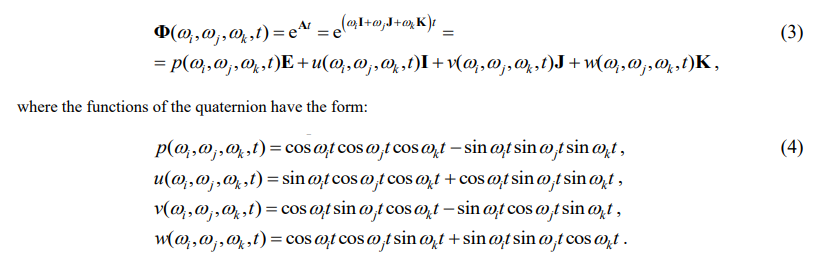
As can be seen from expression (3), the fundamental matrix consists of the sum of the real part with the matrix E and the imaginary part with the matrices I, J, K. Functions (4) have continuous derivatives of any order, therefore, they are analytic and harmonic. It is known that the first derivatives of a harmonic function satisfy the CRC, and the second derivatives satisfy the Laplace equation. The CRC requires that as the amplitude of real oscillations increases, the amplitude of imaginary oscillations decreases. In this case, in accordance with the Laplace equation, the total power of the oscillations should remain unchanged.
These two conditions are of fundamental importance for the analysis of physical processes of gravity, since, according to the law of conservation of energy, in physical space, with any transformation of energy, it must remain the same in magnitude. For example, if the real part of a complex function is defined as potential energy, and the imaginary part as kinetic energy, then the sum of the energies must be constant at any moment in time. It follows that the harmonic function describes a circle with a constant radius on the complex plane, and a sphere in 3D space.
The fundamental matrix (3) is also a quaternion in matrix notation. The variables of the quaternion in the algebraic form x, y, z correspond to the angular frequencies ωi, ωj, ωk, the indices of which indicate the corresponding imaginary coordinate axes of 4D space. Since imaginary numbers i, j, k form spatial coordinates in 4D, the matrices E, I, J, K are orthogonal and also form a 4D orthogonal space. Similar equations can be written for the 7-frequency octonion [2]. The imaginary coordinate axes of space have different angular frequencies, therefore, a connection between space and time is formed. Note that to connect space and time, there is no need to introduce time as the 4th coordinate of space. Time acts as a natural chosen scale of reference for the universality of the values of the periods of events. When time t changes, the time scales of each coordinate change in accordance with the values of the angular frequencies. However, due to the CRC, the energy of the system remains constant. Note that in functions (4) time is included as a product of angular frequencies. It is this fact, together with CRC, that allows us to get the Fourier transform, since when changing time, we obtain functions of frequency change while preserving the energy of the spectra, Parseval’s theorem [3]. This property also allows us to model the processes of changing the curvature of the trajectories of bodies. The fundamental matrix for a single-frequency quaternion, decomposed into basis matrices E, I, J, K, will have the form:
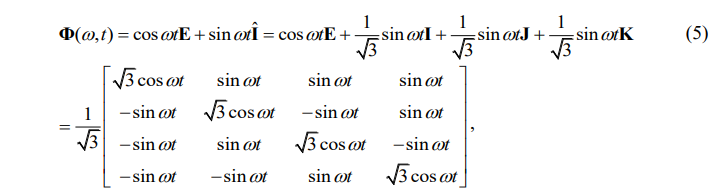
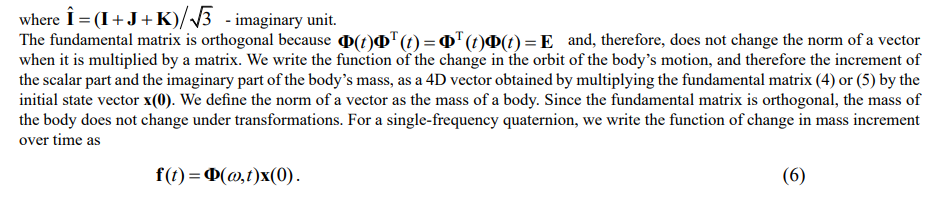
Based on the solution of equation (2) in the form of exponential (3), we can conclude that the dynamic equation (2) carries out a conformal mapping of the mass vector from the hypercomplex space into the rotation space. When exponentially mapping lines in the complex plane, we get circles, and when exponentially mapping 4D hypercomplex space, we get a 4D sphere on three imaginary axes and one real axis that has no direction. Time, as usual, is not a coordinate of space, time is universal and the same for everyone. However, time, together with angular frequencies, is included in the arguments of the sine and cosine functions of the fundamental matrices (3), (5) and, accordingly, is associated with the values of angular frequencies. When time changes, the angular frequencies must change in such a way as to maintain the orthogonality of the matrices and not change the energy during transformations. In other words, the fundamental matrix performs a Fourier transform, in which functions of time become functions of frequency (spectra). Figure 1 shows the rotational trajectory (6) of a scalar mass for a quaternion at the same frequencies, and Figure 2 shows the trajectory at 3 different frequencies.
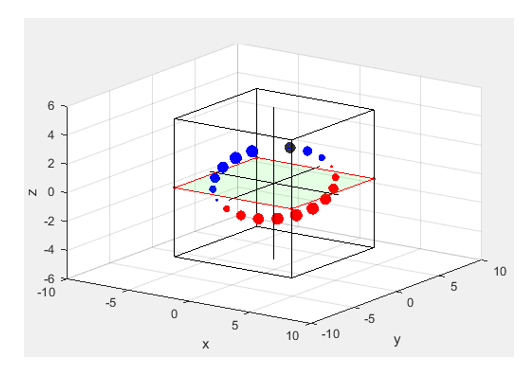
Figure 1: Trajectory of Rotation of the Scalar Mass Increment for a Single-Frequency Quaternion
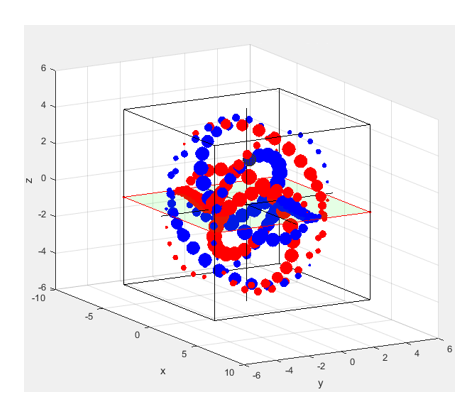
Figure 2: Trajectory of Rotation of The Scalar Mass Increment for a Three-Frequency Quaternion
In reality, we observe the rotation of bodies in the universe, and the figures show mathematical calculations of the increment of the masses of bodies that determine the parameters of these trajectories. As can be seen, the rotation of the scalar increment is around zero, and the orbits are closed. In this case, the scalar takes both a positive (red color) and a negative value (blue color). The initial state of the system is shown in black. The scalar also changes in magnitude, while the total energy is preserved. Conservation of the energy of the system during transformations is equivalent to conservation of the norm of the quaternion, i.e. the length of the radius, and is ensured by the CRC. Since the radius of rotation is calculated as the norm of a vector, it is equal to the radius of rotation of the increments of the scalar part when its value is zero.
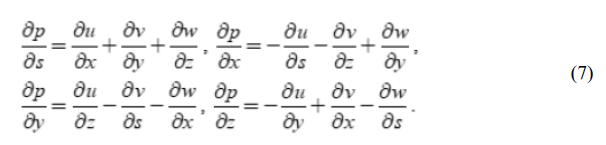
The CRC are obtained from the equality to zero of the derivatives of the quaternion function with respect to the conjugate quaternion. Physically, this means the absence of energy dissipation in a direction perpendicular to the direction of motion of bodies with masses. The CRá for the increment of the scalar part depending on the increments of the imaginary parts along different coordinate axes have the form [4].
Thus, it is shown that the rotation of the planets occurs not due to the force of attraction, but due to the property of space, which carries out an exponential, conformal mapping of rectilinear motions in a multidimensional hypercomplex space into circular motions, i.e., it curves space. In this case, the functions describing the parameters of bodies are harmonic and satisfy the CRC and the Laplace equation. Circular movements of mass increments are carried out around the zero point of space without loss of energy and, therefore, infinitely long. In this case, the increase in body mass can take both positive and negative values. The norm of a vector represents the mass of a body that does not change during its orbital rotation.
Fundamental Constants of Physical Space with Masses
Next, we will determine which parameters of space provide conformal mapping, respectively, the curvature of space and the transformation of rectilinear motion into circular motion. In his research, Einstein spoke about the universality of the laws of nature and wanted to unite the laws of gravity and the laws of electrodynamics. As is known, electrodynamics is based on Coulomb’s law and Maxwell’s equations. Coulomb’s law was established experimentally by Coulomb, and Maxwell’s equations were generalized and written mathematically also on the basis of experiments conducted by Faraday, Ampere, Gauss, Lorentz, and others. Electrical forces are considered to be the dominant physical phenomenon, so these experiments were not affected by the earth’s “gravity”, therefore it can be argued that they are universal and act anywhere in space.
Let us consider Coulomb’s law, which in its form of notation and in the calculated value of force is similar to Newton’s law (1), but shows the interaction of point electric charges. Coulomb’s law was experimentally established in 1785 and describes the magnitude of the force Fe acting between two electric charges q1 and q2 separated by a distance r in a vacuum:
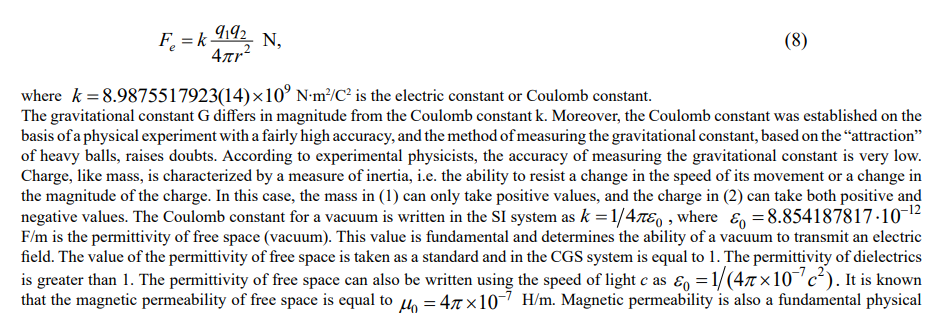
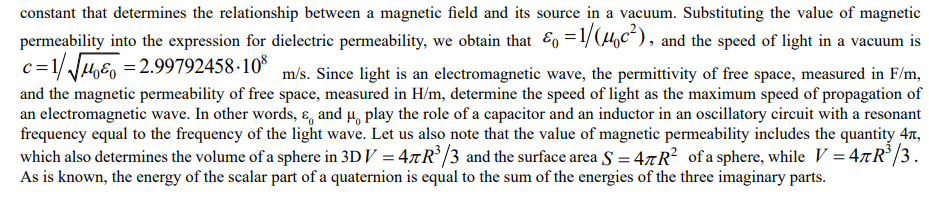
The number π is calculated as the ratio of the circumference to the diameter and is considered a fundamental mathematical constant. The number π has an infinite number of digits after the decimal point, the sequence of digits never repeats and never ends. Currently, more than 100 trillion characters have been calculated. Since the number π is included in the definition of magnetic permeability, it can also be considered not only a mathematical constant, but also a fundamental physical constant of space. With its help, it is possible to calculate with great accuracy the ratio of the length of a straight line segment of the motion of any body to the radius of the circular motion during conformal mapping of the hypercomplex space, at any distance from the place of motion. This mathematical and physical fact forms the connection between galaxies, stars and planets and, accordingly, the integrity of the universe. Thus, according to Coulomb’s law, there are two fundamental constants in free space: the permittivity ε0, which shows the degree of weakening of the electrical intensity depending on the distance, and the magnetic permeability μ0, which shows the degree of weakening of the magnetic intensity depending on the distance. The number π is not only a mathematical but also a fundamental physical constant. Permeability constants have the dimensions of capacitance and inductance, respectively. Therefore, from a physical point of view, capacitance and inductance form spatial oscillatory circuits that contribute to the formation of harmonic wave functions and, accordingly, the circulation of electromagnetic waves.
The Law of Conservation of Energy, Inertia, Capacitance and Inductance of Space with Masses
The main fact that ensures the integrity of the universe, i.e. its functioning as a single organism, is the fundamental law of conservation of energy. This law establishes that energy does not arise from nothing and does not disappear without a trace, but only passes from one form to another. The total energy in a closed system is constant. If we consider the universe as a closed system, then the law of conservation applies to every galaxy, every star and every planet. The universe is constantly expanding at a relatively high rate. But despite the expansion of the universe, recent studies have established that the universe has a zero-energy balance.
From this we can conclude that in order to maintain the integrity of the system, the interaction of the elements of the universe must be based on the principle of the global influence of energy changes. This principle of the instantaneous influence of changes in energy in one place in the universe on other elements of the universe must ensure the law of conservation of energy. In other words, the universe should be viewed as a multiple-input, multiple-output (MIMO) system, i.e., as a very high-dimensional system with connections from one to another. This scheme not only ensures the integrity of the system, but also increases its stability by distributing the energy of any cataclysms throughout the entire universe. At the same time, thanks to the connections between objects in the universe, its energy increases while maintaining its balance between sources and consumers of energy.
Capacity of Bodies with Mass and Potential Energy of Mass
In physics, the mass of a body is determined by the measure of its inertia and by the force of attraction to other bodies. Mass m is measured in the SI system in kilograms (kg). For a given volume of a body Vm and mass density ρm, the mass is calculated as m=pmVm . We defined the mass of a body in a multidimensional space as the norm of a vector in this space. In a hypercomplex space, a vector has one scalar component, and the rest are imaginary. The scalar part corresponds to potential energy, and the imaginary part corresponds to kinetic energy. In this case, the scalar energy is equal to the vector sum of the kinetic energies over the coordinates over the period, and in sum they are equal to the norm of the mass vector. It is known that the capacitance of electrical capacitors is defined as the proportionality coefficient between the accumulated charge q of the antenna conductors or capacitor plates and the voltage u between them and is measured in Farads: C = q \ u F. The capacitance of a charged body is determined through the charge of the body and the electrical field intensity E at a given distance for the vector ar:

However, due to the universality of the laws of nature, the concept of “capacitance” applies not only to electricity. By analogy with a capacitor or a charged body, we determine the potential capacitance of a body Cm with mass m through the mass of the body and the potential intensity P in the direction of the vector ar using a formula similar to (9):

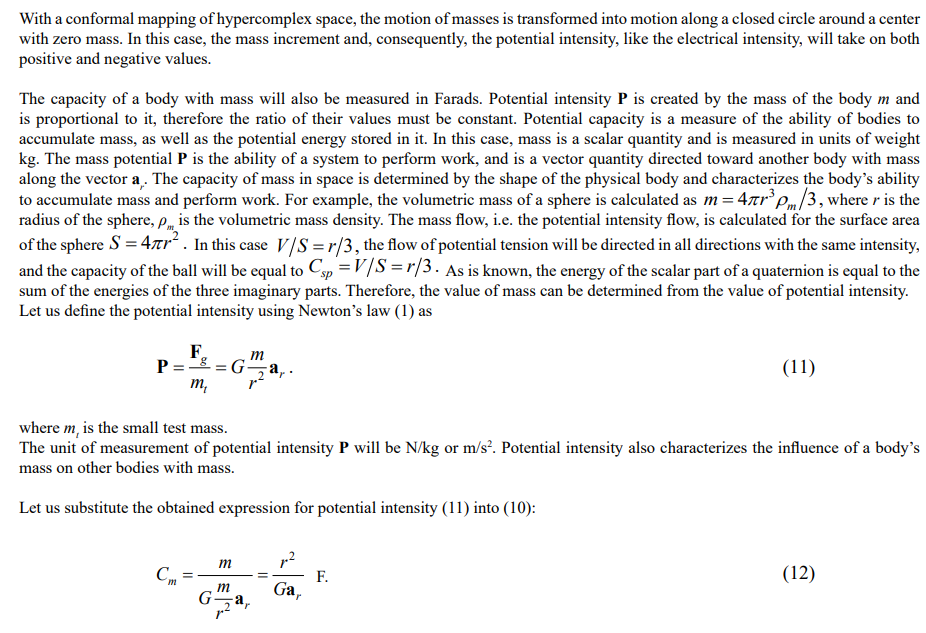
In determining the capacity of a body with mass (12), the masses cancel out. Therefore, this expression must contain the fundamental constants 4π and εm, which are characteristic of bodies with masses, and these constants must be present in the gravitational constant G. Let us define εm as the permeability of potential intensity or as potential permeability. Potential permeability shows the degree of weakening of potential intensity at a distance of 1 m. However, due to the law of conservation of energy, energy as a whole does not decrease, but simply transforms into another type of energy, kinetic. In other words, translational motion turns into circular motion. In general, the movement of mass occurs both along a straight line and in a circle, i.e. in the form of circulation

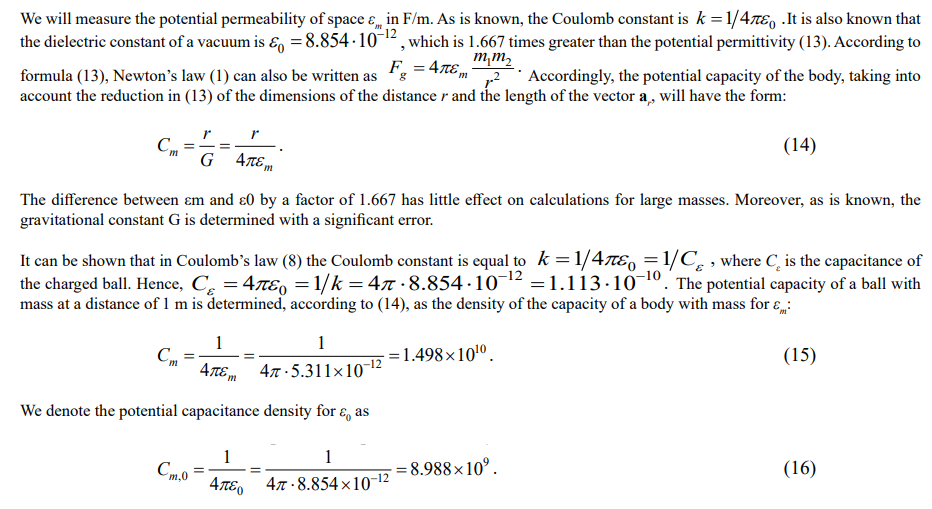
The differences between capacities (15) and (16) are insignificant for large masses. At the same time, the ratio of the capacity of the mass to the capacity of the charges Cm,0\ C€=8.075×10¹⁹ . This means that the potential capacity of the mass must be much greater than the potential capacity of the charge for the interaction forces to have the same values. In fact, this is true; the sizes and masses of bodies in the universe are much larger than the sizes of charged bodies and electrons. In this case, the capacities correspond to the reciprocal values of the Coulomb constant and the gravitational constant: k = 8.9875517923(14)×109 and G = 6.6743×10⁻¹¹ . The ratio of the Coulomb constant to the gravitational constant will be k \G = 1.347 ×10²⁰ . Therefore, the Coulomb constant in (8) seems to increase the force of interaction between charges, while the gravitational constant in (1) decreases it. The mass of a body in a given direction can be calculated from formulas (11), (12) as
m = CmP . (17)
Only physical bodies and particles possess potential capacity, since only they possess mass. From expression (17), it is clear that, for a constant capacity, mass is proportional to the potential intensity in a given direction.
As is known, Faraday established that between electrical bodies there is an electric flow, i.e. spatial current or electrical induction D, which is related to the electrical intensity E through the dielectric constant of free space ε0, as
D = e0E . (18)
In accordance with (18), we write a similar equation for the mass potential P, the potential permeability of space εm and the potential induction R:
R = emP . (19)
Despite the fact that potential induction R is proportional to the potential intensity of mass P, it characterizes another physical phenomenon – the “movement” of mass from one body to another by means of induction. When calculating the force, εm is compensated for, and therefore, there are no limitations on the propagation speed for potential permeability (19). It acts instantaneously, or, more simply, it acts continuously. Based on the law of conservation of energy and induction, when additional mass appears on one body, opposite masses immediately appear on other bodies to compensate for it on the first and, thus, restore the previously existing energy balance. An analysis of Coulomb’s law using Maxwell’s equations for a quaternion shows that opposite charges do not attract each other. An opposite charge is induced on another body, and the opposite charges move toward each other to compensate for the additional charge introduced into space [5]. Let us write the capacitance (10) using the potential induction (19) as

Since potential induction in (20) does not depend on potential permeability in space, the influence of R acts in a straight line. However, changes in the magnitude of mass do not occur instantaneously, but with a corresponding inertia, i.e. with a time delay. As shown above, the hypercomplex space is exponentially mapped into the space of rotations, i.e., energy changes occur exponentially, and we are dealing with mass increments over differential moments of time. Hence, the capacity of mass (10) in any given direction can be represented as

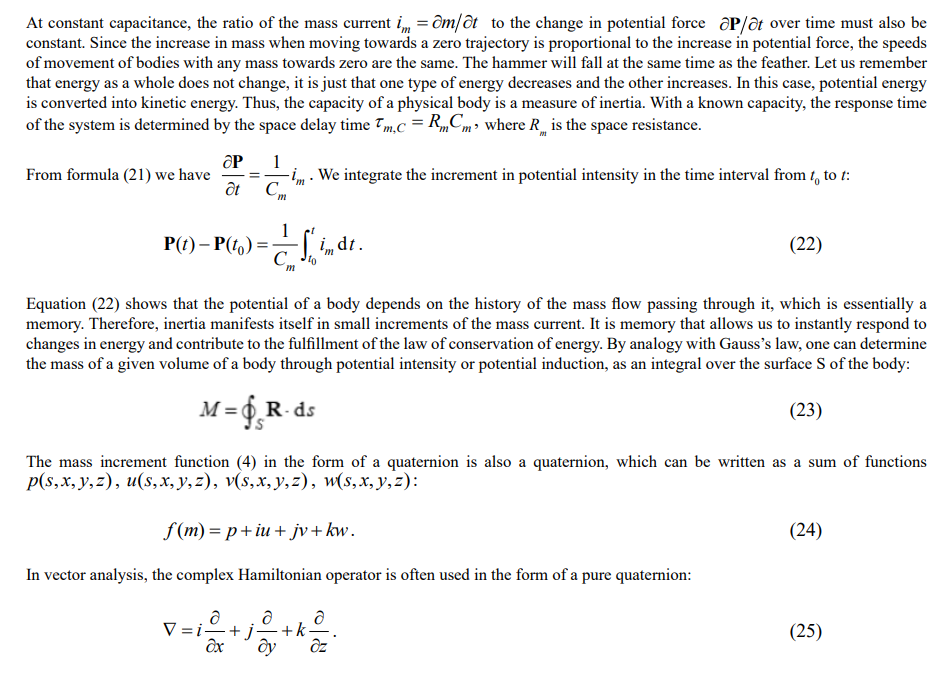
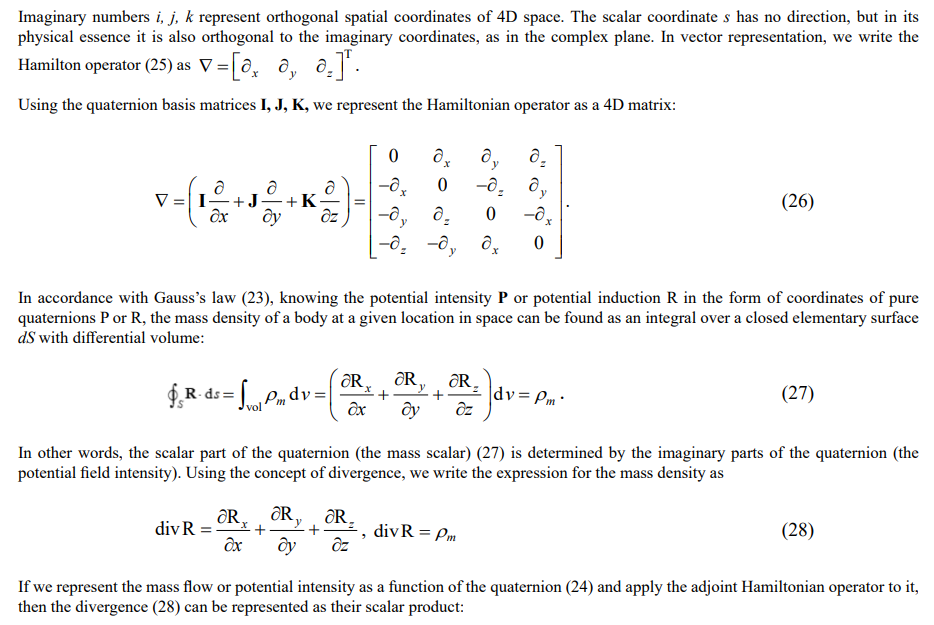

Thus, bodies with mass possess a capacity, defined as the ratio of their mass to the potential intensity they generate. The capacity of a body corresponds to the body’s ability to accumulate mass, as well as the potential energy stored within it, and is a measure of inertia. For the law of conservation of energy to be fulfilled, it is necessary that changes in the energy of each object in the universe be transmitted instantly from all bodies to each body. This is achieved by using the matrix representation (26) and spatially integrating all effects over time. Each body reacts to the sum of all energy changes and has a memory. In other words, energy changes in bodies are not transmitted faster than the speed of light from each body to all other bodies, but rather each body constantly experiences the total energy change from all bodies, as in a MIMO system, and remembers it. It also follows from this that the dimensionality of the space of the universe is not three-dimensional, but very large. Such a dimension can be formed and mathematically described only using hypercomplex numbers. At the same time, any cataclysms in the universe associated with the release of large amounts of energy are distributed among a large number of bodies and, therefore, have little effect on their orbits. As in MIMO systems, the total energy of the universe increases with its dimensionality, i.e., with the increasing number of planets, stars, galaxies, and even individual particles. It’s important to note that the law of conservation of energy cannot be observed without induction, the instantaneous transmission of energy changes to all objects in the system simultaneously, and the presence of memory.
Inductance of Bodies with Mass, Kinetic Energy of Rotation of Mass
The concept of inductance is not only associated with coils of wire or bodies with eddy currents. Rotating bodies with masses also have inductance. For example, planets and planetary satellites rotate around their own axes and revolve around their center of mass. The inductance of bodies with masses shows the amount of rotational motion (kinetic energy) and is a measure of the ability of bodies with masses to accumulate kinetic energy.
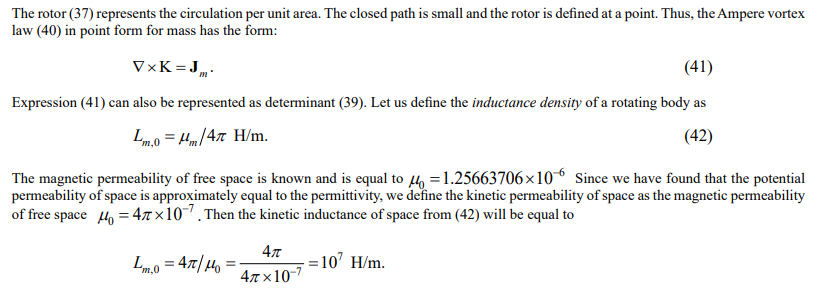
In the conformal mapping of the hypercomplex space, we define the kinetic inductance Lm of the rotation of bodies with mass as the proportionality coefficient between the kinetic current of the mass Im, representing the rotation of the mass in some closed contour of the body or along an orbit, and the total kinetic flow of the mass Φm, created by this current through the surface S, the edge of which is the given contour or orbit:

where the vector ar passes through the surface S.
Thus, the kinetic current of the mass Im in the form of rotation of the mass along a closed line during the proper rotation of the body or along an orbit, forms a force in the form of a kinetic flow of mass Φm. This force, like the magnetic flux force, is associated with accumulated kinetic energy. Kinetic force acts on moving bodies with masses, deflecting their trajectories of motion. All bodies passing near a rotating object are, as it were, drawn into this rotating motion. To visualize this phenomenon, as well as for a magnetic field, we will use lines of force in space, which show the direction of the intensity or induction of force. The lines of force will be closed, denser at the poles and directed from the north pole to the south. In this case, the directions of rotation at the poles are opposite and the lines of force never intersect. In accordance with formula (30), we write the kinetic mass flow as

Therefore, the kinetic force of the mass flow is converted into the kinetic force of the mass current by means of the inductance of the body. In other words, the translational flow Φm creates a rotational motion Im, and vice versa. The kinetic force arising from the action of a mass flow is defined, by analogy with magnetic induction, as kinetic induction T. The kinetic mass flux Φm is a scalar physical quantity and is calculated through kinetic induction as Φm=TScos(α), where α is the angle between the kinetic induction vector T and the normal to the surface of rotation S. Consequently, kinetic induction T is a vector physical quantity that shows the force with which this field acts on a body with mass, possessing kinetic energy, moving in any direction. In other words, the action of kinetic induction and, accordingly, the kinetic inductance Lm, depend on the angle of inclination of the surface of rotation or the inclination of the axis of rotation of the body with mass:

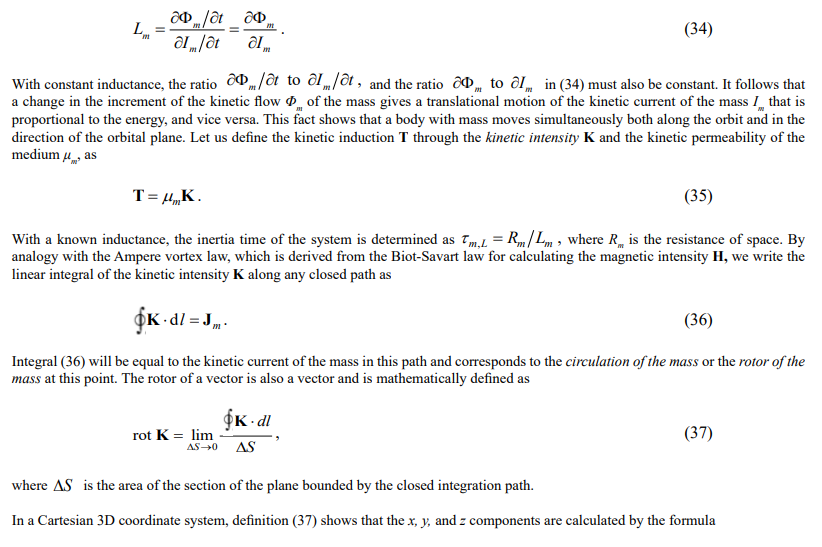
For example, this phenomenon manifests itself when the orbits of planets are tilted. In this case, the inductance vector in space is calculated as the vector sum of orthogonal contours with a mass current. We use the value (32) to characterize the properties of a body to resist the appearance, cessation, and any change in it of the kinetic flow of mass, kinetic energy. Let us express through inductance the self-induction in a body that arises when the acting kinetic flow of mass Φm changes over time. With constant inductance Lm, from (31) we obtain:

As follows from formula (33), when the force of the kinetic mass flow changes, a kinetic current of self-induction of the mass with a negative sign arises in the circuit, which compensates for the change in the scalar mass flow proportional to the magnitude of the body’s inductance. The above property is essentially a measure of kinetic inertia. Kinetic induction T, as well as potential induction R, does not depend on the permeability of the medium and, accordingly, has no limitations on the speed of propagation of influence, i.e. it acts instantly. Kinetic induction shows that there is another physical phenomenon between bodies – the movement of kinetic currents by means of induction. We also note that, as for potential induction, without the instantaneous influence of the change in kinetic induction on other bodies with masses, it is impossible to implement the law of conservation of energy. However, due to inertia, the processes of compensation for changes in kinetic energy occur over a period of time determined by the magnitude of the kinetic inductance. Let us express the inductance of the mass from (33) as
Maxwell’s Quaternion Equations of Gravity
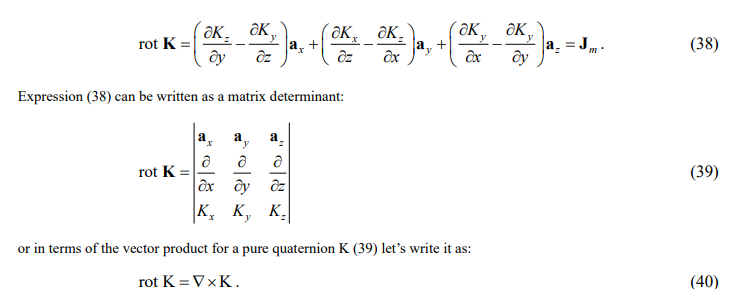
Maxwell’s equations of electrodynamics were obtained by Maxwell in 1865 based on the generalization of the experiments of Faraday, Ampere, Gauss and others. In formulating the equations of electrodynamics, Maxwell used vector mathematics, in particular, the Hamiltonian operator in 3D space with imaginary units i, j, k. This operator is a pure quaternion, i.e. a quaternion without a scalar part. Maxwell’s quaternion equations for electromagnetic waves are also obtained analytically by calculating the derivative of the quaternion function with respect to the conjugate quaternion [6]. Since electrons are absent from physical space, energy is transferred through space using waves formed by electrical and magnetic intensities. In the theory of gravity, satellites move with the planets, the planets move with the sun and, in general, with the stars. In other words, energy is not propagated in waves, but in moving masses. Therefore, we transform Maxwell’s electrodynamic equations into equations for the motion of bodies. In this case, in Maxwell’s equations for electrical intensity E we use the previously introduced concepts of potential intensity P or potential induction R =emP . Maxwell’s equations for potential intensity will take the form:
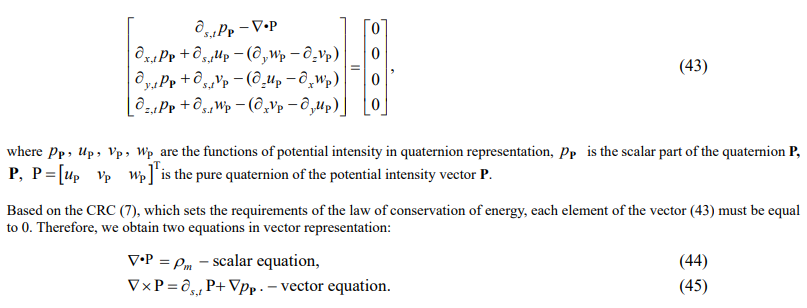
Expression (44) represents Gauss’s law (23) in the form of writing (29).
The potential intensity functions in the quaternion representation (4) are solutions of the dynamic’s equation (2), which transforms the mass vector of bodies into a vector of mass increments. This equation has a solution in the form of a complex exponential, so the potential intensity functions are harmonic functions. Since, according to the CRC, equation (43) must be equal to zero, the energies of the right-hand sides of the equations must be equal to the energies of the left-hand sides, as written in equations (44) and (45).
Maxwell’s equation of motion of bodies for kinetic intensity K or kinetic induction (35) T =mmK will take the form:
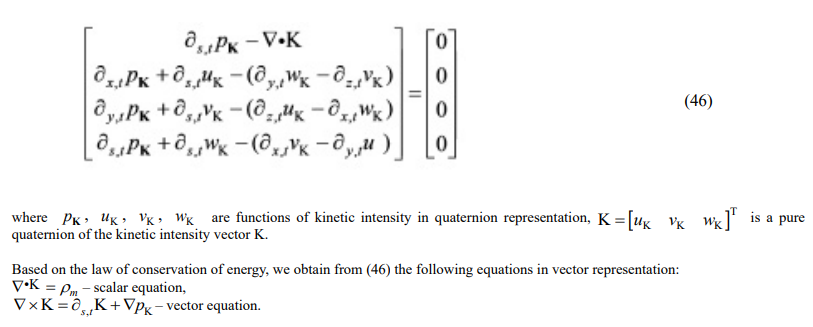
Thus, based on the universality of the laws of nature, Maxwell’s equations apply to the entire observable world—from subatomic particles to galaxies. These laws operate always and at all points in space, independent of human will, making the universe knowable.
Diagram of the Trajectory of the Planets Around the Sun
To describe the orbit of the Earth and other planets around the Sun, a heliocentric ecliptic coordinate system is used, where the origin is the center of the Sun, and the main plane is the plane of the ecliptic (the plane of the Earth’s orbit). The ecliptic is the zodiac circle. The ecliptic is the line on the celestial sphere traced by the Sun over the course of a year, reflecting the Earth’s orbital motion. The plane of the ecliptic is the plane of the Earth’s orbit around the Sun. The center of the Sun (barycenter) in the heliocentric coordinate system is taken as the origin (0,0,0), representing the center of mass of the Solar System. The actual barycenter of the entire system can shift due to the influence of the planets, sometimes being located close to the Sun’s surface rather than at its geometric center.
According to Maxwell’s equations for mass (43) - (48), the planets move simultaneously in a straight line due to the influence of potential intensity and in a circular orbit due to the influence of kinetic intensity. Figure 3 shows a diagram of a planet’s orbit around the Sun, simultaneously moving within the Galaxy along with the Sun. The Sun also moves in the Galaxy together with the Galaxy. The figure shows the Sun’s motion (yellow) during a complete orbit of the planet (blue). The planet’s orbit, due to the action of potential intensity, moves with the Sun (green). The planet’s position at the Sun’s location is connected by straight lines representing the orbital axes. The projection of the orbit onto a plane is a circle (black). The inclination of the orbital axes, which is perpendicular to the orbital line, is also shown.

Figure 3: The Rotation of a Planet in Orbit Around the Sun While Simultaneously Moving With the Sun in the Galaxy
The time it takes the Sun to make a complete revolution around the center of the Galaxy at a speed of 220 km/s is approximately 240 million years. Therefore, the rotation of the planets can be considered as the Sun moves in a straight line. The speed of the planets’ orbits around the Sun is several times slower than the Sun’s. For example, Earth’s orbital speed is approximately 30 km/s, Mercury’s is 48 km/s, Mars’s is 24 km/s, and Venus’s is 35 km/s. Other, more massive planets move even more slowly. Therefore, when calculating orbits, one cannot neglect the motion of the Sun in the Galaxy and consider the Sun to be stationary. In Kepler’s time, the Sun was believed to be stationary and the planets to move in elliptical orbits. The distance to the Sun was determined from an observer on Earth using the position of Mars in the starry sky. As Figure 3 shows, the distance to the Sun from Earth will be greater than the distance predicted by Earth’s rotation, according to Maxwell’s equations for masses. As is well known, the cross-section of a cylinder with an inclined plane is an ellipse. Therefore, when a planet moves with the Sun, the orbital plane becomes inclined, and, consequently, the planetary orbit becomes elliptical. It’s also worth noting that in the time of Kepler and Newton, it was believed that orbital inclinations arose during their formation. However, as Figure 3 shows, orbital inclinations are related to their spiral motion with the Sun. Planets have different orbital inclinations. For example, the inclination of Earth’s rotation axis is 23.26 degrees, Mercury’s is 0.01, Mars’s is 25.19, Venus’s is 177.36, and Saturn’s is 26.73. This is explained by the fact that they must all move simultaneously with the Sun. Moreover, all orbits must lie in a common plane. Since the planets have different masses and periods, according to the law of conservation of energy, the inclination of their rotation axes must be such as to balance potential and kinetic energy, ensuring that the planets move simultaneously. Thus, the obtained parameters of the planetary orbits for a stationary Sun must be recalculated for a moving Sun. After this, it will be necessary to compare these measurements with calculations using the presented Maxwell equations.
Conclusion
Existing theories of gravity, based on the force of attraction and the geometric curvature of space, do not fully describe the gravitational interactions of bodies in the universe. The rotation of planets occurs not due to attraction, but due to the capacitance and inductance of space, which curve rectilinear trajectories, i.e., they exponentially map rectilinear motion in a multidimensional hypercomplex space into circular motion. Mathematically, these effects can be represented as a conformal mapping of hypercomplex space. Circular motion occurs around the zero point of space without energy loss and, therefore, indefinitely. Moreover, the mass increments of bodies can take both positive and negative values. The number π is included in the definition of magnetic permeability and the gravitational constant,so it can also be considered a fundamental physical constant of space, used to calculate the parameters of circular orbits with high accuracy. According to the law of conservation of energy, the universe is a unified system with multiple interconnected MIMO-type sets. This connection is ensured by the phenomenon of induction, which has no limit on the rate of transfer of energy changes, and memory, so the system reacts to such changes instantly. In other words, there is no locality, which in quantum physics manifests itself through “entangled” particles. The law of conservation of energy cannot be realized without induction and the instantaneous transfer of energy changes to all objects in the system simultaneously. Changes in mass do not occur instantaneously, but with a corresponding inertia, i.e., with a time delay. Since the increment of mass when moving toward a zero trajectory is proportional to the increment of potential force and kinetic force, the velocities of bodies with any mass moving toward zero are the same. The capacity of a physical body and inductance are a measure of inertia. The motion of planets and stars is described by two types of Maxwell’s equations for mass: the equation for potential intensity and the equation for kinetic intensity. Maxwell’s equations for mass show that a body with mass moves simultaneously both in its orbit and in the direction of its orbital plane. The different tilts of the planets’ rotation axes are determined by the law of conservation of energy and correspond to the parameters of the planets’ orbits and the speeds of their rotation along the orbit and their own rotation in such a way that the ratios of potential and kinetic energy would ensure their joint movement with the Sun along its orbit in the Galaxy.
References
- Sovetov, V. (2024). The MIMO data transfer line with three-frequency quaternion carrier. Journal of Sensor Networks and Data Communications, 4(2), 01-17.
- Sovetov, V. (2024). The MIMO Data Transfer Line with Seven-Frequency Octonion Carrier. Eng OA, 2(3), 01-23.
- Sovetov, V. (2026). Fourier Transform of a Single-Frequency Octonion. Space Sci J, 3(1), 01-14.
- Sovetov, V. (2025). Cauchy-Riemann Conditions For The Maxwell’s Equations Of A Single-Frequency Quaternion. Space Sci J, 2(1), 01-09
- Sovetov, V. (2025). Coulomb’s law for Single-Frequency Quaternion Charge. J Sen Net Data Comm, 5(3), 01-10.
- Sovetov, V. (2026). Maxwell’s Octonion Equations. Space Sci J, 3(1), 01-14.