

Journal of Veterinary Health Science(JVHS)
ISSN: 2831-3887 | DOI: 10.33140/JVHS

Impact Factor: 0.762

Editorial - (2025) Volume 6, Issue 2
Focus on Fluorosis in Domestic Animals in India
Former Department of Zoology, Government Meera Girls College, Udaipur 303002, Rajasthan, India
Received Date: May 23, 2025 / Accepted Date: Jun 24, 2025 / Published Date: Jul 01, 2025
Copyright: ©©2025 Shanti Lal Choubisa. This is an open-access article distributed under the terms of the Creative Commons Attribution License, which permits unrestricted use, distribution, and reproduction in any medium, provided the original author and source are credited.
Citation: Choubisa, S. L. (2025). Focus on Fluorosis in Domestic Animals in India. J Vet Heal Sci, 6(2), 01-06.
Abstract
It is well known that fluorides are the result of chemical combination of fluorine (F-) with other elements and are widely found in water, air, soil, and even food in natural and anthropogenic forms [1]. When humans and animals are regularly exposed to fluoride for long periods of time, they develop a serious disease called fluorosis which is endemic in many countries including India [1,2].
Introduction
It is well known that fluorides are the result of chemical combination of fluorine (F-) with other elements and are widely found in water, air, soil, and even food in natural and anthropogenic forms [1]. When humans and animals are regularly exposed to fluoride for long periods of time, they develop a serious disease called fluorosis which is endemic in many countries including India [1,2]. If fluorosis is caused by drinking water, it is generally called “hydrofluorosis”, which is most common and hyperendemic in rural areas of India [3-10]. However, it is endemic in many countries of the world[1]. Another cause of fluorosis in humans and animals is industrial fluoride pollution or emissions, long-term exposure to which also causes fluorosis, generally called “neighbourhood fluorosis” and “industrial fluorosis”, respectively [1,11-15]. This type of fluorosis is usually restricted to a particular region and is usually endemic in the vicinity of sources of industrial fluoride pollution. However, in the country, maximum epidemiological research studies have been carried out on hydrofluorosis in various species of domestic animals, such as cattle (Bos taurus), water buffalo (Bubalus bubalis), sheep (Ovis aries), goat (Capra hircus), camels (Camelus dromedarius), horses (Equus caballus), and donkeys (E. asinus) [16-25]. Although there are a wide range of sources of industrial fluoride emission in the country, such as coal burning thermal power plants and brick kilns and industries manufacturing steel, iron, aluminium, zinc, phosphorus, chemical fertilizers, bricks, glass, plastics, cement and hydrofluoric acid [26-29]. Nevertheless, limited research studies have been carried out on industrial fluorosis in a few species of domestic animals in India [30-39]. Even many species of herbivorous wild animals, such as red deer (Cervus elaphus L.), white-tailed deer (Odocoileus virginianus), mule deer (Odocoileus hemionus), elk (Cervus canadensis), moose (Alces alces), bison (Bison bison and B. bonasus)], wild boar (Sus scrofa), voles (Microtus agrestis and Clethrionomys glareolus), wood mice (Apodemus sylvaticus),cotton rats (Sigmodon hispidus)], moles (Talpa europaea)], red-necked wallaby (Notamacropus rufogriseus), swamp wallaby (Wallabia bicolor), eastern grey kangaroos (Macropus giganteus), koala (Phascolarctos cinereus), common brush tail possum (Trichosurus vulpecular), common ringtail possum (Pseudocheirus peregrinus), etc. are also living in the vicinity of many of fluoride emission sources [40-45]. But there is no single report available on chronic fluoride intoxication in wildlife in the country. However, such studies have been well documented in wildlife species in other countries [40-45]. Therefore, there is a need to conduct more research studies on fluoride toxicity in various species of domestic animals as well as wild animals due to various sources of fluoride emission in the country so that the findings of these studies can be used in formulating project or national health policy to protect animal health from chronic fluoride toxicity or fluorosis caused by various sources of fluoride exposures.
Interestingly, fluorosis was not found in domestic animals in India 4-5 decades ago because these animals used to drink water from traditional and natural sources such as perennial ponds, rivers, and shallow wells. The question is what is the reason behind this due to which thousands of domestic animals in the country have started getting affected by fluorosis and even today animals are continuously getting affected by this disease. The main reason for this is that animal keepers started giving water from man-made modern water sources like hand-pumps and bore-wells to their pets instead of giving them water from traditional and natural water sources. Because these water sources are available in sufficient numbers at various places in the villages. Ever since the cattle keepers started giving water to their pets from these water sources, these animals started suffering from fluorosis. Actually, when the “Dracunculus Eradication Programme” was started 4-5 decades ago [46-48], innumerable hand- pumps and deep bore- wells were dug in various places in the villages to provide clean water to the villagers. Since then, the number of these water sources in rural areas has been increasing and even today the villagers are giving water to their domesticated animals from these water sources. Most of the cattle keepers still do not know that giving water to animals from these sources causes fluorosis disease in them.
In fact, during the “Dracunculus Eradication Programme” nobody even realised that the water from these hand-pumps and deep-bore wells (groundwater) contained fluoride chemical. Interestingly, surveys show that almost all these man-made water sources in the country have varying amounts of fluoride in their water [24,49]. Most of these water sources have fluoride content higher than the desirable limit of 1.0 mg/L set by the Bureau of Indian Standards [50]. Whereas, the amount of fluoride in water of most of the water sources in many villages and even in remote areas is higher than the standard maximum acceptable limit of 1.5 mg/L set by the World Health Organization [1]. When people started drinking water from these hand-pumps and bore-wells, their teeth started getting discoloured and light to dark brown horizontal stripes started appearing on them. On the other hand, the hands and legs of children, youngsters, and old people also started getting crooked and many of them started walking with a limp, then the people of the concerned department came to know about this dangerous water-borne disease fluorosis. At present, the human Dracunculiasis disease caused by human dracunculus nematode worm (Dracunculus medinensis) may have been eradicated from India, but in its place a new disease Fluorosis has come, due to which lakhs of people and thousands of domestic animals are suffering from this disease. The eradication of dracunculosis and the arrival of fluorosis in India is like the proverb "falling from the sky and getting stuck on a date palm".
There is no doubt that prolonged drinking of water from hand-pumps, deep-wells, and bore-wells is not safe for the health of domestic animals and causes fluorosis. But there are many places in the country where even perennial freshwater sources (ponds and rivers) are not safe for the health of domestic animals as they have been found to have high fluoride content (>1.0 mg/L) [50]. These sources are also potential sources of long-term fluoride exposure not only to domestic animals [51-55] but also to wildlife leading to fluorosis [40-45]. Although hydrofluorosis has been well studied in most of the common species of domestic animals in the country, especially in tribal areas [16-25].
However, industrial fluorosis due to some manufacturing industries has been reported only in cattle, sheep, and goats [13-15]. But more research studies are needed to identify which of these species are relatively more sensitive or less tolerant to chronic fluoride poisoning. Such studies may be more useful in understanding fluoride toxicity in animals. There are more than 300 coal-based thermal power stations [56] and more than 1400 coal-burning brick kilns [57] in the country which keep emitting fluoride emissions into the environment. This industrial fluoride contaminates water, air, soil, agricultural crops, grass, and forest vegetation on which domestic animals depend for food and water. If these animals are exposed to this industrial fluoride for a long time, they also develop industrial fluorosis. However, there is no report of fluoride poisoning (fluorosis) in domestic animals due to these coal-burning industries, although it is important for animal health. Hence, there is a dire need to study the chronic fluoride poisoning in animals due to coal-burning industries in the country.
Although low levels of fluoride are beneficial for the mineralization and strengthening of teeth and bones during their development, when consumed excessively or exposed to high levels of fluoride for a long time, it becomes toxic and causes a variety of adverse changes. These fluoride-induced changes are permanent and irreversible or non-treatable. The toxic effects that develop in teeth, bones, and soft organs are generally called dental fluorosis, skeletal fluorosis, and non-skeletal fluorosis, respectively [58].
Whether animals are suffering from chronic fluoride poisoning or fluorosis can be identified by the presence of dental fluorosis, which is the earliest visible pathognomonic or clinical sign of chronic fluoride poisoning. It is usually characterized by discoloration of teeth or loss of teeth in animals, which is more evident in calves or immature animals [58]. Dental fluorosis is the most common and widely found in animals in the country and can be easily seen and identified with the naked eye, with the presence of bilateral striated, condensed or diffused, and horizontal light to dark brown stripes on the anterior teeth (Figure 1) [58]. But it may also appear as brown spots, patches, and fine dots on tooth enamel. The most negative aspect of dental fluorosis is that it reduces the life span of animals and they may die at an early age due to poor appetite and cachexia [1,59] as deformity of teeth makes grazing and chewing difficult. In the country, at 1.5-4.4 ppm of fluoride in drinking groundwater, 28.3-70.2% of different species of domestic animals including bovines and flocks are found to be afflicted with dental fluorosis [54, 60].
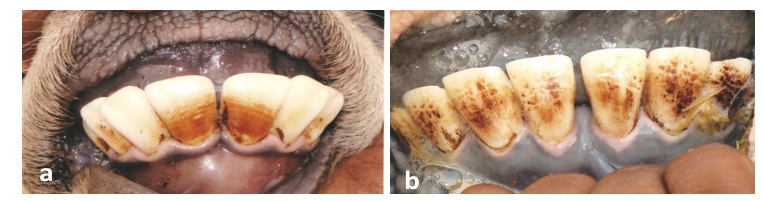
Figures 1: Dental fluorosis in bovine calf (a) and adult (b) characterised with regular and irregular horizontal light to deep brownish staining strips on the surface of anterior teeth.

Figure 2: Skeletal fluorosis in domesticated cow having lameness, enlarged joints, debility, invalidism, wasting of body muscles, and bony lesions in the mandibles, ribs, metacarpus, and metatarsus regions.
Long term bioaccumulation of fluoride alters the balance between bone formation and resorption which gradually leads to various pathological changes in the skeletal bones known as skeletal fluorosis. Excessive accumulation of fluoride in bones and associated muscles and ligaments causes various deformities which are highly painful in animals. Skeletal fluorosis ultimately reduces mobility in animals due to various changes in bones such as periosteal exostosis, osteosclerosis, osteoporosis and osteophytosis [61-63]. These changes appear clinically as unexplained pain and soreness and joints associated with stiffness, lameness, small body growth, and recognizable bone lesions (Figure 2). Excessive bioaccumulation of fluoride in muscles also reduces movement in animals. Nearly all bone lesions in animals appear when bone fluoride levels exceed a threshold level, which varies by species. In general, fluoride levels in the bones of affected animals are shown to be above "normal" (approximately >1000 µg F/g). A threshold level of approximately 4000 µg F/g dry bone, above which obvious lesions become apparent, has been described in various mammalian species [45,64-66]. However, according to Underwood (1977) no gross or microscopic changes in bones were found in animals exposed to fluoride levels up to 2,500 ppm [67]. In the country, at 1.5-4.4 ppm of fluoride in drinking groundwater, 25.7-64.1% of different species of domestic animals including bovines and flocks are found to be afflicted skeletal fluorosis [54,60].
Fluoride is affecting not only teeth and bones but also soft organs and developing several health problems in animals, such as muscle/ body weakness, frequent drinking of water (polydipsia), tendency to urinate frequently (polyuria), gastrointestinal discomforts (loss of appetite, bloating, abdominal pain, constipation, intermittent diarrhea, etc.), allergies, irregular reproductive cycles, abortions, stillbirths, etc. [58]. But it is not necessary that all these health consequences are found in the same animal. However, these health consequences also indicate the onset of chronic fluoride poisoning in animals. These health complaints are not permanent and get cured after removal of fluoride exposure. However, these health complaints in animals are only observational and not conclusive from experimental studies.
However, the severeness of fluorosis in animals is much more dependent on fluoride concentration and its duration and frequency of exposure, age, diet, nutrients, chemicals in water, environment, individual sensitivity, tolerance, and genetics, etc. [68-74].
In India, fluorosis in domestic animals is a serious health problem due to continuous exposure to fluoride through drinking water and industrial pollution, causing economic losses to livestock farmers [25, 51]. However, most livestock farmers are unaware of the disease in their animals, while the concerned departments are also not concerned about the disease in animals. However, this disease can be prevented and controlled in animals. For this, it is necessary to provide food rich in natural minerals and antioxidants to the animals of fluorosis affected areas and protect the animals from exposure to fluoride. Providing fluoride-free water or surface water in place of groundwater and grazing animals in areas free from industrial fluoride pollution or shifting animals from fluoride-affected areas to non-fluoride-affected areas is beneficial. The scary aspect of fluorosis in domestic animals is that the milk of these animals also contains fluoride [75]. Drinking such fluoridated milk can cause many mental disorders in developing children [76], which is not only a matter of concern in the country but can also be a serious challenge.
Funding
No funding was received for this work
Competiting Interest
The author has no conflict of interest.
References
- Bell, M. E., & Ludwig, T. J. (1970). Fluorides and human health. Geneva: World Health Organization.
- Choubisa, S. L., Choubisa, D., & Choubisa, A. (2023). Fluoride contamination of groundwater and its threat to health of villagers and their domestic animals and agriculture crops in rural Rajasthan, India. Environmental geochemistry and health, 45(3), 607-628.
- Choubisa, S. L., Choubisa, D. K., Joshi, S. C., & Choubisa, L. (1997). Fluorosis in some tribal villages of Dungarpur district of Rajasthan, India. Fluoride, 30(4), 223-228.
- Choubisa, S. L. (1999). Chronic fluoride intoxication (fluorosis) in tribes and their domestic animals. International Journal of Environmental Studies, 56(5), 703-716.
- Choubisa, S. L. (2001). Endemic fluorosis in southernRajasthan, India. Fluoride, 34(1), 61-70.
- Choubisa, S. L, Choubisa, L., & Choubisa, D. K. (2001). Endemic fluorosis in Rajasthan. Indian Journal Environmental Health, 43(4), 177-189.
- Choubisa, S. L. (2018). A brief and critical review of endemichydrofluorosis in Rajasthan, India. Fluoride, 51(1), 13-33.
- Choubisa, S. L. (2022). Status of chronic fluoride exposure and its adverse health consequences in the tribal people of the scheduled area of Rajasthan, India. Fluoride, 55(1), 8-30.
- Choubisa, S. L. (2024). A brief review of fluoride-induced bone disease skeletal fluorosis in humans and its prevention. Journal of Pharmaceutics and Pharmacology Research, 7(8), 1-6.
- Choubisa, S. L. (2025). A Brief Review of Fluoride Exposure and Its Adverse Health Effects Among Tribal Children in India. Journal of Clinical Medical health Care, 2(2), 1-9.
- Choubisa, S. L., & Choubisa, D. (2015). Neighbourhood fluorosis in people residing in the vicinity of superphosphate fertilizer plants near Udaipur city of Rajasthan (India). Environmental Monitoring and Assessment, 187(8), 497.
- Choubisa, S. L. (2015). Industrial fluorosis in domestic goats(Capra hircus), Rajasthan, India. Fluoride, 48(2), 105-112.
- Choubisa, S. L., & Choubisa, D. (2016). Status of industrial fluoride pollution and its diverse adverse health effects in man and domestic animals in India. Environmental Science and Pollution Research, 23(8), 7244-7254.
- Choubisa, S. L. (2023). Industrial fluoride emissions are dangerous to animal health, but most ranchers are unaware of it. Austin Environmental Sciences, 8(1), 1-4.
- Choubisa, S. L. (2023). A brief review of industrial fluorosis in domesticated bovines in India: Focus on its socioeconomic impacts on livestock farmers. Journal of Biomed Research, 4(1), 8-15.
- Choubisa, S. L. (1999). Some observations on endemicfluorosis in domestic animals in Southern Rajasthan(India). Veterinary Research Communications, 23, 457-465.
- Choubisa, S. L. (2007). Fluoridated ground water and its toxic effects on domesticated animals residing in rural tribal areas of Rajasthan, India. International journal of environmental studies, 64(2), 151-159.
- Choubisa, S. L. (2010). Osteo-dental fluorosis in domestichorses and donkeys in Rajasthan, India. Fluoride, 43(1), 5.
- Choubisa, S. L. (2010). Fluorosis in dromedary camels in Rajasthan, India. Fluoride, 43(3), 194.
- Choubisa, S. L., Modasiya, V., Bahura, C. K., & Sheikh, Z. (2012). Toxicity of fluoride in cattle of the Indian Thar Desert, Rajasthan, India. Fluoride, 45(4), 371-376.
- Choubisa, S. L. (2013). Fluorotoxicosis in diverse species of domestic animals inhabiting areas with high fluoride in drinking water of Rajasthan, India. Proceedings of the National Academy of Sciences, India Section B: Biological Sciences, 83(3), 317-321.
- Choubisa, S. L. (2013). Fluoride toxicosis in immature herbivorous domestic animals living in low fluoride water endemic areas of Rajasthan, India: an observational survey. Fluoride, 46(1), 19-24.
- Choubisa, S. L. (2018). A brief and critical review on hydrofluorosis in diverse species of domestic animals in India. Environmental geochemistry and health, 40(1), 99-114.
- Choubisa, S. L. (2021). Chronic fluoride exposure and its diverse adverse health effects in bovine calves in India: an epitomised review. Global Journal of Biology, Agriculture and Health Sciences, 10(3), 1-6.
- Choubisa, S. L. (2024). A brief and critical review of skeletal fluorosis in domestic animals and its adverse economic consequences. Journal of Dairy and Veterinary Sciences, 16(4), 1-8.
- Choubisa, S. L. (2025). Can Smoke from Coal-Fired Brick Kilns in India Cause Fluorosis in Domestic Animals? if yes, Then Livestock Owners Need to be Made Aware. Biomedical and Clinical Research Journal, 1(2), 1-7.
- Choubisa, S. L. (2025). Can coal-fired thermal power plants in India cause industrial fluorosis in domestic animals? Livestock owners are unaware. Journal of Veterinary Health Science, 6(1), 1-7.
- Choubisa, S. L. (2025). Risk of Fluorosis and other Health Hazards in Humans from Coal-Fired Brick Kilns in India: People need to be Aware. Clinical Medical Reviews and Reports, 7(1), 1-7.
- Choubisa, S. L. (2025). Is wildlife safe from coal-burning thermal power plants in India in the context of fluorosis? Journal of Veterinary Science Research, (in-press).
- Senthil Kumar, P., & Aravindakshan, C. M. (2015). Industrial fluorosis and its effects on serum biochemistry and haemogram in cattle of Kerala, India. Proceedings of the National Academy of Sciences, India Section B: Biological Sciences, 85, 867-872.
- Rao, D. N., & Pal, D. (1978). Cattle fluorosis problem around an aluminium factory. Environmental Physiology and Ecology of Plants, 2, 399-406.
- Ray, S. K., Behra, S. K., Sahoo, N., & Dash, P. K. (1993).Studies on fluorosis in cattle of Orissa due to industrialpollution. Indian Journal of Animal Science, 67, 943-5.
- Patra, R. C., Dwivedi, S. K., Bhardwaj, B., & Swarup, D. (2000). Industrial fluorosis in cattle and buffalo around Udaipur, India. Science of the Total Environment, 253(1-3), 145-150.
- Swarup, D., Dey, S., Patra, R. C., Dwivedi, S. K., & Ali, S.L. (2001). Clinico-epidemiological observations of industrial bovine fluorosis in India. Indian Journal of Animal Science, 71, 1111-1115.
- Swarup, D., Dwivedi, S. K., Dey, S., & Ray, S. K. (1998). Fluoride intoxication in bovines due to industrial pollution. Indian Journal of Animal Science, 68, 605-608.
- Jena, C. K., Gupta, A. R., & Patra, R. C. (2016). Osteo-dental fluorosis in cattle reared in villages on the periphery of the aluminium smelter in Odisha, India. Fluoride, 49(4), 503.
- Mandal, K. D., Das, M. R., Pati, M., Gupta, A. R., & Patra,R. C. (2019). Prevalence of fluorosis in calves reared in the vicinity of aluminium smelter plant, Odisha. International Journal of Chemical Studies, 7(1), 2502-4.
- Pati, M., Parida, G. S., Mandal, K. D., Gupta, A. R., & Patra,R. C. (2020). Clinico-epidemiological study of industrial fluorosis in calves reared near aluminium smelter plant, at Angul, Odisha. The Pharma Innovation Journal, 9(6), 616-20.
- Sheikh, Z., & Panchal, L. (2018). Anthropogenic fluoride contamination and osteofluorosis in bovines inhabiting Umarda, Jhamarkotra and Lakkadwas villages of Udaipur, Rajasthan, India. International Journal of Inovative Research and Review, 6(1), 12-20.
- Shupe, J. L., Olson, A. E., Peterson, H. B., & Low, J. B. (1984). Fluoride toxicosis in wild ungulates. Journal of the American Veterinary Medical Association, 185(11), 1295-1300.
- Kierdorf, U., Kierdorf, H., Sedlacek, F., & Fejerskov, O. (1996). Structural changes in fluorosed dental enamel of red deer (Cervus elephus) from a region with severe environmental pollution by fluorides. Journal of Anatomy, 188(Pt 1), 183.
- Kierdorf, H., Kierdorf, U., Richards, A., & Sedlacek, F. (2000). Disturbed enamel formation in wild boars (Sus scrofa) from fluoride polluted areas in Central Europe. The Anatomical Record, 259(1), 12-24.
- Walton, K. C. (1987). Tooth damage in field voles, wood mice and moles in areas polluted by fluoride from an aluminium reduction plant. Science Total Environ, 65, 257-260.
- Kim, S., Stair, E. L., Lochmiller, R. L., Rafferty, D. P., Schroder,J. L., Basta, N. T., ... & Jr, C. W. Q. (2001). Widespread risks of dental fluorosis in cotton rats (Sigmodon hispidus) residing on petrochemical waste sites. Journal of Toxicology and Environmental Health Part A, 62(2), 107-125.
- Death, C., Coulson, G., Kierdorf, U., Kierdorf, H., Ploeg, R., Firestone, S. M., ... & Hufschmid, J. (2017). Skeletal fluorosis in marsupials: a comparison of bone lesions in six species from an Australian industrial site. Science of the Total Environment, 584, 1198-1211.
- Death, C., Coulson, G., Kierdorf, U., Kierdorf, H., Ploeg, R., Firestone, S. M., ... & Hufschmid, J. (2017). Skeletalfluorosis in marsupials: a comparison of bone lesions in six species from an Australian industrial site. Science of the Total Environment, 584, 1198-1211.
- Choubisa, S. L., Verma, R., & Choubisa, L. (2010). Dracunculiasis in tribal region of southern Rajasthan, India: a case report. Journal of Parasitic Diseases, 34(2), 94-96.
- Choubisa, S. L. (2022). A historical dreaded human nematode parasite, Dracunculus worm (Dracunculus medinensis) whose awe is still alive in elderly of India. Austin Public Health, 6(1), 1-4.
- Choubisa, S. L. (2018). Fluoride distribution in drinking groundwater in Rajasthan, India. Current Science, 1851-1857.
- B. I. S. (2012). Indian standard drinking water-specification.2nd revision. New Delhi: Bureau of Indian Standards, p. 2.
- Choubisa, S. L. (2022). A brief review of chronic fluoride toxicosis in the small ruminants, sheep and goats in India: focus on its adverse economic consequences. Fluoride, 55(4).
- Choubisa, S. L. (2023). Chronic fluoride poisoning in domestic equines, horses (Equus caballus) and donkeys (Equus asinus). Journal of Bimed Research, 4(1), 29-32.
- Choubisa, S. L. (2023). A brief and critical review of endemic fluorosis in domestic animals of scheduled area of Rajasthan, India: focus on its impact on tribal economy. Clinical Research in Animal Science, 3(1), 1-11.
- Choubisa, S. L. (2023). Is drinking groundwater in India safe for domestic animals with respect to fluoride. Archives of Animal Husbandry & Dairy Science, 2(4), 1-7.
- Choubisa, S. L. (2023). Is it safe for domesticated animals to drink fresh water in the context of fluoride poisoning. Clinical Research in Animal Science, 3(2), 1-5.
- C. E. A. (2024). Thermal Civil Design Division, Central Electricity Authority, Ministry of Power, Government of Inda, New Delhi, India.
- Kamyotra, J. S. (2023). Brick kilns in India. Central Pollution Control Board Delhi, India, pp 1-57.
- Choubisa, S. L. (2022). How can fluorosis in animals be diagnosed and prevented? Austin Journal of Veterinary Science and Animal Husbandry, 9(3): 1-5, id1096.
- Wang, J. D., Zhan, C. W., Chen, Y. F., Li, J. X., Hong Jieping,H. J., Wang Weifeng, W. W., & Cai Jianping, C. J. (1992). A study of damage to hard tissue of goats due to industrial fluoride pollution. Fluoride, 25(3), 123-128.
- Choubisa, S. L., Mishra, G. V., Sheikh, Z., Bhardwaj, B., Mali, P., & Jaroli, V. J. (2011). Toxic Effects Of Fluoride In Domestic Animals. Advances in Pharmacology & Toxicology, 12(2).
- Choubisa, S. L. (1996). Radiological skeletal changes due to chronic fluoride intoxication in Udaipur district, Rajasthan. Pollution Research, 15, 227-229.
- Choubisa, S. L. (2012). Toxic Effects Of Fluoride On HumanBones. Advances in Pharmacology & Toxicology, 13(1).
- Choubisa, S. L. (2022). Radiological findings more important and reliable in the diagnosis of skeletal fluorosis. Austine Medical Sciences, 7(2), 1-4.
- Death, C., Coulson, G., Kierdorf, U., Kierdorf, H., Morris,W. K., & Hufschmid, J. (2015). Dental fluorosis and skeletal fluoride content as biomarkers of excess fluoride exposure in marsupials. Science of the Total Environment, 533, 528-541.
- Shupe, J. L. (1980). Clinicopathologic features of fluoridetoxicosis in cattle. Journal of Animal Science, 51(3), 746-758.
- Turner, C. H., Boivin, G., & Meunier, P. J. (1993). A mathematical model for fluoride uptake by the skeleton. Calcified tissue international, 52, 130-138.
- Underwood, E. J. (1977). Trace elements in human and animal nutrition. 4th Edition, Academic Press, New York.
- Choubisa, S. L. (2010). Natural amelioration of fluoride toxicity (fluorosis) in goats and sheep. Current Science, 99(10), 1331-1332.
- Choubisa, S. L., Choubisa, L., & Choubisa, D. (2011). Reversibility Of Natural Dental Fluorosis. International Journal of Pharmacology & Biological Sciences, 5(2).
- Choubisa, S. L., Mishra, G. V., Sheikh, Z., Bhardwaj, B., Mali, P., & Jaroli, V. J. (2011). Food, fluoride, and fluorosis in domestic ruminants in the Dungarpur district of Rajasthan, India. Fluoride, 44(2), 70.
- Choubisa, S. L. (2012). Osteo-dental fluorosis in relation to chemical constituents of drinking waters. Journal of Environmental Science and Engineering, 54(1), 153-158.
- Kinkrawali, L., & Morzonda, N. (2013). Why desert camels are least afflicted with osteo-dental fluorosis?. Current Science, 105(12), 1671.
- Choubisa, S. L. (2024). Are sheep and goat animals relatively more tolerant to fluorosis. Journal of Veterinary Medicine and Research, 11(1), 1-5.
- Choubisa, S. L. (2024). Is the water buffalo species ( Bubalus bubalis) relatively more sensitive to fluorosis than other species of domestic animals? Still, there is a need for more in-depth research on this. Journal of Veterinary Medicine and Animal Sciences, 7(1), 1-6.
- Gupta, P., Gupta, N., Meena, K., Moon, N. J., Kumar, P., & Kaur, R. (2015). Concentration of fluoride in cow’s and buffalo’s milk in relation to varying levels of fluoride concentration in drinking water of Mathura city in India–A pilot study. Journal of Clinical and Diagnostic Research:, 9(5), LC05.
- Choubisa, S. L., Choubisa, D., & Choubisa, A. (2024). Are children in India safe from fluoride exposure in terms of mental health? This needs attention. Journal of Pharmaceutics and Pharmacology Research, 7(11), 1-6.