Archivos de Ciencia e Investigación(ADCI)
ISSN: 3068-014X | DOI: 10.33140/ADCI


Mathematical Note - (2025) Volume 1, Issue 1
FLT. Formulas of Numbers A, B, C
Received Date: May 15, 2025 / Accepted Date: Jun 09, 2025 / Published Date: Jun 16, 2025
Copyright: ©Copyright: ©2025 Victor Sorokine. This is an open-access article distributed under the terms of the Creative Commons Attribution License, which permits unrestricted use, distribution, and reproduction in any medium, provided the original author and source are credited.
Citation: Sorokine, V. (2025). FLT. Formulas of Numbers A, B, C. Arch Cienc Investig, 1(1), 01-01.
Abstract
1. Theorem. In a hypothetical equality A n + B n - C n = 0 in a number system with a prime base n > 2, mutually prime natural numbers A, B, C (mod n k ) starting from k=1 equal to the numbers A 1 n^(k-1) , B 1 n^(k-1) , C 1 n^(k-1) (mod n k ), where k can be arbitrarily large.
Introduction
- Theorem. In a hypothetical equality An + Bn - Cn = 0 in a number system with a prime base n > 2, mutually prime natural numbers A, B, C (mod nk) starting from k=1 equal to the numbers A n^(k-1), B n^(k-1), C n^(k-1) (mod nk), where k can be arbitrarily large.Properties of Equality (1*):
Properties of Equality (1*):
2.Designations: A1, A2, … Ak – one-, two-, ... k-significant endings of the number A in the numeral system with base n.
3.The numbers A, B, C can be represented as: A = A°nk+Ak, B = B°nk + Bk, C = C°nk+CK, where the base n = 10.
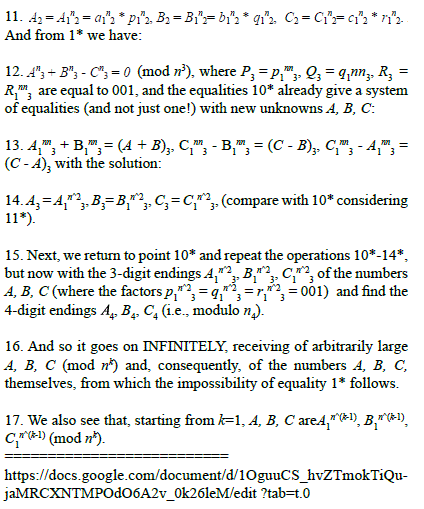
4. Key Lemma: The last two members in Newton Binom (A°nk+A[k])n are nA°nk(Ak)n-1 + A n. From this can be seen, the bers An, Bn, Cn (mod nk+1) there are unambiguous functions of the numbersk A, B, C (mod nk)
5.If A + B (mod n) > 0, then the factors A + B and R in the decomposition of the degrees An+Bn= (A+B)R are mutually prime; If A + B (mod n) = 0, then R = 0 (mod n).
Therefore, if A, B, C (mod n) are not zero, then factors in the equalities
6. Cn = An+Bn = (A+B)R, An = Cn - Bn= (C - B)P, Bn = Cn - An = (C - A)Q are degrees
7.A+B = cn, R=rn. C-B = an, P = pn, C-A = bn, Q = qn, and, since according to Fermat's little theorem,
8. An-1 = Bn-1 = Cn-1 = A n-1 = B n-1 = C n-1 = 1 (mod n), then P , Q , R1 (and p, q1, r1) in 6* is 1 (mod n), and according to 7*
9. P = Q = R = 01 (mod n2). And from equalities 6* we get a system of equations with unknown A, B, C:
10. A1 n 2+ B1 nv2 = (A + B) 2, C1 n 2- B1 n2= (C - B)2 , C1 n 2 - A1 n2 = (C - A)2 (mod n2). Where do we find: