

International Journal of Criminology and Criminal Law(IJCCL)
ISSN: 2996-3397 | DOI: 10.33140/IJCCL

Review Article - (2025) Volume 3, Issue 1
Fines as a Punishment:Historical Tradition, Legal Regulations, and Court Practice
Ph.D, Prorector of Academic Affairs at Ikh Zasag International University, Mongolia
Received Date: Mar 03, 2025 / Accepted Date: Apr 07, 2025 / Published Date: May 23, 2025
Copyright: ©©2025 TUYA Gal, et al. This is an open-access article distributed under the terms of the Creative Commons Attribution License, which permits unrestricted use, distribution, and reproduction in any medium, provided the original author and source are credited.
Citation: Baasanjav, J., Tuya, G. (2025). Fines as a Punishment: Historical Tradition, Legal Regulations, and Court Practice. Int J Criminol Criminal Law, 2(1), 01-05.
Abstract
There is one type of criminal liability imposed on a person who has committed a crime is a fine, and in the systematization of our country's criminal law, a fine is the lightest type of criminal liability. Since the fine began to be implemented in the form of a fine in the form of a fine in the 13th century, during the Great Law, we will examine in detail the situation that has been passed down through legal acts of historical periods and has reached the present day. The issue of whether a fine is effective and whether it is consistent with the purpose of criminal liability is discussed.
Keywords
Criminal Law of Mongolia, Fines as a Punishment, Legal Regulation and Historical Traditions
Introduction
Fines have been a longstanding form of criminal liability, historically regarded as one of the lightest penalties in criminal law. Their origins can be traced back to the 13th century during the Great Law era, where they were implemented as monetary sanctions. Over time, their application and purpose have evolved, leading to debates about their effectiveness and alignment with the goals of criminal liability.
When studying any legal concept, it is very important to consider how the concept arose in the national legal system and under what concepts it developed, and based on this, it is possible to determine the stage of further development. This is because the origin and development of a given legal concept are influenced by the characteristics of the time, social conditions, and history. From this perspective, the first part of the article describes how our country has used fines through document analysis.
In the history of Mongolian criminal law, fines have been the most widely used type of light punishment with a long tradition, and this type of punishment is used taking into account the property status and personal status of the perpetrator.
During the research, the researcher believes that the use of fines has increased, and the effectiveness and social significance of the punishment policy are not fully met, and the issue of effective implementation of this type of punishment is raised in the future.
Theoritical Framework
The legal regulation of fines in criminal law varies significantly between Asian and European jurisdictions, reflecting distinct theoretical frameworks rooted in cultural, historical, and supranational governance models.
Asian systems often integrate traditional norms (e.g., Confucian principles of social harmony) with colonial-era legal traditions (common law in Singapore/Hong Kong vs. civil law in Japan). China combines socialist legal theory with anti-corruption laws, imposing fines up to CNY 3 million (~US$453,000) for corporate bribery. Singapore and Malaysia use fines alongside corporal punishment (e.g., caning) for drug offenses, reflecting a utilitarian approach to deterrence. The Anti-Unfair Competition Law in China penalizes companies with fines and license revocation for bribery, emphasizing economic deterrence. South Asian nations like India and Pakistan criminalize drug possession with fines and imprisonment, though prison conditions and rehabilitation programs remain underdeveloped.
The European Union prioritizes uniformity through directives, such as the 2024 law criminalizing sanctions violations. Individual penalties: Minimum 1–5 years' imprisonment for intentional breaches, with fines for legal persons up to 15% of annual turnover. Rule-of-Law and Proportionality, the EU mandates proportional penalties, requiring fines to reflect the severity of offenses (e.g., >€100,000 in damages triggers stricter sanctions). Corporate liability includes disqualification from business activities, aligning with deterrence theory and economic disincentives.
A historical Study of the Legal Regulation of Fines in Mongolian Criminal Law
In order to consider the issue of how our country has used fines, it is necessary to study ancient laws such as the Great Administration Law that regulated social relations in the 13th century, the Great Execution Law, the People's Order, the Foreign Mongolian Law Code, and the Mongolian Law Code.
Domestic and foreign scholars and researchers unanimously agree that the law established by Genghis Khan was followed in the 13th century. However, this law has been called in various ways, such as ''Government'', ''Great Law of Punishment'', ''Great Law of Punishment'', and ''Great Morality''.
It is now undeniable that this law played a very important role in helping the Mongols establish justice and peace in the world and contribute to peacekeeping. The famous scholar B. Chimid wrote about this law, ''We Mongolians can be proud that the laws of the ancient Babylonian king Hammurabi and the Indian king Manu, which are held up as examples in the history of world government and law, were no less valuable sources of legal culture and history than the laws of the 12 tables of Justinian in Greece.''
There is information that this law imposed a fine of livestock for some crimes. For example, a person who stole a horse was punished by returning the stolen horse to its owner and paying an additional nine horses. The provision of fines of nine times and livestock was passed down in subsequent laws. It was not possible to redeem the fine by executing it with another penalty or to execute the penalty in another form.
The Great Execution established a procedure for the punishment of a fine of nine livestock for the crimes specified in the Great Execution, and the procedure for paying it three, five, seven, and nine times was legalized. For example, the Great Execution was instructed, ''The execution of thieves has begun. The penalty for a camel is fifteen nines, for a donkey nines, for a mare eight nines, for a cow, a donkey, and a sheep six nines.'' Thus, the penalty of nines was widely used in the Great Execution.
The Khalkh Law, adopted in 1709, regulated the various social relations of Mongolia. The punishment of cattle for crimes specified in this law was also widely used. For example, ''If a person steals stones, coal, or lime from a treasury, he shall be fined three ests,'' ''If a thief beats the owner of an animal with a stone or a stick, he shall be fined three ests,'' ''If a person steals from a field, the penalty shall be the same as that of chalk or coal,'' ''If a khan or a khan touches a nobleman with a sharp edge, he shall be fined four ests. If he attacks him verbally, he shall be fined three ests,'' ''If a khan or a khan gives alcohol to a monk, the giver shall be fined four ests of the donor's horse, two of which shall be taken to the government. The other two shall be eaten by a witness.''
The Outer Mongolian Law Code prescribes the punishment for fines, for example, ''If a person speaks ill of the governor and non-governor, the king, the prince, the duke, the prince If the penalty is seven or nine, 1 horse, 1 bull, 1 cow, 2 sheep, and 2 calves should be given; if the penalty is nine or nine, 2 horses, 2 cows, 2 sheep, and 1 calf should be given.
Our country regained its lost independence in 1911 and began the process of establishing its own laws. As a result, 65 books with more than 1,000 provisions - the Mongolian Laws - were developed, approved and enforced. This law retained the nine-digit fine. However, it introduced a penalty for fines that specified the number of animals to be fined. For example, ''when ministers on assignment pass through, the khoshuds shall be protected by guards and household princes and inspectors.
If they are negligent in protecting and ministers on assignment are exposed to theft, the khan, aimag princes and inspectors shall be fined 27 head of cattle and punished with 100 lashes,'' ''if an electric line is burned, the taij official shall be removed from office and fined 18 head of cattle,'' ''if an infectious disease enters another person's house and spreads the disease, the fine shall be nine head of cattle, and if a person dies, the fine shall be 27 head of cattle for the same offense and the victim shall be given the same amount of money,'' ''if a person is not injured but livestock is destroyed to a large extent and the living conditions are rendered unlivable, the taij official shall be fined 18 head of cattle,'' ''if a person's livestock is killed or slaughtered, the person shall be immediately paid for and a fine of nine head of cattle will be given.''
The regulation of fines in Mongolia is defined in the 1926 and 1934 Court Execution Orders, and the 1942, 1961, 1986, and 2002 Criminal Codes as follows. Article 11 of the 1926 Court Execution Order of the Mongolian People's Republic states that ''The fine shall be determined in tugriks and money.'' Article 11 of the 1929 Court Execution Order of the Mongolian People's Republic states that ''the fine shall be determined in tugriks and collected in the state and local treasury.'' Article 28 of the 1934 Court Execution Order of the Mongolian People's Republic states that ''A fine shall be determined in money by the court within the amount specified in the special articles of the execution order. When imposing a fine, the fine shall be determined taking into account the way in which the person lives and his financial situation, and the collected fine shall be transferred to the state treasury.''
Article 41 of the 1942 Criminal Code of the Republic of Mongolia states that ''a fine is a monetary penalty imposed by the court within the amount specified in the relevant articles of this law'', Article 23 of the 1961 Criminal Code of the Republic of Mongolia states that ''a fine is a monetary penalty imposed by the court in the amount specified in the law in cases specified in the law'', and Article 29 of the 1986 Revised Criminal Code of the Republic of Mongolia states that ''a fine is a monetary penalty imposed by the court in the amount specified in the cases specified in this law''.
Article 47, Part 1 of the Criminal Code of Mongolia of 2002 states that ''In cases specified in the special part of this law, a fine is a monetary penalty imposed by the court.'' The revised version of the Criminal Code of 2015 stipulates that a person who has committed a crime shall be fined a monetary penalty equal to the fine units specified in the special part of the Criminal Code, and the amount shall be from four hundred and fifty units to forty thousand tugriks. In addition, it was legislated that in cases where a fine is not served within the specified time, fifteen units of tugriks shall be replaced by one day of imprisonment.
The first definition of a fine in the criminal law of our country was given by Doctor of Law B. Sodovsuren, who considered that ''a fine is a fine imposed by a court decision from the offender and deposited in the state treasury.'' Doctor of Legal Sciences G. Sovd wrote that ''a fine is a monetary penalty imposed by a court in the amount specified in Article 23 of the Criminal Code of the Republic of Mongolia.'' A similar definition was given by lawyer T. Dendev. The authors of the ''Explanation of the Criminal Code of the Republic of Mongolia,'' which was made public in 1982, stated that ''a fine is a monetary penalty imposed by a court in the amount specified in the criminal code in the amount specified in the criminal code.''
The authors of the ''Detailed Explanation of the Criminal Code of the Republic of Mongolia,'' published in 1989, stated that ''a fine is a monetary penalty imposed by a court in the amount specified in the criminal code in the amount specified in the criminal code.''
4. Judicial Practice in Applying Fines in Mongolian Criminal Law The imposition of fines by the courts largely depends on the socio-economic conditions of people's lives and their ability to pay. It has been observed during the study that during financial crises, deterioration of people's living standards, unemployment, and poverty, the imposition of fines by the courts tends to decrease dramatically. As the country's economic situation stabilizes, the number of fines imposed by the courts tends to increase.
The Supreme Court, based on a study of judicial statistics and practice, noted that some courts do not properly assess the preventive and educational importance of fines, and therefore tend to impose prison sentences. Doctor of Legal Sciences S. Zhantsan conducted a study that showed that during the 10-year period from 2002 to 2012, courts imposed fines on a total of 2,946 people, which means that courts imposed fines on an average of about 300 people per year. In 2012, courts imposed fines on 272 people. In 2015, courts sentenced 370 people to fines, which accounted for 4.8% of all convictions. In 2016, courts sentenced 216 people to fines, which accounted for 3.3% of all convictions.
However, considering the imposition of fines in recent years, 8,367 people were sentenced to fines in 2019, 8,296 in 2020, 7,659 in 2021, 8,928 in 2022, 9,544 in 2023, and 10,295 in 2024. The 2015 revision of the Criminal Code of Mongolia stipulated that legal entities should be subject to criminal liability and be subject to fines. Considering the situation of fines imposed on legal entities, 3 legal entities were sentenced to fines in 2019, 5 in 2020, 4 in 2021, 10 in 2022, 14 in 2023, and 22 in 2024.
The execution of a fine begins when the senior decision-maker receives the person sentenced to a fine based on a legally valid court decision, as provided for in Article 153.1 of the Law on the Execution of Court Decisions. The decision-maker shall begin the execution of the sentence immediately upon receipt of the resolution specified in Article 153.2 of the Law.
A personal file for the execution of a criminal decision shall be opened for the convicted person sentenced to a fine, the procedure for serving the sentence, his rights and obligations shall be explained to the convicted person, and a record shall be made and signed. In the case of evasion of a fine, it is stipulated that ''if the fine is not paid within the time period set by the court, the court shall calculate the amount of the unpaid fine as fifteen units of the tugrik and replace it with imprisonment.'' By directly replacing the fine with imprisonment if the person who has been sentenced to a fine does not pay the fine, it has become a policy to make fines equivalent to imprisonment and make them more severe.
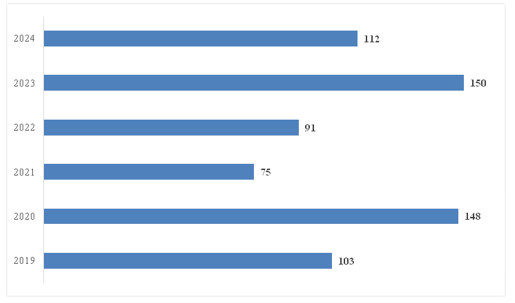
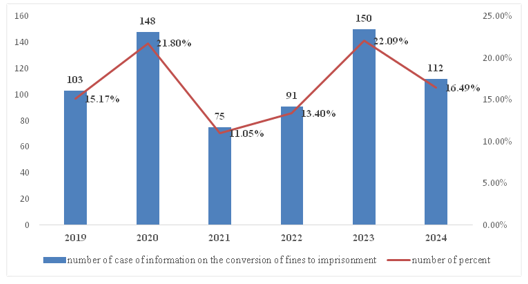
We analyzed and compared between 2019 and 2024. 2019-2020: Sharp increase (+44%) from 103 to 148 cases. 2020 Surge: Could reflect stricter enforcement during pandemic-related economic stress or policy changes. 2020-2021: Dramatic drop (-49%) to 75 cases. 2021 Drop: May indicate temporary leniency, backlog adjustments, or reduced court activity. 2021-2024: Gradual recovery, peaking at 150 cases in 2023 (+100% from 2021). 2023 Peak: Suggests renewed focus on enforcement or systemic factors (e.g., legislative updates). 2024: Slight decline to 112 cases (-25% from 2023 peak). Recommendations for Further Investigation.
Contextual Factors: Cross-reference with legal reforms, economic conditions, or enforcement priorities. Analyze demographic data (e.g., regions or offenses driving trends). Policy Implications: Assess whether fluctuations reflect intentional policy shifts or unintended consequences. Evaluate if 2023's peak correlates with specific enforcement campaigns or resource allocation. Track 2024's full-year data (if incomplete) to confirm stabilization. Compare with parallel metrics (e.g., fine collection rates, incarceration trends) (table 01, Graph 01,02).
|
year |
number of cases |
number of percent |
|
2019 |
103 |
15.17 % |
|
2020 |
148 |
21.80 % |
|
2021 |
75 |
11.05 % |
|
2022 |
91 |
13.40 % |
|
2023 |
150 |
22.09 % |
|
2024 |
112 |
16.49 % |
|
Total |
679 |
100.00% |
|
Source: The Results of Our Study |
||
Table 1: Information on the Conversion of Fines to Imprisonment (2019-2024)
Source: The Results of Our Study
Graph 1: Information on the Conversion of Fines to Imprisonment (2019-2024)
Source: The Results of Our Study
Graph 2: Information on the Conversion of Fines to Imprisonment (Comparisons of number and percent) (2019-2024)
In the event of evasion of a fine, it may be effective to replace it with a sentence that falls within the range of sanctions specified in the relevant article of the special part of the criminal code for which the person was sentenced to a fine, rather than directly replacing it with a sentence of imprisonment. For example, a person who caused minor harm to human health was sentenced to a fine of 1,100,000 tugriks, as provided for in Article 11.6.1 of the special part of the criminal code.
The convicted person does not have the financial means to pay the fine. In this case, the court will be able to replace it with a sentence of community service or restriction of the right to travel, as provided for in Article 11.6.1 of the special part of the criminal code. In other words, it will not be replaced with a sentence of imprisonment as it is now. It is believed that this will have a certain impact on the humanization of criminal legislation.
There are a total of 70 crimes in the special section of the Criminal Code that are punishable by fines for minor crimes. For example, recklessly causing serious harm to human health (part two of Article 11.3); intentionally causing less serious harm to human health (part one of Article 11.4); recklessly causing less serious harm to human health (part one of Article 11.5), etc. However, there are a total of 21 types of serious crimes that are punishable by fines. For example, intentionally causing serious harm to human health (part one of Article 11.1), organizing a conspiracy to illegally hold elections (Article 14.9), preparing and transplanting human blood or organs under unqualified conditions (Article 15.4), etc.
The imposition of a fine, the lightest punishment provided for in the Criminal Code for serious crimes, may significantly weaken the punishment policy for serious crimes that pose a social danger. This is in direct contradiction to the definition of a serious crime as defined in Article 2.6, Section 1 of the General Part of the Criminal Code, which stipulates that a minimum sentence of imprisonment of two years or more is prescribed. In other words, imposing a fine on a serious crime makes it impossible to distinguish it from a minor crime.
Conclusion
It has been established that the penalty of a fine, as a type of criminal liability, is an independent type of ancient punishment specified in the laws of our country, such as the Great Zasag, the Great Death Penalty, the Khalkh Code, the Laws of Outer Mongolia, and the Laws of Mongolia. Also, in later legal sources, such as the Court Death Penalty Codes of 1926, 1929, and 1934, and the Criminal Codes of 1942, 1961, 1986, 2002, and 2015, which were followed during the Mongolian People's Republic, the penalty of a fine has traditionally been specified as an independent type of punishment in the penal system in many articles of the special class of criminal law.
According to the system of punishments specified in the general class of criminal law, a fine is the lightest form of criminal liability, and if the fine is not served within the time specified by the court, it is possible to take humane measures such as community service and restriction of travel, instead of replacing it with the most severe form of criminal liability, which is imprisonment. Also, although a fine is the lightest form of criminal liability, it is common to impose this punishment for a serious crime defined in a special section of the criminal law. This weakens the sentencing policy and creates a situation where it is impossible to distinguish between serious and minor crimes.
If the fine is determined in relation to the salary and income of the convict in a certain period, as well as the illegally obtained income, the value and valuation of the property, etc., it will not only be independent of the exchange rate, but also have the significance of further enhancing the deterrent effect of restricting the property rights of the convict. For example, in the sanctions of the crime of accepting a bribe, imposing a fine in the amount of the bribe they have received can increase the deterrent and preventive effect of the perpetrator [1-15].

Evidence of Study
References
- Criminal Code of Mongolia. 2015
- Explanation of the Criminal Code of the Mongolian People's Republic. Ulaanbaatar., 1982
- Detailed explanation of the Criminal Code of the Mongolian People's Republic. Ulaanbaatar., 1989
- B. Chimid Researching the Law of the Great Power - A Critical Problem of State and Party Legal Reform. Second Book.., Ulaanbaatar., 2008
- B. Batbayar. (2024)The Code of Laws of Mongolia is the First Unified and Diversified (Codified) Law of Mongolia. Thesis for the Degree of Doctor of Law.., Ulaanbaatar.
- B. Sodovsuren. (1964). Criminal Law of the Mongolian People's Republic. General Class. Ulaanbaatar.
- V. Ya. Ryazanovsky. (2008) Historical Review of the Mongolian Laws and Executions, The Law of the GreatPower. Translated from Russian by Ch.Baatar.., Ulaanbaatar.
- G.Sovd. (1973). Criminal Law Course of the Mongolian People's Republic. Ulaanbaatar.
- White Book of Crime in Mongolia. 2016. Ulaanbaatar., 2017
- Historical Collection of Mongolian Legislation. Volume One. 1206-1910.., Ulaanbaatar., 2010
- Historical Collection of Mongolian Legislation. Volume Two. 1911-1926.V month. Ulaanbaatar., 2010
- Historical Tradition of Criminal Legislation of Mongolia (1911-2009). Ulaanbaatar., 2011
- Collection of Resolutions of the Supreme Court of Mongolia (1959-2010). Ulaanbaatar., 2015
- T. Dendev The problem of punishment in the criminal law of the Mongolian People's Republic. Ulaanbaatar., 1975
- S. Jantsan The theory of criminal law of Mongolia /The doctrine of punishment/. Volume II.., Ulaanbaatar., 2014.