


Mini Review Article - (2022) Volume 6, Issue 1
Fiber Technology and Its Application in the Modern Society
Received Date: May 08, 2021 / Accepted Date: May 11, 2021 / Published Date: Jan 03, 2022
Copyright: ©Copyright: Ã?©2022 Hom Bahadur Baniya. This is an open-access article distributed under the terms of the Creative Commons Attribution License, which permits unrestricted use, distribution, and reproduction in any medium, provided the original author and source are credited.
Citation: Hom Bahadur Baniya (2022) Fiber Technology and Its Application in the Modern Society. Stem Cell Res Int 6(1):01-03.
Abstract
The optical fiber refers to the waveguide and the technology associated with the transmission of information as light pulses along with a glass or plastic fiber. This technology is very useful for long-distance and high-performance data networking. There are three basic elements in an optical fiber cable such as core, cladding, and coating. The overall size of the fiber is determined by the outer diameters of its core, cladding, and coating. However, generally, the size of the fiber is estimated to be slightly thicker than a human hair. Light travels in an optical fiber cable by bouncing repeatedly on the walls of the core. Light gets incident on the medium of lower refractive index, the ray is bent away from the normal, so the exit angle is greater than the incident angle. Such reflection is commonly called “internal reflection”. The minimum value of angle of an incident at which the angle of refraction will then approach 90° is called critical angle θc, and for incident angles greater than the critical angle there will be the total internal reflection. This article has been reported the definition of fiber optic, types, working principle and important applications in different areas.
Introduction
An optical fiber is a flexible, transparent rod made by plastic or glass having a diameter slightly thicker than a human hair [1]. Op- tical fibers are used to pass electromagnetic waves, data massage single even light between the two ends and have wide applications at higher band widths than electrical cables. Specially designed fibers are also used for a variety of other applications, some of them being fiber optic sensors and fiber lasers [2]. Optical fibers include a core surrounded by a cladding of material having a lower refractive index. Light is kept in the core by the phenomenon of total internal reflection which causes the fiber acting as a wave- guide [3]. Fibers that transmit signals through many paths are called multi-mode fibers, while those that support a single mode are called single-mode fibers. In multi-mode fibers core diameter is generally large with compared to single-mode that are used for short-distance communication links and for applications where high power must be transmitted. Being able to join optical fibers with loss, is important in fiber optic communication [4]. This is so complex than joining electrical wire or cable. The field of applied science and engineering concerned with the construction and ap- plication of optical fibers is known as fiber optics.
Working Principle
An optical fiber is a cylindrical dielectric waveguide that transmits light along its axis by total internal reflection. The fiber consists of a core surrounded by a cladding layer, both are made of glass or plastics. To confine the optical signal in the core-cladding in- terface, the refractive index of the core is greater than that of the cladding. The boundary between the core and cladding may abrupt in step-index fiber and gradual, in graded-index fiber. Most of the optical fiber is weakly guiding, meaning that the difference in re- fractive index between the core and the cladding is very small [5].
Total internal reflection
an angle greater than the critical angle, the light is completely re- flected. This is called total internal reflection. This effect is used in optical fibers to confine light in the core-cladding interface. Light traveling through the core- cladding interface, many times total internal reflection, bouncing back and forth off the boundary be- tween the core and cladding. The light that enters the fiber within a certain range of angles can travel down the fiber. This range of angles is called the acceptance angle. The size of this acceptance cone is a function of the refractive index difference between the core and cladding. In simpler terms, there is a maximum angle from the fiber axis at which light may enter the core so that it will propagate, or travel, in the core of the fiber.
Types of fiber
Multi-mode fiber
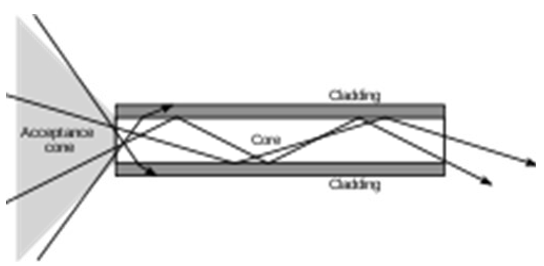
Figure 1: Light propagation through multi-mode fiber [6]
Fiber with a large core diameter of about 10 micrometers may be analyzed by geometrical optics. This fiber is called multi-mode fi- ber. In a step-index multi-mode fiber, rays of light are guided along with the core-cladding interface by total internal reflection. Light rays that meet the core-
cladding boundary at an angle, greater than the critical angle for this boundary, are completely reflected. The critical angle is deter- mined by the difference of refractive index between the core and cladding. When rays that meet the boundary at a low angle are refracted from the core into the cladding. The critical angle deter- mines the acceptance angle of the fiber that reported as a numer- ical aperture (NA). Numerical aperture allows light to propagate down the fiber, allowing efficient coupling of light into the fiber. The higher value of numerical aperture increases the amount of dispersion of light at different angles. In graded-index fiber, the refractive index of the core decreases continuously between the axis and the cladding.
Single-mode fiber
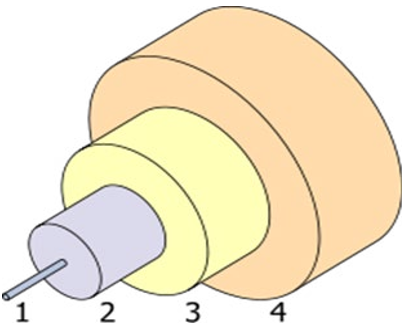
Figure 2: Schematic diagram of the typical single-mode fiber [6]
1. Core: 8 µm
2. Cladding: 125 µm
3. Buffer: 250 µm
4. Jacket: 400 µm
As an optical waveguide, the fiber cable supports one or more con- fined transverse modes by which light can propagate along with the core-cladding interface in the fiber. Fiber propagation takes only one mode is called single-mode or mono-mode fiber. The larger-core multi-mode fiber can be modeled using the wave equa- tion, which shows that such fiber supports many modes of prop- agation. The results of such modeling of multi-mode fiber agree with the predictions of geometric optics. Instead of single-mode fi- bers, a significant fraction of the energy in the bound mode travels in the cladding. The most common type of single-mode fiber has a core diameter of about 10 micrometers and is designed for use in the near-infrared region. The paths depend on the wavelength of the light used so that this fiber actually supports a small number of additional modes at different visible wavelengths [6].
Important applications
Communication
Fiber optic is used as a medium for telecommunication and com- puter technology because it is flexible and can be bundled as ca- bles. It is especially advantageous for the process of long-distance communications because infrared light propagates through the fiber with much lower attenuation compared to electrical cables. Fiber transmission leads to electrical interference where there is no cross-talk between signals in different cables and no pickup of environmental noise. They can also be used in controlling environ- mental pollution where explosive fumes are present, without dan- ger of ignition. Wiretapping is so difficult compared to electrical connections, which are concentric dual-core fibers. Fibers are also used for short-distance connections between devices. Information traveling inside the optical fiber is even immune to electromagnet- ic pulses generated by nuclear devices [7].
Sensors
Fibers have many applications in remote sensing. In many cases, the sensor is itself an optical fiber. Fiber optic is used to connect a non-fiber optic sensor to a measurement mechanism. It can be used because of its small size, or the fact that no electrical power is needed to the remote location, and many sensors can be elon- gated along the length of fiber by using different wavelengths of light, or by sensing the time delay as light passes along the fiber cable through each sensor. The delay of time can be determined using a device such as an optical time-domain reflect meter [8]. To measure modulated intensity, phase, polarization, wavelength, or transit time of light in the fiber. Sensors that vary the intensity of light are the simplest having a simple source and detector are required. In contrast, highly localized measurements can be pro- vided by integrating sensing elements with the tip of the fiber [8]. These can be used by various micro- and nanofabrication technol- ogies, which do not exceed the microscopic boundary of the fiber tip. A significant benefit of extrinsic sensors is their ability to reach inaccessible places. Optical sensors are used to measure the inter- nal temperature of electrical transformers, where the extreme elec- tromagnetic fields present make other measurement techniques impossible. The light is transmitted through fiber optic sensor used on a fence, pipeline, or communication cabling, and the returned signal is controlled and analyzed for disturbances [10].
Power transmission
Optical fiber used to transmit power using a photovoltaic cell to convert light energy into electrical energy. While this method of power transmission is not as efficient as conventional methods, it is very useful in situations where it is desirable not to have a metallic conductor as in the case of use nearby MRI machines, having strong magnetic fields. The glass medium enhances opti- cal interactions, and the long interaction possible by the number of processes, which is difficult for applications and fundamental investigation. Conversely, fiber nonlinearity can have deleterious effects on optical signals, and measures are essential to minimize such unwanted effects.
Conclusion
Fiber optics made of plastic or glass has been defined and classi- fied into two types. As an optical waveguide, the fiber cable sup- ports one or more confined transverse modes that is single mode and multi-mode by which light can propagate along with the core-cladding interface in the fiber. Optical fiber is a cylindrical dielectric waveguide that transmits light along its axis by total in- ternal reflection. This study has been reported structure of single mode and multimode fiber, its working principle, light propagation through core-cladding interface and its important application such as communication, have many applications in remote sensing and even in power transmission using photovoltaic cell to convert light energy into electrical energy. Fiber technology has lots of poten- tial applications in modern society and efficient tool to propagate waves, signals, data massage etc. through core cladding interface by many times total internal reflection. The ability to transmit data using pulses of light has opened the door for many world-changing innovations in medical applications, remote sensors, long distance transmission, and communications. The world of fiber optics has opened many possibilities for solving technological problems and has improved human civilization
Acknowledgement
The corresponding author would like to acknowledge Tri- Chandra College, Tribhuvan University, Institute of Science and Technol- ogy (IOST) and Central Department of Physics (T.U.), Kirtipur, Kathmandu, Nepal for their help and support.
References
- https://www.thefoa.org, Optical Fiber, The Fiber Optic As- sociation, Shenzhen Optico Communication Co Ltd. (April 2015).
- The Optical Industry & Systems Purchasing Directory, Opti- cal Publishing Company (1984).
- Hansberger, Photonic Devices and Systems, Rout ledge, ISBN 9781351424844(2017).
- R J Bates (2001) Optical Switching and Networking Hand- book, New York: McGraw-Hill, ISBN 978-0-07-137356-2.
- PS Archibald and HE Bennett (1978) Scattering from infrared missile domes, Opt Eng 17: 647 Bibcode:1978OptEn..17.647A, https://doi.org/10.1117/12.7972298.
- https://en.wikipedia.or g/wiki/Fiber-ptic_com - munication,opticdevices.sell.everychina.com/p- 109475243-multi-mode-black-sfp-optical-transceiver-opti- cal-fiber-media-converter-single- mode.html.
- Two Revolutionary Optical Technologies. Scientific Back- ground on the Nobel Prize in Physics 2009. Nobelprize.org. 6 October 2009.
- J. Hecht (1999) City of Light, the Story of Fiber Optics, New York: Oxford University Press pages 114, ISBN 978-0-19- 510818-7.
- Way back Machine 06/01/2006, Photovoltaic feat advances power over optical fiber, Electronic Products Archived (2011).
- P Melling and M Thomson (October 2002) Reaction monitor- ing in small reactors and tight spaces, American Laboratory News.