

Journal of Gynecology & Reproductive Medicine(JGRM)
ISSN: 2576-2842 | DOI: 10.33140/JGRM
Impact Factor: 1.247

Research Article - (2025) Volume 9, Issue 3
Factors Associated With The Use of Family Planning Among Men in The Urban District of Mandiana, Guinea
2Department of Obstetrics and Gynaecology, Donka National Hospital, University Hospital Center of Con, Guinea
3Training and Research Center in Infectiology (CERFIG), Gamal Abdel Nasser University, Conakry, Guinea
44Mother and Child Chair, Faculty of Health Sciences and Techniques, Gamal Abdel Nasser University, C, Guinea
5Mandiana Prefectural Hospital, Guinea
Received Date: May 27, 2025 / Accepted Date: Aug 15, 2025 / Published Date: Aug 26, 2025
Copyright: ©Â©2025 Dr. CONTE Ibrahima, et al. This is an open-access article distributed under the terms of the Creative Commons Attribution License, which permits unrestricted use, distribution, and reproduction in any medium, provided the original author and source are credited.
Citation: CONTE, I., BAH, O. H., KADIO, K. J. .J. O., SIDIBE, S. S., SOW, A., et al. (2025). Factors Associated With The Use of Family Planning Among Men in The Urban District of Mandiana, Guinea. J Gynecol Reprod Med, 8(3), 01-09.
Abstract
Introduction: family planning is defined as a means by which couples can decide when to conceive a pregnancy in order to promote the health and well-being of the family. The aim of this study was to analyse men's knowledge, attitudes and practices regarding family planning.
Methods: This was a cross-sectional study carried out from November 2022 to February 2023 in the urban commune of Mandiana and focused on men aged at least 15 years. We used cluster sampling. Individual interviews were conducted during visits to selected households using a standardised questionnaire by interviewers. The data collected was entered into Excel and analysed using R studio 4.4.1 software. A descriptive analysis was carried out for the qualitative variables in the form of percentages, and for the quantitative variables in the form of median with interquartiles. Chi-square and Fisher-exact tests were used for comparisons of proportions. The Wilcoxon test was used to compare medians.
Results: In all, we recorded 92 men using a family planning method out of a total of 339 men surveyed, giving a prevalence rate of 27%. Men aged 15-30 were the most numerous. Almost all the men interviewed were Muslim (86.7%). Farmers/breeders and manual workers were the most represented socio-professional categories (22% each). Married people (monogamous) were predominant in 65.82% of cases. More than 2/3 (71%) of them said they had heard of family planning, and the media was the main source of information (60%). Birth spacing (57%) was the main aim of family planning. Among the respondents, 55.8% of men were in favour of family planning, including 50.7% for family health and savings. In terms of current use of methods, 40.9% of men used contraception with their partner, 35.8% of whom had been involved in choosing the method. The men who said they were using family planning at the time of the survey were older than those who were not (Me (IQR): 40 years (29, 51) vs 30 years (23, 43); p= 0.002. Similarly, the proportions of polygamous married men (54%) and monogamous married men (39%) were significantly different from those of single men (p=0.023). Next, a significant association was observed between current use at the time of the survey and having a favourable opinion of the practice of family planning (p<0.001), participating in the choice of their wife's family planning method (p<0.001), discussing family planning with their wife (p<0.001) and accompanying their wife to the health centre for family planning-related visits (p<0.001). Men who reported discussing family planning with their wives (ORa = 26.3; CI95% = [8.39, 98.6]) were more likely to use family planning routinely.
Conclusion: This study shows a significant proportion of men using contraceptive methods in urban Mandiana. Family planning programmes must include men at all levels of health promotion and family planning education in order to increase couples' acceptance and use of contraceptive methods.
Introduction
Family planning is defined as a means by which couples can decide when to conceive a pregnancy in order to promote the health and well-being of the family [1]. The World Health Organisation (WHO) now considers family planning to be a public health priority [2]. Family planning is a key strategy for controlling population growth and promoting maternal and child health by adequately spacing births and avoiding unwanted pregnancies and abortions [3]. In developing countries, particularly in Africa, maternal health has been a major concern for many stakeholders, as access to quality maternal health services is generally low, with significant negative repercussions such as high maternal morbidity and mortality [4].
In 2022, the global contraceptive prevalence rate, taking all methods into account, was estimated at 65%, and the rate of use of modern methods at 58.7% for women who are married or in a couple [5]. West Africa has one of the highest fertility rates and the fastest population growth in the world [6]. Involving men in the sexual and reproductive health of their wives, including family planning, has proved effective in many contexts. It empowers women in terms of their sexual health, particularly their fertility, while promoting gender equality [7,8]. It also encourages communication on subjects that are often taboo and has a positive influence on the acceptance of contraceptive methods [9,10]. In addition, these programmes improve men's knowledge of reproductive health services and the risks associated with pregnancy, thereby helping to reduce maternal and infant deaths [11,12].
In Guinea, contraceptive prevalence is still low among women of childbearing age (15-49), despite the government's efforts to provide 130 family planning services in recent years. Contraceptive prevalence rose from 9.0% in 2012 to 11.0% in 2018 and 2019 respectively [13]. Among men, most studies have been undertaken among young boys and adolescents in schools [14]. However, very few studies have looked at the use of family planning among men residing in households in our context. The aim of this study was to analyse men's knowledge, attitudes and practices with regard to family planning.
Methods
Type of study: this was a cross-sectional study with descriptive and analytical aims lasting 3 months (24 November 2022 to 24 February 2023)
Study Setting: the Prefecture of Mandiana is one of the five prefectures of the administrative region of Kankan (Republic of Guinea); located to the east of Upper Guinea and 87 km from the administrative region's capital. It is bordered to the east by the Republic of Mali, to the west by the prefecture of Kankan, to the north-west by the prefecture of Siguiri and to the south-east by the Republic of Côte d'Ivoire.
The urban district of Mandiana is bordered to the east and north by the rural district of Faralako, to the west by the rural district of Balandou (Kankan prefecture), and to the south by the districts of Kantoumanina and Missamana (Kankan prefecture). It covers an area of 495 km², has a population of 29,466 and comprises six (6) districts: Kissidoukoura, Bellevue, Hermakonon, Mandiana I, Oudiala and Noumoussoulou.
Study Population: the study focused on men aged 15 and over, married or not, residing in the urban commune of Mandiana for at least 6 months and who agreed to participate in the study.
Sampling: We used cluster sampling. At the first stage, we made a random selection of sectors and neighbourhoods from the list obtained from the authorities of the Mandiana prefecture. At the second level, we selected households (the sampling unit), and at the final level, we selected respondents (the statistical unit).
Data collection: individual interviews were carried out during visits to selected households using a standardised questionnaire by interviewers. The data collected included socio-demographic characteristics (age, ethnicity, religion, education, occupation, marital status), information channels and contraceptive methods, attitudes (reasons for joining, discussion as a couple, men's reactions following the use of contraception by their partner without their knowledge) and practices (current use of family planning, participation in the choice of method, decision to use family planning, current methods used with the partner).
Statistical Analysis: the data collected was entered into Excel and analysed using Rstudio 4.4.1 software. A descriptive analysis was carried out for qualitative variables in the form of percentages, and for quantitative variables in the form of median with interquartiles. Chi-square and Fisher-exact tests were used for comparisons of proportions. The Wilcoxon test was used to compare medians. All variables with a p≤0.20 were included in a multivariate logistic regression model to search for factors associated with current FP use among men. Odds ratios with 95% confidence intervals were calculated and a p-value ≤ 0.05 was considered statistically significant.
Ethical Considerations: Before starting the study, we obtained the necessary authorisation from the competent health authorities. Ethical principles were strictly adhered to by obtaining verbal consent, guaranteeing anonymity and confidentiality of all individual data.
Results
Contraceptive Prevalence
Out of a total of 339 men surveyed, we recorded 92 men using a family planning method, giving a prevalence rate of 27%.
Socio-demographic characteristics of respondents in the urban district of Mandiana
Table1 describes the socio-demographic characteristics of the study participants. A total of 339 men aged 15 and over were included in the study, with the largest number aged 15-30. More than two- thirds of the participants (70%) were of Malinké ethnicity, and almost all of those interviewed were Muslim (86.7%). Men with schooling (65%) were the most numerous, 34% of whom had secondary education. Farmers and manual workers were the most represented socio-professional categories, with 22% each. Married people (monogamous) were predominant in 65.82% of cases.
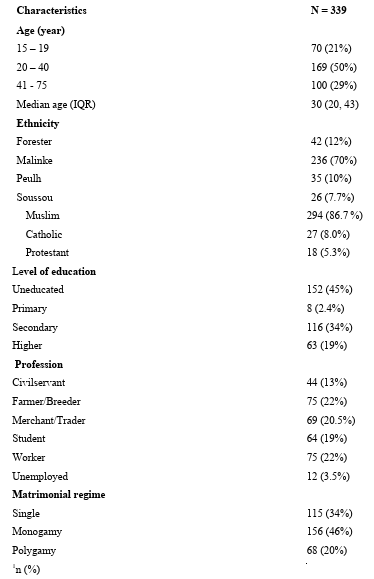
Table 1: Sociodemographic characteristics of men surveyed on family planning in the urban municipality of Mandiana, November 24, 2022 to February 24, 2023
Men's knowledge of family planning
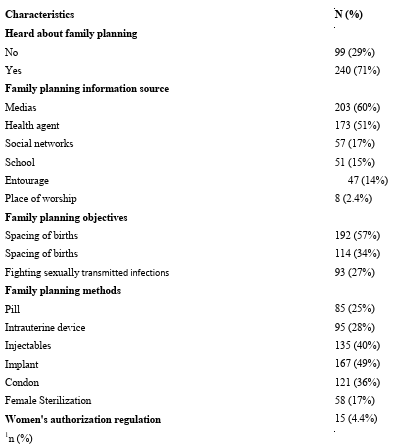
Out of a study population of 339 men, 71% said they had heard of family planning (Table 2). The main sources of information reported were the media (60%), health workers (51%) and social networks (17%). Most respondents mentioned birth spacing (57%) as the aim of family planning, followed by limiting births (34%). The family planning methods most familiar to men in the urban commune of Mandiana were implants (49%), injectables (40%) and condoms (36%).
Table 2: Knowledge of men about family planning in the urban municipality of Mandiana, November 24, 2022 to February 24, 2023
Men's attitudes to family planning
During the study, 55.8% of men were in favour of family planning, including 50.7% for the health and economy of the family and 14.2% for the well-being of the family. The main reasons for men's opposition to family planning cited in the study were lack of information (41.5%), it's not good for health (21.7%) and it's forbidden by religion (10.4%). Among the men who would like to contribute to increasing contraceptive prevalence in Mandiana, 44.8% suggested raising awareness among the whole population about the benefits of family planning, 13.4% suggested raising awareness among men about the importance of family planning, and 12.7% suggested increasing awareness campaigns about the importance of family planning (Table3).
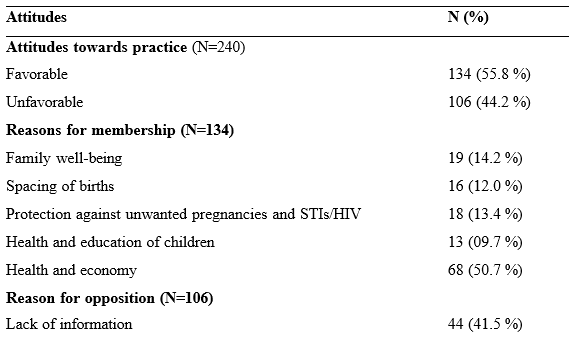
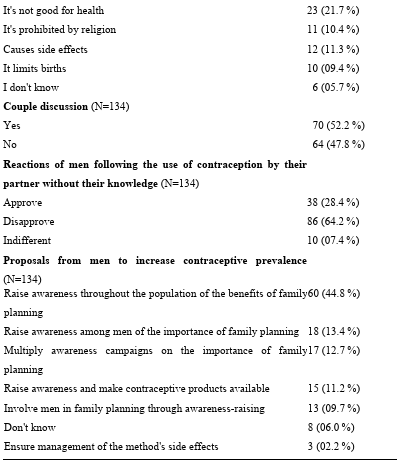
Table 3: Attitudes of men on family planning in the urban municipality of Mandiana, November 24, 2022 to February 24, 2023
Men's family planning practices
According to current method use, 40.9% of men used contraception with their partner. Of these, 35.8% had been involved in choosing the method, and 64.9% of family planning decisions were made by both partners, compared with 27.2% by the man. The methods used were mainly implants (40.9%), condoms (38.7%) and intrauterine devices (32.6%). The main places of supply were the health centre and the prefectural hospital (41.8% and 39.6% respectively) (Table 4).
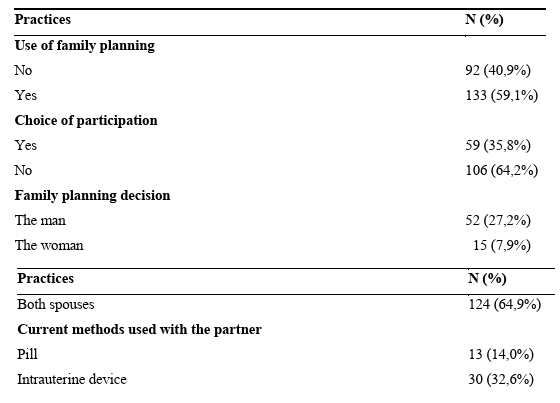
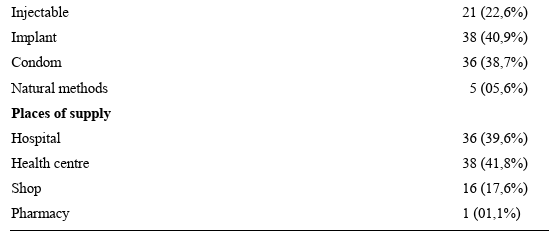
Table 4: Practices of men regarding family planning in the urban commune of Mandiana, November 24, 2022 to February 24, 2023
Factors associated with current use of family planning
The results in Table 5 show that the men who said they were using family planning at the time of the survey were older than those who were not (Me (IQR): 40 years (29, 51) vs 30 years (23, 43); p= 0.002). Similarly, the proportions of polygamous married men (54%) and monogamous married men (39%) were significantly different from those of single men (p=0.023). A significant association was observed between current use at the time of the survey and having a favourable opinion of the practice of family planning (p<0.001), participating in the choice of their wife's family planning method (p<0.001), discussing family planning with their wife (p<0.001) and accompanying their wife to the health centre for family planning visits (p<0.001).
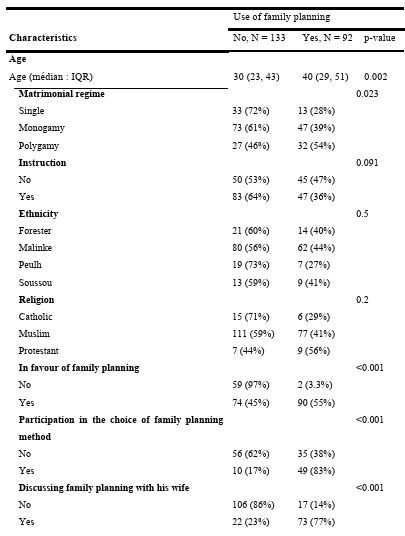

Table 5: Current practice of family planning according to the characteristics of men in the urban commune of Mandiana, November 24, 2022 to February 24, 2023
Married men who were monogamous (ORa = 0.05; CI95% = [0.01, 0.22]), polygamous (ORa = 0.10; CI95% = [0.01, 0.69]) and educated (ORa = 0.40; CI95% = [0.16, 0.94]) were less likely to use family planning routinely. However, men who reported discussing family planning with their wives (ORa = 26.3; CI95% = [8.39, 98.6]) were 26 times more likely to use family planning routinely (Table6).
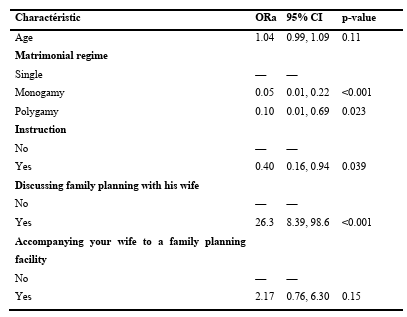
Table 6: Factors associated with the use of family planning among men in the urban commune of Mandiana, November 24, 2022 to February 24, 2023
Discussion
The aim of this study of family planning among men in the urban commune of Mandiana was to analyse men's knowledge, attitudes and practices with regard to family planning. We found significant contraceptive prevalence among the men surveyed. More than two-thirds of the men surveyed said they had heard of family planning. The main sources of information reported were the media, health workers and social networks. The family planning methods that men were most familiar with were implants, injectables and condoms. According to current method use, two out of five men used contraception with their partner. More than a third of the men were involved in choosing the method. The methods used were mainly implants, condoms and intrauterine devices. Monogamous, polygamous and well-educated married men were more likely to use family planning routinely. Similarly, men who reported having discussions about family planning with their wives were more likely to use family planning routinely.
The DHS Guinea -2018 reported a prevalence of 12% [15]. More than two-thirds of the men surveyed in our study said they had heard of family planning. The main sources of information reported were the media, health workers and social networks. In a study conducted in the Congo, the authors reported that out of 114 couples surveyed, 91.2% had said they had heard of family planning, with the media being the main source of information [16]. The results of the DHS 2018 in Guinea were that 90% of men said they had heard of family planning [15]. This result could be explained by insufficient awareness-raising campaigns targeting only women, without involving their spouses, in the belief that family planning only concerns women.
The results of one study showed that male partners were aware (95.5%) and approved (72.8%) of family planning services [17]. Other authors reported that 64.80% of respondents had favourable attitudes towards family planning [16].
With regard to family planning methods, the men in our series were most familiar with implants, injectables and condoms. This result is similar to those of several authors in the sub-region [18-20]. According to the current use of methods, two out of five men used contraception with their partner, and more than a third were involved in choosing the method. The methods used were mainly implants, condoms and intrauterine devices.
According to Senanu AKK et al in Ghana in 2024, around 48% of men were using family planning services [17]. Studies by Manortey S and Kasa AS et al. showed that knowledge of family planning services was positively related to use [21,22]. Contraceptive knowledge and use are influenced by the socio- cultural environment, including personal attitudes and feelings about contraception. There is evidence that some men oppose the use of contraception for reasons of tradition and religion, which require men to maintain the honour and position of their extended family, village, religious group and social organisation [23]. Men's attitudes and social practices towards family planning methods also influence the behaviour of their partners who use contraceptives [24].
Our study noted that monogamous, polygamous and educated married men are more likely to use family planning. Men's involvement in family planning can be either as users of male contraceptive methods or by encouraging and supporting their partners or wives in contraception [25].
In our series, men who reported having discussions about family planning with their wives were more likely to be current users of family planning.
The results of one study showed that women whose spouses supported the use of family planning were more likely to use a contraceptive method if their spouse supported the use of family planning and if their partner had a certain level of education [17]. Finally, men who thought contraception was women's business and those who did not discuss family planning with a health worker were also less likely to use modern contraceptives [26]. Having living children and being well informed about family planning were positive associations between men's participation in the use of family planning services [17].
Involving men is essential to reduce misconceptions about the side effects of contraceptive methods [24]. Several interventions can be used to remove barriers to the use of family planning services in this context. Family planning programmes should target men at all levels of health promotion and education with their partners to reduce misconceptions about family planning methods and increase acceptance [24]. family planning programmes should therefore target men at all levels of the service. Their involvement will also empower women, increase effective contraceptive use and continue to improve reproductive health outcomes [27]. Users' experiences indicate that text messages are an innovative way to raise awareness, promote behaviour change and address myths and socio-cultural norms [28].
This study may have some limitations, particularly its cross- sectional nature. In addition, the study took place in an urban environment and did not take account of the rural environment. It cannot be generalised to the whole of the Mandiana prefecture.
Nevertheless, this study highlights some strong points, as it is one of the first to look at the subject of contraception among men in this prefecture, which is a long way from the capital Conakry. Also, the cluster sampling technique used in this study could make it possible to extrapolate the results to all households in the urban commune of the Mandiana prefecture. This study also highlights the need for men to be involved in the choice of contraceptive methods for women in couples in our communities.
Conclusion
This study shows a significant proportion of men using contraceptive methods in urban Mandiana. The factors associated with the use of contraceptive methods among men were age, level of education, being in favour of family planning, participating in the choice of method and accompanying their wives to the family planning centre. Family planning programmes must include men at all levels of health promotion and family planning education in order to increase couples' acceptance and use of contraceptive methods.
Conflicts of Interest
The authors declare that they have no conflicts of interest in relation to this article.
References
- Valekar, S. S., Pandve, H. T., Chawla, P. S., & Mane, A. B. (2017). Assessment of unmet needs of family planning and reasons for non-use of contraceptive methods among women in reproductive age in rural community. J Community Med Health Educ, 7(04), 1-5.
- Gebre, G., Birhan, N., & Gebreslasie, K. (2016). Prevalence and factors associated with unmet need for family planning among the currently married reproductive age women in Shire-Enda-Slassie, Northern West of Tigray, Ethiopia 2015: a community based cross-sectional study. Pan African Medical Journal, 23(1).
- Fagbamigbe, A. F., Afolabi, R. F., & Idemudia, E. S. (2018). Demand and unmet needs of contraception among sexually active in-union women in Nigeria: distribution, associated characteristics, barriers, and program implications. Sage Open, 8(1), 2158244017754023.
- United Nations Population Division 2023.
- DU DEVELOPPEMENT, E. T. Les Déterminants de la Planification Familiale et du Dividende Démographique en Guinée.
- Plantin, L., Olykoya, A., & Ny, P. (2011). Positive health outcomes of fathers’ involvment in pregnancy and childbirth paternal support: a scope study literature review. Fathering: A Journal of Theory, Research, and Practice about Men as Fathers, 9(1), 87-102.
- Roth, D. M., & Mbizvo, M. T. (2001). Promoting safe motherhood in the community: the case for strategies that include men. African journal of reproductive health, 5(2), 10-21.
- Sternberg, P., & Hubley, J. (2004). Evaluating men's involvement as a strategy in sexual and reproductive health promotion. Health promotion international, 19(3), 389-396.
- Carter, M. W. (2002). 'Because he loves me': Husbands' involvement in maternal health in Guatemala. Culture, Health & Sexuality, 4(3), 259-279.
- Nkwonta, C. A., & Messias, D. K. (2019). Male participation in reproductive health interventions in Sub-Saharan Africa: a scoping review. International Perspectives on Sexual and Reproductive Health, 45, 71-85.
- Mbizvo, M. T., & Bassett, M. T. (1996). Reproductive health and AIDS prevention in sub-Saharan Africa: the case for increased male participation. Health policy and planning, 11(1), 84-92.
- Bangoura, C., Dioubaté, N., Manet, H., Camara, B. S., Kouyaté, M., Douno, M., ... & Delamou, A. (2021). Experiences, preferences, and needs of adolescents and urban youth in contraceptive use in Conakry, 2019, Guinea. Frontiers in global women's health, 2, 655920.
- Dramé, L., Kolié, D., Sidibé, S., Yombouno, J. F., & Delamou,A. (2023). Facteurs associés à l’utilisation des méthodes contraceptives chez les jeunes filles élèves en milieu rural guinéen. Santé Publique, 35(6), 129-140.
- Institut National de la Statistique (INS) et ICF. Enquête Démographique et de Santé Guinée 2018. Conakry, Guinée, et Rockville, Maryland, USA: INS et ICF 2018.
- Kandolo, BB, Kamundu, AK, Mutabazi, AN, & Wembonyama, SO (2023). Knowledge, attitudes and practices of couples regarding family planning in Muhungu, Ibanda health zone. Journal of Medicine, Public Health and Policy Research , 3 (1).
- Kwawukume, S. A. K., Laar, A. S., & Abdulai, T. (2022). Assessment of men involvement in family planning services use and associated factors in rural Ghana. Archives of Public Health, 80(1), 63.
- Diallo, B. (2021). Connaissances et attitudes des parents face a la contraception des adolescentes a Yirimadio, Bamako. Mali Santé Publique, 11-16.
- Fourn 1, N., Aguemon 1, B., Kabibou 2, S., Hounkponou 2,F., Lafia 1, I., & Fourn 1, L. (2014). Connaissances, attitudeset pratiques de la contraception d’urgence chez les étudiantes à l’Université de Parakou (Bénin). Santé publique, (4), 541- 546.
- Tregear, S. J., Gavin, L. E., & Williams, J. R. (2015). Systematic review evidence methodology: providing quality family planning services. American journal of preventive medicine, 49(2), S23-S30.
- Manortey, S., & Missah, K. (2020). Determinants of male involvement in family planning services: a case study in the Tema Metropolis, Ghana. Open Access Library Journal, 7(1), 1-21.
- Semachew Kasa, A., Tarekegn, M., & Embiale, N. (2018). Knowledge, attitude and practice towards family planning among reproductive age women in a resource limited settings of Northwest Ethiopia. BMC research notes, 11, 1-6.
- Tuloro, T., Deressa, W., Ali, A., & Davey, G. (2006). The role of men in contraceptive use and fertility preference in Hossana Town, southern Ethiopia. Ethiopian Journal of Health Development, 20(3).
- Bayray, A. (2012). Assessment of male involvement in family planning use among men in south eastern zone of Tigray, Ethiopia. Scholarly Journal of Medicine, 2(2), 1-10.
- Demissie, T. W., Tegegne, E. M., & Nigatu, A. M. (2021). Involvement in family planning service utilization and associated factors among married men at Debre Tabor town, Northwest Ethiopia, 2017. Pan African Medical Journal, 38(1).
- Ali, A., Zar, A., & Wadood, A. (2022). Factors associated with modern contraceptive use among men in Pakistan: Evidence from Pakistan demographic and health survey 2017-18. Plos one, 17(9), e0273907.
- Kassa, M., Abajobir, A. A., & Gedefaw, M. (2014). Level of male involvement and associated factors in family planning services utilization among married men in Debremarkos town, Northwest Ethiopia. BMC international health and human rights, 14, 1-8.
- Riley, P., & BonTempo, J. (2011). Mobiles for quality improvement pilot in Uganda. Bethesda (MD): Abt Associates, Strengthening Health Outcomes through the Private Sector Project.