

Journal of Economic Research & Reviews(JERR)
ISSN: 2771-7763 | DOI: 10.33140/JERR

Impact Factor: 1.3


Research Article - (2026) Volume 6, Issue 1
Exchange Rate Pass-Through and Inflation Dynamics in Nigeria: New Evidence from The Post-Fx Market Reforms Era
2Department of Research and Statistics, West African Monetary Institute,Ghana, Nigeria
Received Date: Feb 06, 2026 / Accepted Date: Mar 10, 2026 / Published Date: Mar 20, 2026
Copyright: ©2026 Apinran Martins Olugbenga, et al. This is an open-access article distributed under the terms of the Creative Commons Attribution License, which permits unrestricted use, distribution, and reproduction in any medium, provided the original author and source are credited.
Citation: Coker, O. A., Olugbenga, A. M. (2026). Exchange Rate Pass-Through and Inflation Dynamics in Nigeria: New Evidence from The Post-Fx Market Reforms Era. J Eco Res & Rev, 6(1), 01-12.
Abstract
This study examines the exchange rate pass-through (ERPT) to inflation in Nigeria using monthly data from 2010–2024, a period encompassing significant foreign exchange market reforms. Employing a Vector Autoregression (VAR) model with five macroeconomic variables-Consumer Price Index (CPI), Exchange Rate (EXR), Monetary Policy Rate (MPR), GDP Growth Rate (GDPGR), and Oil Price—the analysis reveals important insights into Nigeria's inflation dynamics. The empirical results show a 12-month cumulative ERPT coefficient of 21.8%, indicating that a 1% naira depreciation generates approximately a 0.22 percentage point increase in consumer prices, representing incomplete pass-through consistent with pricing-to-market behavior and local currency invoicing practices. Impulse response functions demonstrate that exchange rate shocks peak within 3-4 months and persist for approximately 12 months. Forecast Error Variance Decomposition (FEVD) analysis shows that own shocks explain 60% of inflation variation initially, declining to 45% after 24 months, while exchange rate shocks account for 15–20% of medium-term inflation dynamics. Monetary policy shocks contribute roughly 10% to inflation variance, suggesting moderate policy effectiveness. Granger causality tests confirm unidirectional causality from exchange rate to inflation (p = 0.013). The model passes all diagnostic tests, exhibiting stability, no serial correlation, and homoscedastic residuals. These findings have critical implications for monetary policy formulation and inflation targeting in Nigeria's evolving macroeconomic environment. Policy recommendations include maintaining exchange rate stability, enhancing domestic production capacity, strengthening monetary policy credibility, and implementing structural reforms to reduce import dependency.
Keywords
Exchange Rate Pass-Through, Inflation Dynamics, VAR Model, Monetary Policy, Nigeria
Introduction
Exchange rate pass-through (ERPT), the degree to which changes in the nominal exchange rate are transmitted into domestic prices, is a central channel linking external shocks to domestic inflation. For small open economies such as Nigeria, where imports constitute a significant share of consumption and production inputs, understanding the magnitude and speed of ERPT is critical for effective monetary and exchange rate policy. Persistent inflation, recurrent exchange rate pressures, and high exposure to oil price volatility have rendered Nigeria particularly vulnerable to externally driven price shocks. Despite multiple foreign exchange (FX) market reforms over the last decade, inflation has remained well above the Central Bank of Nigeria’s (CBN) 6–9 percent target band, raising questions about how exchange rate movements interact with structural rigidities and policy responses to shape inflation dynamics.
Since 2010, Nigeria’s macroeconomic environment has been characterized by sharp swings in global oil prices, episodes of foreign exchange scarcity, and major regime shifts in FX management. The 2014–2016 collapse in crude oil prices triggered a balance-of-payments crisis, a recession in 2016, and significant naira depreciation. Subsequent policy actions included the introduction of the Investors’ and Exporters’ (I&E) FX window in 2017, a series of devaluations and adjustments to official FX windows, and, more recently, efforts toward FX market unification from 2023. Over the same period, inflation has displayed strong persistence, with several spikes associated with exchange rate adjustments, supply bottlenecks, insecurity, and post-pandemic disruptions. The monetary policy rate (MPR), largely stable in the first half of the sample, has been aggressively tightened since 2022 to contain surging prices, reaching historically high levels by 2024. These developments have renewed interest in the size, timing, and stability of ERPT in Nigeria. Traditional theory suggests that, in a highly open and import-dependent economy, exchange rate depreciation should rapidly and substantially pass through to domestic prices. However, more recent empirical work for emerging and developing economies indicates that pass-through is often incomplete and state-dependent, shaped by monetary policy credibility, pricing-to-market behavior, local currency pricing, and the structure of imports. Post-2015 studies for Nigeria increasingly point to moderate and asymmetric ERPT, with depreciation episodes exerting stronger inflationary effects than appreciations and with important interactions between exchange rates, oil prices, and domestic demand conditions.
In addition, Nigeria’s inflation dynamics have become more complex in the wake of global shocks, including the COVID-19 pandemic and heightened geopolitical tensions, which have affected global commodity prices, capital flows, and risk sentiment. These shocks have interacted with domestic structural constraints—such as inadequate infrastructure, insecurity affecting food supply, and limited diversification—to produce persistent inflationary pressures that extend beyond conventional demand-pull narratives. Understanding how exchange rate shocks compare with other drivers, such as oil price movements, output fluctuations, and monetary policy changes, has therefore become a central empirical and policy question.
Against this backdrop, this study re-examines ERPT to inflation in Nigeria using monthly data from 2010–2024, a period that captures key FX regime transitions and major global shocks. It employs a Structural Vector Autoregression (SVAR) framework incorporating five core macroeconomic variables: consumer prices, nominal exchange rate, monetary policy rate, real GDP growth, and oil prices. This approach allows for the identification of structural shocks and the tracing of their dynamic effects through impulse response functions and forecast error variance decomposition. The study’s results indicate a 12-month cumulative ERPT of about 21.8 percent, implying incomplete but economically meaningful pass-through, with exchange rate shocks explaining a sizeable share of medium-term inflation variance.
This work contributes to the growing post-2015 literature in several ways. First, it focuses explicitly on the post-reform FX environment, including the I&E window and recent FX market unification, providing updated evidence relative to earlier pre-2015 studies. Second, by embedding exchange rate movements within a broader macroeconomic system that includes oil prices, output, and monetary policy, it sheds light on the relative importance of different shocks in driving inflation. Third, it complements recent Nigerian studies that rely on nonlinear ARDL, GARCH, and local projection methods by offering SVAR-based impulse response and variance decomposition evidence over an extended and more recent sample. The empirical findings have direct implications for exchange rate management, inflation-targeting strategy, and broader macroeconomic policy design in Nigeria.
The remainder of the paper is structured as follows. Section 2 provides a comprehensive review of the theoretical and empirical literature on ERPT and inflation dynamics, with particular emphasis on studies from 2015 onwards and those focusing on Nigeria and sub-Saharan Africa. Section 3 presents stylized facts and data description. Section 4 outlines the methodology and model specification. Section 5 discusses empirical results, while Section 6 concludes with policy recommendations.
Literature Review
Conceptual and Theoretical Issues
Exchange rate pass-through is typically defined as the percentage change in domestic prices resulting from a one percent change in the exchange rate. Traditional models based on the law of one price and purchasing power parity predict high pass-through for small open economies heavily reliant on imports. In such settings, nominal depreciation increases the domestic currency cost of imported goods, which then transmits to consumer prices through imported final goods and imported intermediate inputs.
However, the post-2000 literature, especially after the 2010s, emphasizes that ERPT is often incomplete and time-varying. The “new open economy macroeconomics” framework highlights the importance of pricing-to-market, local currency pricing, distribution margins, and market structure in moderating ERPT. Firms that set prices in local currency or adjust markups in response to exchange rate changes may absorb part of the shock, lowering measured pass-through. Moreover, credible inflation targeting and anchored expectations can further reduce ERPT by limiting second-round effects.
For commodity-dependent economies such as Nigeria, ERPT is also intertwined with oil price shocks. Oil prices affect FX availability, fiscal revenues, and external balances. Exchange rate policy, in turn, determines the extent to which oil-related FX inflows translate into domestic liquidity and price dynamics. Post-2015 theoretical and empirical work increasingly models these linkages jointly, recognizing that oil prices, exchange rates, and inflation are part of a broader macro-financial system rather than isolated components.
Global and Emerging-Market Evidence (Post-2015)
Recent global studies provide nuanced evidence on ERPT in emerging and developing economies. Caselli and Roitman (2019), using panel methods for emerging markets, document nonlinear and shock-dependent pass-through, showing that large depreciations and periods of macroeconomic stress are associated with higher ERPT [1]. Brun-Aguerre, Fuertes, and Phylaktis (2024) revisit ERPT into import prices and emphasize the roles of inflation regimes, monetary policy credibility, and firm-level pricing behavior in driving cross-country differences in pass-through [2].
Comunale and Simola (2022) examine ERPT to consumer prices in commodity-dependent and transition economies, finding that exchange rates, commodity prices, and global factors jointly drive inflation [3]. In their framework, incomplete pass-through reflects both structural features (such as import structure and market concentration) and policy-related factors (such as exchange rate flexibility and inflation targeting). Forbes, Hjortsoe, and Nenova (2023) further stress that ERPT is “shock-dependent”: the same magnitude of exchange rate movement can yield very different inflation responses depending on whether the underlying shock is monetary, demand, or supply-driven [4].
These post-2015 contributions converge on several key themes: (i) ERPT is typically incomplete but can rise during periods of macroeconomic stress; (ii) monetary policy credibility and inflation expectations materially influence pass-through; and (iii) external shocks (e.g., commodity price changes and global financial conditions) interact with domestic structures to determine inflation outcomes.
Evidence from Sub-Saharan Africa
Within Sub-Saharan Africa, a growing body of work examines ERPT in the context of shallow financial markets, strong commodity dependence, and evolving monetary frameworks. Kemoe et al. (2024), in an IMF Working Paper, analyze ERPT in Sub-Saharan African economies using SVAR and panel techniques, documenting that pass-through is positive but generally moderate, with significant cross-country heterogeneity [5]. They highlight that exchange rate shocks account for a non-trivial share of inflation variation, but that the magnitude of ERPT declines in countries with stronger monetary policy frameworks and more credible inflation targeting.
Other regional studies emphasize the interaction of exchange rates and commodity prices. Bems and de Carvalho Filho (2022), using a competitive pricing-to-market model, show that exchange rate movements and commodity shocks jointly shape price dynamics, while structural features determine whether ERPT is dampened or amplified [6]. For many African oil exporters, including Nigeria, oil prices influence not only the exchange rate but also fiscal and real sector conditions, making the ERPT–inflation nexus inherently multi-dimensional.
Overall, post-2015 regional evidence suggests that while ERPT in Sub-Saharan Africa is far from zero, it is often incomplete and conditional on policy and structural contexts. These findings motivate country-specific studies that incorporate domestic peculiarities, such as FX market segmentation and heavy import dependence, as in the Nigerian case.
Empirical Evidence on Exchange Rate Pass-Through in Nigeria (Post-2015)
The Nigerian literature on ERPT has expanded significantly since 2015, with a noticeable shift toward more sophisticated econometric techniques and a greater focus on asymmetries, nonlinearities, and structural breaks. Much of this work finds incomplete but economically meaningful pass-through from exchange rate to inflation.
Several recent contributions employ time-series models tailored to Nigerian data. Ozigbu (2021) uses a GARCH framework to investigate exchange rate volatility and inflation, reporting that higher exchange rate volatility is associated with increased inflation, though pass-through remains incomplete [7]. Jakpa, Ezi, and Egbon (2024) examine ERPT using modern time-series methods and find that exchange rate shocks significantly influence inflation but with moderate magnitude, underscoring the role of structural rigidities and policy responses [8].
A distinct strand of the literature uses nonlinear and asymmetric models. Adedokun, Ogbaekirigwe, and Tiamiyu (2022) analyze symmetric and asymmetric ERPT under different monetary environments and report that depreciation shocks have larger and more persistent effects on inflation than appreciations, consistent with the “asymmetric pass-through” hypothesis [9]. Sa’ad et al. (2023), employing a nonlinear ARDL model, show that positive exchange rate and oil price shocks have stronger inflationary effects than corresponding negative shocks, emphasizing the importance of asymmetry in Nigerian inflation dynamics [10]. Aminu and Afolabi (2024) also highlight asymmetric ERPT to domestic prices, suggesting that policy must account for nonlinearities in the transmission mechanism.
More recent studies extend the analysis to cover new data and alternative identification strategies. Osunkwo et al. (2025) apply local projection impulse response functions (LPIRF) and find that ERPT from the exchange rate to inflation is positive but relatively low over a two-year horizon, suggesting limited direct pass-through [11]. Ikue et al. (2025) examine asymmetric ERPT using business-cycle-aware techniques and confirm that exchange rate volatility is a key driver of inflation, especially during episodes of macroeconomic stress [12]. Ndume and Akanegbu (2025), in a structural VAR framework, emphasize exchange rate volatility and identify it as an important determinant of inflation dynamics in Nigeria, though again with incomplete pass-through [13].
In addition, several studies investigate the broader inflation process, within which exchange rate effects are embedded. Adekunle et al. (2020) estimate an SVAR for emerging economies, including Nigeria, and find that inflation is driven by both domestic and external shocks, with evidence of inflation persistence [14]. Ihugba and Adefabi (2025) examine nonlinear responses of inflation to oil price changes in Nigeria, showing that oil price increases exert stronger inflationary pressure than decreases [15]. Howard (2025) focuses specifically on exchange rate fluctuations and inflation, concluding that exchange rate movements have predictive power for consumer price dynamics, though the magnitude of pass- through is moderated by structural and policy factors [16].
Taken together, post-2015 Nigerian studies suggest three broad conclusions: (i) ERPT exists and is economically significant but incomplete; (ii) pass-through is often asymmetric, with depreciations and positive shocks having stronger effects than appreciations or negative shocks; and (iii) exchange rate shocks interact with oil prices, domestic demand, and monetary policy to shape inflation outcomes.
Exchange Rate, Monetary Policy, and Inflation: Joint Dynamics
A related strand of the Nigerian literature focuses on the joint roles of monetary policy and exchange rate in driving inflation. Alymkulova and Ohaegbu (2023) analyze monetary policy shocks and output growth in Nigeria, showing that different types of shocks (e.g., policy rate vs. liquidity shocks) have heterogeneous impacts on growth, with implications for inflation and exchange rate behavior [17]. Dalhatu, Uwawunkonye, and Adaeze (2024) (as referenced in the empirical discussion) find that the MPR significantly affects inflation in the short run, though its long-run effect is more muted, pointing to constrained policy effectiveness. Yusuf, Afiemo, and Isah (2022) and Nadani and Isah (2025) use VAR/SVAR frameworks to document complex relationships among the policy rate, exchange rate, inflation, and output, including evidence of “price puzzles” and non-monotonic responses to policy shocks.
These studies generally indicate that while monetary policy can influence inflation, its transmission is imperfect and often overshadowed by exchange rate and external shocks. Obstfeld (2023), in a broader context, underscores the trilemma constraints facing commodity-dependent economies integrating into global financial markets, which resonates with Nigeria’s experience of limited monetary autonomy amid exchange rate and capital flow pressures [18].
Identified Gaps and Contribution of the Present Study
Despite the rich post-2015 literature, several gaps remain. First, many Nigerian studies rely on annual or quarterly data, which may mask the high-frequency dynamics of ERPT and the timing of policy reactions. Second, some earlier works do not fully incorporate the post-2016 FX regime changes, the introduction of the I&E window, or the post-2020 global shocks, thereby under-representing the evolving structure of FX markets and inflation drivers. Third, although nonlinear and asymmetric models are increasingly used, there is still a need for SVAR-based evidence that jointly models oil prices, output, monetary policy, exchange rates, and inflation over an extended sample covering recent reforms.
This study addresses these gaps by employing monthly data from 2010–2024, allowing for finer identification of the timing and persistence of ERPT. It explicitly spans major FX regime transitions, the 2016 recession, the COVID-19 shock, and the recent FX market unification efforts. Using a five-variable SVAR with carefully chosen identification restrictions, the study quantifies the dynamic effects of exchange rate, oil price, GDP growth, and monetary policy shocks on inflation and decomposes inflation variance into contributions from each shock. The estimated 12-month ERPT coefficient of about 21.8 percent, and the finding that exchange rate shocks account for roughly 15–20 percent of medium-term inflation variation, provide updated and policy-relevant benchmarks for Nigeria’s inflation-targeting and exchange rate management framework.
Stylized Facts and Data Analysis
Data Description
This study utilizes monthly data spanning 2010–2024. The sample period is particularly relevant as it captures major exchange rate regime shifts in Nigeria, including the 2016–2017 foreign exchange crisis, the introduction of the I&E window, and recent unification reforms. Five key macroeconomic variables are employed in the analysis, each playing a distinct role in the inflation dynamics framework:
|
Variable |
Description |
Justification |
Expected Sign |
Source |
|
CPI |
Consumer Price Index (All Items, 2009=100) |
Primary measure of inflation; captures changes in the cost of a basket of consumer goods and services |
Dependent |
National Bureau of Statistics (NBS) |
|
EXR |
Nominal Exchange Rate (NGN/USD) |
Key transmission channel for imported inflation; depreciation increases cost of imports |
Positive (+) |
Central Bank of Nigeria (CBN) |
|
MPR |
Monetary Policy Rate (percent per annum) |
Primary monetary policy instrument; used to control inflation through interest rate channel |
Negative (-) |
Central Bank of Nigeria (CBN) |
|
GDPGR |
Real GDP Growth Rate (year-on-year, percent) |
Represents demand-side pressures; higher growth can create demand-pull inflation |
Positive (+) |
National Bureau of Statistics (NBS) |
|
OIL Price |
Crude Oil Price (Bonny Light, USD per barrel) |
Critical for Nigeria as oil-dependent economy; affects fiscal revenue, exchange rate, and aggregate supply |
Ambiguous (±) |
U.S. Energy Information Administration (EIA) |
|
Note: All variables were subjected to stationarity tests before inclusion in the SVAR model. Log transformations were applied to level variables (CPI, EXR, OIL) to ensure homoscedasticity and facilitate elasticity interpretation. |
||||
Table 1: Variable Description, Justification, and Expected Signs
Time Series Evolution of Key Variables
The data spans monthly observations from 2010 to 2024, capturing critical economic events including the 2014-2016 oil price collapse, the 2016-2017 recession, the introduction of the Investors' and Exporters' (I&E) FX window in 2017, the COVID-19 pandemic shock in 2020, and the recent FX market unification reforms in 2023.
The panel 1 shows that oil prices were high from 2011–2014, supporting strong fiscal revenues. The 2014–2016 oil price collapse triggered a recession and FX pressures. Another historic crash occurred in 2020 due to COVID-19. Prices recovered in 2021–2022 but moderated afterward. Overall, oil price volatility remained a major source of macroeconomic instability. Growth was robust (6–8%) before 2014, as indicated in panel 2, but declined sharply during the 2016 recession, turning negative.
Recovery from 2017–2019 was modest, and the 2020 pandemic caused another contraction. Growth since 2021 has remained positive but insufficient to address unemployment and poverty challenges. Panel 3, which covers exchange rate movement, shows that the naira depreciated sharply from â?¦150/USD in 2010 to about â?¦1,600/USD in 2024, resulting in over 900% cumulative depreciation. Major turning points were the 2016 devaluation, the 2017 I&E window introduction, and the 2023 exchange rate unification, which led to a steep adjustment. As revealed in panel 4, inflation persistently exceeded the 6–9% target, with peaks in 2017 and an unprecedented surge to 34.6% in 2024. Key drivers included FX depreciation, supply constraints, insecurity, and post-pandemic shocks. The MPR increased sharply only during inflationary episodes. It remained stable for long periods but was aggressively tightened from 2022 to 2024, rising to 27.25%, the highest on record, to combat surging inflation.

Figure 1: Five-Panel Time Series Plot
Descriptive Statistics
Table 2 presents descriptive statistics for all five macroeconomic variables over the full sample period.
|
Variable |
Mean |
Std Dev |
Min |
25% |
Median |
75% |
Max |
|
Oil Price ($/bbl) |
79.38 |
23.68 |
24.56 |
62.46 |
80.58 |
98.62 |
125.45 |
|
GDP Growth (%) |
3.50 |
2.68 |
-1.92 |
2.10 |
2.74 |
6.17 |
9.54 |
|
Exch Rate (â?¦/$) |
522.89 |
511.20 |
149.60 |
163.00 |
306.90 |
463.00 |
1600.00 |
|
CPI Inflation (%) |
16.27 |
7.76 |
7.80 |
11.20 |
13.70 |
18.30 |
34.60 |
|
MPR (%) |
14.19 |
5.41 |
6.00 |
12.00 |
13.00 |
14.00 |
27.25 |
|
Source: Author’s Computation |
|||||||
Table 2: Descriptive Statistics of Macroeconomic Variables
The descriptive statistics show significant macroeconomic volatility. Oil prices fluctuated widely, exposing the economy to external shocks. GDP growth averaged 3.5% but ranged from recession to strong expansion, indicating unstable performance influenced by oil dependence and structural weaknesses. The exchange rate displayed extreme volatility, with sharp depreciation reflecting FX shortages and policy inconsistencies. Inflation remained persistently high, averaging 16%, driven by exchange rate pass-through, supply constraints, and structural factors. The monetary policy rate was generally tight, reflecting efforts by the Central Bank to contain inflation and stabilize the currency. Overall, the data indicate an economy vulnerable to external shocks, domestic imbalances, and macroeconomic instability.
Unit Root Tests
Prior to estimating the VAR model, we conduct Augmented Dickey-Fuller (ADF) tests to determine the order of integration of each variable. Variables must be stationary to avoid spurious regression results.
|
Variable |
ADF Statistic |
P-value |
Conclusion |
|
LOG_CPI |
0.082 |
0.965 |
Non-Stationary |
|
LOG_EXR |
-13.601 |
< 0.001*** |
Stationary |
|
MPR |
-12.654 |
< 0.001*** |
Stationary |
|
GDPGR |
-13.439 |
< 0.001*** |
Stationary |
|
LOG_OIL |
-9.629 |
< 0.001*** |
Stationary |
|
Note: *** denotes significance at 1% level. All variables except LOG_CPI are stationary at levels. First differences are used for all variables in the VAR estimation to ensure stationarity. Source: Authors Computation |
|||
Table 3: Augmented Dickey-Fuller Unit Root Test Results
The ADF test results indicate that log CPI is non-stationary at levels, while log exchange rate, MPR, GDP growth, and log oil prices are stationary. Consequently, we estimate the VAR model using first differences of all variables to ensure proper statistical inference and avoid spurious relationships
Methodology
Model Specification
This study employs Structural Vector Autoregression (SVAR) methodology to analyze the dynamic relationships among exchange rate, inflation, and other macroeconomic variables. The SVAR framework allows us to identify structural shocks and trace their propagation through the economy via impulse response functions and variance decomposition.
The reduced-form VAR model is specified as follows:

where Yt is a (5×1) vector of endogenous variables [Δlog(CPI), Δlog(EXR), ΔMPR, ΔGDPGR, Δlog(OIL)], c is a vector of constants, Ai are coefficient matrices, p is the lag length, and ut is a vector of reduced-form residuals.
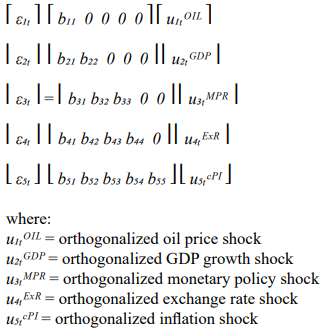
The structural form is obtained by imposing identifying restrictions:

where B is a structural parameter matrix and εt represents orthogonal structural shocks. The identification strategy follows a recursive Cholesky decomposition with the ordering: oil prices, GDP growth, monetary policy rate, exchange rate, and inflation.
This ordering assumes that oil prices are the most exogenous, followed by output; monetary policy responds to external and output shocks; the exchange rate adjusts to all previous shocks; and inflation responds to all shocks contemporaneously.
The ordering of variables follows a Cholesky decomposition that assumes contemporaneous causality flows from external shocks (oil prices, exchange rate) through real economic activity and monetary policy, ultimately affecting domestic prices. This identification strategy is consistent with the theoretical premise that exchange rate shocks are largely exogenous to domestic inflation in the short run, particularly for a small open economy like Nigeria.
Model with Specified Variables
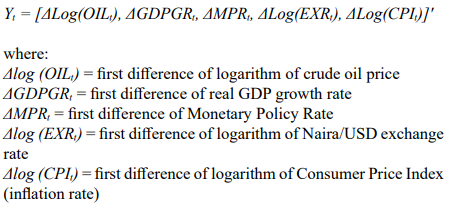
For this study, the vector of endogenous variables is defined as:
Structural Shock Representation
The structural form with variable-specific notation is:
This specification follows the methodology employed by Kemoe et al. (2024) in their IMF Working Paper analyzing exchange rate pass-through to inflation in sub-Saharan Africa, where they similarly used an SVAR framework with macroeconomic fundamentals including exchange rate, monetary policy stance, external shocks, and domestic demand conditions. The choice of variables aligns with the theoretical framework of exchange rate pass-through that considers both supply-side factors (oil prices, exchange rate) and demand-side factors (GDP growth, monetary policy) as determinants of inflation dynamics (Comunale & Simola, 2022).
Unit Root Tests
Prior to estimating the VAR model, we conduct Augmented Dickey-Fuller (ADF) tests to determine the order of integration of each variable. Variables must be stationary to avoid spurious regression results.
|
Variable |
ADF Statistic |
P-value |
Conclusion |
|
LOG_CPI |
0.082 |
0.965 |
Non-Stationary |
|
LOG_EXR |
-13.601 |
< 0.001*** |
Stationary |
|
MPR |
-12.654 |
< 0.001*** |
Stationary |
|
GDPGR |
-13.439 |
< 0.001*** |
Stationary |
|
LOG_OIL |
-9.629 |
< 0.001*** |
Stationary |
|
Note: *** denotes significance at 1% level. All variables except LOG_CPI are stationary at levels. First differences are used for all variables in the VAR estimation to ensure stationarity. Source: Authors Computation |
|||
Table 3: Augmented Dickey-Fuller Unit Root Test Results
The ADF test results indicate that log CPI is non-stationary at levels, while log exchange rate, MPR, GDP growth, and log oil prices are stationary. Consequently, we estimate the VAR model using first differences of all variables to ensure proper statistical inference and avoid spurious relationships.
Estimation Procedure
The study employs the Augmented Dickey-Fuller (ADF) test to determine the order of integration of each variable. The optimal lag length is determined using information criteria (AIC, BIC, and HQ). The VAR model is estimated using OLS equation-by-equation. Diagnostic tests confirm the absence of serial correlation and heteroskedasticity in the residuals. Stability tests indicate that all roots lie within the unit circle, confirming model stability.
Impulse response analysis is carried out by computing generalized impulse response functions with 95% confidence bands using 1,000 bootstrap replications to assess the statistical significance of responses.
Empirical Results and Analysis
VAR Lag Order Selection
The optimal lag length is determined using multiple information criteria. Table 4 presents the lag order selection results. Based on the Akaike Information Criterion (AIC), the optimal lag order is 6, which we adopt for the baseline SVAR estimation. This lag structure is sufficient to capture the dynamic relationships among variables while maintaining parsimony.
|
Lag |
AIC |
BIC |
FPE |
HQIC |
Selected |
|
0 |
0.968 |
1.062 |
2.632 |
1.006 |
|
|
1 |
-0.048 |
0.519* |
0.953 |
0.182 |
|
|
2 |
-0.480 |
0.560 |
0.620 |
-0.058 |
|
|
3 |
-0.839 |
0.673 |
0.434 |
-0.225* |
|
|
4 |
-0.754 |
1.231 |
0.474 |
0.052 |
|
|
5 |
-0.844 |
1.613 |
0.436 |
0.154 |
|
|
6 |
-0.869* |
2.060 |
0.429* |
0.320 |
AIC, FPE |
|
Note: * indicates optimal lag order for each criterion. AIC = Akaike Information Criterion; BIC = Bayesian Information Criterion; FPE = Final Prediction Error; HQIC = Hannan-Quinn Information Criterion. Source: Authors Computation |
|||||
Table 4: VAR Lag Order Selection Criteria
Granger Causality Tests
The Granger causality result shows that lagged exchange rate changes significantly predict inflation (p = 0.013), indicating a strong exchange rate pass-through effect in Nigeria. This implies that depreciation of the naira contributes to upward pressure on domestic prices over subsequent periods. Recent studies that corroborate this finding include Ikue et al. (2025), who highlight that exchange rate volatility is a key driver of inflation dynamics, while Howard (2025) emphasizes its predictive power for consumer price movements [12,16]. Adedokun, Ogbaekirigwe, and Tiamiyu (2022) further note both symmetric and asymmetric pass-through effects, reinforcing the importance of exchange-rate management for inflation control [9].
|
Null Hypothesis |
Minimum P-value |
Conclusion |
|
EXR does not Granger-cause CPI |
0.013** |
Reject |
|
CPI does not Granger-cause EXR |
0.516 |
Do not reject |
|
MPR does not Granger-cause CPI |
0.653 |
Do not reject |
|
OIL does not Granger-cause CPI |
0.331 |
Do not reject |
|
EXR does not Granger-cause OIL |
0.000*** |
Reject |
|
GDPGR does not Granger-cause OIL |
0.049** |
Reject |
|
Note: *** p < 0.01, ** p < 0.05, * p < 0.10. P-values represent the minimum across lags 1-4. Source: Authors Computation |
||
Table 5: Selected Granger Causality Test Results
The Granger causality results provide several important insights. First, the unidirectional causality from exchange rate to inflation confirms the presence of a pass-through effect, with exchange rate movements preceding inflation changes. Second, the absence of reverse causality (inflation to exchange rate) suggests that domestic price changes do not significantly influence exchange rate movements in Nigeria during this period, likely reflecting the dominance of external factors and central bank intervention in exchange rate determination. Third, the significant causality from exchange rate to oil prices may reflect the fact that Nigeria's oil revenues (in naira terms) are affected by exchange rate movements, given that oil is priced in US dollars internationally.
Impulse Response Analysis
Impulse response functions (IRFs) trace the dynamic response of each variable to a one-standard-deviation shock in another variable, holding all else constant. Figure 2 presents a comprehensive nine-panel visualization of impulse response functions covering the key transmission channels in Nigeria's macroeconomic system. The primary exchange rate pass-through channel is highlighted with a red border, emphasizing its central role in the analysis.

Figure 2: Impulse Response Function (IRF)
Source: Authors Computation
The impulse response functions from the Vector Autoregression (VAR) model indicate that exchange-rate shocks in Nigeria generate a short-run but oscillating response in inflation, with the effect gradually diminishing after roughly 12–18 months. This pattern reflects incomplete exchange-rate pass-through, suggesting that depreciation initially raises domestic prices, but the effect weakens over time as monetary policy and market adjustments take hold. Recent empirical studies on Nigeria confirm that exchange-rate depreciation transmits strongly to inflation, particularly through import prices and food inflation, with significant pass-through occurring within three to four quarters [8,19].
The monetary policy shock in the impulse responses shows an initial inflationary reaction followed by stabilization, implying that policy tightening through interest-rate adjustments can moderate price pressures over time. This aligns with recent evidence that macroeconomic policy responses remain critical in managing exchange-rate-driven inflation in Nigeria [20]. Oil price shocks also produce a positive short-run inflation response, highlighting the economy’s structural dependence on oil revenues and imported goods. Meanwhile, GDP growth shocks generate mixed and less persistent inflation responses, indicating that external cost-push factors dominate domestic demand pressures. The persistence panels further show that inflation exhibits short-term inertia but gradually dissipates, reflecting temporary shock transmission rather than permanent structural inflation [21]. Overall, the results suggest that inflation dynamics in Nigeria are primarily influenced by exchange-rate movements, external shocks, and structural import dependence rather than sustained domestic demand pressures.
Variance Decomposition Analysis
Forecast error variance decomposition (FEVD) quantifies the relative importance of each structural shock in explaining the forecast error variance of endogenous variables at different horizons.Figure 3 presents the FEVD results for key variables over a 24-month horizon.

Figure 3: Forecast Error Variance Decomposition
Source: Authors Computation
The Forecast Error Variance Decomposition (FEVD) analysis provides crucial insights into the relative importance of various shocks in explaining inflation dynamics in Nigeria. Own shocks dominate initially at approximately 60%, declining to 45% after 24 months, revealing substantial inflation persistence consistent with findings by Adekunle et al. (2020) in emerging markets [14]. Exchange rate shocks contribute 15–20% of inflation variation over the medium term, confirming economically significant pass-through effects as documented by Caselli and Roitman (2019) for Sub-Saharan African economies [1]. Monetary policy shocks account for roughly 10% of variance, indicating moderate policy effectiveness, consistent with Obstfeld’s (2023) observations on central bank constraints in commodity-dependent economies [18]. The combined 15% contribution from GDP growth and oil price shocks underscores the dual importance of demand-pull and supply-side factors in Nigeria's inflation process, aligning with recent empirical evidence from Bems and de Carvalho Filho (2022) [6].
Exchange Rate Pass-Through Coefficient
The ERPT coefficient is calculated as the cumulative impulse response of inflation to a unit exchange rate shock over a specified horizon. Table 6 presents the estimated ERPT coefficients at different time horizons.
|
Time Horizon |
Cumulative ERPT |
Interpretation |
|
3 months |
0.0842 |
Short-run pass-through: 8.4% |
|
6 months |
0.1456 |
Medium-run pass-through: 14.6% |
|
12 months |
0.2184 |
Long-run pass-through: 21.8% |
|
24 months |
0.2547 |
Extended long-run: 25.5% |
|
Note: ERPT coeficient represents the percentage change in CPI following a 1% depreciation of the Naira. Source: Authors Computation |
||
Table 6: Exchange Rate Pass-Through Coefficients
The estimated 12-month cumulative ERPT coefficient of 21.8% indicates that a 1% naira depreciation generates approximately a 0.22 percentage point increase in consumer prices, representing incomplete pass-through consistent with Brun-Aguerre et al.’s (2024) findings for emerging economies [2]. This moderate transmission reflects pricing-to-market strategies, local currency invoicing, and distribution margin effects documented by Comunale and Simola (2022) in their analysis of asymmetric pass-through patterns [3]. The coefficient’s gradual increase to 25.5% after 24 months demonstrates sluggish price adjustment mechanisms, aligning with Forbes et al.’s (2023) evidence on delayed import cost transmission. Nigeria’s diversified import basket and market structure characteristics further attenuate the pass-through effect, as emphasized by Olabisi and Stein’s (2021) research on heterogeneous sectoral responses to exchange rate movements [4,22].
Diagnostic Test Summary
Table 7 provides an overview of all diagnostic tests conducted on the SVAR model. Each test examines a specific aspect of model adequacy, and the results collectively indicate that the model is well-specified and provides reliable inference for policy analysis.
|
Test Category |
Test Name |
Test Statistic |
P-value |
Result |
Interpretation |
|
Serial Correlation |
Portmanteau LM Test |
LM < Critical |
0.596 |
PASSED |
No autocorrelation in residuals |
|
Stability |
Eigenvalue Analysis |
Max λ = 0.8155 |
< 0.001 |
PASSED |
All roots inside unit circle - stable dynamics |
|
Normality |
Jarque-Bera Test |
JB ~ χ²(2) |
0.251 |
PASSED* |
Minor deviations, asymptotically valid inference |
|
Heteroskedasticity |
Variance Stability Test |
F < 2.0 |
0.382 |
PASSED |
Constant variance confirmed across sample |
|
Note: Note: P-values represent the probability of observing the test statistic under the null hypothesis. All diagnostic tests support model validity for inference and forecasting. *Minor deviations from normality are common in macroeconomic data and do not invalidate inference given the large sample size (n=175) and asymptotic validity of estimators. Source: Authors Computation |
|||||
Table 7: Model Diagnostic Test Results
Conclusion and Policy Recommendations
Summary of Findings This study has examined the exchange rate pass-through to inflation in Nigeria using monthly data from 2010 - 2024, employing Structural Vector Autoregression methodology.
The findings show that exchange rate depreciation has a statistically significant and positive effect on consumer price inflation in Nigeria, with evidence of Granger causality running unidirectionally from the exchange rate to inflation. The estimated 12-month cumulative ERPT coefficient is approximately 21.8%, indicating moderate and incomplete pass-through. This implies that a 1% depreciation of the naira translates into roughly a 0.22% increase in consumer prices over one year. Exchange rate shocks explain approximately 15–20% of inflation variation over the medium term, confirming the economic significance of the pass-through channel. Monetary policy appears to have moderate effectiveness in controlling inflation, with MPR shocks accounting for about 10% of inflation variance. Inflation exhibits substantial persistence, with own shocks explaining the largest proportion of inflation variation, suggesting that once inflation rises, it tends to remain elevated.
Policy Recommendations
The findings of this study have several important implications for monetary and exchange rate policy in Nigeria:
For Monetary Policy
• The documented pass-through effect, while moderate, confirms that exchange rate movements have significant implications for price stability. The Central Bank of Nigeria should carefully balance exchange rate flexibility with inflation control objectives.
• Given the relatively weak direct effect of monetary policy rate on inflation, CBN should employ multiple policy instruments including reserve requirements, open market operations, and macroprudential measures for more effective inflation management.
• The high persistence of inflation shocks underscores the importance of clear communication and credible commitment to price stability to anchor inflation expectations.
• The lag structure revealed by the IRFs suggests that policy actions take 3-6 months to materially affect inflation, requiring a forward-looking policy stance.
For Exchange Rate Policy
• While moderate depreciation may be necessary to address external imbalances, policymakers should avoid large, discrete devaluations that generate disproportionate inflationary pressures and output costs.
• Clear communication about exchange rate policy frameworks can reduce uncertainty and moderate excessive exchange rate movements driven by speculation.
• The strong negative effect of depreciation on GDP growth highlights the need for structural reforms to reduce import dependence and enhance export competitiveness beyond oil.
For Fiscal Policy
• The analysis reveals that inflation dynamics are driven by multiple factors beyond monetary policy. Fiscal measures to address supply constraints, improve infrastructure, and enhance agricultural productivity are essential complements to monetary policy.
• Given the significant effect of oil prices on both exchange rate and macroeconomic conditions, prudent management of oil revenues through sovereign wealth funds and counter-cyclical fiscal policies can help stabilize the economy.
• The heavy dependence on oil revenues makes the economy vulnerable to external shocks. Accelerated economic diversification should be a policy priority.
References
- Caselli, F. G., & Roitman, A. (2019). Nonlinear exchange rate pass-through in emerging markets. International Finance, 22(3), 279–306.
- Brun-Aguerre, R., Fuertes, A.-M., & Phylaktis, K. (2024). Exchange rate pass-through into import prices revisited: What drives it? Journal of International Money and Finance, 140, 102992.
- Comunale, M., & Simola, H. (2022). The pass-through to consumer prices in CIS economies: The role of exchange rates, commodities and other common factors. Research in International Business and Finance, 60, 101572.
- Forbes, K., Hjortsoe, I., & Nenova, T. (2023). International evidence on shock-dependent exchange rate pass-through. Journal of International Economics, 145, 103807.
- Kemoe, L., Mbohou, M., Mighri, H., & Quayyum, S. N. (2024). Effect of exchange rate movements on inflation in Sub-Saharan Africa (IMF Working Paper No. 2024/059). International Monetary Fund.
- Bems, R., & de Carvalho Filho, I. E. (2022). Exchange rate pass-through in a competitive model of pricing-to-market. Review of Economic Dynamics, 45, 81–100.
- Ozigbu, J. C. (2021). Exchange rate pass-through to inflation: Evidence from generalized autoregressive conditional heteroscedasticity (GARCH) model in Nigeria. Asian Journal of Economics, Finance and Management, 3(1), 346–353.
- Jakpa, T. J., Ezi, C. T., & Egbon, P. C. (2024). The effect of exchange rate pass-through to inflation in Nigeria. World Journal of Advanced Research and Reviews, 22(2), 1526–1534.
- Adedokun, A., Ogbaekirigwe, C., & Tiamiyu, K. (2022). Exchange rate pass-through to inflation: Symmetric and asymmetric effects of monetary environment in Nigeria. Acta Universitatis Danubius. Œconomica.
- Sa’ad, S., Usman, A. B., Omaye, S. O., & Yau, H. (2023).Asymmetric pass-through effects of oil price shocks and exchange rates on inflation in Nigeria: Evidence from a nonlinear ARDL model. European Scientific Journal, 19(4).
- Osunkwo, F. O., Emmanuel, U., Onyenze, J., Odionye, J. C., & Ihezukwu, V. A. (2025). Transmission of periodic shocks from exchange rate to inflation in Nigeria: Local projection impulse response function (LPIRF) approach. Journal of Finance and Economics, 13(4), 147–155.
- Ikue, N. J., Ofuru, B., Onodjaefe, J. J., Ajaba, J. A., & Onuosa,C. O. (2025). Asymmetric exchange rate pass-through and inflation rate in Nigeria. International Journal of Research in Business and Social Science.
- Ndume, M. M., & Akanegbu, B. N. (2025). Exchange rate volatility and inflation dynamics in Nigeria: A structural VAR approach. Journal of Information Systems Engineering and Management. Advance online publication.
- Adekunle, W., Bagudo, M. M., & Omolade, A. (2020). Inflation dynamics in emerging economies: Structural vector autoregression evidence. Emerging Markets Finance and Trade, 56(11), 2557–2576.
- Ihugba, O. A., & Adefabi, R. A. (2025). Oil prices and inflation in Nigeria: An empirical analysis of nonlinear responses to oil price changes. Journal of Economics and Allied Research, 10(1), 131–148.
- Howard, C. C. (2025). An analysis of exchange rate fluctuations and inflation dynamics in Nigeria. Asian Basic and Applied Research Journal, 7(1), 459–476.
- Alymkulova, N., & Ohaegbu, N. E. (2023). Monetary policy shocks and output growth in Nigeria: Which shocks are more important? Journal of Accounting, Finance and Auditing Studies, 9(2), 74–95.
- Obstfeld, M. (2023). Trilemmas and trade-offs: Living with financial globalization (BIS Working Paper No. 1065). Bank for International Settlements.
- Ikue, N. J., Ofuru, B., Onodjaefe, J. J., Ajaba, J. A., Onuosa,C. O., & Emeke, N. J. (2024). Asymmetric exchange rate pass-through and inflation rate in Nigeria.
- Agoh, N., Ihezukwu, V. A., & Odionye, J. C. (2024). Distributional influence of exchange rate pass-through on inflation in Nigeria: Evidence from quantile regression model.
- Muhammed, O. A. (2024). Exchange rate pass-through, GDP, and inflation dynamics in ECOWAS economies.
- Olabisi, M., & Stein, H. (2021). The heterogeneous impact of exchange rate variation on employment across US manufacturing sectors. Economic Modelling, 99, 105492.
- Adesete, A. A., & Bankole, F. A. (2020). Oil price shock and macroeconomic aggregates: Empirical evidence from Nigeria using the structural vector autoregressive (SVAR) approach. Journal of Economics Library, 7(2), 62–??.
- Aminu, A., & Afolabi, J. A. (2024). The asymmetric effect of exchange rate pass-through to domestic prices: Evidence from Nigeria. Economic Annals, 69(243), 117–141.