

Advances in Bioengineering and Biomedical Science Research(ABBSR)
ISSN: 2640-4133 | DOI: 10.33140/ABBSR

Impact Factor: 1.7

Research Article - (2023) Volume 6, Issue 4
Evolutionary Theory Based on Ecological Change
Received Date: Mar 20, 2023 / Accepted Date: Apr 10, 2023 / Published Date: Apr 26, 2023
Copyright: ©Ã?©2023 Chen Xinyu. This is an open-access article distributed under the terms of the Creative Commons Attribution License, which permits unrestricted use, distribution, and reproduction in any medium, provided the original author and source are credited
Citation: Xinyu, C. (2023). Evolutionary Theory Based on Ecological Change. Adv Bioeng Biomed Sci Res 6(4), 42-47.
Abstract
The impact of ecological balance on biological evolution has been largely underestimated for a long time. It has not been noticed that the auto-regulation of ecosystems can change the selection coefficient faced by mutant genes. In a stable ecosystem, general favorable variation simply cannot accumulate. As long as the ecosystem does not change, biological evolution is not possible unless some mutation allows the organism to completely change its ecological niche. I named the mutation that can change the ecological niche of organisms as Iinitial-ancestormutation. Since Iinitial-an- cestormutation allow organisms to acquire a new niche, the small group that acquires this mutation is distinguished from the original population and gives rise to a new species. In other words, Iinitial-ancestormutation allow organisms to generate new evolutionary directions and thus form new species. Evolution other than Iinitial-ancestormutation is due to dramatically changed habitat.
The theory of evolution based on ecological changes can explain many phenomena of biological evolution, such as Punctuated equilibrium. The corresponding relationship between species evolution and ecosystem change: emergence of new species → establishment of ecosystem → stability of ecosystem → stability of species → destruction of ecosystem → mass extinction of species → emergence of new species, and so on. In conclusion, biological evolution is not contin- uous, slow and with many transition types, but discontinuous, abrupt and without many transition types.
Keywords
Theory of Evolution, Speciation, Ecological Balance, Punctuated Equilibrium.
Introduction
According to the classic Darwin's theory of natural selection, as-suming that sheep and wolves survive in the grassland, the slow running sheep will be eaten by the fast-running wolves, and the slow running wolves will starve to death, and in the long run, the sheep will run faster and faster, and the wolves will run faster and faster! The Red Queen theory is based on this principle [1].
Assuming this view holds true, then today's creatures should run much faster than those of the distant past, and all ancient animals should have run very, very slowly! However, this does not fit the fossil evidence. In fact, the running speed of animals has not increased linearly over time, and sheep and wolves today do not run much faster than sheep and wolves in the distant past. What is going on here? The reason is that the influence of ecological balance on evolution has been largely underestimated.
It has been noted for a long time that evolution and ecosystems are inextricably linked. However, no theory has ever pointed out the fact that the self-regulating capacity of ecosystems inhib¬its the evolution of organisms. Introducing the mechanism of ecological equilibrium, a deeper exploration of the evolutionary problem will allow us to discover that the evolutionary process of organisms is slightly different from the Darwinian description system.
Ecosystem Autoregulation Neutralizes Favorable Mutation
Suppose, a certain mutation divides wolves into fast wolves and normal wolves, whose fitness is set to ƒ1 and ƒ2, respectively, and suppose ƒ1 > ƒ2. Sheep can also be divided into two cate¬gories: those vulnerable to predation by fast wolves and those not vulnerable to predation by fast wolves, whose numbers are set to n and m, respectively. Assuming that m is zero under nat¬ural conditions, all sheep will be eaten by fast wolves, and there will be an ecological imbalance, sheep will become extinct, and wolves will also become extinct. Neither wolves nor sheep have the chance to evolve. Therefore, the ultimate result of any muta¬tion that leads to ecological imbalance and ecosystem collapse is the extinction of the species. Such mutations are meaningless to the evolution of the species, but instead they make room for other new species to survive.
Now let us consider another case, namely, the case where m is greater than zero in the natural state. It should be noted that the reason why m is greater than zero is that there is not only one technique of survival struggle. A sheep escaping from the preda¬tion of fast wolves may not only be running faster. It’s may be some other survival skills, such as being better at concealment, or more alert, or even brave enough to fight with wolves, etc.
Since ƒ1>ƒ2, the number of fast wolves will increase. Because the survival advantage of fast wolves directly acts on sheep, the number of common wolves will not decrease at the beginning, and only when the number of sheep decreases and the survival of common wolves becomes difficult will the number of common wolves decrease. However, it should be noted that those sheep that are easy to be preyed on by fast wolves (that is, sheep lack¬ing other survival skills) decrease more quickly, and with the increase of fast wolves, they will decrease faster and faster, and the n value will become smaller and smaller until it goes to zero. In this process, the survival advantage of fast wolves becomes smaller and smaller, and eventually goes to zero with the extinc¬tion of sheep that are vulnerable to fast wolf predation. That is, the survival advantage of fast wolves is not likely to last long.
On the other hand, it is impossible for life to evolve and ac¬quire new abilities without paying any price. Just as there are opportunity costs in economics, there are evolutionary costs to biological evolution. For example, faster running requires stron-ger muscles, a stronger heart and more energy. Assuming that the ability gained by a mutation is not sufficient to cover the evolutionary cost, the mutation is actually a harmful mutation. The evolutionary cost limits the extent to which an organism can acquire great abilities through evolution. Considering the exis¬tence of evolutionary cost, we can assume that fast wolves will generally have slightly weaker predation ability than ordinary wolves when they prey on m sheep. And even if there is just a small evolutionary cost, fast wolves will slowly become less and less, and eventually fast wolves will cease to exist in the population.
The following is a simple ecological model to simulate this process. Suppose there is a closed grassland ecosystem, which can support 1000 sheep, and these 1000 sheep can support 100 wolves. Assuming that this ecosystem is balanced, both wolves and sheep reproduce one generation per year, each generation has twice as many sheep and wolves born as the previous gen- eration, and the survival rate is 50%ï¼? and we do not consider seasonal changes, and set the initial mutation so that fast wolves get 95% survival rate and the evolutionary cost is 4%, we will get the following curve.

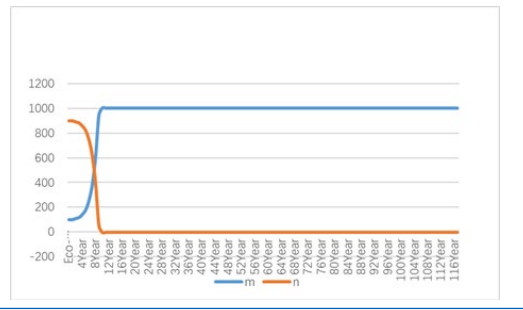

Although fast wolves possessed a survival advantage at the be-ginning, the survival advantage of fast wolves decreased and disappeared as m sheep decreased and disappeared from about the tenth year. And the 4% evolutionary cost finally made fast wolves completely extinct after 116 years.
Through the above analysis, we found that the auto-regulatory ability of the ecosystem would change the selection coefficient of natural selection. Under the regulation of the ecosystem, the favorable variation gradually becomes a neutral variation, and even the original favorable variation will become a harmful variation due to the existence of evolutionary cost. The result is that generally favorable variation simply cannot accumulate in a stable ecosystem. For this reason, we do not see the evolu-tionary phenomenon of animals running faster and faster on the grasslan.
Based on the above analysis we conclude that as long as the ecosystem does not change, the evolution of organisms cannot occur. That is, if the ecosystem remains stable, the species re-main stable, and the formation of new species can only happen after the ecological change.
A new species comes into existence, necessarily living in some ecosystem. This species is newly emerged, so this ecosystem must also be a new ecosystem. In terms of the time sequence between species formation and ecological change, the forma-tion of new species can only occur after ecological change. And, the evolution of organisms can only happen if the ecosystem is changed. Because only with a new ecosystem, new natural selection can occur and new species can be created. Even if a favorable mutation will increase the chances of survival and re¬production of individuals, it is not evolutionarily meaningful if this mutation does not change the ecosystem, and as mentioned before, the automatic regulation of the ecosystem will change the selection coefficient and eventually transform this favorable mutation into a neutral mutation. This also explains why neutral mutation would account for the majority of mutation from the perspective of natural selection.
Dramatically Changed Habitat is the Main Reason for Evolution
The factors that cause ecological changes are commonly seen as follows.
1) Environmental changes. Such as geographical changes, cli¬mate change, etc. Slow crustal movements or violent geological disasters can lead to geographical changes. The Earth's climate is also not static, and glacial periods have occurred many times in the history of the Earth. Both geographic changes and climate change can have a huge impact on ecosystems, thus greatly af¬fecting the evolutionary history of organisms.
2) Species dispersal. One consequence of the overpopulation of organisms is that organisms always tend to expand the survival space of their species. When a species successfully expands its range and reaches a new environment, it is likely to disrupt the local ecosystem, and the invasive species itself will face new ecosystem and environmental conditions. The ecological chang¬es in the new environment are accompanied by the creation of new species.
3) Ecological imbalance. Any dramatic environmental change or biological mutation that leads to ecological imbalance will eventually result in the extinction of a large number of species, freeing up space for survival, and the surviving species re-establishing a new ecological balance. In the process of creating new ecosystems, new species evolve in large numbers.
It is easy to see that dramatically changed habitat is the main cause of biological evolution.
Iinitial Ancestormutation that can change the niche of Organisms, which can lead to the Formation of New Species
In addition to dramatically changed habitat, sometimes a single mutation can lead to the creation of a new species. However, this mutation must be able to change the niche of a particular organism without causing an ecological imbalance. Because this mutation that can change the niche of an organism can directly lead to the creation of a new species, I have named it Iinitial-an-cestormutation.
A mutation that changes the niche of an organism and leads to the creation of a new species usually takes the form of an or-ganism acquiring a new way of living. For example, the abili-ty to obtain new food that the original species could not obtain or to survive in a new environment where the original species could not survive, etc. Individuals that have acquired the Iini-tial-Ancestormutation have more opportunities to reproduce and thus obtain a large number of offspring because their niche has changed and they do not have to compete with other individuals of the original population living in the old niche. The offspring that inherit the genes of the Iinitial-Ancestormutation reproduce to become a new population.
Since the niches of the new populations that acquire the Iini-tial-ancestormutation are changed, they will face different nat-ural selection from the original species. Nor will they become neutral mutations due to automatic regulation of the ecosystem. Interestingly, the variants that favor the survival of the new group in the new niche may also occur in the original species, but for the original species these variants may be evolutionari¬ly meaningless: some are just neutral variants, and even these variants may be not only not favorable but also harmful for the original species! But in the new population, these mutations be¬come favorable ones!
As a result of Iinitial-ancestormutation, organisms acquire a new niche, and as a result, neutral or even harmful mutations in the original species that had no evolutionary significance become evolutionary beneficial mutations, and the new population can rapidly accumulate these evolutionarily significant mutations and evolve in a new direction, thus distinguishing itself from the original population and giving rise to a new species. In other words, by changing the niche of an organism, Iinitial-ancestor-mutation allows the organism to evolve in a new direction, re-sulting in the formation of a new species.
Described in terms of synergetic, Iinitial-ancestormutation is the order parameter that becomes the dominant factor in mutation, allowing organisms to evolve rapidly in a specific direction. Iini-tial-Ancestormutation is like the first domino to fall, changing the selection coefficient and subsequently causing a series of mutational choices that eventually lead to the formation of new species. Therefore, only Iinitial-ancestormutation that changes the niche is evolutionarily significant mutation. In this way, we can classify mutations into five categories: lethal mutations, deleterious mutations, neutral mutations, favorable mutations and Iinitial-ancestormutation.
The main difference between Iinitial-ancestormutation and fa-vorable mutation is that Iinitial-ancestormutation determines the direction of evolution, while favorable mutation is only muta¬tion that is favorable in the direction of evolution.
Iinitial-ancestormutation determines the direction of evolution. Favorable mutation refines the adaptive capacity of the organism during the formation of new species, while helping to accumu¬late differences in the gene pool between populations [2]
Iinitial-ancestormutation is very similar to the key evolution¬ary innovations by Miller. However, Miller and subsequent re¬searchers did not point out its intrinsic nature as a mutation of changing niches or that it could be a necessary and sufficient condition for species formation [3].
Guy Bush's study of Rhagoletis pomonella provides an example of a theory of evolution based on ecological change. About 150 years ago, apple flies were introduced to North America along with the apple tree. A small group of apple flies acquired the Iini-tial-Ancestormutation of parasitizing hawthorn trees, and within a little over a century, this small group had begun to evolve into a new, independent species [4].
On the other hand, the formation of a new species leads to changes in the ecosystem and the niche of other organisms in that ecosystem is forced to change and must undergo new evo¬lution to adapt to the new ecosystem. If they cannot adapt to the new ecological changes, they may become extinct. In turn, new species may form to adapt to the new ecological changes. The greater the ecological change, the more new species are cre¬ated. In other words, the birth of species changes the original ecological balance and promotes the formation of new species. And when an ecosystem reaches equilibrium, it means that spe¬cies also tend to stabilize. If an ecosystem can remain stable, the species in that ecosystem will not evolve until the ecological equilibrium is broken again.
Take the relationship between wolves and sheep in the grass¬land as an example. Suppose a mutation turns sheep into fast and slow sheep, and suppose the fast sheep can completely escape from the predation of wolves. Then the niche of the fast sheep changes, and the small group with the fast sheep gene evolves into a new species. The relationship between slow sheep and wolves remains unchanged, and the new species joins the eco¬system, then a new ecological equilibrium emerges.
If the fast sheep mutation cannot change its niche, that is, it can¬not completely get rid of the predation of wolves. Fast sheep are just a little bit faster than slow sheep, and their fast sheep genes are impossible to accumulate. Because with the decrease of slow sheep and the increase of fast sheep, wolves will prey on more fast sheep and the advantage of fast sheep will become smaller and smaller. Just like the evolution of fast wolves has opportuni¬ty cost, fast sheep cannot run faster without paying any price. In other words, in the end, fast sheep will not have any evolution¬ary advantage, and sheep and wolves will eventually return to the original equilibrium state. Unless fast sheep completely get rid of their original niche and stop being food for wolves, such a new species will soon be formed.
Correspondence Between Ecological Changes and Biological Evolution
Iinitial-ancestormutation in a broad sense does not only refer to variation in genetic material, but can also include new animal behaviors or the spread of plants. As long as the new behaviors of animals, or the spread of plants survive in places where they could not survive before, as long as they can change the niche of organisms, that can be Iinitial-ancestormutation. Any change that can change the niche of an organism is Iinitial-ancestormu-tation. For example, when an organism breaks out of its original habitat and breaks into a new environment due to a change in behavior pattern or something else, creating a new ecosystem, at least one new species will be created.
After a new species is born, with the self-regulation capability of the ecosystem, the marginal revenue of favorable genetic muta¬tions decreases, and when the marginal revenue is zero, the eco¬logical balance and species stability, and evolution almost stops.
Ecological complexity is a result of evolution and at the same time a resistance to evolution. The more stable an ecosystem is, the slower the rate of biological evolution. When ecosystems are stable over time, species are also stable over time. Therefore, the process of evolution is at the same time the process of creating new ecosystems. The evolution of organisms is the evolution of ecosystems. In turn, ecological variation leads to species change, and species can evolve only if the ecology changes.
The process of evolution is essentially a continuous process of breaking ecological balance. The birth of each new species is a disruption of the ecological balance. The alternation between ecological balance and evolutionary disruption of the balance is the main theme of the long evolutionary symphony on Earth.
Application of Evolutionary Theory Based on Ecological Change
Evolutionary theory based on ecological change explains many evolutionary puzzles Why do some species remain very similar to their ancestors over hundreds of millions of years?
Many species have changed little over long periods of time, tens or even hundreds of millions of years. Examples include Coel-acanth, Nautilus Pompiplius, and Cyanobacteria, just to name a few. These species do not appear to have evolved and are often used as examples against the theory of evolution. However, the theory of evolution based on ecological change can fully explain this phenomenon: the niches of these species have been stable and so maintain the stability of the species. As long as the niche is stable, the organism will not evolve.
A chemoenergetic autotrophic bacterium Candidatus Desulforudis audaxviator, which lives deep underground, has no other or¬ganisms in its environment and its environment has not changed much. According to the theory of evolution based on ecological change, if the niche remains stable over time, then the species should also remain stable over time. This was also true, as only 32 base pairs out of 2.35–megabase pair (Mbp) genome in Candidatus Desulforudis audaxviator mutated more than once in the five tons of groundwater tested by the scientists. [5]Candidatus Desulforudis audaxviator achieves ecological balance in a single species. The niche is stable, so the species is stable. Even without competitors, Candidatus Desulforudis audaxviator will not evolve. Because in this narrow niche, no mutation can ex¬pand its niche. If a mutation increases intraspecific competition, it will only lead to population imbalance, and in the long historyof Ideonella sakaiensis 201-F6 corroborates this assertion [7]. There are many other similar evidences, such as the discovery of bacteria that break down PCP in 1985 [8]. Based on this theory, we are even able to design an experiment that provides an niche for a long time and will eventually result in at least one new species. However, the author did not perform this experiment himself, and interested researchers can experimentally verify it.
Why are Species More Abundant in The Tropics Than in Higher Latitudes
Sufficient numbers of specific organisms provide a niche and, therefore, a greater probability of occurrence of organisms that feed on them. When an ecosystem is in equilibrium, the number of organisms at the highest trophic level is not sufficient to sup¬port organisms at higher trophic levels. Because the tropics have more heat and rainfall, they provide more room to live, which breeds longer food chains, more complex food webs, and therefore more biodiversity.
Why did the Cambrian Explosion Occur
Evolutionary theory based on ecological change predicts that long-vacant niches will inevitably be filled by new species. The birth of one new species can trigger the birth of many more new species as long as there is enough space to survive.
The emergence of a new species has the potential to become new food, and the emergence of new food further promotes the emer-gence of new species. This continues until the trophic level in the ecosystem cannot increase, that is, the number of individuals at the highest trophic level is not sufficient to support organisms at higher trophic levels. In this way, a complex ecological equi¬librium is reached. When ecosystems are complex and stable, biological species explosions do not continue to occur
Why did the Cambrian Explosion Occur
Evolutionary theory based on ecological change predicts that long-vacant niches will inevitably be filled by new species. The birth of one new species can trigger the birth of many more new species as long as there is enough space to survive.
The emergence of a new species has the potential to become new food, and the emergence of new food further promotes the emer-gence of new species. This continues until the trophic level in the ecosystem cannot increase, that is, the number of individuals at the highest trophic level is not sufficient to support organisms at higher trophic levels. In this way, a complex ecological equi¬librium is reached. When ecosystems are complex and stable, biological species explosions do not continue to occur
Why did the Cambrian Explosion Occur
Evolutionary theory based on ecological change predicts that long-vacant niches will inevitably be filled by new species. The birth of one new species can trigger the birth of many more new species as long as there is enough space to survive.
The emergence of a new species has the potential to become new food, and the emergence of new food further promotes the emer-gence of new species. This continues until the trophic level in the ecosystem cannot increase, that is, the number of individuals at the highest trophic level is not sufficient to support organisms at higher trophic levels. In this way, a complex ecological equi¬librium is reached. When ecosystems are complex and stable, biological species explosions do not continue to occur
Why have so Many New Species of Human Viruses Emerged in Recent Decades
Ecological knowledge tells us that in a food chain, the flow of energy is characterized by decreasing levels. Humans, as the or¬ganism at the top of the food chain, should be the least numerous according to ecological principles. However, human evolution has been so successful that it has completely broken the ecological laws, with as many as 8 billion people on the planet. Such a large population is bound to crowd out the niches of other organisms, especially large carnivores are most affected.
In addition, in order to meet the requirements of human devel-opment, the number of people still needs to grow. Therefore, according to the basic principle of ecosystem balance, as long as the population keeps increasing, the number of the remaining organisms will inevitably decrease.
Emerging human viruses are the inevitable result of humans occupying too many niches on the planet. A large number of humans is equivalent to a huge number of "edible" niches in the ecosystem, and natural evolution with humans as food becomes more likely, which is actually God's use of biological evolution to achieve ecological equilibrium. As a result, all kinds of new of evolution, those imbalanced populations have disappeared, leaving only Candidatus Desulforudis audaxviator, a species that can remain the niche stable in this tiny niche.
Why have so Many New Species of Human Viruses Emerged in Recent Decades
Ecological knowledge tells us that in a food chain, the flow of energy is characterized by decreasing levels. Humans, as the or¬ganism at the top of the food chain, should be the least numerous according to ecological principles. However, human evolution has been so successful that it has completely broken the ecological laws, with as many as 8 billion people on the planet. Such a large population is bound to crowd out the niches of other organisms, especially large carnivores are most affected.
In addition, in order to meet the requirements of human devel-opment, the number of people still needs to grow. Therefore, according to the basic principle of ecosystem balance, as long as the population keeps increasing, the number of the remaining organisms will inevitably decrease.
Emerging human viruses are the inevitable result of humans occupying too many niches on the planet. A large number of humans is equivalent to a huge number of "edible" niches in the ecosystem, and natural evolution with humans as food becomes more likely, which is actually God's use of biological evolution to achieve ecological equilibrium. As a result, all kinds of new of evolution, those imbalanced populations have disappeared, leaving only Candidatus Desulforudis audaxviator, a species that can remain the niche stable in this tiny niche.
Why Does the Phenomenon of Punctuated Equilibrium Exist in the Process of Evolution
In 1972, American paleontologists Eldredge N and Gould SJ proposed the theory of punctuated equilibrium in biological evolution. It was pointed out that new species can only arise through lineage branching and can only form rapidly by jump¬ing; once formed, new species are in a state of conservation or evolutionary stasis, and there is no significant change in pheno¬type until the next species formation event occurs; evolution is interspersed with jumps and stagnation, and there is no uniform, smooth, gradual evolution. [6]
The theory of evolution based on ecological changes can fully explain this phenomenon: Species are stable when there is ecological equilibrium; it is when there is a dramatic ecological change that a large number of new species can emerge rapidly. If, for some reason, the ecology is disrupted, there will be mass extinctions of species. The large number of extinct species frees up space for survival and waits for the formation of new species and the establishment of new ecosystems.
Thus, we get the correspondence between species formation and ecosystem change: The formation of new species→ New ecosystem establishment→ Ecological balance→ Species remain stable → Ecosystem is destroyed→ The formation of new species, and so on.
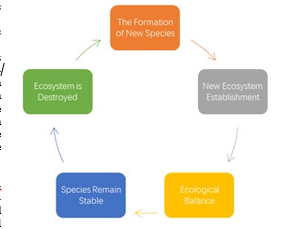
It can be seen that the evolutionary process of organisms during the long geological history was not continuous and slow with a large number of transitional types, but discontinuous, abrupt and without a large number of transitional types.
Long-Vacant Niches will Inevitably be filled by New Species
The theory of evolution based on ecological change asserts that niches that have been vacant for a long time will inevitably be filled by new species. For example, the prolonged and abundant presence of an edible substance in the biosphere will lead to the evolution of organisms that feed on this substance. the discovery of Ideonella sakaiensis 201-F6 corroborates this assertion [7]. There are many other similar evidences, such as the discovery of bacteria that break down PCP in 1985 [8]. Based on this theory, we are even able to design an experiment that provides an niche for a long time and will eventually result in at least one new species. However, the author did not perform this experiment himself, and interested researchers can experimentally verify it
Why are Species More Abundant in The Tropics Than in Higher Latitudes
Sufficient numbers of specific organisms provide a niche and, therefore, a greater probability of occurrence of organisms that feed on them. When an ecosystem is in equilibrium, the number of organisms at the highest trophic level is not sufficient to sup¬port organisms at higher trophic levels. Because the tropics have more heat and rainfall, they provide more room to live, which breeds longer food chains, more complex food webs, and there¬fore more biodiversity.
Why did the Cambrian Explosion Occur
Evolutionary theory based on ecological change predicts that long-vacant niches will inevitably be filled by new species. The birth of one new species can trigger the birth of many more new species as long as there is enough space to survive.
The emergence of a new species has the potential to become new food, and the emergence of new food further promotes the emergence of new species. This continues until the trophic level in the ecosystem cannot increase, that is, the number of individuals at the highest trophic level is not sufficient to support organisms at higher trophic levels. In this way, a complex ecological equi¬librium is reached. When ecosystems are complex and stable, biological species explosions do not continue to occur.
Why have so Many New Species of Human Viruses Emerged in Recent Decades
Ecological knowledge tells us that in a food chain, the flow of energy is characterized by decreasing levels. Humans, as the organism at the top of the food chain, should be the least numerous according to ecological principles. However, human evolution has been so successful that it has completely broken the ecological laws, with as many as 8 billion people on the planet. Such a large population is bound to crowd out the niches of other organisms, especially large carnivores are most affected.
In addition, in order to meet the requirements of human devel-opment, the number of people still needs to grow. Therefore, according to the basic principle of ecosystem balance, as long as the population keeps increasing, the number of the remaining organisms will inevitably decrease.
Emerging human viruses are the inevitable result of humans occupying too many niches on the planet. A large number of humans is equivalent to a huge number of "edible" niches in the ecosystem, and natural evolution with humans as food becomes more likely, which is actually God's use of biological evolution to achieve ecological equilibrium. As a result, all kinds of new human viruses keep appearing
Conclusion
The theory of evolution based on ecological change is the opposite of Niche Conservatism and describes a slightly different mechanism of evolution than Darwin's gradual evolution. How¬ever, the ecological change-based theory of evolution is more logical and more consistent with fossil evidence, and draws sup¬port from a variety of contemporary examples of evolution. I am convinced that the principle of evolution based on ecological change is the most widespread mechanism of evolution. If the theory of evolution based on ecological changes is confirmed, the definition of species will be redefined. Reproductive isola-tion is not an essential characteristic of a species, but simply a result of evolution. In nature, the essence of the same species is whether the niches to which they belong are the same. Only with a stable niche can there be a stable species. If two groups have different niches, then even if the two groups are not reproduc-tively isolated now, they will eventually evolve into two species over time.
References
- Van Valen, L. (1973). A new evolutionary law. Evol theory, 1, 1-30.
- Chen Xinyu, C. (2018). Initial-ancestormutation is a neglected role in speciation. Evolution, 2018(3), 52-55.
- Heard, S. B., & Hauser, D. L. (1995). Key evolutionary innovations and their ecological mechanisms. Historical biology, 10(2), 151-173.
- Linn Jr, C., Feder, J. L., Nojima, S., Dambroski, H. R., Ber-locher, S. H., & Roelofs, W. (2003). Fruit odor discrimination and sympatric host race formation in Rhagoletis. Proceedings of the National Academy of Sciences, 100(20), 11490-11493.
- Chivian, D., Brodie, E. L., Alm, E. J., Culley, D. E., Dehal,P. S., DeSantis, T. Z., ... & Onstott, T. C. (2008). Environmental genomics reveals a single-species ecosystem deep within Earth. Science, 322(5899), 275-278.
- Eldridge, N., & Gould, S. J. (1972). Punctuated Equilibrium: An Alternative to Phyletic Gradualism. Models in Pa-leobiology/Ed. by TJM Schopf, pp. 82-115. San Francisco: Freeman Cooper.
- Yoshida, S., Hiraga, K., Takehana, T., Taniguchi, I., Yam-aji, H., Maeda, Y., ... & Oda, K. (2016). A bacterium that degrades and assimilates poly (ethylene terephthalate). Science, 351(6278), 1196-1199.
- Saber, D. L., & Crawford, R. L. (1985). Isolation and characterization of Flavobacterium strains that degrade penta-chlorophenol. Applied and Environmental Microbiology, 50(6), 1512-1518.