

International Journal of Probiotics and Dietetics(IJPD)
ISSN: 2993-3056 | DOI: 10.33140/IJPD

Research Article - (2023) Volume 3, Issue 1
Ethnobotanical Study on the utilized of medicinal plants by the Phouthai Ethnic Group in Khammouan Province, Lao PDR
2Department of Forest Community and Rural Develop-ment, Faculty of Forestry Science, National University of Laos, China
3State Key Laboratory of Crop Stress Biology for Arid Areas,, College of plant Protection, Northwest A&F Universi¬ty, Yangling, Shaanxi, 712100, China
Received Date: Sep 14, 2023 / Accepted Date: Sep 20, 2023 / Published Date: May 22, 2023
Copyright: ©Â©2023 Khambay Khamphilavong, et al. This is an open- access article distributed under the terms of the Creative Commons Attribution License, which permits unrestricted use, distribution, and reproduction in any medium, provided the original author and source are credited.
Citation: Khamphilavong, K., Zhang, L., Soukkhavong, M., Awais, M., Kang, Y., (2023). Ethnobotanical Study on the utilized of medicinal plants by the Phouthai Ethnic Group in Khammouan Province, Lao PDR. Int J Probiotics and Dietetics, 3(1), 32-45.
Abstract
Background: Plants have been a part of rural areas’ people's life from birth to die since prehistoric times and their utilization is an important traditional culture in the worldwide. However, this is a lack of ethnobotanical study in Laos. The aim of the study is to record the plants' species and explore their medical utilization in Nakeu village, Hinboon district, Khammouan province, middle part Laos.
Methods: Ethnobotanical survey was conducted from August 2018 to July 2019. One hundred and fifty key information (81 males and 69 females). Ethnomedicinal data were collected through semi-structured interviews with key informants.
Results: The total 79 plant species belong to 46 families were recorded as wild medicinal important. Life form importance value (LIV) was highest in tree 52%, followed by shrub 29%, liana 14%, grass 4%. The medicinal plants are used for stomach problems, heart disease, kidney problems, fever, and others, respectively. Used value (UV) was highest in Ocimum americanum (0.93). This knowledge will support primary health care providers and policymakers in decision-making on the utilization of medicinal plants.
Conclusion: In Hinboon district, Khammouane province, Lao PDR, are some of the richest in species of medicinal plants in de- veloping countries, and indeed in Asia. It is worth pointing out the exceptional long list of medicinal plants which are used for traditional medicine and documented as used in the treatment of different common sicknesses. Health policies have to promote the utilization of medicinal plants as part of a strategy to improve the basic health and livelihoods of rural communities throughout the country. Further exploration is needed on the bioactive compound and chemical factor contents of medicinal plants.
Keywords
Medicinal Plants, Traditional Knowledge, Ethnic Group, Laos
Introduction
Plants have been a part of the rural area’s people’s lives since pre¬historic time, and is evolving into an essential traditional cultures worldwide where native peoples used it from birth to death [1-3]. Different kinds of plant species are rare and precious medical re¬sources and environmentally friendly building materials [4]. Gen¬erally speaking, they could be used to treat illness and disease, health tonic, and are important in primary healthcare around the world [5]. Especially in rural area far away from the hospital. Even though in developed countries such as Australia, Canada, France, Belgium, America, a high percentage of the population also treat¬ed plants as traditional medicines [6-8]. Since modern medicines were dissolved or synthesized the basic on of previous plant deriv¬atives, and the extraction of bioactive compounds from plants as plant derivatives always took a lot of time, expertise and money, the search for traditional medicinal plants can help reduce the cost of drug discovery [9, 10]. At the same time, traditional knowledge was being eroded by several processes related to globalization and urbanization [11-13]. Because people in each region of the world had different historical backgrounds, cultures and ways of life, and the flora of their environment is different, they used plants as medicines in different patterns, such as different plant species with different plant parts, preparation methods and applications in medicine [14-16].
Although some mode preparations can use any or all parts of the plant, most medicinal plants are usually strictly related to specific parts of the plant, such as roots, stems, leaves [17-21]. Screening of plant parts usually depends on the organ with the highest con-centration of bioactive substances acting in the treatment [1, 11, 13, 22-24]. But since not all traditional medicines rely on physio-logical effects, other parts can also be used. The preparation of this drug was inherited from the traditional culture and it can be done using various solvents, such as boiling, soaking in water or alcohol [1, 13]. Crushing without extraction, and ingesting without any preparation. The medicine can be used as a drink, tablet or without any preparation. Finally, the way of administration varies from in-gestion to smoke inhalation to external application to the injured area of the body [1, 19, 25-27]. All these differences can be due to the different cultural, geographical and temporal dimensions.
The rural population relies almost entirely on traditional medi¬cine for primary health care and is highly dependent on medicinal plants due to the lack of modern health services.
Although many of number medicinal plants have been known and used by the local community, no one has recorded their knowledge until now. Tra¬ditional healers usually pass on medicinal knowledge to the next generation through oral language [27-29]. In this way, some cru¬cial of key information would be misunderstood or missed. In ad¬dition, there is a lack of sufficient reference knowledge on the use of ethnic medicinal plants among the frequently cited problems in research [14]. Therefore, the current study is urgently needed and carried out mainly from these aspects. Firstly, how many kinds of medicinal plants there are in the Hinboun area of Khammaun Province of the Laos? Secondly, what is the specific function of the medicinal plant and how to use it?
Materials and Methods
Description of the Study Area
The study was conducted in the Phouthai communities at Nakeu village Khammaun province, Laos ‘’Figture. 1’’. It is located 33 km far away from the town, the geographically situated between 17°64' –86°78' N and 140°78'–48°57' E, the total land area of 35,863 ha. The mean monthly temperature is 32 °C, ranging from 15 °C to 38 °C, and total rainfall is 1200 mm, ranging from 600 to 1600 mm and mostly of forested mountainous terrain.

Figure 1: Location of the study sites in Nakeu village Hinboon District, Khammouan Province.
Fieldwork
Ethnobotanical survey was conducted from June 2018. Prior ac-quisition of necessary ethics approval and informed consents were acquired before the actual interview. The consultation meetings and discussions were conducted together with the District of Ag-riculture and Forestry of Office (DAFO), and village leaders. The field collection and direct observation between August 2018 to July 2019 to generate a list of medicinal plants that local people gather around thier village. One hundred and fifty key informa- tion (81 males and 69 females, aged rang 28-44, 45-61, and 62-78 years (Table. 1). Ethnomedicinal data were collected through semi-structured interviews with key informants [22, 23]. We were asked them to shown plant specimens and photographs, and were asked for plant names (local name), part used, and modes of prepa¬ration, mildew treatment, habits and other information were re¬corded. In addition, three focus group discussions were conducted with ten older people with traditional knowledge (male, and fe¬male).
Table 1: The information of the key informant
|
Age group |
Total key informants |
Male |
Female |
|
28-44 |
81 |
49 (60.49%) |
32 (49.38%) |
|
45-61 |
57 |
31 (38.27%) |
26 (37.68%) |
|
62-78 |
12 |
1 (1.23%) |
11 (15.94%) |
|
Total |
150 |
81 |
69 |
Collection and Identification
Veritable species identification of medicinal plants was conducted during field walk with the assistance of the guide from DAFO and traditional healer from village for the record of the local names. And then was literature available in our University and internet resources, take into consideration present Lao plant checklists [24] [30] All botany names were checked for spelling and synonyms, and family classification using the word flora online (http://www. worldfloraonline.org), https://padme.rbge.org.uk/laos/list/.
Data Analysis
Use Value (UV) The relative significance was calculated employing the UV [31] a quantitative measure for the relative significance of species known locally.

Where Un is the use numbers of plants by each informant for a given species while N is the total number of informants. The UV are high when there are many use reports for a plant, mean that a plant is significance, and approach zero when there are a few reports related to its use.
Statistical Analyses
Statistical tests were performed to test difference between the knowledge of different age groups. The numbers of medicinal plants known by informant and continuously variable of in-formant age were analyzed using linear regression. The using report of medicinal plants between males and females were compared using Chi-square statistics, t-test and analyzed of p-value [26].
Results
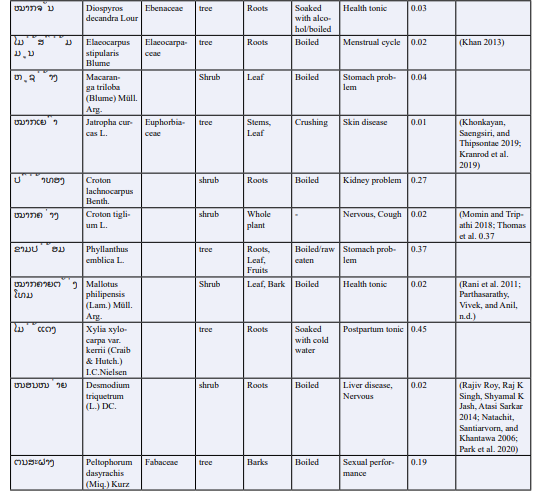
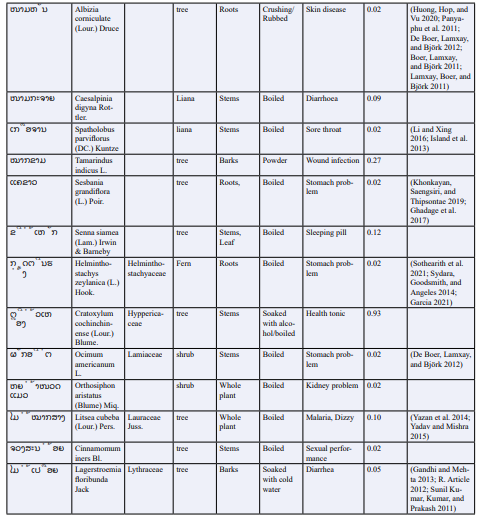
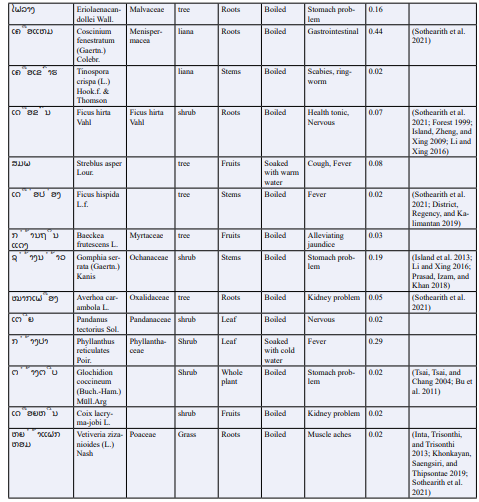
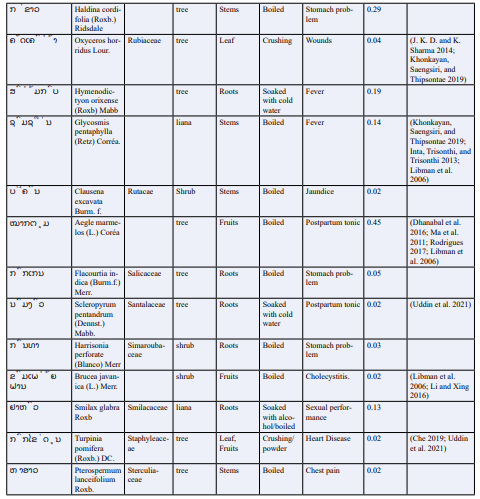
Medicinal Plants Species A total of 79 medicinal plant species belong to 46 families (Ta¬ble 2). The commonly used families were Fabaceae 10.12% (8 species), Euphorbiaceae 7.59% (6 species), Annonaceae, Apocynaceae, Moraceae, Ohyllanhaceae, Rubiaceae, and Ruta-ceae 3.79% (3 species in each), and Araliaceae, Bignonaceae, Combretaceae, Dillenniaceae, Lamiaceae, Lauraceae, Meni-spermaceae, Poaceae, and Simaroubaceae 2.53% (2 species), see in the ‘’Figure. 2’’. The distinctive plant parts used in prepa¬rations both in single and multiple treatments are: roots 29 species (33%), stems 27 species (31%), leaf 13 species (15%), fruits 8 species (9%), whole plants 6 species (7%), and barks 5 species (5%) see in the ‘’Figure. 3’’. which are medicinal used for stomach problem, heart disease, kidney problem, and fever, respectively, based on the frequency of informant citation see in the ‘’Figure. 2’’
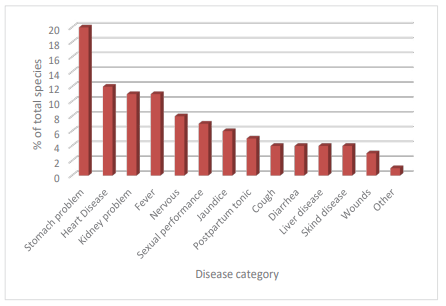
Figure 2: Disease category treated by different medicinal plant species in Hinboun district, Khammouan province
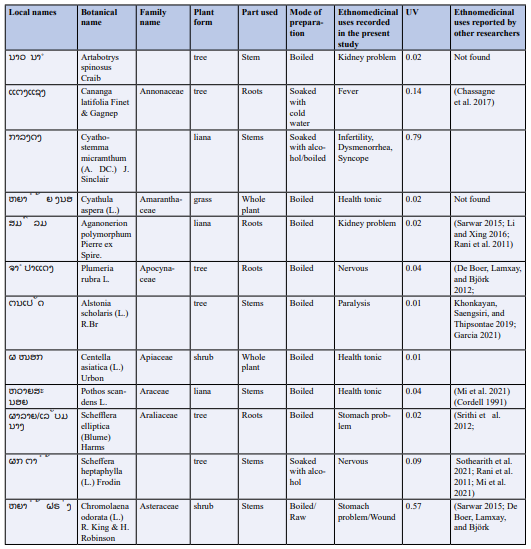
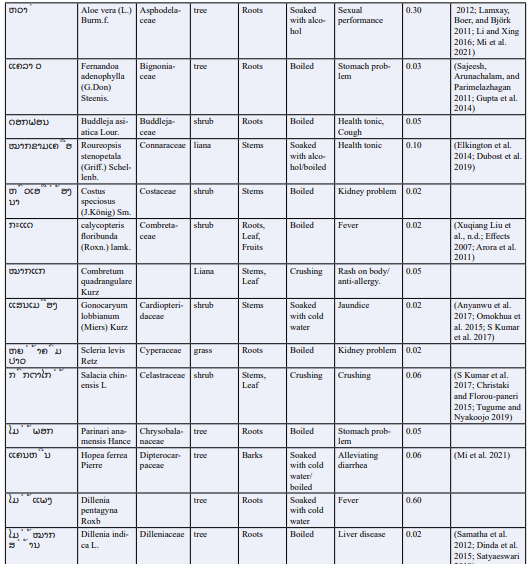
TABLE 2

Use Value
The UV were high for plants with many use reports. Largely used medicinal plants included such as Ocimum americanum (0.93), Cyathostemma micramthum (0.79), Dillenia pentagyna (0.60), Chromolaena odorata (0.57), Aegle marmelos and Xylia xylocar- pa (0.45), Tinospora crispa (0.44), Phyllanthus emblica (0.37), Aloe vera (0.30), Sesbania grandiflora and Haldina cordifolia (0.29), Croton lachnocarpus and Tamarindus indicus (0.27) etc. ‘’Show detail in table 2 and Figure. 3’

Figure 3: Selected medicinal plants its high used value: (A), Ocimum americanum, (B), Chromolaena odorata, (C), Dillenia pentagyna, (D), Tinospora crispa, (E), Sesbania grandiflora, (F), Aegle marmelos, (G), Xylia xylocarpa, (H), Tamarindus indicus, (I), Phyllanthus emblica.
Medicinal Plant Knowledge
This study we found no difference in knowledge of medicinal plant between the male and female. The age basis, the youngest age group knew more medicinal plants (average 14.09 species) than did the middle age group (average 7.59 species). The old¬est group knew the fewest (average 4.51 species). This study we found a relationship between age and number of medicinal plants know by Phouthai people, medicinal plants used increases with age. The younger people use more medicinal plants than older. Moreover, the linear regression between number of plants know by informants and informant age showed a significant positive re¬lationship (R2=0.0257, F (1.129) =20.66, P < 0.001). Comparing the knowledge of medicinal plants between male (81) and female (69) by Chi-square statistics, t-test and analysis of variance, we found no differences in knowledge of the plants between gender.
Indigenous knowledge for preservation and storage medicinal plants
The traditional healers and villagers usually collected the medic-inal plants from different fields, such as in the forest, farmland, in and around their community. Plant parts used were dry and crouched before storing in bags or bottles. It’s very difficult for pa- tients to recognize plant species that are used for treatment, which sometimes seem like ordinary plants that were growing in gardens or in the forest. Almost traditional healers and villagers prefer to stored medicinal plants in dry or powdered form inside bottles or plastic bags to reduce the field collection trips and make sure the availability of plant parts is possible throughout the year.
Indigenous knowledge on processing and using medicinal plants The primary mode of preparation of plant extracts was boiling fol¬low by soaking, and crushing (Table 3). Boiling were commonly used (68%), was prepared by boiling plant parts in a specific quan¬tity of water for fifteen minutes and then mixture allowed to warm/ cool before administration, followed by soaking with water (11%) that pouring down cool/warm water onto plant parts for one or two days and allowed the mixture. Soaking with alcohol (8%) in¬volved pouring alcohol onto plant materials and allowed the mix¬ture. Crushing was used (7%) of the plant species. Most, involved crushing plant materials of a single or combination of more than one part from different species to extract a liquid which was ap¬plying either topically. The mode preparation like powdering, raw eating, and rubbing was used with low frequency in the range of 6% of the plant species.
Table 3: Mode of preparation plant parts used of identified species for treatments in and around Hinboun District Khammouan Province Lao P.D.R.
|
No |
Types of preparation |
Frequency (%) |
|
1 |
Boiling |
60 (68) |
|
2 |
Soaking with water |
10 (11) |
|
3 |
Soaking with alcohol |
7 (8) |
|
4 |
Crushing |
6 (7) |
|
5 |
Raw |
3 (3) |
|
6 |
Powder |
2 (2) |
|
7 |
Rubbed |
1 (1) |
Discussion
The Phouthai people are a social group with characteristic culture transmitted from their antecedents. In their livelihood are interde-pendence between humans and naturals. Indigenous and knowl-edge become their identity. The lifestyle is combined base on tra-ditional plant knowledge, belief’s and exerting and error practices of the in and around communities which are passed on from parent to generation. Nowadays, indigenous plant knowledge is being in¬creasing, this knowledge not only needs to be preserved in their communities but also need to documented [32]. Even more, some plants are used as important medicine and to make income for peo¬ple in the communities. The highest number of medicinal plant species documented, and indicated that the study area has diverse tree used for treatment of disease. The number of medicinal plants documented was less than that of the studies reported elsewhere in Laos [33, 34]. But higher than H. J. DE Boer’s study [35]. The plants were most frequently used for the treatment of the disease such as stomach problems, nervous system, kidney infection, liv- er tonic, and postpartum tonic, which are consistent with other studies [36-38]. Moreover, the considerable number of tradition¬al medicines were from roots, and this is because that roots were available throughout the year, and traditionally considered to be strong medicine with good smell and drinking easily [1, 3, 11, 39]. However, using of stems instead of roots, have been advocated by most ethnobotanical studies, as using roots highly affects the ex¬istence of medicinal plant species, as well as roots were not easily accessible and not sustainable [1, 17, 40, 39]. The most common mode of preparation was boiling. This result is consistent with the finding of [38, 33, 14, 12, 11]. Who documented that the principal mode of medicine preparation was through boiling. As other stud¬ies showed that most medicines was preparing from a mixture or combined plant materials, we also found this [41, 3, 42].
The medicines preparation modes of dominant treatments varied from diseases such as skin diseases preparing by smoke, crashing and burning, and most of the medicines prescribed were by tradi- tional healers orally as they were easy to apply for human disease. In addition, some solvents such as water and alcohol were com¬monly believed to serve as the vehicle to transport the medicines, which is compatible with some other studies in Laos elsewhere and other tropical countries [12, 29, 43]. Villagers and healers know how to use medicinal plants mainly to treat common diseas¬es, including stomachaches, fever, and wounds.
Conclusion
In Hinboun district, Khammuoan province, Lao PDR, it was found that the total of 79 plant species were used for traditional medicine and documented as use in the treatment of different common sick¬nesses, including stomach problems (gastrointestinal, flatulence, diarrhea, detox), kidney infections, fever, dysmenorrheal postpar¬tum tonic, nervous system, skin disease, health tonic, lever infec¬tions, heart disease, dressing wounds, and others. Most majority of these traditional medicinal plants were trees, shrubs, liana, and gasses, mainly from the wild. In terms of the parts of the plant, roots and stems were most frequently used. Usually, medicinal plants were dried and used for preparation by boiling, soaking with cold water or alcohol, crushing.
The current study also highlighted that realization and cultural be¬liefs have a significant influence on the unique source of health¬care, in contrast, religion was found to have no association with health-seeking behavior. Beyond, the therapeutic use of the identi¬fied and documented plants will provide essential data for further researches focusing on pharmacological studies and the conser¬vation of the most important medicinal plants in the study area. Health policies have to promote the utilization of medicinal plants as part of a strategy to improve the basic health and livelihoods of rural communities throughout the country. Further exploration is needed on the bioactive compound and chemical factor contents of medicinal plants.
Acknowledgement
We would like very grateful to the teachers of the Department of Forest Community and Rural Development at the Faculty of For¬estry Science, the National University of Laos, for providing us with field materials, and their students to help us in collection data. We would also like to express our gratitude to the villagers and healers for their invaluable contribution to the study; to our inter¬preter, and thanks to all the staff in the department of forestry at Hinboun district for graciously granting us permission to conduct our study.
References
- Lamxay, V., de Boer, H. J., & Björk, L. (2011). Traditions and plant use during pregnancy, childbirth and postpartum recovery by the Kry ethnic group in Lao PDR. Journal of Ethnobiology and Ethnomedicine, 7(1), 1-16.
- Ayyanar, M., & Ignacimuthu, S. (2011). Ethnobotanical survey of medicinal plants commonly used by Kani tribals in Tirunelveli hills of Western Ghats, India. Journal of ethno-pharmacology, 134(3), 851-864.
- Phumthum, M., Srithi, K., Inta, A., Junsongduang, A., Tangjit-man, K., Pongamornkul, W., ... & Balslev, H. (2018). Ethnomedicinal plant diversity in Thailand. Journal of Ethnopharmacology, 214, 90-98.
- Pieroni, A., Sõukand, R., Quave, C. L., Hajdari, A., & Mustafa, B. (2017). Traditional food uses of wild plants among the Gorani of South Kosovo. Appetite, 108, 83-92.
- Elkington, B. G., Phiapalath, P., Sydara, K., Somsamouth, V., Goodsmith, N. I., & Soejarto, D. D. (2014). Assessment of the importance of medicinal plants among communities around Khiat Ngong of southern Laos. Journal of Environmental Biology, 35(4), 607.
- Molassiotis, A., Fernadez-Ortega, P., Pud, D., Ozden, G., Scott, J. A., Panteli, V., ... & Patiraki, E. (2005). Use of complementary and alternative medicine in cancer patients: a European survey. Annals of oncology, 16(4), 655-663.
- Snyder, J., Zenone, M., & Caulfield, T. (2020). Crowdfunding for complementary and alternative medicine: What are cancer patients seeking? Plos one, 15(11), e0242048.
- Hyodo, I., Amano, N., Eguchi, K., Narabayashi, M., Imanishi, J., Hirai, M., ... & Takashima, S. (2005). Nationwide survey on complementary and alternative medicine in cancer patients in Japan. Journal of clinical oncology, 23(12), 2645-2654.
- Saive, M., Frederich, M., & Fauconnier, M. L. (2020). Plants used in traditional medicine in the Comoros archipelago: a review. Biotechnologie, Agronomie, Société et Environnement, 24(2).
- Mohammadi, S., Jafari, B., Asgharian, P., Martorell, M., & Sharifi-Rad, J. (2020). Medicinal plants used in the treatment of Malaria: A key emphasis to Artemisia, Cinchona, Cryp-tolepis, and Tabebuia genera. Phytotherapy Research, 34(7), 1556-1569.
- Junsongduang, A., Kasemwan, W., Lumjoomjung, S., Sabpra-chai, W., Tanming, W., & Balslev, H. (2020). Ethnomedicinal knowledge of traditional healers in Roi Et, Thailand. Plants, 9(9), 1177.
- Srithi, K., Balslev, H., Wangpakapattanawong, P., Srisanga, P., & Trisonthi, C. (2009). Medicinal plant knowledge and its erosion among the Mien (Yao) in northern Thailand. Journal of ethnopharmacology, 123(2), 335-342.
- Tomasini, S., & Theilade, I. (2019). Local knowledge of past and present uses of medicinal plants in Prespa National Park, Albania. Economic Botany, 73(2), 217-232.
- Yabesh, J. M., Prabhu, S., & Vijayakumar, S. (2014). An ethnobotanical study of medicinal plants used by traditional healers in silent valley of Kerala, India. Journal of ethnopharmacology, 154(3), 774-789.
- Tefera, B. N., & Kim, Y. D. (2019). Ethnobotanical study of medicinal plants in the Hawassa Zuria District, Sidama zone, Southern Ethiopia. Journal of ethnobiology and ethnomedicine, 15(1), 1-21.
- Tesfaye, S., Belete, A., Engidawork, E., Gedif, T., & Asres, K. (2020). Ethnobotanical study of medicinal plants used by traditional healers to treat cancer-like symptoms in eleven districts, Ethiopia. Evidence-Based Complementary and Alternative Medicine, 2020.
- Asowata-Ayodele, A. M., Afolayan, A. J., & Otunola, G. A. (2016). Ethnobotanical survey of culinary herbs and spices used in the traditional medicinal system of Nkonkobe Municipality, Eastern Cape, South Africa. South African journal of botany, 104, 69-75.
- Abbasi, A. M., Khan, M. A., Khan, N., & Shah, M. H. (2013). Ethnobotanical survey of medicinally important wild edible fruits species used by tribal communities of Lesser Himalayas-Pakistan. Journal of ethnopharmacology, 148(2), 528-536.
- Mengesha, G. G. (2016). Ethnobotanical survey of medicinal plants used in treating human and livestock health problems in Mandura Woreda of Benishangul Gumuz, Ethiopia. Adv Med Plant Res, 4(1), 11-26.
- Ouelbani, R., Bensari, S., Mouas, T. N., & Khelifi, D. (2016). Ethnobotanical investigations on plants used in folk medicine in the regions of Constantine and Mila (North-East of Algeria). Journal of Ethnopharmacology, 194, 196-218.
- Lucas, S., Kumar, S., Leach, M. J., & Phillips, A. C. (2020). Complementary and alternative medicine use in Australian children with acute respiratory tract infection-A cross-sec-tional survey of parents. Complementary Therapies in Clinical Practice, 39, 101171.
- Gomez-Beloz, A. (2002). Plant use knowledge of the Wini-kina Warao: the case for questionnaires in ethnobotany. Economic Botany, 56(3), 231-241
- Pei, S. J & Huai, H. Y. (2014). Medicinal plant resources of the Lahu: A case study from Yunnan Province, China. Human Ecology, 383-388.
- Newman, M., Ketphanh, S., Svengsuksa, B., Thomas, P., Sengdala, K., Lamxay, V., & Armstrong, K. (2007). A checklist of the vascular plants of Lao PDR. Royal Botanic Garden Edinburgh.
- Elkington, B. G., Southavong, B., Sydara, K., Souliya, O., Vanthanouvong, M., Nettavong, K., ... & Soejarto, D. D. (2009). Biological evaluation of plants of Laos used in the treatment of tuberculosis in Lao traditional medicine. Pharmaceutical biology, 47(1), 26-33.
- Teklehaymanot, T., & Giday, M. (2007). Ethnobotanical study of medicinal plants used by people in Zegie Peninsula, Northwestern Ethiopia. Journal of ethnobiology and Ethnomedicine, 3(1), 1-11.
- Chassagne, F., Deharo, E., Punley, H., & Bourdy, G. (2017). Treatment and management of liver diseases by Khmer traditional healers practicing in Phnom Penh area, Cambodia. Journal of Ethnopharmacology, 202, 38-53.
- Rani, S. L., Devi, V. K., Soris, P. T., Maruthupandian, A., & Mohan, V. R. (2011). Ethnomedicinal plants used by Kan-ikkars of agasthiarmalai biosphere reserve, Western Ghats. Journal of Ecobiotechnology, 3(7): 16-25.
- de Boer, H. J., Lamxay, V., & Björk, L. (2012). Comparing medicinal plant knowledge using similarity indices: a case of the Brou, Saek and Kry in Lao PDR. Journal of Ethnopharmacology, 141(1), 481-500.
- Muthu, N., Lee, S. Y., Phua, K. K., & Bhore, S. J. (2016). Nu-tritional, medicinal and toxicological attributes of star-fruits (Averrhoa carambola L.): a review. Bioinformation, 12(12), 420.
- Phillips, O., Gentry, A. H., Reynel, C., Wilkin, P., & Gálvez-Durand B, C. (1994). Quantitative ethnobotany and Amazonian conservation. Conservation biology, 8(1), 225-248.
- Tetali, P., Waghchaure, C., Daswani, P. G., Antia, N. H., & Birdi, T. J. (2009). Ethnobotanical survey of antidiarrhoeal plants of Parinche valley, Pune district, Maharashtra, India. Journal of ethnopharmacology, 123(2), 229-236.
- Spring, M. A. (1989). Ethnopharmacologic analysis of medicinal plants used by Laotian Hmong refugees in Minnesota. Journal of ethnopharmacology, 26(1), 65-91.
- Soejarto, D. D., Gyllenhaal, C., Kadushin, M. R., Southavong, B., Sydara, K., Bouamanivong, S., ... & Waller, D. P. (2012). An ethnobotanical survey of medicinal plants of Laos toward the discovery of bioactive compounds as potential candidates for pharmaceutical development. Pharmaceutical biology, 50(1), 42-60.
- Boer, Hugo J De, Vichith Lamxay, and Lars Björk. 2011. “Steam Sauna and Mother Roasting in Lao PDR : Practices and Chemical Constituents of Essential Oils of Plant Species Used in Postpartum Recovery.
- Demie, G., Negash, M., & Awas, T. (2018). Ethnobotanical study of medicinal plants used by indigenous people in and around Dirre Sheikh Hussein heritage site of South-eastern Ethiopia. Journal of Ethnopharmacology, 220, 87-93.
- Phumthum, M., Balslev, H., Kantasrila, R., Kaewsangsai, S., & Inta, A. (2020). Ethnomedicinal plant knowledge of the Karen in Thailand. Plants, 9(7), 813.
- Fortini, P., Di Marzio, P., Guarrera, P. M., & Iorizzi, M. (2016). Ethnobotanical study on the medicinal plants in the Mainarde Mountains (central-southern Apennine, Italy). Journal of Ethnopharmacology, 184, 208-218.
- Vitalini, S., Iriti, M., Puricelli, C., Ciuchi, D., Segale, A., & Fico, G. (2013). Traditional knowledge on medicinal and food plants used in Val San Giacomo (Sondrio, Italy)—An alpine ethnobotanical study. Journal of Ethnopharmacology, 145(2), 517-529.
- Kefalew, A., Asfaw, Z., & Kelbessa, E. (2015). Ethnobotany of medicinal plants in Ada’a District, East Shewa Zone of Oromia regional state, Ethiopia. Journal of ethnobiology and ethnomedicine, 11(1), 1-28.
- Demie, G., Negash, M., & Awas, T. (2018). Ethnobotanical study of medicinal plants used by indigenous people in and around Dirre Sheikh Hussein heritage site of South-eastern Ethiopia. Journal of Ethnopharmacology, 220, 87-93.
- Mahwasane, S. T., Middleton, L., & Boaduo, N. (2013). An ethnobotanical survey of indigenous knowledge on medicinal plants used by the traditional healers of the Lwamondo area, Limpopo province, South Africa. South African Journal of Botany, 88, 69-75.
- Keter, L. K., & Mutiso, P. C. (2012). Ethnobotanical studies of medicinal plants used by Traditional Health Practitioners in the management of diabetes in Lower Eastern Province, Kenya. Journal of Ethnopharmacology, 139(1), 74-80.