

Archives of Epidemiology & Public Health Research(AEPHR)
ISSN: 2833-4353 | DOI: 10.33140/AEPHR
Impact Factor: 1.98


Research Article - (2023) Volume 2, Issue 1
Estimation of Reproduction Number of SARS-COV-2 Omicron Variant Outbreak in Hong Kong
2Institute for Globally Distributed Open Research and Education (IGDORE), Ka?, Novi Sad, Serbia
3Neurophysiology Unit, Fondazione IRCCS Istituto Neurologico “Carlo Besta”, 20133, Milan, Italy
Received Date: Feb 05, 2023 / Accepted Date: Feb 13, 2023 / Published Date: Feb 22, 2023
Copyright: ©Davide Rossi Sebastiano. This is an open-access article distributed under the terms of the Creative Commons Attribution License, which permits unrestricted use, distribution, and reproduction in any medium, provided the original author and source are credited.
Citation: Mattia Allieta, Jelena Komlos and Davide Rossi Sebastiano (2023). Estimation of Reproduction Number of SARS-COV-2 Omicron Variant Outbreak in Hong Kong. Arch Epidemiol Pub Health Res, 2(1), 183-186.
Abstract
We present the evolution of time dependent reproduction number across the five different Hong Kong Special Administrative Region of the People's Republic of China (HK) epidemic waves from January, 2020, to March, 2022. We provide reliable estimation of reproduction number of Omicron variant of concern (VOC) by analysing data related to fifth wave to determine its peculiar characteristics with respect to the other VOCs. HK could be considered as the optimal model for the calculation of the dynamics of Omicron VOC transmission in an environment representative of the fully populated cities of the Asian Pacific coast. On the basis of Rt calculated for Omicron VOC in our work, researchers could refine provisional data for the current outbreak which is affecting China.
Introduction
The Hong Kong Special Administrative Region of the People's Republic of China (HK) recorded relatively few cases of corona-virus disease 2019 (COVID-19), especially if compared with other densely populated regions, due to the quick restrictive measures adopted at the beginning of the outbreak, which caused low local transmission rates with few or no local infections, as demonstrated by the mean effective reproductive number between January 23rd, 2020, and May 12th, 2021 [1,2]. As a result, from January 2020, HK had a total cumulative incidence of about 10000 positive test¬ed cases thanks to an “elimination strategy” which supports the so-called “Zero- COVID” regime, albeit it featured formally four different pandemic waves.
However, in January 2022 the sudden increase of new positive tested cases boosted the fifth wave of the epidemic, with such a worrying increase in new cases that it has pushed China’s Pres-ident Xi Jinping to order HK to stabilize its covid-19 fifth wave of the epidemic as “overriding mission” [3]. The new wave was attributed to the B.1.1.529 variant of severe acute respiratory syndrome coronavirus 2 (SARS-CoV-2), designated as a variant of concern (VOC) Omicron by the World Health Organization (WHO) on November 26th, 2021 [4].
Since HK Chief Executive Carrie Lam decided to track the epi-demic through an extensive and enduring contact tracing involv- ing the entire HK population, the fifth HK wave offered a unique way to determine quantitative epidemiological parameters related to the Omicron VOC only, because most of the recorded infections have been attributed only to Omicron VOC which developed from an environment where a “Zero COVID” regime was present and other VOCs were not existing. Since China's recent COVID-19 outbreak is predominantly led by the Omicron subvariants BA.5.2 and BF.7, which together account for 97.5% of all local infections, the analysis of HK dynamics of the 2022 epidemic could represent an effective model for it [5].
In a previous work, we provided a mapping of the Alpha VOC transmission dynamics spread in all regions of Italy in the first year of the COVID-19 pandemic [6]. With the same methods, we stud¬ied the evolution of time-dependent reproduction numbers across the five different HK epidemic waves to obtain an estimation of the reproduction number of Omicron VOC in order to determine its peculiar characteristics with respect to the other VOCs.
Material and methods
Epidemiological Data
Official data on the COVID-19 pandemic in Hong-Kong has been taken from the complete Our World in Data COVID-19 dataset as downloaded by https://ourworldindata.org/ website. These data are available as open source for all purposes and complemented by vaccination data as implemented by Mathieu et a., 2021 [7]. Data for the analysis were considered from 2020-01-23 to 2022-03-01, i.e. 769 days from the onset related to the first COVID-19-positive cases recorded in Hong-Kong. In this period, we consider the daily number of new confirmed positive cases defined as “Daily Inci-dence” and the number of Fully Vaccinated people, i.e. the number of people that received a full vaccination cycle.
Estimation of Time Dependent Reproduction Number Rt
To evaluate the time dependent reproduction number Rt we adopt- ed the method developed by Wallinga and Teunis, 2004 [8]. The transmission probability (pij) of individual i being infected by individual j at ti, tj onsets, respectively, can be described mathe-matically as [9]:

where  is the distribution of the generation time corresponding to the distribution of the serial interval, i.e. the time between when a person gets infected and when they subsequently infect another other people, calculated at the time i within the assumption that the incubation period does not change over the course of the epidemic [10]. We considered that the distribution of the serial the interval was expected to follow a gamma distribution with a mean (±SD) of 6.50 ± 4.03 days as reported by the Imperial College COVID-19 Response Team [11].
The net reproduction number Rj is then then sum of all pij involving j as the infector Rj = Σj pij and it can be averaged over all cases with same date of onset as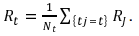
Since Rt are computed by averaging over all transmission networks compatible with observed incidence data, no assumption is made about the time dependence of the epidemic unlike, for example the exponential growth in the well-known Bayesian approach [8,9].
We believe, hence, that this model is particularly suitable to esti¬mate the reproduction number in the post-peak period where the transmission is expected to decrease. All the above data analyses were performed using the R0 package [9] as implemented in the statistical software R (R Core Team; 5 R: A language and environ¬ment for statistical computing. R Foundation for Statistical Com¬puting, Vienna, Austria. URL https://www.R-project.org/], 2017).
Results
The daily incidence of COVID-19 tested positive cases in HK is represented in [Figure 1]. From 2020, January 1st, to 2022, March 1st, HK featured different five pandemic waves. Looking at the smoothed time dependence of effective reproduction number across the waves [Figure 2], we recorded a rather modest varia¬tion with only few events weakly deviating from the control Rt = 1 regime. However, at the beginning of January, 2022 the sudden increase of daily incidence boosted dramatically the fifth wave of epidemic reaching the 50,000 cases in few days, with maximal Rt and smoothed Rt estimated reaching about 3.5 and 2.2, respective¬ly (see also Figure 2).
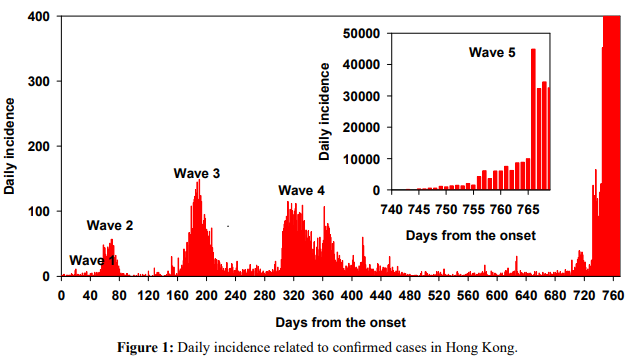
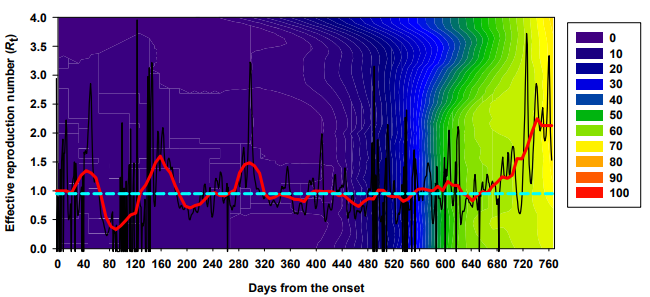
Figure 2: Time evolution of effective reproduction number across the five waves: original series (thinner profile) and moving average smoothing (thicker profile). The false color scale represents the percentage (%) of fully vaccinated people over the total population resident in Hong Kong [7].
Discussion
Based on previous literature, we know that Omicron VOC showed early doubling time consistently shorter than Beta and Delta VOC [12], with a reproduction number expected greater than three times with respect to Delta [13]. However, the Omicron VOC epidemic developed in countries where other VOCs are highly diffused, so it is difficult to derive the contribution of Omicron VOC only from the analysis of cumulative positive cases recorded without an ac¬curate “genomic” tracing able to separate the relative contribution of several VOCs. Hence, only few estimations are available in the literature, based mainly by defining the ratio with respect to Delta VOC or by analyzing small cluster of infected people [14-18].
Despite HK is one of the most densely populated area in the world, before 2022, the effects of restrictive measures imposed by HK government were very satisfactory in limiting the spread of pan-demic, despite the virus mutations [19,14], hence the fifth wave in HK offered a different perspective to evaluate intrinsic epidemio¬logical parameters related to Omicron VOC because it developed from a rather unperturbed zero-covid environment.
In this work, we estimated the reproduction number of Omicron VOC by means of the analysis of the fifth wave of the COVID-19 pandemic in HK, featured since January to February, 2022, deter¬mining and comparing the evolution of time dependent reproduc¬tion number across the five different HK waves in order to obtain the peculiar characteristics of Omicron VOC with respect to the other epidemic waves. We determined for the fifth HK pandemic (highly related to Omicron VOC) a mean Rt approx. 2, in agree¬ment with Kim et al. [20].
Omicron VOC has a growth advantage over the others because of its higher transmissibility, immune evasion, and shorter serial in¬terval [15], which is shorter than or close to its median incubation period [21]. This suggests that a significant amount of secondary transmission may 6 occur prior to the symptomatic disease onset, thus facilitating the epidemic. In the fifth wave of HK, the effective Rt remained persistently high even in a context with relevant full vaccination coverage [22] (see also the “false colors” contour plot in Figure 1), probably due to the scarce effectiveness of BNT162b2 and CoronaVac against Omicron VOC, especially in children and adolescents [23].
Conclusions
The initial stages of the fifth wave of the COVID-19 pandemic in HK, which occurred in January 2022, could be considered as the optimal model for the calculation of the dynamics of Omicron VOC transmission in an environment representative of the fully populated cities of the Asian Pacific coast.
Moreover, on the basis of Rt calculated for Omicron VOC in our work, researchers could refine provisional data for the current out¬break which is affecting China.
Author contributions
Mattia Allieta: conceptualization (lead); data curation (equal); formal analysis (lead); writing original draft (supporting); writ¬ing-review and editing (supporting). Jelena Komloš: data cura¬tion (equal); writing-review and editing (lead). Davide Rossi Se¬bastiano: writing-original draft (lead); supervision (lead).
Funding: This research received no external funding
Conflicts of Interest: Authors declare no conflicts of interest Patients Involvement: No patients were involved
References
- He, X., Lau, E. H., Wu, P., Deng, X., Wang, J., Hao, X., ... &Leung, G. M. (2020). Temporal dynamics in viral shedding and transmissibility of COVID-19. Nature medicine, 26(5), 672-675.
- He, X., Lau, E. H., Wu, P., Deng, X., Wang, J., Hao, X., ... & Leung, G. M. (2020). Author Correction: Temporal dynamics in viral shedding and transmissibility of COVID-19. Nature medicine, 26(9), 1491-1493.
- Silver, A. (2022). Covid-19: China’s president orders Hong Kong to control outbreak.
- World Health Organization. Tracking SARS-CoV-2 variants, 2021 [cited 2021 Nov 27].
- Technical Advisory Group on Virus Evolution statement on the meeting of 3 January on the COVID-19 situation in China
- Allieta, M., Allieta, A., & Rossi Sebastiano, D. (2021). COVID-19 outbreak in Italy: estimation of reproduction numbers over 2 months prior to phase 2. Journal of Public Health, 1-9.
- Mathieu, E., Ritchie, H., Ortiz-Ospina, E., Roser, M., Hasell, J., Appel, C., ... & Rodés-Guirao, L. (2021). A global database of COVID-19 vaccinations. Nature human behaviour, 5(7), 947-953.
- Wallinga, J., & Teunis, P. (2004). Different epidemic curves for severe acute respiratory syndrome reveal similar impacts of control measures. American Journal of epidemiology, 160(6), 509-516.
- Obadia, T., Haneef, R. & Boëlle, PY. The R0 package: a toolbox to estimate reproduction numbers for epidemic outbreaks. BMC Med Inform Decis Mak 12, 147 (2012).
- Britton, T., & Scalia Tomba, G. (2019). Estimation in emerging epidemics: biases and remedies. Journal of the Royal Society Interface, 16(150), 20180670.
- Flaxman, S., Mishra, S., Gandy, A., Unwin, H., Coupland, H., Mellan, T., ... & Bhatt, S. (2020). Report 13: Estimating the number of infections and the impact of non-pharmaceutical interventions on COVID-19 in 11 European countries.
- Karim, S. S. A., & Karim, Q. A. (2021). Omicron SARS-CoV-2 variant: a new chapter in the COVID-19 pandemic. The lancet, 398(10317), 2126-2128.
- Ito, K., Piantham, C., & Nishiura, H. (2022). Relative instantaneous reproduction number of Omicron SARS-CoV-2 variant with respect to the Delta variant in Denmark. Journal of medical virology, 94(5), 2265-2268.
- Kim, D., Jo, J., Lim, J. S., & Ryu, S. J. M. (2021). Serial interval and basic reproduction number of SARS-CoV-2 Omicron variant in South Korea. medRxiv. preprint article, 1-9.
- Backer, J. A., Eggink, D., Andeweg, S. P., Veldhuijzen, I. K., van Maarseveen, N., Vermaas, K., ... & Wallinga, J. (2022). Shorter serial intervals in SARS-CoV-2 cases with Omicron BA. 1 variant compared with Delta variant, the Netherlands, 13 to 26 December 2021. Eurosurveillance, 27(6), 2200042.
- Lee, J. J., Choe, Y. J., Jeong, H., Kim, M., Kim, S., Yoo, H., ...& Park, Y. J. (2021). Importation and transmission of SARS-CoV-2 B. 1.1. 529 (Omicron) variant of concern in Korea, November 2021. Journal of Korean medical science, 36(50).
- Kremer, C., Braeye, T., Proesmans, K., André, E., Torneri, A., & Hens, N. (2022). Observed serial intervals of SARS-CoV-2 for the Omicron and Delta variants in Belgium based on contact tracing data, 19 November to 31 December 2021. MedRxiv, 2022-01.
- Nishiura, H., Linton, N. M., & Akhmetzhanov, A. R. (2020). Serial interval of novel coronavirus (COVID-19) infections. International journal of infectious diseases, 93, 284-286.
- Lou, J., Zheng, H., Zhao, S., Cao, L., Wong, E. L., Chen, Z., ... & Wang, M. H. (2022). Quantifying the effect of government interventions and virus mutations on transmission advantage during COVID-19 pandemic. Journal of Infection and Public Health, 15(3), 338-342.
- Matus, K., Sharif, N., Li, A., Cai, Z., Lee, W. H., & Song, M. (2023). From SARS to COVID-19: the role of experience and experts in Hong Kong’s initial policy response to an emerging pandemic. Humanities and Social Sciences Communications, 10(1), 1-16.
- Boucau, J., Marino, C., Regan, J., Uddin, R., Choudhary, M. C., Flynn, J. P., ... & Barczak, A. K. (2022). Duration of viable virus shedding in SARS-CoV-2 omicron variant infection (preprint).
- Davido, B., Dumas, L., & Rottman, M. (2022). Modelling the Omicron wave in France in early 2022: Balancing herd immunity with protecting the most vulnerable. Journal of Travel Medicine, 29(3).
- Leung, D., Rosa Duque, J. S., Yip, K. M., So, H. K., Wong,W. H., & Lau, Y. L. (2023). Effectiveness of BNT162b2 and CoronaVac in children and adolescents against SARS-CoV-2 infection during Omicron BA. 2 wave in Hong Kong. Communications Medicine, 3(1), 3.