

Journal of Electrical Electronics Engineering(JEEE)
ISSN: 2834-4928 | DOI: 10.33140/JEEE
Impact Factor: 1.2


Review Article - (2026) Volume 5, Issue 2
Emission & Absorption of Photons (Electric Charge & Speed of the Extended Electron in Electric Field)
Received Date: Feb 10, 2026 / Accepted Date: Mar 16, 2026 / Published Date: Mar 25, 2026
Copyright: ©2026 Hoa Van Nguyen. This is an open-access article distributed under the terms of the Creative Commons Attribution License, which permits unrestricted use, distribution, and reproduction in any medium, provided the original author and source are credited.
Citation: Nguyen, H. V. (2026). Emission & Absorption of Photons (Electric Charge & Speed of the Extended Electron in Electric Field). J Electrical Electron Eng, 5(2), 01-04.
Abstract
The subject of “ Emission & Absorption of Photons “ has plenty of topics to be discussed. This article restricts its discussion to this specific topic: how the emission & absorption of photons affect the electric charge and speed of the extended electron when it is subject to an applying electric field E.
Introduction
Recall of the Extended Model of the Electron
A New Interpretation of the Processes of Emission & Absorption of Photons
The extended electron is assumed to be a spherical particle consisting of a negatively charged core (-q0), surrounded by a cloud of static electric dipoles (+q, -q) [1]. This figure of the extended electron is a version of the electron that is screened by a cloud of virtual pairs (e-, e+) in the concept of vacuum polarization of QED, as shown in Figure 1.

Figure 1: The electron is screened by virtual pairs (e-, e+) in the concept of vacuum polarization of QED. We notice that this figure describes the change of the effective (apparent) electric charge of the electron by the external physical condition: it may be the distance between charged particles (or equivalently, the strength of the applying field). In the version, i.e., in the extended electron, the virtual pairs (e-, e+) are replaced by real static electric dipoles. (+q, -q) which surround the core (-q0).
In previous articles, we have proved that when the extended electron is subject to an external electric / magnetic field, electric or magnetic forces are developed on the point charges -q0, -q, +q of the electron to give rise to various features of the electron such as the spin, radiation, and change of the effective charge Q [2,3].In these articles, a new interpretation of the process of emission and absorption of photons has been introduced as follows:
The emission of photons of the electron means it emits its electric dipoles (+q, -q) outwards. That is, the electric dipoles that surround the core (-q0) are identified as photons after they are emitted from the surface of the electron; and thus, photons are tiny static electric dipoles (+q, -q) that construct the electron. And since photons are electric dipoles, they can be attracted by the self electric field of the electron. We already knew the fact that electric dipoles are pulled (attracted) into the stronger region of an inhomogeneous electric field: this is how the electric field of the electron can absorb photons from the surrounding space or from the irradiating source. Therefore, in this article we will accept the innovative idea that when the electron emits photons, it loses some of its electric dipoles; and when it absorbs photons, it gains more electric dipoles from the irradiating source.
With this new interpretation of the process of emission and absorption of photons, we will demonstrate how they affect the effective charge and speed of the electron when it moves in an external electric field So, the topic of this article is: The change of electric charge and speed of the electron when it emits & absorbs photons in the external electric field E.
We will try to prove two following statements:
When the electron emits (radiates) photons: the magnitude |Q| of its effective electric charge increases to q0, and the electron slows down (i.e., it loses energy). (1)
When the electron absorbs photons: |Q| decreases to zero, and the electron speeds up (i.e., it gains energy). (2)
The reasoning will go through three steps:
First, we prove that the emission and absorption of photons of the electron are linked to the physical factor ‘a’, which represents the physical structure of the extended electron. (3)
In second and third steps: we prove that this physical factor ‘a’ has mathematical relationship with the effective electric charge and speed of the electron. (4)
• First step: the Change of Factor ‘a’ in the Emission & Absorption of Photons
First, let ‘s recall some expressions derived from the extended electron when it is subject to an external electric field E [4]: Two electric forces F and F’ are produced on the electron:
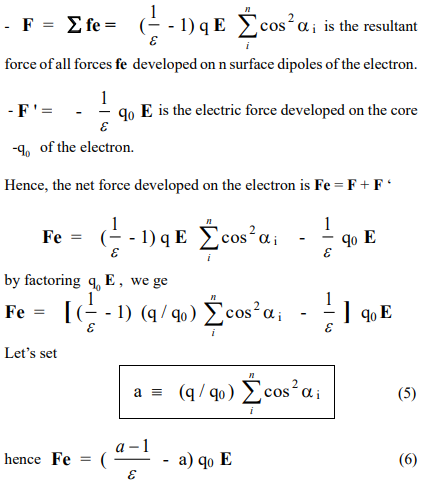
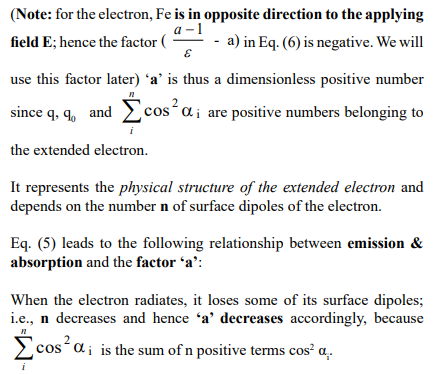
Therefore, in the emission of photons: n decreases, hence ‘a’ decreases (7)
Conversely, when the electron absorbs photons, it gains more surface dipoles; i.e., n increases and hence ‘a’ increases accordingly.
Therefore, in the absorption of photons: n increases, hence ‘a’increases (8)
This is the first step of reasoning: we have linked the emission and absorption of photons to the physical factor ‘a’ by two expressions (7) and (8)
• Second Step: The Change of the Effective Charge |Q| in the Emission & Absorption of Photons
Now, we move to the second step, we will relate the factor ‘a’ to the effective charge Q of the electron.
From Eq. (6) we can deduce the effective electric charge Q of the electron (since Fe = Q E):
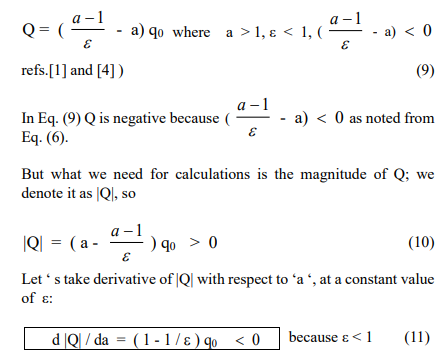
From Eq. (11) we conclude that |Q| is monotonic decreasing with respect to the factor ‘a’. This means that, if ‘a’ increases, |Q| decreases; and if ‘a’ decreases, |Q| increases. This is the result of the second step.
By combining the first and second steps, we come to two results:
• In the emission of photons: ‘a’ decreases (first step), |Q| increases (second step) (12)
• In the absorption of photons: ‘a’ increases (first step), |Q| decreases (second step) (13)
• Third Step: The Change of the Speed of the Electron in the Emission & Absorption of Photons
Finally, the third step will complete the reasoning; we will show that
• In the emission of photons: the electron slows down
• In the absorption of photons: the electron speeds up.
Let us recall that in the previous article entitled “ Electron’s mass and electric charge, which one changes with velocity? “ we have obtained the general expression for the effective electric charge |Q| of the electron when it is subject to an applying field that is represented by the real number N ≥ 0 [5].
The chart shows the magnitude of the electric charge of the electron in function of the speed for various values of N.
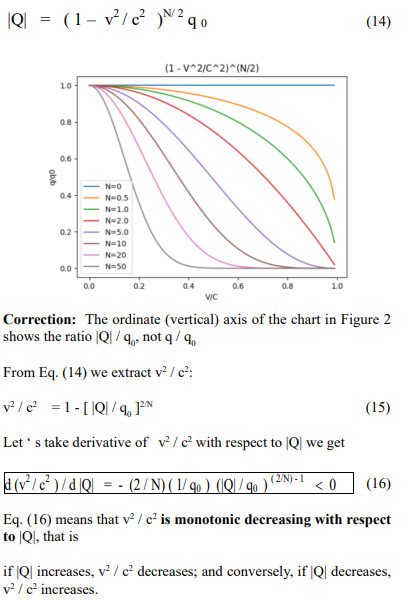
This is the result of the third step. In short, by combining these three steps, we get
• In the emission of photons: ‘a’ decreases (first step), |Q| increases (second step) and v2 / c2 decreases (third step), i.e., the electron slows down. (17)
• In the absorption of photons: ‘a’ increases (first step), |Q| decreases (second step) and v2 / c2 increases (third step), i.e., the electron speeds up. (18).
Summary
First let’s talk about the factor ‘a’ defined by Eq. (5). It originates from the net electric force Fe (Eq. (6) which is produced on the extended electron. Since it changes with the number n of surface dipoles of the electron, it can be used to relate other physical quantities like electric charge or speed of the electron to the emission (radiation) and absorption of photons. Two expressions (7) and (8) in the first step are new statements which did not exist in the mainstream physics.
Next is the change of the effective electric charge of the electron. Nowhere in the mainstream physics do physicists talk about the changeability of the electric charge of the electron: they are determined that it is a fundamental constant of physics, and this is because the electron is a solid point charge! But in the theory of the extended electron, the electron is assumed to have a core (-q0) surrounded by a cloud of static electric dipoles (+q, -q). When exerted upon by an external field, these dipoles change their polarization (orientation), cause a change in the permittivity ε or in the permeability μ of the electron and hence, a change in its electric charge. In the emission & absorption of photons, the change of the factor ‘a’ is the cause of change in the electric charge. Both ε and ‘a’ are present in Eq.(10): this means that the electric charge can be changed by the applying field or by the emission or absorption of photons.
Eq. (10) and Eq. (14) and its chart (Figure 2) are innovative findings of the theory of the extended electron.
Last but not least, let’s talk about the change of the speed of the electron in the process of emission & absorption. Physicists have long revealed that electrons that radiate in the accelerators slow down and electrons in the photoelectric effect speed up. So, the result of the third step is not a new discovery it simply shows that the change of speed of the electron in the emission and absorption can be proved by using equations and expressions deduced from the extended model of the electron. This means that the model is meaningful and suitable for explaining the mechanism of the emission and absorption of photons of the electron [6] .
Appendix
Emission & Absorption of Photons: Part 2: Electric Charge & Speed of the Extended Electron in Magnetic Field To complete the topic of “Emission & Absorption of Photons” I invite the readers who are interested in this subject to read its part 2 at the website www.vixra.org/author/hoa_van_nguyen, in which you can also find other subjects on the extended model of the electron [7].
References
- https://vixra.org/abs/1305.0025.
- Van Nguyen, H. Extended Electron in Time-Varying Magnetic Field: Spin & Radiation.
- Van Nguyen, H. (2013). Extended Electron in Time-Varying Magnetic Field: Spin & Radiation.
- Van Nguyen, H. (2013). Extended Electron in Constant Electric Field.
- Van Nguyen, H. Electron’s Mass and Electric Charge, which one changes with velocity?.
- Van Nguyen, H. (2023). Visualizing Spin & Radiation of the Extended Electron in Electric Field (Emission & Absorption of Photons). Journal of High Energy Physics, 9, 897-911.
- Van Nguyen, H. (2024). A Fundamental Problem in Physics:(Mass vs Electric Charge). Applied Sciences Research Periodicals, 2(9), 48-57.