

Advancements in Journal of Urology and Nephrology(AJUN)
ISSN: 2689-8616 | DOI: 10.33140/AJUN
Impact Factor: 1.0


Research Article - (2019) Volume 1, Issue 1
Effects of Curcuma Longa and Galega Orientalis Herbal Remedies on Homeostatic Renal Functions in Rats with Diabetes Mellitus and Acute Renal Failure
2Institute of Solid State Chemistry and Mechanochemistry of Siberian Branch of Russian, Academy of Sciences 2, Kutateladze, Novosibirsk, 630128, Russia
3Novosibirsk Scientific Research Institute of Hygiene, 7, Parchomenko Str., Novosibirsk, 630108, Russia
Received Date: Feb 01, 2019 / Accepted Date: Feb 07, 2019 / Published Date: Feb 25, 2019
Copyright: ©Aizman Roman I, et al. This is an open-access article distributed under the terms of the Creative Commons Attribution License, which permits unrestricted use, distribution, and reproduction in any medium, provided the original author and source are credited.
Abstract
Aim: To study the effects of phytopreparations Curcuma longa and Galega orientalis on homeostatic renal functions in rats with diabetes mellitus (DM) and acute renal failure (ARF) models.
Materials and methods: The experiments were performed in 2 series on male Wistar rats (n = 60) with a model of diabetes mellitus (the 1-st one) and acute renal failure (the 2-nd one). In both series, the animals were divided into 3 groups: rats of the 1-st group were kept on standard feed, the rats of the other groups were got additionally to the feed turmeric (the 2-nd group) or galega (the 3-d group) (2% of feed weight). On the 3-d day of the experiment, the study of diuretic and ionuretic renal functions on an empty stomach and after water loading was performed. The concentration of ions in urine and plasma was determined by flame photometry; osmotic concentration of biological fluids - by cryoscopy; blood biochemical parameters– by colorimetric method.
Results: In diabetic against both at the background and following water loading polyuria compared to the control animals was observed. Intake of Curcuma longa resulted in a slight decrease of polyuria, but an increase in the Na+ and K+ concentration in the urine. It has been shown that turmeric and galega have a hypoglycemic effect and contribute to the normalization of plasma homeostatic parameters by improving the functional state of the kidneys. This effect was most pronounced following turmeric intake. In rats with acute renal failure both phytopreparations did not cause the changes in renal functions.
Conclusion: Phytopreparations of turmeric and galega in diabetes have a hypoglycemic effect, contribute to the normalization of plasma homeostatic parameters and improve the functional state of the kidneys. In acute renal failure, these herbal remedies have almost no effect on osmotic and ion-regulating responses
Keywords
Diabetes Mellitus, Acute Renal Failure, Homeostasis, Phytopreparation, Curcuma Longa, Galega Orientalis
Introduction
At the present stage, an increase in the growth of renal pathology is a global medical, economic and social problem. Kidney diseases have a special place among all non-infectious diseases, since they tend to spread, lead to deterioration in the quality of life of patients, high mortality and the need for dialysis or transplantation [1].
Around the world, an increase in the number of patients suffering from renal pathology is observed annually in both adults and children, that is a serious public health problem. According to official data, the number of urinary tract diseases in the Russian Federation has increased by 30% over the past decade. The number of patients per one hundred thousand of population averages 11,000 [2,3].
One of the pathologies leading to the occurrence of renal failure is diabetes mellitus (DM). This disease, as a rule, occurs over a rather long period of a person’s life and requires constant monitoring and correction. Despite the rich history of its study and the success in treatment, diabetes is of interest to many researchers because of its progressive increase in the incidence of both type 1 and type 2 [4]. By 2040, the number of people with diabetes aged 20–79 years is projected to increase to 642 million [5].
The greatest danger of diabetes, of course, is associated with complications that develop due to its damaging effects on the vessels. Diabetic nephropathy occupies an important place in this series, which develops in approximately 20.1% of patients with type 1 diabetes and 6.3% of patients with type 2 diabetes [6].
Based on the complexity and high cost of treatment of these pathologies, prevention and development of available methods for correcting and rehabilitating therapy remain the leading direction. A promising approach in this direction is the use of plant origin remedies [7,8].
Analysis of the literature has allowed to establish that herbal medicines have a complex effect on the pathological process, provide the possibility of long-term use without significant side effects, are relatively inexpensive, that has undoubted advantages [9].
Replenishment of the range of medicines, which would contain highly active biological compounds of plant origin, is an important task, since the demand for them is growing rapidly. Among them, plants containing polyphenols (flavonoids, phenol carboxylic acids, caffeic acid metabolites such as rosmarinic and lithospermic acids, tannins, coumarins, etc.) deserve special attention, for example, such as Curcuma longa and Galega orientalis [10].
There is enough data in the literature on the broad biological effects of turmeric (antimicrobial, anti-inflammatory, antioxidant, immunomodulatory, hypolipidemic, anti-cancer, etc. and galega (diaphoretic, antihelminthic, hypoglycemic, hypertensive, antioxidant, etc. [11-13]. However, the physiological mechanisms of the action of these herbal remedies on different mechanisms of the regulation of water-mineral and carbohydrate balance in norm and pathology have not been studied yet (eastern galega) or have not been studied enough (turmeric) [14-16].
Therefore, the aim of this study was to evaluate the effect of long turmeric and eastern galega on the homeostatic functions of the kidneys in rats with alloxan-induced diabetes and experimentally induced acute renal failure.
Material and methods
To assess the effectiveness of using these phytopreparations in the normalization of renal function in diabetes and ARF, experiments were performed in 2 series on adult male Wistar rats (n = 60). In the first series, the animals were simulated DM, for which rats were injected in the interscapular area with 10% alloxan solution at a rate of 0.1 ml / 100 g body weight. To create a model of ARF, animals of the second series were injected into the femoral muscles of both extremities with 50% glycerol solution at the rate of 1 ml / 100 g of body weight [17]. In both series, all animals were divided into 3 groups: receiving standard feed (1st group) and additionally supplements in the amount of 2% by weight of feed in the form of turmeric powder (2nd group) or galega (3rd group). In addition, a general control group consisting of intact animals on a standard diet was studied. The number of animals in each group is presented in table 1.
Table 1: Type of experiment and the number of animals in groups
|
Experimental model |
Standard food |
Standard food + Turmeric |
Standard food + Galega |
|
Control |
10 |
|
|
|
Diabetes mellitus |
6 |
7 |
8 |
|
Acute renal failure |
9 |
10 |
10 |
Herbal preparations were obtained by mechanochemical treatment on the basis of the Institute of Solid State Chemistry and Mechanochemistry of Siberian Branch of RAS.
All groups of animals were in standard vivarium conditions without restriction of water and food intake.
On the 7th day of the experiment, kidney function was studied by analyzing background urine samples collected in exchange cells for 3-5 hours of observation, as well as an assessment of the renal response to oral administration of 5% of the body weight of the water load. Urine samples after water loading were collected for 3 hours. At the end of the experiment, from animals under ether anesthesia blood samples in a volume of 5 ml from the inferior vena cava were collected in chilled and treated with sodium-free heparin tubes for subsequent physico-chemical analysis of plasma. The content of the main metabolites in the blood plasma, reflecting the functional state of the kidneys (creatinine, urea), triglycerides were determined by the colorimetric method (analyzer “BS – 200E”, China); glucose - by electrochemical method (“Super GL”, Dr. Muller, Germany), the concentration of electrolytes in urine and plasma (Na +, K +) was measured by flame photometry (BWB-XPF Flame Photometer, United Kingdom); Osmolarity of these biological fluids - by cryoscopy method (Osmomat milliosmometer, Germany).
The calculation of water and ion-excretion functions of the kidneys was performed according to the generally accepted formulas [18].
Statistical analysis of the results was carried out on the basis of determining the arithmetic means (M) and their errors (± m). The significance of differences was assessed by the non-parametric Wilcoxon-Mann-Whitney test for independent samples and the Student’s t-test for dependent values at a significance level ≤ 0.05. The calculations were made according to the generally accepted formulas using the standard programs of the Excel 2010 package.
All experiments were performed in accordance with the International recommendations for conducting biomedical research using animals, adopted by the International Council of Scientific Societies in 1985, with Art. ХI Helsinki Declaration of the World Medical Association (1964) and the rules of laboratory practice in the Russian Federation (Order of the Ministry of Health of the Russian Federation dated June 19, 2003, No. 267).
Results and Discussion
To characterize the functions of the kidneys, essential information is provided by homeostatic blood parameters, which reflect the functional reserve capabilities of the organ as the main effector of the homeostasis regulation system [18]. As a rule, such indicators are indicators of water-mineral, protein, to a lesser extent, carbohydrate and fat metabolism. Therefore, at the first stage of work, we analyzed the biochemical blood parameters in rats with experimental models of diabetes and acute renal failure in dormant conditions in the morning on an empty stomach and after 7 days of intaking turmeric or galega (Table 2). As can be seen from table 2, in both series of experiments, the concentration of creatinine in plasma was significantly increased compared with the control. At the same time, under the conditions of diabetes, both herbal remedies contributed to its decrease, whereas with ARF, the concentration of the metabolite did not change in all groups and was significantly higher than the control.
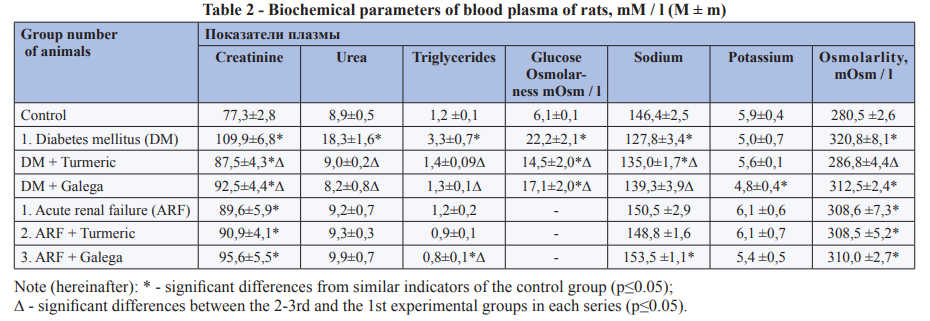
Various changes in the homeostatic parameters of blood plasma were also observed in other indicators. Thus, in diabetes, the concentration of urea, triglycerides, glucose and osmolarity also increased, while the concentration of sodium decreased. Acceptance of phytopreparations contributed to the normalization of most of these parameters and a decrease in glucose concentration, especially after turmeric intake. In case of ARF, plasma concentration shifts were less pronounced, and mainly concerned osmolarity enhancement. Intake of both phytopreparations did not cause any changes in the studied parameters in comparison with the pure model of ARF.
The obtained data on homeostatic changes in the blood plasma with both models of violations dictated the need to assess the osmotic and ion-regulating functions of the kidneys in diabetes and ARF. Since the most distinct reserve capacity of an organ is revealed in the conditions of water-salt loading tests, we analyzed the renal functions of rats in resting conditions on an empty stomach and after 5% water load (Tables 3 and 4) [19-21].
Table 3: Diuretic and ionuretic kidney function in rats with a model of alloxan-induced diabetes mellitus after intake of phytopreparations Curcuma longa (C) and Galega officinalis (G) on the background of spontaneous urination (background) and after 5% water load
|
Parameter |
Animal groups |
|||
|
Control |
DM |
DM + C |
DM +G |
|
|
Background |
|
|
|
|
|
V, ml/100g*hour |
0,29±0,04 |
1,52±0,30* |
0,73±0,20* |
0,52±0,13*+ |
|
GFR, ml/100g*hour |
8,6±1,9 |
9,2±2,9 |
6,5±2,1 |
6,7±2,4 |
|
%RH2O,% |
97,1±0,1 |
80,9±2,3* |
90,6±1,4* |
78,9±3,8* |
|
U/Posm |
2,8±0,1 |
3,2±0,1* |
2,7±0,2 |
3,4±0,2* |
|
ÃÃÃÂ??ÂÃÂ?¡osm, ml/100g*hour |
0,80±0,1 |
4,90±0,1* |
1,90±0,5*+ |
1,90±0,5*+ |
|
CH2O, ml/100g*hour |
-0,70±0,1 |
-3,40±0,8* |
-1,30±0,3*+ |
-1,40±0,4*+ |
|
UNaV, mcM/100g*hour |
11,1±1,4 |
32,2±5,8* |
16,0±3,6+ |
7,3±2,3+ |
|
EFNa, % |
0,9±0,1 |
3,2±0,6* |
1,2±0,2+ |
1,8±0,3*+ |
|
UKV, mcM/100g*hour |
14,7±1,9 |
39,1±7,8* |
17,9±3,9+ |
13,3±2,6+ |
|
EFK, % |
24,0±1,2 |
76,2±5,7* |
39,8±5,1*+ |
52,8±9,8*+ |
|
Following 5% of body weight water loading |
||||
|
V, ml/100g*hour |
1,35±0,06# |
0,95±0,10# |
0,93±0,20* |
0,59±0,13 |
|
GFR, ml/100g*hour |
11,7±2,3# |
9,2±2,1 |
5,6±0,7*+ |
3,7±0,1*+ |
|
%RH2O,% |
88,1±0,2# |
88,7±2,2# |
84,1±4,1 |
82,6±1,9*+ |
|
U/Posm |
0,6±0,1 |
3,3±0,6* |
1,9±0,3#*+ |
1,1±0,1#*+ |
|
ÃÃÃÂ??ÂÃÂ?¡osm, ml/100g*hour |
0,80±0,1 |
4,4±0,6* |
0,9±0,5+ |
0,7±0,2+# |
|
CH2O, ml/100g*hour |
0,70±0,1 |
-3,5±0,5* |
-0,2±0,4+# |
-0,2±0,1#*+ |
|
UNaV, mcM/100g*hour |
5,1±0,9 # |
6,6±1,4# |
9,5±1,5#* |
8,6±2,1 |
|
EFNa, % |
0,3±0,1# |
0,6±0,2# |
1,2±0,2*+ |
1,4±0,2*+ |
Notes:
# - significant differences from background
+ - significant differences from the group of diabetes
* - significant differences from control
Analysis of the diuretic kidney function in the background showed that rats with diabetes had a significantly higher level of urination than healthy animals due to reduced fluid reabsorption. This is consistent with experimental and clinical observations of polyuria in diabetic patients due to osmotic diuresis (in our study, the osmotic concentration index U / Posm increased, Cosm increased 6 times, and the excretion of free osmotically water CH2O decreased 5 times) [22]. In parallel with the increase in fluid output, the excretion of sodium and potassium increased, which also increased the osmotic clearance. This was due to a decrease in electrolyte reabsorption in the renal tubules, as evidenced by a significant increase of the excreted cation fraction (EFNa and EFK). Intake of phytopreparations contributed to the reduction of the described changes in renal functions, especially after intake of turmeric as compared with galega. Thus, smaller homeostatic shifts in blood plasma in rats with diabetes following phytopreparations intake (Table 2) was undoubtedly due to partial normalization of the kidney functions.
After the water load, a smaller reserve capacity of the osmotic and ion regulating mechanisms in animals with diabetes was revealed. If intact rats developed a pronounced diuretic response with excretion of osmotically free fluid (CH2O became positive) and more pronounced inhibition of its re absorption (% RH2O was reached 88.1%), then with diabetes there was a paradoxical reaction - a diuresis decrease compared to background and an increase in liquid reabsorption without significant changes in osmoregulatory processes. In the control, the excretion of sodium decreased in response to fluid intake (osmotic regulation), and that of potassium increased, while the excretion of both cations was observed in diabetes. Phytopreparations had no significant effect on the ionouretic response.
Thus, turmeric, and to a lesser extent, galega at rest contributed to the reduction of impaired osmotic and ion-regulating functions of the kidneys in diabetes; however, after a water load, these effects were much less pronounced, which may be due to the insufficient reserve mechanisms necessary for the normalization of the renal response.
To substantiate this hypothesis and test the effectiveness of herbal remedies at the next stage, we investigated the renal function in case of acute renal failure (Table 4), when part of the nephrons no longer function, and thus the organ’s reserve capacity was initially reduced.
Table 4 - Diuretic and ionuretic kidney functions in rats with a model of acute renal failure after intake of herbal remediesCurcuma longa (C) and Galega officinalis (G) on the background of spontaneous urination and after 5% water load
|
Parameter |
Animal groups |
|||
|
KOH |
ARF |
ARF + C |
ARF + G |
|
|
Background |
||||
|
V, ml/100g*hour |
0,29±0,04 |
0,28±0,5 |
0,25±0,05 |
0,51±0,05*+ |
|
GFR, ml/100g*hour |
8,6±1,9 |
6,5±1,5 |
7,9±1,6 |
7,7±1,5 |
|
%RH2O,% |
97,1±0,1 |
94,6±1,0 |
95,2±0,1 |
92,9±2,7* |
|
U/Posm |
2,8±0,1 |
2,8±0,4 |
3,3±0,5 |
2,6±0,4 |
|
ÃÃÃÂ??ÂÃÂ?¡osm, ml/100g*hour |
0,80±0,1 |
0,70±0,1 |
0,80±0,1 |
1,30±0,3*+ |
|
CH2O, ml/100g*hour |
-0,70±0,1 |
- 0,43±0,08* |
-0,49±0,1* |
-0,60±0,1 |
|
UNaV, mcM/100g*hour |
11,1±1,4 |
7,4±1,9* |
13,9±2,0+ |
12,4±3,0 |
|
EFNa, % |
0,9±0,1 |
0,8±0,2 |
0,9±0,1 |
0,8±0,1 |
|
UKV, mcM/100g*hour |
14,7±1,9 |
49,3±10,9* |
44,2±6,9* |
39,6±6,3* |
|
EFK, % |
24,0±1,2 |
46,5±7,5* |
53,7±10,1* |
70,6±14,9* |
|
Following 5% of body weight water loading |
||||
|
V, ml/100g*hour |
1,35±0,06# |
0,62±0,15#* |
0,52±0,16#* |
0,53±0,11* |
|
GFR, ml/100g*hour |
11,7±2,3# |
2,1±0,2*# |
1,2±0,6*# |
2,2±0,5 |
|
%RH2O,% |
88,1±0,2# |
76,5±4,6*# |
66,0±1,0*# |
80,2±2,3*# |
|
U/Posm |
0,6±0,1 |
0,8±0,1# |
0,5±0,1# |
0,7±0,1# |
|
Cosm, ml/100g*hour |
0,76±0,1 |
0,44± 0,1*# |
0,26±0,1* |
0,29±0,1*# |
|
CH2O, ml/100g*hour |
-0,70±0,1 |
0,10±0,1*# |
0,26±0,1*# |
0,18±0,1*# |
|
UNaV, mcM/100g*hour |
5,1±0,9 # |
3,6 ± 0,9# |
2,9 ±0,9# |
2,9 ± 0,6# |
|
EFNa, % |
0,3±0,1# |
1,1±0,3* |
5,1 ±0,1*+# |
0,7±0,1* |
Notes:
# - significant differences from background
+ - significant differences from the group with acute renal failure
* - significant differences from control
As can be seen, in rats with ARF there were no marked differences in the diuretic and ionuretic renal functions compared with the control (only a tendency towards a decrease in GFR and fluid reabsorption, as well as a significant increase in the osmotically free water and potassium excretion). At this stage, phytopreparations practically did not cause any changes in the renal reaction compared with ARF. After water load, the urine output level increased in all animals, however, in the experimental groups it was significantly less than in the control, which indicated a decrease in the functional reserves of the kidney diuretic function. Moreover, the GFR was even lower than in the background, but there was a greater inhibition of % RH2O and an increase in the excretion of osmotically free water. This was accompanied by a decrease in the output of sodium, potassium, and osmotically active substances, which was important for maintaining osmotic homeostasis while reducing diuretic response. However, the observed increase in plasma osmolarity in acute renal failure rats (Table 2) indicated a functional failure of the rat’s renal reaction to maintain this parameter. As a result of renal functional reserves decrease during acute renal failure, herbal remedies had practically no effect on the osmotic and ion-regulating functions of the kidneys that led to ion-osmotic shifts in plasma.
Discussion
Today, despite the great interest of specialists of different profiles to herbal medicine, there is not enough data in the literature describing the physiological mechanisms of the action of Turmeric and Galega orientalis rhizome powder on osmotic and ion-regulating functions of the kidneys at diabetes mellitus and renal failure [23,24]. Considering the progressive growth of these pathologies and the occurrence of complications on their background, as well as the lack of effective treatment methods, it became necessary to search for new promising means of correction that normalize homeostasis at various disorders. It is known that creatinine is the main indicator of the renal functional state, therefore, analyzing these data, it was possible to conclude that turmeric and galega contributed to some improvement in the functions of the organ only at diabetes and had no effect at acute renal failure. This was also confirmed by data of urea and triglycerides concentration in animals in different groups. Changes in the concentration of glucose in the blood of animals with alloxan-induced diabetes indicated, firstly, the development of pathology after injection of the drug, and, secondly, the hypoglycemic effect of turmeric and galega. It is extremely important for further study of the mechanism of their action, along with the existing already the results of turmeric effects [25]. It was previously shown that oral intake of turmeric rhizome powder caused a decrease in blood glucose concentration in both healthy and diabetic animals due to a decrease in glucose absorption in the small intestine, inhibition of the activity of Na + -glucose cotransporter, an increase in glycogen content in the liver, and an increase in insulin and C-peptide and a decrease in plasma corticosterone concentration, as well as due to the partial regeneration of the β-cells of the islets of Langerhans [26]. It should be noted that these phytopreparations used for the correction of diabetes and ARF in this work differed in their chemical properties from whole, natural plants due to the chemical characterization with liquid-phase extraction and mechanochemical processing. Therefore, they contain presumably such active substances as curcumin and galegin, which probably increased their biological activity and, consequently, their effectiveness. The second experimental pathology model (ARF) studied in this work was interesting because when it was created, a large number of nephrons were “turned off” by obstructing the latter with glycerol molecules; in addition, massive lipid peroxidation of cell membranes by myoglobin occurred that also formed clots in the tubules of the nephrons, blocking them [27,28].
It is known that the water load stimulates the inclusion of reserve nephrons, thereby increasing the excretion of fluid [29]. Under the conditions of this model, ARF was important to find out how much herbal remedies can help restore nephron functions due to “switching on” reserve nephrons, preventing lipid peroxidation, speeding up the splitting and utilization of glycerol molecules, or in some other way.
The lack of a renal effect from the use of these herbal remedies indicates the inexpediency of their use in the conditions of this pathology, which is important for nephrologists. Phytodrugs of Curcuma longa and Galega orientalis can be considered as promising nutritional supplements for the correction of homeostasis in diabetes due to their hypoglycemic effect and influence on the homeostatic function of the kidneys (especially turmeric), while in case of ARF, the use of these herbal remedies is inappropriate.
Conclusion
Thus, the analysis of the obtained material allows us to conclude that phytopreparations Curcuma longa and Galega orientalis have a hypoglycemic effect in diabetes and contribute to the normalization of plasma homeostatic parameters due to the improvement of the functional state of the kidneys, especially at rest. To a greater extent, this effect is manifested following turmeric intake. In acute renal failure, as a result of impaired renal function, especially GFR, and reduced reserve capacity, these herbal remedies practically did not have effect on osmotic and ion-regulation response, which was manifested in homeostatic shifts in plasma and parameters of renal response at rest and after water load.
References
- Vyalkova AA, Gricenko VA (2017) Urinary tract infection in children: modern aspects of etiological diagnosis and treatment. Russian journal of Perinatology and Pediatrics 1: 99-108.
- Gerasimova OYu, Semchenko LN (2016) Remenec S.S. Epidemiology of chronic kidney disease and organization of medical care for patients with chronic renal failure (literature review). South Ural medical journal 4: 4-9.
- Kuprienko NB, Svetlova ZV, Smirnova NN (2017) Metabolic bases of prevention of urinary system infection in children. Scientific notes of the St. Petersburg state medical University named after academician I.P. Pavlov 24: 22-27.
- International Diabetes Federation. IDF Diabetes Atlas Eighth Edition [Internet]. 2015; 7. [cited 09.12.2018] Available from: http://www.diabetesatlas.org.
- Ogurtsova K, da Rocha Fernandes JD, Huang Y, Linnenkamp U, Guariguata L, et al. (2017) IDF Diabetes Atlas: Global estimates for the prevalence of diabetes for 2015 and 2040. Diabetes Res Clin Pract 128: 40-50.
- Dedov II, Shestakova MV, Vikulova OK (2017) Epidemiology of diabetes in the Russian Federation: clinical and statistical analysis according to the register of diabetes. Diabetes 20: 13-41.
- Nikolaev SM, Matkhanov IE, Korsun VF (2017) Systemic action of herbal medicines for diseases. Practical herbal medicine 2: 29-33.
- Savateeva-Lyubimova TN, Sivak KV (2012) Comparative assessment of the toxic effects of drugs on intact animals and in conditions of modeling pathological conditions. Biomedicine 4: 76-79.
- Tkachuk VN, Al’-SHukri SH, Ammo Rizan (2011) Experience with the use of herbal medicine in patients with nephrolithiasis after extracorporeal shock wave lithotripsy. Urology 5: 8-10.
- Ermolenko TI (2014) Prospects for the use of phytopreparations in the treatment of urolithiasis. Scientific Bulletin, Series: Medicine. Pharmacy 27: 205-211.
- Babu PS (1997) Hypolipidemic action оf curcumin, the active principle of turmeric (Curcuma longa) in streptozotocin induced diabetic rats. Mol Cell Biochem 166: 169-175.
- Gonzalea-Andres F, Redondo P, Pescador R, Urbano B (2004) Management of Galega officinalis L. and preliminary results on its potential for milk production improvement in sheep. New Zeland Journal of Agricultural Research 47: 233-245.
- Ostanova NA, Pryachina NI (2003) Some farmacological properties of the aerial parts Galega officinalis L. and G. orientalis Lam. Plant resources 39: 119-129.
- Yakimova TV, Uhova TM, Burkova VN, Arbuzov AG, Mozzhelina TK, et al. (2005) Hypoglycemic effect of the extract from Galega officinalis (Fabaceae), cultivated in the Altai. Plant resources 41: 134-138.
- Aizman RI, Koroschenko GA, Gerasev AD, Gaidarova AP (2014) The use of non-medicinal drugs for the correction of carbohydrate and water-mineral balance in case of its violations. Novosibirsk, NGPU 90.
- Aizman RI, Koroshchenko GA, Gajdarova AP, Sakharov AV, Subotyalov MA (2014) The mechanisms of Curcuma longarhizome action on glucose metabolism in Alloxan-induced diabetic rats. International Ayurvedic Medical Journal 2: 752-760.
- Shustin L, Wald H, Popovtzer MM (1998) Role of down-regulated CHIF mRNA in pathophysiology of hyperkalemia of acute tubular necrosis / Amer. J Kidney Diseases 32: 600-604.
- Natochin YuV (1974) Physiology of the kidney: Formulas and calculations. Leningrad: Publishing House Science 60.
- Vander A (2000) Physiology of the kidneys. St. Petersburg: Publisher “Peter” 256.
- Aizman RI, Velikanova LK (1980) Evaluation of water-salt metabolism and kidney function using stress tests. In: New Methods of Scientific Research in Clinical and Experimental Medicine, Novosibirsk: NGMI 5-13.
- Velikanova LK, Aizman RI, Abaskalova NP (1997) Reserve features of the kidneys and water-salt homeostasis. Novosibirsk: NGPU publishing house 165.
- Natochin YuV Diabetes: the functional state of the kidney. Diabetes 1: 22-27.
- Muruev BA, Razuvaeva YG, Toropova AA (2018) Structural changes in the thymus of white rats on the background of immobilization stress and their correction with herbal remedies. Morphology 153: 191-192.
- Tishkovets SV, Mondodoev VG, Razuvaeva YaG, Toropova AA, Tsydendambaev PB (2017) The effect of complex herbal remedies on the functional state of the thyroid gland of white rats with experimental hypothyroidism. New and unconventional plants and prospects for their use 12: 78-81.
- Aizman RI, Koroshenko GA, Gerasev AD, Gajdarova AP (2014) The use of non-medicinal drugs for the correction of carbohydrate and water-mineral balance in case of its violations. Novosibirsk: Publishing House of the NSPU 90.
- Kozlova AP (2017) Physiological mechanisms of action of rhizome Curcuma longa on carbohydrate metabolism of rats in normal and experimental diabetes : dis. candidate of biology.Novosibirsk 114.
- Zager RA (1996) Rhabdomyolysis and myohemoglobinuric acute renal failure. Kidney Int 49: 314-326.
- Sukhovershin RA (2012) Effect of myoglobinuric renal failure on nitric oxide production in rats. Bulletin of the Siberian Branch of the Russian Academy of Medical Sciences 32: 34-38.
- Berhin EB, Ivanov YuI (1972) Methods of experimental studies of the kidneys and water-salt metabolism. Barnaul: Alt. Prince Publishing House 199.