

Journal of Agriculture and Horticulture Research(JAHR)
ISSN: 2643-671X | DOI: 10.33140/JAHR
Impact Factor: 1.12

Research Article - (2024) Volume 7, Issue 1
Effect of Maturity Stages on Physiological Properties of Banana Fruits
2Department of Post-harvest Technology, Vietnam National University of Agriculture, Vietnam
Received Date: Jun 04, 2024 / Accepted Date: Jul 31, 2024 / Published Date: Aug 16, 2024
Copyright: ©Â©2024 Tolcha Techane Alemu, et al. This is an open-access article distributed under the terms of the Creative Commons Attribution License, which permits unrestricted use, distribution, and reproduction in any medium, provided the original author and source are credited.
Citation: Alemu, T. T., Oanh, V. T. K. (2024). Effect of Maturity Stages on Physiological Properties of Banana Fruits. J Agri Horti Res, 7(1), 01-09.
Abstract
This study was conducted to understand changes of physicochemical properties of fruits of two apple cultivars (red and yellow) as influenced by stage of maturity and physiological properties of banana fruits. Results indicated that maturity stage at harvest significantly (P<0.05) affected quality of apple cultivars and banana fruits. The result of study showed red apple cultivar has higher TSS, diameter, weight and a-value while the yellow cultivar apple has higher firmness, b* and L*- values. Apple red cultivar showed higher diameter (65.9 mm), higher TSS (14.6%), L* (46) and a* (22) values and yellow apple cultivar depicted higher firmness 10.04 N and b* values (26.7). The study also depicted that, ripe banana exhibited higher intensity respiration CO2 and ethylene production compare to green banana. However, during storage conditions, the cold storage exhibited lower intensity respiration CO2 and ethylene production. Ripe banana showed maximum intensity respiration 7.6 CO2 (LCO2 /kg/h) and ethylene 7.4 μLC2 H4/kg*h. However, during room temperature at 32o C and cold storage at 13oC temperature, bananas stored at room temperature revealed higher respiration 1.2 CO2 (LCO2 / kg/h) and 1.64 μLC2 H4 /kg*h ethylene compared with cold storage 0.9 CO2 (LCO2 /kg/h) and 1.1 μLC2 H4 /kg*h respectively. Thus, it can be concluded that the choice of fruit picking time (maturity stage) plays a key role in influencing the quality attributes of apple cultivar fruits. Further research is recommended on more quality parameters with different types of apple and banana varieties.
Keywords
Apple Cultivars, Banana, Maturity Stages
Introduction
Banana is one of globally consumed fruit and the most important crop in the world. Maturity stage of banana fruit is an important factor that affects the fruit quality during ripening and marketability after ripening. The ability to identify maturity of banana fruit will be a great support for farmers to optimize harvesting phase which helps to avoid harvesting either under-matured or over-matured banana. This fruit is climacteric fruits which produce ethylene and short shelf life [1]. If banana is not harvested at optimum stage of maturity, it’s physicochemical properties will be affected by different factors. Particularly physiological factor like respiration is one of the most factor reduce the quality and shelf life of banana because of temperature. Temperature is also one of external (extrinsic) factor encourage respiration rate and reduce quality of fruits.
Therefore, it is an important to harvest fruit at the right maturity stage to maintain the general quality and to avoid problem come from respiration and temperature because of ethylene. Therefore, the objective of this experiment was to determine effect of stage of maturity of banana fruit on respiration rate and ethylene production as well to determine effect of storage condition on respiration rate and ethylene production of banana fruit.
Materials and Methods
Materials
During laboratory experiment a lot of materials were used for measuring respiration rate and ethylene production. Some were:
Green and ripe Bananas fruit……… as sample
Electronic balance…........................... to measure samples weight
Black Jar…............................................ to contain/hold/ sample
Graduate cylinder…............................ to measure volume
Gases analyzer…................................. to measure respiration rate
Ethylene Analyzer……………...….to measure concentration of ethylene gases in banana
Thermometer….................................... to measure temperature
Cold storage /fridge).............................. for storage purpose through reduce temperature
Methodology
The physiological properties (intensity respiration rate in terms of CO2 production and ethylene) produces of both banana fruits (green and yellow) were measured according to [2]. This physiological property banana fruits (ripe and green) were measured in terms production of CO2 concentration by using the closed system method in which samples were placed in airtight 5 L volume black jar container, and CO2 concentration was analyzed after 1 hour and expressed as LCO2 /kg.h.
To measure respiration rates in terms of CO2 production, we have used different methods and protocols. At the first step, the prepared green and ripe banana fruits five in number were weighed by using balance and put in black jar and sealed with grease and store at room temperature at 32oc and waited for one hour. The volume of jar was determined by using water and it was 5 liters. The volume of samples was determined by using liquid displacement method or by adding water into jar and put sample into it. The overflowed water was measure and consider as volume of sample. That means the volume of sample was obtained by subtraction of volume of samples from volume of jar. After one hours, Gases analyzer was used and directly we have placed and inserted the syringe to the hole of black Jar and the value of CO2 produced directly recorded from Gases analyzer and replicated three times. The same procedure was followed to measure carbon dioxide after storage in cold storage at 13oc for one-hour. Then, the below formula was applied for calculation of CO2.

Weight = weight of sample in kg and T time in hour, volume in liter
To measure ethylene produced, the weight and volume were measure by following the same above procedure used in carbon dioxide measurement. After that, ethylene analyzer syringe was placed inside of black jar and the value of ethylene produced was directly taken from it and repeated three time. After that, below formula was applied. Ethylene was also determined after cold storage at 13oc for one-hour by following the same procedure done for bananas storage at room temperature.

Weight = weight of sample in kg and T time in hour
The effect of storage temperatures (room temperature, 32oc) and cold storage,13oc for one hour with inside jar 26oc) on respiration rate and ethylene production also done and compared. The banana fruits used looks like below.
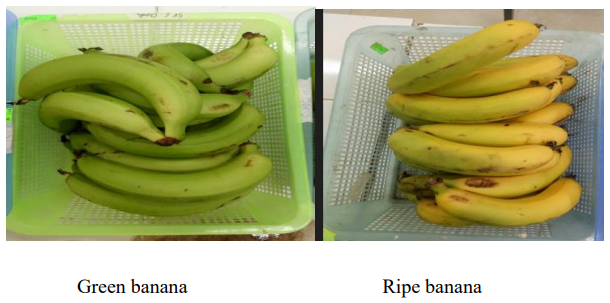
Figure 1: Green and Ripe Banana
Results and Discussions
Data recorded for determination of respiration rate (CO2) and ethylene.
|
Parameter’s |
Replication |
Initial |
Final |
CO2 produced (LCO2/kg*h) |
Mass (kg) |
Sample
Volume (L) |
Jar volume (L) |
Time (hr) |
|
CO2 |
R1 |
0 |
0.94 |
6.2 |
0.66081 |
0.65 |
5 |
1 |
|
R2 |
0 |
0.71 |
4.7 |
|||||
|
R3 |
0 |
0.61 |
4 |
|||||
|
|
Average |
4.97 |
||||||
|
Ethylene |
Replication |
Initial |
Final |
 |
0.66081 |
0.65 |
5 |
1 |
|
R1 |
0.1 |
1.1 |
6.5 |
|||||
|
R2 |
0.1 |
1.1 |
6.5 |
|||||
|
|
R3 |
0.1 |
1.1 |
6.5 |
|
|
|
|
|
|
|
Average |
6.5 |
|
|
|
|
|
Table 1: Ripe Banana in Jar One
|
parameter’s |
Replication |
Initial |
Final |
CO2 produced (LCO2/kg*h) |
Mass (kg) |
Volume sample (L) |
Volume Jar(L) |
Time (hr) |
|
CO2 |
R1 |
0 |
1.43 |
9.4 |
0.66172 |
0.650 |
5 |
1 |
|
R2 |
0 |
1.43 |
9.4 |
|||||
|
R3 |
0 |
1.4 |
9.2 |
|||||
|
|
Average |
9.33 |
||||||
|
Ethylene |
Replication |
Initial |
Final |
|
0.66172 |
0.650 |
5 |
1 |
|
R1 |
0.3 |
1.6 |
8.5 |
|||||
|
R2 |
0.3 |
1.6 |
8.5 |
|||||
|
R3 |
0.3 |
1.6 |
8.5 |
|||||
|
|
|
Average |
8.5 |
|
|
|
|
|
Table 2: Ripe Banana in Jar Two
|
Parameter |
Replication |
Initial |
Final |
CO2 produced
(LCO2/kg*h) |
Weight (kg) |
Volume sample(L) |
Volume jar (L) |
Time (hr) |
|
CO2 |
R1 |
0 |
1.68 |
9.9 |
0.73982 |
0.6 |
5 |
1 |
|
R2 |
0 |
1.42 |
8.4 |
|||||
|
R3 |
0 |
1.19 |
7.1 |
|||||
|
|
Average |
8.5 |
||||||
|
Ethylene |
Replication |
Initial |
Final |
|
0.73982 |
0.6 |
5 |
1 |
|
R1 |
0.3 |
1.6 |
7.7 |
|||||
|
R2 |
0.3 |
1.5 |
7.14 |
|||||
|
R3 |
0.3 |
1.4 |
6.5 |
|||||
|
|
|
Average |
7.13 |
|
|
|
|
|
Table 3: Ripe Banana in Jar 3
|
parameter’s |
Replication |
Initial |
Final |
CO2 produced
(LCO2/kg*h) |
Mass (kg) |
Sample Volume (L) |
Jar Volume (L) |
Time (hr) |
|
CO2 |
R1 |
0 |
0.22 |
1.2 |
0.80607 |
0.6 |
5 |
1 |
|
R2 |
0 |
0.19 |
1.03 |
|||||
|
R3 |
0 |
0.15 |
8.2 |
|||||
|
|
Average |
1.02 |
||||||
|
Ethylene |
Replication |
Initial |
Final |
|
0.80607 |
0.6 |
5 |
1 |
|
R1 |
0.1 |
0.4 |
1.64 |
|||||
|
R2 |
0.1 |
0.4 |
1.64 |
|||||
|
R3 |
0.1 |
0.4 |
1.64 |
|||||
|
|
|
Average |
1.64 |
|
|
|
|
|
Table 4: Green Banana in Jar 1
|
Parameter |
Replication |
Initial |
Final |
CO2 produced
(LCO2/kg*h) |
Weight (kg) |
Sample volume (L) |
Jar volume (L) |
Time (hr) |
|
CO2 |
R1 |
0 |
0.25 |
1.4 |
0.77987 |
0.6 |
5 |
1 |
|
R2 |
0 |
0.25 |
1.4 |
|||||
|
R3 |
0 |
0.24 |
1.4 |
|||||
|
|
Average |
1.4 |
||||||
|
Ethylene |
Replication |
Initial |
Final |
|
|
|
|
|
|
R1 |
0.3 |
0.5 |
1.13 |
0.77987 |
0.6 |
5 |
1 |
|
|
R2 |
0.3 |
0.4 |
0.56 |
|||||
|
R3 |
0.3 |
0.5 |
1.13 |
|||||
|
|
Average |
0.94 |
||||||
Table 5: Green Banana in Jar 2
|
Parameters |
Replications |
Initial |
Final |
CO2 produced
(LCO2/kg*h) |
Mass |
Samle Volume (L) |
Jar.Volume (L) |
Time
(hr) |
|
CO2 |
R1 |
0 |
0.33 |
1.89 |
0.78033 |
0.54 |
5 |
1 |
|
R2 |
0 |
0.34 |
1.94 |
|||||
|
R3 |
0 |
0.35 |
2 |
|||||
|
|
Average |
1.97 |
||||||
|
Ethylene |
Replication |
Initial |
Final |
|
0.78033 |
0.54 |
5 |
1 |
|
R1 |
0.3 |
0.5 |
1.14 |
|||||
|
R2 |
0.3 |
0.4 |
0.57 |
|||||
|
R3 |
0.3 |
0.4 |
0.57 |
|||||
|
|
|
Average |
0.76 |
|
|
|
|
|
Table 6: Green Banana in Jar 3
|
Storage condition |
Replication |
Initial |
Final |
CO2 LCO2/kg.hr produced |
Weight (kg) |
Sample Volume(L) |
Jar Volume(L) |
Time (hr) |
|
Cold storage |
R1 |
0 |
0.88 |
5.8 |
0.6608 |
0.65 |
5 |
1 |
|
R2 |
0 |
0.68 |
4.5 |
|||||
|
R3 |
0 |
0.5 |
3.3 |
|||||
|
|
Average |
4.5 |
||||||
|
Room temperature |
Replication |
Initial |
Final |
CO2 LCO2/kg.hr produced |
Weight (kg) |
Sample Volume(L) |
Jar Volume(L) |
Time (hr) |
|
R1 |
0 |
0.94 |
6.2 |
0.6608 |
0.65 |
5 |
1 |
|
|
R2 |
0 |
0.71 |
4.7 |
|||||
|
R3 |
0 |
0.61 |
4 |
|||||
|
|
Av |
4.97 |
|
|
|
|
||
Table 7: Co2 of Ripe Banana After Stored in Cold Storage At 13oc and 32oc at Room Temperature
|
Storage condition |
Replications |
Initial |
Final |
|
Weight (kg) |
Sample Volume(L) |
Jar Volume(L) |
Time (hr) |
|
Cold storage |
R1 |
0.3 |
1.2 |
5.9 |
0.6608 |
0.65 |
5 |
1 |
|
R2 |
0.3 |
1.2 |
5.9 |
|||||
|
R3 |
0.3 |
1.2 |
5.9 |
|||||
|
|
Average |
5.9 |
||||||
|
Room temperature |
Replications |
Initial |
Final |
|
Weight (kg) |
Sample Volume(L) |
Jar Volume(L) |
Time (hr) |
|
R1 |
0.1 |
1.1 |
6.5 |
0.6608 |
0.65 |
5 |
1 |
|
|
R2 |
0.1 |
1.1 |
6.5 |
|||||
|
R3 |
0.1 |
1.1 |
6.5 |
|||||
|
|
Average |
6.5 |
|
|
|
|
||
Table 8: C2H4 of Ripe Banana After Stored in Cold Storage At 13Oc and 32Oc at Room Temperature
|
Storage condition |
Replication |
Initial |
Final |
LCO2 /kg.hr produced |
Weight (kg) |
Volume Sample (L) |
Volume Jar (L) |
Time (hr) |
|
Roo m temperature |
R1 |
0 |
0.22 |
1.2 |
0.80607 |
0.6 |
5 |
1 |
|
R2 |
0 |
0.19 |
1.04 |
|||||
|
R3 |
0 |
0.15 |
0.82 |
|||||
|
|
Average |
1.02 |
||||||
|
Cold storage |
Replication |
Initial |
Final |
LCO2 /kg.hr produced |
Weight (kg) |
Volume Sample (L) |
Volume Jar (L) |
Time (hr) |
|
R1 |
0 |
0.19 |
1.01 |
0.80607 |
0.6 |
5 |
1 |
|
|
R2 |
0 |
0.16 |
8.7 |
|||||
|
R3 |
0 |
0.15 |
8.2 |
|||||
|
|
Average |
5.97 |
||||||
Table 9: CO2 of Green Banana After Stored in Cold Storage At 13oc and 32oc at Room Temperature
|
Storage condition |
Replication |
Initial |
Final |
|
Weight (kg) |
Volume
Sample m(L) |
Volume Jar (mL) |
Time (hr) |
|
Room temperature |
R1 |
0.1 |
0.4 |
1.64 |
0.80607 |
6000 |
5 |
1 |
|
R2 |
0.1 |
0.4 |
1.64 |
|||||
|
R3 |
0.1 |
0.4 |
1.64 |
|||||
|
|
Average |
1.64 |
||||||
|
Cold storage |
Replication |
Initial |
Final |
|
0.80607 |
6000 |
5 |
1 |
|
R1 |
0.1 |
0.3 |
1.1 |
|||||
|
R2 |
0.1 |
0.3 |
1.1 |
|||||
|
R3 |
0.1 |
0.3 |
1.1 |
|||||
|
|
Average |
1.1 |
||||||
Table 10: C2 H4 of Green Banana After Stored in Cold Storage at 13oc and 32oc at Room Temperature
Based on the above tables, recorded data and information, below results which are average was obtained. That means stage of maturity and temperature used as factors. The below figures were drawn by using averages for both ripe and green banana including both storage conditions room temperature and cold storage.

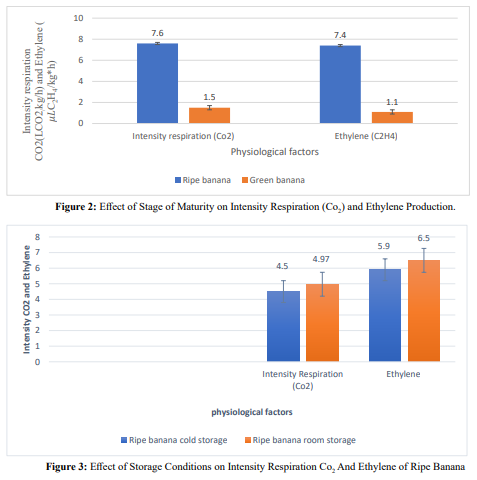
This above fig.3 depicted, effect of storage condition room temperature (32oC) and cold storage (13oc) for one hour and inside of jar 26oc on maturity stage of banana fruits. According to the Fig.3 above implied, the respiration and Ethylene data corresponding to cold and room temperatures indicated that as the temperature increased the respiration progressed at a faster rate. Our results exhibited, the higher and lower intensity respiration CO2 (4.97 and 4.5 L/kg*h) respectively and higher and lower 
Therefore, ripe banana fruits stored at room temperatures (32oc) implied higher intensity respiration CO2 and ethylene compare to the ripe banana stored at cold storage 13oc. This is might due to the fact that, at higher temperatures an increase in respiration rate could occur due to the increase in metabolic activities. In other way due to low temperatures slow down plant metabolic processes such as respiration, ethylene production and, in general, enzyme activity. This work witness with the work of [4,2].
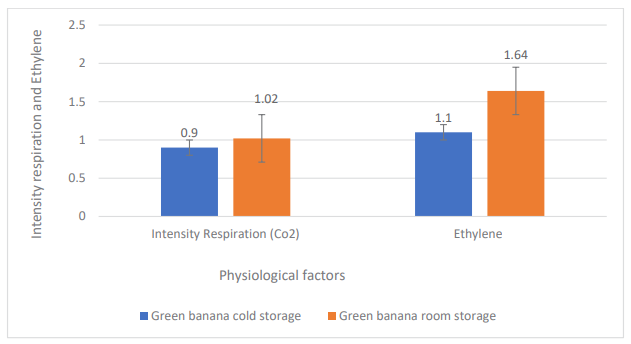
Figure 4: Effect of Storage Condition on Intensity Respiration and Ethylene of Green Banana
Figure 4 above showed, effect of storage conditions (room temperature 32oc) and cold storage (13oc) for one hour and 26oc in jar on intensity respiration CO2 and ethylene production of green bananas. The recorded data showed, green banana stored at room temperature and cold storage produce Intensity respiration CO2 1.02 and 0.9 L/kg*h respectively and produced ethylene 1.54 and  stored in room temperature produce higher intensity respiration CO2 and ethylene than green banana stored at cold storage. This is due to the fact that, lower temperature reduces respiration and Ethylene production including other physiological factors. This is because of as storage temperature increased and respiration rates increased and vice versa [5]. This idea supported with the work of who worked on effects of maturity on physicochemical properties of Gac fruit [6].
Conclusion
Based on the obtained results, intensity respiration CO2 and ethylene production of banana fruits were affected by stage of maturity and storage conditions. The ripe banana exhibited higher intensity respiration CO2 and ethylene production compare to green banana. However, during storage conditions, the cold storage exhibited lower intensity respiration CO2 and ethylene production. Therefore, to maintain quality of agriculture products like banana appropriate and optimum stage of maturity and application of cold storage are very important.
Acknowledgment
This work was conducted under guidance and help of prof. Vu Thi Kim Oanh and I would like to thanks her heartfully. All of activities done under guidance of Prof, Oanh who is course lecturer and my gratitude for her. Next my gratitude is for miss Minh who is laboratory technician. Next, my appreciation goes to Post-harvest Technology Department at faculty of food science and technology, VNUA. The other appreciation was for my friends (Stephen Mutua Mutinda, Thang Vu Quyet, Salifu Adam, George Owusu Ntim and Gemechu Warkina) since we have collected data together during laboratory work.
References
- Surya Prabha, D., & Satheesh Kumar, J. (2015). Assessment of banana fruit maturity by image processing technique. Journal of food science and technology, 52, 1316-1327.
- Pathare, P. B., & Al-Dairi, M. (2022). Effect of mechanical damage on the quality characteristics of banana fruits during short-term storage. Discover Food, 2(1), 4.
- Balaguera-López, H. E., Martínez-Cárdenas, C. A., & Herrera-Arévalo, A. (2016). Effect of the maturity stage on the postharvest behavior of cape gooseberry (Physalis peruviana L.) fruits stored at room temperature. Bioagro, 28(2), 117-124.
- Bhande, S. D., Ravindra, M. R., & Goswami, T. K. (2008). Respiration rate of banana fruit under aerobic conditions at different storage temperatures. Journal of Food Engineering, 87(1), 116-123.
- Devanesan, J. N., Karuppiah, A., & Abirami, C. K. (2011). Effect of storage temperatures, O2 concentrations and variety on respiration of mangoes. Journal of Agrobiology, 28(2), 119-128.
- Tran, X. T., Parks, S. E., Roach, P. D., Golding, J. B., & Nguyen, M. H. (2016). Effects of maturity on physicochemical properties of G ac fruit (M omordica cochinchinensis S preng.). Food science & nutrition, 4(2), 305-314.