

Toxicology and Applied Pharmacology Insights(TAPI)
ISSN: 2641-0451 | DOI: 10.33140/TAPI

Research Article - (2022) Volume 5, Issue 1
Dynamics of age-related changes in biochemical parameters of blood plasma of the emerald pheasant (Phasianus versicolor) in post-embryogenesis
Received Date: Feb 18, 2022 / Accepted Date: Feb 27, 2022 / Published Date: Mar 07, 2022
Copyright: ©Copyright: ©2022 Sh.A.Topchiyeva. This is an open-access article distributed under the terms of the Creative Commons Attribution License, which permits unrestricted use, distribution, and reproduction in any medium, provided the original author and source are credited.
Citation: Sh.A.Topchiyeva (2022) Dynamics of age-related changes in biochemical parameters of blood plasma of the emerald pheasant (Phasianus versicolor) in post-embryogenesis,Toxicology and Applied Pharmacology Insights. 5: 39-41.
Abstract
The article presents experimental data on the detection of age-related changes in blood biochemical parameters in pheasants. The research is devoted to the artificial breeding of one of the subspecies of pheasants of our wild fauna (the emerald pheasant - Phasianus versicolor). The aim of the work was to determine the total protein content in the blood plasma of pheasants in post-embryogenesis in comparison with the indicators in the chicks of the original line when using a complex of vitamins and anti-stress drugs. As a result of experimental studies, a change in the total blood plasma protein of pheasants from the moment of hatching and up to 2 months of age was revealed, with the complex use of vitamins (A-20000 IU, D3 -1250 IU, E-50 mg), as well as anti-stress preparations of succinic acid and fenozepam at a dose of 0.02 g, 0.03 g, 0.05 g per 1 kg of body weight per day.
Keywords
emerald pheasant - Phasianus versicolor, blood, total protein, vitamins, anti-stress drugsIntroduction
Thanks to the transport and regulatory functions of the blood, a multilateral connection is provided between the digestive system and metabolism. It is expressed not only in the fine coordination of digestive activity and metabolism due to nervous and hormonal regulation, but also in the presence of special functions of the gas- trointestinal tract that contribute to the implementation of chem- ical processes in tissues. Experimental data confirm the scientific hypothesis about the circulation of digestive enzymes and their presence in blood plasma. Proteins are the most important part of blood plasma. About 60% of all plasma proteins are accounted for by albumin, which plays a major role in maintaining oncotic blood pressure, and also performs transport and nutritional functions, the rest is accounted for by á- and ß-globulins and other plasma pro- teins, including enzymes (trypsin , amylase, lipase). In 1-day-old chickens, the protein content in the blood plasma was significantly lower than in subsequent periods of life, which is associated with a low function of protein biosynthesis. The composition of the blood of birds is notable for its constancy, since only with the stability of the composition of the internal environment of the body, a clear and uninterrupted operation of its systems is possible [1, 2].
Biochemical parameters of blood are important in determining the state of health in birds and, in turn, change with age [3, 4]. The literature contains extensive and contradictory material on the bio- chemistry of chickens [5, 6], including the use of various additives [7-9] and depending on age.
From the literature data in poultry farming, succinic acid is used in the initial period of bird life; in this case, the daily dose is taken at the rate of 0.03 g per 1 kg of body weight. The unique property of both succinic acid and fenozepam makes it possible to activate adaptation processes in the body of birds and stabilize metabolism, which helps to increase the productivity of birds [10-12].
Biochemical analyzes of blood plasma in birds are widely used to diagnose various diseases, however, there is a very limited amount of information on pheasants and partridges [13, -15]. However, a blood test may be performed for several reasons including as a screening procedure to assess the general health of birds [16, 17].
Thus, it can be stated that the experimental data given in the liter- ature on the detection of age-related changes in blood biochemical parameters in pheasants, including data on the determination of the total protein of the blood plasma of pheasants in postembryo- genesis when using a complex of vitamins and anti-stress drugs, are insignificant and contradictory.
Based on the foregoing, the goal of the presented work follows, namely, the determination of biochemical parameters of blood plasma in the emerald pheasant - Phasianus versicolor in postem- bryogenesis in comparison with the parameters in birds of the original line when using a complex of vitamins and anti-stress drugs fenozepam and succinic acid.
Material and research methods
During the period of experimental studies and experiments, the chickens were kept in the vivarium of the Institute of Zoology of ANAS. At the same time, the conditions of feeding and keeping were observed, and the chicks had constant access to clean wa- ter. In the experiment, industrial compound feed was used as feed, which was enriched with protein and vitamin supplements. At the same time, a complex of vitamins was added to the feed to bring the nutritional level of 100 g of dry food to: vitamins A-20000 IU, D3-1250 IU, E-50 mg. Succinic acid and fenozepam were mixed into food or diluted in drink at a dose of 0.02 g, 0.03 g, 0.05 g per 1 kg of body weight per day.
Determination of total blood plasma protein was carried out by spectrophotometric method on a Specord 210 Plus spectrophotom- eter (Analytic Jena). A heparin solution was added to the tubes, and the blood was centrifuged at 5000 rpm in an SM-50 centrifuge for 15 minutes. Plasma was separated, followed by determination of total protein by the Lowry method.
Research Results
Pheasants were divided into two groups, experimental and control, 10 animals in each group. For the experiments, 5 individuals were taken from each group, the studies were carried out in duplicate. Live weight and safety of birds were taken into account. Blood samples were taken from the cubital vein of the wing (vena cuta- nea ulnaris superficialis) in 35 pheasants, whose age corresponded to 1, 5, 10, 20, 30, 60 days. 0.5 ml of whole blood was taken from each bird and placed in blood collection tubes containing a heparin solution.
Male and female pheasants were analyzed separately, as gender may affect the validity of the study. All values were expressed as mean M±m with standard error, and P≤0.05 was determined to be statistically significant.
In the experiment, 1-day-old pheasants showed a low content of protein in the blood plasma compared to that in subsequent age periods, which is associated with a low function of protein bio- synthesis.
Table 1 presents experimental data on changes in total blood plas- ma protein and live weight of pheasants with the complex use of vitamins and anti-stress drugs.
Table 1.
Dynamics of changes in the total protein of the blood plasma of emerald pheasants with the complex use of vitamins and anti-stress drugs. depending on age (M±m)
|
Age |
Live weight, g. |
Total protein, g/l |
||
|
control |
experience |
control |
experience |
|
|
1 |
21,5±0,15 |
21.93 |
23.7±0,1 |
23,9±0,3 |
|
5 |
24,1±0,40 |
25.62 |
26.6±0,5 |
26.8±0,4 |
|
10 |
39,5±0,65 |
41.93 |
26.8±0,3 |
26,7±0,6 |
|
20 |
85,2±1,44 |
86.60 |
29.2±0,2 |
29,5±0,5 |
|
30 |
143,0±2,60 |
153.15 |
31.6±0,5 |
31,8±0,3 |
|
60 |
377,1±12,60 |
378.60 |
38.4±0,6 |
38,9±0,8 |
From the data presented in the table, it can be seen that the change in the biochemical blood parameters of both the control and ex- perimental groups of pheasants was observed by the age of 5 days (26.6±0.5 g/l and 26.8±0.4 g/l, respectively), which in all likeli- hood was associated with intensive growth and functional forma- tion of the digestive system.
The concentration of total blood protein in pheasants increased with age, which in turn is due to the formation and improvement of protein biosynthesis processes. It should be noted that there were no significant differences in the content of total blood protein in the pheasants of the control group and chickens that were fed with the anti-stress drug succinic acid and fenozepam up to 10 days of age (Fig.1).
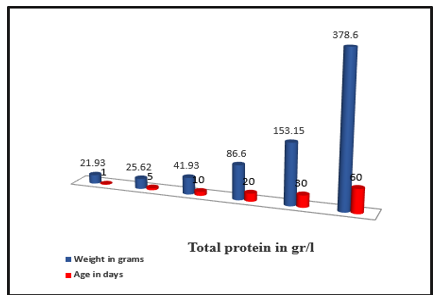
Fig.1: Dynamics of changes in the total blood plasma protein of emerald pheasants with the complex use of vitamins and an- ti-stress drugs
The concentration of total protein by the age of 20 days reached 29.2±0.2 g/l (control), slightly increasing by the age of 30 days to 29.5±0.5 g/l (experiment). By the age of 60 days, the total protein reached a maximum value of 38.4±0.6 g/l (control) and 38.9±0.8 g/l (experiment), remaining constant in subsequent age periods.
At least 5 measurements were made in each age group. Statistical processing of the experimental data included the calculation of themean value (M±m). Significance of differences was assessed by Student’s t-test, and differences were considered statistically sig- nificant at P‹ 0.05.
It should be noted that the lowest content of total protein in the blood plasma was found in 1-day-old pheasants, and the greatest increase in blood biochemical parameters was detected by the 5-day age, which is associated with the intensive growth and de- velopment of the digestive system in pheasants.
A change in the biochemical blood parameters of both the control and experimental groups of pheasants was observed by the age of 5 days (26.6±0.5 g/l and 26.8±0.4 g/l, respectively), which was most likely associated with intensive growth and functional devel- opment of the digestive system. systems.
By the age of 60 days, the total protein reached a maximum value of 38.4±0.6 g/l (control) and 38.9±0.8 g/l (experiment), remaining constant in subsequent age periods. It has been established that anti-stress preparations do not have a significant effect on the dy- namics of changes in the blood plasma protein of pheasants. It was found that a more intensive development and an increase in the mass of pheasants corresponded to a lower content of total protein in blood serum and vice versa.
Thus, the amount of total protein in the blood plasma of pheasants increases with age and reaches its maximum value by 60 days of age, which is explained by the formation of the body and the im- provement of the protein-educational function.
Based on the foregoing and on the basis of experimental data on identifying the effect of anti-stress drugs and a complex of vita- mins on the biochemical parameters of the blood of pheasants, the dynamics of changes in the parameters of total blood plasma pro- tein during 60 days of postembryogenesis was established. As a re- sult, experimental studies did not reveal significant changes in the total blood protein of pheasants with the complex use of anti-stress drugs fenozepam and succinic acid.
Conclusion
1. Experimental studies have revealed a change in the total blood plasma protein of pheasant chicks from the moment of hatch- ing and up to 60 days of age with the complex use of vitamins (A-20000 IU, D3-1250 IU, E-50 mg) and anti-stress drugs.
2. It has been established that the dynamics of changes in the total blood plasma protein of pheasants, succinic acid and fe- nozepam do not significantly affect.
3. It was found that a more intensive development and an in- crease in the growth of the mass of pheasants corresponded to a lower content of total protein in blood serum and vice versa.
References
- Rothman S., Liebow C., Isenman L. Conservation of digestive enzymes. Phys. Rev., 2002, 82:1-18
- Korotko G.F. Formation of the enzyme component of the se- crets of the digestive glands. Physical culture, sports - science and practice. 2013, 1:51-57.
- Cherkasova V.V., Zelensky K.S. Hematological and biochem- ical parameters of the blood of broiler chickens in ontogene- sis. News of the Orenburg State Agrarian University. 2009, 4(24-1):60-63.
- Ponomarev V.A., Pronin V.V., Kletikova L.V. and other Clinical and biochemical indicators of bird blood. Ivanovo, 2014:69-132.
- Alagawany M.,Altia A.I., Ibrahim Z.Z. et all. The effective- ness of dietary sunflower meal and exogenous enzyme on growth, digestive enzymes, carcass traits fnd blood chemis- try of broilers, Environ. Sci. Pollut. R. 2017, 24(13):12319- 12327.
- Dong X.Y., Yin Z.Z., Ma Y.Z. et all. Effects of reaning systems on laying performance, egg quality and serum biochemistry of Xianju chickens in summer. Pouliry Sci., 2017, 96(11), 3896-3900.
- Kamely M., Karimi M., Rahimi S. Blood biochemistry, thy- roid hormones, and performance in broiles with ascites caused by caffeine. Pouliry Sci., 2016, 95(11):2673-2678.
- Toghyani M., Mosavi S., Modaresi M., Landy N. Evaluation of kefir as a potential probiotic on growth performance, se- rum, biochemistry and immune responses in broiler chicks. Animal nutrilion, 2015, 1(4):305-309.
- Mikhailova A.G., Khairullin R.F., Demidyuk I.V. et all. Clon- ing, sequencing, expression and characterization of thermo- stability of oligopeptidase B from Serratia proteamaculans, a psychrophilic protease. Protein Express. Purif., 2014, 93:63- 76.
- https://www.megamix.ru/products/aviculture/organiches- kie-kisloty/yantarnaya-kislota/.
- https://ria.ru/20210215/yantarnaya_kislota-1597597811.html
- https://edrid.ru/rid/219.017.cae5.html
- Wilkinson, N., I. Dinev, Aspden W. J., Hughes R. J. Stanley, Ultrastructure of the gastro intestinal tract of healthy Jap- anese quail (Coturnix japonica) using light and scanning electron microscopy. Animal Nutrition, 4(4): 2018.
- Nazifi S., Mosleh N., Ranjbar V.R., Khordadmehr M. Ref- erence values of serum biochemical parameters in adult male and female ring-necked pheasants (Phasianus colchi- cus). Comparative Clinical Pathology, 2011.
- Dinev, I., Axial skeleton pathology in broiler chickens. World’s Poultry Science Journal, 70(02): 303-308, 2014.
- Keçeci T., Çöl R. Haematological and biochemical values of the blood of pheasants (Phasianus colchicus) of different ages. Turkish Journal of Veterinary and Animal Sciences, 35(3): 149-156, 2011.
- Nicolov S. Kanakov D. Blood plasma biochemical parame- ters of captive black-necked pheasant (Phasianus colchicus), gray partridge (Perdix perdix) and chukar partridge (Alectoris chukar) of both sexes in Bulgaria. Trakia Journal of Sciences 19(2):142-146.