

Archives of Biology & Life Sciences(ABLS)
ISSN: 2996-962X | DOI: 10.33140/ABLS


Research Article - (2026) Volume 3, Issue 1
Ditribution of Caryota urens L. in Western Ghats of Karnataka State, India
Received Date: Feb 19, 2026 / Accepted Date: Mar 12, 2026 / Published Date: Mar 16, 2026
Copyright: ©2026 U.V. Singh. This is an open-access article distributed under the terms of the Creative Commons Attribution License, which permits unrestricted use, distribution, and reproduction in any medium, provided the original author and source are credited.
Citation: Singh, U. V. (2026). Ditribution of Caryota urens L. in Western Ghats of Karnataka State, India. Archives Biol Life Sci, 3(1), 01-09.
Abstract
Caryota urens called as fish tail palm based on the structure of its bipinnate leaflets; whose ancestral blueprints date back to the age of the dinosaurs, is a fascinating tree and cannot be ignored if walking through the moist deciduous forest of western ghats. It is a symbol of habitat of Hornbills. The species is a widely respected in gardens of South East Asian countries.
During the survey carried out in 2016-18, the Caryota urens was found in Forest divisions of Hassan, Koppa, Shimoga, Sagara, Sirsi, Mangalore Belgavi and Honnavara of Western Ghats in Karnataka. Not having its population in Chickamanglore ,Yellapur, Karwar, Madkeri, Kundapur and Virajpet is surprising. Due to surplus agriculture consumable foods and sugarcane its utility has been reduced in Karnataka.
Introduction
The literature surrounding Caryota urens spans from ancient Ayurvedic texts and tribal folklore to formal botanical descriptions. Its importance is primarily rooted in its utility, often described as a "provider" tree in South Asian cultures. In ancient Sanskrit texts of Ayurveda, it is often referred to as Shankarjata (meaning "the matted hair of Shiva"), a name inspired by the pendulous, hair-like appearance of its long, dangling inflorescences. It is documented in Ayurvedic pharmacopeia for its cooling properties and its use in treating digestive ailments.
In the history and literature of Sri Lankan Chronicles, the palm is known as Kithul. It appears in historical records as a vital source of nutrition for forest-dwelling communities and Buddhist monks. Traditional poems and songs celebrate the "Kithul-tapper," a figure of great skill who climbs the tall trees to harvest sap.
Research by Kew Science and the Plant Resources of South East Asia (PROSEA) database identifies the primary native range as Western and Southern India (Western Ghats) and Sri Lanka. Its Native Regions is most abundant in the high-altitude forest gardens of the Central Highlands of Sri Lanka (up to 1,500m) and the Bastar Plateau of Chhattisgarh, India. Due to its economic value, it has been introduced to and naturalized in Myanmar, Malaysia, Southern China, Nepal, and even parts of the Caribbean and Florida (USA). In Sri Lankan Forest gardens, studies show high densities averaging 18 palms per garden or up to 500 individuals per 0.5 hectare in high-rainfall zones like Kotmale.
Among the tribes of Chhattisgarh in Bastar (India), the palm is celebrated as Sulphi. It is often called the “Kalpavriksha of the Bastar”, referring to the mythical wish fulfilling tree. Local folk songs and oral histories describe the tree as a social hub, where communities gather to drink the fermented sap (Sulphi wine) during festivals. In some South Asian rural traditions, the “fishtail’ shape of the leaf was thought to ward off the “evil eye” Leaves were sometimes hung near the entrances of homes or cattle sheds to protect the inhabitants. In modern ethnobotanical writing of contemporary literature, Carvota urens is frequently highlighted in “Underutilized crops” journals and sustainable development pages. It is often used as a case study for Non-Timber Forest Products (NTFPs), with authors emphasising its role in the socio –economic survival of indigenous groups in the Western Ghats and Sri Lankan highlands.
In regard to its Taxonomic History, the species was formally described by Carl Linnaeus in 1753 in his seminal work Species Plantarum [1]. It is considered the type species for the genus. The species was officially entered into Western scientific literature by Carl Linnaeus in his foundational work Species Plantarum. He chose the name urens (stinging) to warn of the irritating calcium oxalate crystals in the fruit. Subsequently, Robert Wight, the Scottish botanist in the 19th century, featured detailed illustrations and descriptions of Caryota urens in his Icons Plantarum Indiae Orientalis, helping to categorize the palm's unique bipinnate leaf structure for the global scientific community [2]. The taxonomic classification of Caryota urens places it within the palm family, specifically under a group known for their unique "fishtail" foliage and monocarpic (once-flowering) nature. The genus Caryota consists of approximately 13 to 15 species. The name is derived from the Greek word karyon, meaning "nut" or "kernel." Specific Epithet urens is a Latin word translates to "stinging" or "burning." This refers to the stinging crystals of calcium oxalate found in the fruit pulp, which cause intense irritation if handled or ingested.
The geological and evolutionary history of Caryota urens is tied to the ancient lineage of the palm family (Arecaceae), which is one of the oldest flowering plant families on Earth. While Caryota urens as a distinct species is a relatively modern product of tropical evolution, its "ancestral blueprints" date back to the age of the dinosaurs.
It is claimed that the offshoots of this species go back to the Cretaceous Period of 145 to 60 million years ago. The palm family originated during the early Cretaceous on the supercontinent of Laurasia or possibly Western Gondwana. Fossils of palm-like pollen and leaves from this era show that the basic structure of palms was established very early. Caryota urens belongs to the tribe Caryoteae. For a long time, scientists thought this tribe was related to modern feather palms of Arecoideae, but DNA evidence has revealed that they are actually a specialized, ancient branch of the fan palms Coryphoideae. The tribe Caryoteae (comprising Caryota, Arenga, and Wallichia) evolved specifically in the Indo-Malayan region.
During the Tertiary Period 66–2.6 million years ago;(Eocene and Oligocene), the earth’s climate fluctuated and accordingly palms underwent massive diversification. Caryota urens is unique because it developed bipinnate leaves (leaflets that divide twice). Geologically, this is considered a highly specialized evolutionary trait that likely developed as an adaptation to the dappled light of dense Asian rainforest understories, allowing the tree to maximize surface area for photosynthesis while remaining flexible in wind. During the Pleistocene ice ages (2.6 million years ago to Present) generally referred as Glacial Cycles, the "Indo-Malayan" rainforests expanded and contracted. Caryota urens found refugia in the stable, humid climates of Sri Lanka and the Western Ghats of India Figure-2. The current "geological" footprint of Caryota urens is heavily influenced by humans. Because it was so valuable for sugar (jaggery) and fibre, early human migrations across South and Southeast Asia helped transport and naturalize the species far beyond its original ancestral pockets in India and Sri Lanka. While specific fossils of Caryota urens are rare due to the soft nature of palm tissue, fossilized palm wood and leaf impressions matching the Caryoteae tribe have been found in Tertiary deposits across Asia.
Plants are found in moist tropical climates where temperatures never fall below 10°c, the average annual rainfall is 1,500mm or more and the driest month has 25mm or more rain. They can also succeed in warm temperate zones and in drier areas with an annual rainfall as low as 250mm and one month or more where rainfall is below 25mm in extremely exceptional circumstances Mature plants can be killed by temperatures of 5°c or lower. Plants grow well in full sun, even when small. Prefers a moist, shady situation. It prefers a pH in the range 6 - 7.5, tolerating 5.5 – 8.
A debatable point regarding its monocarpic nature of species, living for several years without flowering, but then dying once it has flowered. It attains full size in about 10 - 15 years, and then flowers for another 5 or more years. It flowers from the top down, and once the last fruit on the bottom inflorescence matures, the plant dies. The daily yield per tree of sap for wine and sugar can be 20 - 27 litres. When flowering begins, the inflorescence is stimulated to produce juice; the inflorescence is then bound into a 'candle' form and tapped for its sweet juice by repeatedly slicing off the end of the candle. A tapping period may last for 10 - 15 years before the tree dies. Harvest for sago and other purposes is mainly from wild and semi-wild populations. The trunk yields 100 - 150 kilos of starch. Usually harvests for timber occurs when the tapping period has ended.
Limiting the scope of this study of Caryota urens, in the part of Western Ghats (WG) fall within the territory of Karnataka State has been emphasised more herein. The Western Ghats in Karnataka, more commonly/locally known as Malnad (the land of hills), are a critical Central segment run parallel to western coasts from Belgaum to Mangalore districts out of 1,600 km long mountain chain from Gujarat to Tamil NÄdu. This region is a UNESCO World Heritage site and is often described as the "Crown of Karnataka" due to its ecological and cultural significance. Karnataka hosts 10 of 39 protected area (National parks, Sanctuaries). It spreads over 44 talukas covering land scape of about 44891.0 Sq. Kms including forest cover 22026.0 Sq. Kms in the Karnataka state.
The Karnataka region houses continuous range of ghats. Some of the notable ghats include Agumbe ghat, Charmadi ghat, Shiradi ghat, Bisle ghat, Sampaji ghat and Hulekal ghat. The Ghats rise abruptly from the Arabian Sea coastal plains, forming a steep "wall" that creates a dramatic climate barrier and results to good south-west monsoon in the region which support the high forests of excellent biodiversity. It also caused to good rains in plains of Karnataka. The WG are also characterised wth some high peaks like Mullayanagiri (1930 m). Kudremukh(1894m) and Tadiandamol (1748 m) and others. A unique feature of the higher altitudes (above 1,500m) is the Shola ecosystem, where patches of stunted evergreen forests are nestled in valleys surrounded by vast montane grasslands. Because of such unique features, the Karnataka Ghats act as the primary rain-catcher for the Indian monsoon. The region receives some of the highest rainfall in the country. Agumbe and Hulikal are often called the "Cherrapunji of the South," receiving over 6,000–7,000 mm of rain annually. While the western side is lush and tropical, the eastern slopes transition into a "rain shadow" area, leading into the drier Deccan Plateau. Karnataka’s Western Ghats are the water tower of South India. They are the source of major perennial/seasonal river systems like: east-flowing- The Kaveri (originates at Talakaveri), Krishna, and Tungabhadra, Ghataprabha systems. West- flowing: Shorter, faster rivers like the Sharavathi (famous for Jog Falls), Netravati, and Aghanashini and many more.
This global hotspot of biodiversity, supports an enormous vegetal wealth, over the years is undergoing great stress due to anthropogenic disturbances and climatic changes. Western Ghats region which forms a narrow stretch running from the hills south of Tapati river in the north(Gujarat) to Kanyakumari(Tamilnadu) in the south along the west coast of India covering approximately 1600 km from the states of Gujrat, Maharashtra, Goa, Karnataka, Kerala and Tamil Nadu. Western Ghats or ‘Sahyadris , a chain of mountains parallel to west coast, covering a total area of about 160,000 km2. Western Ghats encompasses a considerable gradient of climatic conditions which have resulted in the development of diverse forest types ranging from the dry scrub types to the semi-evergreen and evergreen forests. The tropical rain forests in the parts of Western Ghats and the ‘sholas’ in the Nilgiris and Karnataka’s Kudremukha hills are the most outstanding features of Western Ghats.
The entire Western Ghats biogeographic region is a major genetic estate with an enormous biodiversity of ancient lineage. Nearly 5800 species of flowering plants occur here of which 56 genera and 2100 species are endemic. Karnataka alone claimed to harbours 3900 species belonging to 1323 genera and 199 families while Nilgiris have 2611 species of flowering plants. Western Ghats being much older in age compared to Himalayan mountains, support a large majority of relict or paleoendemic. Another unique feature of the endemic flora of Western Ghats is the prevalence of monotypic genera. The flora of southern Western Ghats, shows close affinity with the flora of Sri Lanka, supporting the view that Sri Lanka was connected to South India during the geologic past. And this is one of the reason that Caryota urens is found in Srilanka of the same genetic makeup.
The Western Ghats region is also a rich germplasm centre of number of wild relatives of our crop plants such as the cereals & millets, legumes, tropical & sub-tropical fruits, vegetables, spices & condiments and a few others. The alarming rate of loss of biodiversity including fish tail palm in Western Ghats is a major concern today. Encroachments, grazing, spread of invasive alien weeds, recurrent forest fires and selective removal of certain species like medicinal plants have all resulted in severe destruction of the virgin forests which now survive only as pockets in the mountains summit and valley areas. The explosive human population growth, expansion of agriculture, introduction of plantation crops like tea, coffee, rubber etc have resulted in the extermination of many taxa, endangering a number of economically important timber and other species. The study is taken up for shouldering responsibility of inventory and behavioural changes of rich depository of Sandalwood in Western Ghats of Karnataka state.
Studies in the domain of forest ecological dynamics especially on natural regeneration status, and prevailing threat to the Jagary palm require a holistic approach for its assessment. Assessing the ecological dynamic trends of availability in the forests is also of special interest in present heritage depository in the State. Though Sago palm had been used since ancient times without giving thought of its sustainability, new explorations will bring scientific management of the species. The current article is expected to identify rich pockets of this species from the forests of the Divisions and allotting regeneration credits.
The present article is the part of study carried out in the project on “Assessment of Population Status and Removal of Bio-resources in Forests with Special Emphasis on Medicinal Plants in Karnataka” under the NMPB scheme and implemented by the Karnataka Biodiversity Board in collaboration with Karnataka State Medicinal Plants Authority (KAMPA) and Karnataka Forest Department (KFD). The distribution pattern in the entire forest have not been estimated in any State of the country in wholistic manner. The outcome of the study will help in conservation, planning, management, development of this species and sustainable use across the forest division besides the specific objective in this article.
Methodology
Considering the important role of the multiple agencies involved in the project study, it had been decided by the Karnataka Biodiversity Board (KBB) and Karnataka Medicinal Plants Authority (KAMPA) to implement the project in all beats of all Divisions (non-wildlife forest lands) during post monsoon season(s) in collaboration with the front-line staff of the Karnataka Forest Department (KFD).
A line transect method had been adopted for this study by surveying an average of 0.5% forest areas in each beat and in overall of all forest lands. Table-1 [3-5]. The beat is the basic unit of forests. The following steps are taken for conducting the transect surveys.
(i). Transect lines of 10-meter width in the proportionate of 0.5% of the area are drawn across the beats in such a manner that all types of vegetation’s viz. natural forests, plantations, hill/slopes, riversides, marshy lands, ponds etc. are get covered proportionately. The transect lines are marked with GPS reading, drawn on Topo sheets and then translated in the field.
(ii). All individuals of each of the tree species in the whole transect line have been recorded/counted in the prescribed Proforma along with their girth class measurements Table-2, (3,10,11).
(iii). For counting of herbs, shrubs, and climbers, rectangular sub plots of 5mtx5mt size have been demarcated along the transect line at an interval of every 200 meters alternately.
(iv). If the subplot at the beginning of the transect line is fixed on the right side, it is laid at the left side after 200 meters. The marking of the subplots alternately to the sides has been followed for the entire transect line. The samples of subplots thus cover about 0.00625% of the beat forest area.
(v). All the herbs, shrubs, orchids and climbers in subplots with medicinal value/otherwise found in them have been counted, identified and recorded in the prescribed Proformas.
(vi). GPS reading at the beginning, middle and at the end of the transect line and the GPS reading at the centre of each subplot (5mtx5mt) have been noted and recorded.
(vii). Each transect survey team comprised of two students of botany/Forestry/Ayurveda/trained botanist, a Forester, a Forest Guard, a Forest Watcher or such other staff, and a local Botanist/ Ayurveda doctor/Plant Scientist. The students once got trained at later phase of the survey, the combination was changed to a student (trained) two staff (Forester and Forest Guard), a local man known to vernacular names and a watcher as helper in each team.
(viii). All the data recorded were analysed in well-designed program to get required outcome.
Enumeration Survey in the Divisions was taken by the KBB along with KAMPA in the year 2016 to 2018 during post monsoons. Initial training in the subject was organized at all forest Divisions and to the DCF, ACF, RFO’s, DyRFO’s, FG’s, FW’s and locals. To assess the population of Caryota urens and others, inventory with a sampling intensity of 0.5% has been designed as transit lines. Accordingly, about-11605 Kms of transit line of 10.0 width covering forest area of 2410090.529 ha Table-1. The distribution of plants in various girth classes and corresponding figures of per hectare number of trees (overall trees, mature trees and regeneration of tree species) Table-2, herbs and shrubs types of fishtail palm Table -3 as well as species composition in various forests have been recorded during the transect surveys. Same methodology has been applied in all the divisions.
|
S.N. |
Divisions |
Beats Nos |
Forest area Ha |
Transit line Kms |
|
1 |
Belgavi Division |
109 |
119178.398 |
600.711 |
|
2 |
Bhadravati Division |
84 |
83098.43 |
421.703 |
|
3 |
Chikmanglore Division |
60 |
62290.076 |
287.515 |
|
4 |
Dharwar Division |
43 |
35437.537 |
169.583 |
|
5 |
Haliyal Division |
111 |
99786.881 |
512.1634 |
|
6 |
Hassan Division |
63 |
48553.6 |
242.679 |
|
7 |
Honnavara Division |
78 |
158182.34 |
743.83 |
|
8 |
Hunsur Division |
37 |
16549.83 |
85.81 |
|
9 |
Karwar Division |
62 |
119020.881 |
595.27 |
|
10 |
Koppa Division |
66 |
79309.315 |
403.152 |
|
11 |
Kundapur Division |
78 |
43159.61 |
215.006 |
|
12 |
Madikeri division |
31 |
864674.61 |
4362.57 |
|
13 |
Manglore Division |
123 |
178197.398 |
570.951 |
|
14 |
Sagara Division |
166 |
98582.6 |
448.4481 |
|
15 |
Shimoga Division |
117 |
69101.765 |
337.8737 |
|
16 |
Sirsi Division |
80 |
171354.653 |
858.29 |
|
17 |
Virajpet Division |
22 |
30910.53 |
127.68 |
|
18 |
Yellapur Division |
66 |
132702.068 |
622.122 |
|
|
TOTAL |
1396 |
2410090.53 |
11605.3538 |
Table-1: The Total Number of Beats, Forest Area and Transit Line Drawn in Each Division
|
S.L |
Divisions |
No. of Total Species of trees |
No. of Species having only Mature trees |
No. of Species having only Regeneration |
|
1 |
Hunsur Division |
125 |
38 |
104 |
|
2 |
Bhadravati Division |
240 |
148 |
174 |
|
3 |
Hassan Division |
315 |
154 |
242 |
|
4 |
Chikmanglore Division |
273 |
141 |
236 |
|
5 |
Yellapur Division |
252 |
157 |
210 |
|
6 |
Dharwar Division |
140 |
62 |
124 |
|
7 |
Madikeri Division |
170 |
91 |
79 |
|
8 |
Shimoga Division |
336 |
225 |
273 |
|
9 |
Koppa Division |
361 |
246 |
281 |
|
10 |
Sirsi Division |
339 |
255 |
304 |
|
11 |
Sagara Division |
440 |
318 |
383 |
|
12 |
Haliyal Division |
262 |
167 |
216 |
|
13 |
Kundapur Division |
302 |
162 |
257 |
|
14 |
Belgavi Division |
342 |
119 |
206 |
|
15 |
Manglore Division |
395 |
245 |
315 |
|
16 |
Karwar Division |
76 |
43 |
42 |
|
17 |
Honnavara Division |
116 |
67 |
62 |
|
18 |
Virajpet Division |
159 |
57 |
19 |
Table-2: Showing the Number of Total Tree Species, Total Species of Mature Trees and Their Regeneration Recorded During the Survey
|
SN |
Divisions |
Regeneration % |
Mature trees% |
|
1 |
Hassan Division |
0 |
2.796 |
|
2 |
Koppa Division |
0 |
2.056 |
|
3 |
Shimoga Division |
0.866 |
1.616 |
|
4 |
Sagara Division |
1.025 |
0.786 |
|
5 |
Sirsi Division |
0 |
0.743 |
|
6 |
Manglore Division |
1.137 |
0.613 |
|
7 |
Haliyal Division |
0 |
0.128 |
|
8 |
Belgavi Division |
0.186 |
0.052 |
|
9 |
Honnavara Division |
0.312 |
0 |
|
10 |
Bhadravati Division |
0 |
0 |
|
11 |
Chikmanglore Division |
0 |
0 |
|
12 |
Yellapur Division |
0 |
0 |
|
13 |
Dharwar Division |
0 |
0 |
|
14 |
Madikeri Division |
0 |
0 |
|
15 |
Kundapur Division |
0 |
0 |
|
16 |
Karwar Division |
0 |
0 |
|
17 |
Hunsur Division |
0 |
0 |
|
18 |
Virajpet Division |
0 |
0 |
Table-3: Population Distribution of Caryota Urens L.in the Forests of Western Ghats of Karnataka
Results and Discussion
During the survey it was observed that it plays a role of a "generalist" within tropical ecosystems, capable of thriving in both primary rainforests and human-managed forest gardens. It is a characteristic species of the wet tropical biome, preferring moist, shady, and cool environments like deep ravines, valleys, and forest clearings. It thrives where annual rainfall is 1,500mm or more in comfortable temperature between 24–30°C for optimal growth. It is sensitive to frost; temperatures below 5°C cause significant tissue damage. It is frequently seen in limestone areas and karst forest ecosystems, though it is adaptable to various well-draining soils.
Caryota urens is a pleonanthic, unique or gathered intermediate sized wild/semi wild palm species belongs to Arecaceae family, commonly known as the fishtail palm, jaggery palm, toddy palm, Indian sago palm, sulpha palm etc. It is a solitary-stemmed, evergreen palm growing up to 20 metres tall (Figure-1). The straight, unbranched stem, which can be 30cm in diameter or so, is topped by a rosette of large gracefully curved leaves that can each be up to 6 metres long. The fast-growing, solitary-trunked palm is native to India, Sri Lanka, Myanmar, Malaysia, South China and grows up to altitude of 1500.meters. It is widely recognized for its unique leaf structure and its significant role in traditional economies. It ecologically prefers muggy, shady and cool places and naturally colonise in tropical Asian regions. Palm trunk act as admirable source of edible food grade flour called kithul flour in Kerala. The plant is widely cultivated as an ornamental in gardens in the tropics for its wide range of uses It is also grown commercially for its sap, which is used to make sugar and alcoholic beverages, whilst its fibre is exported from Sri Lanka.
The fruit is capable of irritating the skin and causing a burning sensation. A well prominent naturally grown tree stands robust in Shankey tank Campus of Forest department Bangalore at the bank of a natural stream to Shanky tank.
During the survey, the Caryota urens was found in Forest divisions of Hassan (Sakleshpur talka), Koppa, Shimoga, Sagara, Sirsi, Mangalore Belgavi and Honnavara. It is pertinent to mention that survey in Karwar division was not properly done, therefore no palms were reported. Not having the population in Chickamanglore ,Yellapur, Madkeri, Kundapur and Virajpet is surprising Table-3. Dharwad, Bhadravati and Hunsure divisions are comparatively dry areas of having Dry Deciduous Forest. The population of this palm is well distributed in Dandeli wild life Santury and Ansi National Park. This is one of the reason the Horn bills are found in good numbers in this forest [6].
Caryota urens which is commonly called as the fishtail palm, jaggery palm, or toddy palm, is a fast-growing, solitary-trunked palm native to India, Sri Lanka, Myanmar, and Malaysia. It is widely recognized for its unique leaf structure and its significant role in traditional economies The trunk is a smooth, grey-brown trunk reaching heights of 10–20 meters (approx. 30–60 feet) and about 25-30 cm in diameter. It is marked by prominent, widely spaced leaf-scar rings. The leaves are unique in identification of this palm with bipinnate leaves (leaflets that divide a second time). The leaflets are triangular and jagged at the tips, resembling the tail of a fish. The flowers: produces pendent clusters of white, unisexual on inflorescences that can be up to 2-3 meters long. The fruits are: Small, round, red drupes (about 1 cm wide). contains oxalic acid, which is a severe skin and membrane irritant.
Plants are found in moist tropical climates where temperatures never fall below 10°c, the average annual rainfall is 1,500mm or more and the driest month has 25mm or more rain. They can also succeed in warm temperate zones and in drier areas with an annual rainfall as low as 250mm and one month or more where rainfall is below 25mm Mature plants can be killed by temperatures of 5°c or lower. Plants grow well in full sun, even when small. Prefers a moist, shady situation.]. Prefers a pH in the range 6 - 7.5, tolerating 5.5 – 8. A monocarpic species, living for several years without flowering, but then dying once it has flowered.
It attains full size in about 10 - 15 years, and then flowers for another 5 or more years. It flowers from the top down, and once the last fruit on the bottom inflorescence matures, the plant dies. The daily yield per tree of sap for wine and sugar can be 20 - 27 litres. When flowering begins, the inflorescence is stimulated to produce juice; the inflorescence is then bound into a 'candle' form and tapped for its sweet juice by repeatedly slicing off the end of the candle. A tapping period may last for 10 - 15 years before the tree dies. Harvest for sago and other purposes is mainly from wild and semi-wild populations. The trunk yields 100 - 150 kilos of starch. Usually harvests for timber occurs when the tapping period has ended.
The monocarpic nature of the species is' unique "die-after-flowering" (monocarpic) trait is an evolutionary gamble that likely developed in response to specific pollination and seed-dispersal cycles in stable tropical environments, allowing the tree to put all its energy into one massive reproductive event. This habit of the Caryota urens is debatable and plenty of reports are indicates that the species is pleonanthic.
Caryota urens is a smooth, grey-brown trunk reaching heights of 15–22 meters (approx. 45–65 feet) and about 30 cm in diameter. It is marked by prominent, widely spaced leaf-scar rings. This is one of the few palms with bipinnate leaves (leaflets that divide a second time). The leaflets are triangular and jagged at the tips, resembling the tail of a fish. It produces pendent clusters of white, unisexual flowers on inflorescences that can be up to 3 meters long. The fruits are small, round, red drupes (about 1 cm wide) and contains oxalic acid, which is a severe skin and membrane irritant.
Caryota urens thrives in tropical and sub-tropical regions, preferring humid rainforest clearings and valleys between 300–1200 meters in elevation. Young plants prefer 50–70% shade to avoid leaf scorch, while mature trees can handle full sun. It is popular as an ornamental tree in parks and large gardens [7]. It can be grown as an indoor plant when small but grows rapidly and will eventually require significant space.
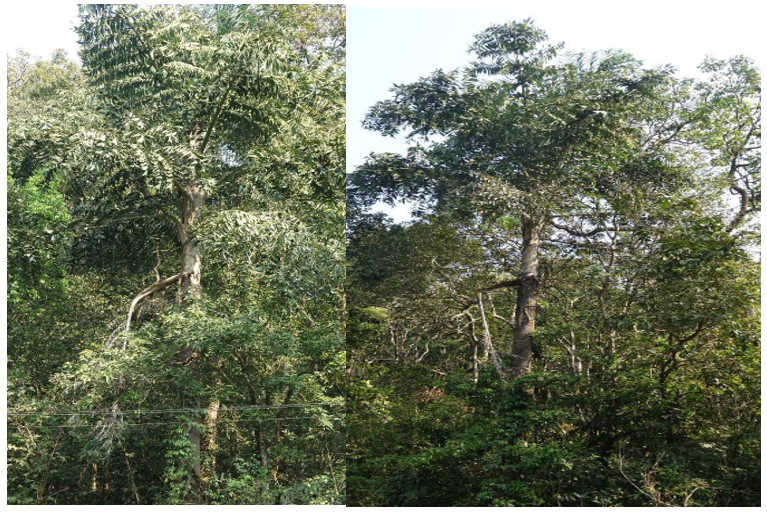
That the Caryota urens have a wide range of edible uses: The sap extracted from the inflorescence of the plant is used to make sugar and alcoholic beverages. A primary product of the plant in rural communities is the sugar substitute called kitul honey or jaggary obtained from the juice from the flowers. This is concentrated in large, wide-mouthed vessels on an open fire to prepare a viscous, golden syrup with a delicious flavour. The sap can be further concentrated to give kithul jaggary (candy). Sap collected from the inflorescence is fermented with a crude, mixed inoculum of yeast to obtain toddy [8].
This beverage can be distilled, as is coconut toddy, to prepare a more concentrated spirit. The pith or heart of the trunk contains a starch similar to sago, often used as a food source during famines. The starch obtained from the stems is used to make sago. Because the outside stem is very tough, the plant tends to get utilized for its starch mainly in times of food shortage. Leaves are cooked and eaten. The very young unfolding leaves and leaf bud are cooked and eaten as a vegetable. A somewhat bitter flavour. Harvesting this terminal bud effectively kills the tree since it is unable to make side shoots and so cannot produce new growth. Strong fibres from the leaf bases are used to manufacture ropes, brushes, brooms, and baskets. The outer wood is heavy and durable, used in traditional construction for rafters, flooring, and fencing. The seeds can be used as a masticatory in place of betel nut.
Many birds are attracted to the small, fleshy red fruits of Caryota urens, though they must be physically adapted to handle the fruit's toxic calcium oxalate crystals. In their native habitats of India and Southeast Asia, the birds as stated are the primary consumers: Barbets: Specifically, the Brown-headed Barbet and White-cheeked Barbet. They often visit the palm daily, sometimes swallowing the fruit whole or pecking at the pulp. Bulbuls: The Red-whiskered Bulbul and Yellow-vented Bulbul are frequent visitors. Because of their smaller size, they often eat the fruit "piecemeal," pecking away the flesh and dropping the seed. Koels & Cuckoos: The Asian Koel is a major consumer.
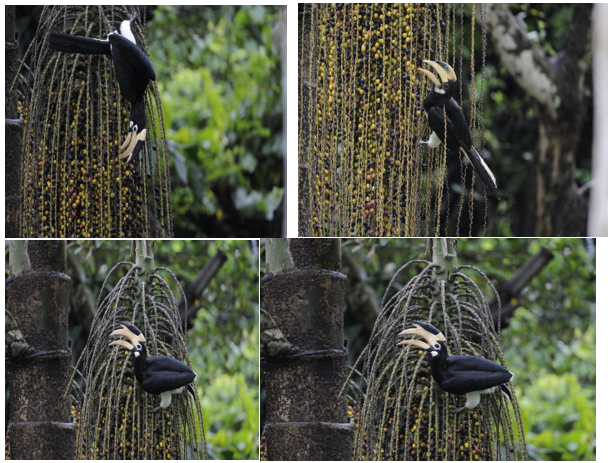
They typically swallow the fruit whole and later regurgitate the large seeds, making them excellent seed dispersers. Mynas & Starlings: Common Mynas and Brahminy Starlings are frequently observed feeding on the ripe clusters. Hornbills: In forest environments, large birds like the Indian Grey Hornbill or the Malabar Pied Hornbill consume the fruits. Their robust digestive systems allow them to process the pulp and disperse the seeds over long distances Figures. Kingfishers: While kingfishers are usually hunters of fish or insects, the Stork-billed Kingfisher has been documented in Kerala, India, specifically feeding on Caryota urens fruits. Pigeons: The Pink-necked Green Pigeon and Imperial Pigeons are known to include these palm fruits in their diet when other forest fruits are scarce. While birds are vital for dispersal, they share the fruit with several mammals.
Palm Civets (often called "Toddy Cats") and Fruit Bats are arguably the most significant consumers of Caryota urens fruit; they often carry the fruit away from the mother tree, which helps the palm colonize new areas. Having rich in sweet sap it is liked by elephants.
Caryota urens exists in a complex web of biological relationships, serving as a food source and a structural component of the forest. In the wild, it is often found in the understory or canopy gaps of evergreen and semi-evergreen forests. In karst (limestone) regions, researchers have identified specific forest types where it associates with Garcinia bracteata (Mangosteen relative), Celtis tetrandra (Nettle tree) Debregeasia orientalis. In Southern India and Sri Lanka, it is a key component of "Shola" forests (high-altitude stunted montane forests).
Because the palm produces massive quantities of energy-rich fruit and sap, it supports a wide variety of wildlife like Fruit Bats and Palm Civets (Paradoxurus Hermaphroditus) are the primary dispersers. They consume the fruit and excrete the seeds away from the parent tree. The pendulous inflorescences attract high numbers of honeybees and other nectar-seeking insects. Birds such as Hornbills Figure, Barbets, and Bulbuls are major associates that rely on its fruit during the fruiting season (January–August). The sap of Caryota urens is naturally rich in sugars (10–20%), making it a host for various fermenting microorganisms.
Research into "Toddy" production identifies the following natural associates found in the sap like Saccharomyces cerevisiae and Schizosaccharomyces pombe, Acetobacter species and Leuconostoc, which are responsible for the natural fermentation of the sap into palm wine and eventually vinegar [9].
This palm is having wide range of food and medicinal values. A porridge prepared from the seed flour is prescribed by local physicians to treat gastric ulcers, migraine headaches, snake-bite poisoning and rheumatic swellings. The root is used for treating tooth ailments the bark and seed are used to treat boils. The tender flowers are used for promoting hair growth [10].
A very strong, fine, soft and durable fibre is obtained from the leaf bases It is used to make a wide range of products, but especially brooms, brushes, ropes, baskets etc It is also used for stuffing cushions. A woolly substance, or scurf, scraped from the leaf-stalks is used for caulking boats. It is also extensively used in machine brushes for polishing linen and cotton yarns, for cleaning flax fibre after it is scutched, for brushing velvets, and other similar purposes. A woolly substance, or scurf, scraped from the leaf-stalks is used for caulking boats. It is also extensively used in machine brushes for polishing linen and cotton yarns, for cleaning flax fibre after it is scutched, for brushing velvets, and other similar purposes. The fibre becomes very pliable after being steeped in linseed oil. The leaves are used for thatching [11].
The mature wood in the outer portion of the stem is strong, heavy and durable. The stem yields an inferior timber sometimes used for construction purposes, especially in traditional buildings, for purposes such as planking, flooring, rafters, roofing, partitioning and fencing, and also for making spears. The stem, cut lengthways in half with its centre scooped out, is used for gutters and drains, or to convey water over long distances. Polished stems are used as monoliths in modern houses Propagation Seed At room temperature the seeds remain viable for 30 - 90 days, depending on storage conditions. An experiment in SriLanka on the effect of seed storage and exposure to sunlight revealed
Acknowledgement
I extend my sincere thanks to the Karnataka Biodiversity Board for sharing the information and data analysis etc. My special thanks are due to National Medicinal Plants Board, New Delhi; Shri R.M.N.Sahai the then Chairman Karnataka Biodiversity Board, Shri CR Jawahar and Ms. Shruthi.S, Karnataka Biodiversity Board, students and staff of the Ayurvedic colleges and all others who were engaged directly/indirectly in this exercise. Thanks, are also due to the then Deputy Conservators of Forests of all18 Divisions and their front-line staffs who have contributed a lot in this assessment exercise. My thanks to Shri Manoj Kumar Principal Secretary Forest and Nilesh Kumar Sindhe Director DWLS for providing the photographs of Hornbill eating fruits of Sago palm and mature trees of Caryota urens respectively.
References
- Linnaeus, C. (1753). Species plantarum (Vol. 2, p. 1189).
- Wight, R. (1840–1853). Icones plantarum Indiae orientalis.
- Singh, U. V. (2026). Natural regeneration status of Santalum album in Western Ghats of Karnataka State, India. Curr Res Env Sci and Eco Letters, 3(1), 1–11.
- Singh, U. V. (2020). Ecological dynamics of biodiversity in landscape of Mangalore division. European Journal of Applied Sciences, 8(4), 11–84.
- Singh, U. V. (2023). Dynamics of biodiversity behavior in forest landscape of Belagavi Division, Karnataka, India. Ecology and Conservation Science, 2(5).
- Arun Prakash, V. R., et al. (2020). Mechanical, thermal and fatigue behaviour of surface-treated novel Caryota urens fibre–reinforced epoxy composite. Biomass Conversion and Biorefinery.
- Riffle, R. L., & Craft, P. (2003). An encyclopedia of cultivated palms. Timber Press.
- De Zoysa, N. (1992). Tapping patterns of the kitul palm (Caryota urens) in the Sinharaja area, Sri Lanka. Principes, 36(1), 28–33.
- Somasiri, H. P. P. S., et al. (2011). A review of the palm sugar industry in Sri Lanka and the potential for its development.
- Anamika, G., et al. (2021). Updated review on ethnomedicinal plant Caryota urens. International Journal of Pharmaceutical Research.
- Anamika, G., et al. (2021). Updated review on ethnomedicinal plant Caryota urens. International Journal of Pharmaceutical Research.