

Advances in Theoretical & Computational Physics(ATCP)
ISSN: 2639-0108 | DOI: 10.33140/ATCP
Impact Factor: 2.6

Research Article - (2025) Volume 8, Issue 2
Distribution of Electrons in the Atom, According To New Axioms and Laws
Received Date: Feb 05, 2025 / Accepted Date: Mar 28, 2025 / Published Date: Apr 14, 2025
Copyright: ©Ã?©2025 Valentina Markova. This is an open-access article distributed under the terms of the Creative Commons Attribution License, which permits unrestricted use, distribution, and reproduction in any medium, provided the original author and source are credited.
Citation: Markova, V. (2025). Distribution of Electrons in the Atom, According To New Axioms and Laws. Adv Theo Comp Phy, 8(2), 01-10.
Abstract
The Theory of new Axioms and Laws contains 2 new Axioms and 8 new Laws and is created by the same author. This Theory claims that elementary particles are constructed simultaneously from 2 different vortices: open transverse vortex and open longitudinal vortex. The vortices are mutual orthogonal in space (S) and in time (T) and they can be accelerating or decelerating.
The transverse vortex is open vortex , transversely coiled in 2D .Pulsating in time (T) it forms concentric transverse vortex that spread in space as transverse wave .Every points on this transverse wave move with a constant time: T= const. This is the Real time-space of light waves and Electromagnetic waves.The longitudinal vortex is also open, but is wound longitudinally in 3D. Pulsating in time (T) it forms unique longitudinal waves. If it has positive acceleration the accelerating longitudinal vortices suck in free vortices from outside to themself. They are attracted and packed as they inserted each inside other and form an accelerating longitudinal Funnel.Each spiral in Funnel changes the ratio(v/w) between longitudinal velocity (v) and angular velocity (w) so that the length all spirals is one and the same: S=.const. The longitudinal Funnels generate the Gravitational time-space.
The electron is generated by a transverse decelerating vortex coming from the proton. It winds up a transverse deceleration vortex in a from out to inward direction in form of toroid with radius (r). Generates in center of toroid in 2D a longitudinal vortex with length (l), perpendicular to plane of toroid. The electron changes the ratio (r/l) between parameters (r) and (l) depending on its pulsation in time T(respiration) and its pulsation in space S (the distance to nucleus).
If the electron is located in the central orbits around the nucleus, it has a maximum length (max) of the longitudinal vortex and a minimum radius (r min) of the transverse vortex or: (l>r). Thus electron shrinks to a point without mass, it becomes invisible to an outside observer and it is perceived as longitudinal wave. If the electron is located in the peripheral orbits around the nucleus, it has a minimum length (l min) of the longitudinal vortex and a maximum radius (r max) of the transverse vortex from toroid or: (l
Introduction
The Theory of new Axioms and Laws
The Axioms
According the Axiom of Classical Field Theory: div (rot E) is equal to zero (0),(Figure 1,Ia)) [1].
According new Axiom1: A field in which the vector E moves with a monotonically non-uniform speed (decelerating or accelerating) becomes an open vortex field structure: div (rot E) is not equal to zero (0), (Figure 1,Ib). [2-4]. Axiom 1 claims that there are 2 type open vortices - transverse (in plane 2D) (Figure 1,Ic) and longitudinal (in volume 3D) (Figure 1Id). Each of them can be accelerating or decelerating. Therefore we receive 4 type of open vortices.
According Axiom2: There are mutually orthogonal field structures that form a resonant system by exchanging energy and matter with each other, (Figure1,IIa,b). [2-4].
Axiom2 claims that orthogonal pairs form many pairs of particles (connected in the right direction) and many pairs of antiparticles (connected in the opposite direction) (Not pictures). The main pair of particles is electron – proton (Figure1,IIc,d). Their generating direction is from proton to electron. There are pair and inverse direction that form positron and antiproton.
The Laws
According Law1: A decelerating transverse vortex in plane 2D generates in its center perpendicular in volume 3 D accelerating longitudinal vortex (Figure 1,IIc : electron)). [3,4].
According Law2: A decelerating longitudinal vortex in volume 3D generates in center of perpendicular plane in 2D an accelerating transverse vortex (Figure 1,IId: proton) [4,5].
Law 5 for 2D: The main decelerating vortex (in 2D) decreases in (n) portions (ψn ) times; the emitted primary transverse vortices increases in (n) portions (ψn ) times,where ψ is equal to the Golden proportion (Figure 1e) [5,6].
Law 5 for 3D: The decelerating vortex in 3D is described with a system of 4 equations in which: longitudinal velocity (V) decreases in (n) portions (ψn ) times; the angular velocity (w), the amplitude (W) and the number (N) of cross vortices increase in (n) portions (ψ n ) times:
I V2 = V0 (1 – V), 1)
I W2 = W0 (1 +W),
Iw2 = w0 (1+ w),
IN2 = N0 (1+ N)
where vn,wn are periodic roots with period n; vn ,wn are mutual orthogonal that fulfill the requirement for orthogonality: vn . wn = V0 .w0 , vn .ωn = V0 .W0 ; n = 0 ÷ ∞; the roots vn , wn and ωn and nn are expressed as: vn = (1/ψn ).V0 , ωn =ψn .W0 ; wn = ψn .W0 , [nn ] = ψn .N0 ; linear velocity V0 is the starting value of Vn , amplitude of cross vortex W0 is the starting value of ωn , angular velocity w0 is starting value of wn , number N0 is starting value of nn , [nn ] is the closest integer; ψ is a proportional that fulfills the requirement: ψ-1/ ψ =1, ψ is known as Golden ratio (Figure1,IIIa) [4-6].
In Space where we live the most movements are decelerating. The reason is that the transverse vortices have density and their some kind of mass. The result is that this Space is full of transverse vortices and they exerts resistance. The correspondng Space-Time is described by constant of Time (as a proportion).
According Law 5 for pulsating in Time (T), the transverse vortex coiled in electron and proton pulsates in time (T) as well. In the initial phase, when the electron shrinks it decreases in volume. The reason is that the velocity at the entrance of the transverse vortex is high because the acceleration is positive. This means, in short, that the velocity of the entrance of the transverse vortex of the electron, is accelerated.
Law 6 for 2D : The main accelerating vortex (in 2D) has increasing longitudinal velocity (V) and sucks inward many primary accelerating vortices with decreasing amplitudes (W), where at every i-th step the variable is changed by a degree (i) of the parameter ψ or (ψ i ), where ψ is equal to the Golden proportion (Figure 1f) [5,6].
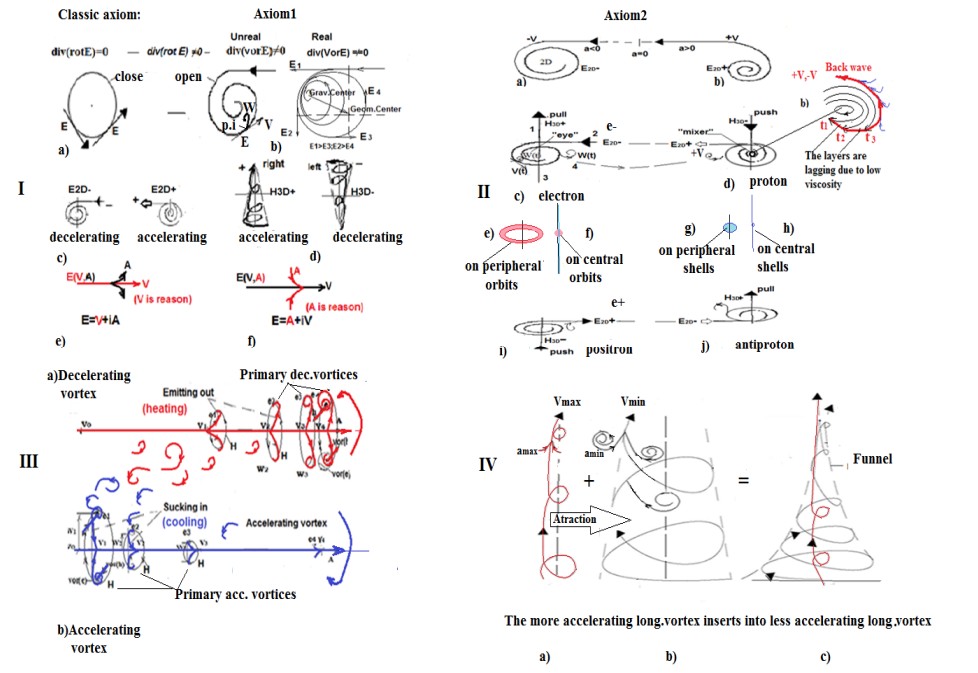
Figure 1. I. a) Classic Axiom :closed vortex, b) New Axiom1:open eccentric vortex, c)Transverse decelerating and accelerating vortices, d) Longitudinal accelerating and decelerating vortices, e) Decelerating vortex emits dec. primary vortices:Law5,f) Accelerating vortex suck in acc. primary vortices: Law6
II. New Axiom2: a) Model of first orthogonal object, b) Model of second orthogonal object, c) Model of electron: Law1 in pull passive, d) Model of proton: Law2 in push active, e) Model of positron: Law1 in push passive, f) Model of antiproton; Law2 in pull active. III. a) Decelerating vortex with decreasing velocity emits decelerating primary vortices with increasing amplitudes: Law5, b) Accelerating vortex with increasing velocity sucks in acc. Primary vortices with decreasing amplitudes: Law6.
IV. a) Longitudinal vortex with max. velocity, max acceleration, min amplitude and min. number of loops, b) Longitudinal vortex with min. velocity, min acceleration, max. amplitude and max. number of loops, c)Longitudinal vortex with max. velocity attracts long. vortex with min. velocity and inserts himself in center of slowest one.
Law 6 for 3D: The accelerating vortex in 3D is described with a system of 4 equations in which: longitudinal velocity (V) increases in (n) portions (ψn ) times, the angular velocity (w), the amplitude (W) and the number (Nn ) of cross vortices decrease to zero in (n) portions (ψ n) times:
I V(t)2 = V0 (Vo +V(t)),
I W(t)2 = W0 (W0 –W(t)), 2)
I w(t)2 = w0 (w0 - w(t))
I N2 = N0 (N 0 - Nn ),
where the roots vn, wn and ωn and nn are expressed as: vn = (ψn ).V0 , ωn = (1/ψn ).W0 , wn = (1/ ψn ).W0 , nn = (1/ψn ).N0 ; linear velocity V0 is the starting value of Vn , amplitude of cross vortex W0 is the starting value of ωn, angular velocity w0 is starting value of wn , number N0 is starting value of nn ; ψ is a Golden proportion that fulfills the requirement: ψ-1/ ψ =1: vn ,wn n are periodic roots with period n; vn ,wn are mutual orthogonal that fulfill the requirement for orthogonality: vn .wn = V0 .w0 , vn .ωn = V0 .W0 ; n = 0 ÷ ∞; the roots vn , wn and ωn and nn are expressed as: vn = (ψn ).V0 , ωn = (1/ ψn ).W0 , wn = (1/ ψn ) .W0 , nn =(1/ψn ).N0 ;
The first positive root of the first equation is: v1 = ψ.V0 = 1,62. V0 . The periodic roots of the first equation are obtained from the expression: vn = V0 . (vn-1+vn-2).
The first positive root of the second equation is: w1 = (1/ψ.)W0 = 0,62.W0 . The periodic roots of the second equation are obtained from the expression: wn-2 = W0 . (wn -wn-1).
Therefore when velocity (V) increases, the amplitude (W) decreases so that at each step (ni) (according to Consequence of Law 4) the product (Vi ). (Wi ) is a constant (Figure 4a). For an accelerating longitudinal vortex, the amplitude (W) decreases only if it is directed from the outside to inside, ie. if the accelerating vortex sucks in cross vortices with decreasing amplitude (W) (Figure 1,IIb) [4-6].
The Distribution of Protons in the Nucleus is the Reason for the Respectively Distribution of Electrons
The information is brief,retrospective and preliminary. It is necessary to connect the object of electron with the entire complex system of generation and construction of the atom -for example with generation of the nucleus. It was published in previous reports and described in detail [22,23].
Structure of the Longitudinal Funnels, Generating the Nucleus
The reason for the above distribution of electrons is that the nucleus of atom is formed by many shells of protons inserted one into another .The author takes this hypothesis as good and it is used in this report. The protons are tightened, organized and are contracted by accelerating longitudinal Funnels coming from all directions of 3D from out-inward. This action of the accelerating Funnels (like necessary condition) is assisted by the action of the neutrons (like sufficient condition) as well.
The central spirals of accelerating longitudinal Funnel have maximal longitudinal velocity (v max) (in direction of the moving) and minimal angular speed (w) (along the radius). The more outer spirals of accelerating longitudinal Funnel have less longitudinal velocity and more angular speed and so on. The peripheral spirals have minimal longitudinal velocity(v min) (in direction of moving) and maximal angular speed (w max) (along radius) (Law6).
For example: (According Law6 and system of equation (2)) If the peripheral spiral has minimal (vmin) longitudinal velocity (vmin = vo) (in direction of moving) and maximal (wmax) angular speed (wmax = w o) (along radius).
The first inner spiral (Figure 1,IV,b) will accelerate by a factor of Golden proportion (φ) and the longitudinal velocity becomes: v1 = v0 . (φ 1). The angular velocity decreases by a factor of φ and becomes : w1 = w0 / (φ 1).
The second inner spiral accelerates once more by a factor of φ and becomes: v2 = v0 .(φ.2 ). The angular velocity decreases by a factor of φ and becomes: w2 = w0 / (φ2 ) and so on to the most central spiral. Let the number of spirals inserted into each other in the accelerating Funnel be N.
The most central spiral (Figure 1,IV,a) is almost a straight line and with maximum longitudinal velocity: vmax = vN = v0 (φ N). The central vortex has almost zero angular velocity: w min = wN = w0 /(φ N), (According Law6 and system of equation (2)).
Distribution of Electrons in Relation to Distribution of Protons in Nucleus
It is known that the nucleus of atom is formed by many shells of protons inserted one into another .They are tightened and contracted by accelerating longitudinal Funnels coming from all directions of 3D from out-inward .This is assisted by the action of the neutrons as well.
a) The Central Spirals of Accelerating Funnel in Nucleus, The Central Protons and the Central Electrons [22,23]. It has seen before that the central spirals of accelerating longitudinal Funnel have maximal longitudinal velocity (v max) (in direction of the moving) and minimal angular speed (w min) (along the radius) (Law6).
This is the reason the central protons have maximal length (L max) of longitudinal vortex and minimal transverse radius (R min). That is why the central protons look like to invisible points without mass and look like waves.
Because central protons generate and manage electrons in central orbits, then the central electrons also have minimal length of longitudinal vortex (l max) and maximal radius of transverse vortex (r min). These central electrons The central electrons are generated in orthogonal way to the central protons (Axiom2). They form resonant pairs that exchange matter and energy. The decelerating transverse vortex emanating by the proton is wound transversely in 2D and forms a toroid as the body of the electron. In the center of the toroid a perpendicular accelerating longitudinal Funnel is generated in 3D(Law1). Therefore, the central electrons must have the similar shape like central protons. Or the central electrons must have smallest radius (r min) and longest length of longitudinal vortex (l max). The more outer spirals of accelerating longitudinal Funnel have less longitudinal velocity and so on.look like to invisible points without mass and is similar to waves.
b) The Peripheral Spirals of Accelerating Funnel, Peripheral Protons and Peripheral Electrons [22,23]. The peripheral spirals of accelerating longitudinal Funnel have minimal longitudinal velocity (v min) (in direction of the moving) and maximal angular speed (w max) (along the radius) (Law6).
That is why the peripheral protons have minimal length of longitudinal vortex (L min) and maximal transverse radius of body (R min). Thus, the peripheral protons look like well visible spheres. Because peripheral protons generate and manage electrons in peripheral orbits then the peripheral electrons also must look like to visible spheres.
The peripheral electrons are generated by the peripheral protons (Axiom 2). They form resonant pairs that exchange matter and energy. The decelerating transverse vortex emanating by the proton is wound transversely in 2D and forms a toroid as the body of the electron). And in the center of the toroid of body a perpendicular accelerating longitudinal Funnel is generated in 3D (Law1).Therefore, the peripheral electrons must have the similar shape like peripheral protons. Or the peripheral electrons must have also biggest radius (r min) and shortest length of longitudinal vortex (l max).
The Electron as an Elementary Particle According Theory of New Axioms and Laws
Structure of Electron
a) Generation of Electron
The electron is created by a transverse decelerating vortex in a 2D plane, and in the center of the vortex is generated a longitudinal acceleration vortex in 3D, perpendicular to the plane 2D (Law 1). This transverse vortex comes from the proton that controls its own electron (Axiom2) Thus the electron organizes itself as a thin transverse pulsating toroid in the 2D plane .The transverse vortex coming from its own proton in plane 2D pulsates in time (T) That is why the longitudinal perpendicular vortex also pulsates but in volume 3D in time (T).
b) The Proton Pulsates in Time (T) The pulsation in time of period (T) of proton that is a master of its own electron (Axiom2) The pulsation of protons is the reason that the orbit of the electron transforms from circle to ellipse (Figure 2c,d). The reason is that the proton contracts during the first part (T/2) of the pulsation period (T). The contracting proton attracts and contracts its own electron (Axiom2). According Law of Conservation of Energy and Axiom2, this contracting electron has maximal longitudinal velocity (v max) along the orbit, minimal angular speed (wmin) and pass in minimal distance to its proton along straight line.
After this the proton expands during the second part (T/2) of the pulsation period (T). The expanding proton repels and expands its own electron (Axiom2). According Law of Conservation of Energy and Axiom2, this expanding electron has minimal longitudinal velocity (v min) along the curve orbit, maximal angular speed (w max) and pass in maximal distance to its proton along curve line.
Result: Because the pulsation (T/2+T/2) of each proton, the every under-controlled electron movec) The Electron Pulsates in Time (T) How the electron pulsates in time (T): At the first half-period (T/2) electron expands. The transverse vortex tightly wound around the periphery of the toroid and the radius increases to r max. The entire toroid becomes clearly visible (Figure1,IIe). At the next halfperiod (T/2) electron shrinks to a point and becomes an invisible (Figure 1,IIf).
d) The proton pulsates in space S In previous articles it was described that the nucleus contains in a very compact volume protons with different appearance [22,23].s along an ellipse Thus, the electron moves along 2 opposite almost straight lines passing close to the proton and 2 opposite curves in the most distant parts. Therefore, this curve is an ellipse and due to the pulsation (T/2+T/2) of each proton in a period of time (T) its under-controlled electron moves along an ellipse.
In the center there are protons with elongated longitudinal vortices (l max) and very contracted transverse vortices (r min) which manifest as longitudinal waves (r < l). Their bodies are invisible and these protons are perceived mostly as longitudinal waves.
In the periphery the protons gradually expand and acquire larger radii (r max) from the increased transverse vortices and minimum lengths (l min) from the contracted longitudinal vortices (r > l). Therefore their bodies are visible and these protons are perceived mostly as particles.
Result: The distribution of protons in the nucleus causes the exactly this distribution of electrons in the electron shell Therefore the spatial distribution of protons in the nucleus (according to Axiom2) is the reason for exactly this distribution of electrons in the electron shell.
e) The electron pulsates in space S According to the longitudinal Funnel construction and Rule of accelerating longitudinal vortices (Law6) the central vortex has the maximum longitudinal velocity: vmax = vN = v0 (φ N). This is the reason the internal protons to have the longest longitudinal vortices (Figure 1,IVa). The central vortex has almost zero angular velocity: w min= wN = w0 /(φ N ), This is the reason the internal protons are shrunk to points without mass and emit longitudinal waves (Figure 1,IIh).
Therefore, the internal electrons in internal orbits also are shrunk to points without mass. (Figure 1,IIf).That is why the internal electrons have also elongated longitudinal vortices and very narrow transverse vortices in the form of points.
Result: The internal electrons are shrunk in transverse vortex to point and are elongated in longitudinal vortex: l >r This is the reason internal electrons to emit longitudinal vortices that are sucked by protons (Axiom2). Their very narrow transverse vortices (r min)( as points ) do not reflect light waves and are invisible to an outside observer.
Result: The internal electrons are invisible, without masses and are perceived as waves. According to the longitudinal Funnel construction and Rule of accelerating longitudinal vortices (Law6) the peripheral vortices of Funnel have a minimum longitudinal velocity (v min) and maximal angular speed (w max) (Figure 1,IVb).
Thus the peripheral protons have shortest length of longitudinal vortices (L min) and have maximal radius (R max) or are inflated to spheres (Figure 1,II g). Therefore, the electrons that rotate on the peripheral orbits also have smallest longitudinal vortices (l min) and very inflated transverse vortices(r max) in the form of toroid (Figure 1,IIa).
Thus the peripheral electrons are inflated to dense toroid that have maximal mass. They reflect light waves and are clearly visible to an external observer.
Therefore the peripheral electrons in outer orbits are more inflated, with a larger volumes and masses and look like a visible toroid. (Figure 1,IIe ). This is the reason the electrons are visible only at periphery of outer orbits.
Result: The external electrons are expanded in transverse vortex and are shortened in longitudinal vortex: l
For comparison – on the inner orbits electrons shrink, lose volumes and become to invisible points without masses (Figure 1,IIf). This is the reason the electrons in inner orbits to be perceived as waves while the electrons in outer orbits to be perceived as particle.
Result: The external electrons are visible, with masses and are perceived as particles. Simultaneously of generation of transverse vortex, the electron generates and the longitudinal accelerating pulsating vortex in the center of the transverse vortex in the 3D volume, perpendicular to the 2D plane (Law1). The longitudinal vortex also pulsates in antiphase time (T/2).There the transverse vortex and its longitudinal vortex are mutual orthogonal in space (S) (mutually perpendicular) and in time (T) (anti-phased) (Axiom2).
For example: When the longitudinal vortex contracts (l min) the transverse vortex expands (r max) during half period (T/2) (Figure 1,IIe). When the longitudinal vortex elongated (l max) the transverse vortex contracts (r min) during the next half period (T/2) (Figure 1,IIf).
f) Visible and invisible of electron along ellipse
The electron is visible only in 2 opposite arcs of an ellipse: In the two opposite arcs of the ellipse, the electron is maximally inflated (r max) (Figure 1,IIe). The reason is that the transverse vortex has maximal radius (r max) with minimal length (l min) of the longitudinal vortex at its center (Figure 2a). Thus the electron toroid becomes maximal visible.
The electron is invisible along 2 opposite straight section of ellipse: In the two opposite straight sections of the ellipse the transverse vortex of electron is minimal and radius is minimal (r min).
Result: Along ellipse orbit the electron is visible only in 2 points at 2 opposite curves , where electron is maximal expanded.
The electron body is maximally collapsed to an invisible point with minimum eccentricity and the longitudinal vortex in the center has maximal length. Thus electron looks like a point and it is invisible for outside observer. (Figure 1,IIf) [6,7,8].
Electron Appearances
According to Axiom 2, the electron is orthogonal to the proton .Thus the electron pairs with the proton in a resonance system in the space S. According Law2 when the decelerating longitudinal vortex generating the proton pulsates at time T, then the accelerating longitudinal toward the electron also pulsates at time T.
a) Action of the Electrons in Outer Orbits
When the electron is in an outer orbit, the volume is maximal and the eccentricity is maximal (Law1) Therefore, inside the toroid of the electron is emitted primary decelerating transverse vortices with maximal curve and bend in maximum amplitude to the Gravity center (G1). The maximal curve and bend cause electron to has a maximal speed of rotation around its axis. Because of the curvature of these decelerating primary vortices are to the left then the electron rotates also from right to left (if the observer looks against the longitudinal vortex).
Result: On periphery orbits, the transverse vortex of electron is inflated in the form of a toroid with maximal radius (r max) and the perpendicular longitudinal vortex is smallest (l min). According Law4 and the Law of Conservation of Motion when electron has maximum speed of rotation around its axis (w max) with maximal expanded form , the electron will acquire a minimum velocity along orbit (v min) around proton (v. w = const.) (Figure 2a).
Result: On periphery orbits the toroid of electron is inflated and emits to its Gravity center (G1) maximally long and bended arcs of primary decelerating vortices, Because the volume of toroid of electron is maximal. This cause maximal eccentricity of toroid, maximal length of primary transverse vortices and maximal arc of primary vortices. It is the reason for maximal speed of rotation (wmax) around its axis. Because of Law of Conservation of moving except maximal speed of rotation (wmax), the inflated electron toroid in peripheral orbit to has and minimal speed (v min) along orbit: (w max .v min = const.) (Figure 1,II.....).
Result: On peripheral orbits electron has maximal speed of rotation around its axis (w max) and minimal speed along orbit (v min) along orbit. It is necessary to emphasize the connection between the shortened the longitudinal vortex (l min) and the minimal orbital velocity (vmin) with the fact that the peripheral electrons are visible ,with mass and are perceived as particles.
b) Action of the Electrons in Inner Orbits When the electron is in an inner orbit, the transverse vortex is collapsed, the volume is minimal and the eccentricity tends to zero.The electron has minimal speed of rotation (w min), the electron toroid is shrunk to a point. This is the reason to has and maximal speed (v max) along orbit: (w min .v max = const.) (Figure 1,IIf).
Result: On central orbits the transverse vortex of electron is shrunk to a point and the perpendicular longitudinal vortex has maximal length (l max). Inside the toroid body of the electron, the arc amplitude of the decelerating primary vortices tends to zero That is why electron has a minimum speed of rotation around its axis (wmin) And due to the almost zero length and curvature of these decelerating primary vortices (toward left), the electron will rotate very slowly from right to left (if the observer is looking against the longitudinal vortex). According Law 4 and due to Law of Conservation of motion when the electron has minimal speed around its axis (wmin) then it will acquire a maximum velocity along orbit (v max) [6-8].
Result: On central orbits electron has minimal speed of rotation (w min) around its axis and a maximal tangential speed (v max) around its orbit: (w min, v max). On central orbits the shrunk body of electron creates inside itself minimum arc lengths of primary vortices and thus is caused a minimum speed of rotation (w min) around its axis. This is the reason in central orbits shrunk electron has a maximal tangential speed (v max) around its orbit.
c) Action of Electron to be Visible
Depending on its volume and density electron can be visible or invisible from an independent observer. In peripheral orbits electron is expanded and has maximum number of transverse windings that reflect the light waves.
Result: In peripheral orbits the electron body is well visible. The reason is that the decelerating transverse vortex is tightly coiled at the periphery in a transverse spiral, which is visible to an external observer.
Result: In peripheral orbits the tightly coiled transverse spiral of the toroid is visible because it reflects the light waves. The reason the tightly coiled transverse spiral of the toroid to be visible is that it reflects the light waves, which are also transverse. If any outside observer sees the reflected waves then he will perceives the toroid as a particle with mass.
d) Action of Electron to be Invisible We saw in previous paragraph that in central orbits electron has minimal radius (r min) and looks like appoint and maximal longitudinal vortex (l max).and looks like a long spindle.
Result: In central orbits the electron body is invisible. The reason is that it looks like a point and does not reflect the light waves and light waves make diffraction around them. Result: In central orbits electron looks like a point and it does not reflect the light waves. The reason is that central electrons do not reflect light waves but they make diffraction around point of electron.
e) The Action of Other Vortices to be Invisible Except transverse vortices that can be visible or invisible, there are primary and longitudinal vortices and longitudinal Funnel that can only invisible.
Result: The decelerating primary transverse decelerating vortices emitted by the main transverse decelerating vortex (of electron) from the periphery to the center are invisible. The reason that the primary transverse vortices and accelerating or decelerating longitudinal vortices to be invisible is that the thickness of its thread is commensurate with the length of the light wave. The reason that the accelerating or decelerating longitudinal Funnel are invisible is that the thickness of its thread is commensurate with the length of the light wave.
Result: The accelerating longitudinal Funnel that is emitted perpendicularly by electron and the decelerating longitudinal Funnel that is sucked perpendicularly by proton are invisible. Because the light wave not reflect by the thread of Funnels, the light wave forms diffraction, bypassing the thread of the vortices and continues at the same speed and in the same direction.
Result: The light waves make bypass the longitudinal Funnels because of diffraction to light waves. As a summary, it should be emphasized that all longitudinal vortices (accelerating or decelerating) and their structures such as Funnels do not reflect solar waves and are therefore invisible.
The Electron Exists both a Particle and a Wave
Electron Exists As Particle in 2 Points of Both opposite Curves of Ellipse
The decelerating transverse vortex that makes up the body of the electron (Law1) is visible to an external observer only at 2 points of the electron's orbit. These are points from the two opposite arcs of the electron's ellipse. At these 2 points, the electron is expanded, has mass, it is visible and is perceived as a particle. Only at these 2 points of orbit the electron is maximally inflated with maximal radius (r max) and minimal length of longitudinal vortex (l min) [8,9]. Therefore in these 2 points of ellipse electron has following parameters: r max, l min (r>l) and respectively: w max, v min (w>v).
Result: In only 2 points electron has the appearance of an expanded with maximal radius (r max) and very tightly coiled toroid from his main decelerating transverse vortex. This is the reason the main transverse vortex generating the electron (Law1) to emit primary decelerating vortices from itself to inward to his center (Law 5). It causes maximal curve and length of primary transverse vortices in direction from periphery of electron to Gravity center (G1). It cause respectively and maximal angular speed (w max) (electron rotates in maximum around its axis) and minimal speed along ellipse (v min) (electron almost stops in these points where it rotates).
Result: In only 2 points on the both opposite curves of ellipse orbit the electron has view of expanded body (r max). Because electron body has minimal length of longitudinal vortex (l min) and maximal radius (r max) with maximal mass, it is well visible and is perceived as particle. Therefore electrons are not visible along the entire orbit. The electron appears only at 2 points. Thus electron appears and dis appears again and again.
Electron Exists As Wave in Both opposite Straight Line of Ellipse
At the remaining points of the ellipse orbit, the electron is shrunk with minimal volume and is invisible [8,9]. In all other points in the electron's orbit around the proton, the electron is shrunk, with minimal volume up and invisible.
Result: At all other points of the elliptic orbit of the electron, the toroid of electron has minimal radius (r min) because it has correspondingly a minimal number of transverse coils of main transverse vortex. Because radius is minimal (r min) the main transverse vortex generating the electron (Law1) has minimal coils and the electron looks like a point. It cause respectively and minimal angular speed (w min) (electron almost stop to rotate rotates around its axis) and maximal speed along ellipse (v max) (electron moves with maximal velocity along straight line of ellipse).
The reason is that at all other points of elliptic orbit electron has the appearance of a point.
Result: At all other points of elliptic orbit the electron has the appearance of very shrunk body to a point (rmin), without mass and it is invisible.
Because the body of electron has minimal radius (r min) and maximal length of longitudinal vortex (l max), it has minimal (almost zero) mass, it is invisible and it is perceived as an wave.
The Other Structures as Waves
According to Law 1 the pulsating decelerating transverse vortex at the entrance to the body of the electron in 2D generates perpendicularly a pulsating accelerating longitudinal vortices in the Gravity center (G1) of the electron in 3D these longitudinal vortices insert itself each other and form longitudinal Funnel.
Result: The pulsating longitudinal vortices and longitudinal Funnel is invisible. The reason that the longitudinal vortex is invisible is that the longitudinal vortex consists of a longitudinal spirals with a very thin threads. The thickness of its thread is commensurate with the length of the light wave. Therefore, the light wave does not reflect but forms diffraction by bypassing the thread of the vortices and continuing with the same speed and in the same direction [9,10].
Result: The pulsating longitudinal vortices and longitudinal Funnel are perceived as waves. Thus the accelerating longitudinal vortices or a longitudinal Funnel are not visible to an external observer, at no point of the electron's elliptical orbit.
Result: The pulsating longitudinal vortex and longitudinal Funnel emit invisible pulsating longitudinal waves. According to Law 5, if the electron hits itself to a dense barrier, the main decelerating transverse vortex sharply slowest and will emit as impulses many biggest primary transverse vortices towards the center of the toroid in 2D.Thus the electron (Law1) sharply and impulse shrinks to minimal radius (r min). Electron will shoot a highly accelerating and longest perpendicular longitudinal vortex (l max) in 3D.
Therefore when the electron hits a solid barrier, it reacts like an elastic body .While it shrinks in plane of body in 2D to a point (radius r min), it lengthens along longitudinal vortex (length l max) in volume 3D as an wave.
Result: When electron hits to a solid barrier, it reacts as elastic body. It shrinks in plane of body in 2D to a point and it lengthens along longitudinal vortex in volume 3D as an wave.
Result: Electron shrinks in plane of body in 2D to a point (to radius rmin) and it lengthens along longitudinal vortex (length l max) as an wave.
Modification of Newton's Laws for a Rotating electron
Newton's First Law
"A freely rotating body maintains its state of rotation with a constant angular velocity until any external forces (moments of forces) act on it to change this motion".
Thesis: When an elastic body constructed by two mutual orthogonal open vortices (with a rotating structure) is hit outside -in, it will bounce not in opposite direction ,but perpendicular along its axis up or down .This rotating body does not jump in the opposite to the hit direction, like it is according to Newton's First Law of Mechanics. Moreover this type elastic body will bounce up or down not with the impact speed and power, but with some reduced speed. The reason of reduction is that elastic body absorbs part of Energy of entrance hit like a spring.
For Example: If we hit a rotating peg, that rotates to the left, it will jump up (towards our face). If we hit this peg-top that rotates (inverse) to the right, it will jump down (if it can).
According to Newton's first law, it is assumed that upon impact this body will change its trajectory, but in the same, previous, plane. But in reality, upon impact on this body, it does not change its trajectory in the same plane in 2D. It reacts by bouncing in a perpendicular to previous plane in 3D.
Result: When an electron is struck from the outside-in, does not change its trajectory in its previous plane (in 2D), but bounces in a perpendicular direction (in3D), just when it changes from particle to wave.
The reason: The reason is that the electron is constructed by two mutual orthogonal (in time T and in space S) open vortices (transverse and longitudinal) and it has behavior of an unique elastic body
Newton's Second Law-Force
"It acting on the system from the outside results in an acceleration of the system: F = m. a"
Thesis: The rotating body with mass M upon impact with force F receives acceleration A not in the direction of force F, but in a direction perpendicular to the force F. Except direction the elastic body slows down and its own reaction. Due to inertia of elastic, body the acceleration a lagging in phase (by 90 degrees) after the act of force F.
Result: The electron, when struck from the outside with a force F in plane 2D, receives an acceleration A in a direction perpendicular to F in volume 3D, with acceleration (A) lagging behind force (F) in phase. Very important is that this kind of rotating elastic body like the electron , absorbs of part of power (F) and electron acceleration (A)is less than the acceleration of any usual solid body (a).
Result: According Modification of Newton's Second Law The elastic body of electron receives less acceleration(A) in comparison on acceleration of usual solid body (a), according Classical Newton's Second Law : A<,a.
The reason: The reason is that the elastic body absorbs part of Force of hit (F) inward and late the reaction to outward because it lag behind force(F) in phase (90 degrees).
Conclusion: The electron is not an solid particle and it does not execute the classical Newton’s Laws. But the electron is not only an wave, because it does not execute classical Maxwell’s Laws.
Newton’s Third Law
“Every action has an equal and opposite reaction”
Thesis: In the case of the electron, the reaction is not in the opposite direction, but in a perpendicular direction. Since the electron is an elastic body (it contains transverse and longitudinal springs) the reaction is not equal in magnitude but is smaller.
Result: The result of the impact on the elastic body of the electron is a smaller amplitude reaction and the direction is not the opposite, but perpendicular. Therefore, the electron does not manifest itself as a classical particle and we cannot study it with the methods of Newton's Laws.
Conclusion
The electron is a complex object that is built in the contact between 2 different time-spaces: time-space of a transverse vortex (T = const.)-and time-space of a longitudinal vortex or Funnel (S = const.).
All the properties of the electron are determined by this special construction. In particular, the manifestation of the electron as a particle is caused by the properties of the transverse vortex in timespace T const. and the manifestation of the electron as a wave is caused by the properties of the longitudinal vortex in time-space S const.
Conclusion: The manifestation of the electron as a particle is caused by the properties of the transverse vortex and the manifestation of the electron as a wave is caused by the properties of the longitudinal vortex.
Conclusion: In the outer orbits and more precisely only in 2 arcs of each outer elliptical orbit the electron manifests itself as a particle. Its orbital velocity is a minimum (v min) and the angular velocity is a maximum (w max.).
Conclusion: In the inner orbits and also in the two straight parts of each its elliptical orbit, the electron manifests itself as a wave - its orbital velocity in is a maximum and its angular velocity is a minimum.
References
1.Landau, L. D. (Ed.). (2013). The classical theory of fields(Vol.
2.. Elsevier. 2. Markova, V. (2003). The other axioms (Monograph, Book 1). Nautilus, Sofia.
3. Markova, V. (2005). The other axioms (Monograph, Book 2). Nautilus, Sofia.
4. Markova, V. (2019, September). Extended Field Theory, New Axioms, Laws and Consequences. In 2th International Conference on Quantum Mechanics & Nuclear Engineering, Paris, France.
5. Markova, V. (2017). Modeling of gravitational waves by creating a system of paired cross vortices. Some properties, conclusions and applications. IOSR Journal of Applied Physics (IOSR-JAP 9: 25-32.
6. Markova, V. (2017, July). New axiom for description of Gravity. In 5th International Conference on Physics, Athens, Greece (pp. 17-20).
7. Markova, V. (2018, July). About the new axioms and laws. In 5th International Conference on Theoretical and Applied Physics, Vienna, Austria.
8. Markova, V. (2019). Extended Field Theory, New Axioms, Laws and Consequences. 2th International Conference on Quantum Mechanics & Nuclear Engineering, Paris, France.
9. Markova, V. (2019). Modeling of Two Different Space-times, Based on Knowledge of New Axioms and Laws. 2nd Global Summit on Physics, Paris, France.
10. Markova, V. (2020). Essence of Electric Charge of elementary particles according of New axioms and Laws, Adv. Theo Comp Phy, 3(4), 298-303.
11. Markova, V. (2021). System of electron-proton. Movement, rotation, pulsation and Gravity Forces. Adv Theo Comp Phy, 4(1), 14-22.
12. Markova, V. (2021). The Gravity Funnels, formed by the longitudinal vortices, according to the new Axioms and Laws, Adv Theo Comp Phy, 4(1), 61-68.
13. Markova, V. (2022). Presence of a New Space-time in Which the Path S (Along the Motion Spiral) is a Constant, Acta Scientific Applied Physics, 2(2), 07-14.
14. Markova, V. Properties of the new time-space with a constant path (Sconst), 2022/BP/15747D B P International (e-book), Book Name: Innovations in Science and Technology.
15. Markova, V. (2022). System Electron–Proton. Journal of Theoretical and Computational Physics. Vol: 1, (1), 01-10.
16. Markova, V. (2022). Properties of the New Time-space with a Constant Path (Sconst.), Acta Scientific Applied Physics, 2(5), 141-155.
17. Markova, D. V. (2022). Gravity Field (LF) in inner planets of the Sun system described by theory of new axioms and laws,
18. Mrkova, V. (2023). Why the Electron Spins Around its Proton and Around its Axis, According to the New Axioms and Laws, Acta Scientific Applied Physics, 3(5), 44-57.
19. Markova, V. (2023). Intelligent Behavior of Electrons, According New Axioms and Laws, Acta Scientific Applied Physics, 3(6), 14-28.
20. Markova, V. (2023). The Electric Induction like behavior of electrons is proof of the new Theory of new Axioms and Laws, International Journal of Frontiers in Engineering and Technology Research, 5(2), 30-41.
21. Markova, V. (2024). Difference between Electromagnetic and Gravitational Field According New Axioms and Laws. Adv Theo Comp Phy, 7(2), 01-10.
22. Markova, V. (2025). Generating the Nucleus of the Atom by an Accelerating Longitudinal Funnel Based on the New Axioms and Laws. Adv Theo Comp Phy, 8(1), 01-11.
23. Markova, V. (2025). Generation and Distribution of Protons in the Nucleus According to New Axioms and Laws, International Journal of