

Journal of Agriculture and Horticulture Research(JAHR)
ISSN: 2643-671X | DOI: 10.33140/JAHR
Impact Factor: 1.12

Research Article - (2026) Volume 9, Issue 1
Digitalisation, Tokenisation and Trusted Data Infrastructure for Multi‐Purpose Agricultural Cooperatives in Serbia and the Western Balkans A Practical Operating Model and Tokenomics Framework Using IBDCP Layer‐Zero
Received Date: Jan 14, 2026 / Accepted Date: Feb 11, 2026 / Published Date: Feb 24, 2026
Copyright: ©2026 Dean Rakic, et al. This is an open-access article distributed under the terms of the Creative Commons Attribution License, which permits unrestricted use, distribution, and reproduction in any medium, provided the original author and source are credited.
Citation: Rakic, D., Brajovic, B. (2026). Digitalisation, Tokenisation and Trusted Data Infrastructure for Multi?Purpose Agricultural Cooperatives in Serbia and the Western Balkans. J Agri Horti Res, 9(1), 01-06
Abstract
Multiâ?purpose agricultural cooperatives in Serbia and the Western Balkans are increasingly expected to provide endâ?toâ?end services across inputs, machinery, grain trading and aggregation, cold chain, and processing. Many cooperatives underperform or fail due to recurring operational failure points: creditâ?linked inputs that create arrears and liquidity stress, sideâ?selling that weakens volumes and bargaining power, inconsistent grading and quality controls, weak governance and limited professional staffing, and fragmented evidence trails that slow audits, financing, and support programs. This paper synthesizes desk research and regional constraints and proposes a practical operating model in which Digitalisation is treated as an operating discipline - combining serviceâ?line economics, clear member contracts, and verifiable records. Building on Serbia’s public digital infrastructure (eAgrar and eâ?invoicing) and investment opportunities under IPARD III, the proposal introduces a “collaboratorâ?toâ?collaborator (C2C)” principle supported by a permissioned evidence backbone using IBDCP Block control (Interoperable Blockchain Data Custody Protocol) as a Layerâ?Zero consensus and interoperability layer. Tokenisation is added as a closedâ?loop utility mechanism to convert verified activity into programmable rights and incentives - e.g., loyalty/patronage credits, service access tokens for scarce capacity, and quality proof attestations - without creating publicly traded speculative assets. Optional AI services can augment planning, anomaly detection, and member advisory, but do not replace governance. The paper concludes with a phased implementation roadmap and policy recommendations for ministries, paying agencies, municipalities, cooperative unions, and development partners.
Keywords
Agricultural Cooperatives, Serbia, Western Balkans, Digitalisation, Traceability, Tokenisation, Tokenomics, Cold Chain, Grain Aggregation, IBDCP, Layer Zero, Cooperative Governance
Introduction
Agricultural cooperatives are frequently proposed as a mechanism to raise competitiveness of small and medium farms through aggregation, shared services, and improved market access. In developing and transition economies, a recurrent challenge is aligning members' incentives as both users of cooperative services and investors providing capital [1]. In Serbia and the wider Western Balkans, demand is growing for ''multi-purpose'' cooperatives that can provide an integrated bundle: inputs and agronomy, machinery services, grain trading and aggregation, cold chain for horticulture, and processing/packaging. This bundling can improve farm incomes, but it raises operational complexity, working-capital needs, compliance requirements (food safety, traceability, invoicing), and the consequences of governance failure.
Method of Scope
The paper is a design-oriented synthesis intended to be piloted and evaluated. Inputs include:
(i) Desk research on cooperative economics and governance,
(ii) Review of Serbia's legal and digital infrastructure relevant to cooperative operations,
(iii) Practical service-line failure analysis for multi-purpose cooperatives (inputs, machinery, grains, cold chain, processing), and
(iv) A Tokenisation and evidence-anchoring design that prioritizes auditability, data minimization, and closed-loop utility.
The paper does not present new econometric results, it proposes a tractable operating model and an implementation roadmap suitable for public and institutional stakeholders.
Institutional and Funding Environment in Serbia
Three elements in Serbia's current environment make digitalization both more feasible and more necessary:
(i) public digital systems for agriculture and invoicing,
(ii) the legal framework for cooperatives, and
(iii) investment programs that increasingly require auditable evidence.
|
Institutional element |
Operational relevance for cooperatives |
Digital implications |
|
eAgrar (digital agriculture registry & incentives workflows) |
Digital administration of farm registration and incentives, raises baseline requirements for member onboarding and evidence handling. |
Align member onboarding and proof collection with eAgrarâ??compatible workflows, support assistedâ??digital pathways. |
|
SEF / eFaktura (state eâ??invoicing system) |
Eâ??invoices and electronic archiving increasingly standard for B2B/B2G, improves traceability of transactions and services. |
Integrate billing/settlement to reduce disputes and strengthen audit trails, automate VAT evidence where applicable. |
|
IPARD III and national coâ??financing |
Investment support for equipment, storage, processing and marketing, requires compliant procurement and verification. |
Digitally verifiable workflows (contracts, delivery tickets, QA, maintenance, invoices) improve eligibility and auditability. |
Table 1: Digital Implications by Institutional Elements
Serbia's cooperative sector operates under the Law on Cooperatives (Official Gazette of RS No. 112/2015, in force since 7 January 2016), which defines cooperative governance bodies, membership relations, and distribution of profits/losses [1,2].
Problem Diagnosis: Failure Points in Multi-Purpose Cooperatives
Failure in multi-?purpose cooperatives typically occurs through cascading operational breakdowns rather than a single "Market Access" issue. Table 2 maps common failure points for service bundles spanning inputs, machinery, grain aggregation, cold chain, and processing.
|
Service line |
Most likely failure point |
Early warning indicators |
Digitalisation leverage |
|
Inputs on credit |
Input credit → side-selling → arrears → liquidity stress |
Rising DSO, repeated rescheduling, volume shortfalls vs plan |
Contracted credit rules, e-invoicing integration, verified delivery and repayment evidence |
|
Machinery services |
Scheduling conflicts, underutilization, poor maintenance, disputes over damage |
Low utilization, frequent breakdowns, member complaints |
Digital booking, service logs, telematics, preventive maintenance, tokenized access slots |
|
Grain trading & aggregation |
Inconsistent grading, weak weights/ measures, settlement delays |
High dispute rate, outlier grades, shrinkage above norms |
Digital weighbridge tickets, QA attestations, proof anchoring, automated settlements |
|
Cold chain |
Temperature excursions, weak SOP enforcement, shrinkage and claims |
High spoilage, repeated alarms, buyer rejections |
IoT monitoring, excursion proofs, HACCP records, traceable pallet-days |
|
Processing & packaging |
Non-compliance (HACCP/ traceability), batch recall risk, cost overruns |
Audit findings, rising rework, inconsistent yields |
Lot/batch genealogy, QA/QC workflows, compliance evidence, process analytics |
|
Cross-cutting |
Weak governance and inadequate professional staffing |
Slow decisions, unclear accountability, missing reporting |
Role-based workflows, auditable approvals, transparent KPIs |
Table 2: Common Failures by Service Line
Digitalisation for Delivery Quality: The C2C Principle
Digitalisation improves cooperative performance when it operationalizes a collaborator-to-collaborator (C2C) principle: a cooperative is not merely an intermediary, but a service-and-trust network where members, cooperative staff, partner cooperatives, buyers, banks, and public programs interact through shared rules and verifiable evidence.
C2C quality improves when (i) obligations are explicit (member contracts, service SLAs), (ii) benefits are rule-based and transparent (pricing, rebates/patronage, access to shared capacity), and (iii) disputes can be resolved using trusted records (weights, grades, temperature logs, settlement statements).
Practical Operating Model
Governance
A multi-purpose cooperative requires governance that separates (a) member democratic control, (b) professional management, and (c) independent oversight.
• General Assembly: approves strategy, annual plan, patronage policy, and major investments, elects Board and Supervisory Committee.
• Board of Directors: sets service-line policies (credit, pricing, quality standards), approves budgets, monitors KPIs, quarterly performance reviews.
• Supervisory/Audit Committee: independent oversight of compliance, conflicts of interest, and integrity of records, access to audit trails.
• Token Steering Committee (if Tokenisation is adopted): approves token rules, caps, redemption catalog, and exception governance, monthly reviews.
Staffing (Minimum Viable Structure)
A viable starting point for a multi-purpose cooperative (scaled to volume) includes:
• General Manager (P&L accountable) and Operations Manager (intake / logistics / machinery scheduling).
• Finance & Compliance lead (e-invoicing, reporting, program compliance, credit controls).
• Quality & Food Safety lead (grain grading SOPs, HACCP/ cold chain, lab coordination).
• Procurement & Input Services officer (vendor management, pricing, member orders).
• Digital & Data officer (system administration, integrations, data governance, assisted-digital member support).
• Warehouse/cold store supervisor and equipment technicians/ operators (may be pooled across partner co-ops).
Service Pricing and Settlement
• Published service catalog with unit rates (machinery per hour/ha, cold storage per pallet-day, drying per tonne, lab per sample) [5].
• Credit pricing reflects cost of capital, discounts only via rule-based programs (e.g., early repayment).
• Settlement SLAs (e.g., grain settlement T+3 for standard lots), with exceptions governed transparently.
• Patronage/loyalty returns calculated from audited margins and distributed as credits or rebates under a formal policy [6].
Member Contracts
• Membership agreement: governance rights, minimum participation requirements, data permissions, dispute process [7].
• Service agreement: scope, pricing, quality standards, scheduling rules, liability limits (machinery/cold chain).
• Marketing/aggregation agreement: delivery commitments, grading rules, price formulas, settlement terms.
• Collateral and set-off clauses for input credit (where lawful), linked to delivery and settlement flows.
Financing Approach Aligned to Serbia-s Environment
• Capex: structure investments (cold stores, dryers, processing) to match IPARD III eligibility and procurement rules, maintain digital evidence for audits [8].
• Working capital: revolving lines secured by receivables/ inventory, improve bankability through verifiable delivery tickets, QA, and settlements.
• Member capital: phased increases via shares and retained patronage (member credits), consistent with cooperative law and incentive alignment [9].
• Warehouse Receipts (Optional): controlled custody instruments for grain advances, strict governance and risk limits.
Reference Architecture (Core Systems & IBDCP & Optional AI)
The recommended architecture uses conventional enterprise systems for operational throughput, and uses IBDCP selectively as a trusted proof and interoperability backbone across parties. Figure 1 illustrates the layered approach [10].
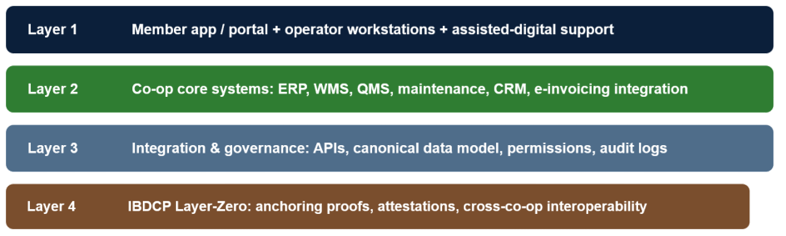

Figure 1: Reference Architecture: Core Systems + IBDCP Layer-Zero Backbone, AI
Using IBDCP as a Backbone
IBDCP (Interoperable Blockchain Data Custody Protocol) is described by its proponents as a Layer-Zero consensus protocol enabling interoperability between centralized and decentralized systems, supporting auditability, data sovereignty, and cross-party coordination [3,4]. In this model, IBDCP anchors minimal, high-value proofs (hashes + attestations + pointers), while bulk operational data remains in high-performance systems. Eligible proof events include: member agreements and consent, input credit issuance, weighbridge tickets, grading results, temperature excursions, batch genealogy checkpoints, maintenance logs, invoices and settlement statements, and program compliance attestations.
Optional AI Services
AI can support forecasting, capacity planning, anomaly detection (fraud/shrinkage/outlier grades), and member advisory. AI should be deployed with clear accountability, human oversight, privacy controls, and monitoring. AI augments—rather than replaces— governance and internal controls.
Tokenisation and Tokenomics for Cooperative Networks
Tokenisation is introduced as a practical, closed-loop mechanism to operationalize C2C incentives and capacity allocation. The objective is not to create speculative, publicly traded assets, but to convert verified cooperative activity into programmable rights and credits, anchored by trusted evidence [12].
Design Principles
• Closed-Loop Utility: tokens represent service rights/credits within the cooperative network, no cash convertibility, no public exchange listing.
• Evidence-Anchored Minting: mint/burn only on verified events recorded in core systems and anchored/attested via IBDCP [13].
• Anti-speculation by design: restricted transferability, role-based permissions, caps, kill-switch during pilot.
• Legal posture: utility/rights/credits framing, proportional KYC/AML for higher-risk transfers, periodic legal review.
• Data Minimization: operational data off-chain, only proofs anchored, strict access controls.
Token classes (Minimum Viable Set)
|
Token |
Represents |
Minting trigger (proof) |
Use / redemption |
Transfer rules |
|
LPC (Loyalty / Patronage Credits) |
Ruleâ??based participation and quality credits |
Delivery accepted, quality tier achieved, training completed, on-time repayment |
Service discounts, fee offsets, priority services, patronage distribution |
Non-transferable by default (or limited within registered household/entity) |
|
SAT (Service Access Tokens) |
Right to scarce capacity (machinery slot, pallet-days, drying hours) |
Booking confirmed, service performed (burn/settle) |
Reserve or share capacity, enforce fair scheduling across members/co-ops |
Transferable only within approved co-op network |
|
QPT (Quality Proof Tokens) |
Non-monetary attestations that lots/batches meet defined specs |
QA pass recorded, lab certificate, cold-chain checkpoint |
Buyer confidence, faster settlement, reduced disputes, compliance evidence |
Non-transferable as value, attached to lots/batches as proof |
|
WRC (optional) |
Controlled claims over stored commodities for financing/advances |
Custody verified, stock reconciled, audit checks passed |
Collateral for advances, inter-co-op financing under strict rules |
Transferable only to approved counterparties under custody controls |
Table 3: Token Classification
Tokenomics Mechanics (illustrative)
• LPC Minting: LPC = BaseRate × DeliveredVolume × QualityMultiplier × LoyaltyMultiplier, with monthly caps per member and a network cap [14].
• SAT Pricing: SAT cost equals published service rate (e.g., pallet-days) adjusted by congestion multipliers approved by the Board.
• Burning/Settlement: tokens are burned upon redemption, LPC may expire (e.g., 24 months) to manage liabilities.
• Integrity Controls: automated freezes if thresholds are crossed (minting spikes, repeated QA failures, reconciliation gaps).
Implementation Roadmap and Risk Controls
|
Phase |
Scope |
Exit criteria |
|
0–3 months (Foundations) |
Governance templates, service catalog, member contracts, baseline accounting, core ERP/WMS/ QMS selection, eFaktura integration. |
Audit-ready accounts, signed contracts, basic intake and settlement working, KPI dashboard. |
|
3–6 months (Evidence backbone pilot) |
Anchor proofs for priority events via IBDCP (contracts, tickets, grades, settlements), assisted-digital member support. |
Reduced disputes, settlement SLA compliance, reconciliations pass, incident response tested. |
|
6–12 months (Tokenisation pilot) |
Deploy LPC + SAT, introduce QPT after QA stabilises, caps and kill-switch, begin cross-co-op capacity sharing. |
Member adoption, utilisation improvement, integrity exceptions resolved, legal review passed. |
|
12–24 months (Scale and finance) |
Expand to multiple co-ops, introduce controlled WRC (if needed), add AI services for forecasting/ anomaly detection. |
Improved bank terms, program audit success, measurable margin and shrinkage improvement. |
Table 4: Implementation Roadmap
Risk controls should be explicit: segregation of duties, quarterly audits, reconciliation between physical stock and digital records, cybersecurity baseline, incident response runbooks, and clear dispute escalation paths.
Policy Recommendations
• Adopt cooperative governance templates that include service-line reporting and independent audit access to digital trails.
• Provide co-financed technical assistance for ERP/WMS/ QMS adoption, data governance, and assisted-digital member onboarding.
• Standardise digital evidence requirements for IPARD and national programs (tickets, QA, maintenance, invoices) to reduce paperwork and disputes.
• Enable compliant pilots for permissioned evidence anchoring (IBDCP) and closed-loop tokenisation, with clear -utility/ rights- guardrails.
• Promote inter-co-op collaboration (shared machinery pools, cold chain hubs) via interoperable attestations rather than a single mandated system.
Limitations and Future Research
The model requires empirical validation through pilots across different cooperative sizes and value chains. Future work should quantify impact on side-selling, working-capital cycles, shrinkage, quality claims, and access to finance, and should assess member acceptance and digital inclusion outcomes.
Appendix A: One-page Token Policy (C2C tokenisation on IBDCP)
Purpose and scope: Permissioned, closed-loop tokens to strengthen C2C operations (member co-op, co-opco-op). IBDCP anchors proofs for eligible events (contracts, delivery tickets, QA attestations, settlements).
Token classes (minimum viable set):
Loyalty/Patronage Credits (LPC): earned for verified deliveries/ quality/training/on-time repayment, redeemable for services. Service Access Tokens (SAT): rights to scarce capacity (machinery slots, cold storage pallet-days, drying hours).
Quality Proof Tokens (QPT): non-transferable attestations that lots/batches meet defined specs (lab, HACCP, cold-chain). Warehouse Receipt Claims (WRC) (optional, controlled): verified custody of stored lots for internal collateral/advance workflows.
Participants and access
Holders: members, authorised staff accounts, approved partner cooperatives (permissioned). Role-based wallet permissions (member/operator/auditor), identity tied to verified membership records
References
- Food and Agriculture Organization of the United Nations (FAO) (2025). (n.d.). New strategies for mobilizing capital in agricultural cooperatives.
- Republic of Serbia. (2015). Law on Cooperatives (Official Gazette of RS No. 112/2015, entered into force 7 January 2016).
- Rakic, D. D., & Brajovic, B. (2025). Digitalisation, Tokenisation and Trusted Data Infrastructure for Multi-Purpose Agricultural Cooperatives in Serbia and the Western Balkans A practical operating model and tokenomics framework using IBDCP Layer-Zero.
- Rakic, D. (2025). Blockcontrol – Interoperable Blockchain Data Custody Protocol (IBDCP).
- Food and Agriculture Organization of the United Nations (FAO) (2025). (n.d.). Cooperative shortcomings.
- Ljubojevic, G., & Sekulic, N. M. (2021). Serbian agricultural cooperatives and their path towards the European Union legal aspect.
 190.
190. - Republic of Serbia – Ministry of European Integration. (2024). IPARD III Financing Agreement (EU contribution and entry into force).
- Republic of Serbia – Ministry of Finance. (2021–2025). Law on Electronic Invoicing and amendments, System eFaktura resources.
- NALED. (2022). E-fakture i elektronska placanja za konkurentniju privredu (B2B mandatory from 1 January 2023).
- Republic of Serbia – eAgrar. (2023). Start of electronic register updates (20 March 2023).
- Šaric, B. B. (2025). E-AGRAR PLATFORM: usefulness and usage challenges of a new government e-service in agriculture.
- Zakic, V., Nikolic, M. & Kovacevic, V. (2018). International Experiences in Cooperative Audit and Lessons for Serbia. Economic of Agriculture 65(1), pp. 111-124.
- IPARD III Financing Agreement between Serbian government, EU exchanged (2024). Serbian Government Official Website.
- World Bank. (2019). Exploring the Potential of Agriculture in the Western Balkans: A regional report.