

International Journal of Women's Health Care(IJWHC)
ISSN: 2573-9506 | DOI: 10.33140/IJWHC
Impact Factor: 1.011

Research Article - (2017) Volume 2, Issue 1
Differences in Associations of Menopausal Symptoms with Job-related Stress Factors in Full-time and Part-time Workers in Japan
2Department of Reproductive and Menopausal Medicine, Institute of Biomedical Sciences, Tokushima University Graduate School, Tokushima, Japan
3Department of Preventive Medicine, Institute of Biomedical Sciences, Tokushima University Graduate School, Tokushima, Japan
Received Date: Feb 02, 2017 / Accepted Date: Feb 11, 2017 / Published Date: Feb 16, 2017
Copyright: ©Matsuzaki K. This is an open-access article distributed under the terms of the Creative Commons Attribution License, which permits unrestricted use, distribution, and reproduction in any medium, provided the original author and source are credited.
Abstract
Background: A large proportion of women in the workforce including part-time workers and full-time workers are in the period of menopausal transition. The degree and kind of menopausal symptoms may be different in full-time workers and part-time workers since the contents of job-related stress in full-time workers and part-time workers are different. We compared menopausal symptoms and job-related stress factors in full-time workers and part-time workers and the associations of menopausal symptoms with job-related stress in both groups.
Methods: Health questionnaires including Greene’s climacteric scales and job-related stress scores were given to 613 female general workers aged 45-60 years in Japan.
Results: Total Greene’s climacteric scores were not significantly different in full-time workers and part-time workers. Symptoms with high frequencies in both full-time and part-time workers were feeling tired or lacking in energy, loss of interest in sex and irritability. Scores for quantitative overload, qualitative overload and interpersonal relationships in full-time workers were significantly lower than those in part-time workers, while scores for physical overload and workplace environment in part-time workers were significantly lower than those in full-time workers. Psychological symptoms showed significant associations with job control, interpersonal relationships, workplace environment, job fitness and job satisfaction in full-time workers.
Conclusions: The degree of job-related stress and the association of job-related stress with menopausal symptoms were different in full-time workers and part-time workers, though menopausal symptoms were similar in full-time and part-time workers. Different strategies for management of menopausal symptoms may be needed in full-time workers and part-time workers.
Keywords
Menopausal symptoms, Job-related stress, Full-time and Part-time workers.
Introduction
The number of Japanese female workers is increasing every year and the proportion of female workers in the total workforce was 43.9% in 2015 [1]. A report by the OECD showed that the proportion of part-time workers increased in the period from 2000 to 2012, reaching 16.9% in 2012, though the proportions vary in different countries [2]. In Japan, the proportion of part-time workers has been increasing since 2010 and the proportion was 34.5% in female employees in 2015 [1].
Job-related stress may be different in full-time workers and part-time workers since the problems they face are different. Full-time workers have more responsible positions than do part-time workers and their employment status is more stable. Working hours for full-time workers are longer than those for part-time workers and overtime work is often required. On the other hand, part-time female workers have also several problems. A survey on the reasons for dissatisfaction and anxiety regarding part-time work showed that low salary was the main reason in part-time female workers (60.1% of the responders) followed by hard work (28.6%), difficulty to take a paid vacation (28.1%) and unstable employment (20.3%) [3]. It has been reported that the prevalence of psychological distress was not different in permanent workers and part-time workers, but temporary workers had a significantly higher prevalence of psychological distress than did permanent workers among Japanese female employees [4]. Kim et al. reported that job class such as manual labor or non-manual labor was associated with health-related quality of life but that work type such as full-time work or part-time work was not a significant factor in female employees [5].
In 2015, the proportions of women aged from 45 to 54 years were 28.3% in part-time workers and 20.4% in full-time workers in Japan [1], indicating that a large proportion of women in the workforce including part-time workers and full-time workers are in the period of menopausal transition. Thus, there is a potential impact between work and menopause. Recently, there have been some studies on the association of menopausal symptoms with job-related stress. It has been reported that menopausal symptoms might have a negative impact on work [6]. Work-related factors may influence menopausal symptoms [6]. We previously reported an association of menopausal symptoms with job-related stress in Japanese nurses [7]. However, there have been few studies on the association of menopausal symptoms with job-related stress according to work status such as full-time work and part-time work. The degree and kind of menopausal symptoms may be different in full-time workers and part-time workers since the contents of job-related stress in full-time workers and part-time workers are different. Also, an understanding of the difference in working status as background characteristics of menopausal symptoms in female workers is necessary for treatment of menopausal symptoms. In this study, we compared menopausal symptoms and job-related stress factors in full-time workers and part-time workers and the associations of menopausal symptoms with job-related stress in both groups in Japanese female general workers aged 45-60 years.
Materials and Methods
This study was conducted from September to December in 2013. We asked female residents of communities through public health nurses and working women at companies through the staff of the companies whether cooperation for our research is possible in advance and invited general workers for whom cooperation was obtained. The participants were informed of the purposes and procedure of the study in the invitation letter. It was stated in this letter that cooperation in the questionnaire survey is based on free will and that there is no disadvantage for subjects who do not cooperate. Agreement for participation in this study was obtained by having the questionnaire form returned to us by mail.
Nine hundred and fifty female general workers aged 45-60 years completed the health questionnaire. General workers consisted of full-time workers and part-time workers including self-employed workers, office workers and regular service workers. Part-time workers were defined as workers whose scheduled working hours per week or working days were less than those of ordinary workers.
Questionnaire
We designed a self-administered questionnaire that took about 20 minutes to complete. The first part of the questionnaire consisted of questions on socio-demographic factors, life style and medical history including questions on age, height and weight for calculating body mass index (BMI), marital status, menstrual and menopausal status, drug treatment, current smoking habit and alcohol drinking habit. Menstrual and menopausal status was divided into premenopause, perimenopause and postmenopause.
The second part of the questionnaire consisted of questions on menopausal symptoms using Greene’s Climacteric Scale, by which psychological symptoms, somatic conditions, vasomotor symptoms and loss of sexual interest are assessed. The scale lists 21 symptoms, and participants register their response by indicating “not at all”, “a little”, “quite a bit” or “extremely” [8]. The total Greene Climacteric score is the sum of all 21 scores. Psychological symptoms are divided into a measure of anxiety (sum of symptoms 1-6) and a measure of depression (sum of symptoms 7-11). Somatic aspects are addressed in symptoms 12-18 and vasomotor symptoms are addressed in symptoms 19 and 20. Symptom 21 is a probe for sexual dysfunction.
The third part of the questionnaire consisted of questions on occupational characteristics including years of job experience. Job-related stress factors were assessed by the Brief Job Stress Questionnaire provided by the Ministry of Labour of Japan [9]. There were 17 questions in 9 categories (quantitative overload, qualitative overload, physical overload, job control, skill discretion, interpersonal relationships, workplace environment, job fitness and satisfaction with work). A response of “yes”, “yes to some extent”, “not really” or “no” was given to the questions. Some items were scored in reverse, and the smaller the total number of such scores was, the greater was the job-related stress.
The Ethics Committee of Tokushima University Hospital approved the study (number 1772).
Statistical analysis
Baseline characteristics such as age and BMI are presented as means ± standard deviation. Each categorized variable is expressed as number with percentage. The significance of differences in variables in the two groups was evaluated by the chi-square test or the t-test. The significance of differences in the proportions of menopausal symptoms in the two groups was also evaluated by the chi-square test.
The differences in menopausal symptoms and job-related stress factors between full-time workers and part-time workers were evaluated by the t-test. In order to adjust for age and menopausal status, we used analysis of covariance with the Bonferroni test.
Correlations between Greene’s scores and scores of job-related stress factors were determined by using partial correlation analysis. All p values are two-tailed, and those less than 0.05 were considered to be statistically significant. Statistical analyses for data evaluation were carried out using SPSS version 21 for Windows.
Results
Response
The overall response rate was 64.5% (613/950). We excluded incomplete questionnaires (n=57) and we excluded women of ages outside the age range in the inclusion criteria (n=10) and night shift workers because of the difference in the daily working environment (n=19). In addition, women who had taken medications that might mask menopausal symptoms, including hormone therapy drugs (n=7), antidepressant or anti-anxiety drugs (n=6), and thyroid hormone and anti-thyroid drugs (n=21), were excluded. Women with coronary heart diseases (n=5) and women with rheumatoid arthritis (n=8) were also excluded since they took medicine. Data were analyzed for 480 (78.3%) of the 613 general workers.
Background characteristics of the subjects
As can be seen in Table 1, the mean age of the part-time workers was significantly higher than that of the full-time workers. Also, the proportion of women in postmenopause in the part-time workers was higher than that in the full-time workers. There were no significant differences between full-time and part-time workers in BMI, marital status, current smoking habit and alcohol drinking habit. Family structure was significantly different in the two groups. The proportion of part-time workers in a household with husband and child/children was significantly higher than that of full-time workers. There was no significant difference in the proportion of women caring for their parents and children. Also, the proportions of women who were supported by their family and their friends were not significantly different in the two groups. There was no significant difference in the proportions of office workers in the part-time workers (37.5%) and full-time workers (28.0%) (Data not shown).
|
|
Full-time workers n=184 |
Part-time workers n=296 |
p value |
|||
|
Age yearsa |
50.3 |
(4.1) |
51.7 |
(4.5) |
0.001 |
|
|
Body mass index kg/m2a |
22 |
(3.3) |
22 |
(3.2) |
0.996 |
|
|
Menstrual cycle No, % |
Pre-menopause |
67 |
36.4 |
77 |
26.0 |
0.017 |
|
Peri-menopause |
41 |
22.3 |
59 |
19.9 |
||
|
Post-menopause |
76 |
41.3 |
160 |
54.1 |
||
|
Marital status No, % |
Married |
144 |
78.3 |
252 |
85.1 |
0.165 |
|
Single |
11 |
6 |
13 |
4.4 |
||
|
Divorce |
20 |
10.9 |
17 |
5.7 |
||
|
Others |
9 |
4.8 |
14 |
4.8 |
||
|
Family structure No, % |
Single |
15 |
8.2 |
13 |
4.4 |
0.016 |
|
Husband and wife |
21 |
11.4 |
43 |
14.5 |
||
|
Two households |
72 |
39.1 |
153 |
51.7 |
||
|
Three households |
39 |
21.2 |
46 |
15.5 |
||
|
Others |
37 |
20.1 |
41 |
13.9 |
||
|
Caring for their parents No, % |
Yes |
40 |
21.7 |
53 |
17.9 |
0.342 |
|
No |
144 |
78.3 |
243 |
82.1 |
||
|
Support by family and friends No, % |
Much |
147 |
79.9 |
223 |
75.3 |
0.207 |
|
A little |
30 |
16.3 |
66 |
22.3 |
||
|
No |
7 |
3.8 |
7 |
2.4 |
||
|
Current smoking No, % |
Yes |
19 |
10.3 |
25 |
8.4 |
0.488 |
|
No |
165 |
89.7 |
271 |
91.6 |
||
|
Alcohol drinking habit No, % |
Yes |
55 |
29.9 |
82 |
27.7 |
0.606 |
|
No |
129 |
70.1 |
214 |
72.3 |
||
Table 1: Baseline characteristics of the subjects. aMean SD, The values in parenthesis excluding age and BMI are percentages.
Menopausal symptoms in full-time workers and part-time workers
Total Greene’s climacteric scores were not significantly different in full-time workers and part-time workers (Table 2). As can be seen in Figure 1 and Figure 2, more than 60% of both full-time workers and part-time workers had menopausal symptoms such as feeling tired or lacking in energy, loss of interest in sex, irritability, difficulty in concentrating and feeling tense or nervous. The proportion of part-time workers with muscle and joint pain was significantly higher than the proportion of full-time workers with muscle and joint pain (p<0.05).
|
|
Full-time workers |
Part-time workers |
t-test p value |
||
|
Psychological factor |
6.6 |
(4.3) |
6.3 |
(4.3) |
0.535 |
|
Anxietic factor |
3.1 |
(2.4) |
3.0 |
(2.2) |
0.655 |
|
Depressive factor |
3.5 |
(2.3) |
3.4 |
(2.4) |
0.492 |
|
Somatic factor |
2.7 |
(2.5) |
2.9 |
(2.5) |
0.369 |
|
Vasomotor factor |
0.9 |
(1.1) |
0.9 |
(1.1) |
0.805 |
|
Sexual factor |
1.3 |
(0.7) |
1.4 |
(0.7) |
0.245 |
|
Total |
11.5 |
(6.6) |
11.5 |
(6.8) |
0.986 |
Table 2: Greene’s climacteric scores in full-time workers and part-time workers. Values are means (standard deviation).
Figure 1: Comparison of psychological factors in full-time workers and part-time workers.
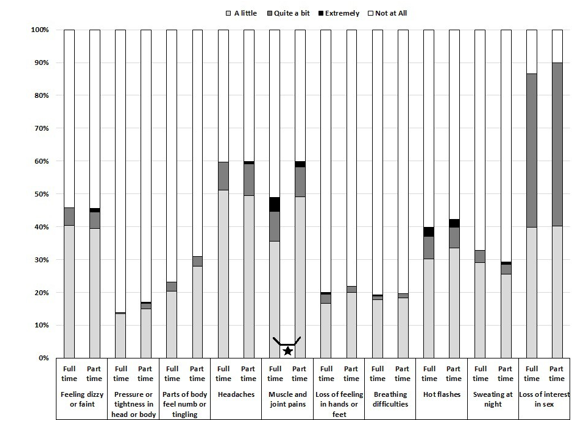
Figure 2: Comparison of somatic, vasomotor and sexual factors in full-time workers and part-time workers. p < 0.05.
Job-related stress in full-time workers and part-time workers
A lower score of each factor shown in Table 3 indicates a higher level of job-related stress. Scores for quantitative overload, qualitative overload and interpersonal relationships in full-time workers were significantly lower than those in part-time workers. However, scores for physical overload and workplace environment in full-time workers were significantly higher than those in part-time workers.
Associations of menopausal symptoms with job-related stress factors
As can be seen in Table 4, total menopausal symptoms and psychological symptoms showed significant associations with job control, interpersonal relationships, workplace environment, job fitness and job satisfaction in full-time workers. In part-time workers, the correlations of psychological symptoms with job-related stress factors were weak. Somatic, vasomotor and sexual factors did not show significant associations with any of the factors of job-related stress in full-time workers or part-time workers.
|
|
Menopausal symptoms (Total) |
Psychological symptoms |
||
|
Job-related stress factors |
Full-time workers |
Part-time workers |
Full-time workers |
Part-time workers |
|
Quantitative overload |
-0.024 |
-0.128* |
-0.042 |
-0.153* |
|
Qualitative overload |
-0.055 |
-0.101 |
-0.069 |
-0.134* |
|
Physical overload |
0.025 |
-0.084 |
0.011 |
-0.098 |
|
Job control |
-0.268** |
-0.097 |
-0.308** |
-0.118* |
|
Skill discretion |
-0.101 |
-0.197* |
-0.135 |
-0.195* |
|
Interpersonal relationships |
-0.270** |
-0.178* |
-0.321** |
-0.188* |
|
Workplace environment |
-0.234* |
-0.159* |
-0.262** |
-0.152* |
|
Job fitness |
-0.256** |
-0.130* |
-0.279** |
-0.144* |
|
Job satisfaction |
-0.233* |
-0.109 |
-0.265** |
-0.138* |
Table 4: Correlations of job-related stress factors with menopausal symptoms. *p<0.05 **p<0.01.
Discussion
In the present study, the contents and degree of menopausal symptoms were not significantly different between full-time workers and part-time workers, but job-related stress factors were
|
Job-related stress factors |
Full-time workers |
Part-time workers |
t-test p value |
||
|
Quantitative overload |
2.1 |
(0.8) |
2.6 |
(0.8) |
<0.001 |
|
Qualitative overload |
2.2 |
(0.7) |
2.6 |
(0.7) |
<0.001 |
|
Physical overload |
2.8 |
(1.0) |
2.5 |
(1.0) |
0.004 |
|
Job control |
2.7 |
(0.7) |
2.6 |
(0.8) |
0.063 |
|
Skill discretion |
2.8 |
(0.8) |
2.8 |
(0.9) |
0.975 |
|
Interpersonal relationships |
3.1 |
(0.6) |
3.2 |
(0.6) |
0.017 |
|
Workplace environment |
3.2 |
(0.8) |
3.0 |
(0.9) |
0.022 |
|
Job fitness |
2.9 |
(0.8) |
3.0 |
(0.8) |
0.105 |
|
Job satisfaction |
3.0 |
(0.8) |
2.9 |
(0.9) |
0.263 |
Table 3: Comparison of job-related stress factors in full-time workers and part-time workers. Values are means (standard deviation).
different between full-time workers and part-time workers. In full-time workers, job-related stress was closely associated with menopausal symptoms, particularly psychological symptoms.
We showed that concerns regarding job-related stress were different in full-time workers and part-time workers. Quantitative overload such as long working hours and interpersonal relationships were stressful for full-time workers. Qualitative overload for full-time workers includes attentiveness and concentration for working as well as psychological load for which a high level of knowledge and high level of technique are needed. On the other hand, part-time workers may have stress from physical overload and workplace environment since their work mainly involves physical overload rather than technical and administrative work and since their job environment and welfare are insufficient. However, it has been reported that health-related quality of life did not differ depending on work patterns such as full-time work and part-time work [5]. It has also been reported that there was no significant difference in mental stress between full-time workers and part-time workers [4].
In full-time workers, we found that job-related stress was significantly associated with psychological symptoms. Hammam et al. reported that overload, extraordinary job responsibility, poor physical environment including temperature, ventilation and noise in the workplace, and long working hours were factors that aggravated menopausal symptoms in medical teaching staff 10). Factors such as problems with colleagues and supervisors and static posture were also addressed [10]. Griffiths et al. reported that flexible working hours and attention to workplace temperature and ventilation have become known as organizational-level support in professional, managerial and administrative occupations during the menopausal transition [11]. We previously reported a similar association in nurses with managerial positions. Nurses with managerial positions had job-related stress regarding less job fitness, less satisfaction and poor interpersonal relationships [7]. Keuskamp et al. reported that there was a significant association between casual full-time employment and poor physical health compared to permanent full-time employment because of the distress regarding job insecurity and lower job control [12].
On the other hand, the association of job-related stress with menopausal symptoms was weak in part-time workers in the present study, though the degree of menopausal symptoms in part-time workers was similar to that in full-time workers. Therefore, factors other than job-related stress may be involved in the occurrence of menopausal symptoms in part-time workers. It has been reported that approximately 20% of female part-time workers in Japan selected short working hours for personal reasons such as child rearing and care for their parents [3]. Since we showed that there were no significant differences in child rearing and/or caring for parents in the two groups, other factors should be considered.
Menopausal symptoms with high frequencies were general fatigue and loss of interest in sex in both full-time workers and part-time workers, and the frequencies of psychological symptoms including irritability, difficulty in concentration, and feeling tense or nervous were also high. The proportions of women with psychological symptoms were high in both full-time workers and part-time workers. To the best of our knowledge, there has been no report on analysis of the frequencies of menopausal symptoms separately in full-time workers and part-time workers. Although full-time workers and part-time workers were mixed, it has been shown that severe menopausal symptoms were fatigue and irritability in middle-aged nurses in China [13]. Dhillon et al. reported that the prevalence of fatigue was 79.1% in nurses and teachers [14]. In the present study, the frequency of vasomotor symptoms was not high. Vasomotor symptoms such as hot flashes and night sweats have been reported to be problems that interfere with work [15-17]. Vasomotor symptoms may indirectly influence psychological symptoms including insomnia [18] and tiredness/lack of energy [10,19]. Sleep disturbance due to hot flashes resulted in fatigue, irritability and decreased work productivity [20]. Geukes et al. reported that psychological and somatic symptoms were the strongest predictors of work ability [21]. Whiteley et al. demonstrated that joint stiffness was a symptom correlated with significantly higher levels of overall work impairment [22]. We showed that the proportion of women who complained of muscle and joint pain was relatively high in part-time workers. One possible explanation is the high frequency of physical work rather than administrative work. We previously reported that nurses complained of muscle and joint pain in menopausal symptoms. Nurses might have a large physical load due to prolonged work, irregular working shifts, night shift and unusual positions for nursing.
Considering the recent increases in the numbers of both full-time workers and part-time workers [1], both full-time and part-time workers may be important in the workforce. Although the concerns regarding work differ in full-time workers and part-time workers, careful consideration for working management is needed for not only full-time workers but also part-time workers. Since the number of female workers aged from 40 to 59 years has been increasing, strategies for management of menopausal symptoms and job-related stress are important for workers in the climacteric generation. Fenton et al. reported that education for working women on how to manage their symptoms is important [23]. Education for employers regarding menopausal symptoms associated with the menopausal transition and the association of menopausal symptoms with job-related stress is also needed.
There are several limitations in the present study. First, ages and menstrual status were different between full-time workers and part-time workers. The higher mean age in the part-time workers may be due to the higher proportion of postmenopausal women. We analyzed the proportions of full-time workers and part-time workers according to menstrual status, but there was no significant difference. Second, the cross-sectional design of this study makes is impossible to determine the exact nature of the association between menopausal symptoms and job-related stress. Third, company size was not uniform. Psychological stress and menopausal symptoms may be influenced by the size of the company. However, it has been reported that company size was not significantly associated with psychological distress in females [4].
Conclusions
The degree of job-related stress and the association of job-related stress with menopausal symptoms were different between full-time workers and part-time workers, though menopausal symptoms were similar. Considering the background characteristics, different strategies for management of menopausal symptoms may be needed in full-time workers and part-time workers.
Acknowledgement
The authors would like to thank the women who took the time to share their experiences with us.
Contributions
Kazuyo Matsuzaki and Toshiyuki Yasui contributed to the design of the study, collected the data and commented on the first draft of the paper. Kazuyo Matsuzaki and Hirokazu Uemura analyzed the data. All authors reviewed the final version of the manuscript
References
- Ministry of Internal Affairs and Communications Statistics Bureau (2015) Labour force survey long-term chronological order data.
- Organization for Economic Cooperation and Development. OECD factbook 2014: Economic, environment and social statistics.
- The general condition of the 2011 part-timer synthesis fact-finding.
- Inoue A, Kawakami N, Tsuchiya M, Sakurai K, Hashimoto H (2010) Association of occupation, employment contract, and company size with mental health in a national representative sample of employees in Japan. J Occup Health 52: 227-240.
- Kim B, Kim W, Choi H, Won C, Kim Y (2012) Health-related Quality of Life and Related Factors in Full-time and Part-time Workers. Korean J Fam Med 33: 197-204.
- Jack G, Riach K, Bariola E, Pitts M, Schapper J, et al. (2016) Menopause in the workplace: What employers should be doing. Maturitas 85: 88-95.
- Matsuzaki K, Uemura H, Yasui T (2014) Associations of menopausal symptoms with job-related stress factors in nurses in Japan. Maturitas 79: 77-85.
- Greene JG (1998) Constructing a standard climacteric scale. Maturitas 29: 25-31.
- Shimomitsu T, Yokoyama K, Ohno H, Maruta T, Tanigawa T (2000) Manual of the Brief Job Stress Questionnaire. In: Reports on the study of job stress and its effects on health in the workplace: The research grant for the prevention of work-related diseases from the Japan Ministry of Labour. Tokyo: The Ministry of Labour 17-27
- Hammam AMR, Abbasa RA, Hunterb MS (2012) Menopause and work-The experience of middle-aged female teaching staff in an Egyptian governmental faculty of medicine. Maturitas 71: 294-300.
- Griffiths A, MacLennan SJ, Hassard J (2013) Menopause and work: an electronic survey of employees’ attitudes in the UKMaturitas 76: 155-159.
- Keuskamp D, Ziersch AM, Baum FE, LaMontagne AD (2013) Precarious employment, psychosocial working conditions, and health: Cross-sectional associations in a population-based sample of working Australians. Australian Journal of Industrial Medicine 56: 838-844.
- Liu M, Wang Y, Li X, Liu P, Yao C, et al. (2013) A health survey of Beijing middle-aged registered nurses during menopause. Maturitas 74: 84-88.
- Dhillon HK, Mohd ZNMN, Singh H (2007) Documentation of self-care actions taken for somatic complaints by postmenopausal Malay women living in Kelantan Malaysia. Maturitas 58: 241-248.
- Williams RE, Levine KB, Kalilani L, Lewis J, Clark RV (2009) Menopause-specific questionnaire assessment in US population-based study shows negative impact on health-related quality of life. Maturitas 62: 153-159.
- Whiteley J, Wagner JS, Bushmakin A, Kopenhafer L, Dibonaventura M, et al. (2013) Impact of the severity of vasomotor symptoms on health status, resource use, and productivity. Menopause 20: 518-524.
- Utian WH (2005) Psychosocial and socioeconomic burden of vasomotor symptoms in menopause: a comprehensive review. Health Qual Life Outcomes 3: 47.
- Sarrel P, Rousseau M, Mazure C, Glazer W (1990) Ovarian steroids and the capacity to function at home and in the workplace. Ann N Y Acad Sci 592: 156-161.
- Sarrel P, Portman D, Lefebvre P, Lafeuille MH, Grittner AM, et al. (2015) Incremental direct and indirect costs of untreated vasomotor symptoms. Menopause 22: 260-266.
- Oldenhave A, Jaszmann LJ, Haspels AA, Everaerd WT (1993) Impact of climacteric on well-being. A survey based on 5213 women 39 to 60 years old. Am J Obstet Gynecol 168: 772-780.
- Geukes M, van Aalst MP, Nauta MC, Oosterhof H (2012) The impact of menopausal symptoms on work ability. Menopause 19: 278-282.
- Whiteley J, DiBonaventura Md, Wagner JS, Alvir J, Shah S (2013) The impact of menopausal symptoms on quality of life, productivity, and economic outcomes. J Womens Health (Larchmt) 22: 983-990.
- Fenton A, Panay N (2014) Menopause and the workplace. Climacteric 17: 317-318.