

Advances in Bioengineering and Biomedical Science Research(ABBSR)
ISSN: 2640-4133 | DOI: 10.33140/ABBSR

Impact Factor: 1.7

Research Article - (2023) Volume 6, Issue 11
D-Cell Hypothesis of Schizophrenia Leading to Develop Non-D2 Receptor-Binding Antipsychotics
Received Date: Oct 05, 2023 / Accepted Date: Nov 06, 2023 / Published Date: Nov 28, 2023
Copyright: ©Â©2023 Keiko Ikemoto. This is an open-access article distributed under the terms of the Creative Commons Attribution License, which permits unrestricted use, distribution, and reproduction in any medium, provided the original author and source are credited.
Citation: Ikemoto, K. (2023).
Abstract
The latest psychopharmacological study showed effectiveness of a novel non-D2-receptor-binding drug, SEP-363856, for treatment of schizophrenia. The compound is trace amine-associated receptor 1 (TAAR1) full agonist and also 5-hydroxytryptamin 1A (5-HT 1A) receptor partial agonist. I found the TAAR1 ligand neuron, D-neuron, in the striatum and nucleus accumbens (Acc), a neuroleptic acting site, of human brains, though they were scarcely found in the monkey, and D-neuron reduction in these regions by using post-mortem brains of patients with schizophrenia. The reduction of D-neurons was significant (t-test, p<0.05) in Acc of schizophrenia. I proposed “D-cell hypothesis of schizophrenia”, a link of dopamine (DA) hypothesis and neural stem cell (NSC) dysfunction hypothesis, showing NSC dysfunction-based D-neuron reduction being cellular basis of mesolimbic DA hyperactivity of schizophrenia, and predicted prospectiveness of TAAR1 ligands for treatment of schizophrenia. This hypothesis has been verified by effectiveness of a TAAR1 agonist in reducing symptoms of schizophrenia.
Keywords
Efficacy of the ExVent Accessory for the O2Vent Optima Oral Appliance in the Treatment of Obstructive Sleep Apnea
Introduction
Schizophrenia is a mental illness, which afflicts approximately 1% of population, and manifests delusion, hallucination, disorganized thought, flattened affect, and impaired cognitive processes. The latest pharmacological research has demonstrated the effectiveness of a novel psychotropic agent, SEP-363856, with a unique, non-D2 receptor mechanism of action [1]. The compound is trace amine-associated receptor 1 (TAAR1) full agonist, and also 5-hydroxytryptamin 1A (5-HT 1A) receptor agonist. In the present article, I show how the TAAR1 ligand neuron, D-neuron, which I call “trace amine (TA) neuron, type 1”, relates to pathogenesis of schizophrenia, that is, “D-cell hypothesis of schizophrenia” [2, 3].
Dopamine (DA) dysfunction, neural stem cell (NSC) dysfunction, glutamate dysfunction or neurodevelopmental deficits are well-known hypotheses for etiology of schizophrenia [4-7]. “D-cell hypothesis” is a distinct hypothesis which shows the cellular and molecular basis of mesolimbic DA hyperactivity of schizophrenia, for which any of the previous hypotheses have not given an appropriate explanation [4].
“D-cell hypothesis of schizophrenia” explains progressive pathology of schizophrenia, linking NSC dysfunction hypothesiswith DA hypothesis in etiology of schizophrenia, and predicted effectiveness of TAAR1 agonists [1, 4, 5].
Striatal D-Neuron Reduction and TAAR1
The TA neuron in the rat central nervous system (CNS) was described by Jaeger et al. in 1983 [2]. Initially, they defined “the non-monoaminergic aromatic L-amino acid decarboxylase (AADC)-containing cell”, and called the “D-cell” [2]. “D” means decarboxylation. AADC is an equivalent enzyme to dopa decarboxylase (DDC). The D-cell contains AADC but neither dopaminergic nor serotonergic [2]. Then, it is natural that the D-cell (=AADC-only cell) is thought to produce TAs, such as β-phenylethylamine (PEA), tyramine and tryptamine. AADC is the rate-limiting enzyme for TA synthesis [2, 3].
However, it is confusing that these TAs are also “monoamines”, as each one has one amino residue. It would be better to use the nomenclature of “TA cells, type 1” for D-cells, and “TA neurons, type 1” for D-neurons. There are other types of TAs which are not synthesized via AADC. In the present article, I use the words, D-cell and D-neuron, signifying TA cell, type1 and TA neuron, type1, respectively.
In the human Acc, caudate nucleus (Ca) and putamen (Pu), there were D-neurons, though monkey homologous areas scarcely contained D-neurons (Fig, 1AB). By using pathological and legal autopsy brains of patients with schizophrenia and an immunohistochemical method, I showed lack of striato-accumbal D-neurons (D15, D16) in post-mortem brains of patients with schizophrenia (see Fig. 1C) [3].
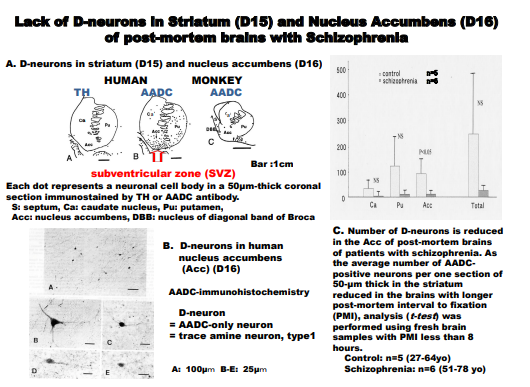
Figure 1: A: Coronal sections through the caudate nucleus (Ca), putamen (Pu) and nucleus accumbens (Acc) of the human and monkey. The ventral margin of Acc coincides with the subventricular zone of lateral ventricle (SVZ), NSC region. B: AADC-immunostained coronal section through Acc of a post-mortem brain with no detectable neuropsychiatric illnesses. C: Striato-accumbal D-neuron reduction in brains with schizophrenia. Cloning of TA receptors in 2001, elicited enormous efforts for exploring signal transduction of these G-protein coupled receptors whose genes are located on chromosome focus 6q23.1 [8-10]. The receptors have been shown to co-localize with DA or adrenaline transporters in monoamine neurons and to modulate the functions of monoamines [10]. The TAAR1 has many ligands, including, PEA, tyramine, 3-iodothyronamine, 3-methoxytyramine, normetanephrine, and psychostimulants, for example methamphetamine and 3,4-methylenedioxymethamphetamine (MDMA) [11]. TAAR1 knockout mice showed schizophrenia-like behaviors with a deficit in prepulse inhibition [12].
TAAR1 stimulation increase of DA neurons in the midbrain ventral tegmental area (VTA) reduced firing frequency of VTA DA neurons [12, 13]. This demonstrated a critical role of TAAR1 stimulation decrease for mesolimbic DA hyperactivity in schizophrenia.
D-Cell Hypothesis of Schizophrenia
A new theory, “D-cell hypothesis”, explains pathophysiology of mesolimbic DA hyperactivity of schizophrenia (Fig. 2A) [4]. In brains of patients with schizophrenia, dysfunction of NSC in the subventricular zone of lateral ventricle (SVZ) causes D-neuron decrease in the striatum and Acc [14]. This induces TA decrease in these nuclei. Lateral ventricle enlargement seen in schizophrenia brain imaging is also due to NSC dysfunction [5, 15]. TAAR1 stimulation decrease in DA terminals of VTA DA neurons, caused by TA decrease, increases firing frequency of VTA DA neurons [12, 13]. This increases DA release and DA turnover in the Acc, resulting in mesolimbic DA hyperactivity (Fig. 2A). D2 stimulation of NSC in the striatum is shown to inhibit forebrain NSC proliferation [16]. Striato-accumbal DA hyperactivity may accelerate D-neuron decrease, which accelerates hyperactivity of mesolimbic DA system. D2 blocking agents in pharmacotherapy of schizophrenia block inhibition to forebrain NSC proliferations (Fig. 2B) [16].
This is consistent with clinical evidences that initial pharmacotherapy using D2 antagonists is critical for preventing progressive pathognomonic procedures of schizophrenia [17]. Duration of untreated psychosis is a predictor of long-term outcome of schizophrenia. Importance of early intervention for first episode schizophrenia by using D2 antagonist has been emphasized [17]. D2 antagonists block disease progression (Fig. 2B). D-cell hypothesis not only links DA hypothesis with NSC dysfunction hypothesis (Fig. 2A), but also explains the mechanisms of disease progression of schizophrenia (Fig. 2A). To inhibit the cycle of pathological progression, intervention indicated by × in Fig. 1B is effective. In animal studies, effectiveness of TAAR1 ligands for schizophrenia-like symptoms of schizophrenia model animals has been shown[13]. Recent clinical trial studies have shown the efficacy of a novel agent, SEP-363856, TAAR1 full agonist and 5-HT 1A receptor partial agonist for treatment of schizophrenia [1]. Efficacy of the TAAR1 full agonist to schizophrenia seems equivalent to that of the DA agonist for treatment of Parkinson’s disease which lacks DA neurons in the midbrain substantia nigra.
Disease progression is inhibited also by neurotrophic substances (Fig. 2B), such as, brain-derived neurotrophic factor (BDNF), lithium, anticonvulsants, or antidepressants.
Neurotrophic effects of these substances activate NSC functions, and inhibit striato-accumbal D-neuron decrease. Stress, aging, and alcohol intake suppresses NSC functions, which may cause vulnerability to a psychotic state.


Figure 2:
A: Scheme of “D-cell hypothesis of schizophrenia”. In a brain with schizophrenia, dysfunction of neural stem cells (NSC) in the subventricular zone (SVZ) of lateral ventricle causes D-neuron decrease in the striatum and nucleus accumbens (Acc). This induces TA (=β-phenylethylamine (PEA)) decrease in these nuclei and TAAR1 stimulation decrease into DA terminals of VTA DA neurons, causing firing frequency increase in VTA DA neurons [12, 13]. This increases DA release and DA turnover in the Acc (mesolimbic DA hyperactivity). Striatal DA hyperactivity causes excessive D2 stimulation of NSC in the striatum and inhibits forebrain NSC proliferation, which accelerates D-neuron decrease and accelerates mesolimbic DA hyperactivity [16].
B: Novel strategies for treatment of schizophrenia, indicated by “D-cell hypothesis”. The cycle of disease progression is to be inhibited by intervention (shown by ×) with TAAR1 agonists, D2 antagonists, and neurotrophic substances, for example, brain-derived neurotrophic factor (BDNF), lithium, anticonvulsants or antidepressants. Stress, aging, and alcohol intake suppresses NSC functions, which may also cause a psychotic state.
Perspectives
Early in 1974, Sabelli and Mosnaim proposed “Phenylethylamine hypothesis of affective behavior”, indicating involvement of PEA in animal behaviours [18]. Level of PEA, of which specific degrading enzyme is MOAB elevated in the striatum of MAOB knockout mice, by 8-10 times of that of controls [19]. Indeed, MAOB enzyme active neurons, that is D-neurons, were densely packed in the Acc of mice which lack MAOA [20]. PEA, which has a similar chemical structure of amphetamines, is the most probable TA affecting on psychiatric symptoms. An initial clinical symptom frequently observed in first episode schizophrenia is disturbance of sleep-wake-rhythm, insomnia and daytime hypersomnia. A MAOB inhibitor, selegiline ameliorates daytime sleepiness of narcolepsy or other neuropsychiatric diseases, possibly by PEA increase via inhibition of PEA degradation.
Recent medicinal chemistry produced various TAAR1 ligands. The 1st compound proceeded to phase II clinical trial was SEP-363856, TAAR1 full agonist, of which successful results for the treatment of schizophrenia have been shown [1].
SEP-363856 administration did not evoke extrapyramidal symptoms or body weight gain, possibly being an innovative antipsychotic agent [1].
“D-cell hypothesis” (see review reference 21) shows D-cell-involved etiological dynamism in also wide spectrum of psychotic states in neurological as well as psychiatric illnesses. NSC functions may affect on D-neuron activities, clinical course and prognoses of neuropsychiatric illnesses.
Limitations
Although effectiveness of the TAAR1 agonist for treatment of schizophrenia verified “D-cell hypothesis of schizophrenia”, the results of striatal D-neuron reduction in post-mortem brains with schizophrenia have not yet been reconfirmed by other research groups probably due to technical difficulty of AADC immunostaining using human post-mortem brain materials. The present study has been performed as few legal use of legal autopsy brain materials in Japan.
Acknowledgement
The present study was supported by Grants-in-Aids for Scientific Research from Japan Society for the Promotion of Science (C1-10680713, C1-12680740, C-22591265), Research Resource Network (RRN), Sumitomo Pharmaceutical Corporation, INSERM U52 & CNRS ERS 5645 (Claude Bernard University) (France), Shiga University of Medical Science (Japan), Fujita Health University (Japan), Clinical Research Institute of National Minami Hanamaki Hospital (Japan), Fukushima Medical University (Japan), and Iwaki Kyoritsu General Hospital (Iwaki City Medical Center) (Japan).
References
- Koblan, K. S., Kent, J., Hopkins, S. C., Krystal, J. H., Cheng, H., Goldman, R., & Loebel, A. (2020). A non–D2-receptor-binding drug for the treatment of schizophrenia. New England Journal of Medicine, 382(16), 1497-1506.
- Jaeger, C. B., Teitelman, G., Joh, T. H., Albert, V. R., Park, D. H., & Reis, D. J. (1983). Some neurons of the rat central nervous system contain aromatic-L-amino-acid decarboxylase but not monoamines. Science, 219(4589), 1233-1235.
- Kitahama, K., Ikemoto, K., Jouvet, A., Nagatsu, I., Sakamoto, N., & Pearson, J. (1998). Aromatic L-amino acid decarboxylase-and tyrosine hydroxylase-immunohistochemistry in the adult human hypothalamus. Journal of Chemical Neuroanatomy, 16(1), 43-55.
- Hokfelt. T., Ljungdahl, A., Fuxe, K., & Johansson, O. (1974). Dopamine nerve terminals in the rat limbic cortex: aspects of the dopamine hypothesis of schizophrenia. Science, 184(4133), 177-179.
- Reif, A., Fritzen, S., Finger, M., Strobel, A., Lauer, M., Schmitt, A., & Lesch, K. P. (2006). Neural stem cell proliferation is decreased in schizophrenia, but not in depression. Molecular psychiatry, 11(5), 514-522.
- Olbrich, H. M., Valerius, G., Rüsch, N., Büchert, M., Thiel, T., Hennig, J., ... & Van Elst, L. (2008). Frontolimbic glutamate alterations in first episode schizophrenia: evidence from a magnetic resonance spectroscopy study. The world journal of biological psychiatry, 9(1), 59-63.
- Christison, G. W., Casanova, M. F., Weinberger, D. R., Rawlings, R., & Kleinman, J. E. (1989). A quantitative investigation of hippocampal pyramidal cell size, shape, and variability of orientation in schizophrenia. Archives of General Psychiatry, 46(11), 1027-1032.
- Bunzow, J. R., Sonders, M. S., Arttamangkul, S., Harrison, L. M., Zhang, G. E., Quigley, D. I., ... & Grandy, D. K. (2001). Amphetamine, 3, 4-methylenedioxymethamphetamine, lysergic acid diethylamide, and metabolites of the catecholamine neurotransmitters are agonists of a rat trace amine receptor. Molecular pharmacology, 60(6), 1181-1188.
- Borowsky, B., Adham, N., Jones, K. A., Raddatz, R.,Artymyshyn, R., Ogozalek, K. L., ... & Gerald, C. (2001). Trace amines: identification of a family of mammalian G protein-coupled receptors. Proceedings of the National Academy of Sciences, 98(16), 8966-8971.
- Lindemann, L., Meyer, C. A., Jeanneau, K., Bradaia, A., Ozmen, L., Bluethmann, H., ... & Hoener, M. C. (2008). Trace amine-associated receptor 1 modulates dopaminergic activity. Journal of Pharmacology and Experimental Therapeutics, 324(3), 948-956.
- Zucchi, R., Chiellini, G., Scanlan, T. S., & Grandy, D. K. (2006). Trace amine-associated receptors and their ligands. British journal of pharmacology, 149(8), 967-978.
- Wolinsky, T. D., Swanson, C. J., Smith, K. E., Zhong, H.,Borowsky, B., Seeman, P., ... & Gerald, C. (2007). The Trace Amine 1 receptor knockout mouse: an animal model with relevance to schizophrenia. Genes, Brain and Behavior, 6(7), 628-639.
- Revel, F. G., Moreau, J. L., Pouzet, B., Mory, R., Bradaia, A., Buchy, D., ... & Hoener, M. (2013). A new perspective for schizophrenia: TAAR1 agonists reveal antipsychotic-and antidepressant-like activity, improve cognition and control body weight. Molecular psychiatry, 18(5), 543-556.
- Sanai, N., Tramontin, A. D., Quinones-Hinojosa, A.,Barbaro, N. M., Gupta, N., Kunwar, S., ... & Alvarez-Buylla, A. (2004). Unique astrocyte ribbon in adult human brain contains neural stem cells but lacks chain migration. Nature, 427(6976), 740-744.
- Degreef, G., Ashtari, M., Bogerts, B., Bilder, R. M., Jody,D. N., Alvir, J. M. J., & Lieberman, J. A. (1992). Volumes of ventricular system subdivisions measured from magnetic resonance images in first-episode schizophrenic patients. Archives of general psychiatry, 49(7), 531-537.
- Kippin, T. E., Kapur, S., & van der Kooy, D. (2005). Dopamine specifically inhibits forebrain neural stem cell proliferation, suggesting a novel effect of antipsychotic drugs. Journal of Neuroscience, 25(24), 5815-5823.
- Penttilä, M., Jääskeläinen, E., Hirvonen, N., Isohanni, M., & Miettunen, J. (2014). Duration of untreated psychosis as predictor of long-term outcome in schizophrenia: systematic review and meta-analysis. The British Journal of Psychiatry,205(2), 88-94.
- Sabelli, H. C., ... & Mosnaim,A. D. (1974). Phenylethylamine hypothesis of affective behavior. American Journal of Psychiatry, 131(6), 695-699.
- Grimsby, J., Toth, M., Chen, K., Kumazawa, T., Klaidman, L., Adams, J. D., ... & Shih, J. C. (1997). Increased stress response and β–phenylethylamine in MAOB–deficient mice. Nature genetics, 17(2), 206-210.
- Ikemoto, K., Kitahama, K., Maeda, T., Tokunaga, Y., Valatx, J. L., De Maeyer, E., & Seif, I. (1997). Electron-microscopic study of MAOB-containing structures in the nucleus accumbens shell: using MAOA-deficient transgenic mice. Brain research, 771(1), 163-166.
- Ikemoto, K. (2016). Involvement of so-called D-neuron (trace amine neuron) in the pathogenesis of schizophrenia: D-cell hypothesis. In Trace Amines and Neurological Disorders (pp. 295-307). Academic Press.