

International Journal of Natural Sciences and Interdisciplinary Research(IJNSIR)
ISSN: 3143-1046 | DOI: 10.33140/IJNSIR


Research Article - (2026) Volume 1, Issue 2
Dark Matter and Hubble Tension - A New Approach

Received Date: Jun 01, 2026 / Accepted Date: Jul 27, 2026 / Published Date: Aug 07, 2026
Copyright: ©2026 Wolf-Dieter Groch. This is an open-access article distributed under the terms of the Creative Commons Attribution License, which permits unrestricted use, distribution, and reproduction in any medium, provided the original author and source are credited.
Citation: Groch, W. D. (2026). Dark Matter and Hubble Tension - A New Approach. Int Nat Sci Int Rese, 1(2), 01-11.
Abstract
This article presents a new approach that can simultaneously explain dark matter effects and the Hubble Tension. The model presented does not use dark matter to explain its effects, nor does it make any modifications to physical principles (as the MOND model does). The only assumption is that blueprints from nature and characteristics of natural objects also apply to our universe.
Specifically, our universe is embedded in a fractal manner in a super-ordinate 4D-space. ("Fractal" here does not refer to the distribution of mass in the universe, but to its structure.) This is how the usual interpretation of the universe is integrated into a higher-level, more comprehensive interpretation
Keywords
Dark Matter, Expansion of The Universe, Hubble Tension, Fractal Embedding, Fractal Dimension
Introduction
There are a number of scientific publications that express doubts about the usual interpretation of the universe; for example Turner in " there is something seriously wrong with our understanding of the universe" [1]. This applies in particular to the "expansion of the universe" and to "dark matter" (see below).
Bruno Leibundgut from ESO states in "I think people have made themselves comfortable with this dark matter and the cosmological constant [2]. It all worked out nicely somehow. But no one said that this should really be the ultimate model."
And even the Nobel Prize winner Adam G. Riess writes in "With measurement errors negated, what remains is the real and exciting possibility we have misunderstood the universe" [3].
The following article describes a new approach to the interpretation of "dark matter" and "Hubble Tension". This approach is strongly influenced by the ideas of fractal geometry and is based on the blueprints of nature and its characteristics. It does not require dark matter to explain its effects nor does it need modifications to physical principles (such as the MOND model).
The presented text is not to be seen as a finished result. Rather, it is intended to provide an impetus for further interdisciplinary discussions.
The author is aware that the presented model is a purely theoretical hypothesis not based on concrete measurements or observations, as the author, as a non-astrophysicist, does not have access to such sources. However, the author hopes that there are research groups that will now find that this model fits their observations or measured data. Based on this, the presented model can then be further developed.
Before the approach is presented, some theories about “dark matter” and “Hubble Tension” are briefly summarized. This is followed by a short introduction to “fractal geometry”.
Dark Matter
Dark matter is one of the great mysteries of modern cosmology. And there are scientists who fundamentally doubt its existence; e.g. Oppenheim and Russo in "...but in the absence of any direct evidence for dark energy or dark matter it is natural to wonder whether they may be nnecessary scientific constructs. " [4].
A well-known approach to avoid dark matter is the use of the MOND model ("modified Newtonian dynamics"); e.g. [5,6].
Another example is in Gupta, where the absence of dark matter is explained with CCC+TL cosmology ("covarying coupling constants" coupled with "tired light") [7].
"There are experiments to find dark matter. For example, researchers want to explore dark matter with the help of quantum detectors [8]. And the Large Hadron Collider (LHC) at CERN is also being used. For example, in Freese and Winkler [13], it is attributed to a second Big Bang, and in Bodas et al. [14], it is explained with the help of a kind of “dark mirror” universe."
ESA’s Euclid mission is also dedicated to investigating dark matter among other things [12].
And there are numerous other theories on dark matter. For example in Freese and Winkler it is attributed to a second Big Bang, and in Bodas et al. it is explained with the help of a kind of "dark mirror" universe [13,14].
In Nadler et al. an approach with Self-interacting Dark Matter (SIDM) is described [15]. And Bertone et al. use Weakly-interacting Massive Particles (WIMP) [16].
There are also attempts to explain dark matter with electro-zero point energy (EZPE); see [17]. Another interpretation in Sutter [18] assumes that dark matter is located in an additional dimension.
The approach presented here also uses an additional dimension, but dark matter is not placed there. It is shown that due to the proposed fractal embedding of our 3D-universe in a super-ordinate 4D-universe, it is possible to explain the gravitational effects, which are usually explained with the help of dark matter, by "normal" baryonic matter. This means that the introduction of dark matter can be completely avoided.
Hubble Tension
It is now clear that the Hubble Tension is not based on measurement errors; see [19,20]. This means that the mystery of Hubble Tension is still unsolved. And as in the case of the dark matter, there are also different approaches to solutions here.
A detailed discussion can be found, for example, in [21]. The authors classify the many proposals to resolve the tension in these categories: early dark energy, late dark energy, dark energy models with 6 degrees of freedom and their extensions, models with extra relativistic degrees of freedom, models with extra interactions, unified cosmologies, modified gravity, inflationary models, modified recombination history, physics of the critical phenomena, and alternative proposals.
The model presented belongs to the latter category.
Fractal Geometry
Since fractal geometry is not yet a fundamentally well-known branch of mathematics, the aspects of fractal geometry relevant here are briefly introduced below. For a more detailed description see for example [22,23].
Benoit Mandelbrot is considered the "father of fractals"; [24]. He referred to himself as a "fractalist"; [25]. A well-known quote comes from him: "Clouds are not spheres, mountains are not cones, coastlines are not circles, and bark is not smooth, nor does lightning travel in a straight line."; [25]. This quote reflects the fact that there are hardly any smooth and straight objects in nature. This fact will be used later.

Figure 1: Example for "Crumpled Lines" and "Crumpled Surfaces" (Source: https://www.google.de/maps/@61.7917153,5.0716531,3 3941m/data=!3m1!1e3)
A basic principle of fractal geometry is the so-called "self-similarity". This means that parts of an object are similar to scaled-down copies of the whole object.
As an example, one can imagine a small branch of a deciduous tree. This looks - e.g. with respect to the characteristics of its branching - similar to a scaled-down copy of a larger branch; and this in turn looks similar to the entire tree.
Another example would be a rugged coastline; see figure 1. In the satellite image, a large section of this coastline has a similar appearance to a small section of it when viewed from low or medium altitude. And even from head-height, the waterline of a rocky coastline usually has a similar jagged appearance.
Such line courses, which in reality can be observed in a variety of contexts, are often referred to as "crumpled lines". Further examples of crumpled lines are e.g. Brownian Movements, the graphs of temperature development or stock exchange curves.
In fractal geometry, fractals are generated iteratively. Figure 2 shows the generations 0 to 4 of the Koch curve named after the Swedish mathematician Helge von Koch. The self-similar Koch curve is considered to be a synthetic (i.e. regular) version of a natural coastline. The typical characteristics of a coastline are present in the Koch curve.

Figure 2: Generations 0 to 4 of the Koch curve
Self-similarity is one of the basic principles of nature. Another one is that certain construction plans and characteristics are used in a wide variety of places. Besides the "branching" principle already mentioned above, which also occurs, for example, in roots, blood vessels, lightning, natural watercourses, etc., this also includes, for example, the "spiral" principle (e.g. snail shells, water vortexes, hurricanes, flower heads, spiral galaxies).
A special feature of fractal objects is their so-called "fractal dimension", which extends the Euclidean integer dimension concept. For example, a crumpled line can no longer be represented within a 1D-space, but requires a 2D-space. That is why a crumpled line has a fractal dimension between 1 and 2, which depends on how "crumpled" the line is, i.e. how much of the 2D-space it occupies.
The Koch curve has the same fractal dimension of about 1.262 as an average natural coastline.
Another well-known fractal curve is the Hilbert curve (figure 3), named after the German mathematician David Hilbert; this curve belongs to the area-filling curves. This means that the fractal dimension of the Hilbert curve assumes the value 2 when the number of iterations approaches infinity, even though it is only a line.
The same applies to crumpled surfaces whose fractal dimension is between 2 and 3; the dimension number 2 corresponds to a flat surface and the dimension number 3 is present if the crumpled surface is space-filling.

Figure 3: Example of an area filling curve – the iteratively created generations 1 to 6 of the Hilbert curve
The concept of fractal dimension is directly related to measurements of lengths, areas or volumes. The English mathematician Lewis Fry Richardson posed the well-known question: "How long is the coast of England?" [26]. Since a coastline is a crumpled line, the measured length depends directly on the length of the ruler used. With a long ruler, one measures "past" many inlets and estuaries and obtains a much smaller coastline length than would be the case with a shorter ruler. With shorter and shorter rulers, one can measure "into" more and more inlets and at some point one can measure around every boulder, stone and ultimately every grain of sand at the waterline. From a mathematical point of view, the measured length tends to infinity as the scale length approaches zero.
For the Koch curve shown in figure 2, its length increases by a third with each iteration step. If an infinite number of iterations were carried out, the length of the Koch curve would approach infinity. And of course the same applies to the area-filling Hilbert curve from figure 3.
Crumpled objects, fractal dimension and fractal length measurement will play a decisive role in the model presented below to explain dark matter and the Hubble tension.
Definition of Fractal Embedded Universes
As described above, most natural objects have a fractal character – this is especially true for global objects such as coastlines and terrain surfaces.
Introduction of a Fractal Embedded Universe
This raises the question: why should our universe, which is a natural object, be "straight" and "smooth"? And this leads to the following thesis.
Thesis: the universe we know is a "crumpled" 3D-object embedded into a higher-level 4D-space.
The embedded universe is referred to as a fractally embedded universe (abbreviation: FEU) in the following.
Since we are three-dimensional beings, the super-ordinate 4D-universe is just as imperceptible to us as the fractal character (e.g. curvature) of our embedded universe.
Embedding in a four-dimensional space cannot be represented graphically. For this reason, either 1D-FEUs embedded in a higher-level 2D-space or 2D-FEUs embedded in a higher-level 3D-space are considered below.
Figure 4 shows a section of a 1D-FEU that is crumpled to varying degrees at different positions. This crumpled line results from a mixture of different generations of the Hilbert curve with a rounded shape. The line could be made even more "crumpled" by additionally taking the Koch curve of figure 2 into account. However, for the sake of clarity, a simplified version of this curve is used in the following. In principle, any non-overlapping crumpled line could be used here.
Dots or short short line segments would correspond to planets or galaxies in a 1D-FEU. And if there were living beings in this universe, they would be able to look "upwards" (continuing the line course) into the universe "above". But since their gaze would follow the winding course of the universe (just like light follows a fiber optic cable), the curvature of the universe would not be recognizable to them with their perception restricted to 1D.
The same would apply if they were to launch into space in a spaceship, for example. The windings of the 1D-FEU are only perceptible from the super-ordinate view of the embedding 2D-universe.

Figure 4: Principle sketch for a section of a moderately crumpled one-dimensional FEU
Figure 5 shows a scarf floating in water as an example of a section of a moderately crumpled 2D-universe (crumpled surface); disc-shaped planets or galaxies would be possible here.
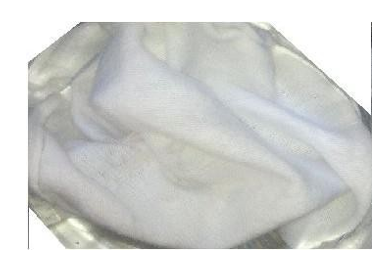
Figure 5: Example of a moderately crumpled two-dimensional FEU embedded in 3D-space
And if there were two-dimensional living beings in a 2D-FEU, it would again be the case that they could neither see the curvature of their universe nor perceive it during a flight. Again, this would only be possible from the perspective of the super-ordinate 3D-universe.
If we consistently pursue this idea of fractal embedding, the next step is to create a 3D-universe that is embedded in a fractal manner in a super-ordinate 4D-space. However, such a 3D-FEU can no longer be represented graphically.
In such a universe, galaxies and worlds as we know them could exist and there could be “our” form of life. And as this corresponds to the actual conditions: the curvatures or bulges existing in 4D-space would not be perceptible to the inhabitants of these worlds.
Discussion of FEUs and Their Properties
First of all, it is assumed that - as described above - the spatial 3D-universe that we can perceive is embedded in a fractally crumpled manner in a 4D-space.
The presented fractal embedding leads to the expectation of an almost isotropic cosmic microwave background radiation, which is consistent with the current state of knowledge; [27]. By this embedding, e.g. the following phenomena can be explained simply:
1. "dark matter" and
2. "Hubble tension"
Dark Matter or its Non-Existence
Dark, i.e. invisible matter is usually used to explain the occurrence of gravitational forces when no visible matter can be found nearby. The introduction of crumpled universes allows a simple, alternative explanation here. This is explained below using a simplified version of the example of the 1D-FEU introduced in figure 4.
In a 1D-FEU, the gravitational forces to be interpreted can be explained using baryonic matter instead of dark matter. However,as shown in figures 6 and 7, this matter, which causes the force to be interpreted, lies in a neighboring winding of the FEU (see below) or in an “island universe” (see figure 8).

Figure 6: Principle sketch for a section of a 1D-FEU demonstrating an alternative interpretation of dark matter
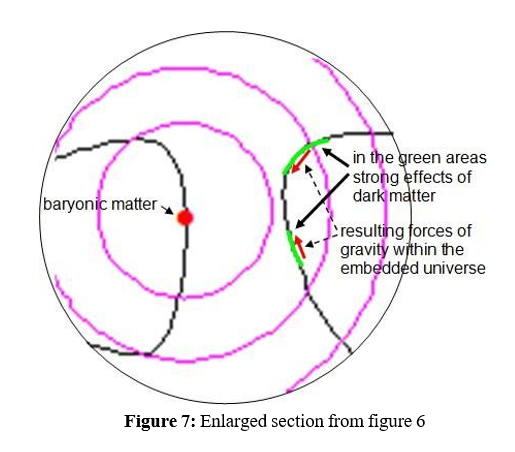
Gravitational forces are not limited to the dimension(s) of the embedded universe, but propagate in all directions within the entire embedding universe; see purple lines in figures 6 and 7. In the embedded universe, however, only the directional components of this force that lie within the FEU are perceptible; see red arrows in figure 7. The area in which these forces occur is shown in green in figure 6 and 7.
Figure 7 shows an enlarged section of figure 6. The gravitational field of baryonic matter located in the turn of the FEU shown on the left causes gravitational forces (see red arrows) within the section of the FEU shown on the right. These forces act in a direction in which no causative baryonic matter is present within this turn. This effect is explained in the conventional view by the forces caused by "dark matter".
Corresponding to real coastlines, a 1D-FEU can also have islands that cannot be reached within the 1D-FEU without a "jump"; see figure 8. These are further referred to as "island universes".

Figure 8: Principle sketch for a section of a 1D-FEU with an "island universe".
In figure 8, for example, strong gravitational forces are also measured "inside" the FEU in the area marked in green, although no matter is present there.
And figure 9 shows an example of how very strong gravitational forces can occur in an area of a 1D-FEU, if there is a lot of baryonic mass in neighboring windings. In conventional view this would be explained by the presence of a lot of dark matter. This effect can be multiplied in a 2D or 3D-FEU.

Figure 9: Principle sketch for an enlarged section of a 1D-FEU demonstrating extreme effects of dark matter
Figure 10 shows a mapping of our universe with areas of dark matter marked. These "clouds" correspond to the areas of the FEU marked in green in figures 6, 7 and 8 or constellations as shown in fig 9. It can be assumed that wherever dark matter is marked in figure 10, our FEU is both heavily crumpled and rich in baryonic mass. (In contrast, the "voids" correspond to less crumpled regions that contain little mass in neighboring windings). A ratio of approximately 1:5 between baryonic and dark matter in our 3D-universe can be explained by strong curvatures and island universes and the presence of a lot of baryonic matter; see figure 9 for example. The presence of dark matter can therefore be completely dispensed with here.

Figure 10: 3D-mapping of dark matter in our universe; [28]
Wechsler and Tinker discuss the connection between galaxies and their "dark matter halo" [29]. In the FEU-model, this can be represented, for example, by the fact that there are windings within the galaxy and baryonic mass occurs relatively close to each other in neighboring windings - see figure 9.
In [30] a dwarf galaxy is reported that does not contain any dark matter. This case can be easily represented with the FEU-model: if the dwarf galaxy is located in a "straight" (not crumpled) section of the FEU, in the vicinity of which there are no other turns with baryonic masses, then no "dark matter effects" occur there.
The opposite case of a dwarf galaxy with an extremely large amount of dark matter is presented in [31]. This case can also occur in the FEU-model if the dwarf galaxy is located in an area of the FEU in which there is an extremely large amount of mass in neighboring turns - see figure 9.
It is even imaginable that fractal crumpling can occur within a galaxy or a planet. This would mean that the gravity measured at different places on this planet may be slightly different. Such variations are actually measured on Earth, but they are attributed to centrifugal force, Earth’s flattening, and elevation profile.
Expansion of the Universe; Hubble Tension
In the following, the expansion of the universe is discussed taking fractal aspects into account; 1D-FEUs are again used for demonstration purposes.
In the general case, the expansion of a 1D-universe can be imagined with the help of a "rubber blanket analogy". The expansion of the 1D-universe then corresponds to the uniform stretching of the blanket in both directions; the section of the 1D-FEU shown (on the blanket) is also enlarged uniformly. The magnification factor f (>1) would correspond to the propagation speed of the universe measured in the usual way.
In order to explain the Hubble tension, in addition to the FEU representation from figure 4, additional extreme conditions are now used for the part of a universe shown in the section.
Case 1: The embedded, line-like 1D-universe is a “normal”, i.e. straight and not crumpled line. In this case, the distance between two galaxies or planets within this universe grows linearly by the same factor f with which the displayed section is scaled.
Case 2: In the opposite extreme case, the embedded universe is an area-filling curve, such as the Hilbert curve in figure 3. Since this curve fills the entire area, the length of the curve grows quadratically by the factor f2, because the displayed area is scaled by the factor f in every direction.
Case 3: Since the embedded 1D-universe is neither straight nor area-filling according to the considerations presented above, its fractal dimension is between 1 and 2 and the "length" of the embedded 1D-universe grows more than linearly but less than quadratically as the universe expands.
Conclusion: Case 3 thus provides a possible explanation for the Hubble Tension. These considerations can be transferred accordingly to our 3D-universe.
The fact that the universe does not expand at the same rate everywhere can also be explained using the rubber blanket analogy.
Areas of the FEU with a high proportion of dark matter are less (or not at all) enlarged during the expansion transferred to the blanket, this means that it is thicker there and therefore less flexible. But if the entire blanket is stretched evenly, the non-thickened, i.e. less rigid areas of the blanket must expand considerably more. However, these areas correspond to the parts of the FEU that contain less baryonic mass - this would then correspond to the voids, for example, in which a higher propagation speed is actually measured. The rubber blanket analogy is consistent with the findings in [32].
Worm Holes
Figure 11 shows (at the position of the arrow) a constellation within a 1D-FEU where two turns of the universe touch each other. At this point of contact a "worm hole" results, through which one can switch back and forth between the different turns of the FEU. Sutter suggests this as a shortcut through space-time [33]; see also the next section.

Figure 11: Principle sketch for a section of a 1D-FEU with a "worm hole
Exceeding the Speed of Light
Figure 12 demonstrates how the speed of light can be exceeded in a FEU. Within the embedded universe, the light must follow the winding course of the universe to get from one of the brown-drawn dots to the other. If one could move at the speed of light along the yellow drawn "shortcut" in 12(a), one would reach the other brown dot much earlier than the light following the FEU. As an alternative to such a “jump”, one could also imagine warping the course of the 1D-FEU in such a way (see 12(b)) that a wormhole is created as a shortcut like in figure 11.

Figure 12: Principle sketch for a section of a 1D-FEU demonstrating "superluminal speed"
Universe Curved or Flat?
It has apparently still not been conclusively clarified whether the universe is "flat" or "curved". But it is assumed "that the universe is flat with only a 0.4 % margin of error"; [34].
An FEU can also be regarded as straight. This is because the turns of the FEU are only local and essentially cancel each other out in the sum.
Summary
This paper presents a new interpretation of our universe that is based on the characteristics and building plans of nature.
The fractal embedding of our universe makes it possible to explain numerous phenomena that are difficult or impossible to explain using conventional methods - in particular dark matter and Hubble tension. Also wormholes and superluminal speed can be explained here.
Outlook
From the measured 3D distribution of dark matter (see figure 10) it should be possible to formulate hypotheses about the 4D course of our 3D-FEU, i.e. the windings of our universe in the super-ordinate 4D space.
In addition, it should be possible to draw conclusions about the fractal dimension present in certain areas of the universe based on the local propagation speed measured in those areas. And this, in turn, can help to refine the 4D course mentioned above.
The extension by one dimension also raises the following question: what happens within the embedded universe, if e.g. matter or energy is “moved crossways" to this universe. This motion itself is not perceptible within the embedded universe because it has no motion component within this universe. Nevertheless, this motion should cause measurable effects (such as electrical current flow or similar) within the embedded universe.
Extending the universe by an additional dimension opens up further interesting approaches to solutions. For example, this enables a simple explanation of entangled particles in quantum physics. In entangled elements are defined as "point pairs" in geometric algebra [35]. These consist of two points that, while spatially separated, belong to the same object and thus share the same properties.
Such point pairs can be connected to one another with the aid of an additional spatial dimension and can therefore be defined and used very easily.
References
- Turner, B. (2024). James webb telescope confirms there is something seriously wrong with our understanding of the universe.
- Leibundgut, B. (2021). What is wrong with the expansion of the universe?
- Center, N. S. F. (2024). Nasa’s webb, hubble telescopes affirm universe’s expansion rate, puzzle persists.
- Oppenheim, J. and Russo, A. (2024). Anomalous contribution to galactic rotation curves due to stochastic spacetime.
- Skordis, C. and ZÅ?osnik, T. (2021). New relativistic theory for modified newtonian dynamics. Phys. Rev. Lett. 127, 161302.
- Duerr, P. M. (2023). Methodological reflections on the mond/ dark matter debate. Studies in History and Philosophy of Science 101 (2023) 1-23.
- Gupta, R. P. (2024). Testing ccc+tl cosmology with observed baryon acoustic oscillation features. The Astrophysical Journal.
- Pumpo, F. D., Friedrich, A., and Giese, E. (2023). Optimal baseline exploitation in vertical dark-matter detectors based on atom interferometry editor’s pick special collection: Large scale quantum detectors. AVS Quantum Science.
- Baum, S., Carena, M., Tong Ou, D. R., Shah, N. R., and Wagner, C. E. M. (2023). Lighting up the lhc with dark matter.
- The-CMS-Collaboration (2021). Search for resonant production of strongly coupled dark matter in proton-proton collisions at 13 tev.
- Angloher, G., Bharadwaj, M. R., Dafinei, I., Di Marco, N., Einfalt, L., Ferroni, F., ... & (COSINUS Collaboration). (2024). Deep-underground dark matter search with a COSINUS detector prototype. Physical Review D, 110(4), 043010.
- ESA (2024). Euclid overview.
- Freese,K. and Winkler, M. W. (2023).Dark Matter and Gravity Waves from a Dark Big Bang.
- Bodas, A., Buen-Abad, M. A., Hook, A., and Sundrum, R. (2024). A closer look in the mirror: Reflections on the matter/ dark matter coincidence.
- Nadler, E. O., Yang, D., and Yu, H.-B. (2023). A self-interacting dark matter solution to the extreme diversity of lowmass halo properties. The Astrophysical Journal Letters, Volume 958, Number 2.
- Bertone, G., Bozorgnia, N., Kim, J. S., Liem, S., McCabe, C., Otten, S., and de Austri, R. R. (2018). Identifying wimp dark matter from particle and astroparticle data. Journal of Cosmology and Astroparticle Physics.
- Nieuwenhuizen, T. M. (2023). Solution of the dark matter riddle within standard model physics: From galaxies and clusters to cosmology.
- Sutter, P. (2021a). Can we explain dark matter by adding more dimensions to the universe?
- Riess, A. G., Anand, G. S., Yuan, W., Casertano, S., Dolphin, A., Macri, L. M., Breuva, L., Scolnic, D., Perrin, M., and Anderson, R. I. (2024). Jwst observations reject unrecognized crowding of cepheid photometry as an explanation for the hubble tension at σ-confidence. The Astrophysical Journal Letters, Volume 962, Number 1.
- Cervantes-Cota, J. L., Galindo-Uribarri, S., and Smoot, G. F. (2023). "The unsettled number: Hubble’s tension". Arxiv.
- Valentino, E. D., Mena, O., Pan, S., Visinelli, L., Yang, W., Melchiorri, A., Mota, D. F., Riess, A. G., and Silk, J. (2021). In the realm of the hubble tension—a review of solutions. Classical and Quantum Gravity, Volume 38, Number 15, 2021.
- Gordon, N. (2006). Introducing fractal geometry. Icon (publisher), ISBN 1840467134, ISBN 9781840467130.
- Wolfram, S. (2012). The father of fractals. The Wall Street Journal.
- Mandelbrot, B. (2012). The Fractalist: Memoir of a Scientific Maverick. Pantheon Books.
- Mandelbrot, B. (1982). "The Fractal Geometry of Nature". W. H. Freeman and Co.
- Richardson, L. F. (1961). The problem of contiguity: An appendix to statistics of deadly quarrels. General Systems Yearbook. Vol. 6. pp. 139–187.
- Smoot, G. F. (2008). "cmb anisotropies: Their discovery and utilization". Nature Astronomy.
- Esa (2007). "First 3d map of the universe’s dark matter scaffolding".
- Wechsler, R. H. and Tinker, J. L. (2018). The connection between galaxies and their dark matter halos. Annual Review of Astronomy and Astrophysics Volume 56, 2018.
- Asencio, E., Banik, I., Mieske, S., Venhola, A., Kroupa, P., and Zhao, H. (2022). The distribution and morphologies of fornax cluster dwarf galaxies suggest they lack dark matter.Monthly Notices of the Royal Astronomical Society, volume 515, issue 2, pages 2981-3013,
- Smith, S. E. T., Cerny, W., Hayes, C. R., Sestito, F., Jensen,J., McConnachie, A. W., Geha, M., Navarro, J. F., Li, T.S., Cuillandre, J.-C., Errani, R., Chambers, K., Gwyn, S., Hammer, F., Hudson, M. J., Magnier, E., and Martin, N. (2024). The discovery of the faintest known milky way satellite using unions. The Astrophysical Journal, 961:92 (15pp), 2024 January 20.
- Mazurenko, S., Banik, I., Kroupa, P., and Haslbauer, M. (2024). "a simultaneous solution to the hubble tension and observed bulk flow within 250 h−1 mpc". Monthly Noticesof the Royal Astronomical Society, Volume 527, Issue 3, January 2024, Pages 4388–4396.
- Sutter, P. (2021b). Wormholes may be viable shortcuts through space-time after all, new study suggests.
- Valentino, E. D., Melchiorri, A., and Silk, J. (2019). Planck Evidence for A Closed Universe and A Possible Crisis for Cosmology. Nature Astronomy 4th November 2019.
- Cafaro, C., Bahreyni, N., & Rossetti, L. (2024). From entanglement to universality: A multiparticle spacetime algebra approach to quantum computational gates revisited. Symmetry, 16(6), 734.