

AI and Intelligent Systems: Engineering, Medicine & Society(AIISEMS)
ISSN: 3068-9503 | DOI: 10.33140/AIISEMS

Research Article - (2026) Volume 2, Issue 1
CUP-Ω∗: A Covariant GKLS–Einstein–Langevin Universal Equation for Thermodynamically Consistent Quantum–Informational Dynamics in the CUCE/Spinoza/Hilbert Framework
Received Date: Nov 10, 2025 / Accepted Date: Dec 22, 2025 / Published Date: Jan 05, 2026
Copyright: ©2026 Gallardo Vicente Merino. This is an open-access article distributed under the terms of the Creative Commons Attribution License, which permits unrestricted use, distribution, and reproduction in any medium, provided the original author and source are credited.
Citation: Merino, G. V. (2026). CUP-??: A Covariant GKLS
Abstract
We formulate CUP-Ω∗ as a covariant evolution law for a quantum state functional defined on Cauchy hypersurfaces. The generator combines Tomonaga–Schwinger hypersurface dynamics with a covariant GKLS dissipator constructed from modular jump operators relative to a unified thermodynamic target state. Under explicit locality and integrability conditions, the evolution is foliation independent. Under detailed balance and primitivity assumptions, the quantum relative entropy to the target state provides a Lyapunov functional, ensuring a second-lawtype monotonicity and exponential convergence to a unique attractor. We further couple the matter dynamics to an Einstein–Langevin stochastic semiclassical gravity equation to encode stress-tensor fluctuations and back-reaction consistently. Finally, we derive falsifiable, quantitative constraints—finite-step Choi positivity, order-independence under spacelike update exchange, and monotone relativeentropy decay—that can be tested in controlled open quantum platforms and interpreted as physically grounded stability principles for learning-like dynamics.
Keywords
Covariant Open Quantum Systems, Quantum Markov Semigroups, Detailed Balance, Tomonaga–Schwinger Equation, Stochastic Gravity, Information Geometry, Thermodynamic Learning
Introduction
A recurring technical challenge in both quantum information science and artificial intelligence is to design dynamics that are simultaneously expressive and stable. In quantum platforms, stability means admissibility of the evolution (complete positivity and trace preservation) and compatibility with thermodynamic constraints, often expressed by detailed balance and entropy production inequalities for quantum dynamical semigroups [1-4]. In machine learning, stability is often enforced by requiring monotone descent of a loss or free-energy functional, echoing information–thermodynamic constraints on computation [5-7]. The CUCE/Spinoza/Hilbert framework proposes that these motifs are not merely analogous but operationally unified: a single dynamical principle should govern reversible (Hamiltonian) change, irreversible organization (thermodynamics), and informational constraints (observer/prior).
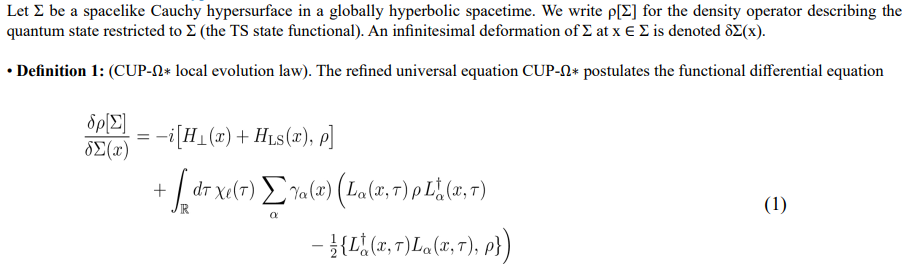
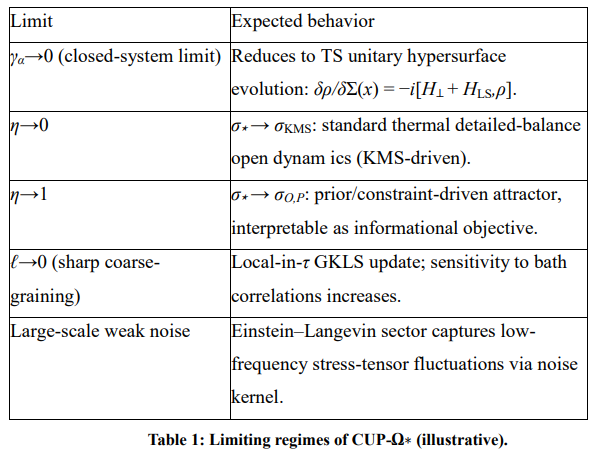
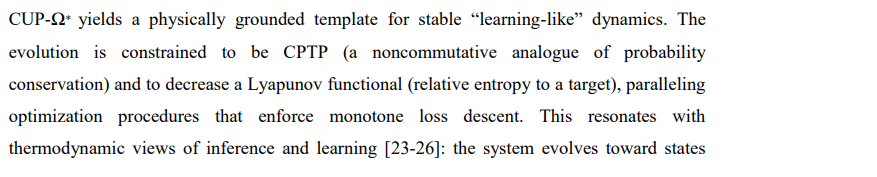
The refined universal equation CUP- provides a concrete proposal in this direction by embedding completely positive opensystem evolution into the Tomonaga–Schwinger (TS) hypersurface formalism, and by allowing a stochastic semiclassical gravitational coupling consistent with the Einstein–Langevin approach [8-11]. This manuscript has three goals. First, we state a self-contained definition of CUP and identify minimal axioms guaranteeing covariance and finite-step complete positivity. Second, we establish a thermodynamic stability structure in which quantum relative entropy to a unified target state is a Lyapunov functional, yielding secondlaw monotonicity and exponential convergence under primitivity. Third, we provide falsifiable and quantitative predictions suitable for experimental tests in engineered open quantum systems and for conceptual transfer to AI as a template for stable “learning-like” dynamical flows.
Results
State Functional on Hypersurfaces and the Local Generator


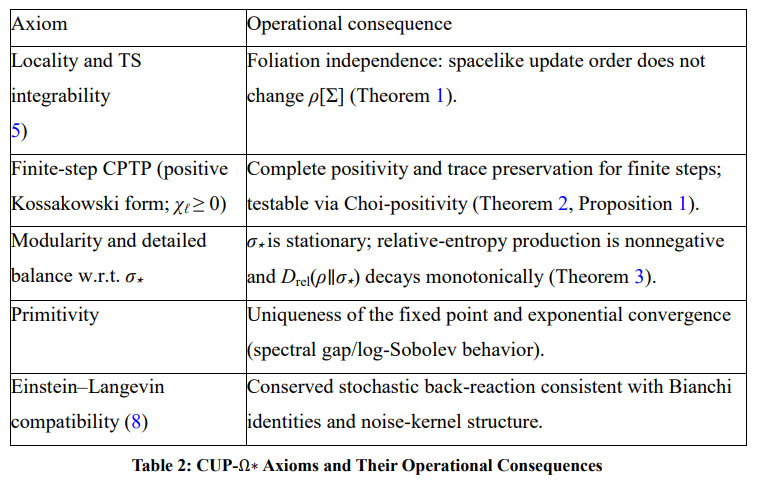
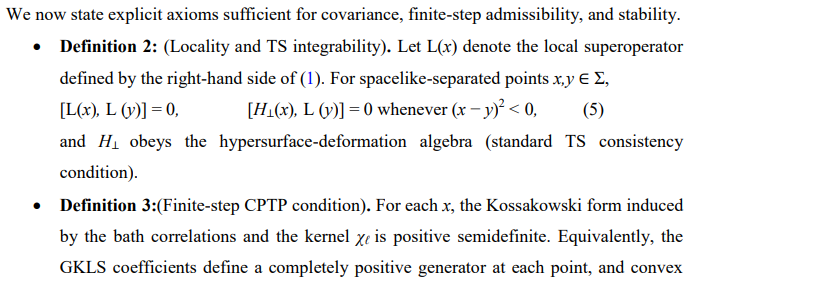
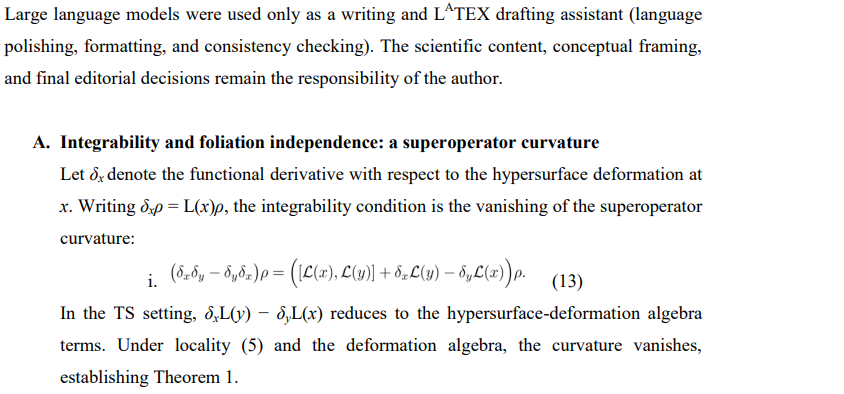
Consistency Axioms

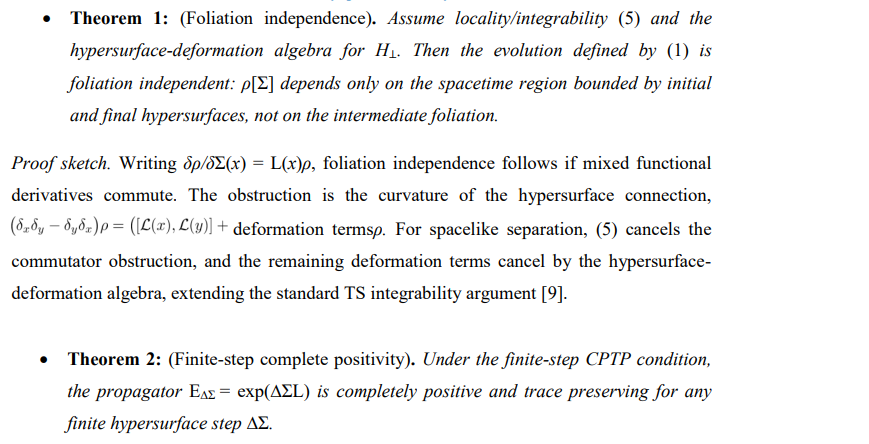
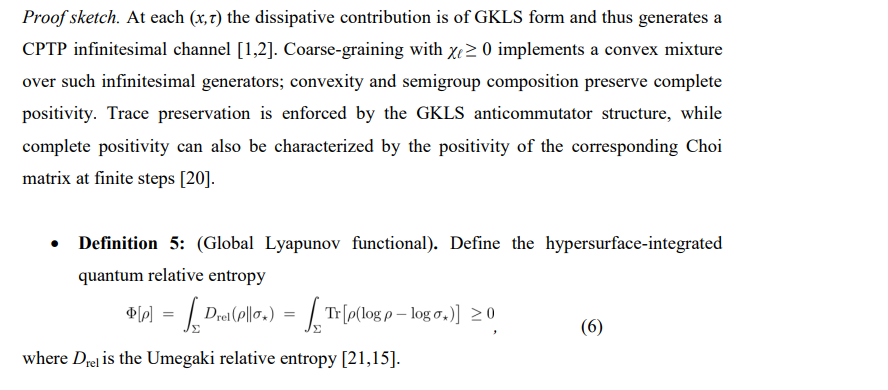
Main Theorems: Covariance, CPTP, and Lyapunov Stability
Coupling to Stochastic Semiclassical Gravity
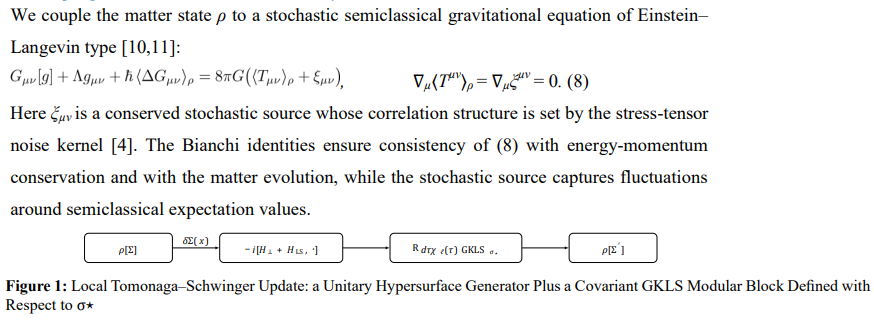


Figure 3: Schematic Lyapunov Descent: Relative Entropy to the Target State Decreases Monotonically
Under Detailed Balance and Converges Exponentially Under Primitivity
Visual Summary
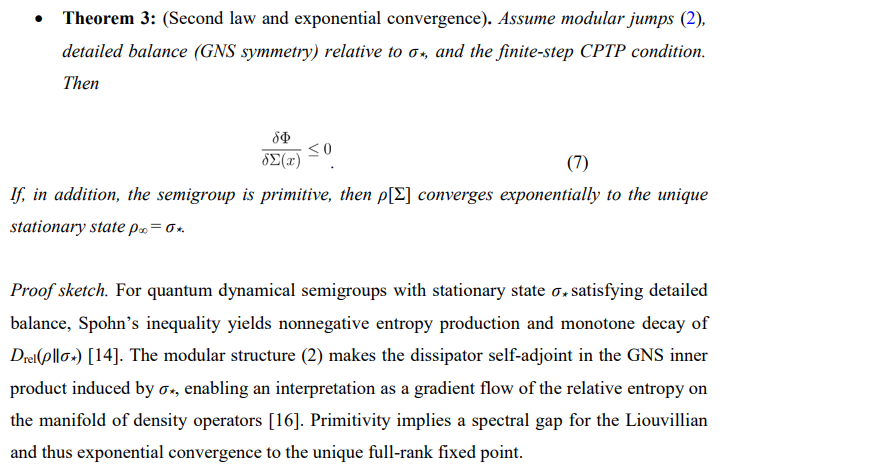
Figures 1–3 provide schematic visualizations of the local TS update, integrability, and Lyapunov descent.
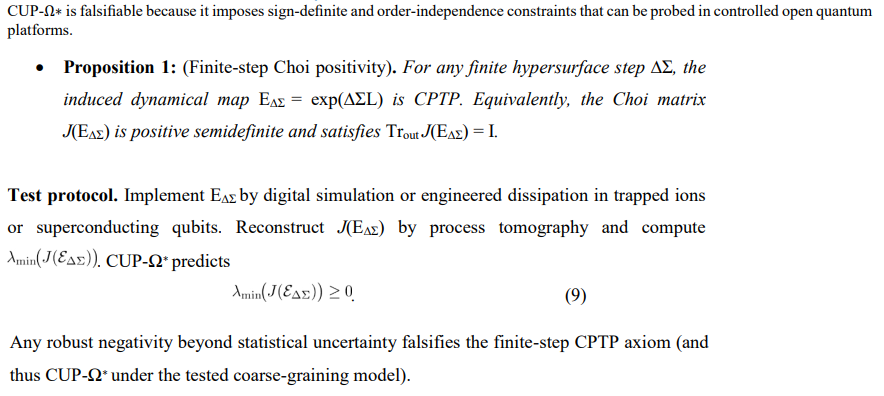
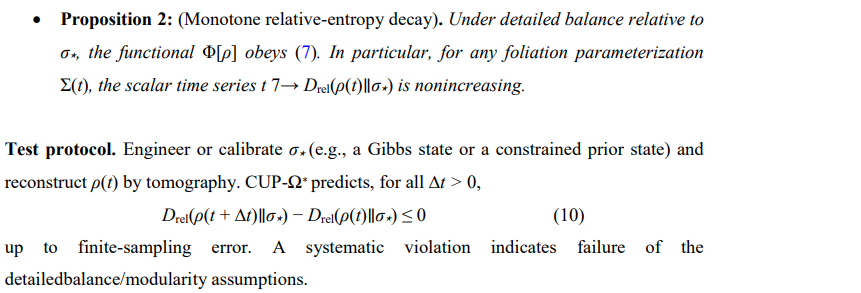
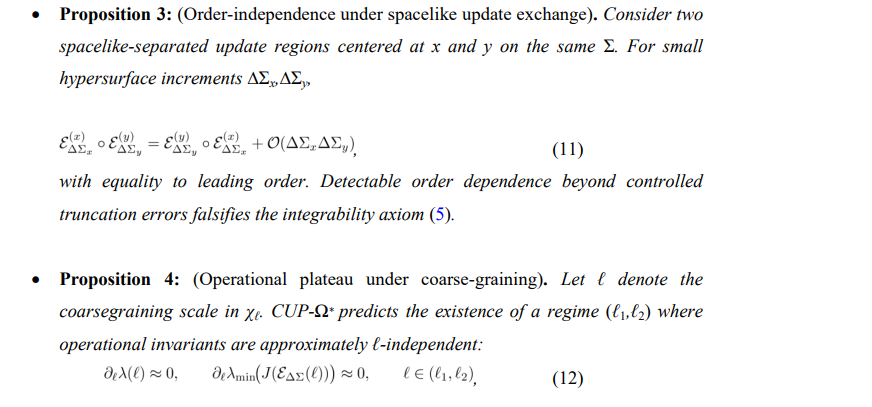
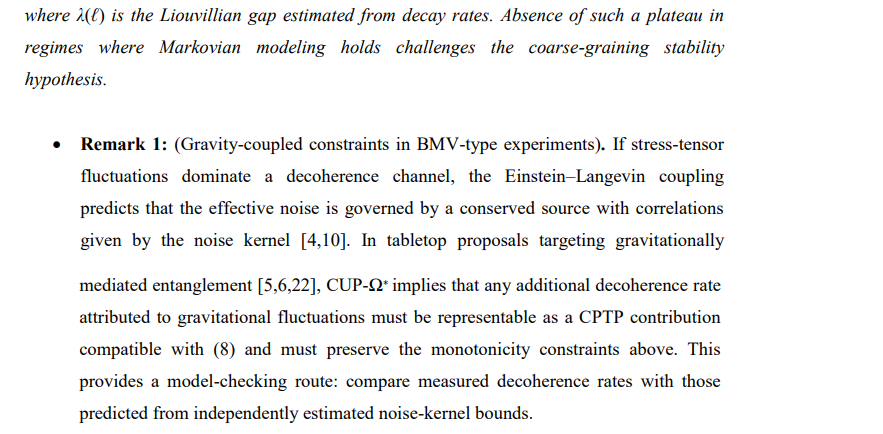
Quantitative Predictions and Falsifiability
Implications for Artificial Intelligence

Methods
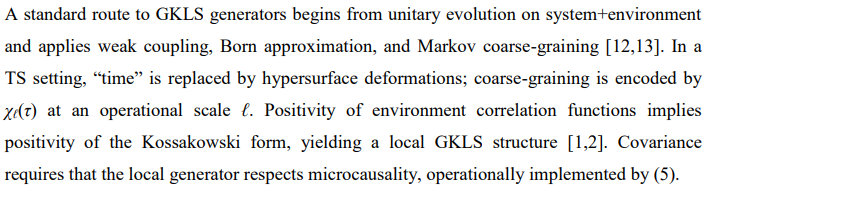
From Coarse-Grained TS Dynamics to Covariant GKLS
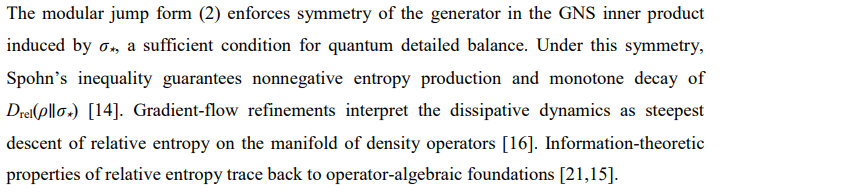
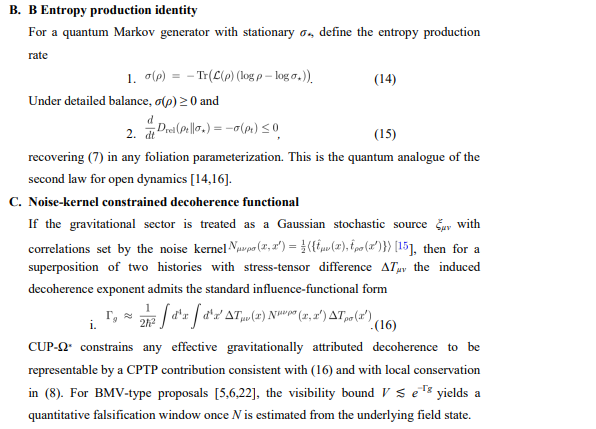
Detailed Balance, Modularity, and Entropy Production
AI-Assisted Drafting Statement
Conclusion
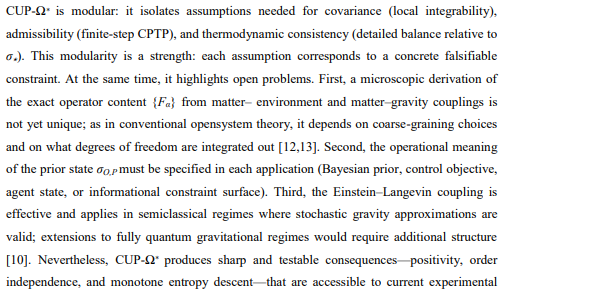
and simulation platforms. The framework also provides a mathematically well-defined
bridge to AI via Lyapunov-stable descent under admissibility constraints [27].
Declarations
Author contributions
V.M.G. conceived the CUP- formulation, developed the theoretical structure
and proofs, and wrote the manuscript.
Competing interests
The author declares no competing interests.
Data availability
No datasets were generated or analyzed during the current study.
Code Availability
No simulation code is associated with this manuscript. All LATEX source code,
including TikZ/PGFPlots figures, is provided with this submission package.
Acknowledgements
The author thanks the open scientific community for foundational results on
quantum dynamical semigroups, detailed balance, and stochastic semiclassical
gravity, and acknowledges the use of AI tools for language and LATEX drafting support.
References
- Lindblad, G. (1976). On the generators of quantum dynamical semigroups. Communications in Mathematical Physics, 48, 119–130.
- Gorini, V., Kossakowski, A., & Sudarshan, E. C. G. (1976). Completely positive dynamical semigroups of N-level systems. Journal of Mathematical Physics, 17, 821–825.
- Martin, P. C., & Schwinger, J. (1959). Theory of many-particle systems I. Physical Review, 115, 1342–1373.
- Phillips, N. G., & Hu, B. L. (2003). Noise kernel and the stress-energy bitensor of quantum fields in curved spacetimes. Physical Review D, 67, 104002.
- Bose, S., Mazumdar, A., Morley, G. W., Ulbricht, H., & Toroš, M., et al. (2017). A spin entanglement witness for quantum gravity.Physical Review Letters, 119, 240401.
- Marletto, C., & Vedral, V. (2017). Gravitationally induced entanglement between two massive particles is sufficient evidence of quantum effects in gravity. Physical Review Letters, 119, 240402.
- Stinespring, W. F. (1955). Positive functions on C*-algebras. Proceedings of the American Mathematical Society, 6, 211–216.
- Tomonaga, S. (1946). On a relativistically invariant formulation of the quantum theory of wave fields. Progress of Theoretical Physics, 1, 27–42.
- Schwinger, J. (1948). Quantum electrodynamics I: A covariant formulation. Physical Review, 74, 1439–1461.
- Hu, B. L., & Verdaguer, E. (2008). Stochastic gravity: Theory and applications. Living Reviews in Relativity, 11, Article 3.
- Martín, R., & Verdaguer, E. (1999). Stochastic semiclassical gravity. Physical Review D, 60, 084008.
- Davies, E. B. (1974). Markovian master equations. Communications in Mathematical Physics, 39, 91–110.
- Davies, E. B. (1976). Quantum theory of open systems. Academic Press.
- Spohn, H. (1978). Entropy production for quantum dynamical semigroups. Journal of Mathematical Physics, 19, 1227–1230.
- Petz, D. (2008). Quantum information theory and quantum statistics. Springer.
- Carlen, E. A., & Maas, J. (2017). Gradient flow and entropy inequalities for quantum Markov semigroups with detailed balanceJournal of Functional Analysis, 273, 1810–1869.
- Kubo, F., & Ando, T. (1980). Means of positive linear operators. Mathematische Annalen, 246, 205–224.
- Bhatia, R. (2007). Positive definite matrices. Princeton University Press.
- Kubo, R. (1957). Statistical-mechanical theory of irreversible processes I. Journal of the Physical Society of Japan, 12, 570–586.
- Merino Gallardo, V. (2025). CUP-: Universal refined equation within the CUCE/Spinoza/Hilbert framework.
- Umegaki, H. (1962). Conditional expectation in an operator algebra. IV. Entropy and information. Kodai Mathematical Seminar Reports, 14, 59–85.
- Aspelmeyer, M. (2022). Tabletop experiments for quantum gravity: A user’s manual. arXiv.
- Landauer, R. (1961). Irreversibility and heat generation in the computing process. IBM Journal of Research and Development, 5,183–191.
- Bennett, C. H. (1973). Logical reversibility of computation. IBM Journal of Research and Development, 17, 525–532.
- Sagawa, T., & Ueda, M. (2010). Generalized Jarzynski equality under nonequilibrium feedback control. Physical Review Letters, 104, 090602.
- Friston, K. (2010). The free-energy principle: A unified brain theory? Nature Reviews Neuroscience, 11, 127–138.
- Spinoza, B. (1994). Ethics (E. Curley, Ed.). Penguin Classics.