

Japanese Journal of Medical Science(JJMS)
ISSN: 2996-2536 | DOI: 10.33140/JJMS

Review Article - (2024) Volume 2, Issue 2
Critical Points in Mother-To-Child Transmission of HIV: Necessities for Mothers to Know
2Department of Public Health and Hygiene, Faculty of Health Sciences, University of Buea, Cameroon
3Department of Sociology and Anthropology, School of Social and Management Science, University of Bue, Cameroon
Received Date: Aug 31, 2024 / Accepted Date: Sep 24, 2024 / Published Date: Oct 21, 2024
Copyright: ©©2024 Ngachangong Victorine Mulur, et al. This is an open-access article distributed under the terms of the Creative Commons Attribution License, which permits unrestricted use, distribution, and reproduction in any medium, provided the original author and source are credited.
Citation: Mulur, N, V., Charles, D., Shey, N, D., Vubo, E, Y. (2024). Critical Points in Mother-To-Child Transmission of HIV: Necessities for Mothers to Know. Japan J Med Sci, 2(2), 01-06.
Abstract
The review on critical points in mother-to-child transmission of HIV was conducted because diverse information is difficult and pulling information together is often better and clearer. Mother-to-child transmission of HIV remains a critical point of concern for both parents and healthcare providers. Many studies have shown that despite all efforts made to reduce mother-to-child transmission of HIV, the intended rate is yet to be achieved. It is relevant because many more mothers and healthcare workers can use the information without searching tiringly. The objectives were to explore, outline, and expose the epidemiology, prevention, and results. Information was obtained from published articles and experiences. Results showed that the epidemiology was between 2% to 11.4%. The prevention strategies included the use of voluntary counseling, early initiation of antiretroviral therapy for HIV-infected mothers and children born to them, the use of replacement feeding, etc. The risk factors for transmission were late initiation of preconception antiretroviral therapy, use of mixed feeding, single-dose Nevirapine, and low knowledge of MTCT. The information can be used for the sensitization of mothers and the general public to reduce transmission rates from mother to child. It can also be used during seminars to educate healthcare providers on the various transmission routes and how to prevent transmission, which can be used to educate mothers during antenatal care and follow-up care.
Keywords
HIV, MTCT, Epidemiology, Prevention, Risk Factors, PMTCT
Abbreviations
ANC- antenatal clinic
ART- antiretroviral therapy ARVs- antiretrovirals
AZT- Zidovudine
EBF- exclusive breastfeeding
ERF- exclusive replacement feeding HAART- highly active antiretroviral therapy HIV- human immunodeficiency virus
MF- mixed feeding
MTCT- mother-to-child transmission of HIV PMTCT- prevention of mother-to-child transmission Sd- single dose
NVP- Nevirapine
Introduction
The transmission of HIV from mother to child remains a public health problem despite the advances in the scientific understanding of HIV and its prevention and treatment, moreover, too many people with HIV or at risk for HIV still donot have access to prevention, care and treatment and there is still no cure [1].
Globally in 2023, about 1.3 million people got infected with HIV, and women and girls accounted for 44% of the new infections. Meanwhile, in sub-Saharan Africa, women and girls accounted for 62% of all the new infections. Statistics also showed that about 4000 adolescent girls and women aged 15- 24 years became infected globally in 2023 with 3100 of these in sub-Saharan Africa. Since 2010 there has been a decline of new infection amongst children by 62%, from 300,000 in 2010 to 120,000 in 2023. The progress of reducing HIV infections is greatest among children but this progress has stalled in recent years [1-3].
The 2024 global fact sheets also showed that about 84% of pregnant women had access to ART in 2023 to prevent transmitting HIV to their babies during pregnancy and childbirth and to protect their health [2]. The 2022 joint release by WHO, UNAIDS, and UNICEF showed that only half (52%) of children
living with HIV were on life-saving ARV treatment, which was far behind adults where three-quarters were receiving ARV [4].
Mother-to-child transmission accounts for about 90% of HIV infections in children and about 14% of new HIV infections globally [5]. An estimated 1.3 million women and girls with HIV get pregnant yearly and in the absence of any intervention, mother-to-child transmission of HIV during pregnancy, labour/ delivery and breastfeeding ranges from 15% to 45 [6]. However, mother’s awareness of their HIV status and timely treatment along with their baby can reduce infection to about 2% (7). Mother-to- child transmission can be prevented by getting pregnant women tested for HIV, HIV positive women are started immediately on antiretroviral with their newborns thereby reducing the risk of HIV transmission to babies from 25% to 2% [7].
Prevention of mother-to-child transmission has been tried but there still exist lapses. The evidence is in the prevalence in children. The objectives of the study were to explore the epidemiology of mother-to-child transmission of HIV, outline the preventive strategies, and explore the risk factors.
Epidemiology of Mother-To-Child Transmission of HIV
Mother-to-child transmission remains a significant contributor to the HIV/AIDS pandemic. Without any intervention, 15 – 30% of HIV-exposed infants get infected during pregnancy, labour, and delivery with a further 5-15% acquiring HIV through breastfeeding. Without treatment, HIV infections in infants and young children result in mortality or increased morbidity or impose a great burden on the child and the family [8].
|
Period |
Estimated risk |
|
During pregnancy |
10 – 20% |
|
During labour and delivery |
30 – 40% |
|
During breastfeeding |
15 – 30% |
|
Transmission rate without breastfeeding |
15 – 25% |
|
Transmission rate with breastfeeding up to 6 months |
25 – 35% |
|
Transmission rate with breastfeeding up to 6 – 12 months |
30 – 45% |
Source [9]
Table 1: Estimated MTCT Transmission Rates Associated with Pregnancy, Labour, Delivery, and Breastfeeding
However, suppressing viral load by medication during the breastfeeding period can reduce the rate of MTCT to < 2%. Many studies have shown that the rate of vertical transmission of HIV-1 in children among HIV-infected mothers receiving triple therapy a combination of Zidovudine, Lamivudine, and Nevirapine (AZT/3TC/NVP) or a prophylactic treatment of AZT/3TC treatment can be as low 0.0% [10].
Between 2021 and 2022 the global rate of MTCT stood at 11% which was still high despite all interventions as cited by Tuthil and colleagues [6,8]. This study in Cameroon put the overall MTCT (HIV-vertical transmission) rate at 3.95% while in Kenya it stood at 8.9%. Concerning feeding options, HIV transmission rates were 2.72%, 3.8%, and 21.43% (p = 0.011)for exclusive breastfeeding (EBF), exclusive replacement feeding (ERF), and mixed feeding (MF) respectively [6,11]. This showed that children who had been exclusively breastfed were less likely to receive HIV from their mothers.
A systematic review and meta-analysis in Cameroon showed an overall rate of MTCT 7.00% which varied across the regions. This rate of MTCT was higher than the 6% and 2% respectively observed in South Africa and Botswana as reported by the 2013 United Nations Program on HIV/AIDS [12] as well as the 6.6% obtained in China [13]. Meanwhile, it was relatively low compared to the 11.4% observed in a systematic review in Ethiopia [14]. In other studies like the randomised clinical trial in Malawi by Taha et al, the overall mother-to-child transmission rate at 6-8 weeks was 18.1% [15].
Prevention of Mother-To-Child Transmission of HIV
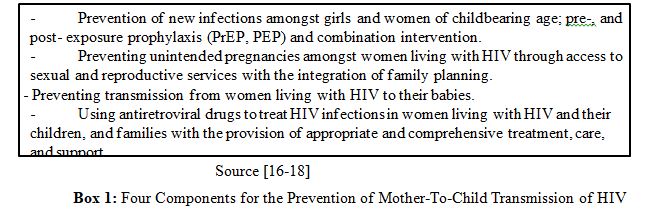
The most important and effective way to improve maternal and child health is through the prevention of mother-to- child transmission of HIV. The following interventions have contributed to PMTCT, including primary prevention of HIV, prevention of unintended pregnancies among women and girls living with HIV, integration of HIV and sexual and reproductive health services, access to HIV testing and counseling throughout pregnancy, initiation of lifelong antiretroviral therapy for mothers with support for adherence, retention in care and viral suppression for mothers living with HIV, safe delivery practices, optimal infant feeding practices and access to postnatal antiretroviral prophylaxis for infants [16,17].
The elimination of mother-to-child transmission of HIV (e-MTCT) has the following goals, reducing vertical transmission rates to ≤ 5% in breastfeeding and ≤ 2% in non-breastfeeding. Steps in achieving these goals include generalized coverage of HIV screening amongst pregnant women through provider- initiated counseling and testing and implementation of option B+ (lifelong triple ARV therapy [ART] to all HIV-infected pregnant women) and right breastfeeding options [10].
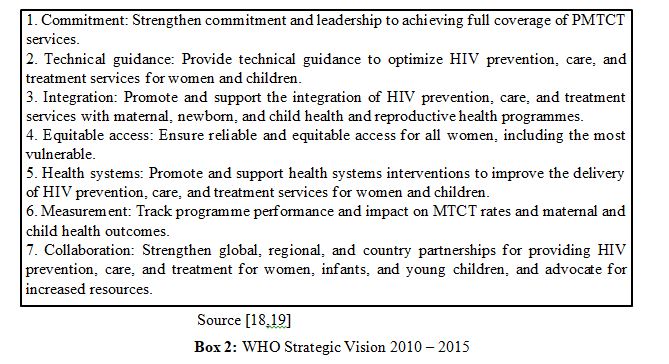
To achieve the elimination of MTCT, PMTCT programs require the women and their infants to have access to antenatal care, HIV testing services and HIV treatment, care during pregnancy, use of ART for pregnant women living with HIV, safe delivery practices and appropriate infant feeding options, uptake of infant prophylaxis and other postnatal services. WHO recommended lifelong antiretroviral therapy for all people living with HIV (including pregnant and breastfeeding women) or a child diagnosed with HIV [11]. The WHO Strategic Vision 2010 – 2015 saw that a comprehensive and sustained approach to scale- up quality and effective PMTCT services in high-burdened countries was necessary and the following seven strategic directions were put forward, commitment, technical guidance, integration, equitable access, health system, measurement, and collaboration [18].
The four areas of PMTCT can be integrated into maternal, newborn, and child health programs as follows: before pregnancy, young women should have access to comprehensive and integrated health programs to prevent HIV infections and unintended pregnancies which can be through counseling on safe sex practices, prevention of HIV transmission and other sexually transmitted infections, prompt treatment of STI, voluntary counseling and testing, disclosure to partner etc. During pregnancy and childbirth, the following aspects can be integrated into ANC service, family planning, and birth preparedness, detection and treatment for STIs like syphilis, counseling for HIV “opt-out”, disclosure to partners, counseling on infant feeding, HIV and STI prevention. In the postnatal period, we want to concentrate on follow-up care, prevention of MTCT of HIV, and family planning. Some key areas include immunisation, adherence to exclusive breastfeeding, or replacement feeding, and monitoring the nutritional status of the child [19].
Various approaches have been implemented to reduce pediatric HIV with targets still to be accomplished. This led to the creation of the Global Alliance for Ending AIDS in Children by 2030, which UNAIDS, UNICEF, and WHO led. This alliance after consultation came up with four pillars for collective action:
1. Closing the treatment gap for pregnant and breastfeeding adolescent girls and women living with HIV and optimizing continuity of treatment;
2. Preventing and detecting new HIV infection among pregnant and breastfeeding adolescent girls and women;
3. Accessibility to testing, optimized treatment, and comprehensive care for infants, children, and adolescents exposed to and living with HIV; and
4. Addressing rights, gender equality, and social and structural barriers that hinder access to services [4].
According to Van Lettow and Co, timely PMTCT interventions can reduce the risk of transmission to less than 5% of mothers who adhere to the strategies during pregnancy, labour, delivery, and breastfeeding. These interventions range from administering antiretroviral therapy to the mother to a short course of antiretroviral drugs for the baby, measures to prevent HIV acquisition during pregnancy, and choosing the right breastfeeding options [20]. From their study, 97% of all the mothers were offered HIV testing and counseling (HTC) and 96% underwent HTC during antenatal clinic visits.
Knowledge of PMTCT can greatly encourage utilization but some studies have shown low knowledge of pregnant women on the PMTCT services such as this study in Iran where 82.6% of the women did not about the availability of antiretroviral prophylactic drugs of mother to foetus transmission and only 57% had tested for HIV WITH 28.2% not ready to undergo testing. Moreover, other methods like prioritizing cesarean delivery over normal vaginal delivery have been seen to reduce the MTCT of HIV [21].
Risk Factors in Mother-To-Child Transmission
Mother-to-child transmission of HIV can occur during pregnancy, labour, and breastfeeding with the risk highest during the second trimester and labour as contractions increase meanwhile the risk during breastfeeding increases with a combination of factors as breastfeeding is prolonged [9] Table 2. The major reasons for these risk factors of MTCT are widely varied ranging from refusal to HIV testing, initiation on antiretroviral, early initiation of babies to HIV-positive mothers, right breastfeeding options, and follow-up services.
|
Pregnancy |
Labour and Delivery |
Breastfeeding |
|
High viral load (recent infection or advanced stage of AIDS) |
High viral load (recent infection or advanced stage of AIDS) |
High viral load (recent infection or advanced stage of AIDS) |
|
Viral, bacterial, or parasitic infections of the placenta (malaria) |
Rupture of membranes over 4hours |
nipples |
|
Sexually transmitted infections |
Invasive procedures during delivery increase contact with infected blood from the mother’s genital mucosa (episiotomy, forceps deliveries, etc.) |
Introduction of supplementary feeding before 6 months (food, liquids, or formula) |
|
Maternal nutrition (undirect cause) |
|
|
Source [9]
Table 2: Main Risk Factors for MTCT of HIV
The presence of a PMTCT program or service in a country or health institution will determine the risk of MTCT. Studies have shown that the presence of these services can greatly reduce the MTCT as a systematic review in Cameroon showed the major factor associated with MTCT was the non-availability of PMTCT interventions for children and mothers [12].
According to Blanche, maternal viral replication is a major risk factor for the infection of the child pre-, peri-, or post-partum with a high risk of in-utero transmission when the maternal viral load is high [22]. Taking ART consistently from before conception and throughout pregnancy greatly reduces the risk of MTCT as it has been shown that an undetectable maternal viral load reduces transmission risk to zero when it is taken before conception. Meanwhile, a high maternal viral load can increase the risk of transmission to 4.4 times [23,24] Table 3. This should be a push factor in increasing preconception initiation of ART in HIV-positive women and increasing screening for early detection and treatment.
|
Maternal Viral Load |
Treatment Initiation |
|
||
|
Before conception |
1st Trimester |
2nd Trimester |
3rd Trimester |
|
|
n 95%CI |
n 95%CI |
n 95%CI |
n 95%CI |
|
|
Undetectable < 50 copies/ml |
0/2651, 0.0 (0.0 – 0.1) |
1/501, 0.2 (< 0.01 – 1.1) |
9/1735, 0.5 (0.2 – 1.0) |
4/452, 0.9 (0.2 – 2.3) |
|
>400 copies/ml |
5/230, 2.2 (.7–5.0) |
1/69, 1.5 (.04–7.8) |
7/291, 2.4 (1.0–4.9) |
10/228, 4.4 (2.1–7.9) |
Adapted from Ref [24]
Table 3: Results on Transmission Rates According To the Timing of Antiretroviral Therapy Initiation vs. Maternal Viral Load in a French Perinatal Study 2000-2011
To attain the WHO 95-95-95 percent goal, 95% of people living with HIV know their status, with 95% started on ARTs and 95% started on ARTs having a reduced viral load. The study by Van Lettow and Co showed that few women knew their HIV status during pregnancy and just about 5% were on highly active antiretroviral therapy (HAART). Moreover, very few of the HIV-positive women were on HAART and there was a suboptimal use of NVP prophylaxis for those not on HAART at the onset or during labour, and 66% of the infants were given sd-NVP within 72 hours of birth [15]. Reasons for this can be the unwillingness of the mothers to reveal their HIV status, stigma from the community, and lack of support from husbands or partners. Furthermore, the risk of MTCT increases in children who receive single-dose Nevirapine [18].
The success of using ARTs has been proven but in sub-Saharan there remains the risk for postnatal transmission through breastfeeding [14]. Following recommended feeding options can reduce the risk of MTCT, when not adhered to the risk of transmission increases. A study in Cameroon showed that there was a 5.3 and 7.4 times higher risk of HIV transmission with mixed feeding (MF) compared to exclusive replacement feeding (ERF) and exclusive breastfeeding (EBF) respectively [11]. Moreover, other studies have shown that the duration of breastfeeding also increases the risk of MTCT, with the risk higher at the initial phase of breastfeeding as colostrum is rich in maternal immune cells [6]. The use of antiretroviral provided a platform for “safe” breastfeeding however, though the risk of MTCT is extremely reduced, zero risk has never been achieved with “safe breastfeeding”, compared to artificial feeding. The use of antiretrovirals in the treatment of mothers, rendering viral replication undetectable in milk, or treatment of the child, following the “post-exposure prophylaxis” approaches have greatly reduced the risk of transmission through breastfeeding to less than 1-2% [22, 24].
Based on other studies the following factors have been seen to contribute to the MTCT of HIV: low maternal adherence to antenatal care utilization, less availability and accessibility of PMTCT interventions and HIV counseling especially in remote areas, extensive home deliveries, low level of knowledge and awareness about MTCT might also contribute to high HIV infection rates amongst children [25-27]. One major risk factor is difficulty in screening though statistics show an increase in screening. The reasons are multifactorial ranging from organisational difficulties to family and social consequences of stigmatization [22].
Conclusion
The rate of mother-to-child transmission of HIV varies greatly across countries ranging from 2% to 11.4% with most of the MTCT transmission taking place within 6 – 8 weeks after delivery.
The various strategies for the prevention of mother-to-child transmission of HIV identified include ‘the Opt-out’ option of voluntary counseling and treatment, early initiation of antiretrovirals for HIV-infected mothers and children born to them, and choosing the right breastfeeding option of replacement feeding.
Finally, the major risk factors for MTCT include late initiation of preconception ARTs and delay initiating the baby when born, a maternal viral load of 50 - ≥400 cells/ml, using mixed feeding or prolonged breastfeeding. Using a single dose Nevirapine treatment was associated with increased risk of transmission
Recommendations
After the review the following recommendations can be made to increase the education of mothers of MTCT to pregnant women at antenatal clinics, ensuring that HIV testing is made available for all pregnant women and those who test positive should be started on antiretroviral therapy immediately.
Other recommendations include involving the male partner in antenatal care, PMTCT, and couple voluntary counseling. Mothers with known HIV status should be recommended to practice exclusive replacement feeding if it is acceptable, feasible, affordable, sustainable, and safe otherwise exclusive breastfeeding for the first 6 months of life, complete integration of PMTCT programmes with maternal and newborn and child health care services.
Conflict of Interest
The authors declare no conflict of interest.
References
1. Global, H. I. V. (2021). AIDS statistics—Fact sheet.
2. HIV and AIDS Epidemic Global Statistics.
3. HIV data and statistics.
4. New Global Alliance launched to end AIDS in children by 2030.
5. Fasakin, K. A., Omisakin, C. T., Adebara, I. O., Ajetunmobi, W. A., Adeniyi, A. A., Esan, A. J., ... & Afe, A. J. (2018). Assessment of PMTCT success rates based on antiretroviral interventions and feeding options: a prospective cohort study. International Journal of MCH and AIDS, 7(2), 226.
6. Tuthill, E. L., Odhiambo, B. C., & Maltby, A. E. (2024). Understanding mother-to-child transmission of HIV among mothers engaged in HIV care in Kenya: a case report. International Breastfeeding Journal, 19(1), 14.
7. Perinatal (Mother-to-Child) HIV Transmission - MN Dept. of Health.
8. Global guidance on criteria and processes for validation- elimination of mother-to-child transmission of HIV, syphilis and hepatitis B virus.
9. Ministry of Public Health. 2015 National Guideline for the Prevention and Management of HIV in Cameroon.
10. Ghoma Linguissi, L. S., Sagna, T., Soubeiga, S. T., Gwom, L. C., Nkenfou, C. N., Obiri-Yeboah, D., ... & Simpore,
J. (2019). Prevention of mother-to-child transmission (PMTCT) of HIV: a review of the achievements and challenges in Burkina-Faso. HIV/AIDS-Research and Palliative Care, 165-177.
11. Njom Nlend, A. E., Motaze, A. C. N., Sandie, A., & Fokam, J. (2018). HIV-1 transmission and survival according to feeding options in infants born to HIV-infected women in Yaoundé, Cameroon. BMC pediatrics, 18, 1-8.
12. Ka’e, A. C., Nka, A. D., Yagai, B., Domkam Kammogne, I., Ngoufack Jagni Semengue, E., Nanfack, A. J., ... & Fokam, J. (2023). The mother-to-child transmission of HIV- 1 and profile of viral reservoirs in pediatric population: A systematic review with meta-analysis of the Cameroonian studies. PLoS One, 18(1), e0278670.
13. Dong, Y., Guo, W., Gui, X., Liu, Y., Yan, Y., Feng, L., & Liang, K. (2020). Preventing mother to child transmission of HIV: lessons learned from China. BMC Infectious Diseases, 20, 1-10.
14. Endalamaw, A., Demsie, A., Eshetie, S., & Habtewold, T. D. (2018). A systematic review and meta-analysis of vertical transmission route of HIV in Ethiopia. BMC Infectious Diseases, 18, 1-11.
15. Taha, T. E., Kumwenda, N. I., Gibbons, A., Broadhead, R. L., Fiscus, S., Lema, V., ... & Hoover, D. R. (2003). Short postexposure prophylaxis in newborn babies to reduce mother-to-child transmission of HIV-1: NVAZ randomised clinical trial. The Lancet, 362(9391), 1171-1177.
16. Prevention of mother-to-child transmission in Prisons. A Technical Guide, 2020 UNODC (United Nations Office on Drugs and Crimes.
17. FHI360 2012 Strategic Approach. Prevention of Mother-to- Child Transmission of HIV.
18. World Health Organization. (2010). PMTCT strategic vision 2010-2015: preventing mother-to-child transmission of HIV to reach the UNGASS and Millennium Development Goals: moving towards the elimination of paediatric HIV, December 2009.
19. Kak, L., Chitsike, I., Luo, C., & Rollins, N. (2011). Prevention of mother-to-child transmission of HIV/AIDS programmes. Opportunities for Africa’s newborns: Practical data, policy and programmatic support for newborn care in Africa: WHO, 113-26.
20. Van Lettow, M., Bedell, R., Landes, M., Gawa, L., Gatto, S., Mayuni, I., ... & Schouten, E. (2011). Uptake and outcomes of a prevention-of mother-to-child transmission (PMTCT) program in Zomba district, Malawi. BMC public health, 11, 1-8.
21. Tarahomi, M., Yaghmaie, F., Asadi, S., Asgari, S., Fatemi, F., Zeraati, H., & Chamani-Tabriz, L. (2010). Preventing mother-to-child transmission of HIV/AIDS: do Iranian pregnant mothers know about it?. Journal of Reproduction & Infertility, 11(1), 53.
22. Blanche, S. (2020). Mini review: Prevention of mother– child transmission of HIV: 25 years of continuous progress toward the eradication of pediatric AIDS?. Virulence, 11(1), 14-22.
23. Mandelbrot, L., Tubiana, R., Le Chenadec, J., Dollfus, C., Faye, A., Pannier, E., ... & Veber, F. (2015). No perinatal HIV-1 transmission from women with effective antiretroviral therapy starting before conception. Clinical Infectious Diseases, 61(11), 1715-1725.
24. John-Stewart, G., Mbori-Ngacha, D., Ekpini, R., Janoff, E. N., Nkengasong, J., Read, J. S., & Newell, M. L. (2004). Breast-feeding and transmission of HIV-1. JAIDS Journal of Acquired Immune Deficiency Syndromes, 35(2), 196-202.
25. Sahlu, I., Howe, C. J., Clark, M. A., & Marshall, B. D. (2014). HIV status, knowledge of mother-to-child transmission of HIV and antenatal care use among Ethiopian women. Journal of epidemiology and global health, 4(3), 177-184.
26. Abtew, S., Awoke, W., & Asrat, A. (2016). Knowledge of pregnant women on mother-to-child transmission of HIV, its prevention, and associated factors in Assosa town, Northwest Ethiopia. HIV/AIDS-Research and Palliative Care, 101-107.
27. World Health Organizationf. Prevention of mother-to-child transmission of HIV: use of nevirapine among women of unknown serostatus: report of a technical consultation, Geneva, 5-6 December 2001. 2002.