

Toxicology and Applied Pharmacology Insights(TAPI)
ISSN: 2641-0451 | DOI: 10.33140/TAPI

Research Article - (2026) Volume 8, Issue 1
Considerations for Stabilizing the Two Main Pillars of Healthcare: Financing and Nursing

Received Date: May 07, 2026 / Accepted Date: Jul 12, 2026 / Published Date: Jul 27, 2026
Copyright: ©2026 Franz Porzsolt. This is an open-access article distributed under the terms of the Creative Commons Attribution License, which permits unrestricted use, distribution, and reproduction in any medium, provided the original author and source are credited.
Citation: Porzsolt. F. (2026). Considerations for Stabilizing the Two Main Pillars of Healthcare: Financing and Nursing. Toxi App Phar Insig, 8(1), 01-09.
Abstract
Background: Reducing healthcare expenditure while improving the quality of care could help stabilize the two major challenges facing healthcare systems: rising costs and declining sustainability. Randomized controlled trials (RCTs) have been recommended for evaluating the effects of health services for more than 50 years. When first introduced into health services research, however, this experimental approach was controversial because methods for objectively evalu- ating its limitations were not yet available.
Objectives: Our aim was to describe methods that enable the identification, verification, and correction of suspected errors in healthcare delivery.
Methods: The intellectual legacy of Albert Einstein (born in Ulm in 1879) and the “hochschule für gestaltung (hfg) Ulm” (Ulm School of Design, 1953–1968) provided the conceptual foundation for clarifying not only formal but also functional relationships. We adopted two principles attributed to Albert Einstein: "A problem cannot be solved with the same mindset that created it" and "If I had 60 minutes to solve a problem, I would spend 55 minutes understanding it." Collaboration with Prof. Hans ("Nick") Roericht and his hfg team encouraged us to apply a design principle developed by American architects and designers. This principle serves both as a framework for developing new products and as a tool for assessing the quality of existing products, concepts, and systems.
Results: (1) The experimental findings of RCTs provide proof of principle (PoP) but do not directly measure real-world effectiveness (RWE). Consequently, RCTs systematically overestimate RWE by approximately 30%, contributing to overprovision of healthcare services and increasing financial pressures. (2) The principles derived from the Ulm legacy enabled further development of methods for identifying healthcare errors and supported a redefinition of the tasks and responsibilities of nursing staff in both clinical care and research. (3) Because of the complexity of healthcare delivery, care provision, research, and data collection should be performed by separate teams.
Discussion: Current approaches to healthcare evaluation can be refined and improved. However, this transformation is complicated by inherent conflicts of interest. Healthcare research should focus on measuring the outcomes that are achieved under routine clinical conditions ("care as usual"). The strategy required to demonstrate these real-world outcomes ultimately benefits all patients who depend on healthcare services. Although healthcare professionals may initially perceive these changes as disruptive, broader acceptance is likely once public trust in healthcare policy has been restored. An essential first step toward rebuilding this trust is to actively involve frontline healthcare professionals in redesigning the tasks and responsibilities associated with everyday patient care.
Keywords
Nursing, Financing, Healthcare, Outcomes, Real-Word Effectiveness, Mindset
Introduction
Two major challenges affect healthcare systems worldwide: the shortage of nursing staff and the financial sustainability of healthcare systems. Despite extensive research, the underlying causes of the nursing shortage remain poorly understood and cannot yet be clearly identified [1,2]. One proposed solution—the academization of the nursing profession—has not yet demonstrated its intended impact and remains an ongoing process [3-5].
The financial challenges facing healthcare systems have been attributed to a variety of factors. While economically stable societies are generally better equipped to address these challenges than economically unstable ones, sustainable solutions are still needed. Several concepts for optimizing healthcare delivery have recently been proposed and can now be evaluated in practice [6]. Accordingly, this paper has three objectives: (1) to examine the avoidable consequences of misinterpreting healthcare data; (2) to demonstrate how the principles of the Ulm Heritage can optimize the roles and responsibilities of nurses in both clinical practice and research; and (3) to explore the structural and functional characteristics of complex healthcare systems.
Various reasons are given to explain the financing problem of health systems. In economically stable societies the problem is easier to solve than in unstable conditions. Ideas for optimizing health care were discussed and can now be tested [6]. Resilient solution strategies could help all systems overcome the challenges.
This paper aims to describe three achieved goals: 1) Discussing avoidable consequences of misinterpreted data. 2) Optimization of the tasks and responsibilities of nurses in care and research through the “Ulm Heritage”. 3) Considering the forms and functions of complex health care.
Methods
I. Discussing Avoidable Consequences of Misinterpreted Data
Avoiding the consequences of misinterpretation of experimental data requires obtaining an initial indication of a possible misinterpretation. Finding these clues requires interest and ability that is a typical characteristic of scientists. If characteristics such as “lateral thinking” / “thinking out of the box” experience a change in social meaning, some scientists could refrain from mak-ing critical comments in consideration of “political correctness”. The risk of not discussing potential errors is the loss of valuable scientific achievement by not discussing the initial suspicion of significant consequential damage. Scientists and politicians should therefore be motivated to open a new discussion space for the communication of initial suspicions with potential consequences.
Optimization of the tasks and responsibilities of nurses in care and research.
Our team learned from former teachers and students at the “Ulmer hfg” how to apply the “Form Follows Function (FFF)” rule of the American architects and designers to put the rules of clinical epidemiology to the test [7]. The FFF rule seems to be suitable for almost any form of quality control well beyond architecture and design. The rule can also be used to assess a person's suitability for a specific task. The correspondence between the requirements of the task and the proven performance allows a prediction of the chance of successfully mastering the expected challenges.
The city of Ulm has preserved the memory of its honorary citizen Albert Einstein (*1879 in Ulm). Two of his recommendations supported our team in developing the method that enables an undistorted description of the effects of health strategies that are generated under the conditions of unstructured “natural chaos” in everyday care. His comment that “a problem cannot be solved with the way of thinking that caused the problem” is easy to understand. But anyone who has ever tried to develop a new thought model “out of the box” will notice how difficult it is not to constantly fall back into old thought structures and get caught in the web of traditional thought patterns. The second of his helpful tips also concerns the development of solution strategies: “If I had 60 minutes to solve a problem, I would use 55 minutes to understand the problem.” This statement motivated us to analyze the quality of the study questions in a project with six international teams on 20 published studies each [8]. The results confirmed the need to discuss a recommendation for a standardized definition of the forms and functions of a four-part scientific question. The importance of a precise question only becomes clear when one considers that almost every precise question has a high chance of receiving a correct answer, but a correct answer to every imprecise answer can only be expected by chance.
These examples practically describe concepts that could be used for the professional qualification of nursing staff. The targeted measures specifically describe the added value that can be achieved through further training measures. General academization could fail as a theory-heavy concept without reference to concrete added value.
II. Considering the Forms and Functions of Complex Health Care
In the health sciences, we are currently concerned with the difference between the experimental gold standard, the “Randomized Controlled Trial (RCT)” and the non-experimental, “Pragmatic Controlled Trial (PCT)”. In addition to the inclusion criteria for describing the patients to be examined in an RCT, the RCT also defines exclusion criteria. These criteria identify the large subgroup of patients who meet the inclusion criteria of the RCT but are not eligible for inclusion in this RCT. The exclusion of these patients is justified if all so-called confounding factors that could influence the observed effect in addition to the tested intervention (therapy) should be excluded.
From the perspective of patients, nurses, and doctors, the “suitability” of the drug is not insignificant but is not the most important decision criterion. That's why we should compare the significant difference between "suitability" from the perspective of science with the "health added value" from the perspective of patients, nurses, and doctors. Table 1 describes this difference between POP and RWE together with the third outcome dimension,the subjectively perceived value (VAL). This description is based on the three questions that Sir Archibald Cochrane and Sir Austin Bradford Hill required to be answered before introducing any innovation into routine care [9].

Table 1: Answering the three Cochrane-Hill questions from the perspectives of experimental clinical research, health-services research, and economic research. Experimental solutions and objective answers are distinguished from pragmatic solutions and subjective answers by their background colors. Modified from [10,11]
This requirement is consistent with Hippocrates' recommendation 2,500 years ago to treat not just the “painful knee” but to consider the whole patient [12]. His recommendation and the strategy of the epidemiologists Cochrane and Bradford Hill are still part of the core principles of health care today. The management of complex healthcare requires a clear and transparent description of the tasks of all partners involved. Orienting future decisions towards the achievable health added value will require coordination from the perspectives of doctors and nursing staff, at least in the initial phase. Possible differences in the priority of care measures between generalists and specialists will need to be clarified among physicians. Since all decisions are recorded, frequently occurring decision problems can be identified and analyzed based on the documented effects.
The tasks of care and data collection, which were previously perceived as stressful by many doctors and nursing staff, should generally be carried out by professional documentarians in the future. The importance of correctly and completely collected data cannot be fulfilled and taken responsibility for alongside a primary task. Doctors and nurses should be used to fulfill their original tasks. Any form of non-skilled employment carries the risk of uneconomical use of valuable resources. The size of the ecosystem, i.e. a region in which the cultural conditions and values are similar, is important. Between 50 and 150 million inhabitants will be needed in an ecosystem, to reflect the true variance of the variables. This system offers physicians and nursing staff in the second half of their careers the opportunity to reduce their clinical workload or to work in the professional field of complex data collection, a role that allows for greater flexibility than direct patient care. Collecting Real-World Evidence (RWE) data requires solid practical experience with clinical workflows, as it also entails liability for the accuracy of the data captured.
Results
I. Discussing Avoidable Consequences of Misjudged Data
The first indication of a systematic misinterpretation of collected data in medicine arose from a “training conflict”. Current international wisdom says that valid scientific information should be generated in experimental RCTs and the significance of the statement depends on the level of evidence. A critical questioning of this doctrine is hardly discussed. The ability to question criti¬cally is only taught at a few research institutes whose teachers predominantly work in the theory of science. The failure to apply this important skill to clinical knowledge created a serious conflict that was not apparent to us when we began our training.
A small group of young doctors, noticed that the care results reported in the printed matter were always better than the results we were able to observe on the patients at our university hospital. A rogue who thinks evil. We were only able to explain the actual cause of this systematic difference a decade later: What we read in textbooks and scientific journals is mostly based on experiments, i.e. on results from RCTs which describe the POP, but RWE. Experts from all professions use this experimental data to make ethical, epidemiological, medical, economic, legal and political decisions on CAU.
This error in interpretation is probably one of the main causes of over-care and the financing problem that exists in almost all health systems. We were also able to describe analogous chal¬lenges when interpreting screening methods [13]. These incorrect burdens on all budgets can be reduced by proving that they are suitable for everyday use. The willingness to make the neces-sary changes to the assessment of health services needs the contributions of all partners. To date, health services have been evaluated based on production costs and the achievable economic profit. The orientation towards realistically achievable health added value, which largely depends on the individual initial risks of the patient being cared for, would make it considerably easier to compare different care strategies. The added value of healthcare that can realistically be achieved can be described using both the objectively measurable RWE and the subjectively perceived value (VAL). The current state of development of PCT should offer enough discussion points for further development [14-23].
II. Optimization of the Tasks and Responsibilities of Nurses in Care and Research
To correct the interpretation error, attention must be paid not only to the form of the data collected, but also to its function. The assessment—and ultimately the remuneration—of care ser-vices depends on demonstrating the added value achieved. We often forget that this added value in terms of health outcomes is the product of a collaborative team. Any individual service can become worthless if the team does not support it. Success can only be enhanced by helping the weakest team members optimize their contribution.
Experimental data cannot describe the suitability of measures for everyday use, but only their basic suitability. Proof of suitability for everyday use can only be provided if all variables that influence the measured effects of everyday care are recorded. The multitude of different influencing factors explains that most patients suffer from not just one, but several health problems. For this reason, several therapists are usually involved in caring for the same patient. Even within the same professional group, therapists evaluate the priorities of different illnesses differently. The required documentation of all data from the same patient must be recorded in a common database. Without this common database, it will not be possible to consider the impact of all existing initial risks and all measures taken when interpreting all results achieved. This complex care structure can only be depicted under the unstructured conditions of the “natural chaos” of everyday care, but not in experiments [14-23].
If the added value of nursing care is to be demonstrated, the nursing staff must provide this evidence themselves. Methodological support can be provided by other professions. Examples of concrete scenarios have been published [24-26].
Correcting the interpretation error requires attention not only to the form of the data collected, but also to its function. Experimental data cannot describe the suitability of measures for everyday use, but only their fundamental suitability. Proof of suitability for everyday use can only be achieved if all variables that influence each of the measured effects of everyday care are recorded. The large number of different influencing factors makes it clear that most patients suffer from not just one, but several health problems. This is why several therapists are usually involved in caring for the same patient. Even within the same professions, therapists will evaluate the priorities of different illnesses differently. The necessary documentation of all data relating to the same patient must be recorded in a common database. Without this common database, it will not be possible to consider the effects of all existing initial risks and all measures applied when interpreting all results achieved.
We are all often subject to the fallacy of interpreting an undetectable effect as an absent effect. However, undetected effects can either actually be caused by the absence of the effect or by an insensitive detection system [27].
Knowledge of this connection can be important if events that induce uncertainty and fear, e.g. unwanted information, cannot be objectified for methodological reasons, but are subjectively perceived by some people as a reduction in “perceived safety” and often as anxiety. Explaining repeatedly reported increases in mental health disorders in the context of the corona pandemic will not be easy to explain because of the many possible causes [26,27].
III. Considering the Forms and Functions of Complex Health Care
Proof of the suitability of health services for everyday use requires a reliable comparison and exchange of information between the doctors and nurses providing care. The core task of the new supply concept is to demonstrate increased supply efficiency. This proof can only be achieved if the entire team pursues common goals for patient care and work processes. Fulfillment of these criteria confirms “top quality medical care”. The remuneration for the services provided will also be based on this in the future.
In general, uniform criteria for the tasks and responsibilities of doctors and nurses must be defined within an ecosystem to ensure the best possible health and economic care, which can be confirmed using measurable endpoints. The scientific information on the forms and functions of the new form of care and the practical experiences in different regions can offer helpful information [16-23].
Aconsistent separation between care and data collection is necessary because of the importance, the requirements for professionalism and the transfer of responsibility for the management provided in both service areas. These requirements are compensated for by the new perspectives that can be offered to doctors and nurses in the second half of their professional careers. There are various reasons that suggest or require changing jobs. The experience gained in everyday care is a prerequisite for understanding and being able to implement the complexity of everyday care.
Discussion
I. Discussion of the Avoidable Consequences of Misinterpreting Data
It is surprising that the suspicion of a systematic misinterpretation of data from randomized controlled trials (RCTs) was not raised sooner. This experience should prompt us all to view our environment more attentively and, above all, critically. Responsible citizens should urge their governments to provide compelling justifications whenever resources—which are limited almost everywhere—are not prioritized for education. In turn, academies and universities should demonstrate educational success using valid data. Failure to do so leaves the affected society unable to identify the causes of that failure. We should all keep two simple lines of reasoning in mind: First, most patients do not suffer from a single illness (mono-morbidity) but from various conditions. Second, it is evident that some of our fellow citizens are frequently afflicted by illness, while others fall ill only very rarely. This observation should encourage us to consider both risk factors involved: the disease diagnosed by the physician and the patient's constitutional factor that is clearly significant when assessing an individual patient's risk of illness. Many professions require specific health prerequisites. As scientists, we should recognize that nature governs most processes through networks. Consequently, "mono-morbidity" can stem from two causes: either there is truly only a single underlying cause, though this appears to be rare—or we currently know of only one of the many causes influencing our health. This suspected multicausality explains the difficulty in distinguishing the effects of various conditions (whether congenital or acquired) from one another. On the other hand, the healthcare sector confirms that our evolving understanding, namely, that the world is more complex than we previously thought—applies to health as well. Ultimately, we should seek advice from experts dealing with the ethical aspects of health on how to equitably apply knowledge regarding the risk profiles of all citizens in the future, to foster social cohesion rather than division.
Complex challenges invariably require the collection of extensive data. The more data collected, the greater the risk of data misuse. However, it must also be considered that any warning regarding data misuse can stoke (diffuse) anxiety and thus lead to a loss of "perceived safety." When addressing potential data misuse, opportunities and risks must always be weighed against each other. Our data indicate that "good news" does not measurably influence perceived safety, whereas "bad news" significantly increases perceived unsafety and anxiety. From this, it follows that when conveying "bad news," the objective of such messages must be differentiated: the professional communication of unavoidable "bad news"—such as objective health results—is a skill that can be learned. Measures and strategies for disseminating "bad news" intended to frighten others, thereby impairing their decision-making ability, can be quantified and should be reduced [24-26].
Figure 1 The safety loop connects objectively measurable risks with risk communication, the subjective perception of the objective risks, and the decision-making back to the initial objective risk. This loop can be influenced at any point of transition by external—and often unavoidable—information. Depending on the nature of information (e.g., from public media), the significance of such unavoidable information becomes particularly apparent. "Bad news" triggers a sense of uncertainty, diffuse anxiety, and an impairment of decision-making ability. Information can harm citizens more than knives. Knives must be surrendered, whereas information is largely protected. There is a need for discussion.
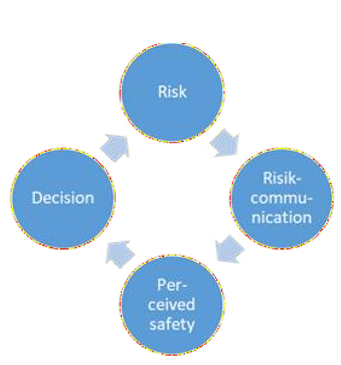
Figure 1: llustrates this “Safety Loop”
Optimizing the Tasks and Responsibilities of Nursing Staff in Care Delivery and Research
Under the banner "Ulm Heritage," we have compiled findings and recommendations—derived from discussions with former faculty and students of the hfg Ulm or shared with us during Ulm-based projects dedicated to preserving Albert Einstein’s legacy. An error in the interpretation of experimental data, which had persisted for 50 years, was confirmed through the application of the FFF rule by American architects and designers, leading to the development of a proposed correction [10-12]. The aim of this publication is not only to appeal to research oriented nursing staff but also to motivate interested practitioners to maintain contact with those active in nursing science. As early as 1919, the Swiss psychiatrist Eugen Bleuler highlighted a problem in his book *Autistic-Undisciplined Thinking in Medicine and Its Overcoming* that remains unresolved to this day [28]. The next generation of nursing staff might consider a specialized preparatory seminar for those interested in research. Such a seminar would convey valuable insights from earlier generations to young researchers and prevent future generations from misjudging the potential impact of nursing interventions.
Fifteen years ago, the *British Medical Journal* published a thesis of mine—unconventional at the time—in a blog post titled "The Y Nurse – Pain in the Neck or Blessing for the Team" [29]. The "Y-Nurse", a clinically experienced, empathetic nurse with strong communication skills, could represent the nursing perspective in all team meetings and, through targeted yet constructive questions, help prevent overtreatment and avoidable costs resulting from unnecessary procedures. This "Y-Nurse" role, which could be combined with the documentation duties of patient care technicians (PCTs) as a part-time position, would offer experienced nursing staff an ideal new opportunity for a challenging professional role in the latter half of their careers. It would provide the team with a sense of security in decision-making, while offering the nurse a secure and cost-effective job.
III. Examination of the Forms and Functions of Complex Healthcare
The results obtained confirm that the rule established by American designers, along with Einstein’s recommendations, proved helpful in applying the well-known but underutilized FFF rule (Form-Function-Form) to solution development. The FFF rule contributes to the optimal design of a new product or concept by requiring, first, the definition of the function; second, the selection of the best possible form (structure); and third, the confirmation of an ideal alignment between the defined function and the selected form. An ideal concept exists when the ideal alignment of form and function is confirmed from the perspective of most observers. An example of such confirmation includes the third care condition shown in Table 2.

Table 2: This table describes three different care conditions, the experimental RCT, and two non-experimental care conditions, the Pragmatic Controlled Trial (PCT) and care outside of clinical trials, i.e. Care as usual (CAU). These three care conditions differ in terms of function and 13 distinct formal (structural) criteria. This table does not yet consider thresholds, which were irrelevant in the era of experimental trials. CGMT: Medical treatment contract. ESRC: Endpoint-specific risk classes. IRB: Institutional review board. *PCT: Pragmatic controlled trial. *RCT: Randomized controlled trial [22]
These three care conditions represent 1) Experimental study describing "Proof of Principle" (POP) or efficacy in randomized controlled trials (RCTs), 2) Observational study (pragmatic study) describing the outcomes of “Care as Usual” (CAU), i.e., realworld effectiveness (RWE) in PCTs, and 3) Description of “Care as Usual” (CAU), i.e. healthcare without systematic out come evaluation. The yellow background indicates differences across the three care conditions. Identical formal criteria in two care conditions are highlighted in blue.
Figure 2 translates the information presented in Table 2 into a three-dimensional “Cube of Care Conditions (CCC)”. The three dimensions of this cube (depth, width and height) describe the functions, the shapes (structures) and the threshold values of different forms of care. Our traditional model distinguished between two forms of care: experimental care within a structured experimental study (RCT) and care outside a structured RCT under the unstructured, non-experimental conditions of routine clinical practice (CAU). The risk profiles of the investigated populations were not assed in these investigated cohorts. The new conceptual model considers a third form of care.
This third form combines non-experimental and seemingly unstructured care under real-world conditions with a strictly structured evaluation of outcomes. This strictly structured yet non-experimental analysis, the Pragmatic Controlled Trial (PCT) relies on the principles of Bayesian statistics, which require comprehensive documentation of all endpoint-specific risk profiles (ESRPs).
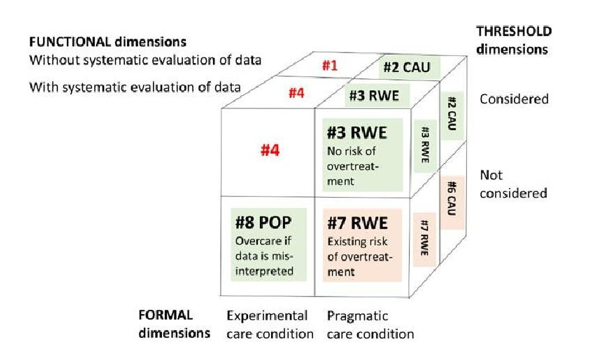
Figure 2: The Cube of Care Conditions (CCC). Each care condition within this cube is characterized by its function, its form (structure), and a third dimension: thresholds (see below). The cube consists of eight small dices, each defined by the three dimensions of the large cube. Each dimension of the large cube can assume two different states. This allows for the definition of a maximum of 2 × 2 × 2 distinct forms of care. The length of each cube describes the function of the type of care model (with or without systematic analysis of outcomes). The width describes the form (structure) of the care model (experimental or non-experimental/pragmatic). The height describes the consideration of thresholds (with or without) for assessing treatment needed and treatment success. Five of the eight small cubes represent specific outcome dimensions: CAU and RWE, each with or without the consideration of thresholds, as well as the experimentally proven POP (without a threshold). The three remaining cubes describe an irrational or unethical study. The eight small cubes are labeled with the numbers 1 through 8. Five of the eight small cubes describe the three forms of care listed in Table 2: CAU with #2 and CAU without #6 threshold; RWE #3 with and RWE #7 (both pragmatic) and POP #8 (the experimentally proven POP) without a threshold. Small cubes #1, #4, and #5 represent illogical or unethical care conditions. Thresholds were not relevant in the experimental era because the sensitivity of the method defined the limit of detection.
The advantage of the three-dimensional concept lies in the three empirically demonstrable dimensions that characterize each specifically defined form of care. In the era of experimental studies, thresholds were insignificant because the limits of detectability were defined by the properties of the methods themselves. With the emergence of potential evidence regarding real-world effectiveness (RWE), two thresholds become relevant for decision-making: the threshold describing the minimum level of health impairment that justifies treatment, and the minimum evidence of treatment success that justifies the treatment.
Since every experienced practitioner is familiar with the parameters influencing the formal determination of these thresholds, the "typically German bureaucratic" approach to defining them can be dispensed with—if colleagues can demonstrate a "consensus on the thresholds" based on their billed cases.
The use of AI can contribute to further improvements in the quality of care. The concept of a PCT (Patient-Centered Treatment or Pragmatic Controlled Trial) could optimize the current structure of the electronic patient record. Depending on the specific question at hand, the data stored therein must be filed under the keywords used for retrieval. Another solvable challenge is the documentation of all data utilized simultaneously by different healthcare providers for the same patient within a shared database.
Distinguishing between insignificant and risky combination effects—such as contraindications—can serve as an additional warning signal for treating physicians. The scientifically validated suitability of a care principle could be termed "proof of principle" (POP). Specifically, this assessment examines tolerability as well as desired and adverse effects under standardized, experimental conditions. An unbiased examination of effects—i.e., RWE—has not previously been possible. To date, no method has gained general acceptance for distinguishing between effects caused by one of the therapies employed and those caused by other influencing factors. When methods are developed to demonstrate suitability for everyday use, it must be considered that all effects that we can observe in health sciences are subject to the laws of natural science. Even in the healthcare system, no effects can contradict the laws of nature. If we pay attention to this simple sentence, it will be possible to distinguish unconfirmed assumptions from proven facts. However, this distinction can only be made if scientists in all areas retain the independence of their profession. Any form of influence from external interests will block the function of science and reduce its importance in international comparison. A pioneer of the British National Health Service (NHS), Sir John Armstrong Muir Gray, summed up the aspect of consecutive decision-making sovereignty:Scientists make decisions, policy makers take decisions [30]. This statement says that we scientists have the task of providing political decision-makers with the best possible justification for our proposals to derive the optimal solution to a social challenge from this information. The importance of scientific independence can be illustrated with an example. The absence of an undesirable effect cannot be evaluated as scientific evidence according to the rule of Altman & Bland “Absence of evidence is not evidence of absence” [27].
In summary, the introduction of the PCT creates significant advantages that can only be achieved if the core health care professions, doctors and nursing offer a common concept that is assessed as practicable by economics and politics. Checks and balances are necessary in healthcare. The experience in the healthcare system could be returned to policy makers to avoid seemingly insurmountable hurdles (Appendix) [31-34].
Acknowledgments
Support to the work reported here was provided by co-authors from Australia (A. Coates), Austria (E. Greimel, M. Kojer), Brazil (L.L.C. Correia, P.C.M. Mayer, A.C.L de Nobrega, R.A. Silva-Sobrinho, T.G. Thomaz), Canada (R. Miller, D. Osoba, B. Phillips, D, Sackett, I.F. Tannock), Chile (L,M. Letelier), Germany (S.I. Becker, G.O. Kamga Wambo, M.S. Phlippen, J. Sigle, Ch. Weiss, M. Weiss, F. Wiedemann), Hungary (J. Demeter), Italy (V. Balassone, P. Rosati), Lebanon (M. Nabulsi), Norway (M. Eisemann), Sweden (K. Öberg), Switzerland (A. Glaus, HJ Senn), United Kingdom (F. Godlee, J.A.M. Gray, D.L. Sackett) and the United States of America (A.K. Ghosh, R.M. Kaplan, C.J. Roads, A.R. Williams, K. Schmaling, P. Wyer). The international contacts were supported by the Senior Expert Service (SES, GmbH, Bonn) and the German Academic Exchange Service (DAAD). Without this support, many connections would not have been possible.
References
-
- Shamsi, A., & Peyravi, H. (2020). Nursing shortage, a different challenge in Iran: A systematic review. Medical journal of the Islamic Republic of Iran, 34, 8.
- MacLean, L., Hassmiller, S., Shaffer, F., Rohrbaugh, K., Collier, T., & Fairman, J. (2014). Scale, causes, and implications of the primary care nursing shortage. Annual review of public health, 35, 443-457.
- Plappert, C. F., Bauer, N. H., Dietze-Schwonberg, K., Grieshop, M., Kluge-Bischoff, A., Zyriax, B. C., & Striebich, S. (2024). Academic education of midwives in Germany (part 1): Requirements for bachelor of science programmes in midwifery education. Position paper of the Midwifery Science Committee (AHW) in the DACH Association for Medical Education (GMA). GMS Journal for Medical Education, 41(3), Doc33.
- Striebich, S., Bauer, N. H., Dietze-Schwonberg, K., Grieshop, M., Kluge-Bischoff, A., Zyriax, B. C., & Plappert, C. F. (2024). Academic education of midwives in Germany (part 2): Opportunities and challenges for the further development of the profession of midwifery. Position paper of the Midwifery Science Committee (AHW) in the DACH Association for Medical Education (GMA). GMS Journal for Medical Education, 41(3), Doc32.
-
- Froger, R., Debray, I., & Martin, P. (2019). Évaluation des connaissances des étudiants et processus pathologiques.
- Jamison, D. T., Summers, L. H., Chang, A. Y., Karlsson, O., Mao, W., Norheim, O. F., ... & Yamey, G. (2024). Global health 2050: the path to halving premature death by mid-century. The Lancet, 404(10462), 1561-1614.
- Sullivan, L. H. (1922). The tall ofice building artistically considered.
- Phlippen, M. S. (2020). Progress in evidence-based medicine by critical appraisal of evidence-based medicine: the HOST catalogue: concordance of study hypothesis, objective, statistics and translation (Doctoral dissertation, Dissertation, Ulm, Universität Ulm, 2021).
- Haynes, B. (1999). Can it work? Does it work? Is it worth it?: The testing of healthcare interventions is evolving. Bmj, 319(7211), 652-653.
- Porzsolt, F. (2023). [Commentary]“Form Follows Function (FFF)”–Applying this rule of designers and architects can reduce misinterpretations and methodical shortcomings in healthcare.
- Porzsolt, F., Weiss, M., & Weiss, C. (2024). Applying the Rule of Designers and Architects “Form Follows Function (FFF)” Can Reduce Misinterpretations and Methodical Shortcomings in Healthcare. Trends Gen Med, 2(1), 1-7.
- Porzsolt, F. (2026). Der erste Schritt in einer neuen Ära? Monitor Versorgungsforschung 2026; 01: 56-57.
-
- Porzsolt, F., Matosevic, R., & Kaplan, R. M. (2020). Recommendations for cancer screening would be different if we measured endpoints that are valid, reliable, specific, and important to patients. Cancer Causes & Control, 31(8), 705-711.
- Porzsolt, F., Eisemann, M., Habs, M., & Wyer, P. (2013). Form follows function: pragmatic controlled trials (PCTs) have to answer different questions and require different designs than randomized controlled trials (RCTs). Journal of Public Health, 21(3), 307-313.
- Porzsolt, F., Thomaz, T. G., Constaˆncio, T. I., Silva-Júnior, A. G. D., & Nobrega, A. C. L. D. (2013). The risks of information in health care: do we need a new decision aid?. Clinics, 68(9), 1177-1179.
-
- Porzsolt, F., Rocha, N. G., Toledo-Arruda, A. C., Thomaz, T. G., Moraes, C., Bessa-Guerra, T. R., ... & Weiss, C. (2015). Efficacy and effectiveness trials have different goals, use different tools, and generate different messages. Pragmatic and observational research, 47-54.
- Porzsolt, F., Weiß, C., Weiß, M., Müller, A. G., Becker, S. I., Eisemann, M., & Kaplan, R. M. (2019). Versorgungsforschung braucht dreidimensionale Standards zur Beschreibung von Gesundheitsleistungen–teil 2. Monitor Versorgungsforschung, 12(04), 2019.
- Porzsolt, F., Wiedemann, F., Phlippen, M., Weiss, C., Weiss, M., Schmaling, K., & Kaplan, R. M. (2020). The terminology conflict on efficacy and effectiveness in healthcare. Journal of comparative effectiveness research, 9(17), 1171-1178.
- Porzsolt, F., Weiß, C., & Weiss, M. (2023). Covid-19: Twinmethode zum Nachweis der Real-World Effectiveness (RWE) unter Alltagsbedingungen. Das Gesundheitswesen, 85(01), 22-25
- Porzsolt, F., Weiss, C., & Weiss, M. (2024). An Evidence-Based Hypothesis: Doctors Do Not Make Decisions Randomly but Based on Individual Patient’s Risk Profiles.
- Porzsolt, F., Wiedemann, F., Schmaling, K., & Kaplan, R. (2019). 25 The risk of imprecise terminology: incongruent results of clinical trials and incongruent recommendations in clinical guidelines.
- Porzsolt, F. (2025). The Call for Progress in Evidence-Based Medicine.
- Porzsolt, F. (2026). A Strategy That Works Not Only in Experiments, but Also in Patients–Part 2: Aimed, Achievable and Future Goals. Achievable and Future Goals (March 09, 2026).
- Porzsolt, F. (2010) Form Follows Funktion: An der Schnittstelle zwischen Design und Klinischer Ökonomik. KrV Kranken- und Pflegeversicherung, 1(1)15-18.
- Porzsolt, F. (2015). Pflege-TÜV und Versorgungsforschung.Monitor Pflege, 4(11).
- Porzsolt. F., Becker. S, I., Kern. A, O., Langer. D., Müller. A., Wiedemann. H., Kaplan R, M. (2019). Strategien undMaßnahmen zur Bewältigung des Pflegenotstands. Monitor Pflege, 2(1) 24-.
- Altman, D. G., & Bland, J. M. (1995). Statistics notes: Absence of evidence is not evidence of absence. Bmj, 311(7003), 485.
- Bleuler, E. (1921). Das autistisch-undisziplinierte Denken in der Medizin und seine Überwindung.
- Porzsolt, F. (2010). The y-nurse: pain in the neck or blessing for the team. BMJ blog by BMJ Group, December 29, 2010. BMJ Group, London.
- Gray, J. M. (2004). Evidence based policy making. Bmj, 329(7473), 988-989.
- Porzsolt, F. (2007). Gefühlte Sicherheit-Ein Entscheidungskriterium für Patienten?. ZFA-Zeitschrift für Allgemeinmedizin, 83(12), 501-506.
- Porzsolt, F., Polianski, I., Görgen, A., & Eisemann, M. (2011). Safety and security: the valences of values. Journal of Applied Security Research, 6(4), 483-490.
- Porzsolt, F. (2016). Safety means perception of risk. J Med Safety, 10, 18-24.
- Porzsolt, F., Pfuhl, G., Kaplan, R. M., & Eisemann, M. (2021). Covid-19 pandemic lessons: uncritical communication of test results can induce more harm than benefit and raises questions on standardized quality criteria for communication and liability. Health Psychology and Behavioral Medicine, 9(1), 818-829.
Appendix: Insights from healthcare as return of investment to policy makers.
It is stressful for all employees in health systems to endure the consequences of political parties' inability to compromise. The concept of the “political party,” which emerged in England in the second half of the 17th century, appears to be showing its age, as values within the party appear increasingly divergent, as do the views of health system experts.
A new concept could prevent the construction of political firewalls because their usefulness is already being questioned given the increasing diversity of values within the party. The aim of all parties admitted to the election - regardless of their orientation - should be to contribute to the formation of a concept that can govern. Qualifying as an opposition party alone is not enough to efficiently create a functioning parliament. The qualifications of almost all professions in all sectors are important to us, but perhaps not enough about the suitability of the professional group that decides our fate. If firewalls reduce the chance of constellations capable of governing before the elections, the system appears to be limiting itself. In the age of digitalization, it should be no problem to create a list of the most important (regional or nationwide) political challenges instead of defining a party program. Every candidate for a political mandate should define or, if necessary, replace the hierarchy of their own priorities on this list. This means that even after the election, compliance with the election promises becomes transparent. This validity of the FFF rule, which has now been widely confirmed, could also be used to ensure the quality of political offices.
A new concept could prevent the construction of political firewalls because their usefulness is already being questioned given the increasing diversity of values within the party. The aim of all parties admitted to the election - regardless of their orientation - should be to contribute to the formation of a concept capable of governing. Qualifying as an opposition party alone is not enough to efficiently create a functioning parliament. The qualifications of almost all professions in all sectors are important to us, but perhaps not enough about the suitability of the professional group that determines the fate of all of us.
Any political association could avoid the hassle of drawing up common party programs. Based on the profile of the members up for election, each voter can decide to whom they will entrust their vote. The parties differ in the two criteria, the list of potential office holders and the correspondence of the functions and forms described from the perspective of the voters. Ultimately, the existing parties could be replaced and financed by cooperation teams to solve challenges. The legitimacy of every elected official to solve a social challenge is confirmed by the election results