

International Journal of Botany and Horticulture Research(IJBHR)
ISSN: 2994-872X | DOI: 10.33140/IJBHR
Impact Factor: 0.98

Research Article - (2023) Volume 1, Issue 1
Comparison between Corn and Potato Starch-Based Bioplastic: Thermal Variation
Received Date: Sep 18, 2023 / Accepted Date: Oct 03, 2023 / Published Date: Oct 20, 2023
Copyright: ©Â©2023 Praveen Soni. This is an open-access article distributed under the terms of the Creative Commons Attribution License, which permits unrestricted use, distribution, and reproduction in any medium, provided the original author and source are credited.
Citation: Soni, P. (2023). Comparison between Corn and Potato Starch-Based Bioplastic: Thermal Variation. Int J Bot Hor Res, 1(1), 80-83.
Abstract
The development in the field of bioplastic has become the revolutionary step against the use of conventional plastic. Bioplastic has been prepared from plants, bacterial and algal sources and commonly bioplastic is made by starch sources i.e. potato, rice ,maize , jackfruit and corn. However, the existing property of bioplastic has not been completely replenished over the use of plastic. Both starch sources (potato and corn) were used to prepare bio-plastic under similar conditions. Similar ingredients are to be used so that variation in the properties can be easily identified. The potato starch-based bio-plastic specimen shows comparable better ease in molding and takes less time to thicken than the corn starch. The observation suggests that bioplastic preparation can be optimized as per the requirements such as time , molding expenses with temperature variation.
Keywords
Molding ,Biodegradable Wax , Gluten , Magnetic Stirrer
Introduction
The uses of bioplastic have spread over many fields. It is simply bio-degradable version of plastic with its specific properties .The major problem associated with the use of plastic are its biodeg-radation period and longtime exposure in the environment. The invention of bio-plastic solved this to a large extent but with that we had compromised to the other essential properties like tensile strength ,ductility ,water repellent etc.(these properties have made the use of plastic for protective storage purpose).Now a day re-searches are ongoing to improve these essential properties in the bio-plastic. Many prior studies have been conducted to produce bio-plastics using natural starches like banana peel starch corn starch, rice starch, cassava starch, tapioca starch, sago starch and potato starch, etc. “Science and Education" Scientific Journal / ISSN 2181-0842 November 2021 / Volume 2 Issue 11.[1]. Gur-jar, Pandel and Jethoo performed the experiment with bio-plastic in which they found the effect of glycerol as a plasticizer on the mechanical and moisture absorption properties of starch-based bioplastic [2]. Varying amount of glycerol was used to produce bio- plastic and then their tensile strength, density and moisture content were determined. Marichelvam, Jawaid and Asim (9th April 2019) prepared the bio-plastic by mixing of glycerol, gel¬atin and citric acid and distilled water in various ratios, and the mixture was heated for a certain temperature for a certain time and spread on a glass plate [3]. They performed various tests in order to analyze the mechanical properties, water solubility and water absorption of the bio- plastic. Momotaz, Hasan and Sarkar (1st Fab. 2022), focused in this research to develop the manufac¬turing process of starch-based biodegradable plastic with optimal and mechanical properties [4]. Therefore bioplastic prepared from different sources have different properties and the same sources but with the different methodologies shows different features. The prior work was also related to improve the properties of bio-plastic by varying the different components associated in the process. The properties of bioplastic largely depend on the temperature used for its manufacturing and as well as the time. The aim of our experi-ment was to find the difference in the properties of corn and potato starch-based bioplastic at varying temperature.
Materials and Methods
The bio-based manufacturing approach is used in this journal. The comparative study comprises the effect of manufacturing tempera¬ture on the properties of bioplastic prepared from corn and potato starch .
A.) Experiment Materials
• Corn starch , potato starch , glycerol , 1% dilute vinegar ( pre-pared from glacial acetic acid), distilled water , wax .
• Equipment : Measuring balance , magnetic stirrer heater , ther- mometer , tray dryer and some other process handling objects.
B.) Experimental Process
• First measure the quantity of starch in the measuring balance.
• Take distilled water in the beaker and add starch .
• Mix with the help of spatula.
• Add the glycerol and vinegar into the solution and mix well.
• Put the beaker into a magnetic stirrer heater and set the tempera¬ture.
• Heat the solution until the thick slurry is obtained.
• Apply wax to the mould surface.
• Pour the solution into the mould and allow it to dry for some time at room temperature.
• Put the specimen in the tray dryer.
• Take out the sample and allow it to dry at room temperature for 7 days.
The quantities of components are in a specific ratio: 21 parts water ,3 parts starch & 2 parts vinegar and glycerol (the object which is used to measure these quantities should have similar dimensions for each case) The procedure remains the same for both the starch sources ( corn and potato ) to see the actual impact of tempera¬ture on the properties. Three samples have been prepared for both starch sources at three different temperatures that are 60, 80 and 100 â??. These temperatures are set on the heater and then with the help of a thermometer rise in the temperature is observed until it reaches the set point .Continuous stirring(magnetic stirrer) is re¬quired so that air bubbles can’t be trapped which causes specimens to be prone to fungal attacks during drying .Properties are com¬pared for the same cases. All the specimens were allowed to dry in the tray dryer for the same time interval 2 hours & same set point temperature on dryer 50ºC ( tray dryer provide uniform heating to the product).
Observation
The following physical nature was affected that has an important role in the manufacturing of bioplastic on the industrial scale. One can optimize the time and molding expenses.
|
S.N. |
Temperature |
Corn-Based |
Potato-Based |
|
1 |
60ºC |
Drying duration = 35 min Molded in metal sheet, sticky even dried in the tray dryer . |
Drying time = 24 min Flowing in nature, i.e. less viscous. Molded in metal sheets. |
|
2 |
80ºC |
Drying time = 33 min. Molded in metal sheet. Comparatively thicker solution. |
Drying time = 18min Molded in metal sheet. Less viscous & easier to mold than corn starch. |
|
3 |
100 ºC |
Drying time = 27 min Molded on wooden plank. Thickest solution. |
Time of drying = 13 min Molded in wooden plank. From above two potato- based starch more viscous. |
Visual observation
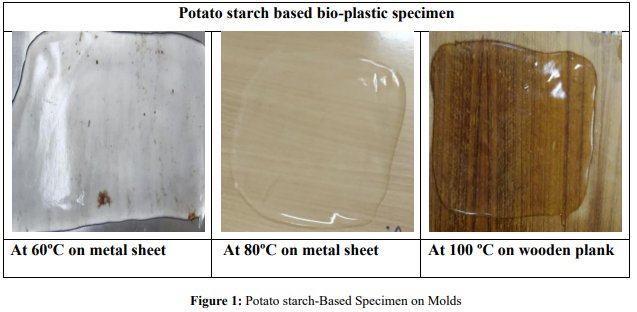
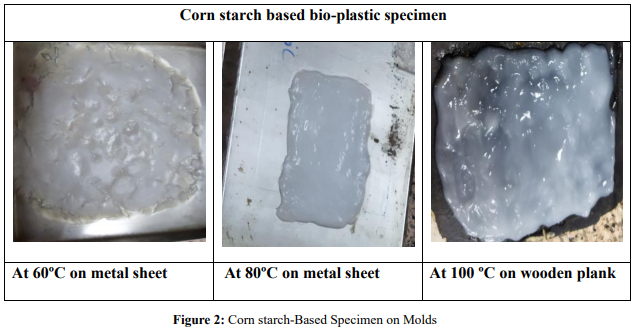
(these pictures have been taken after drying in the tray dryer for 120 minutes each samples)
All the samples from both sources of bio-plastic were compared under similar conditions so the effect of temperature could be easily detected. The room temperature considered for drying was 25ºC±5 . After the preparation of bioplastic biodegradable wax can be applied on the specimen to make it much water repellent .our case ,wax was applied so that it could be easily removable from the moulds.
Result and Discussion
These observations(Table 1) suggest that potato starch-based bio¬plastic takes less time to thicken or form a slurry than that of corn starch-based bioplastic. The gluten-free nature of potato-based starch and the higher the amylose content in the provided starch( potato starch has more than corn), the greater the tendency of the starch to form a gel largely responsible for this nature.
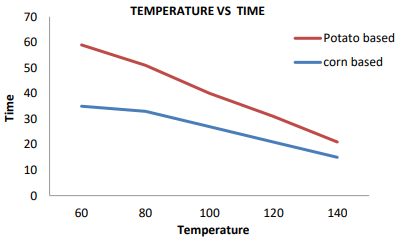
Figure 3: Relation between Set Point Manufacturing Temperature and Time Required to form Moldable Slurry
The above picture (Figure 3) clearly shows that as we increase the temperature time taken to form slurry is getting reduced and at very less temperature the time was quite high and after that it falls with linear relationship. With this estimation, it becomes possi- ble to predict the optimum temperature to prepare the bio-plastic. Moreover, after a certain limit of temperature, the specimen will lose its chemical binding properties and elastic property ; thus one has to keep this factor in mind while optimizing the set tempera- ture value. The second important result revealed from the experi-ment (Figure1 and Figure2) is that molding energy requirement for potato-based bio-plastic is comparatively less than the corn-based bio-plastic. The specimens that were prepared at lower tempera¬ture have an easy molding nature; this signifies that the case in which elasticity is the main purpose of bioplastic, i.e., in the case of polybags at low optimum temperatures will benefit.
Conclusion
According to the report of Ellen MacAurthur there will be more plastic than fish in the ocean by 2050.plastic production is expect¬ed to double again in the next 20 year and almost quadruple by 2050 [5]. so if no action is taken then this will become hell sit¬uation the earth .the production of bio-based plastic is the alter¬nate to this but till now it has not replaced the large production of conventional plastic because of certain drawbacks in it but we have to compromised with the certain low-grade property as see¬ing the upcoming dreadful situation. The research is continuing to improve its properties. The research has also revealed the optimum temperature selection to improve the fast production rate and also the type of starch source that is benefitted in commercial scale i.e. we have specified the molding energy cost criteria .this factor can become very important in producing the bio-plastic and minimize its cost to make it much quantity substitution for plastics
References
- Sasan, J. M. (2021). Bioplastic made from starch as a better alternative to commercially available plastic. Science and Education, 2(11), 257-277.
- Gujar, S., Pandel, B., & Jethoo, A. S. (2014). Effect of plasticizer on mechanical and moisture absorption properties of eco-friendly corn starch-based bioplastic. Nature Environment and Pollution Technology, 13(2), 425.
- Marichelvam, M. K., Jawaid, M., & Asim, M. (2019). Corn and rice starch-based bio-plastics as alternative packaging materials. Fibers, 7(4), 32.
- Momotaz, F., Sarkar, A., Hasan, N., & Chowdhury, H. K. (2022, September). Development of Biodegradable Plastics From Potato Starch With Enhanced Physico-Mechanical Properties Comparative to the Regular Plastic. In International Textile and Apparel Association Annual Conference Proceedings (Vol. 78, No. 1).
- Harvey Sinead (2022) . Plastic pollution is one of the most pressing global environmental challenges., “IAEA office of Public information and communication”,1-3.