

Insights of Herbal Medicine(IHM)
ISSN: 2834-7749 | DOI: 10.33140/IHM



Research Article - (2024) Volume 3, Issue 1
Comparative Proximate Analysis of Citrullus Collocynthis (Melon) and Prosopis Africana (Mesquite)
2Biocrops Biotechnology Company Limited, Abuja, Nigeria
3Sheda Science and Technology Complex, P.M.B 186, Garki,Abuja, Nigeria
Received Date: Jan 10, 2024 / Accepted Date: Mar 01, 2024 / Published Date: Mar 01, 2024
Copyright: ©©2024 J C Ogbu, et al. This is an open-access article distributed under the terms of the Creative Commons Attribution License, which permits unrestricted use, distribution, and reproduction in any medium, provided the original author and source are credited.
Citation: Ogbu, J. C., Ugoh, S. C., Adetoun, B. E., Odusanya, J. T., Nwosu, P. C. (2024). Comparative Proximate Analysis of Citrullus Collocynthis (Melon) and Prosopis Africana (Mesquite). Insights Herbal Med, 3(1), 01-04.
Abstract
It is necessary to compare the nutrient quality before and after fermentation, to know the influence of fermentation on processed food. This research compares the nutrient composition before and after fermentation of Citrullus colocynthis and Prosopis Africana. 2007). The Proximate composition (The moisture content, Ash content, Fibre content and lipid content) of the different samples was determined (Fermented Citrullus collocynthis in foil and Unfermented Prospis africana had highest moisture content of 83.0 and 62.1 respectively, Fermented Prosopis africana in Nylon and Unfermented Citrullus collocynthis had the highest Ash content of 1.20 and 0.67 respectively, Fermented Prosopis africana in foil and Fermented Citrullus collocynthis in foil had the highest fibre content of 40.18 and 12.80 respectively, Fermented Prosopis africana in foil and Unfermented Citrullus collocynthis had the highest fat content of 2.00 and 30.00 respectively.
Keywords
Ash Content, Lipid Content, Moisture Content, Fiber Content, Unfermented, Fermented, Citrullus Colocynthis, Prosopis Africana.
Introduction
The developed nations made mandatory to label all marketed processed food products with their nutrient content to enable the consumer maintain a healthy food regime. Reliable data on nutrition quality of melon and mesquite is therefore very essential in aiding nutritionists and technologists in dietary formulations, processing and product development as well as in nutrition labeling. The knowledge of the chemical composition of any edible organisms is extremely important since the nutritive value is reflected in its biochemical content [1].
Materials and Method
This study was carried out at the University of Abuja, Gwagwalada, FCT. Gwagwalada is one of the five municipal area councils of the Federal Capital Territory Abuja. Gwagwalada has an area of 1,043km2 and a population of 443,000 at the 2021 census.
Sample Collection
Fresh samples of Citrullus collocynthis and Prosopis africana seeds (unfermented) were purchased from Gwagwalada market in FCT, Abuja and placed in a clean plastic container and transported to the laboratory.
Preparation of Sample using Traditional Method
Okpehe and ogiri was produced traditionally. Raw mesquite and melon seeds (1000g) were cleaned seperately to remove extraneous materials. The seeds were washed in clean water, drained and boiled for 12hours. The boiled seeds were de-hulled and cotyledons were boiled in enough quantity of water for one hour and drained. The boiled seeds were allowed to cool, ground to form paste, wrapped with transparent Nylon (NL) and aluminium foil (FL) and left to ferment for five days.
Proximate Analysis
The proximate analysis was carried out at the chemistry laboratory of University of Abuja. The proximate parameters (moisture, ash, crude fats, and fibers) were determined using standard methods.
Moisture Content Determination
This was done by the gravimetric method as described by [2]. About 5g of each sample was weighed and put into a weighed moisture can. The can and its sample content were dried in the oven at 105°C for 3 hours in the first instances. It was cooled in desiccators and reweighed. The weight was recorded while the sample was returned to the oven for further drying. The drying, cooling and weighing was repeated until a constant weight was obtained. The weight of moisture lost was determined by difference and expressed in percentage. It was calculated as in
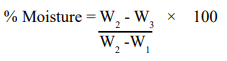
WhereW1 = weight of empty moisture canW2 = weight of can + sample before dryingW3 = weight can + sample after drying to a constant weight. This was done in triplicate and mean value was calculated.
Ash Content Determination
This was done using the furnace incineration gravimetric method as described by [2]. About 5g of each sample was put in a previously weighed porcelain crucible. The sample in the crucible was put in a muffle furnace set at 550°C and allowed to burn for 2-3 hours. The sample was carefully removed from furnace and cooled in desiccators. Each sample was reweighed and the weight of the ash was obtained by difference and expressed as percentage using the formula given in
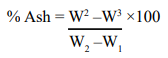
Where W1 = weight of empty crucible W2= weight of crucible + weight of sample W3 = weight of crucible + weight of ash This was done three times and the mean value was calculated.
Fat Determination
The fat contents of the samples were determined by the solvent extraction method using Soxhlet apparatus described by [2]. About 5g of each sample was wrapped in a porous paper (Whatman No.1 filter paper). The wrapped sample was placed in an extraction thimble. The thimble was placed in a Soxhlet reflux flask containing 200ml of petroleum ether. The upper end of the reflux was connected to a water condenser. The solvent (petroleum ether) was heated, boiled, vaporized and condensed into the reflux flask. The sample remain in contact with the solvent until the reflux flask filled up and siphoned over, carrying its oil extract down to the boiling flask. This process was allowed to run repeatedly for at least four (4) hours before the defatted samples was removed, the solvent recovered, and the oil extract was left in the flask. The flask, containing the oil extract was dried in the oven at 60°C for 30 minutes to remove any residual solvent. Oil extracts was cooled in desiccators and weighed. By difference, the weight of fat extract was determined and expressed a percentage of the weight of sample analysed and given the expression in
% Fat = w2 –w1 /w3×100
WhereW1 = weight of flask
W2 = weight of flask and extracted fat
W3 = weight of sample This analysis was done in triplicates of each sample. The means was calculated and recorded accordingly.
Crude Fiber Determination
This was determined by the method as described by [2]. About 5g of each sample was defatted (during fat analysis). The defatted samples were boiled in 200ml 1.25% H2SO4 solution under reflux for 30 minutes. After which, each sample was washed with several portions of hot (boiling) water using two–fold Mushin cloth to trap the particles. The washed sample was carefully put backed to the flask. 200ml of 1.25% sodium hydroxide (NaOH) solution was added to flask. Again, the sample was boiled for 30 minutes and washed as before with hot water. Each sample was carefully transferred to a weighed porcelain crucible and dried in the oven at 105°C for 3 hours. After cooling in desiccators, they were reweighed, put in a muffle furnace and incinerated at 550°C for two hours. Again, they were cooled in desiccators and reweighed. The crude fibre content will be calculated using %
Crude fibre = W2 -W3 /W2 -W1×100
Where W1 = weight of empty crucible
W2 = weight of crucible + sample before washing and drying in the oven
W3 = weight of crucible + sample after drying
Results
|
|
%Moisture |
%Ash |
%Fibre |
%Fats |
|
Unfermented Prosopis Africana |
62.1 |
1.98 |
18.33 |
0.15 |
|
Fermented Prosopis Africana in foil |
53.0 |
1.19 |
40.18 |
2.00 |
|
Fermented Prosopis Africana in Nylon |
36.5 |
1.20 |
24.64 |
0.50 |
|
Unfermented Citrullus colocynthis |
25.50 |
0.67 |
7.41 |
30.00 |
|
Fermented Citrullus colocynthis in foil |
83.00 |
0.31 |
12.84 |
1.50 |
|
Fermented citrullus colocynthis in nylon |
51.50 |
0.54 |
10.92 |
2.50 |

Figure 1: Proximate composition of unfermented and fermented samples (Prososis africana)
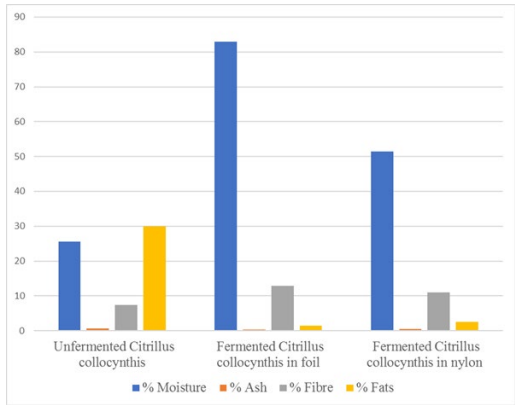
Figure 2: Proximate composition of fermented and unfermented samples (Citrillus collocynthis)
Discussion
The Proximate analysis shows that the moisture content in the mesquite seed reduced as result of the fermentation (from 62.1% in unfermented mesquite to 53.0% and 36.5% in fermented mesquite in foil and fermented mesquite in nylon respectively). On the other hand, the moisture content in the melon seeds increased as a result of fermentation ( from 25.5% in unfermented melon to 83.0% and 51.5% in fermented melon in foil and fermented melon in nylon respectively). Also, fermented Mesquite and melon in foil had more moisture than fermented melon and mesquite in nylon. In both mesquite and melon, the ash content reduced as a result of fermentation, For mesquite (from 1.98% to 1.19% and 1.20% in foil and nylon respectively), For melon (from 0.67% to 0.31% and 0.54% in foil and nylon respectively). In both mesquite and melon fermented samples in nylon had more ash content. Fermentation improved the fiber content of both mesquite and melon seeds. In mesquite (from 18.33% to 40.18% and 24.64% for unfermented, foil and nylon respectively). For melon (from 7.41% to 12.84 and 10.92 in unfermented, foil and nylon respectively). In both mesquite and melon fermented samples in foil had more fibre content. There was no change in the fat content of fermented mesquite in foil but fermented mesquite in nylon increased from 0.50% to 2.00%. The fat content in melon seeds reduced as a result of fermentation (from 30.00% to 1.50% and 2.50 % for unfermented, fermented in foil and Fermented in nylon respectively).
References
- Onwuka, G. I. (2018). Food Analysis and Instrumentation: Theory and Practice. 2nd Edn. Naphtali Prints, Lagos. pp. 179-228
- Nagabhushanam, R., & Farooqui, U. M. (1982). Mobilization of protein, glycogen and lipid during ovarian maturation in marine crab, Scylla serrata Forskal