

Journal of Biotechnology and Bioinformatics(JBB)
ISSN: 2997-2728 | DOI: 10.33140/JBB
Impact Factor: 0.98


Research Article - (2025) Volume 2, Issue 1
Combined Effects of Polyethylene Microplastics and Biochar on Chlorophyll Content in Wheat (Triticum aestivum)
2Professor and Former Head, Department of Botany, Patliputra University, India
Received Date: Nov 14, 2025 / Accepted Date: Dec 15, 2025 / Published Date: Dec 24, 2025
Copyright: ©2025 Viplav Anand, et al. This is an open-access article distributed under the terms of the Creative Commons Attribution License, which permits unrestricted use, distribution, and reproduction in any medium, provided the original author and source are credited.
Citation: Anand, V., Sheel, R. (2025). Combined Effects of Polyethylene Microplastics and Biochar on Chlorophyll Content in Wheat (Triticum aestivum). J biotech bioinform, 2(1), 01-06.
Abstract
Microplastic contamination in agricultural soils is an emerging concern for crop health and productivity. This study investigated the short-term (21-day) effects of polyethylene (PE) microplastics and wood biochar, both individually and in combination, on the chlorophyll content of wheat (Triticum aestivum) seedlings grown under semi-natural outdoor conditions. Eight treatments were established: control (S), three PE concentrations (S+PE 0.5%, 1%, and 2%), biochar alone (S+B), and three combined PE + biochar treatments (S+B+PE 0.5%, 1%, and 2%). Chlorophyll content was determined spectrophotometrically from the third fully expanded leaf. PE microplastic exposure led to slight, non-significant reductions in chlorophyll, indicating minor physiological stress, whereas biochar significantly enhanced pigment levels. Combined PE + biochar treatments restored chlorophyll content close to control values, demonstrating biochar’s capacity to mitigate microplastic-induced stress. These findings highlight biochar’s potential as a practical soil amendment for sustaining early plant physiological stability in microplastic-contaminated soils.
Keywords
Polyethylene Microplastics, Biochar, Wheat, Chlorophyll, Photosynthesis, Stress Mitigation
Introduction
Microplastic pollution in soil ecosystems has become a growing concern for agricultural sustainability worldwide [1- 3]. Polyethylene (PE) microplastics, primarily derived from mulch films, irrigation pipes, and packaging residues, are frequently detected in agricultural soils and can alter soil physical structure, microbial activity, and nutrient cycling [1,3,4]. Such changes may influence key physiological processes in plants, including photosynthesis and chlorophyll biosynthesis [5-7]. Microplastics can also modify the transport and bioavailability of co-contaminants, and several studies report interactions between plastics and hydrophobic organic contaminants (HOCs), such as polycyclic aromatic hydrocarbons (PAHs), which can intensify stress responses in plants [4,6,8,9]. Oxidative stress and altered antioxidant defences are frequently observed under such combined exposures [10].
Chlorophyll, the primary photosynthetic pigment, serves as a sensitive indicator of plant physiological status; its reduction reflects early oxidative or metabolic stress [10,11]. Biochar—a carbon-rich soil amendment produced by biomass pyrolysis—has been widely reported to improve soil fertility, water retention, and microbial activity [12,13]. Its high porosity and surface functionality enable the adsorption of organic contaminants and may reduce the bioavailability or reactivity of microplastics in soil [13,14]. Collectively, these properties make biochar a promising amendment for mitigating contaminant- and microplastic-induced stress in plants [12,15,16]. The present study investigates the short-term effects of polyethylene microplastics on the chlorophyll content of wheat (Triticum aestivum) seedlings and evaluates whether biochar application can mitigate microplastic-induced physiological stress. We further examine early impacts on plant vigor and discuss possible mechanistic pathways underlying these interactions [4,17].
Materials and Methods
Experimental Design
A pot experiment was conducted at Ganga Devi Mahila College, Kankarbagh, Patna, Bihar (25.594° N, 85.150° E) to evaluate the effects of polyethylene (PE) microplastics and wood biochar on chlorophyll content in wheat (Triticum aestivum L., variety PBW- 550), a winter (rabi) crop commonly grown in Bihar. The study was carried out from 14 October 2024 to 4 November 2024, when daily temperatures ranged from 20–32 °C, with relative humidity around 60–65%. The experiment was set up outdoors in a wood- framed structure (2 m × 1.5 m × 1.5 m) covered with a transparent plastic sheet to protect the pots from rainfall while allowing natural sunlight. Pots were placed directly on the ground to simulate natural microclimatic and microbial conditions. Eight treatments were applied in a completely randomized design (CRD), each with three replicates: Control (Soil only), Soil + 0.5% PE microplastics, Soil + 1% PE microplastics, Soil + 2% PE microplastics, Soil + Biochar, Soil + Biochar + 0.5% PE, Soil + Biochar + 1% PE, Soil + Biochar + 2% PE. Each pot contained 700 g of air-dried soil. The experiment lasted 21 days from sowing to harvest.
Soil Collection and Preparation
Topsoil (0–20 cm) was collected from an agricultural field near the college campus. The soil was air-dried, crushed, and passed through a 2 mm sieve. The soil was not sterilized, in order to maintain native microbial communities. Physicochemical properties of the soil were: pH 7.2, organic carbon 0.92%, total nitrogen 0.08%, available phosphorus 25 mg kg⻹, and potassium 110 mg kg⻹, classifying it as sandy-loam.
Microplastic Preparation and Application
Low-density polyethylene (LDPE) microplastics were obtained by shredding clean agricultural mulch films to < 2 mm particle size [20]. Microplastics were incorporated into the soil at 0.5%, 1%, and 2% w/w (equivalent to 3.5 g, 7 g, and 14 g per 700 g soil, respectively).
Biochar Characteristics and Application
Commercial wood-derived biochar (purchased online from an agricultural supplier) was applied at 2% w/w (14 g per 700 g soil). According to the manufacturer, the biochar had pH 9.1, carbon content 72%, and specific surface area 320 m² g⻹ [12,13]. The biochar was thoroughly mixed into the soil prior to sowing.
Seed Sowing and Growth Conditions
Certified wheat seeds were surface-sterilized with 1% sodium hypochlorite for 5 min, rinsed, and air-dried. Thirty seeds were sown per pot, later thinned to 25 uniform seedlings after germination. Pots were watered daily with deionized water to maintain approximately 70% field capacity. No fertilizers or chemical additives were used.
Selection of Leaf Samples for Chlorophyll Estimation
At harvest (day 21), the third fully expanded leaf counted from the apex (youngest growing tip) was collected from three representative seedlings per pot, selected for uniform size and absence of visible stress symptoms (necrosis or chlorosis) [10]. The selected leaves were pooled to form a single composite sample per replicate. This ensured consistent physiological age of sampled leaves across treatments.
Chlorophyll Estimation
Chlorophyll content was determined following [18]. Fresh leaves (0.2 g) were homogenized in 10 mL of 80% acetone, centrifuged at 5000 rpm for 5 min at 4 °C, and the supernatant absorbance was measured at 663 nm and 645 nm using a UV-Vis spectrophotometer. Chlorophyll a, chlorophyll b, and total chlorophyll were calculated as: Chl a (mg•g⻹ FW) = 12.7 × A663 − 2.69 × A645, Chl b (mg•g⻹ FW) = 22.9×A645−4.68×A663, Total Chl (mg•g⻹ FW) = Chl a + Chl b. Where A663 = absorbance at 663 nm and A645 = absorbance at 645 nm. The final results were expressed as mg chlorophyll per gram of fresh leaf weight (mg•g⻹ FW).
Data Analysis
Mean ± standard deviation (SD) was calculated using Microsoft Excel. One-way ANOVA followed by Tukey’s HSD test was performed using a Python script in Google Colab, assisted by ChatGPT-generated code [16]. Graphs were plotted directly in Google Colab using Python libraries.
Results
Plant Growth Observations
All treatments showed healthy germination and early growth. Visual observations indicated that PE-treated pots had slightly reduced vigor compared to the control, whereas biochar-amended pots displayed greener foliage and better turgor. This observation aligns with reports of biochar improving nutrient and water availability, leading to enhanced leaf color and photosynthetic activity [12,15].
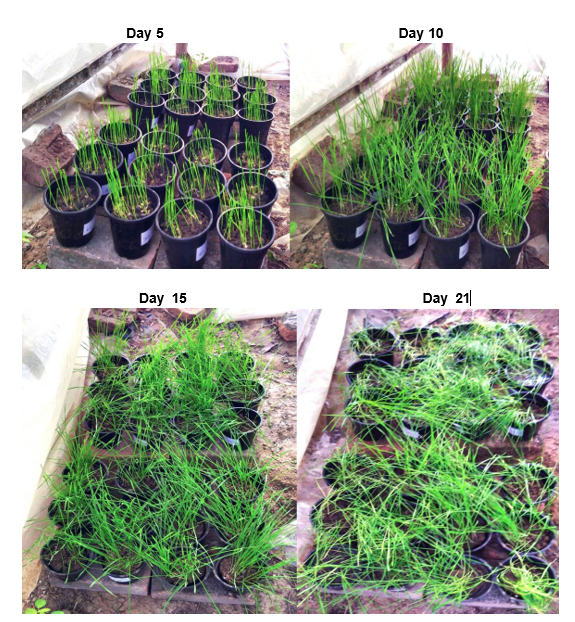
Figure 1: Representative wheat seedlings grown in outdoor pots placed on the ground inside a wood-framed, plastic-covered structure at Ganga Devi Mahila College, Patna. Seedlings are shown for different treatments: control (S), biochar alone (S+B), PE microplastics alone (S+PE 0.5%, 1%, 2%), and combined treatments (S+B+PE 0.5%, 1%, 2%). Photographs were taken at Days 5, 10, 15, and 21 to illustrate changes in leaf color and vigor
Chlorophyll Content
Average chlorophyll content after 21 days is summarized in Table 1. A small reduction in total chlorophyll (approx. 2–3%) was observed with increasing PE concentrations; similar small declines have been observed in short-term PE exposure studies [4,5]. Biochar alone increased chlorophyll by approximately 6% relative to the control, consistent with previous reports showing that biochar enhances chlorophyll content and photosynthetic performance in wheat and other cereals [12,15]. Combined PE + biochar treatments restored chlorophyll close to control values, indicating partial mitigation [14,16].
Table 1: Mean ± SD of total chlorophyll content of wheat seedlings under different treatments. Measurements were taken from the third fully expanded leaf to ensure consistent physiological age of leaves across treatments.
Statistical Outcomes
The one-wayANOVAshowed no statistically significant differences among treatments (p > 0.05). However, as illustrated in Figure 2, the data exhibit a clear directional pattern: chlorophyll content gradually declined with increasing microplastic concentration, suggesting early physiological stress despite the lack of statistical significance. Such subtle, non-significant pigment responses have also been reported in short-term microplastic exposure studies [5,19]. Additionally, the combined biochar + PE treatments showed a slight upward shift in chlorophyll values relative to the PE-only treatments, indicating a modest restorative trend toward control levels. A small reduction in variability was also observed in biochar-amended treatments, suggesting more stable chlorophyll responses compared to PE-only soils. Furthermore, the highest microplastic concentration (2%) consistently produced the lowest mean chlorophyll values across replicates, reinforcing the concentration-dependent pattern visible in the dataset.

Figure 2: Boxplot showing the distribution of total chlorophyll content in wheat seedlings under different treatments. Treatments include control (S), biochar alone (S+B), PE microplastics alone (S+PE 0.5%, 1%, 2%), and combined treatments (S+B+PE 0.5%, 1%, 2%).
Discussion
Short-term exposure (21 days) to PE microplastics up to 2% w/w produced only marginal decreases in chlorophyll content in wheat seedlings. The one-way ANOVA revealed no statistically significant differences among treatments (p > 0.05), but a clear trend of decreasing chlorophyll content with increasing microplastic concentration was apparent (Figure 2). This suggests that even low- level exposure may induce subtle physiological stress in seedlings, consistent with previous short-term microplastic studies where pigment changes remain minor during early growth stages [5,19]. Similar subtle physiological responses have been documented in plants exposed to organic pollutants, where stress effects appear directionally but remain statistically non-significant in the short term [10,12]. The effects of microplastics on chlorophyll can be influenced by particle size, polymer type, and co-contaminants, which may explain the modest responses observed [2,4,6].
Biochar consistently improved chlorophyll levels in our experiment. Its beneficial effect can be attributed to its chemical and physical properties (pH 9.1, carbon content 72%, surface area 320 m² g⻹), which enhance nutrient retention and water availability [11,12]. These improvements were observed even in outdoor pots under semi-natural conditions, suggesting that biochar can support higher photosynthetic pigment content despite natural fluctuations in temperature and light. Similar improvements in photosynthetic activity and stress resilience have been reported in crops treated with biochar under abiotic stress conditions [12,20]. Moreover, biochar’s porous surfaces can absorb hydrophobic organic contaminants and modulate interactions with microplastics, reducing the bioavailability of phytotoxic compounds [13,14].
Combined biochar + PE treatments tended to restore chlorophyll toward control levels, highlighting biochar’s mitigating potential under semi-field conditions. This aligns with findings from other studies where biochar reduced pollutant bioavailability and improved plant performance under contaminant stress [15,16]. The magnitude of mitigation is context-specific, influenced by biochar feedstock, pyrolysis temperature, microplastic properties, and co- occurring contaminants [13,17]. Such context specificity is likely more pronounced in outdoor conditions, where environmental fluctuations and soil microbial dynamics can modulate plant responses compared to controlled laboratory experiments [1,3]. The subtle decline in chlorophyll with increasing microplastic concentration suggests that wheat seedlings may experience low- level oxidative or physiological stress, which may not immediately manifest as statistically significant differences. Early-stage stress responses, such as altered pigment biosynthesis or minor disruptions in photosynthetic efficiency, have been reported under short-term microplastic or organic pollutant exposure [5,9,19]. These early physiological changes could accumulate over longer growth periods, potentially affecting overall plant vigor, biomass accumulation, and yield if exposure persists [8,11].
The consistent ameliorative effect of biochar indicates its potential role as a practical soil amendment to counteract microplastic- induced stress. Its nutrient retention, water-holding capacity, and pollutant sorption properties likely contribute to maintaining photosynthetic function under challenging conditions [13-15]. The combined treatment data emphasize that integrating biochar into agricultural soils contaminated with microplastics may serve as a proactive strategy to safeguard early plant growth stages [16,20]. Future research should focus on longer-duration field trials to monitor cumulative effects of microplastic exposure on wheat growth, including reproductive stages and yield parameters. Additionally, evaluating interactive effects with hydrophobic organic contaminants, heavy metals, and microbial communities will provide a comprehensive understanding of biochar’s mitigation potential under realistic environmental scenarios [14,16,20].
Conclusion
Short-term exposure (21 days) to polyethylene microplastics up to 2% w/w produced only minor, statistically non-significant reductions in chlorophyll content in wheat seedlings grown under semi-natural outdoor conditions. These subtle, directional decreases suggest early physiological stress responses that may intensify with prolonged exposure. In contrast, wood biochar consistently enhanced chlorophyll levels and partially offset the minor stress effects induced by microplastics. Combined PE + biochar treatments restored chlorophyll content close to control levels, demonstrating biochar’s potential as a mitigating soil amendment under real-world environmental conditions. The interaction between microplastics and biochar appears to be context-dependent, influenced by factors such as material properties, soil conditions, and exposure duration. Overall, these findings highlight the applicability of biochar beyond controlled laboratory settings, suggesting that it can enhance early plant physiological stability in microplastic-affected soils. Future studies should extend exposure durations, test diverse biochar types, and evaluate combined contaminant interactions to assess cumulative effects on plant growth, yield, and soil health under long-term field conditions.
References
- Bläsing, M., & Amelung, W. (2018). Plastics in soil: Analytical methods and possible sources. Science of the total environment, 612, 422-435.
- Chae, Y., & An, Y. J. (2018). Current research trends on plastic pollution and ecological impacts on the soil ecosystem: A review. Environmental pollution, 240, 387-395.
- Steinmetz, Z., Wollmann, C., Schaefer, M., Buchmann, C., David, J., Tröger, J., ... & Schaumann, G. E. (2016). Plastic mulching in agriculture. Trading short-term agronomic benefits for long-term soil degradation?. Science of the total environment, 550, 690-705.
- Hüffer, T., Weniger, A. K., & Hofmann, T. (2018). Sorption of organic compounds by aged polystyrene microplastic particles. Environmental Pollution, 236, 218-225.
- Liu, S., Wang, J., Zhu, J., Wang, J., Wang, H., & Zhan, X. (2021). The joint toxicity of polyethylene microplastic and phenanthrene to wheat seedlings. Chemosphere, 282, 130967.
- Ma, Y., Huang, A., Cao, S., Sun, F., Wang, L., Guo, H., & Ji, R. (2016). Effects of nanoplastics and microplastics on toxicity, bioaccumulation, and environmental fate of phenanthrene in fresh water. Environmental Pollution, 219, 166-173.
- Wang, F., Zhang, X., Zhang, S., Zhang, S., & Sun, Y. (2020). Interactions of microplastics and cadmium on plant growth and arbuscular mycorrhizal fungal communities in an agricultural soil. Chemosphere, 254, 126791.
- Ahammed, G. J., Wang, M. M., Zhou, Y. H., Xia, X. J., Mao,W. H., Shi, K., & Yu, J. Q. (2012). The growth, photosynthesis and antioxidant defense responses of five vegetable crops to phenanthrene stress. Ecotoxicology and environmental safety, 80, 132-139.
- McCarrick, S., Cunha, V., Zapletal, O., VondráÄek, J., & Dreij,K. (2019). In vitro and in vivo genotoxicity of oxygenated polycyclic aromatic hydrocarbons. Environmental Pollution, 246, 678-687.
- Shen, Y., Li, J., Gu, R., Yue, L., Zhan, X., & Xing, B. (2017).Phenanthrene-triggered Chlorosis is caused by elevated Chlorophyll degradation and leaf moisture. Environmental Pollution, 220, 1311-1321.
- Li, J., Zhang, H., Zhu, J., Shen, Y., Zeng, N., Liu, S., ... & Zhan, X. (2021). Role of miR164 in the growth of wheat new adventitious roots exposed to phenanthrene. Environmental Pollution, 284, 117204.
- Zulfiqar, B., Raza, M. A. S., Saleem, M. F., Aslam, M. U.,Iqbal, R., Muhammad, F., ... & Khan, I. H. (2022). Biochar enhances wheat crop productivity by mitigating the effects of drought: Insights into physiological and antioxidant defensemechanisms. PLoS One, 17(4), e0267819.
- Li, W., Xing, Y., Guo, Y., Zhang, D., Tang, Y., Chen, J., ... & Jiang, B. (2024). The removal and mitigation effects of biochar on microplastics in water and soils: application and mechanism analysis. Sustainability, 16(22), 9749.
- Su, J., Zhu, Y., Chen, X., Lu, X., Yan, J., Yan, L., & Zou,W. (2024). Biochar Influences Polyethylene Microplastic- Contaminated Soil Properties and Enzyme Activities. Agronomy, 14(12), 2919.
- Wu, Q., Zhou, W., Chen, D., Tian, J., & Ao, J. (2024). Biochar mitigates the negative effects of microplastics on sugarcane growth by altering soil nutrients and microbial community structure and function. Plants, 13(1), 83.
- Miao, J., Chen, Y., Zhang, E., Yang, Y., Sun, K., & Gao, B. (2023). Effects of microplastics and biochar on soil cadmium availability and wheat plant performance. GCB Bioenergy, 15(8), 1046-1057.
- Rillig, M. C., & Bonkowski, M. (2018). Microplastic and soil protists: a call for research. Environmental Pollution, 241, 1128-1131.
- Arnon, D. I. (1949). Copper enzymes in isolated chloroplasts. Polyphenoloxidase in Beta vulgaris. Plant physiology, 24(1), 1.
- Wang, J., Coffin, S., Sun, C., Schlenk, D., & Gan, J. (2019). Negligible effects of microplastics on animal fitness and HOC bioaccumulation in earthworm Eisenia fetida in soil. Environmental Pollution, 249, 776-784.
- Sajjad, M., Huang, Q., Khan, S., Khan, M. A., Liu, Y., Wang, J., ... & Guo, G. (2022). Microplastics in the soil environment: A critical review. Environmental Technology & Innovation, 27, 102408.