

Archives of Epidemiology & Public Health Research(AEPHR)
ISSN: 2833-4353 | DOI: 10.33140/AEPHR
Impact Factor: 1.98


Research Article - (2023) Volume 2, Issue 3
Codified Barriers to Mental Health Care, an Example from New York State
Received Date: Sep 09, 2023 / Accepted Date: Oct 20, 2023 / Published Date: Oct 31, 2023
Copyright: ©Â©2023 Sandra D Richardson. This is an open-access article distributed under the terms of the Creative Commons Attribution License, which permits unrestricted use, distribution, and reproduction in any medium, provided the original author and source are credited.
Citation: Richardson, S. D. (2023). Codified Barriers to Mental Health Care, an Example from New York State. Arch Epidemiol Pub Health Res, 2(3), 260-264.
Abstract
This analysis illustrates the impact of codified barriers to mental health care such as the New York Secure Ammunition and Firearms Enforcement Act (NY SAFE Act). New York State Division of Criminal Justice Services (DCJS) data, United States Census data, and existing literature were utilized to quantify the barrier to mental health care created by NY SAFE Act reporting and effectiveness in identifying the target population. For each DCJS database search related to such reports, about 12 adults who received mental health services in the past year are less likely to seek mental health care; and about 16 adult gun owners are less likely to seek mental health care because of this law. This reporting captures approximately 2.7% of individuals who are suicidal or homicidal. These results indicate that NY’s SAFE Act reporting has created a large barrier to mental health care and is ineffective in capturing its target population.
Introduction
Society has many rules codified into law that are intended to improve public safety and protect civil rights. Although it may seem counterintuitive to codify a barrier to mental health care, some laws may have unintended consequences.
A barrier to care is something that prevents people from receiving adequate health care. Some common examples of barriers to adequate health care include availability of providers, cost, stigma, poor health literacy, and policy. Something that is codified is written into law. Familiar examples of things codified are traffic rules, banking rules, tax rules, and civil rights. Three examples of codified barriers to mental health care include New York (NY) Secure Ammunition and Firearms Enforcement (SAFE) Act Mental Hygiene Law (MHL) § 9.46 reporting, National Instant Criminal Background Check System (NICS) mental health reporting by states to the Federal government, and red flag laws. Here, publicly available data and a current law are used to illustrate 1) the magnitude of the barrier to mental health care created by that law and 2) the percentage of the target population captured by that same law. These results will contribute to the understanding of whether such laws support population wellbeing.
MHL § 9.46
NY SAFE Act MHL § 9.46 is used to illustrate the unintended barrier to mental health care created by a law as well as whether that law is effective in capturing its target population. Therefore, an understanding of NY SAFE Act MHL § 9.46 intent and reporting is essential. NY SAFE Act MHL § 9.46 was created in 2013 in the wake of the tragic Sandy Hook Elementary School shooting that occurred on December 12, 2012. Although well intended, this law was put into place without stakeholder or expert contribution, or time to consider ramifications. On their website, the New York State Psychiatric Association has stated several concerns about privacy and intent of MHL § 9.46 reporting, including the following quote: “Following discussions with OMH staff, it has become clear that the intent of the SAFE Act reporting requirement is solely to limit access to legal firearms and not to protect individuals from imminent risk of harm to self or others” [1]. OMH stands for the NY State (NYS) Office of Mental Health (OMH). Under the governor’s message of necessity provision which expedited passage without the three-day review period, the timeline for passage of the NY SAFE Act was as follows: 1) NYS Senate Bill 2230 approved on January 14, 2013; 2) NYS Assembly Bill 2388, approved on January 15, 2013; 3) signed by the governor on January 15, 2013 [2]. MHL § 9.46 has a lower reporting standard than NICS reporting, therefore a person can be prohibited from owning a gun in NYS but not have this restriction in other states [3-5].
MHL § 9.46 currently contains only four bullets (a through d), and 303 words intended to prevent harm to self or others [6]. It designates which provider types are to file reports and the list of provider types has expanded over time. It gives a general explanation of reporting danger to self or others, and the sequence of entities who will receive and act on the information. It does not require reporting if such would endanger the reporter or potential victims. Lastly, it relieves the reporter of accountability in filing these reports. MHL § 9.46 does not inform reporters that reporting revokes rights without due process of law or validation of the accuracy of the report. Nor does this law clearly state that the reporting standard is MHL § 9.01 – this information is provided in a document on the NYS Office of NICS Appeals and SAFE Act website [3]. Related directly to MHL § 9.46 language, MHL § 9.01 explains that there must be threats or attempts at suicide or conduct demonstrating danger to oneself, or homicidal or violent behavior toward others to meet the reporting standard [7].
Once a report is filed with the NYS OMH through the NYS Office of NICS Appeals and SAFE Act online form, it goes to the County Director of Community Services (DCS) [3]. The DCS checks that the report was filed by a mandated reporter and that what the reporter wrote appears reasonable for reporting (DCS, personal communication, December 2020). However, the DCS does not see the medical record or have any contact with the reported individual. As there is no independent second opinion on an individual’s risk of harm, clinical misjudgment, bias related to guns, and ignorance of the law go unchecked. Next, the report makes its way to the NYS Division of Criminal Justice Services (DCJS) where information about the reported individual is entered into a NYS database of persons who are not permitted to possess guns, and a search of records is conducted to see if the reported individual has a handgun permit in NYS. If there is a handgun permit, the individual is reported to the county and is ordered to appear in court. This notification can take weeks (County sheriff, personal communication, June 2020; County court, personal communication, June 2020), which is in stark contrast to the “need for immediate action” in the reporting standard explanation [3]. There is no required notification to those without a handgun permit that they were reported and are now listed in a NYS database as a person prohibited from gun ownership – for these people there is no appeal process and no due process of law (OMH, personal communication, June 2021; DCJS, personal communication, June 2022). Individuals who are reported are not permitted to see the report against them. The NYS OMH retains all MHL § 9.46 reports ever filed, and the NYS DCJS retains only the last five years of this information (OMH, personal communication, May 2021; DCJS, personal communication, January 2022) [3].
Suicidal ideation, Homicidal ideation, Gun ownership
The Substance Abuse and Mental Health Services Administration estimates that in the past year 15.68% of NYS adults received mental health services and 4.21% had serious thoughts of suicide [8]. Arecent study found that in Nationwide Emergency Department data of over 25 million adults, the prevalence of homicidal ideation (HI) is 0.25% [9]. In a study of 251 Florida Emergency Department patients on involuntary hold, 76.9% of those who were homicidal were also suicidal [10]. Another study revealed that because of NY SAFE Act reporting, 9% of individuals seeking mental health care would be less likely to seek such care [11]. About 10 percent of their study population responded that they owned a gun. An estimate for 2017 indicated that 30 percent of adults in the United States own guns [12]. However, the 2022 estimate for New York State is that 20% of adults own guns [13]. This paper uses NYS population level data to quantify both the barrier to care created by MHL § 9.46 reporting and the percentage of those with suicidal or homicidal thoughts captured by this reporting.
Methods
Data was obtained from the NYS OMH and the NYS DCJS through freedom of information requests (OMH, personal communication, May 2021; DCJS, personal communication, January 2022), and from the United States Census Bureau website [14]. The OMH data is from inception of MHL § 9.46 reporting in March of 2013 through December 2021. The DCJS data utilized includes January 2018 through December 2021. Due to the timing of the DCJS request, 2017 data is incomplete and therefore excluded. The Census Bureau (n.d.) NYS population estimates for July 2021 are a total population of 19,835,913 with 79.3% (15,729,879) of the total population being 18 years of age or older. Based on OMH data, the total number of reports, the average number of reports per year, and percentages of reports by reporter type are presented. The DCJS data related to these reports provides the total number and yearly average of database searches, and number and percentage of searches that resulted in county notification. To allow alignment, OMH results are also presented limited to the years for which complete DCJS data are available.
The number or percentage of adults who are expected to report thoughts of suicide, homicide, or both, and the percentage of individuals who are less likely to seek mental health care due to MHL § 9.46 are applied to the NYS population data. The barrier to care is quantified in the number of individuals who are less likely to seek mental health care because of this law and also in the ratio of individuals less likely to seek care to DCJS data base searches. The percentage of the target population that this reporting may identify if all reports were accurate is also presented. Figures were created using Microsoft Excel. The author certifies responsibility.

Figure 1: Percentage of New York State Mental Hygiene Law § 9.46 Reports by Provider Type and Year
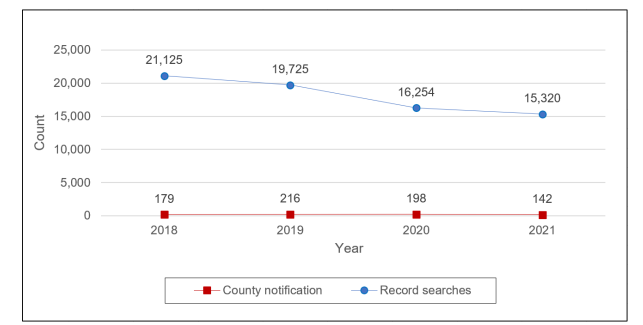
Figure 2: Count of New York State Division of Criminal Justice Services Mental Hygiene Law § 9.46 Database Searches and County Notification by Year
Results
The total number of MHL § 9.46 reports filed from 2013 through 2021 was 183,577, with a yearly average of 20,397; from 2018 through 2021 the total and average were 77,085 and 19,271, respectively. From 2013 through 2021 the percentage of reports by reporter type were: physician 69.2%, registered nurse 15.7%, social worker 11.6%, and psychologist 3.5% (Fig. 1). The total number of related DCJS database searches related to MHL § 9.46 reports from 2018 through 2021 was 72,424 with a yearly average of 18,106, and the number of reports to a county was 735 (Fig. 2). Thus, 1% of DCJS database searches resulted in county notification. Among NYS adults there are about 3,145,976 who own guns and 12,583,903 who do not, based on the estimated 20% gun ownership. At a rate of 4.21%, about 662,228 NYS adults are expected to have serious thoughts of suicide each year. Using a prevalence of 0.25%, approximately 39,325 NYS adults are expected to have HI each year. Applying 76.9% to 39,325, the number expected to have both suicidal ideation (SI) and HI is 30,241 which represents 0.19% of NYS adults.
When the percentage less likely to seek mental health care due to NY SAFE Act reporting (9%) is applied to the percentage of NYS adults who received mental health services in a year, there are 221,980 individuals less likely to seek mental health care because of MHL § 9.46. When the 9% is applied to the number of NYS adults who do not own guns the result is 1,132,551 individuals who are less likely seek mental health care because of MHL § 9.46. If that same 9% is applied only to adult NYS gun owners, there are 283,138 individuals who are less likely to seek mental health care each year because of MHL § 9.46. The ratio of adults who received mental health services and are less likely to seek mental health care to DCJS database searches is 12 to 1. The ratio of adults who do not own guns and are less likely to seek mental health care to DCJS database searches is 63 to 1. The ratio of adult gun owners less likely to seek mental health care to DCJS database searches is 16 to 1. Assuming there are no inaccurate reports among the DCJS database searches, this reporting is capturing approximately 2.7% of the target NYS population of individuals with SI, HI, or both.
Discussion
There are many MHL § 9.46 reports filed each year and assuming these reports are accurate, they only capture a small percentage of the target population while deterring a larger number of people from seeking mental health care. For 2018 through 2021 there is a discrepancy between yearly average reports to OMH (19,271) and yearly average DCJS database searches (18,106). Although the reasons for this discrepancy are unclear, this may be due to multiple reports on the same individual. For this reason, the DCJS database searches were used in the calculations of ratios of those less likely to seek care and the percentage of the target population captured by this reporting. Although at first glance one may think the number of reports represents harm reduction, this is not necessarily the case. These reports are filed without an independent second opinion, sometimes by reporters not authorized to diagnose SI or HI, and based on DCJS data 99% of reported people have no opportunity to challenge the report. For the same reasons, the 2.7% of the target population captured by this reporting is likely an overestimate. It is important to note that among the 1% of reported individuals who are ordered to court, there have been instances where the MHL § 9.46 report was not upheld (County court, personal communication, August 2020; OMH, personal communication, June 2021), but the number overturned is unknown.
The ratios of individuals less likely to seek mental health care to the number of DCJS database searches show that this reporting while potentially benefiting a smaller number, is increasing the risk of harm to hundreds of thousands of people every year. Simply put, MHL § 9.46 reporting has created a large barrier to mental health care. Among the ratios presented, the one most closely aligned to the population in the original research paper by Charder et al. (2021) is that for every 1 DCJS database search there are 12 individuals who received mental health care in the past year who are less likely to seek mental health care because of this law [11]. It might be expected that the 12 to 1 ratio among those who received mental health care in the past year would be lower than among other groups because those who have recently received such care may have already established trust with a provider. The ratio for gun owners shows that for every 1 DCJS database search there are 16 guns owners who are less likely to seek mental health care due to this law. However, this is likely an underestimate because the 9% estimate used in the calculation was based on a study of both gun owners and non-gun owners already seeking mental health care. In addition, this law is written to target legal gun ownership which may make gun owners far more reluctant to seek care.
It is important to note that billable ICD-9-CM or ICD-10-CM codes related to SI and HI have existed since at least 2014, making these medical diagnoses [15]. Among the provider types required to report, some are not authorized to make medical diagnoses or to admit a person for observation or inpatient care which would be an immediate need if the reporting standard were met [16]. It seems then that a more appropriate course of action for those reporters would be to refer to a higher-level care provider so that proper diagnosis and care is rendered in a timely manner [17]. It follows that there is an obligation to observe or admit for care if the reporting standard is met. While in a facility for observation or admission, a person would not have access to guns or other potentially harmful objects, and it is very unlikely that a person would be discharged to the community if SI or HI presented an imminent risk [17, 18]. Therefore, this reporting is unlikely to prevent imminent harm.
Reporting by providers who are not authorized to diagnose SI or HI and who cannot provide the appropriate immediate care needed, sharing of private information without consent that may not meet the reporting standard or be required by law, lack of an independent second opinion, lack of provider accountability, delayed or lack of notification about reporting, and no due process of law undermine patient trust in mental health care providers. This is an unfortunate paradox because it is common knowledge that trust is the basis of an effective therapeutic relationship in mental health care.
A limitation of this illustration is that many of the sources provided population estimates but not exact numbers or percentages. The prevalence for HI and HI with SI was based on ED data because the prevalence of HI in the general population is unknown. The large numbers in the ED data estimate may better represent the general population than estimates from psychiatric facilities or other subpopulations. In addition, the time frames of various sources of information varied from 2016 to 2021. These limitations are mitigated by the large population numbers in which small changes are unlikely to cause a significant shift in results. There may be a bias toward a lower ratio of those less likely to seek care to DCJS database searches because the percentage of those less likely to seek care is based on individuals who are already seeking care. Thus, they may already have established trust in a provider. Even with potential underestimation, the results clearly show a significant barrier to mental health care.
Conclusion
These results illustrate that NYS SAFE Act MHL § 9.46 reporting captures a very small percentage of its target population and is a large barrier to mental health care. It is within reason to extrapolate these results to NICS mental health reporting and red flag reporting as well. Removing these codified barriers to mental health care may be in the interest of population wellbeing.References
- New York State Psychiatric Association. (n.d.). The Safe Act: Guidelines for complying with the new mental health reporting requirement. Retrieved November 5, 2022, from https:// www.nyspsych.org/ny-safe-act
- New York State Assembly. (n.d.). S02230 summary. Retrieved November 5, 2022, from https://assembly.state.ny.us/leg/?de-fault_fld=&leg_video=&bn=S02230&term=2013&Summa-ry=Y&Actions=Y
- New York State Office of NICS Appeals and SAFE Act. (2013). NY SAFE Act introduction for mental health providers. Retrieved November 5, 2022, from https://nics.ny.gov/ docs/nysafe.pdf
- New York State Office of NICS Appeals and SAFE Act. (n.d.). National instant criminal background check system. Retrieved November 5, 2022, from https://nics.ny.gov/nics.html
- Cornell Law School Legal Information Institute. (n.d.). Part 543 – certificate of relief from disabilities related to firearms possession. Retrieved November 5, 2022, from https://www. law.cornell.edu/regulations/new-york/title-14/chapter-XIII/ part-543
- The New York State Senate. (2022a). Mental hygiene (MHY) chapter 27, title B, article 9, section 9.46. Retrieved November 5, 2022, from https://www.nysenate.gov/legislation/laws/MHY/9.46
- The New York State Senate. (2022b). Mental hygiene (MHY) chapter 27, title B, article 9, section 9.01. Retrieved Novem-ber 5, 2022, from https://www.nysenate.gov/legislation/laws/ MHY/9.01
- Substance Abuse and Mental Health Services Administration. (n.d.). 2018-2019 national survey on drug use and health: Model-based prevalence estimates (50 states and the District of Columbia). Retrieved January 23, 2023, from https://www.samhsa.gov/data/sites/default/files/reports/rpt32805/2019NSDUHsaeExcelPercents/2019NSDUHsae-ExcelPercents/2019NSDUHsaePercents.pdf
- Carbone, J. T., Holzer, K. J., Vaughn, M. G., & DeLisi, M. (2020). Homicidal ideation and forensic psychopathology: Evidence from the 2016 nationwide emergency department sample (NEDS). Journal of Forensic Sciences. 65(1):154-159. Retrieved October 30, 2022, from https://doi. org/10.1111/1556-4029.14156
- Maniaci, M. J., Burton, M. C., Lachner, C., Vadeboncoeur, T. F., Dawson, N. L., Roy, A., Dumitrascu,. A. G., Lewis, P. C., & Rummans, T. A. (2019). Patients threatening harm to others evaluated in the emergency department under the Florida involuntary hold act (Baker Act). Southern Medical Journal. 112(9):463-468. Retrieved October 30, 2022, from https://doi. org/10.14423/SMJ.0000000000001019
- Charder, N., Liberatos, P., Trobiano, M., Dornbush, R. L., Way, B. B., & Lerman, A. (2021). The influence of New York’s SAFE Act on individuals seeking mental health treatment. Psychiatric Quarterly. 92(2):473-487. Retrieved October 26,2021, from https://doi.org/10.1007/s11126-020-09816-4
- Pew Research Center. (2017). America’s complex relationship with guns. Retrieved November 5, 2022, from https://www. pewresearch.org/social-trends/2017/06/22/the-demograph-ics-of-gun-ownership/
- World Population Review. (n.d.). Gun ownership by state 2022. Accessed October 29, 2022, from https://worldpopula-tionreview.com/state-rankings/gun-ownership-by-state
- United States Census Bureau. (n.d.). Quick facts New York. Retrieved October 29, 2022, from https://www.census.gov/ quickfacts/fact/table/NY/PST045221
- ICD10data.com. (n.d.). The web's free 2023/2022 ICD-10-CM/PCS medical coding reference. Retrieved October 30, 2022, from https://www.icd10data.com/
- NYS Office of the Professions. (n.d.). New York State licensed professions. Retrieved November 5, 2022, from http:// www.op.nysed.gov/prof/
- Poa, E., & Kass, J. S. (2015). Managing outpatients with suicidal or homicidal ideation. Behavioral Neurology and Neuro-psychiatry. 21(3):838-843. Retrieved October 30, 2022, from https://doi.org/10.1212/01.CON.0000466671.87229.c7
- Betz, M. E., & Boudreaux, E. D. (2016). Managing suicidal patients in the emergency department. Annals of Emergency Medicine. 67(2):276-282. Retrieved October 30, 2022, from https://doi.org/10.1016/j.annemergmed.2015.09.001