

Advances in Bioengineering and Biomedical Science Research(ABBSR)
ISSN: 2640-4133 | DOI: 10.33140/ABBSR

Impact Factor: 1.7

Review Article - (2021) Volume 4, Issue 4
Clinic Stories Possible Learning from Drug Addiction
Received Date: Nov 10, 2021 / Accepted Date: Nov 18, 2021 / Published Date: Nov 30, 2021
Copyright: ©Copyright: ©2021 Vera Marta Reolon, et al. This is an open-access article distributed under the terms of the Creative Commons Attribution License, which permits unrestricted use, distribution, and reproduction in any medium, provided the original author and source are credited.
Citation: Vera Marta Reolon (2021) Clinic Stories Possible Learning from Drug Addiction. Adv Bioeng Biomed Sci Res 4(4): 114-118
Abstract
Search for a theoretical framework that answers cultural, social and anthropological questions about man, using complements to live as a being-in-the-world, based on the psychoanalytic clinic. Investigate whether the use of narcotics is individual or a result of social issues that drive the subject to use psychoactive substances. Analyze the clinical structures linked to the use of these substances. To investigate the relationship between fractures with the law and chemical dependency, and religion/ spirituality, establishing links between clinical structures in drug addiction and society. As objectives: to investigate the issues with the Father’s Law and the use of chemical substances. Relate cultural and social systems linked to addictions; seek individual and family assumptions, perhaps social, that elucidate the necessary search for a complement/drug.
Keywords
is chemical dependency produced by a unique clinical structure?
Introduction
Based on the bibliographical reference of the psychoanalytic clinic (Calligaris, Melman, Magno, Santiago and others) and that of clinical practice, we inferred that we live in a social envi-ronment with drug-addicting characteristics. Data manipulation, political corruption, institutions that are no longer able to main-tain themselves and respond to the needs of society, the family in disarray (not only from the perspective of tradition, its con-stitution, but a family without moral values that support, keep their members together), lies, objectification of the other, use of animals, living beings, as if they were objects, objectification of life as a drug. These are characteristics used by drug addicts in their relationship with drugs, which they repeat, even if “recov-ered”, from groups of mutual help, demanding love, AA, with their families, with their girlfriends, with their wives, with their husbands, with their children, with the objects they own, with the people they relate to, at work, ..., in life. Thus, to under-stand what we can abstract from the clinic with drug addiction, in order to theorize about and provide work with violence, with public policies, with harm reduction (not only personal, but at the collective level, in health, in social assistance, at work, in relationships, in institutions, etc.) becomes essential so that soci-ety can still think about living collectively.
There are many issues that permeate the environment of those who work with chemical dependency, but not only these, but so-ciety as a whole seeks to reduce the damage caused by the indis-criminate use of drugs and alcohol. Violence resulting from the use goes beyond the family environment of drug addiction, en-compasses the entire society when public security can no longer cope with social violence, the increase in begging in the streets (social shelters do not serve them, because to stay in that envi¬ronment they have to quitting the addiction, which they don’t do, they prefer to remain on the streets), even for those who are employed, companies are unable to respond to processes that demand specialized care and more comprehensive policies. In families, it is known that a drug addict influences another (or other) member of the same to become addicted.
What to do? Answers can only be answered if we have a safe path to travel through that comes from within the environment. Answers that we have obtained in observation (but not only), in listening to drug addiction, the addict, their families, their sur¬roundings.
I think that the psychological clinic, listening to the ego, aim¬ing to change behaviors, does not respond sufficiently, as the chemically dependent stops using drugs, but continues with their “dependent” attitudes in all their relationships. I believe that just thinking about a clinical structure of drug addictions and treat¬ments that provide a deeper approach to the problems (some distinct and singular, of course, like all subjectivity, but others collectively similar) will we reach some possibility of really re¬ducing collective and individual harms, perhaps we think about the possibility of “cure” (a forbidden word in the middle, as the existing treatments “think” of one day at a time and impossible cures).
In this sense, can we think of a specific clinical structure in drug addiction? And if there is(are) such structure(s), what(are) would it(are)?
Theoretical Reference
We live in a particular social moment, when we notice slack with the law, on the roads there is a speed limit that is always exceed-ed and is only followed if I fear the fine that will be inflicted on me if I am “caught”; when I should not use my cell phone while driving and use it, even risking my life and that of others; when we make an appointment with someone that is never fulfilled; when you look for, and even teach (which is worse!) to your children, the “little way” to win. If someone “wins” it is because someone else “loses”, that is a “game”. When we live the law, we live respect for the other, so everyone wins, because every¬one has the limit that is imposed by the existence of the other.
This social permeated with attempts to take personal advantage at any cost (and often they are not attempts!) makes us think of a particular, differentiated social structure, something like the name Contardo Calligaris of “drug addicting social structure”, after Melman [1].
It is not enough for a large number of individuals in a communi¬ty to be affected by something for this to become a social symp¬tom [...] but one can speak of a social symptom from the moment that drug addiction is, in a way, inscribed, even if it is between the [...] lines of the discourse that is the dominant discourse of a society at a given time [1].
It is not by chance that we live, in our globalized world, the scourge of drugs in an exacerbated way. Drugs show a particular form of transgression, the transgression of the paternal law, as the paternal mark present in the subject is a mark of respect for the family law, the social law, the law of Desire. Not the desire, as it is presented in popular language, but the Desire that con¬stitutes us as subjects, to grow, not only externally, in size, but to grow in your being, progress, know yourself and the world, make your own difference.
In these times, together with the transgression of internal and social laws, we observe moments of unique violence, which differs greatly from the violence of primitive wars. It is a vio-lence that is sometimes silent, coercive, enslaving, pretending to be liberating. We see, then, barbaric crimes, which shock us for their coldness, for the lack of affection, for the distancing of the human.
I think that we have a lot to study about these facts, but it is ur¬gent to raise awareness of the need for changes, a search for the passage of significant inscriptions in the generation of children, essential care for the structuring of these children, so that they can be better adults.
Drugs are said to be a social scourge. A scourge for the degrada-tion they cause in users and their families and a scourge for the violence they unleash, as in order to have access to drugs, many need to commit robberies, robberies, destruction and death. We study a lot and the more we advance in existing theories, by combining them with a practice, we realize that there is still a lot to study so that we can actually cause some really effective and lasting effect. Something has become evident when treating drug users: problems with the “law”. Not only the legal law, the con¬stitutional law, but something deeper is perceived, above, what can be seen is that in this social faction the points of convergence have to do with the weakening of the structural law, of the first mark which is that of the “Father’s Name” – basic and neces¬sary signifier for any compliance with social norms, conduct and laws. Working with drug addiction recovery necessarily implies making this inscription count, either by fortifying it (when exist¬ing or weakened) or by seeking to “sew it” to a partialized psy¬chic structure. In this, great advances can be seen in working the spirituality of these “sick people”, bringing the figure of God as a loving and disciplining Father (who has laws to be followed).
In order for us to be marked as desiring, to have a “voice full of value”, we need the primordial mark of a narcissistic insti-tution, which we call the Love of the Other. Another one that plays a maternal role for us, as the founding mother of the lov¬ing imprint that we will carry in our lives. Without this initial mark, we are not considered structurally subjects, owners of an identity, we will always be tied to someone who must lead us through life, as this mark is primordial, necessary in our frantic struggle for liberation. With the brand we can free ourselves and follow. Without the mark, we are tied to the Other’s desire, to its impositions: “Freud saw in the beginnings of psychic expe¬rience a primary identification that would consist in the ‘direct and immediate transfer’ of the ego in formation to the “father of individual prehistory”, the which would have the sexual charac¬teristics of father and mother and would be a conglomeration of their functions” [2]. Lacan, scholar and translator of Freudian texts in France, expands and supports Freudian thought from philosophy, art, culture, and clinic, even substituting the term penis, used by Freud and covering more, from the phallus idea:
If the word penis is reserved for the royal member, the word phallus, derived from Latin, designates this organ more in the symbolic sense [...] the adjective “phallic” occupies a large place in the Freudian theory of the single libido (of male essence), in the doctrine of female sexuality and sexual difference and, final¬ly, in the conception of the different stages [...] the phallus is a divine attribute [...] Lacan makes the phallus the very signifier of desire [3].
Antigone (who goes against the moral law and follows her eth¬ics, her desire), represented in the works of Sophocles, is the bearer of Desire. Desire as an instituting mark of difference, as a subject’s singularity. Desire that comes from the love transmit¬ted by the Other, which is vital energy, a life drive. Plato, in The Banquet, tells us about Eros, as love, desire, life. It is Plato who best portrays and describes, in literature and philosophy, love, as the instituter of desire, the instituter of search, the instituter of difference:
Why start with a reading of this Platonic text? First, because all philosophy is potentially contained in Plato. Both the one that belongs to the great history of Western metaphysics and the one that sought to reverse or deconstruct Platonism. But not all of Plato is in philosophy. He exceeds it by resorting to myths, the staging of a literary carnival and the dialogical effects of writing. Secondly, because it is a founding text for the Western concep¬tion of love, always resurrected and commented on, from Ploti-nus or Marsilio Ficino to Freud or Lacan [4].
How can we understand and interpret ethics, from philosophy, from antiquity to post-modernity? For psychoanalysis, what is Desire? Thinking about psychoanalytic theory and psychoanal¬ysis, as psychotherapy, based on ethics is essential when we re¬fer to post-modernity, a period characterized by perversion and psychosis. Lacan, in his Seminar 7, already outlined the ethics of psychoanalysis, and its axiom. “Do not give in to your desire” [5].
What makes it possible for there to be human desire, for this field to exist, is the assumption that everything that actually hap-pens is accounted for somewhere. Kant was able to reduce the essence of the moral field to its purity, but in its central point it remains that there must, at some point, be a place for accounting. [...] It is insofar as the subject situates himself and constitutes himself in relation to the signifier that this rupture, this division, this ambivalence, at whose level the tension of desire is located, takes place.
This study also seeks to analyze, as an appendix, the work An-ti-Oedipus: Capitalism and Schizophrenia (1966), by Gilles Deleuze and Felix Guattari, in order to reflect on the issue of de¬sire, bearing in mind that psychoanalysis focuses its studies and his theory on the Oedipus Complex. If human culture is based on, formed, in the prohibition of incest originated in Sophocles’ Oedipal myth, how to think about culture, desire and man based on Deleuzian Anti-Oedipus?
With psychoanalysis, there is a linguistic deconstruction of the subject, so that he can “find” himself, understand himself effec¬tively, as a psychic structure. In this way, it is necessary, import¬ant and relevant, to investigate how Derrida deconstructs psy¬choanalysis, especially in and with the work States-of-the-soul of psychoanalysis (2001), so that we arrive at a new conception of society-desiring subject:
Who suffers and mourns? Who suffers from what? What is the complaint of psychoanalysis? What condolence book does she open? Who signs? What does not go well according to the pre-vailing marks of its discourse, its practice, its hypothetical or virtual community, its institutional inscriptions, its relations with what was once called civil society and the State , in the distur¬bance of its sociology, and in a different way in each country, in the mutation that affects the figure of patients and practitioners, in the transformation of demand, of the scene and of what I called the “analytic situation” – about which I Do I remember talking, decades ago, about its precariousness and historical ar¬tificiality [6]?
Psychoanalysis, as an interpretive theory of reality, as “herme-neutics”, serves to analyze the phenomena, in the individual field, through the manifestations of the unconscious, present in the language of different subjects, in jokes, in the interpretation of dreams, etc. It can, however, interpret social phenomena by analyzing the manifestations of society, organizations and insti¬tutions, and social groups. The desire that constitutes us is our ethical differential before the world. Seeking it, we differentiate ourselves from others, we become unique: “[...] desire would be the only ‘ethical universal’ we have; and the novelty of Freud’s revolutionary practice consisted in placing this tragic issue at the center of our ethical thinking, promising us something new in the possibilities of our souls [7].
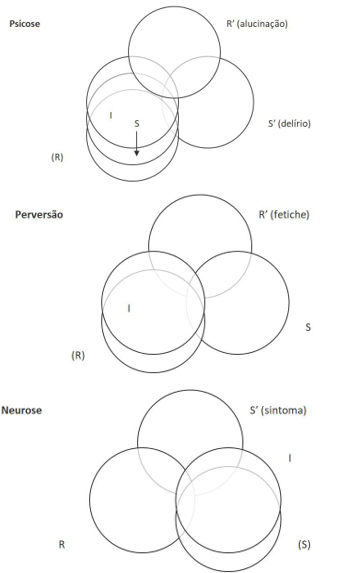
” Desire, which structures us as human beings and induces us to seek life throughout our existence, is “transmitted” to us in the Other’s desire, the desire of the one who once desired us (before our generation, by our parents) and who later “looked” at us with a look of possibilities to live and be happy. This initial, structural desire, launched by the Other, is what we call, in psychoanalysis, love, love of structure. Juranville (1987) differentiates the struc-tures neurosis, psychosis and perversion, with regard to desire and love of structure [8]:
The psychotic does not give, does not want the relationship with the Other, who would suppose that he would enter into cas¬tration. “Psychosis”, says Lacan, “is a kind of failure as far as the realization of what is called ‘love’ is concerned.” In it, the subject wants absolute jouissance, which he actually knows at the level of his body. Hence his narcissism. [...] [In perversion] it is given only to the symbolic Other, essentially absent from the world. All human “others”, including the subject himself, are instruments of jouissance for this Other. [...] The neurotic therefore needs a supplementary symbolic, that is, the symptom, where the desire remains repressed [8].
In topological terms, based on the Borromean node proposed by Lacan, Juranville elaborates the three structures in this way:
To love is to see in the other the desire for me that constitutes me. But it’s a decoy, because what I actually see is actually a reflection of my desire for the other. Socrates, in the voice of Plato, in The Banquet, using Diotima as an interlocutor, says that to love is to desire what you still don’t have, what you lack, what you want to keep with you. Love is love of something. Love is the desire for what is good and to be happy, it is the desire for immortality.
Unlike Plato, who conceives of love as movement, drive, life, desire for something, search for something, Schopenhauer found the a priori manifesting itself in the Will. As Dumoulié (2005) puts it, our knowledge is enclosed in the world of phenomena, therefore of representation, but we have immediate intuition through our body, the intimate essence of beings and the world [4]. For Schopenhauer, who was influenced by Plato and Kant, the world is a phenomenon, it is representation. The Will would be in a world of ideas – platonic -, in an idealized, superior, un-reachable world, which can only be symbolized. The Will, how-ever, is not external, for Schopenhauer, it is in us:
The thing itself, which we cannot know from the outside, we reach it directly from the inside, as it is in us. This Will, of which the human will is but a manifestation, is a metaphysical prin-ciple, the mainstay of all that it is. [...] The expression “thing in itself” must be understood in the most concrete way, as an almighty Thing that inhabits each one of us, that makes us live and devours us at the same time. In essence it is a raw, blind and insatiable desire [4].
Schopenhauer states that, if desire is born out of lack, its ori-gin is suffering. Both at the origin and at the end, according to Schopenhauer, desire is always suffering; and as he is the very essence of existence, “suffering is the foundation of all life.” Schopenhauer presents himself as the first philosopher who ad-dressed the theme of love until then abandoned by poets. Only Plato, before him, would have addressed this question. The basis of Schopenhauer’s “metaphysics of love” is “physics”. As a pre-cursor of psychoanalysis, he states that all passion is rooted in the sexual instinct or is an individualized sexual instinct: “What we believe to be our desire is only the manifestation of the Thing in itself, infinite, blind, and that aims for nothing else except the perpetuation of the Will for the procreation of species” [4].
For Lacan, desire is the desire of the Other. I know nothing of my desire, except what the Other reveals to me. Thus, the object of desire is the object of the Other’s desire. Through the Oth-er’s Gaze, my desire is constituted. It is through this Gaze that I constitute myself, as a subject. J.-D. Nasio states that “a related definition of desire is given to us: desire is, above all, a sequel to this constitution of the I in the Other”(1995), held at the Estádio do Espelho.
Lacan opposed us a philosophy of desire to a biology of pas-sions, but he used a philosophical discourse to conceptualize the Freudian view, which he considered insufficient. Thus, he estab-lished a link between desire based on recognition (or desire for the desire of the other) and unconscious desire [...] Through the Hegelian idea of recognition, Lacan introduced, between 1953 and 1957, a third term, to which he gave the demand name. This is addressed to someone else and apparently focuses on an ob¬ject. But this object is inessential, since the demand is the de¬mand for love. [...] Need, of a biological nature, is satisfied with a real object (food), while desire [...] is born from the distance between demand and need.
Thus, it seems to me that ethics and desire come into conflict when we think of postmodernity and times of structures: perver-sion and psychosis. Jacques Derrida (2001), similarly, in Psy-choanalysis’ Soul-States, points to the existence of an ongoing double resistance: one, from the world to psychoanalysis and the other, from psychoanalysis to itself as well as to the world, or that is, from psychoanalysis to psychoanalysis as being-in-the-world. Derrida detects, in psychoanalysis, a crisis. A crisis in relation to the role, the place of the analyst.
Derrida claims that the character of the analytic session would be revolutionary. What he criticizes, however, is that psycho¬analysis places itself in a superior position to the analysand, adopting an intellectualized posture, which intends to “nor-malize” the subject, instead of transforming his instincts, in the sense of desire.
The Thinker asks us about Psychoanalysis:
Psychoanalysis, I think, has not yet undertaken and, therefore, has even less managed to think, penetrate and change the axioms of ethics, legality and politics, especially in the seismic places where the theological ghost of sovereignty trembles and where the most traumatic are produced. geopolitical events, let us say, confusedly, the most cruel of these times. [...] It is above all there that the concept of cruelty [...] in psychoanalysis and beyond, calls for indispensable analyzes to which we should turn. [...] Psychoanalysis is indelible, its revolution is irreversible – and yet, as a civilization, it is deadly [6].
Derrida, then, questions whether there is a relationship between psychoanalysis and ethics, law and politics. And he answers that psychoanalysis, in itself, does not produce, nor cause, any ethics, law or policy, but it is a matter of responsibility, in these three domains, of taking psychoanalytic knowledge into account. If psychoanalysis does not produce, nor does it cause any ethics, what relationship is there between the analyst-analyst? How is the encounter between the psychoanalyst and the patient struc-tured? Isn’t transference configured from a pre-established eth¬ics between them?
If psychoanalysis does not take this mutation into account, if it does not engage in it, if it does not transform itself in this rhythm, it will be – and already is, to a large extent – deported, outdated, left by the side of the road, exposed to all drifts, to all appropriations, to all amputations; or else, conversely, she will remain rooted in the conditions of a time that was that of her birth, still aphasic in its Central European cradle [6].
Final Considerations
Such questions, along with others that will come during the course of the research, will be answered, or at least elucidated, broken down into others. At the end of this work, which will probably remain unfinished, always under construction, I intend to contribute to a possible reformulation of ideas and theories, which remained frozen during the course of psychoanalysis, from its origins in the late nineteenth century to post-modernity.
Therefore, (all these points are in progress) will be carried out: a) the Bibliographic Review of comparative literature among the main contemporary currents of applied ethics, drug addictions, psychoanalytic clinic, especially the Freudo-Lacanian clinic; b) the systematization of clinical analyzes carried out in the field of chemical dependencies based on clinical listening to drug ad¬dicts and their families, in work carried out with them, in Thera¬peutic Communities and Institutions for the care of drug addicts; c) the qualitative comparison of items a and b; and d) the theo-retical-conceptual elaboration of the results and possible appli¬cation of these concepts in psychoanalytic practice and in public policies, linked to applied ethics and the clinic of drug addiction
References
- Melman Charles (1992) Alcoolismo, delinqüência, toxicomania: uma outra forma de gozar. São Paulo: Escuta.
- Kristeva, Júlia (1987) No princípio era o amor. São Paulo: Brasiliense.
- Roudinesco, Elisabeth (2002) A família em desordem. Rio de Janeiro: Zahar.
- Dumoulié Camille (2005) O desejo Petrópolis: Vozes.
- Lacan, Jacques (1998) O seminário 7: a ética da psicanálise. Rio de Janeiro.
- Derrida Jacques (2001) Estados-da-alma da psicanálise. São Paulo: Escuta.
- Rajchman Jonh (1993) Eros e Verdade – Lacan, Foucault e a questão da ética. Rio de Janeiro: Zahar.
- Juranville, Alain (1987) Lacan e a Filosofia. Rio de Janeiro: Zahar.
- Associação Psicanalítica De Porto Alegre (2003) A direção da cura nas toxicomanias. Porto Alegre: APPOA.
- Birman Joel (2005) Mal-estar na atualidade: a psicanálise e as novas formas de subjetivação. Rio de Janeiro: Civili-zação Brasileira.
- Deleuze, Gilles, GUATTARI, Félix (1966) O Anti-Édipo: capitalismo e esquizofrenia. Lisboa: Assírio e Alvim.
- Ferreira, Nadiá Paulo (1995) Tóxicos e manias: o mal-estar na contemporaneidade. Rio de Janeiro UERJ.
- Freud, Sigmund (1976) Edição stantart brasileira das obras psicológicas completas. Rio de Janeiro: Imago.
- Fuks, Lúcia Barbero, Ferraz, Flávio Carvalho (2000) A clínica conta histórias. São Paulo: Escuta.
- Jacques Lacan (1966) Écrits Seuil.
- Magno (1980) O porre e o porre do Quincas Berro D’Água. Rio de Janeiro Aoutra.
- Charles Melman (1991) Clínica psicanalítica: artigos e con-ferências. Salvador: Ágalma.
- Nasio (1995) Introdução às obras de Freud, Ferenczi, Grod-deck, Klein, Winnicott, Dolto, Lacan. Rio de Janeiro: Zahar.
- Nogueira Filho, Durval Mazzei (1999) Toxicomania. São Paulo: Escuta.
- Platão (1991) O Banquete (Coleção Os Pensadores). São Paulo: Nova Cultural.
- Rinaldi Doris (1996) A ética da diferença: um debate entre psicanálise e antropologia. Rio de Janeiro: Zahar.
- Elisabeth Roudinesco (2007) Filósofos na tormenta. Rio de Janeiro: Zahar.
- Plon, Michel (1998) Dicionário de psicanálise. Rio de Janeiro: Zahar.
- Santiago, Jésus (2001) A droga do toxicômano: uma parcei-ra cínica na era da ciência. Rio de Janeiro: Zahar.
- Schopenhauer, Arthur (2004) O mundo como vontade e rep-resentação. Rio de Janeiro: Contraponto.