

International Journal of Women's Health Care(IJWHC)
ISSN: 2573-9506 | DOI: 10.33140/IJWHC
Impact Factor: 1.011

Research Article - (2021) Volume 6, Issue 2
Client Satisfaction with Contraceptive Counseling and Associated Factors in Public Health Institutions: A Cross-Sectional Study Design
2Leul Deribe, School of Nursing and Midwifery, College of Health Sciences, Addis Ababa University, Ad, Ethiopia
Received Date: Mar 12, 2021 / Accepted Date: Mar 23, 2021 / Published Date: Apr 01, 2021
Copyright: ©Jembere Tesfaye, et al. This is an open-access article distributed under the terms of the Creative Commons Attribution License, which permits unrestricted use, distribution, and reproduction in any medium, provided the original author and source are credited.
Citation: Getahun Tesfaye, Leul Deribe, Jembere Tesfaye. (2021). Client Satisfaction with Contraceptive Counseling and Associated Factors in Public Health Institutions: A Cross-Sectional Study Design. Int J Women's Health Care, 6(2), 144-150.
Abstract
Objective: The main objective of the study was to assess client satisfaction with contraceptive counseling and associated factors among women attending the family planning clinics in Asella town public health institutions, Ethiopia. Methods: Study subjects were selected using systematic random sampling and data were collected using interviewer administered and entered into software for analysis. Multivariate logistic regression model was used to predict the relation between variables and a significant of statistics was assured using 95% CI and p value < 0.05 was considered as significant predictor.
Results: This study revealed that 62.8% of the study respondents were satisfied with contraceptive counseling. Multiple logistic regression models showed that, being urban in residence, time taken to reach nearby health facility, being asked reproductive history, explained side effects, privacy ensured, asked worries and concern about the method and use of the leaflet were predictors associated with client satisfaction with contraceptive counseling.
Conclusions: About 62.8% of clients were satisfied with contraceptive counseling. Being urban in residence, time taken to reach nearby health facilities, explains side effects, being asked reproductive history, worries and concern about the method and use of the leaflet were factors associated with client satisfaction with contraceptive counseling.
Keywords
Contraceptive, Counseling, Family Planning, Satisfaction, Public, Ethiopia
Introduction
Family planning (FP) saves lives of women and children and im- proves the quality of life for all and it is one of the best invest- ments that can be made to ensure the health and well-being of women, children, and communities (Federal Ministry of Health, Ethiopia 2011) by decreasing maternal mortality and improves women’s health through preventing unwanted and high-risk preg- nancies and reducing the need for unsafe abortions. Some contra- ceptives also improve women’s health by reducing the likelihood of disease transmission and protecting against certain cancers and health problems [1,2].
One principal determinant of uptake and continued utilization of family planning services is overall client satisfaction with those services [3]. Satisfaction is one of the factors that influence the use of FP and other reproductive health services [4]. Women who re- ported had received contraceptives counseling was more satisfied with their method [5].
World Health Organization (WHO) recommends offering evi- dence-based, comprehensive contraceptive information; educa- tion and counseling to ensure informed choice for all women who need the services [6]. According to Turkish Demographic health survey (DHS) 2013, 33% of all women use a modern contracep- tive method [7]. United nation population fund agency (UNFPA) DHS analysis from 24 countries in 2016, showed contraceptive prevalence and side effect counseling in Honduras, Senegal, Ken- ya and Ethiopia was 64&49, 22&81, 53&60 and 27&33 respec- tively which is low especially in Ethiopia [8]. To increase modern contraceptive prevalence rates and decrease discontinuation rates, contraceptive counseling is crucial and helps clients to obtain the information they need to use contraceptive methods correctly and thereby decrease the likelihood that they will discontinue use of the method and decrease unmet need of family planning [9,10,11].
Effective contraceptive counseling empowers people to exercise their right to good quality family planning care [12]. Providing quality education, counseling and medical services related to fam- ily planning can lead to improved reproductive health outcomes [13,14]. These all facts suggest the need to reorient and refocus the contraceptive counseling to offer a tailored approach to meet indi- viduals’ needs of clients. Therefore, the study intended to examine client satisfaction with contraceptive counseling and client pro- vider -interactions as related to family planning services and bring into focusing the relevance to counseling and effective human re- lations to family planning in public health facilities in Asella town.
Material and methods
A cross sectional study design was conducted. All reproductive age group women living in Asella town and all reproductive age group women attending family planning clinics in Asella public health institutions considered as a study population. Moreover, women of reproductive age group attending the family planning clinic who are selected systematically for proportionally allocated sample size were study unit.
The inclusion criteria were all women who came for family plan- ning service during data collection period and the exclusion crite- ria was women who were unable to hear and speak, seriously ill and unable to respond and were not volunteer to be interviewed. The sample size was calculated by using single population propor- tion formula with the assumptions: proportion of client satisfaction with contraceptive counseling was taken to be 50% at significant level α= 0.05, 95% confidence interval, margin of error 5% and 10% non-response rates.
Since no previous research has been done in the study set-up, it was assumed that 50% of women would be satisfied with contra- ceptive counseling. By adding 10% non-response rate, a total of 422 clients were recruited as study units among women attending clinics in public health institutions in the town during study period. In this study, all public health institutions in Asella town were se- lected (one hospital and two health centers). The average monthly family planning flows of consecutive three months was estimated to be 729 (200 for Asella Hospital, 215 for Asella health center and 314 for Halila health center). Then, the final sample size was pro- portionally allocated to these health facilities by considering their monthly client flows. Lastly, subjects were taken by systematic random sampling (i.e. Kth= N /sample size) =>729 /422 ≈ 2 which means Kth= 2), thus every 2nd client who came for FP service was recruited as study units in each health facilities until the total sample size for this study was obtained. This study has dependent variable (Client satisfaction with contraceptive counseling) and in- dependent variables (sociodemographic characteristic of individu- al, client related, facility related and provider related).
Data was collected using interviewer administered standardized and pretested questionnaire which was modified from The Johns Hopkins School of Public Health Center for Communication Pro- grams IEC Research Tools [15]. This tool was first prepared in English, then translated to Afan Oromo (local language), and then retranslated back into the English language by experts to evaluate its consistency. The collected data were checked for complete- ness and entered into Epi-info version 3.5. 4 and the analysis was made with Statistical Package for Social Science (SPSS) versions 20. Descriptive summaries were used to describe the study vari- ables and variables (p <0.25) detected at bivariate level and those deemed to be important were subsequently entered into multivar- iate logistic regression model to control for possible confounding variables, to examine association and to produce crude and ad- justed odds ratio along with their corresponding confidence limits (95% CI) and a p-value less than 0.05 were considered to be sta- tistically significant.
Ethical Approval or Informed Consent Statement
Ethical approval of the study was obtained from Addis Ababa University Institutional Review Board Committee of College of Health Sciences. Authorization was obtained from Health Bureau of Asella City Administration and Directors of all health facilities. All the information given by the respondents has been used for research purpose only. Participants’ privacy and confidentiality of the information were maintained by the declaration of Helsinki
Results
Socio Demographic Characteristics of Respondents
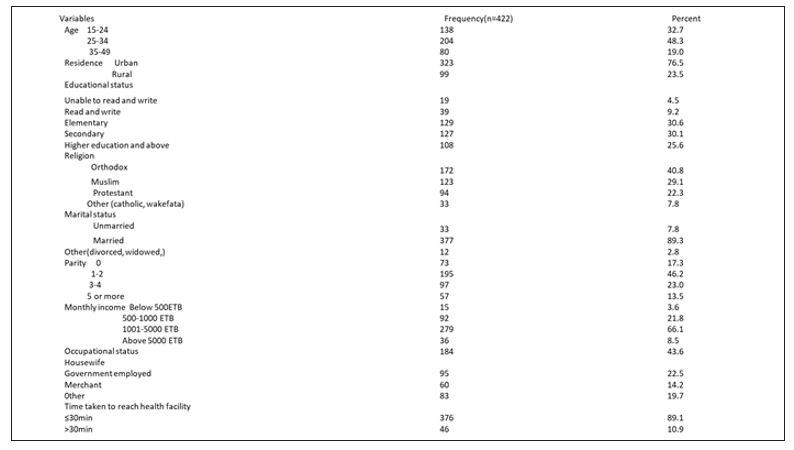
A total of 422 women attending family planning clinic were inter- viewed making response rate of 100%. The mean age of the moth- ers was 27.64 with standard deviation of 6.29 years. The average household income of the clients was about 90USD (2678ETB). The respondents have two alive children in average as indicated below Table 1.
Response of Clients On Rapport Building of Health Care Provider
None of the client reported that the provider introduced self and greeted them in respectful manner while 100% of them report they were given a seat and assured comfort. Out of 422 respondents, 392(92.9%) of them report they were addressed respectfully and 88.2% of them said privacy and confidentiality was assured.
Response of Clients On What They Were Asked by Health Care Provider
Provider asked if clients were concerned about using a modern family planning method in only 45(10.7%) cases, 74.2% clients did not give previous history, 55.7% were asked about breastfeed- ing, 18.0% asked about having children in the future, 35.5% knew about contraceptive and 90.8% were interested to use any contra- ceptive methods.
Response of Family Planning Clients On What They Were Helped by Health Care Provider
Out of 422 family planning clients, 322(76.3%) of them were asked what worried them about using a modern family planning method. About half (49.8%) of respondents reported health care provider explained their results of physical examination and 178(42.2%) of respondents said health care provider encourage them to partici- pate in choosing a method. Response of Family Planning Clients On What They Were Explained by Health Care Provider Only 23.2% of respondents said that health care provider explained possible side effects of the method as depicted on Table 2.
Table 2: Response of Family Planning Clients On What They Were Helped by Health Care Providers in Asella Town, 2018
|
Variables |
Response |
Frequency |
Percent |
|
|
Encourage you to participate in choosing a method |
No |
322 |
76.3 |
|
|
Yes |
100 |
23.7 |
||
|
Acknowledge and respond to |
No |
0 |
0 |
|
|
clients’ concerns, if any |
Yes |
0 |
0 |
|
|
|
NA |
422 |
100 |
|
|
Discuss the reasons that some methods might not be appropri- ate for clients |
No |
400 |
94.8 |
|
|
Yes |
22 |
5.2 |
||
|
Explain the results of physical examination |
No |
212 |
50.2 |
|
|
Yes |
210 |
49.8 |
||
|
Ask what worried you about using a modern family plan- ning method |
No |
113 |
26.8 |
|
|
Yes |
309 |
73.3 |
||
|
Were you recommended any of the methods |
No |
244 |
57.8 |
|
|
Yes |
178 |
42.2 |
||
|
Did you choose a method today |
No |
23 |
5.5 |
|
|
|
Yes |
399 |
94.5 |
|
|
Were you given your chosen method today |
No |
25 |
5.9 |
|
|
Yes |
397 |
94.1 |
||
|
Health reasons |
2 |
8 |
||
|
The main reason you do |
Method not available |
10 |
40 |
|
|
not given your chosen |
||||
|
Method never available |
2 |
8 |
||
|
method(n=25) |
||||
|
Out of stock |
2 |
8 |
||
|
The main reason you do |
Told to return during menses |
4 |
16 |
|
|
not given your chosen |
||||
|
Told to talk to partner |
5 |
20 |
Response of Family Planning Clients On What They Were Recommended by Health Care Provider
Out of total respondents, 398(94.3%) of them reported they were scheduled for a follow-up appointment while 61.8% of them were told to come back if there is any problem even before the appoint- ment. Fifteen (3.6%) of them said they were referred for further family planning services.
Response of Family Planning Clients On Interpersonal Commu- nication Skills of HCP and Use of Materials During Consultation Regarding to interpersonal communication about 4.7%, 6.4%, and 6.2%, clients responded, as they did not get politely treatment, heard jargon words and not ensured privacy. Service provider use flip chart, poster and contraceptive samples in 17.8%, 12.3% and 57.1% respectively. Only 5.7% of the health care providers used anatomic model during contraceptive counseling.
Satisfaction with Contraceptive Counseling
Satisfaction with contraceptive counseling was assessed using structured & standardized questionnaire containing nine satisfac- tion questions. Overall 62.8% of women attending family planning clinics in Asella governmental health institutions were satisfied with contraceptive counseling.
Factors Associated with Client Satisfaction of Contra- ceptive Counseling
Independent variables which had a p value of less than 0.25 in bivariate analysis (residence, time taken to reach nearby health facility, address clients respectfully, asking reproductive history, asking breastfeeding status, ask worries and concern, using visual aid during consultation, explaining possible side effects treating clients politely, using words client can speak and understand, en- suring privacy and use of leaflets during consultation were signifi- cantly associated with satisfaction with contraceptive counseling) were entered to multivariate analysis to assess the association of each independent variable with satisfaction of contraceptive coun- seling. After controlling the confounding factors, the multivariate model revealed that residence, time taken to reach nearby health facility, asking reproductive history, explain possible side effects, ensuring privacy, asking worries and concern and use of leaflet during consultation were significantly associated with client sat- isfaction with contraceptive counseling. Accordingly, clients who came from urban were 2 times more likely (AOR= 1.93, 95%CI (1.09-3.41) satisfied with contraceptive counseling compared with those who came from urban area.
The odds of reporting satisfaction were higher among clients who reached health facility at less than 30 minutes to receive care as compared with clients who had reached health facility more than 30 minutes (AOR= 2.2, 95%CI (1.06- 4.49). Clients who were asked reproductive history were 2 times more likely (AOR=1.92, 95%CI (1.06-3.47) satisfied with contraceptive counseling com- pared with their counterparts. The odds of reporting satisfaction is higher among clients who get a clear description of the side effects of the method as compared to their counterparts (AOR- =0.41;95%CI(0.22- 0.77).Clients whose privacy was not ensured had 88% fewer odds of satisfaction with the family planning counseling as compared to those who were ensured with priva- cy[AOR=0.12,95% CI(0.02-0.68).Women were more likely to be satisfied when the provider asked about their concerns and worries about family planning methods (AOR=2.41, 95%CI (1.27- 4.56) than those who were not asked. Clients who did not use leaflet had 59% fewer odds of satisfaction with family planning counsel- ing than those who had used leaflet on family planning counseling [AOR = 0.41; 95% CI: (0.19-0.86) as shown Table 3.
Table 3: Factors Associated with Client Satisfaction with Contraceptive Counseling in Multivariate Analysis in Asella Town, 2018
|
Variable |
Satisfied |
Dissatisfied |
COR(95%CI) |
AOR(95%CI) |
|
Residence Urban |
51(51.52) |
48(48.48) |
1.85(1.17-2.92) |
1.93(1.09-3.41)** |
|
Rural |
214(66.25) |
109(33.75) |
1 |
1 |
|
Time to reach H/F ≤30min |
132(84.1%) |
25(15.9%) |
2.2(1.19-4.08) |
2.18(1.06-4.49)** |
|
>30min |
244(92.1%) |
21(7.9%) |
1 |
1 |
|
Reproductive History Yes |
57(52.3%) |
52(47.7%) |
1.80 (1.16-2.82) |
1.92(1.06-3.47)** |
|
No |
208(66.5%) |
105(33.5%) |
1 |
1 |
|
Explain side effect Yes |
71(72.4%) |
27(27.6%) |
0.57(0.35-0.93) |
0.41(0.22-0.77)** |
|
No |
194(59.9%) |
130(40.1%) |
1 |
1 |
|
Privacy ensured Yes |
262(66.2) |
134(33.8%) |
1 |
1 |
|
No |
3(11.5%) |
23(88.5%) |
.07(.020-0.226 ) |
0.12(.02-0.68) ** |
|
Worries and concerns Yes |
178(57.6%) |
131(42.4%) |
.463(1.51-4.03) |
2.41(1.27-4.56)** |
|
No |
87(77.0%) |
26(23.0%) |
1 |
1 |
|
Used leaflet Yes |
49 (79.0%) |
13 (21.0%) |
1 |
1 |
|
No |
216(60.0%) |
144(40.0%) |
0.40(0.208-0.76) |
0.41(0.19-0.86)** |
Keys: **Statistically significant at p<0.05 in multivariate, OR=crude odd ratio, OR= adjusted odd ratio
Discussion
The findings of this study revealed that 62.8% of women attending family planning clinics in Asella governmental health institutions were satisfied with contraceptive counseling. This finding is in line with study done in Ethiopia [16]. In this study, only 23(2.0%) of clients reported side effects were explained by health care provid- er. This finding is lower than study result found in Namibia [17]. This inconsistency may be due to difference in sociodemographic characteristics of the respondents, sample size and time of study conducted. In this study, 93.8% of clients reported their privacy `was maintained which is similar with study conducted in Rwanda [18].
In this study, Family Planning poster was noticed only by 12.3% of all interviewed women which is inconsistent with study result in Ibrid Jordan [19]. This inconsistency may be due to difference in sociodemographic characteristics of the health care provider, shortage of counseling aid and poor counseling technique in this study.
In this study, none of the client reports that health care provider in- troducing themselves to them. This result is consistent with study finding in Egypt and about 94.3 % health care provider schedules follow up [20]. Majority of clients had been told when to return to the facility for method resupply, which is consistent with study conducted in urban Kenya [21].
Clients who took shorter time to reach a facility had a higher odds of satisfaction (OR=2.18, 95% CI=1.06-4.49) than their counter- parts. This finding is consistent with research conducted in Gondar and Hossana town [16,22].
Clients for whom possible side effects explained were less likely (AOR=0.41, 95% & CI=0.22- 0.77) satisfied with contraceptive counseling. This finding is in line with the study conducted in southern Ethiopia [16]. Clients whose privacy was not maintained during examination and procedure were less likely satisfied than those who reported their privacy was maintained. This finding is in line with study conducted in Hosanna town public health facility [23].
This study revealed that clients who were asked about reproduc- tive history by health care provider were almost two times more likely (AOR=1.92, 95% CI 1.06-3.47) satisfied with contraceptive counseling than their counter parts which is supported by study conducted in Kenya and Ethiopia [22,24]. Being rural in residence had a higher odds of satisfaction in this study (OR=1.93, 95%CI= 1.09-3.41). This is consistent with study conducted in Benishangul Gumuz, Ethiopia [25]. Women were more likely to be satisfied when the provider asked about their concerns and worries about family planning methods (AOR=2.40, 95%CI= 1.27- 4.56) than their counterparts which is supported by study result found in Ad- dis Ababa [26]. Clients who did not use leaflet had 59.0% fewer odds of satisfaction with family planning counseling than those who had used leaflet on family planning counseling (AOR=0.41; 95% CI (0.19-0.86) which is consistent with the study result in Kenya and Ethiopia [11,16].
Acknowledgements
The authors would like to acknowledge the contributions of re- search assistants, Addis Ababa University, Health Bureau of Asel- la City Administration, Directors of all health facilities and study participants during data collection.
References
- Ministry of Health (2011) Ethiopia. National Guideline forFamily Planning Services in Ethiopia 1-65.
- World Health Organization (WHO) (1985) Health benefits offamily planning.
- Hutchinson PL, Do M, Agha S (2011) Measuring client satis- faction and the quality of family planning services: A compar- ative analysis of public and private health facilities in Tanza- nia, Kenya and Ghana. Comparative Study 11: 203.
- Chavane L, Dgedge M, Bailey P, Loquiha O, Aerts M, et al. (2017) Assessing women’ s satisfaction with family planning services in Mozambique. J Fam Plann Reprod Health Care 43: 222-228.
- Luiza A, Borges V (2017) Satisfaction with the use of contra- ceptive methods among women from primary health care ser- vices in the city of São Paulo, Brazil. Rev. Bras. Saude Mater. Infant 17: 749-56.
- Oda S, Chen W, Kitazawa M (2008) BREW implementation of a mobile phone-based monitor for women’s healthcare. Proc IEEE/EMBS Reg 8 Int Conf Inf Technol Appl Biomed ITAB 288-291.
- Hacettepe University Institute of Population Studies (2013) Turkey Demographic and Health Survey 2014. 371.
- Loaiza E, LiangM, SnowR (2016) INFORMED CHOICE- FOR MODERN CONTRACEPTIVE USE: Evidence from 24countries served by the UNFPA Supplies Programme.
- ACQUIRE Project N (2008) THE ACQUIRE PROJECT toUSAID.
- Gavin L, Moskosky S (2014) Providing Quality Family Plan- ning Services. CDC US off Popul Aff 63: 1-55.
- Survey H. Kenya (2014) Assessment of Family Planning Ser- vices 4.
- Yadav D, Dhillon P (2015) Assessing the impact of family planning advice on unmet need and contraceptive use among currently married women in Uttar Pradesh, India. PLoS One 10: 1-16.
- Family Planning and Reproductive Health Manual 2017.
- Assaf S, Wang W, Mallick L (2017) Quality of care in family planning services in Senegal and their outcomes. BMC Health Serv Res 17: 346.
- KimYM, Ed D, Lettenmaier C (1995) Tools to Assess FamilyPlanning Counseling: Observation and Interview.
- Daniel Wogu, Tsegaye Lolaso, Mengistu Meskele (2020) Client Satisfaction with Family Planning Services and Asso- ciated Factors in Tembaro District, Southern Ethiopia. Open Access Journal of Contraception 11: 69-76.
- Nelumbu P, Amakali K, Kathë Hofnie-Hoëbes (2016) Appli- cation of elements of the informed choice of modern contra- ceptives among reproductive aged women in the Khomas re- gion of Namibia. Journal of Nursing Education and Practice 6: 130-138.
- Findings K (2012) Examining the Influence of Providers on Contraceptive Uptake in Rwanda 98-101.
- Kamhawi S, Underwood C, Murad H, Jabre B (2013) Cli- ent-centered counseling improves client satisfaction with family planning visits: evidence from Irbid, Jordan. Glob Heal Sci Pract 1: 180-192.
- Nasr EH, Hassan HE (2016) Association between quality of family planning services and client’s satisfaction level in ma- ternal and child health centers in Port Said city. Journal of Nursing Education and Practice 6: 85-99.
- Tumlinson K, Pence BW, Curtis SL, Marshall SW, Speizer IS (2015) Quality of care and contraceptive use in urban Kenya. Int Perspect Sex Reprod Health 41: 69-79.
- Agha S, Do MAI (2009) The quality of family planning ser- vices and client satisfaction in the public and private sectors in Kenya. Int J Qual Health Care 21: 87-96.
- ArgagoTG, HajitoKW, KitilaSB (2015) Client’s satisfaction with family planning services and associated factors among family planning users in Hosanna Town Public Health Facili- ties, South Ethiopia: Facility-based cross-sectional study. Int J Nurs Midwifer 7:74-83.
- Zenebe K, Mekonen B (2014) Utilization and Associated Fac- tors of Modern Contraceptive among Women Attending Art Clinics in Gondar Town, North west Ethiopia: Institutional Based Cross Sectional Study 2: 1896-1899.
- Amentie M, Abera M, Abdulahi M (2015) Utilization of Fam- ily Planning Services and Influencing Factors Among Women of Child Bearing Age in Assosa District, Benishangul Gumuz Regional State, West Ethiopia. Science Journal of Clinical Medicine 4: 52-59.
- Teshome A, Birara M, Rominski SD (2017) Quality of family planning counseling among women attending prenatal care at a hospital in Addis Ababa, Ethiopia. Int J Gynaecol Obstet 137: 174-179.