

Journal of Geology & Mining(JGM)
ISSN: 3066-4950 | DOI: 10.33140/JGM

Research Article - (2024) Volume 1, Issue 1
Chemical Heterogeneity of Garnet in Eclogite-Blueschist Complexes
2Adyshev Institute of Geology National Academy of Sciences of Kyrgyz Republic, Russia
Received Date: Nov 04, 2024 / Accepted Date: Dec 19, 2024 / Published Date: Dec 30, 2024
Copyright: ©©2024 V. V. Fedkin, et al. This is an open-access article distributed under the terms of the Creative Commons Attribution License, which permits unrestricted use, distribution, and reproduction in any medium, provided the original author and source are credited.
Citation: Fedkin, V. V., Kotova, L. S. (2024). Chemical Heterogeneity of Garnet in Eclogite-Blueschist Complexes. J Geol Min, 1(1), 01-13.
Abstract
In mafic eclogite-blueschist complexes, the unique properties of garnet were studied - to preserve its composition under conditions of a changing metamorphism regime and to record these changes in the process of their development. In the key paragenesis with omphacite, plagioclase, and quartz, garnet, within the limited space of one sample and even one grain, is able to record multidirectional and opposite trends in changes in metamorphism parameters. The studies were carried out on two known complexes of mafic eclogites, similar in origin, but contrastingly different in terms of formation conditions: the Maksyutov (Southern Urals) and Atbashi (Southern Tien Shan) eclogite-blueschist complexes. For the deeper Maksyutov complex, a 4-stage RT trend of its retrograde development from the stability field of ultrahigh-pressure (SHB) minerals (diamond and coesite) to low-temperature diaphthoresis of the greenschist facies (T=870-310°C, P=3.5-0, 6 GPa). For the less deep Atbashi complex, a one-stage prograde-retrograde development trend was recorded within T=300-650°C and P=8-13 GPa. In parallel, in the same complexes, a study was carried out and the conditions for the formation of contrasting series of rock - high-pressure eclogite inclusions (of boudins, blocks, interlayers and lenses) in the strata of weakly metamorphosed metasedimentary rocks were identified. It has been established that the processes of tectonic mélange and coherent development of the host matrix are independent stages of a single process of metamorphic evolution of the complex. In the multi-stage history of the Maksyutov terrane, they are separated in time, but sometimes they repeat in the form of a cycle at different stages of development. In the one- act Atbashi eclogite-blueschist complex, both processes proceed sequentially in the same key of metamorphic evolution.
Keywords
Composition and Zoning of Minerals, Garnet-Pyroxene Geothermobarometry, Tectonic Mélange, Coherent Development, Maksyutov Complex, Atbashi Complex, Crustal Mafic Eclogites, Contrasting Series of Rock
Introduction
In metamorphic petrology, garnet is one of the most important minerals for assessing the physicochemical parameters of mineral formation and the conditions of formation of metamorphic complexes. On its basis, a whole series of mineralogical geothermometers, geobarometers, indicators of the activities of volatile components have been developed, programs and complexes of mutually consistent thermodynamic databases have been created for studying the corresponding properties of minerals, PT parameters of geological processes and phenomena [1-18]. Due to its ability to change its composition under the influence of physicochemical conditions of formation and to maintain these changes in equilibrium with other minerals for a long time, garnet is widely used as a sensitive mineralogical sensor for assessing the thermodynamic parameters of a wide variety of natural systems and processes [2,4,9,14,16-24,]. Its role is especially great in the study of crustal eclogite complexes, where in association with pyroxene, plagioclase and quartz it is, in fact, the only reliable tool for determining the parameters of mineral formation during the development of the complex. In this regard, the task was set to evaluate the petrological properties and capabilities of garnet and minerals coexisting with it as a sensitive and accurate RT sensor of HP/UHP mineral formation for studying the conditions of formation of crustal mafic eclogites.
Theoretical Framework
The study of chemical heterogeneity of garnet, its composition and zoning were carried out on the basis of the garnet-pyroxene paragenesis Grt+Cpx+Pl+Qtz – the main information source of the conditions of formation of high-pressure mineral associations. Garnet in this equilibrium is of key importance, since it has a unique ability to retain its original composition, changing it in new grains, growths and substitutions during the evolution of metamorphism. The associated change in its composition with other phases of the eclogite association allows us to reconstruct the direction and parameters of metamorphism at different stages of the complex development throughout the temperature and pressure range of its existence, restoring the PTt history of its formation.
Petrological Aspects of The Study
The task of studying the possibilities and properties of garnet for assessing the PT parameters of crustal eclogite formation is considered against the background of solving the petrological problem of the origin in the EBSC of contrasting series of high- pressure eclogite rocks in the thickness of a weakly metamorphosed matrix. The formation of contrasting rock series in the EBSC has been studied for over 20 years but remains controversial. Its essence is how rock series with contrasting metamorphic levels can form and exist for a long time in the EBSC [25-29]. As a rule, these are eclogite bodies, boudins, interlayers, and lenses included in the metasedimentary or granitoid strata of host rocks with different metamorphic levels. Boudins and large eclogite bodies are traditionally considered as a product of tectonic mélange, while their interlayers and lenses in the interbedded host rock series are considered coherent formations with a lower degree of metamorphism and diaphthoresis. The causes of the origin and conditions of co-occurrence of contrasting rock series are not yet fully understood and are the subject of active discussions. There are two points of view to explain this phenomenon: the tectonic mélange model - TM model and the coherent formation model of layered strata - CU model [25-28]. The issue of the formation of contrasting rock series of the Atbashi complex was recently considered in the context of a study of the HP-UHP metaophiolite belt "Chinese Western Tien Shan", to the southwestern part of which it adjoins. Both models of the formation of such series were considered, but both remain controversial. Methods of mineralogical thermobarometry allow us to evaluate the significance of these concepts in the formation of these structures, to find out the causes of the origin of contrasting rock series, the conditions of their long-term coexistence, and to evaluate the significance and role of garnet in this process.
The objects of study were the known complexes of mafic eclogites that are similar in their origin, but differ in the physicochemical conditions of formation: the Maksyutov eclogite-glaucophane schist complex in the Southern Urals (MK) and the Atbashi complex in the Southern Tien Shan (AK). Both of them are part of the intracontinental Ural-Mongolian Hercynian fold belt system, were formed in a wide temperature range - 350-750 °C, but have differences in the depth of their origin: deeper for the Maksyutov complex - in the area of stability of coesite and diamond (at a peak pressure of 3.2 GPa), and less deep - in the area of stability of the Ab-Jd-Qtz paragenesis, (in the range of P = 1.2-1.9 GPa), - for the Atbashi complex.
The Maksyutov complex is located in the Main Ural Fault zone on the boundary of the Riphean strata of the Suvanyak complex in the west and the Kempirsay hyperbasite belt in the east. The complex was finally formed in the late Paleozoic, and isotopic dating of various rocks and minerals obtained by different methods gives an interval of the eclogite stage of metamorphism from 550 to 390-330 million years [2,30]. The age of the protolith is Riphean, the oldest dating shows 1.1-1.4 billion years. Mineral associations Ol-En, Qz-Jd, Law determine the level of metamorphism at P = 0.8-2.4 GPa and T = 400-700 °C and the known finds of quartz pseudomorphs after coesite graphite cuboids after diamond and diamond micro inclusions in garnet indicate peak metamorphic parameters at the early stage of the complex formation up to P = 2.8-3.2 GPa and even up to P = 3.1-3.4 GPa at T = 633-740 °C [4,31-37]. In the history of the complex formation, four stages of conjugate prograde-retrograde metamorphism were recorded with gradually decreasing parameters to the blue and greenschist facies: T = 310-520 °C and P = 0.6-1.2 GPa [18,20-22,38].
The Atbashi eclogite-glaucophane schist complex is confined to the most important tectonic boundary between the middle and southern Tien Shan. Detailed petrographic studies of eclogite- glaucophane and other associated rocks show that these rocks were formed under conditions of moderate pressure (up to 10-12 kbar) in the temperature range of 300-600 °C [14,39]. The age of metamorphism of the eclogite-glaucophane rocks of the complex is determined as 320-360 million years although there are older dates for the protolith - from 520-550 to 1100 million years [30]. Metamorphic parameters (T=350-650°C and P=4-12 kbar) for different mineral associations indicate several stages of mineral formation: a progressive stage for garnet-clinopyroxene rocks and eclogites, an inversion stage for garnet-glaucophane schists, and a retrograde stage of diaphthoresis for garnet-chlorite and mica schists and quartzites [24]. Progressive metamorphic processes and retrograde transformation of rocks (growth of glaucophane, muscovitisaion, carbonation, etc.) occur against the background of intense alkaline metasomatism and acid leaching.
Methodology
Phase Correspondence and Local Equilibrium Method
Thermobarometric studies of the parameters of metamorphism of eclogite associations were carried out by traditional methods of cation-exchange thermometry [13,15]. It is based on the principle of local (mosaic) equilibrium of Korzhinsky [1973], working under conditions of paragenetic compatibility of coexisting minerals. It is assumed that the centers of growing phases, their edges and mineral inclusions at different times of their crystallization are in a state of thermodynamic equilibrium. In such a situation, the compositions of equilibrium phases record the temperature conditions of successive stages of metamorphism and allow us to calculate the physicochemical parameters of their formation at each point of the existing paragenesis, trace the dynamics of their evolution based on grain zoning, and reproduce the reconstruction of the thermal history of these polymetamorphic rocks.
Microprobe Analysis Technique
The chemical composition of minerals, their heterogeneity and zoning were studied by the electron probe X-ray spectral analysis (EPXRSA) method at the D.S. Korzhinsky Institute of Experimental Mineralogy of the Russian Academy of Sciences. Microprobe analysis was carried out using a Tescan Vega II XMU scanning electron microscope (Tescan, Czech Republic) equipped with an INCA Energy 450 X-ray spectral microanalysis system with an energy-dispersive (INCAx-sight) X-ray spectrometer (Oxford Instruments, UK). Analysis conditions: accelerating voltage of 20 kV, current of absorbed electrons on Co of 0.3 nA, analysis time at a point of 70-100 s. Analytical lines and standards of the IEM RAS, applied in EPXRSA of minerals, were used [19]. All microprobe analyses of minerals used in the article were performed and processed by the author of this work in the Laboratory of Physical Research Methods of the IEM RAS.
Garnet-Pyroxene Mineralogical Thermobarometry of Mafites
In metabasin HPU/HP rocks, garnet and clinopyroxene are considered as the most informative and conservative phases for estimating the temperatures of mineral equilibria. Thermobarometric calculations of the parameters of metamorphism of eclogite associations were performed based on a microprobe study of the composition and zoning of coexisting phases and mineral inclusions in the paragenesis Grt + Cpx ± Pl + Qz using Powell's Grt-Cpx geothermometric and an improved Pl-Cpx-Qz geobarometer [10,16]. For low-temperature associations involving garnet and other Fe-Mg minerals, the Geopath program was used [13].
Thermobaric studies of eclogites and host rocks were conducted based on microprobe data on the composition and zoning of key rock-forming minerals - garnet, clinopyroxene and plagioclase. The microprobe was used to study the compositions of large porphyroblastic grains of contacting minerals and small newly formed crystals, grains with direct and reverse zoning, as well as all possible variants of inversion zoning.
In all studied samples, garnet is present in the form of large porphyroblast and in the form of smaller, often idiomorphic crystals in the main mass of the rock. Large porphyroblastic grains are fractured, usually destroyed, have unclear boundaries and fuzzy, vague outlines. They often contain numerous inclusions of quartz, epidote, sphene, rutile, and less commonly clinopyroxene and plagioclase, sometimes completely replaced by an association of secondary minerals, which in some cases fill the box-like or framework structures of the mineral. Such grains typically show retrograde zoning with higher temperatures in the central parts, while the compositions of the outer zones are close to that of the matrix garnet.
Garnet almost always has direct, reverse and inversion zoning, recording in its composition differently directed PT trends of metamorphic evolution. In some cases, traces of these processes are preserved in one sample or, what is more interesting, even in one garnet grain. Clinopyroxene in eclogite rocks is present in the form of small (0.1-0.4 mm) crystals of short prismatic appearance, sometimes making up to 40-55% of its main mass. It forms associations with glaucophane, epidote, chlorite, muscovite and quartz. Often at the edges it is replaced by glaucophane, chlorite or fine-grained aggregate of these minerals. Pyroxene inclusions in garnet do not differ in composition from matrix grains, which are also used to determine the PT parameters of Grt-Cpx-Ab- Qz equilibrium. In the rocks of the Maksyutov complex, the composition of clinopyroxene is close to omphacite and varies insignificantly within individual samples. At the contact with garnet at the edges of large porphyroblastic grains, in inclusions or in the main mass of the rock, its composition fluctuates within the range of XJd ~ 0.22-0.45 mol %, and within one grain does not exceed 0.3-0.35 mole fraction of the jadeite component. The analyzed omphacites from the Maksyutov eclogites are rich in the combined Eskola and Chermak component, which confirms the conditions of their high-pressure origin [38]. In the eclogites of the Atbashi complex, the range of clinopyroxene composition can reach XJd = 0.05-0.60 units of the jadeite component.
Plagioclase, used to estimate the pressure in the paragenesis Grt+Cpx+Pl+Qz, is usually present in relatively low-pressure rocks of the complex that have undergone retrograde secondary changes. Under the influence of metasomatic processes, it changes its composition, approaching albite XAb ~ 0.9-1.0. Usually, these are small non-twinned crystals (0.1-0.2 mm), which form the matrix of the rock together with chlorite, muscovite and quartz. Sometimes plagioclase grains are confined to spotted accumulations of secondary chlorite. Inclusions of plagioclase in large garnet grains significantly facilitate the task of interpreting the conditions of metamorphism during the formation of the rock.
Results of Study
Maksyutov EBS complex
The maximum parameters of metamorphism of the Maksyutov complex are determined by the presence of rocks with UHP mineral associations (including diamond and coesite) in its composition and at the early stage of development could reach T = 650-700 °C and P = 2.7-3.2 GPa [20,32,33,35,36,38]. Our studies and the latest data from Ural geologists [12,18,37]. confirm the top parameters of the initial stage of metamorphism: T = 800 → 900 ° C - at the prograde stage and T = 910 → 730 ° C at the retrograde stage at P = 3.5 GPa. The parameter intervals of the conjugate stages of prograde-retrograde metamorphism practically coincide and are preserved in the compositions of coexisting phases as a result of tectonic mélange - rapid removal and boudinage of eclogite bodies. The phenomena of tectonic mélange (eclogite boudinage) and coherent development of the host strata during the formation of the complex are repeated many times. Prograde and retrograde PT trends, constructed from the compositions of the Grt-Cpx-Pl- Qz paragenesis phases, form conjugate pairs characterizing the modes of individual stages (cycles) of the complex development. At least four such cycles have been recorded according to the data of microprobe studies of coexisting Grt and Cpx over 200 Ma of the complex development period (Table 1). Contrasting changes in the composition of garnet and minerals in equilibrium with it often occur in a very limited space of a single section, and sometimes even within a single grain. These unique properties of garnet to preserve traces of the initial PT conditions of its crystallization and simultaneously record all subsequent changes in the parameters of mineral formation make it possible to study in detail the features of pulsation processes of metamorphism, ultimately leading to the formation of contrasting series of rocks.
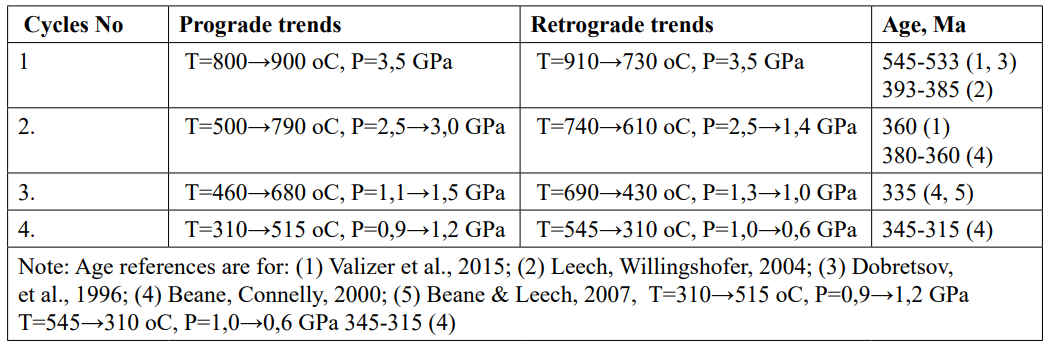
Table 1: Generalized RT Trends of Prograde-Retrograde Cycles Of Development Of The Maksyutov eclogite-blueschist complex (Fedkin, 2020).
The top parameters of the progressive and regressive stages of initial metamorphism turned out to be very close to each other: 800→900 °C and 910→730 °C, respectively, at P=3.5 GPa. These parameters were preserved in the compositions of coexisting phases as a result of tectonic mélange - rapid removal and boudinage of eclogite bodies. Subsequent processes of regressive and repeated progressive metamorphism occurred at lower parameters, reflecting the conditions of lower-level stages, down to 310-460 °C at P=1.1-1.5 GPa [20]. At the same time, garnet in high-pressure inclusions of eclogite rocks retains its original composition, recording the conditions of metamorphism at the early stages of the complex development. Garnet grains of different generations are often found even in one sample, and with changes in metamorphic conditions, the progressive zoning of garnet can change to regressive and back, forming inversion zoning.
In sample 216-1 (Fig. 1) from the eclogite lens (Karayanovo site), the central part of a large garnet grain retained traces of a regressive change in composition from Prp15Alm57Sps2Gros26 to Prp14Alm61Sps2Gros23, recording the PT conditions of the second stage of metamorphism (Table 1). It is separated from the outer zone by a rim of low-temperature minerals Chl+Gln+Mu+Pl+Qtz+Ilm, which may have shielded the crystal core from the impact of the changed conditions of the next stage. As a result, garnet with opposite progressive zoning from Prp19Alm58Sps1Gros20 to Prp26Alm60Sps2Gros12 was formed in the outer shell, which reflects the conditions of the next, prograde stage of development of the complex.

Figure 1: Garnet Porphyroblast in Grt-Cpx-Gln eclogite (Sample 216-1)
a — without analyzer, b — with analyzer, c — large garnet crystal with inversion zoning: regressive 695 °C/1.6 GPa→615 °C/1.4 GPa in the grain center and weakly progressive 630 °C/1.44 GPa→660 °C/1.46 GPa in the marginal zone. The grain structure reflects the sequential growth of garnet, its cyclic nature and mosaic nature of thermodynamic equilibrium. Figures – temperature (oC)/ pressure (GPa).
Thus, garnet, which originated in the eclogite rock under high- pressure conditions, after its ascent and possible boudinage, is preserved and continues to exist at the stage of coherent development of the complex. At the same time, its composition still preserves the parameters of previous events, despite the change in the direction (PT trend) of metamorphism.
A similar situation of multidirectional crystallization of garnet is recorded in the boudinage eclogites of the Antingan area. In sample 185b-1, the idiomorphic porphyroblastic garnet is relatively fresh, contains virtually no inclusions, and has weak fracturing parallel to the foliation of the rock (Fig. 2a). In equilibrium with clinopyroxene, it shows a prograde PT trend in the range of 473- 657 °C. In high-temperature rocks, at T> 620-660 °C, plagioclase is virtually absent, and the pressure of prograde grain growth could not be estimated. The same eclogite sample also contains more altered garnet grains. They are fractured, filled with inclusions of low-temperature minerals, including small grains of acid plagioclase (Pl0.95-Pl0.90), allowing us to estimate the value of equilibrium pressure. Fracturing in garnet crystals does not coincide with the foliation of the rock. Clusters of quartz, sphene and glaucophane in the form of curving streams flowing around porphyroblast create a shadow structure of drag, rotation and displacement (Fig. 2b). Garnet zoning in such grain’s changes to the opposite: 594→498 °C, which indicates the active impact of retrograde metamorphism on the rock and the transition from the stage of tectonic mélange to the process of coherent development of the complex in the range of PT parameters of the third prograde- retrograde cycle: T=470→660; 620→520 °C at P=2.0→1.5 GPa.

Figure 2: Prograde-retrograde garnet from an eclogite lens in the host Grt-Gln-Mu-Qz schist, sample 185b, Antingan area, Maksyutov complex: a – progressive garnet grain preserved as a result of tectonic mélange; b – garnet altered during the coherent development of the complex at the regressive stage of metamorphism.
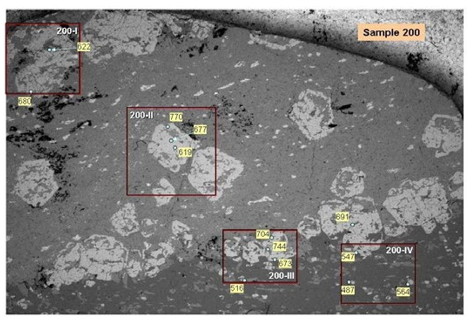
Figure 3: Multidirectional zoning of garnet in the eclogite interlayer in the member of host Grt+Cpx+Gln+Mu+Qz schists. The rectangles show individual areas of the microprobe survey. Numbers are the temperature (°C) according to Grt-Cpx equilibrium.
An illustrative example of typical garnet behavior and changes in its composition during the formation of contrasting rocks in the EGSC can be seen in the eclogite layer, in the pack of host Grt-Cpx-Gln-Mu-Qz schists (Fig. 3). In the eclogitic layer in the Grt-Cpx-Gln-Mu-Qz schist, garnet has multidirectional zoning. In its central part, progressive zoning of the initial stage of eclogite formation (622-680 °C) has been preserved in large destroyed garnet crystals. Moreover, the larger the garnet grain, the higher the upper temperature of the progressive zoning trend. As it moves toward the contact with the host rock, the garnet zoning changes to the reverse 770→677→619 °C, which gradually increases at the boundary with the matrix: 744→673, 691→547 °C, recording the regressive influence of the host complex. In some grains, one can observe the inversion zoning of garnet, which indicates the cyclic nature of the rock formation process at the coherent stage under quasi-equilibrium conditions. Low-temperature newly formed small garnet grains in the main mass of the host rock complete the process of retrograde development of the complex. They contain almost no inclusions and record relatively low prograde trends in the range of T ~ 490-565 °C.
It is characteristic that clinopyroxene in all areas of the eclogite interlayer and in the main mass of the host rock retains a stable composition within XJd=0.34-0.41, and only garnet zoning from Prp11.6Alm60.8Sps1.2Grs26.4 in the center to Prp21.4Alm64.6Sps2.4Grs11.6 at the edge records the maximum temperature spread (>280 °C) during the formation of this rock. Such a transformation of garnet and its composition occurs under the influence of new PT conditions of metamorphism at the coherent stage of rock development. It is evident that the relatively hot eclogite interlayer, cooling in the cold matrix, comes to equilibrium at T~500-550 °C upon contact with it, then continuing to coexist. In this case, garnet exists independently throughout the history of the rock development, sometimes dissolving and disintegrating in the center of the eclogite inclusion (section 200- I), sometimes recrystallize into large euhedral grains in the middle of the interlayer (section 200-II), sometimes forming new crystals in the rock matrix with a new zoning trend (section 200-IV).
Transitional forms of grains and their composition are clearly visible in section 200-III. Thus, the eclogite boudins, having ended up in the gneiss-schist mass as a result of tectonic mélange, was captured as an interlayer or lens and then, in the process of further joint existence at the stage of coherent development of the complex, underwent thermobaric transformations, recording all stages of its development in the garnet composition. The contrasting nature of the coexisting rocks (eclogite and schist) disappeared as soon as thermodynamic equilibrium was achieved between them. Thus, the formation of contrasting rock series - eclogite inclusions and the host gneiss-schist strata in the Maksyutov EBSC occurred both as a result of tectonic mélange and in the process of coherent development of the complex. At the same time, boudins and small eclogite bodies that arose at the stage of tectonic mélange are involved in the processes of general development of the complex at the following stages of terrane evolution. Models of the formation of contrasting rock series of the EBSC of tectonic mélange and the coherent formation of layered strata - the CU model [18,25,26,27]. certainly, exist as independent schemes for the early stage of development of the complex. But then a single process of metamorphic evolution unites them within the framework of a common history of the existence of the terrane. Regarding the behavior and properties of garnet in high-pressure rocks of the Maksyutov complex, it should be noted that garnet goes through all stages of terrane development: UHP stage of eclogite formation with stability parameters of diamond and coesite (in boudins and large eclogite bodies), HP conditions of stability of Pl-containing eclogite-like rocks in interlayers and lenses of the host complex, in the gneiss-schist mass of rocks of medium and low metamorphism grades. The mobility of its composition and the ability to preserve traces of previous stages of development makes garnet an indispensable sensor (indicator) of the evolution of thermobaric conditions of EBSC formation.
The Atbashi eclogite-glaucophane schist complex is located in the junction zone of large structural-tectonic elements of the earth's crust - the East Siberian Craton and the Alpine folded system, and the geodynamic conditions for the formation of contrasting rock series are comparable to the Maksyutov EBSC. This issue has recently been discussed in the composition of the high-pressure metaophiolite belt "Chinese Western Tien Shan" [29]. Both concepts of the formation of such series were considered, but they remain controversial. The fact is that the variegated composition of the host rocks of the complex - pelitic, pelitic-feldspar, mafic, quartz-carbonate rocks, quartzites and quartzite schists, does not have clear signs of high/ultra-high (HP/UHP) pressure [14]. The maximum pressure of matrix rock formation does not exceed 5-7 kbar, while eclogite and eclogite-like (Grt-Cpx, Grt-Cpx- Gln) mineral associations indicate higher parameters: P up to 14-15 kbar (in some samples up to 17-19 kbar) in the range of T = 350-700 °C [40]. However, coesite-containing rocks with a maximum pressure of 1.5-2.5 GPa are noted in the HP-UHP system of the metaophiolite belt "Chinese Western Tien Shan", to the southwestern part of which the Atbashi complex adjoins [29].
Eclogites are of subordinate importance among the rocks of the Atbashi complex. On the one hand, their bodies and inclusions have clearly distinct independent outlines, form separate blocks and forms in the form of boudins, layers and lenses. On the other hand, they are involved in folded structures of later origin (Fig. 4). The degree of metamorphism decreases from the central parts of eclogite inclusions to the contacts of the host complex. Petrographic relationships of rock-forming minerals demonstrate constant reaction relationships of HP minerals with newly formed low-temperature associations with the participation of Gl? Chl, Ep, Zo, Tc et al. In thin sections, it is clear how depressed the eclogite parageneses feel in the host greenschist complex.
Mass determinations of PT parameters of the formation of contrasting series of rocks of the Atbashi complex show, in contrast to the Maksyutov complex, a single-act history, with the main tendency of prograde development of the terrane. Regressive changes are certainly also present in the rocks of the complex, but against the background of high-pressure eclogite inclusions, layers and bodies within the framework of the tasks set, they are not so interesting. Basically, the PT trends of Grt-Cpx equilibria in eclogites and eclogite-like rocks have a prograde direction, and only with a decrease in the level of metamorphism in Grt-Cpx- Gln schists, Gln-Chl-Qz and Chl-Qz-micaceous diaphtorites are equilibria with an inversion and negative slope of trends recorded. The transition of high-pressure rocks to various low-temperature associations in the process of their coherent interaction is not always clear and unambiguous.

Figure 4: Scheme of relationships between rocks of different compositions of the Atbashi eclogite-glaucophane schist complex (Kotova, 1989). 1 – eclogites, 2 – eclogite schists, 3 – Gl rocks, 4 – Zo rocks, 5 – garnetites, 6 – Tc schists, 7 – carbonate rocks, 8 – Chl-Carb-Ab rocks, 9 – Px - Gl-Qtz rocks, 11 – quartzites and quartzite schists, 12 – interbedded rocks of different compositions.
Therefore, it is not always possible to determine a stable sequence of mineral transformations (Fig. 5). The interaction of the initial high-pressure rocks of tectonic origin in the form of individual boudins (eclogites, pyroxenites, garnetites, etc.) with the host gneiss-schist complex confirms the connection between two models of the formation of contrasting rock series (TM and CU models) in a single process of metamorphic evolution.

Figure 5: Relationships of contrasting rocks of the Atbashi eclogite-glaucophane schist complex formed during its coherent development. Arrows indicate stable transformations of rocks
The successive transformation of high-pressure rocks into low-temperature chlorite, chlorite-mica schists, carbonate and glaucophane rocks is clearly traced at the intersection of eclogite boudins, layers and lenses in a strike cross with an outlet into the host complex. In sample At-054 from the central part of a large eclogite boudin, the progressive zoning of garnet (XPrp=0.17- 0.53) and the omphacite composition of pyroxene (XJd=0.4-0.6) record a prograde P-T trend with parameters T=420-600 °C and P=11-13.5 kbar (Fig. 6a). These conditions arose at an early stage of the complex formation and were preserved in the compositions of coexisting phases as a result of tectonic mélange. They are not associated with the subsequent formation of the host Grt- Chl schists, which in contacts with eclogite record the minimum parameters of their formation at T-350-520 °C and P=0.8-4.0 kbar and the prograde PT trend of their development, which is due to the extremely low magnesia of garnet (XPrp=0.07-0.11) in this pair. Grt-Am rocks in contact with the eclogite boudin also retained traces of prograde metamorphism, inheriting them, apparently, from the boudins during joint formation and continuing the eclogite P-T trend in the region of low temperatures up to T-300-550 °C at P=8-10 kbar. In Grt-Cpx associations, regressive changes in the composition of minerals characteristic of retrograde Grt-Cpx-Chl and Grt-Chl associations are completely absent. As we move away from the central part of the boudin, the Grt-Cpx associations still retain a prograde tendency at a fairly high pressure: from 425 °C/10.5 kbar to 670 °C/13.5 kbar (Fig. 6b), but a slight decrease in contact points to the lower pressure region is already noticeable, especially in the Grt-Amp paragenesis. The conjugate prograde P-T trends in the Grt-Cpx, Grt-Am and Grt-Chl associations at the contact with the eclogite and the host Grt-Gln-Chl schist show the initial conditions for the formation of contrasting rocks of the complex. The successive transformation of high-pressure rocks into low-temperature chlorite, chlorite-mica schists, carbonate and glaucophane rocks is clearly traced at the intersection of eclogite boudins, layers and lenses in a strike cross with an outlet into the host complex. In sample At-054 from the central part of a large eclogite boudin, the progressive zoning of garnet (XPrp=0.17- 0.53) and the omphacite composition of pyroxene (XJd=0.4-0.6) record a prograde P-T trend with parameters T=420-600 °C and P=11-13.5 kbar (Fig. 6a).
These conditions arose at an early stage of the complex formation and were preserved in the compositions of coexisting phases as a result of tectonic mélange. They are not associated with the subsequent formation of the host Grt-Chl schists, which in contacts with eclogite record the minimum parameters of their formation at T-350-520 °C and P=0.8-4.0 kbar and the prograde PT trend of their development, which is due to the extremely low magnesia of garnet (XPrp=0.07-0.11) in this pair. Grt-Am rocks in contact with the eclogite boudin also retained traces of prograde metamorphism, inheriting them, apparently, from the boudins during joint formation and continuing the eclogite P-T trend in the region of low temperatures up to T-300-550 °C at P=8-10 kbar. In Grt-Cpx associations, regressive changes in the composition of minerals characteristic of retrograde Grt-Cpx-Chl and Grt-Chl associations are completely absent. As we move away from the central part of the boudin, the Grt-Cpx associations still retain a prograde tendency at a fairly high pressure: from 425 °C/10.5 kbar to 670 °C/13.5 kbar (Fig. 6b), but a slight decrease in contact points to the lower pressure region is already noticeable, especially in the Grt-Amp paragenesis. The conjugate prograde P-T trends in the Grt-Cpx, Grt-Am and Grt-Chl associations at the contact with the eclogite and the host Grt-Gln-Chl schist show the initial conditions for the formation of contrasting rocks of the complex.

Figure 6: PT Conditions of Formation of High-Pressure (HP) Rocks of the Atbashi Eclogite-Glaucophane Schist Complex, Formed at the stage of Tectonic Mélange. a) Progressive PT Trend of Eclogite Formation from the Central Part of the Boudin; b) Decrease in Metamorphic Parameters with Distance from the Center of the Eclogite Boudi
During the transition to the host quartzite-schist mass in the marginal parts of eclogite bodies and in the surrounding low- pressure Grt-Chl rocks, a change in the nature of metamorphism from prograde to retrograde is observed, and a tendency for the PT trends to reverse clockwise (“clockwise”), which means a transition to the coherent stage of the complex’s development. These changes gradually spread to an increasingly wider range of host rocks, in which in Grt-Cpx pairs, fairly high equilibrium parameters and a progressive direction of the PT trend are sometimes preserved (Fig. 7a). But gradually, the progressive zoning of rock-forming minerals (Grt, Cpx, etc.) changes to the opposite, recording the beginning of the retrograde stage of metamorphism and the transition to the coherent stage of the complex’s development. The coherent stage of the complex development is characterized by a noticeable pressure decrease to 5-6 kbar at E=500-550 °C, a significant reversal and change in the Grt-Gln-Chl schist matrix of the PT trend direction from progressive to regressive, the disappearance of eclogites and Grt-Cpx gneisses from the section, and the formation of multidirectional zoning of minerals. Under the conditions of retrograde low-pressure metamorphism, mainly inversion and regressive trends of metamorphic conditions are recorded in the Grt-Am and Grt-Chl mineral pairs (Fig. 7b). Multidirectional PT trends are preserved in the Grt-Am paragenesis at relatively high parameters: T=250-550 °C and P=1.3-6.3 kbar. In chlorite schists and diaphthorites, Grt-Chl associations with retrograde PT trends are stable in almost the same temperature range: P=3.5→1.2 kbar and T=550→300 °C.
In crystalline schists of the host complex, pyroxene of the second generation with a minimum share of the jadeite component (XJd=0.03-0.08) is formed. In equilibrium with garnet (XPrp=0.05- 0.21), such a composition shows parameters that are fundamentally different from the HP conditions of formation of eclogitic boudins. During the transition to the host quartzite-schist sequence in the marginal parts of the eclogite bodies and in the surrounding low- pressure Grt-Chl rocks, a change in the nature of metamorphism from prograde to retrograde and a tendency for the PT trends to reverse clockwise are observed, which means a transition to the coherent stage of the complex development. These changes gradually spread to an increasingly wider range of host rocks, in which in Grt-Cpx pairs, fairly high equilibrium parameters and a progressive direction of the PT trend are sometimes preserved (Fig. 7a). But gradually the progressive zoning of rock-forming minerals (Grt, Cpx, etc.) changes to the opposite, recording the beginning of the retrograde stage of metamorphism and the transition to the coherent stage of the complex development. The coherent stage of the complex development is characterized by a noticeable decrease in pressure to 5-6 kbar at E = 500-550 °C, a significant reversal and change in the Grt-Gln-Chl schist matrix of the direction of PT trends from progressive to regressive, the disappearance of eclogites and Grt-Cpx gneisses from the section, and the formation of multidirectional zoning of minerals. Under the conditions of retrograde low-pressure metamorphism, mainly inversion and regressive trends of metamorphic conditions are recorded in Grt-Am and Grt-Chl mineral pairs (Fig. 7b). In the Grt-Am paragenesis, differently directed PT trends are preserved at relatively high parameters: T=250-550 °C and P=1.3-6.3 kbar. In chlorite schists and diaphthorites, Grt-Chl associations with retrograde PT trends are stable in almost the same temperature range: P=3.5→1.2 kbar and T=550→300 °C.
In the crystalline schists of the host complex, pyroxene of the second generation with a minimum proportion of the jadeite component (XJd=0.03-0.08) is formed. In equilibrium with garnet (XPrp=0.05-0.21), such a composition shows parameters that are fundamentally different from the HP conditions of the formation of eclogitic boudins.

Figure 7: Coherent stage of development of the Atbashi eclogite-glaucophane schist complex: a) change in the direction of P-T metamorphic trends clockwise (“clockwise”) in the Grt-Am and Grt-Chl parageneses; b) final stage of coherent formation of the Atbashi complex under conditions of retrograde low-pressure metamorphism.
At the late stages of the complex development, eclogite inclusions, interlayers and boudins formed under HP conditions as a result of tectonic mélange are included in the glaucophane schist complex and participate in the process of its coherent development. They form a series of multidirectional trends of individual mineral pairs, generalizing the final conditions of their joint origin (“Final Geotherm”, Fig. 8).

Figure 8: Generalized diagram of the evolution of PT parameters of the formation of contrasting rocks of the Atbashi complex as a result of tectonic mélange processes - prograde trends: (1) eclogites and (2) Grt-Gln rocks; and their coherent development at the regressive stage of metamorphism - (3) Grt-Chl schists.
The minimum PT conditions for mineral formation in the rocks of the Atbashi complex are recorded at the level of the lower greenschist facies in the form of regressive PT trends from T=550- 570 °C and P=3-5 kbar to T=350-400 °C at P=0.5-2.0 kbar. The successive transition from eclogites to Grt-Gln rocks, quartzite schists and chlorite diaphthorites builds a transition from a low (~10 deg/km) geothermal gradient to conditions of increased gradient, typical for areas of intracontinental suture structures, usually achieved in crustal basic (eclogite-glaucophane schist) and aluminous complexes (“Peak Geotherm”, Fig. 8) [24,41,42].
Discussion
The conducted studies of chemical heterogeneity of garnet and associated minerals of high-pressure rocks of the Maksyutov and Atbashi eclogite-glaucophane schist complexes have shown the effectiveness of mineralogical thermobarometry and phase correspondence methods for solving urgent petrological problems based on data on the composition and zoning of coexisting phases for studying the conditions of formation of crustal basic eclogites and the issue of formation of contrasting rock series in them.
Garnet has unique properties to preserve its original composition, reflecting the PT parameters of the initial stages of metamorphism, and simultaneously to fix changes in these parameters in subsequent metamorphic processes in new grains, growths and substitutions. High inertness of garnet to changes in its composition formed at high parameters, and high activity to crystallization of new grains and growths under changed conditions of metamorphism are very typical for garnet from high-pressure rocks of both complexes. Due to the wide stability region, garnet goes through all stages of terrane development: UHP stage of eclogite formation under stability parameters of diamond and coesite (in boudins and large eclogite bodies), HP conditions of stability of Pl-containing eclogite-like rocks in interlayers and lenses of the host complex, in the gneiss-schist thickness of rocks of medium and low stages of metamorphism. Garnet from mafic eclogites is characterized by properties that emphasize the unique nature of the mineral and its indispensability in the study of EBS complexes:
• Ability to long-term preservation of its composition under the conditions of past stages of metamorphism;
• High sensitivity to changes in PT conditions of mineral formation and the ability to preserve these changes against the background of previous values;
• The ability to change its composition and zoning in any direction of the evolution of metamorphic parameters: prograde and retrograde;
• Garnet actively crystallizes in the matrix, grows on old Grt and readily changes composition under new conditions;
• High ability to recrystallize, build up shells, independent crystallization of grains of a new composition in accordance with the current conditions of metamorphism;
• Garnet has the ability to accumulate (record) in its composition information about the parameters of various contrasting processes: top HP-UHP metamorphism, high-pressure tectonic mélange and coherent development of the complex at the stage of its rise and exhumation. At the same time, information about almost every stage of the complex's development is reflected and preserved in its composition. In the Maksyutov complex, these processes are repeatedly repeated during the history of its development, in the Atbashi region they were limited to a single-act manifestation.
The data on the composition of garnet and associated minerals in the eclogite inclusions and host rocks of the Maksyutov and Atbashi complexes support the idea of the formation of contrasting series of EBSC rocks as a result of tectonic mélange at the early stage of the complex development (eclogite bodies, blocks, boudins) and coherent processes of formation of host strata at the regressive stage of development. However, gradual transitions and merging of the tectonic mélange stage and the stage of coherent development noted in the Atbashi complex and in individual samples of the Maksyutov EBSC showed that these processes occur in a single key of metamorphic events and are not always independent. On the other hand, temporary breaks between two independent processes are visible in the multistage Maksyutov complex when the direction of its development changes. Thus, the question of continuity or independence of evolutionary processes according to the models of tectonic mélange or coherent development remains open. In any case, the transition of one process into another and its final consequences are practically not always visible and significant, and due to the involvement of previously formed rocks in subsequent metamorphic events, they are erased and become less noticeable and effective.
For contrasting rock series, in addition to the known structural and morphological features, petrologic features have been established that allow for an unambiguous classification of their belonging to a particular formation model. Rocks formed during tectonic mélange are characterized by an order of magnitude higher level of metamorphism with a progressive direction of PT trends of its development, prograde zoning of the main rock-forming phases - Grt, Cpx, Pl and maximum values of their fundamentally important composition parameters: XPrp - in garnet, XJd - in clinopyroxene, XAb. - in plagioclase. Rocks of coherent development are characterized by features of the opposite type: a reduced level of metamorphism with characteristic negative PT trends, regressive zoning of rock-forming phases and relatively low values of their key composition parameters. To these features should be added the syn-folded relationships of the eclogite interlayers with other rocks of the host complex, the change in the direction of the PT trends of the development of rocks of the complex of the “clockwise” type, the formation of new phases of a fundamentally different composition: garnet, pyroxene and albite, first of all.
In both studied complexes, the level of metamorphism of eclogite inclusions, boudins and bodies is an order of magnitude higher than that of the host rocks. It is with the maximum parameters of metamorphism up to 800-900 °C and 3.2-3.5 GPa that the finds of high-pressure minerals (diamond, coesite, etc.) in the Maksyutov complex are associated. At the same time, the level of thermobaric processing of the host gneiss-schist strata of this complex at the regressive stage of development drops to the bottom of the greenschist facies. In the Atbashi EBSC, the maximum parameters of Grt-Cpx-Pl-Qtz equilibria in eclogite boudins and bodies reach 650-700 °C and 13-15 kb. (sometimes up to P=18-19 kb.), while the host rock complex was formed under conditions of low-temperature metamorphism, the parameters of which decrease to 300-350 °C and 2-4 kb. Contrasting rock series have fundamentally different directions of development of metamorphic processes: prograde evolution in eclogite inclusions and reversible prograde-retrograde development in mineral associations of the shale strata. As they move away from the central parts of eclogite bodies, the prograde PT trends gradually transform into the "clockwise" type trends, with subsequent disappearance of clinopyroxene from equilibrium and the appearance of Grt-Am, Grt-Gln, Grt-Chl associations, mica schists and quartzites. The clockwise reversal of the prograde PT trends in Grt-Cpx rocks is a characteristic feature of the initial stage of their coherent development in the host complex.
All critical phases (Grt, Cpx, Pl, etc.) of eclogite bodies have progressive zoning, the widest and most stable composition for key components: in garnet, the pyrope index XPrp varies from 0.108-0.113 in the centers of grains to 0.533 at the edges; the XJd content in Cpx reaches 0.50-0.66; the proportion of albite in plagioclase reaches values of XAb = 0.40. In retrograde rocks of the host complex, the composition and zoning of coexisting phases are not constant and can change from grain to grain; regressive zoning of reference minerals predominates against the background of regressive RT trends of the host rocks.
Conclusion
Comparative study of two eclogite-glaucophane schist complexes, Maksyutov and Atbashi, which are quite similar in geological and tectonic position and at the same time contrasting in the level and periodicity of metamorphism, has led, within the framework of the set tasks, to unambiguous and comparable results, both on the properties of garnet and on the formation of contrasting rock series in the EBSC.
Garnet, which originated in an eclogite rock under high-pressure conditions, after its rise and possible boudinage, remains a stable phase in the process of further development of the complex. It goes through all stages of terrane development, from the UHP stage of eclogite formation in the area of diamond and coesite stability to rocks of the gneiss-schist complex of medium and low grades of metamorphism. The mobility of its composition and the ability to preserve traces of previous stages of development makes garnet an indispensable sensor (indicator) of the evolution of thermobaric conditions of the formation of eclogite-glaucophane schist complexes.
The formation of contrasting series of rocks of eclogite complexes occurs as a result of the processes of tectonic mélange and coherent development of the host gneiss-schist strata. Boudins and small bodies of eclogites that formed at the stage of tectonic mélange are involved in the processes of joint development of the complex at the following stages of the evolution of the complex. Garnet is a sensitive indicator of the conditions of formation and properties of contrasting series of rocks. Its composition and zoning clearly show the characteristic features of tectonic mélange and the coherent stage of development of the complex. At the stage of tectonic mélange, a significantly higher level of metamorphism of eclogite rocks and inclusions, its prograde direction, as well as progressive zoning of key minerals - garnet and clinopyroxene - are manifested. The characteristic features of the coherent stage of development are: a relatively low level of metamorphism of the host strata, its retrograde direction, reverse (regressive) zoning of critical minerals and a wide range of their reference compositions. The change in the character of metamorphism from prograde to retrograde and the direction of the RT trends of its development of the “clock-wise” type determine the transition conditions between these stages.
The phenomena of tectonic mélange and coherent development of EBS complexes, in principle, are independent phases of the general process of metamorphic evolution, differing in a number of the above-listed features, separated in time or united into a single process of metamorphic evolution. In the multi-stage history of the Maksyutov EBSC, these processes are separated in time and sometimes repeat in a cycle at the following stages of the complex's development. In the single-act Atbashi EBSC, both events occur sequentially in a single key of metamorphic evolution.
References
- Ai, Y. (1994). A revision of the garnet-clinopyroxene Fe2+- Mg exchange geothermometer. Contributions to Mineralogy and Petrology, 115(4), 467-473.
- Dobretsov, N. L., Shatsky, V. S., Coleman, R. G., Lennykh, V. I., Valizer, P. M., Liou, J., ... & Beane, R. J. (1996). Tectonic setting and petrology of ultrahigh-pressure metamorphic rocks in the Maksyutov Complex, Ural Mountains, Russia. International Geology Review, 38(2), 136-160.
- Ellis, D. J., & Green, D. H. (1979). An experimental study of the effect of Ca upon garnet-clinopyroxene Fe-Mg exchange equilibria. Contributions to Mineralogy and Petrology, 71(1), 13-22.
- Leech, M. L., & Ernst, W. G. (2000). Petrotectonic evolution of the high-to ultrahigh-pressure Maksyutov Complex, Karayanova area, south Ural Mountains: structural and oxygen isotope constraints. Lithos, 52(1-4), 235-252.
- Fedkin, V. V., Leech, M. L., Shchipansky, A. A., Valizer,P. M., Burlick, T. D., & Ernst, W. G. (2017). Coexisting zoned garnets and clinopyroxenes from mafic eclogites of the Maksyutov Complex, South Ural Mountains, Russia. Experiment in Geosciences, 23(1), 10.
- Ganguly, J. (1979). Garnet and clinopyroxene solid solutions, and geothermometry based on Fe-Mg distribution coefficient. Geochimica et Cosmochimica Acta, 43(7), 1021-1029.
- Holland, T. J. B., & Powell, R. (2011). An improved and extended internally consistent thermodynamic dataset for phases of petrological interest, involving a new equation of state for solids. Journal of metamorphic Geology, 29(3), 333- 383.
- Ravna, K. (2000). The garnet–clinopyroxene Fe2+–Mg geothermometer: an updated calibration. Journal of metamorphic Geology, 18(2), 211-219.
- Perchuk, L. L., Aranovich, L. Y., Podlesskii, K. K., Lavrant'eva, I., Gerasimov, V. Y., Fed'Kin, V. V., ... & Berdnikov, N. V. (1985). Precambrian granulites of the Aldan shield, eastern Siberia, USSR. Journal of metamorphic Geology, 3(3), 265- 310.
- Powell, R. (1985). Regression diagnostics and robust regression in geothermometer/geobarometer calibration: the garnet/clinopyroxene geothermometer revisited. Journal of metamorphic Geology, 3(3), 231-243.
- Råheim, A., & Green, D. H. (1974). Experimental determination of the temperature and pressure dependence of the Fe-Mg partition coefficient for coexisting garnet and clinopyroxene. Contributions to mineralogy and Petrology, 48(3), 179-203.
- Valizer, P., Krasnobaev, A., & Rusin, A. (2011, December). Ultrahigh-pressure (UHP) associations in ultramafites of the Maksutov complex (Southern Urals). In Doklady Earth Sciences (Vol. 441, No. 2).
- Gerya, T. V., Perchuk, L. L., & Podlesskii, K. K. (2004). Data Base and Program of Mineral Thermobarometry “GEOPATH,”. Experimental Mineralogy: Some Results at the Turn of the 21st Century, 188-206.
- Kotova L.S. Petrochemical evolution of the eclogite- glaucophane schist complex of the Atbashi Range (Southern Tien Shan). // In the collection Geochemistry of igneous and metamorphic formations of the Tien Shan. Frunze: Ilim, 1989,pp. 110-127
- Perchuk, L. L. (1977). Equilibria of rock forming minerals. Saad Publications, Translations Division.
- Perchuk A.L. New version of the omphacite-albite-quartz geobarometer taking into account the structural states of omphacite and albite // Dokl. RAS USSR, 1992, v. 324, no. 6, pp. 1286-1189
- Sobolev, N. V. (1964). Paragenetic types of garnets. Isd. Izd. Akad. Nauk.(in Russian).
- Fedkin V.V. Four episodes of thermal evolution of eclogites of the Maksyutov complex (Southern Urals). // Geology and Geophysics, special issue "Problems of igneous and metamorphic petrology, geodynamics and the origin of diamonds" (on the 110th anniversary of V.S. Sobolev's birth). Novosibirsk, Publishing House of the Siberian Branch of the Russian Academy of Sciences, 2020. v. 61. pp. 666-684,
- Beane, R. J., Liou, J. G., Coleman, R. G., & Leech, M. L. (1995). Petrology and retrograde Pâ?ÂÃÂ?ÂÂT path for eclogites of the Maksyutov Complex, Southern Ural Mountains, Russia. Island Arc, 4(4), 254-266.
- Beane, R., & Leech, M. (2007). The Maksyutov Complex:The first UHP terrane 40 years later.
- Lennykh, V. I., Valizer, P. M., Beane, R., Leech, M., & Ernst,W. G. (1995). Petrotectonic evolution of the Maksyutov Complex, Southern Urals, Russia: implications for ultrahigh- pressure metamorphism. International Geology Review, 37(7), 584-600.
- Fedkin, V. V., Burlick, T. D., Leech, M. L., Shchipansky, A., Valizer, P. M., & Ernst, W. G. (2021). Petrotectonic origin of mafic eclogites from the Maksyutov subduction complex, south Ural Mountains, Russia.
- Valizer, P., Krasnobaev, A., & Rusin, A. (2011, December). Ultrahigh-pressure (UHP) associations in ultramafites of the Maksutov complex (Southern Urals). In Doklady Earth Sciences (Vol. 441, No. 2).
- Fedkin V.V. Mineralogical geothermobarometry in developing metamorphic systems. // Experimental mineralogy: some results at the turn of the century. 2004, M, Nauka, v. 2, pp. 172-187.
- Ye, K., Yao, Y., Katayama, I., Cong, B., Wang, Q., & Maruyama, S. (2000). Large areal extent of ultrahigh-pressure metamorphism in the Sulu ultrahigh-pressure terrane of East China: new implications from coesite and omphacite inclusions in zircon of granitic gneiss. Lithos, 52(1-4), 157- 164.
- Liu, F., Xu, Z., Yang, J., Maruyama, S., Liou, J. G., Katayama, I., & Masago, H. (2001). Mineral inclusions of zircon and UHP metamorphic evidence from paragneiss and orthogneiss of pre-pilot drillhole CCSD-PP2 in north Jiangsu Province, China. Chinese Science Bulletin, 46, 1038-1042.
- Hacker, B. R., Andersen, T. B., Johnston, S., Kylander-Clark,R., Peterman, E. M., Walsh, E. O., & Young, D. (2010). High-temperature deformation during continental-margin subduction & exhumation: The ultrahigh-pressure Western Gneiss Region of Norway. Tectonophysics, 480(1-4), 149- 171.
- Meyer, M., Klemd, R., Hegner, E., & Konopelko, D. (2014). Subduction and exhumation mechanisms of ultra-high and high-pressure oceanic and continental crust at Makbal (Tianshan, Kazakhstan and Kyrgyzstan). Journal of Metamorphic Geology, 32(8), 861-884.
- Lü, Z., & Bucher, K. (2018). The coherent ultrahigh-pressure terrane of the Tianshan meta-ophiolite belt, NW China. Lithos, 314, 260-273.
- Dobretsov, N.L., Sobolev N.V., Shatsky V.S. 1989 Eclogites and glaucophane schists in folded areas. // Novosibirsk: Nauka, 1989. 234 p.
- Beane, R. J., & Connelly, J. N. (2000). 40Ar/39Ar, U–Pb, and Sm–Nd constraints on the timing of metamorphic events in the Maksyutov Complex, southern Ural Mountains. Journal of the Geological Society, 157(4), 811-822.
- Chesnokov, B. V. (1965). Increasing of volume of quartz grains in eclogites of the South Urals. Doklady Akademii Nauk SSSR, 162, 176-178.
- Dobretsov, N.L., Dobretsova, L.V. New data on the mineralogy of the Maksyutov eclogite-glaucophane schist complex, Southern Urals // Reports of the USSR Academy of Sciences, 1988, Vol. 300, No. 1, pp. 195-200.
- Leech, M., & Ernst, W. G. (1998). Graphite pseudomorphs after diamond? A carbon isotope and spectroscopic study of graphite cuboids from the Maksyutov Complex, south Ural Mountains, Russia. Geochimica et Cosmochimica Acta, 62(12), 2143-2154.
- Bostick, B. C., Jones, R. E., Ernst, W. G., Chen, C., Leech, M. L., & Beane, R. J. (2003). Low-temperature microdiamond aggregates in the Maksyutov metamorphic complex, south Ural Mountains, Russia. American Mineralogist, 88(11-12), 1709-1717.
- Valizer, P. M., Krasnobaev, A. A., & Rusin, A. I. (2013). Jade– grossular eclogite of the Maksyutovo complex, South Urals. Litosfera, (4), 50-61.
- Valizer P.M., Krasnobaev, A.A., and Rusin A.I. UHPM eclogite of tha Maksyutov complex (southern Urals) // DAN 2015, v.461, pp.316-321.
- Lennykh, V. I., & Valizer, P. M. (1999). High-pressure metamorphic rocks of the Maksiutov complex (Southern Urals): Fourth International field Symposium Guide.
- Sobolev, V. S. (1977). Metamorphic complexes of Asia: Novosibirsk, USSR.
- Fedkin V.V. On the coherence of eclogite rocks in eclogite- glaucophane schist complexes. // Proceedings of the All- Russian scientific conference "Dobretsov Readings: Science First-Hand". Novosibirsk, Publishing House of the Siberian Branch of the Russian Academy of Sciences, 2022, pp. 342- 345.
- Fedkin, V. V. (1986). Geothermobarometry for Metamorphic Complexes and the Problem of Metamorphism Evolution. Experiment in Solving of the Actual Geological Problems”.Moscow:“Nauka Publ, 183-200.
- Fedkin V., Karamata S., Cvetkovic V. (1998) Mineralogical Geothermobarometry and Condition of Formation of Metamorphic Complexes of Serbia. In: “Experimental and theoretical modeling of mineral formation processes”. Moscow: “Nauka Publ.” pp. 469-490 (in Russian).
- Dobretsov, N.L. Glaucophane schist and eclogite-glaucophane schist complexes of the USSR. Novosibirsk, Nauka, 1974, 429 p
- Korzhinsky, D.S. Physicochemical foundations of mineral paragenesis analysis. Moscow, Nauka, 1973, 288 p
- Miyashiro, A. (1974). Volcanic rock series in island arcs and active continental margins. Amer. Jour. Sci., 274.
- Perchuk L.L., Lavrentieva I.V., Aranovich L.Ya., Podlesski K.K. Biotite-garnet-cordierite equilibria and evolution of metamorphism. Moscow, Nauka, 1983, 200 p.
- Valizer, P. M., Krasnobaev, A. A., & Rusin, A. I. (2015, March). UHPM eclogite of the Maksyutov complex (Southern Urals). In Doklady Earth Sciences (Vol. 461, pp. 291-296). Pleiades Publishing.
- Whitney, D. L., & Evans, B. W. (2010). Abbreviations for names of rock-forming minerals. American mineralogist, 95(1), 185-187