

Journal of Geology & Mining(JGM)
ISSN: 3066-4950 | DOI: 10.33140/JGM


Research Article - (2025) Volume 2, Issue 1
Characterization of Source Rocks for Manufactured Sand (M-Sand) in Kancheepuram District, Tamil Nadu: A Petrographic Approach
2Centre for Earth and Atmospheric Sciences, Sathyabama Institute of Science and Technology, Rajaji Salai, Jeppiaar Nagar, Chennai-600 119, Tamil Nadu, India
Received Date: Dec 04, 2024 / Accepted Date: Jan 20, 2025 / Published Date: Jan 23, 2025
Copyright: ©©2025 V. Gopal, et al. This is an open-access article distributed under the terms of the Creative Commons Attribution License, which permits unrestricted use, distribution, and reproduction in any medium, provided the original author and source are credited.
Citation: Srinivasan, S. R., Krishnamurthy, R. R., Mageswari, G., Gopal V. (2025). Characterization of Source Rocks for Manufactured Sand (M-Sand) in Kancheepuram District, Tamil Nadu: A Petrographic Approach. J Geol Min, 2(1), 01-07.
Abstract
The aggregate properties of M-Sand depend on the geological properties of the parent rock. Further the properties of rock vary from region to region and hence an integrated study of petrographic properties of M-sand gains much importance. For this, we have taken source rock of 10M-sand sample in Kancheepuram district which lies in the northern part of Tamil Nadu is chosen as the study area as it houses many M-sand quarries region. The present study was carried out on petrography on the source rocks i.e., Charnockites and Granitic Gneisses to understand the mineralogical characteristics of these rocks. Moreover, it is used for the production of M-sand and the distribution of various minerals and their concentration were also studied. The predominant major minerals present in the samples are quartz, hypersthene, plagioclase-feldspar, hornblende and K-feldspar. The other major minerals such as clinopyroxene, orthopyroxene, olivine and microcline were found in low content of about 1- 1.5%. Among the secondary and accessory minerals, biotite and opaque are present in almost all the rock samples of both Charnockite and Granite Gneiss. The source rocks of M-sand do not show the presence of illite, montmorillonite and muscovite but low percentage of biotite is observed in the rock samples. Thus, the Charnockites and Granitic Gneisses in this region reveals that both the rocks are very much suitable to produce M type sand.
Keywords
Petrography, M Type Sand, Charnockite, Granitic Gneiss, Kancheepuram District
Introduction
The production of manufactured sand must be carefully considered since finely crushed minerals have more effects on concrete and mortar than coarse aggregates. The different mineral content and chemical content are included in the rocks and its functions. It also determined that there is still some discourse among industry and quarry including mining regarding the suitable rock types for manufacturing the production of sand. The potentially harmful chemical and mineralogical compositions of parent rocks may have an impact on the immediate and long-term durability of concrete and mortar, making this issue more significant. Moreover, structural elements may fail if the aggregate materials employed in concrete and mortar cannot sustain greater loads or climate changes [1,2]. Thus, the source rocks must be thoroughly examined to determine their chemical, physical, mechanical, and durability characteristics before being used as sources for the production of aggregate for construction projects.
In the present study, the petrological and mineralogical features of the source rock of Manufactured sand (M-Sand) is studied in detail in order to understand and evaluate the nature and quantum of minerals present in these rocks which decides the characteristics of the M-sand. The petrographic analysis of the source rocks is crucial because it will shed additional information on how different types of M-sand behave differently in terms of producing good mortar and concrete. It will also help to determine whether there are any undesirable minerals or minerals that impair the concrete's strength. The formation of aggregate quality generally depending upon the parent rock composition, which would have effects in positive or negative values based on the performance of concrete and mortar [3,4]. Recently, manufactured sand is being utilized widely and most importantly to effectively alleviate the concerns with river sand mining, construction sector has started using the synthetic sand instead of river sand for construction projects [5]. As a result, more quarries are being run to offer manufacturing the aggregates of sand and coarse sand to be utilized in mortar and concrete productions. Basement rock in high-grade, with one or more mineralogical and chemical compositions is the source for manufactured sand [6].
Charnockite is a felsic in composition, massive and melanocratic granulite rock with alkalic nature. The charnockites are dark in colour, medium to coarse grained and mostly equigranular in this study area. It exhibits hypersthenes dominant rock with granulitic interlocking texture [7]. It composed of feldspar, quartz, biotite and hypersthene. Dark colour is due to the presence of orthopyroxene and cordierite. Charnockite and Granitic Gneiss show significant variation in composition. Abundance of hypersthene, quartz, feldspar, garnet, biotite, sillimanite and cordierite were also found. Charnockite has the properties with greatest density and specific gravity and least water absorption which can be reliably used for construction purposes [8]. The engineering studies carried out in pretending field conditions about the physical and strength properties of the rocks. The alteration effect in the characteristics of charnockite in the aspect of petrography on its strength, its engineering properties and transformations of the specific gravity which took place during weathering. Weathering processes affects the physical property, mineralogy and chemical composition of rock as well as the mechanical properties of the rock thereby reducing the strength and mechanical behavior of the rock materials [9]. Manufactured sand production is booming in the study area of Kancheepuram District, Tamil Nadu which highly warrants the detailed study on the mineralogical and petrological features of the source rocks.
Study Area
An undulating topography with several depressions that are utilized as irrigation tanks characterizes majority of the area. The District's significant geomorphic units have been identified by interpreting the satellite imagery as follows: i) Chengleput- Tirukkalukkunram Surface (Erosional) ii) Palar Surface (fluvial) and iii) Mamallapuram (Mahabalipuram) surface (Marina) etc. The significant rivers of the region are the Palar and Cheyyar. In general, the drainage pattern is radial and sub-dendritic. All rivers flow significantly during the monsoon season and are seasonal. A significant river, the Palar, draining this District, rises in Western Ghats of Karnataka and empties into the Bay of Bengal close to Pudupattinam. The Jawadu Hills in Tiruvannamalai District are the source of the Cheyyar, a Palar tributary. It flows northeasterly through the Kancheepuram District before joining the Palar close to Pazhaiyaseevaram. Additional seasonal rivers including the Tandiar and Korattalaiar partially drain the northern and southern portions of this area, respectively. All rivers flow significantly during the monsoon season and are seasonal. The area's elevation varies from 100 metres above MSL (mean sea level) in the west to sea level in the east. The coastal tract is marked by three beach terraces with elevations between 4 and 12m and wide inter terrace depressions. The surface of the coastal plain is generally lying in the level of low or gently rolled, and it is elevated slightly above the nearby river water levels. The development of a huge alluvial plain led to the coastline's straight trend. The coastline region contains a variety of sand dunes. Salt marsh, mud flats or lagoons, estuarine tidal and other coastal landforms are among them [10].
Crystalline rocks from the Archaean period are exposed in the region, together with sedimentary rocks from the Mio-Pliocene Gondwana Supergroup and Cuddalore Formation. A gravel bed known for Kanjeevaram gravels in the region dated from the Pliocene to the early Pleistocene. Alluvium and laterite have been associated with Quaternary age. The Khondalite Group, Charnockite Group, and Migmatite Complex are examples of Archaean rocks. Garnet sillimanite gneiss is well exposed in the Pachchamalai hill, which is located at the northeastern part of Chrompet, Parangimalai, and southeast of Pallavaram. It is mostly a quartz sillimanite-rich rock with a negligible quantity of felspar in Pachchamalai Hill. Charnockite and metapellite are closely interbanded in Tambaram Hill, especially in the hinge zones. Near Kadaperi, isolated outcrops can be found on either side of National Highway 45. Charnockite makes up the majority of the district, with enclaves of khondalite, leptynite, and BMQ being found at Tirukkalukkunram, St. Thomas Mount, and the areas east of Guduvancheri, Madurantakam, and Paler. The charnockite type at St. Thomas Mount has received substantial research attention. It is a typical rock made of firm, compact, jointed bluish grey quartz that occasionally displays noticeable foliation. The outcrop is a distinctively separated group of hills [10].
Kancheepuram, renowned as city of thousand temples, located in the northern part of east coast of Tamil Nadu. Its eastern border is bounded by the Bay of Bengal, and its northern, western, and southern borders are formed by Vellore and Thiruvannamalai Districts, Villupuram District, and the Union Territory of Puducherry, respectively. It is located between latitudes 77° 28' and 78° 50' E and longitudes 11° 00' and 12° 00' N. The District has an area of 4433 sq. Kms and an 87.2-kilometer shoreline. Granite, stone quarry, Sand quarry, silica sand and clay are the minerals available in Kancheepuram district. The geology of the study area was indicated by the presence of 70% of sedimentary rock and 30% of hard rock and the region has a complicated geological structure, with the crystalline rocks from the Archaean period are exposed in the region. The geological formations of Charnockite, Granite, Gneiss, Sandstone, Sandy Clay, Shale, Laterite, Alluvium and Marine deposits are presented in this District. In the study area, Charnockite covers the dominant and felsic, melanocratic, granulite rock with alkali nature, typically clear but dark in color. The appearance of the rock is greasy, medium to coarse grained, equigranularity and well jointed. Based on these minerals mentioned above are very less in mining activities. However, numerous rough stone quarries are operational for production of construction material in many of the areas in the district. The quarries that are prevailing in the district are i) Granite Quarry-6 Nos. ii) Stone Quarry-75 Nos. iii) Silica Sand-7Nos and iv) River Sand-1 No. Therefore, the present study is aimed to understand the mineralogical characteristics of the Charnockites and Granitic Gneiss from the Kancheepuram district, Tamil Nadu, India (Figure. 1).
Methodology
The Charnockite and Granitic Gneisses (source rock of M-sand samples) were collected at 10 locations at Kancheepuram District. For studying petrography, thin section of the rock was prepared and the mineral contents were studied using polarizing electron microscope. A thin section of rock was used for cutting with a diamond saw and optically flat ground. A glass slide which is to be mounted and then smoothened using finer abrasive grit until the sample is about 30μm thick. This method is involved using Michel-Lévy interference colour chart [11]. Typically, quartz is used (as the gauge) to determine the thickness and considered as one of the most abundant minerals in the earth.
When the thin section slides were placed between two polarizing filters set at right angles to each other, the optical properties of the minerals which gets alter the colour and intensity of the light. Different minerals have optical properties as distinct. For example, plagioclase is a clear mineral with multiple parallel twinning planes. Large blue-green minerals are clinopyroxene with orthopyroxene as exsolution. In plane polarized light (PPL), quartz is colorless with less relief and no cleavage. Under cross polarized light (XPL), quartz having less interference colors and defined mineral used to determine with a standardized thickness of 30-micron thin sections.
Results and Discussion
The results of petrographic study based on the weight percentage of the major minerals present in different rock types used as source rocks for production of manufactured sand illustrate that quartz, hypersthene, Plagioclase-feldspar, hornblende and K-feldspar are found to be major minerals. Results revealed that the Charnockite have high quartz contents varying between 27- 33 vol. %, hypersthene (22-30 vol %), plagioclase feldspar (11-17 vol. %), hornblende (6-11 vol. %) and K-feldspar (8-10 vol. %) with their mean values are found to be 29.6, 27.3, 13.7, 9.0 and 8.8% respectively (Table. 1). The other major minerals such as clinopyroxene, orthopyroxene, olivine and microcline are found to be less than 1%. Among the secondary and accessory minerals, biotite and garnet predominates with the mean value of 4.8 and 2.2%, respectively (Table. 2).
|
Major Minerals (in %) |
||||||||||
|
Rock Type |
Sample No. |
Quartz |
K-feldspar |
Plag. feldpar |
Hypersthene |
Hornblende |
Clino-pyroxene |
Ortho pyroxene |
Olivine |
Microcline |
|
Charnockite |
K1 |
30 |
9 |
14 |
25 |
11 |
0 |
0 |
0 |
2 |
|
Charnockite |
K2 |
33 |
10 |
11 |
22 |
9 |
0 |
2 |
0 |
2 |
|
Charnockite |
K3 |
30 |
9 |
17 |
26 |
8 |
0 |
0 |
0 |
2 |
|
Charnockite |
K4 |
30 |
8 |
15 |
29 |
8 |
0 |
1 |
0 |
2 |
|
Charnockite |
K5 |
29 |
9 |
14 |
27 |
11 |
0 |
0 |
0 |
0 |
|
Charnockite |
K6 |
27 |
8 |
13 |
30 |
10 |
0 |
1 |
0 |
0 |
|
Granitic Gneiss |
K7 |
28 |
10 |
14 |
0 |
10 |
3 |
0 |
2 |
0 |
|
Charnockite |
K8 |
29 |
9 |
12 |
30 |
9 |
0 |
0 |
0 |
0 |
|
Charnockite |
K9 |
27 |
8 |
14 |
29 |
6 |
0 |
0 |
0 |
0 |
|
Charnockite |
K10 |
31 |
9 |
13 |
28 |
9 |
0 |
1 |
0 |
0 |
Table 1: Major Mineral Composition of Charnockite and Granitic Gneiss (Source Rocks of M- Sand) at Kancheepuram District
Petrographic studies of the source rocks of Kancheepuram region illustrates quartz, hypersthene, feldspar, hornblende and smaller amount of biotite type mica in the charnockite and granitic- gneiss rocks. Rocks containing predominant amount of quartz, hypersthenes with smaller amount of mica will be good for the strength of concrete and mortar. Higher content of quartz in these rocks is crucial as the mineral is inert in nature. Under normal conditions, quartz having less reactive and more well-behaved tool for concrete purposes and mortar at even at higher temperatures, it is more stable and since it has a very strong Si-O bond [12]. The two minerals in rocks that are deemed to be the most harmful to the concrete purposes and mortar are mica and clay [13]. The flaky particles in mica greatly diminish the workability of the cement- sand mix, and the fine form of clay greatly reduces the strength of mortar and concrete. It was observed that replacing R-sand (river sand) with mica (20%) and clay minerals (4%) such as illite and smectite resulted in a 50–60% reduction in the compressive strength of mortar after just 28 days [13]. Studies on the different grain size inclusions of mica minerals, such as biotite, muscovite and chlorite in the mortar and concrete purposes indicate higher inclusion levels of mica with larger grain sizes in mortar and concrete leading to the reduction in workability, compressive and flexural strengths [14]. Muller (1971) demonstrated that biotite has negligible impact on concrete's compressive strength, however 6% muscovite in sand was found to be significantly reduce the compressive strength [15]. According to Leemann and Holzer (2011), the muscovite reduces the concrete's slump by nearly 50% and proved that compressive strength decreases as mica content increases, with 2% muscovite mica inclusion in the sand causes a 20% reduction in compressive strength [14]. In the present study area, the source rocks of M-sand do not show the presence of illite and montmorillonite. Among the minerals of mica group, Muscovite is found to be nil in all the studied samples of this region and low percentage of biotite is observed in the rock samples. Hence, the results of petrographic study on the source rocks in this region reveals that these rocks are more suitable for the production of M-sand.
|
Rock Types |
Sample No |
Secondary Minerals |
Accessory Minerals |
others |
||
|
Sillimenite |
Garnet |
Biotite |
Muscovite |
Opaque |
||
|
Charnockite |
K1 |
0 |
0 |
5 |
0 |
4 |
|
Charnockite |
K2 |
2 |
0 |
4 |
0 |
5 |
|
Charnockite |
K3 |
1 |
0 |
4 |
0 |
3 |
|
Charnockite |
K4 |
0 |
0 |
3 |
0 |
4 |
|
Charnockite |
K5 |
0 |
0 |
6 |
0 |
4 |
|
Charnockite |
K6 |
1 |
0 |
5 |
0 |
5 |
|
Granitic Gneiss |
K7 |
0 |
22 |
5 |
0 |
6 |
|
Charnockite |
K8 |
1 |
0 |
4 |
0 |
6 |
|
Charnockite |
K9 |
1 |
0 |
7 |
0 |
8 |
|
Charnockite |
K10 |
0 |
0 |
5 |
0 |
4 |
Table 2: Secondary and Accessory Mineral Composition of Source Rocks of M-Sand at Kancheepuram District (Results in %)
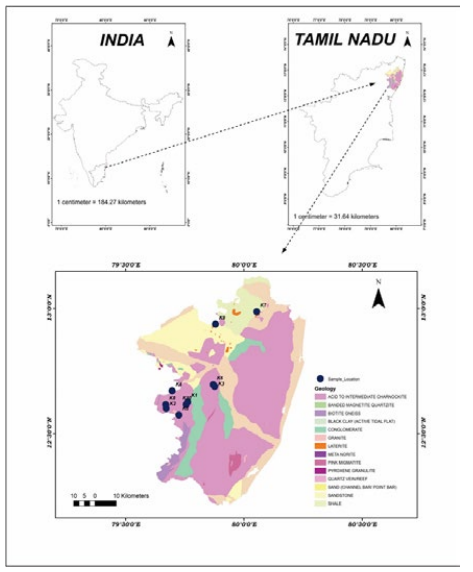
Figure 1: Map Showing the Locations of Charnockites and Granitic Gneiss samples Collected from Kancheepuram District, TamilNadu, India (K1-K6= Charnockites; K7= Granitic Gneiss; K8-K10= Charnockites)
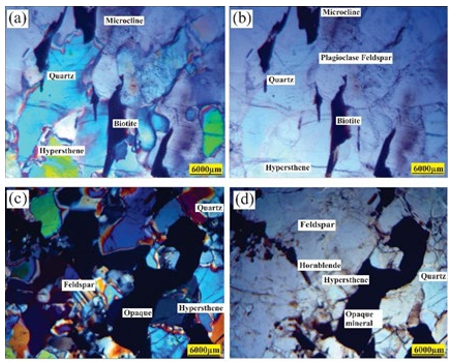
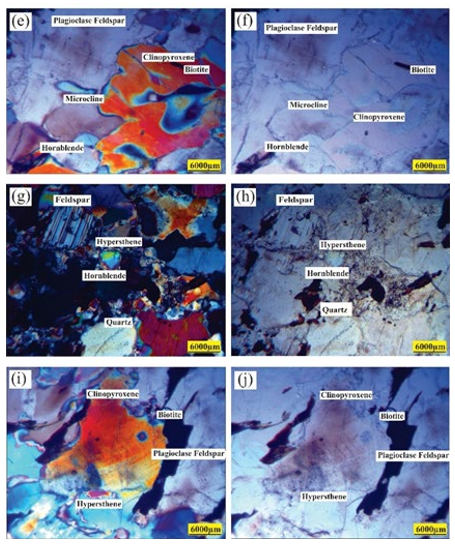
Figure 2: Photomicrographs showing Charnockites under crossed and parallel polarized light (a) biotite shows moderate relief, (b) quartz and opaque oxides, (c) microcline indicates deformed orthoclase, (d) Hornblende showing clearly two set cleavage and second order interference colour, (e) and (f) Brown biotite intruded in the clinopyroxene, (g) and (h) Feldspar showing polysynthetic twinning, (i) and (j) Hornblende is surrounded by the hypersthene
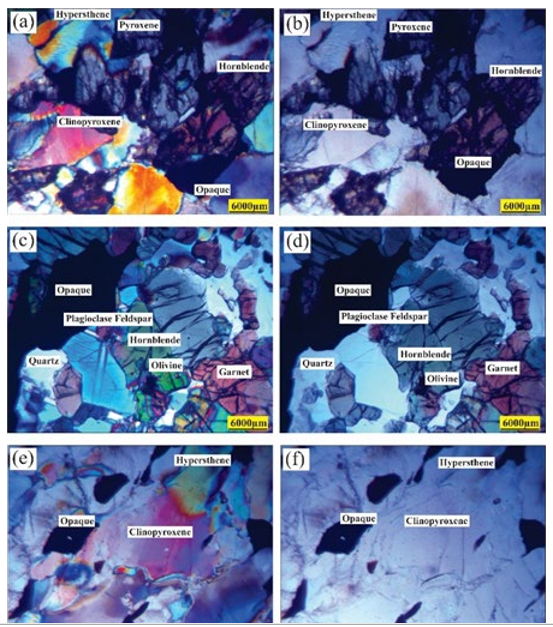
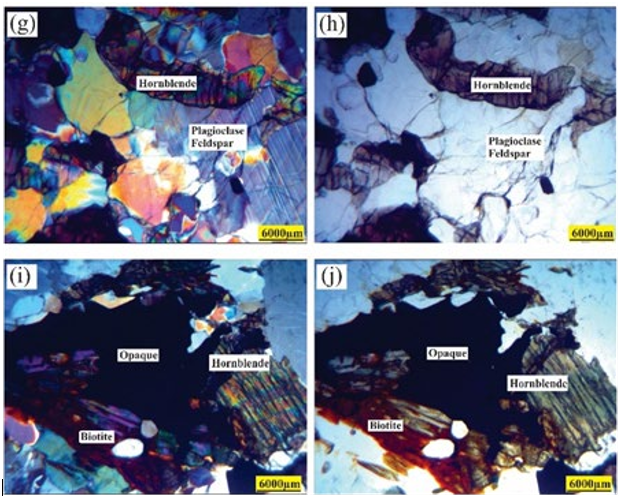
Figure 3: Photomicrographs showing Charnockites and Granitic Gneiss under crossed and parallel polarized light (a) and (b) hornblende clearly shows two sets of cleavage and second order interference colour, (c) garnet shows high relief in irregular masses (d) olivine is altering to opaques, (e) and (f) pyroxene along two sets of cleavage with the opaques (g) and (h) plagioclase feldspar showing polysynthetic twinning, (i) pyroxene is altering to biotite gradually, (j) Biotite along the margins of the clinopyroxene
Petrographic Characteristics
The Charnockite marked as K1 in the region was examined under crossed and parallel polarized light and the microcline indicates deformed orthoclase (Figure. 2a and b). Brown biotite shows moderate relief and strong pleochroic features. Hypersthene showing high relief and strongly pleochroic exhibiting green colour. Quartz and opaque oxides are also present. The Charnockite marked as K2 in the region was examined under crossed and parallel polarized light and the microcline indicates deformed orthoclase. Hornblende showing clearly two set cleavage and second order interference colour (Figure. 2c and d). Deformed plagioclase feldspar showing polysynthetic twinning. Brown biotite shows moderate relief and strong pleochroic features. Hypersthene showing high relief and strongly pleochroic exhibiting green colour. Quartz and opaque oxides are also present. The Charnockite marked as K3 in the region was examined under crossed and parallel polarized light and the brown biotite shows moderate relief and strong pleochroism present intruded in the clinopyroxene (Figure. 2e and f). Hornblende and clinopyroxene are present along the margins of the grain boundaries. Microcline clearly indicates deformed orthoclase. The Charnockite marked as K4 in the region was examined under crossed and parallel polarized light and the pyroxene which shows moderate relief and two set of cleavage along the opaque oxides. Microcline is set next to the pyroxene. Biotite showing brown colour with moderate relief is present along the pyroxene (Figure. 2g and h). The Charnockite marked as K5 in the region was examined under crossed and parallel polarized light and the plagioclase feldspar showing polysynthetic twinning is present along the high relief clinopyroxene. Biotite is found to be present along the margins of the clinopyroxene representing that the pyroxene is altering to biotite gradually. Hypersthene existing in these rocks represents green colour high relief (Figure. 2i and j). The Charnockite marked as K6 in the region was examined under crossed and parallel polarized light. The hornblende clearly shows two sets of cleavage and second order interference colour. Pyroxene shows moderate relief and two sets of cleavage along the opaque oxides. Hypersthene showing high relief and strongly pleochroic exhibit green colour. Quartz and opaque oxides are also found to be present in these rocks (Figure. 3a and b). The Granitic Gneiss marked as K7 in the region was examined under crossed and parallel polarized light and the melanocratic massive are mainly composed of quartz, plagioclase feldspar. Hornblende illustrates two sets of cleavage and first order interference colour. Olivine is getting altered to opaque oxides. Irregular masses of high relief garnet are also found to be present in these rocks (Figure. 3c and d). The Charnockite marked as K8 in the region was examined under crossed and parallel polarized light and the hypersthene illustrates green colour high relief. Pyroxene shows moderate relief and two sets of cleavage along the opaque oxides (Figure. 3e and f). The Charnockite marked as K9 in the region was examined under crossed and parallel polarized light and the Hornblende shows clearly two sets of cleavage and second order interference colour. Plagioclase feldspar showing polysynthetic twinning is present along the high relief clinopyroxene. Pyroxene shows moderate relief and two sets of cleavage along the opaque oxides. Hypersthene shows high relief and strongly pleochroic exhibiting green colour. Quartz and opaque oxides are also found to be present in these rocks (Figure. 3g and h). The Charnockite marked as K10 in the region was examined under crossed and parallel polarized light and the hornblende shows clearly two sets of cleavage and second order interference colour. Biotite is present along the margins of the clinopyroxene representing that the pyroxene is altering to biotite gradually. Quartz and opaque oxides are also observed to be present in these rocks (Figure. 3i and j).
Conclusion
Petrographic investigations were conducted on the source rocks utilised in the production of M-sand, focussing on the analysis of mineral distribution and concentration characteristics. The properties of the precursor rock used in production greatly influence the quality of both coarse and fine aggregates. Therefore, coarse aggregates must possess inherent strength and durability, exhibit exceptional particle shape and gradation, and demonstrate resistance to environmental variations, among other desirable characteristics. The composition of minerals in the source rock determines the rock's strength and subsequently affects the strength of aggregates in concrete or mortar. Therefore, the petrographic analysis becomes highly important. Outlined below are the key findings derived from the study.
Identified primary minerals consist of Quartz, hypersthene, Plagioclase-feldspar, hornblende, and K-feldspar. In the low concentration range of around 1-1.5 percent, the other major minerals, such as clinopyroxene, orthopyroxene, olivine, and microcline, were identified. The presence of garnet in charnockites is found at a comparatively low concentration of less than 1.4%, whereas in almost all samples of Granitic Gneiss, garnet composition is at least 25%. Principal secondary and accessory minerals present in almost all rock samples of both Charnockite and Granite Gneiss are biotite and opaque minerals. The survey findings reveal that the Charnockite in the examined region consists of minerals arranged in the following sequence of prevalence: quartz > hyperthenes > plagioclase feldspar > hornblende > K-feldspar. The results indicate that the Granitic Gneiss source rocks in the research region include minerals in the following order of abundance: quartz higher than plagioclase feldspar, followed by hornblende and finally K-feldspar. A notable differentiation in the mineral composition of Charnockite and Granitic Gneiss source rocks is the absence of hypersthenes in the granitic gneisses.
References
1. Arulmoly, B., & Konthesingha, C. (2022). Pertinence of alternative fine aggregates for concrete and mortar: A brief review on river sand substitutions. Australian Journal of Civil Engineering, 20(2), 272-307.
2. Dziedzic, K., & Glinicki, M. A. (2023). Risk assessment of reactive local sand use in aggregate mixtures for structural concrete. Construction and Building Materials, 408, 133826.
3. Van Wyk, P. R., & Croucamp, L. (2014). Evaluation of rock types for concrete aggregate suitability for the construction of a gravimeter vault and access road at the Matjiesfontein Geodesy Observatory site near Matjiesfontein, South Africa. Journal of the South African Institution of Civil Engineering= Joernaal van die Suid-Afrikaanse Instituut van Siviele Ingenieurswese, 56(2), 30-36.
4. Paredis, B., Weltje, G. J., & Heins, W. A. (2020). Quantitative analysis of the joint variability of rock texture and composition in thin section: The Generalized Griffiths Descriptor and its application to sediment generation from granitoids. Earth- science reviews, 205, 103188.
5. Branavan, A., Konthesingha, K. M. C., Nanayakkara, S. M. A., & Premasir, H. M. R. (2020). Optimizing blending of manufactured sand with offshore sand based on physical and virtue characteristics.
6. Kroner, A. (1991). Lithotectonic subdivision of the Precambrian basement in Sri Lanka. summary of research of the German-Sri Lanka consortium, 5-21.
7. Akhil, K. S., & Reddy, D. V. (2015). Geological and Geotechnical Investigations of Calicut Granite of Kerala State-A Case in Study. In Proceedings of the National Conference on Technological Innovations for Sustainable infrastructure.
8. Akhil, K. S., & Reddy, D. V. (2015). Geological and Geotechnical Investigations of Calicut Granite of Kerala State-A Case in Study. In Proceedings of the National Conference on Technological Innovations for Sustainable infrastructure.
9. Abdulraman, S. O., Musa, V. I., & IA, S. M. A. (2022). Investigation of the Effect of Weathering of Selected Charnockite Rocks in Nigeria on Its Engineering Properties. Material Science, 4(2), 1-15.
10. KDMSR Kancheepuram District Mineral Survey Report, 2019.
11. Sørensen, B. E. (2013). A revised Michel-Lévy interference colour chart based on first-principles calculations. European Journal of Mineralogy, 25(1), 5-10.
12. Tiecher, F., Gomes, M. E., Dal Molin, D. C., Hasparyk, N. P., & Monteiro, P. J. (2017). Relationship between degree of deformation in quartz and silica dissolution for the development of alkali-silica reaction in concrete. Materials, 10(9), 1022.
13. Tugrul, A., Hasdemir, S., & Yılmaz, M. (2015). The effect of feldspar, mica and clay minerals on compressive strength of mortar. In Engineering Geology for Society and Territory- Volume 5: Urban Geology, Sustainable Planning and Landscape Exploitation (pp. 93-96). Springer International Publishing.
14. Leemann, A., & Holzer, L. (2001). Influence of mica on the properties of mortar and concrete. Proceedings of the 8th Euroseminar on Microscopy Applied to Building s Materials. Athens/Greece, 199-204.
15. Muller, O. H. (1971). Some aspects of the effect of micaceous sand on concrete. Civil Engineering= Siviele Ingenieurswese, 1971(9), 313-315.