

Advances in Bioengineering and Biomedical Science Research(ABBSR)
ISSN: 2640-4133 | DOI: 10.33140/ABBSR
Impact Factor: 1.7

Research Article - (2024) Volume 0, Issue 0
Characteristics Study of Visceral Fat Ratio’s Relationship with Body Weight, Food Portion Size and Exercise Using Viscoplastic Energy Model of GH-Method: Math-Physical Medicine (No. 1044, VMT #442)
Received Date: Mar 15, 2024 / Accepted Date: Apr 04, 2024 / Published Date: Apr 05, 2024
Copyright: ©©2024 Gerald C. Hsu. This is an open-access article distributed under the terms of the Creative Commons Attribution License, which permits unrestricted use, distribution, and reproduction in any medium, provided the original author and source are credited.
Citation: Hsu, G. C. (2024). Characteristics Study of Visceral Fat Ratio
Abstract
Excessive body weight, particularly from visceral fat, elevates the risk of metabolic syndrome, type 2 diabetes, heart disease, fatty liver, and certain soecific cancers. Unlike subcutaneous fat, which is beneath the skin, visceral fat is more detrimental due to its adverse effects on metabolism and hormone levels.
Consuming large, high-calorie, and fatty meals can lead to a positive energy balance, subsequently increasing both body weight and visceral fat storage as surplus calories are converted to fat.
Aerobic exercises, including walking, running, and cycling, effectively reduce visceral fat. Similarly, resistance training contributes by augmenting muscle mass, enhancing metabolic rate, and improving insulin sensitivity, aiding in visceral fat reduction. The pathophysiological mechanisms involved encompass insulin resistance and inflammatory markers such as TNF-alpha and IL-6, leading to systemic inflammation, insulin resistance, and metabolic disturbances. Hormonal imbalances involving leptin and adiponectin affect hunger, satiety, fat distribution, and insulin sensitivity. Energy balance also plays a crucial role in weight gain and visceral fat accumulation.
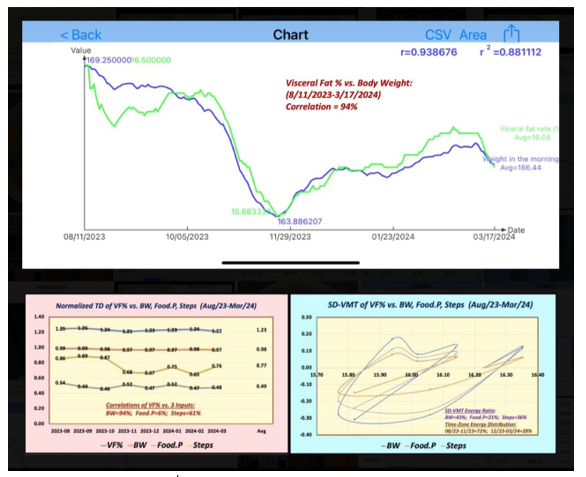
The author analyzed personal data on visceral fat ratio (VF%), body weight (BW), food portion sizes, and walking steps from August 11, 2023, to March 17, 2024, to examine the correlation between VF% and BW. Moreover, he utilized the space-domain Viscoplastic medicine energy method (SD-VMT) to calculate the energy association between VF% and its three major influencing factors.
Key Message
The author has successfully reduced his body weight from 220 lbs in 2010 to 164 lbs by 2024 through food portion control and walking exercises. However, his visceral fat percentage remained stubbornly at 16.5% (13% is considered as “normal”). B combining his daily walking exercise with his new resistance training starting from August 11, 2024, he has managed to decrea his visceral fat percentage by 1%, from 16.5% to 15.5%.
Viscoelastic Medicine theory (VMT #442):
Introduction
Excessive body weight, particularly from visceral fat, elevates the risk of metabolic syndrome, type 2 diabetes, heart disease, fatty liver, and certain soecific cancers. Unlike subcutaneous fat, which is beneath the skin, visceral fat is more detrimental due to its adverse effects on metabolism and hormone levels.
Consuming large, high-calorie, and fatty meals can lead to a positive energy balance, subsequently increasing both body weight and visceral fat storage as surplus calories are converted to fat.
Aerobic exercises, including walking, running, and cycling, effectively reduce visceral fat. Similarly, resistance training contributes by augmenting muscle mass, enhancing metabolic rate, and improving insulin sensitivity, aiding in visceral fat reduction.
The pathophysiological mechanisms involved encompass insulin resistance and inflammatory markers such as TNF-alpha and IL-6, leading to systemic inflammation, insulin resistance, and metabolic disturbances. Hormonal imbalances involving leptin and adiponectin affect hunger, satiety, fat distribution, and insulin sensitivity. Energy balance also plays a crucial role in weight gain and visceral fat accumulation. The author analyzed personal data on visceral fat ratio (VF%), body weight (BW), food portion sizes, and walking steps from August 11, 2023, to March 17, 2024, to examine the correlation between VF% and BW. Moreover, he utilized the space-domain Viscoplastic medicine energy method (SD-VMT) to calculate the energy association between VF% and its three major influencing factors.
Biomedical and Engineering or Technical Information
on meticulously reviewed by the author of this paper. The author has adopted this approach as an alternative to including a conventional reference list at the end of this document, with the intention of optimizing his valuable research time. It is essential to clarify that these sections do not constitute part of the author's original contribution but have been included to aid the author in his future reviews and offer valuable insights to other readers with an interest in these subjects.
Pathophysiological explanations of relationships between visceral fat and body weight, food portion size, exercise
The relationship between visceral fat, body weight, food portion size, and exercise involves complex pathophysiological mechanisms. Here's a brief explanation of each aspect:
Visceral Fat and Body Weight
Visceral fat, also known as intra-abdominal fat, is stored within the abdominal cavity, surrounding vital organs such as the liver, pancreas, and intestines. It is metabolically active and releases fatty acids, inflammatory markers, and hormones that can affect body metabolism.
Body Weight Connection
Excess body weight, particularly in the form of visceral fat, is associated with an increased risk of metabolic syndrome, type 2 diabetes, heart disease, and certain types of cancer. Visceral fat is more harmful than subcutaneous fat (the fat that is found under the skin) because of its effects on metabolism and hormone production.
Visceral Fat and Food Portion Size
Food portion size directly affects energy intake, which can contribute to weight gain if it exceeds the body's energy expenditure. Larger portion sizes can lead to overeating, even when not hungry, contributing to an increase in body fat.
Pathophysiological Impact
Consuming large portions of food, especially high in calories and fat, can lead to a positive energy balance. Over time, this can cause an increase in visceral fat storage due to the excess calories being stored as fat in the body.
Visceral Fat and Exercise
Exercise plays a crucial role in managing body weight and reducing visceral fat. It can help burn calories, improve metabolism, and reduce the amount of visceral fat even without significant weight loss.
Exercise Effect on Visceral Fat
Aerobic exercises, such as walking, running, and cycling, are particularly effective at reducing visceral fat. Resistance training also plays a role by increasing muscle mass, which can boost metabolic rate and improve insulin sensitivity, further helping in the reduction of visceral fat. Pathophysiological Mechanisms
• Insulin Resistance:
Both obesity and lack of physical activity can lead to insulin resistance, a condition where cells do not respond effectively to insulin. This can lead to increased blood sugar levels, promoting further visceral fat storage.
• Inflammatory Markers: Visceral fat releases inflammatory markers like TNF-alpha and IL-6, which can contribute to systemic inflammation, insulin resistance, and other metabolic disorders.
• Hormonal Imbalance: Visceral fat affects the balance of hormones such as leptin and adiponectin, which play roles in hunger and satiety, as well as fat distribution and insulin sensitivity.
• Energy Balance: At the core of weight gain and visceral fat accumulation is the concept of energy balance. Consuming more calories than expended leads to fat storage, while a calorie deficit leads to fat loss.
The relationship between visceral fat, body weight, food portion size, and exercise is intricate, with each factor influencing the others through various pathophysiological pathways. Managing these factors through diet and regular physical activity is crucial for reducing visceral fat and improving overall health.
MPM Background
To learn more about his developed GH-Method: math-physical medicine (MPM) methodology, readers can read the following three papers selected from his published 760+ papers.
The first paper, No. 386 (Reference 1) describes his MPM methodology in a general conceptual format. The second paper, No. 387 (Reference 2) outlines the history of his personalized diabetes research, various application tools, and the differences between biochemical medicine (BCM) approach versus the MPM approach. The third paper, No. 397 (Reference 3) depicts a general flow diagram containing ~10 key MPM research methods and different tools.
The Authors Diabetes History
The author was a severe T2D patient since 1995. He weighed 220 lb. (100 kg) at that time. By 2010, he still weighed 198 lb. with an average daily glucose of 250 mg/dL (HbA1C at 10%). During that year, his triglycerides reached 1161 (high risk for CVD and stroke) and his albumin-creatinine ratio (ACR) at 116 (high risk for chronic kidney disease). He also suffered from five cardiac episodes within a decade. In 2010, three independent physicians warned him regarding the need for kidney dialysis treatment and the future high risk of dying from his severe diabetic complications.
In 2010, he decided to self-study endocrinology with an emphasis on diabetes and food nutrition. He spent the entire year of 2014 to develop a metabolism index (MI) mathematical model. During 2015 and 2016, he developed four mathematical prediction models related to diabetes conditions: weight, PPG, fasting plasma glucose (FPG), and HbA1C (A1C). Through using his developed mathematical metabolism index (MI) model and the other four glucose prediction tools, by the end of 2016, his weight was reduced from 220 lbs. (100 kg) to 176 lbs. (89 kg), waistline from 44 inches (112 cm) to 33 inches (84 cm), average finger-piercing glucose from 250 mg/dL to 120 mg/dL, and A1C from 10% to ~6.5%. One of his major accomplishments is that he no longer takes any diabetes-related medications since 12/8/2015.
In 2017, he achieved excellent results on all fronts, especially his glucose control. However, during the pre-COVID period, including both 2018 and 2019, he traveled to ~50 international cities to attend 65+ medical conferences and made ~120 oral presentations. This hectic schedule inflicted damage to his diabetes control caused by stress, dining out frequently, post-meal exercise disruption, and jet lag, along with the overall negative metabolic impact from the irregular life patterns; therefore, his glucose control was somewhat affected during the two-year traveling period of 2018-2019.
He started his COVID-19 self-quarantined life on 1/19/2020. By 10/16/2022, his weight was further reduced to ~164 lbs. (BMI 24.22) and his A1C was at 6.0% without any medication intervention or insulin injection. In fact, with the special COVID-19 quarantine lifestyle since early 2020, not only has he written and published ~500 new research articles in various medical and engineering journals, but he has also achieved his best health conditions for the past 27 years. These achievements have resulted from his non-traveling, low-stress, and regular daily life routines. Of course, his in-depth knowledge of chronic diseases, sufficient practical lifestyle management experiences, and his own developed high-tech tools have also contributed to his excellent health improvements. On 5/5/2018, he applied a continuous glucose monitoring (CGM) sensor device on his upper arm and checks his glucose measurements every 5 minutes for a total of 288 times each day. Furthermore, he extracted the 5-minute intervals from every 15-minute interval for a total of 96 glucose data each day stored in his computer software. Through the author’s medical research work over 40,000 hours and read over 4,000 published medical papers online in the past 13 years, he discovered and became convinced that good life habits of not smoking, moderate or no alcohol intake, avoiding illicit drugs; along with eating the right food with well-balanced nutrition, persistent exercise, having a sufficient and good quality of sleep, reducing all kinds of unnecessary stress, maintaining a regular daily life routine contribute to the risk reduction of having many diseases, including CVD, stroke, kidney problems, micro blood vessels issues, peripheral nervous system problems, and even cancers and dementia. In addition, a long-term healthy lifestyle can even “repair” some damaged internal organs, with different required time-length depending on the particular organ’s cell lifespan. For example, he has “self-repaired” about 35% of his damaged pancreatic beta cells during the past 10 years.
Energy Theory
The human body and organs have around 37 trillion live cells which are composed of different organic cells that require energy infusion from glucose carried by red blood cells; and energy consumption from labor-work or exercise. When the residual energy (resulting from the plastic glucose scenario) is stored inside our bodies, it will cause different degrees of damage or influence to many of our internal organs.
According to physics, energies associated with the glucose waves are proportional to the square of the glucose amplitude. The residual energies from elevated glucoses are circulating inside the body via blood vessels which then impact all of the internal organs to cause different degrees of damage or influence, e.g. diabetic complications. Elevated glucose (hyperglycemia) causes damage to the structural integrity of blood vessels. When it combines with both hypertension (rupture of arteries) and hyperlipidemia (blockage of arteries), CVD or Stroke happens. Similarly, many other deadly diseases could result from these excessive energies which would finally shorten our lifespan. For an example, the combination of hyperglycemia and hypertension would cause micro-blood vessel’s leakage in kidney systems which is one of the major cause of CKD.
The author then applied Fast Fourier Transform (FFT) operations to convert the input wave from a time domain into a frequency domain. The y-axis amplitude values in the frequency domain indicate the proportional energy levels associated with each different frequency component of input occurrence. Both output symptom value (i.e. strain amplitude in the time domain) and output symptom fluctuation rate (i.e. the strain rate and strain frequency) are influencing the energy level (i.e. the Y-amplitude in the frequency domain).
Currently, many people live a sedentary lifestyle and lack sufficient exercise to burn off the energy influx which causes them to become overweight or obese. Being overweight and having obesity leads to a variety of chronic diseases, particularly diabetes. In addition, many types of processed food add unnecessary ingredients and harmful chemicals that are toxic to the bodies, which lead to the development of many other deadly diseases, such as cancers. For example, ~85% of worldwide diabetes patients are overweight, and ~75% of patients with cardiac illnesses or surgeries have diabetes conditions.
forIn engineering analysis, when the load is applied to the structure, it bends or twists, i.e. deform; however, when the load is removed, it will either be restored to its original shape (i.e, elastic case) or remain in a deformed shape (i.e. plastic case). In a biomedical system, the glucose level will increase after eating carbohydrates or sugar from food; therefore, the carbohydrates and sugar function as the energy supply. After having labor work or exercise, the glucose level will decrease. As a result, the exercise burns off the energy, which is similar to load removal in the engineering case. In the biomedical case, both processes of energy influx and energy dissipation take some time which is not as simple and quick as the structural load removal in the engineering case. Therefore, the age difference and 3 input behaviors are “dynamic” in nature, i.e. time-dependent. This time-dependent nature leads to a “viscoelastic or viscoplastic” situation. For the author’s case, it is “viscoplastic” since most of his biomarkers are continuously improved during the past 13-year time window.
Time-dependent output strain and stress of (viscous input*output rate)
Hooke’s law of linear elasticity is expressed as:
Strain (ε: epsilon )
= Stress (σ: sigma) / Young’s modulus (E)
For biomedical glucose application, his developed linear elastic glucose theory (LEGT) is expressed as:
PPG (strain) = carbs/sugar (stress) * GH.p-Modulus (a positive number) + post-meal walking k-steps * GH.w-Modulus ( a negative number)
Where GH.p-Modulus is reciprocal of Young’s modulus E.
However, in viscoelasticity or viscoplasticity theory, the stress is expressed as:
Stress
= viscosity factor (η: eta) * strain rate (dε/dt)
Where strain is expressed as Greek epsilon or ε.
In this article, in order to construct an “ellipse-like” diagram in a stress-strain space domain (e.g. “hysteresis loop”) covering both the positive side and negative side of space, he has modified the definition of strain as follows:
Strain
= (body weight at certain specific time instant)
He also calculates his strain rate using the following formula:
Strain rate
= (body weight at next time instant) - (body weight at present time instant)
The risk probability % of developing into CVD, CKD, Cancer is calculated based on his developed metabolism index model (MI) in 2014. His MI value is calculated using inputs of 4 chronic conditions, i.e. weight, glucose, blood pressure, and lipids; and 6 lifestyle details, i.e. diet, drinking water, exercise, sleep, stress, and daily routines. These 10 metabolism categories further contain ~500 elements with millions of input data collected and processed since 2010. For individual deadly disease risk probability %, his mathematical model contains certain specific weighting factors for simulating certain risk percentages associated with different deadly diseases, such as metabolic disorder-induced CVD, stroke, kidney failure, cancers, dementia; artery damage in heart and brain, micro-vessel damage in kidney, and immunity-related infectious diseases, such as COVID death.
Some of explored deadly diseases and longevity characteristics using the viscoplastic medicine theory (VMT) include stress relaxation, creep, hysteresis loop, and material stiffness, damping effect based on time-dependent stress and strain which are different from his previous research findings using linear elastic glucose theory (LEGT) and nonlinear plastic glucose theory (NPGT).
Results
Figure 1 shows 3 Data table, TD and SD results of 3 single cases.
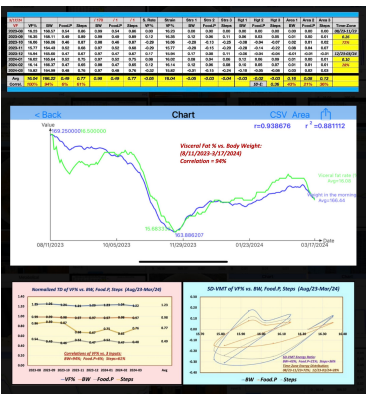
Figure 1: Data table, TD and SD results
Conclusion
In summary, a remarkably high correlation coefficient of 94% was observed between body weight and visceral fat percentage (VF%), based on 90-day moving average curves. Furthermore, the analysis of total energies—represented by the areas under the monthly curves for output symptoms and three input factors— revealed the following:
• VF% versus body weight accounted for 43% of the total energy, with a correlation coefficient (R) of 94%.
• VF% versus food portion size constituted 21% of the total energy, with an R of 6%.
• VF% versus walking steps made up 36% of the total energy, with an R of 62%.
Above data table shows a strong correlation (94%) between visceral fat percentage and body weight, with the biggest 43% contribution on the total energy—the highest among three factors studied. Furthermore, exercise has a greater impact (36%) on visceral fat percentage than food portion size (21%). The SD-VMT energy distribution over two different time zones was as follows:
• From August 2023 to November 2023, the distribution was 72%.
• From December 2023 to March 2024, it decreased to 28%.
This indicates that the initial four-month period had a more significant impact on visceral fat compared to the more recent four-month period.
Key Message
The author has successfully reduced his body weight from 220 lbs in 2010 to 164 lbs by 2024 through food portion control and walking exercises. However, his visceral fat percentage remained stubbornly at 16.5% (13% is considered as “normal”). By combining his daily walking exercise with his new resistance training starting from August 11, 2024, he has managed to decrease his visceral fat percentage by 1%, from 16.5% to 15.5%.
References
For editing purposes, majority of the references in this paper, which are self-references, have been removed for this article. Only references from other authors' published sources remain. The bibliography of the author’s original self-references can be viewed at www.eclairemd.com. Readers may use this article as long as the work is properly cited, and their use is educational and not for profit, and the author’s original work is not altered.
For reading more of the author’s published VGT or FD analysis results on medical applications, please locate them through platforms for scientific research publications, such as ResearchGate, Google Scholar, etc.