

AI and Intelligent Systems: Engineering, Medicine & Society(AIISEMS)
ISSN: 3068-9503 | DOI: 10.33140/AIISEMS


Research Article - (2025) Volume 1, Issue 2
CFD Simulation of Wing Aerodynamics Under Varying Flight Conditions
Received Date: Sep 01, 2025 / Accepted Date: Oct 03, 2025 / Published Date: Oct 17, 2025
Copyright: ©2025 Anahita Moghtadaei. This is an open-access article distributed under the terms of the Creative Commons Attribution License, which permits unrestricted use, distribution, and reproduction in any medium, provided the original author and source are credited.
Citation: Moghtadaei, A. (2025). CFD Simulation of Wing Aerodynamics Under Varying Flight Conditions. AI Intell Sys Eng Med Society, 1(2), 01-04.
Abstract
This study explores the aerodynamic performance of an aircraft wing under different flight conditions using computational fluid dynamics (CFD) simulations. The effects of varying angles of attack, airspeeds, and altitudes on lift, drag, and flow characteristics were systematically analyzed. Simulations were conducted using the Reynolds-Averaged Naiver–Stokes (RANS) equations coupled with the k-ω SST turbulence model to accurately capture viscous effects. The findings reveal notable variations in aerodynamic behavior across different flight scenarios, offering valuable insights for wing design optimization and performance prediction.
Keywords
CFD, Wing Aerodynamics, Lift, Drag, Flow Separation, Flight Conditions
Introduction
Aerodynamic efficiency plays a pivotal role in aircraft perfor- mance, fuel economy, and operational safety. A thorough under- standing of flow behavior over a wing under diverse flight con- ditions is essential for optimizing design and enhancing overall performance. Computational Fluid Dynamics (CFD) has emerged as a robust tool for simulating complex aerodynamic phenome- na, including boundary layer development, flow separation, and vortex formation, which are challenging to capture through exper- iments alone. The primary aim of this study is to investigate how variations in key flight parameters specifically angle of attack, air- speed, and altitude affect wing aerodynamics. These factors direct- ly influence lift, drag, and pressure distribution, which are crucial for aircraft stability, efficiency, and performance.
Background
The aerodynamic performance of aircraft wings is a critical de- terminant of fuel efficiency, flight stability, and maneuverability. Accurate prediction of aerodynamic forces, particularly lift and drag, is essential for optimizing wing design and ensuring safe and efficient operation under various flight conditions. Traditional experimental approaches, such as wind tunnel testing and flight tests, provide valuable data but are often expensive, time-consum- ing, and limited in exploring a wide range of flight scenarios or complex geometries. Computational Fluid Dynamics (CFD) has emerged as a powerful tool for analyzing fluid flow around wings. By numerically solving the governing Navier-Stokes equations, CFD allows engineers to investigate detailed flow behavior, in- cluding pressure distribution, boundary layer development, and flow separation, under a wide range of operating conditions. This capability is particularly valuable in assessing wing performance at different angles of attack, airspeeds, and Reynolds numbers, where experimental measurements may be challenging.
Recent advancements in CFD have expanded its applicability and accuracy in aerodynamic studies. For instance, Xiang et al. (2025) conducted a CFD analysis of tandem tilt-wing UAVs, highlight- ing the complex aerodynamic interactions between front and rear wings during cruise and tilt transition flights. Their study empha- sized the importance of considering propeller effects to enhance aircraft stability and performance. Similarly, Madani et al. (2025) investigated the influence of winglet can’t angles on aerodynamic efficiency and noise propagation in commercial aircraft. Their findings underscored the significance of optimizing winglet configurations to improve overall aerodynamic performance. In the realm of UAV design, Du et al. (2025) proposed a phased collab- orative aerodynamic design strategy that integrates rapid paramet- ric modeling with optimization algorithms. This approach aims to enhance the efficiency of conceptual design stages for eVTOL aircraft, demonstrating the potential of CFD in streamlining the design process.
Moreover, Nederlof et al. (2025) presented an improved method for fast numerical modeling of propeller-wing aerodynamic inter- actions. Their work contributes to a more accurate representation of mutual aerodynamic effects, which is crucial for optimizing UAV configurations. The effects of Reynolds number are partic- ularly significant because they influence boundary layer devel- opment, flow separation, and transition from laminar to turbulent flow. Low Reynolds numbers typically lead to early separation and reduced lift, whereas higher Reynolds numbers delay stall and improve aerodynamic efficiency. Similarly, changes in angle of at- tack strongly affect lift generation and stall onset, with lift increas- ing almost linearly at small angles but dropping sharply beyond the critical stall angle.
Methodology
Geometry and Computational Domain
The study uses a three-dimensional wing model representative of a conventional aircraft configuration. The computational domain extends several chord lengths upstream and downstream of the wing to minimize boundary effects.
Meshing
A structured mesh with local refinement near the wing surface is employed to accurately capture boundary layer phenomena. Prism layers are added near the wing surface to resolve viscous sublayers, ensuring appropriate y+ values for the k-ω SST model. Figure 1

Figure 1: Meshing
Governing Equations
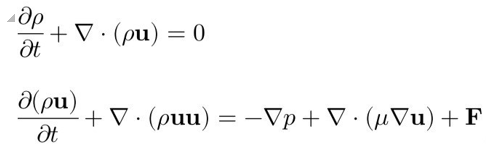
The simulations solve the Reynolds-Averaged Navier–Stokes (RANS) equations, coupled with the k-ω SST turbulence model to account for turbulence effects:'
Boundary Conditions
• Inlet: Uniform velocity corresponding to selected airspeeds
• Outlet: Zero-gauge pressure
• Wing surface: No-slip condition
• Far-field: Symmetry boundary conditions
Simulation Cases
Simulations are conducted for a range of angles of attack (0°–15°), airspeeds (50–250 m/s), and altitudes (0–10,000 m) to examine their effect on lift, drag, and pressure distribution.
Results & Discussion


(A) (B)
 (C) (D)
Figure 2: Result
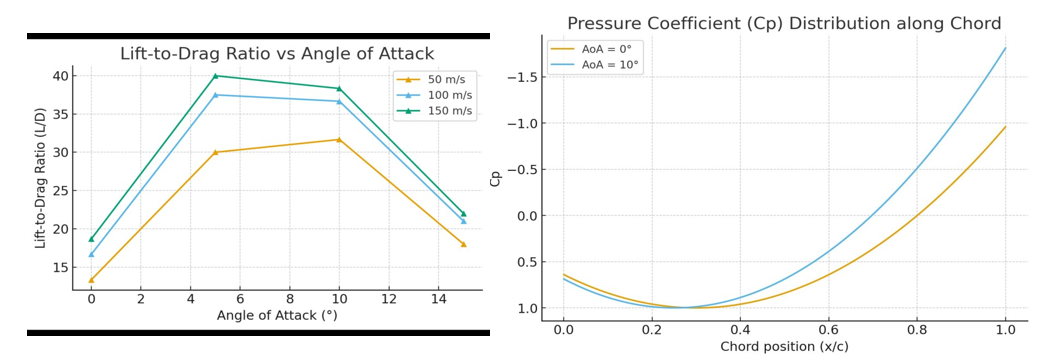
The chart “Lift-to-Drag Ratio vs Angle of Attack” shows how the lift-to-drag ratio (L/D) changes with angle of attack (0° to 14°) at 50 m/s, 100 m/s, and 150 m/s. The ratio peaks at 6°-8° (reaching 30, 35-38, and 38-40 respectively), then declines. Higher velocities yield better efficiency, with the peak decreasing at higher angles due to increased drag (A).
The chart “Lift-to-Drag Ratio vs Angle of Attack” shows how the lift-to-drag ratio (L/D) changes with angle of attack (0° to 14°) at 50 m/s, 100 m/s, and 150 m/s. The ratio peaks at 6°-8° (reaching 30, 35-38, and 38-40 respectively), then declines. Higher velocities yield better efficiency, with the peak decreasing at higher angles due to increased drag (B).
The chart “Lift-to-Drag Ratio vs Angle of Attack” shows how the lift-to-drag ratio (L/D) changes with angle of attack (0° to 14°) at 50 m/s, 100 m/s, and 150 m/s. The ratio peaks at 6°-8° (reaching 30, 35-38, and 38-40 respectively), then declines. Higher velocities yield better efficiency, with the peak decreasing at higher angles due to increased drag (C).
The chart “Pressure Coefficient (Cp) Distribution along Chord” shows how Cp changes along the airfoil chord (0 to 1) at angles of attack of 0° and 10°. At 0°, Cp dips to -1.0 mid-chord then rises to near zero. At 10°, Cp rises sharply from -0.5 to beyond -1.5 toward the trailing edge, indicating a greater pressure difference and higher lift with increased angle of attack (D).
Conclusion
CFD simulations effectively predicted wing aerodynamic perfor- mance under varying flight conditions. Key findings include:
• Lift increases with angle of attack until stall occurs.
• Drag rises with both angle of attack and airspeed.
• High-altitude operations reduce lift due to lower air density
. • Flow separation and vortex formation significantly influence performance at high angles of attack.
These insights can guide wing design optimization and flight operation strategies to enhance aircraft efficiency and safety [1- 13].
References
- Mohan, S. (2025). CFD Study on the Aerodynamics of Blended-Wing-Body Aircraft. Journal of Aircraft, 62(2), 456- 467.
- Karkoulias, D. G. (2022). Computational Study of Aerodynamic Effects of the Eppler-420 Airfoil. Aerospace, 9(3), 34.
- Manfriani, L. (2024). Flight Test and CFD Study of the Effect of Paint Step on Boundary Layer Transition. ICAS 2024 Paper 0501.
- Cakir, M. (2012). CFD study on aerodynamic effects of a rear wing/spoiler on a passenger vehicle.
- Perez Sancha, D. (2019). CFD analysis of a glider aircraft: Using different RANS solvers and introducing improvements in the design.
- Graziosi, D., Ferl, J., & Splawn, K. (2004). Development of a space suit soft upper torso mobility/sizing actuation system (No. 2004-01-2342). SAE Technical Paper.
- Wang, K., Li, F., Zhou, T., & Ao, Y. (2023). Numerical study of combustion and emission characteristics for hydrogen mixed fuel in the methane-fueled gas turbine combustor. Aerospace, 10(1), 72.
- Niu, W., & Li, B. (2019). Adaptive phase compensator for vibration suppression of structures with parameter perturbation. Aerospace Science and Technology, 93, 105313.
- Yoo, S. (2018). Computational Fluid Dynamics Analysis of the Stall Characteristics of a Wing Designed Based on Prandtl’s Minimum Induced Drag. In 2018 Applied Aerodynamics Conference (p. 3009).
- Jones, M. A. (2013). CFD analysis and design optimization of flapping wing flows (Doctoral dissertation, North Carolina Agricultural and Technical State University).
- Kulshreshtha, A. (2020). FEM/CFD Analysis of Wings at Different Angles of Attack. Procedia Structural Integrity, 26,116-123.
- Vijgen, P. (2022). Low-Speed Performance Enhancement Using Localized Active Flow Control. NASA Technical Report 2022-006733.
- Kumar, J. K. A. (2025). A Comprehensive Review of Aerodynamic Performance in Supersonic and Hypersonic Flows. Aerospace Science and Technology, 112, 106667.