

Advances in Theoretical & Computational Physics(ATCP)
ISSN: 2639-0108 | DOI: 10.33140/ATCP

Research Article - (2025) Volume 8, Issue 2
Certainty and Uncertainty in Sets of Complementary Items
Received Date: Mar 25, 2025 / Accepted Date: May 05, 2025 / Published Date: Jun 13, 2025
Copyright: ©2025 Anna C.M. Backerra. This is an open-access article distributed under the terms of the Creative Commons Attribution License, which permits unrestricted use, distribution, and reproduction in any medium, provided the original author and source are credited.
Citation: Backerra, A. C. M. (2025). Certainty and Uncertainty in Sets of Complementary Items. Adv Theo Comp Phy, 8(2), 01-15.
Abstract
Twin physics is a unification theory, based upon the mathematical definition of complementarity, in which physical phenomena are described as entangled appearances of certainty and uncertainty. Experimental results of quantum mechanics, the view of Heisenberg and relativity theory of Einstein are incorporated. Physical descriptions on a quantum-mechanical scale as well as an astronomical scale can be reconciled by considering them in that way. Applying twin physics, more insight has been gained into fundamental phenomena, known as the four forces of nature, as well as elementary particles and spaces; new insights emerge in the fields of nanophysics, optics, magnetism and astronomy. These results gave rise to the idea generalizing the mathematical structure of twin physics to a much broader so-called ‘twin view’, applicable to phenomena in general, for instance the commercial traffic.
In the twin view, some kind of unit for the considered phenomenon in general has to be selected, as well as a few characteristic qualities to describe the interaction between these units. For each quality, a set of four elements has to be defined, two by two being complementary. Each pair has to contain a determinate item, describing ‘certainty’, and an indeterminate one, describing ‘uncertainty'. Moreover, one pair has to be of major importance and the other pair of minor importance. As an example, the construction of these sets in twin physics is shown. Special attention is paid to finding indeterminate items, as science is historically mainly oriented to determinate items. Finally, by defining suitable operators, the theory can be applied in a relatively easy way.
Keywords
Twin Physics, Set Theory, Complementarity, Certainty, Uncertainty, Determinism, Indeterminism, Commercial Traffic
Introduction
Since the discovery of the laws of Newton all science has been deterministic. Scientific progress was understood to be the minimization of indeterminism. The discovery of the quantum of action by Max Planck in 1900 marks the natural boundary of classical physics and can be seen as the starting signal for the search for describing uncertainty. Since that discovery, the classical view of physics has changed rapidly [1].
The assumption of Planck that the radiation energy of a body is transmitted in quanta, rather than continuously, inspired Albert Einstein in 1905 to assume that light in general is a discontinuous phenomenon [2]. The idea that elementary entities can have both particle and wave properties (but not at the same time), was proposed in his theory of the photon, considered as an elementary particle of light. This is the origin of the involvement of duality. In 1913 Niels Bohr proposed that the quantum hypothesis was valid for light as well as for matter. In 1924 Louis de Broglie derived an equation predicting that all atomic particles can act like a train of light waves [3].
The real break-through of indeterminism came about as a result of experiments, carried out in 1927 by Clinton Davisson and Lester Germer [4]. It was experimentally shown that the diffraction pattern of electrons exhibited a dual character in behavior, one being certain and one uncertain [3]. In formulating this, again it was necessary to move away from pure determinism.
Even more so than Planck’s theory of radiating energy and Einstein’s photon theory, the existence of fundamental uncertainty in mass- carrying particles was a shock to the entire scientific world and caused a lasting fascination for the occurrence of duality in physics. In 1926, Erwin Schrödinger published the first mathematical description of the dualistic behavior of matter [5]. He assumed that at the moment of measurement the formalism no longer is valid, called the ‘collapse of the wave function’. This is the first example of an explicit transformation of mathematics into physics, showing that mathematics and physics are not necessarily congruent. This revolutionary development is adopted in twin physics, resulting in the descritpio of many finite spaces, and therefore also finite fields, instead of one infinite space with many infinite fields.
In 1927, Werner Heisenberg presented the uncertainty principle at an atomic level, as an attempt to connect this formalism and observational experience, saying that it is impossible to determine the position and the velocity of a particle at the same time [3]. And this, finally, was the irreversible introduction of uncertainty in physics.
Nevertheless, for decades scientists were convinced that uncertainty was a microscopic phenomenon that could ultimately be phased out in general physics and kept searching for a novel kind of deterministic physics. The concept of uncertainty was hard to grasp, because there was no mathematical description available at the time. Uncertainty and indeterminism were generally even considered to be concepts beyond imagination. A mathematical alternative, the artifact of probabilistic randomness from quantum mechanics, was not satisfying in the long run. So, scientists tried to banish uncertainty from physics by searching in different ways for a fundamentally new kind of deterministic physics, but eventually these attempts failed.
A few physicists continued to search for a way of accepting duality as a fundamental characteristic of nature, such as Niels Bohr (1885 - 1962), Heisenberg (1901 - 1976), Carl F. von Weizsäcker (1912 - 2007), Max Jammer (1915 - 2010) and Kenneth W. Ford (*1926). They realized that the absence of suitable mathematics stood in the way of more progress in describing uncertain aspects. As a possible source of inspiration to develop new mathematics, Heisenberg wrote a series of books about the philosophical consequences of this interpretation, of which ‘Schritte über Grenze’ is the most profound [6]. But it wasn’t until 1974 when a breakthrough in mathematics was realized by the presentation of a definition of complementarity by Jammer [7], to tackle uncertainty in a mathematical manner by approaching complementarity from a logical perspective. This idea is adopted in twin physics.
In our first publication about twin physics, we used the definition of Jammer to construct a complementary mathematical language [8]. This is a mathematical formalism, based on the concept that determinate and indeterminate manifestations occur together in nature, in such a manner that one of both dominates an observation. In this way it was possible to tackle uncertainty in three-dimensional space and in one-dimensional time from a mathematical perspective.
We introduced a unit of potential energy, called the Heisenberg unit (H-unit), as the basic item, instead of elementary particles. Supplying this unit with a number of mathematical attributes, both determinate and indeterminate, and using a mathematical method called set theory, the interaction between two H-units can be expressed in complementary language. By introducing two types of H-units, a neutral and a charged one, the divide between atomic and astronomic phenomena could be bridged. Finally the results of these interactions are transformed into actual physical items.
It turned out that not only descriptions of dark matter, solid particles, electrons, photons and neutrinos were obtained, but moreover, each of them could be described as coming in several types. Also the four forces of nature as distinguished in classical physics, including gravity, could be described. Twin physics gives more insight into basic physical laws and assumptions, shows how the speed of light is the link between small-scale and large-scale physics, explains the quantization postulated by Planck and derives the laws of Maxwell in an extremely simple way [9]. Moreover, a series of well-known but unexplained physical phenomena came within the reach of this theory, like the electric features of graphene and the role of magnetism in photonics [10].
So it seems that twin physics holds the promise of a powerful model that serves as a conceptual basis for a unification theory. After introducing the terms determinism and indeterminism as central concepts of any phenomenon you want to describe, provided it is coherent and large enough, it seemed to be usable as a guideline for a more general application, be it in health care, psychology, or whatever. We applied a physical result of twin physics, concerning a specific type of electron, to explain why the corona-virus was so contageous [11]. Another result, concerning finite magnetic fields in and around the human body, is applied in a simplified form, called the twin model, to investigate the influence of magnetism on human health in general [12]. This twin model is also applied to human behavior in general [13].
With the global economy in great uncertainty, the idea came up that it is worth investigating whether this theory can also be of significance in that area. For that reason we have generalized twin physics to the twin view in general, which may be useful for experts in the field.
The Complementary Interpretation
The Complementary Interpretation In 1974 Jammer suggested a definition of a complementary interpretation as a reflection of Bohr’s notion of complementarity, as understood by the so-called Copenhagen school [7]. This definition is also based upon the idea to tackle uncertainty in a mathematical manner, by conceiving complementarity from a logical perspective as follows, which was a proposition of Von Weizsäcker from 1955 [14].
A given theory admits a complementary interpretation if four conditions are satisfied:
(a) It contains (at least) two descriptions A1 and A2 of its substance-matter.
(b) A1 and A2 refer to the same universe of discourse.
(c) Neither A1 and A2, if taken alone, accounts exhaustively for all phenomena of this universe.
(d) A1 and A2 are mutually exclusive, in the sense that their combination into a single description would
lead to logical contradictions.
An example is woven textile, constructed from woof and weft, being threads perpendicular to each other. Both are a part of textile, they are mutually exclusive and a cloth cannot be made using only one of them. Thus woven textile is a complementary system containing two items.
Another example involves complementary painted shelves. One shelve is painted red, the other green. Using color science and the conditions above, these shelves are complementarily painted, because red and green are distinct, they refer to colors, they exclude each other and each cannot describe all colors. Two other shelves are painted pink and yellow, so they too are complementarily painted. Thus the shelves together form a complementary system, containing four items.
The two descriptions A1 and A2 will be called a complementary pair; each description separately will be called an attribute of this pair. The example of textile contains one complementary pair, the example of painted shelves contains two pairs.
Our objective is to create mathematics, describing pairs of certain and uncertain items, which will be called determinate and indeterminate attributes, respectively. We will take A1 as the certain or determinate attribute, indicated by D, and A2 as the uncertain or indeterminate attribute, indicated by U. In colloquial speech, D could be a determinate event, occurring at a predictable moment, and U an indeterminable event, occurring at an unpredictable moment. In mathematics, D might be a convergent series and U a divergent series. So the terms determinism and indeterminism are used as the central concepts of any phenomenon you want to describe, as long as it is complete and coherent.
The universe of discourse will be called a quality, indicated by q and defined as a mathematical item, related to the considered phenomenon and appearing to us in a complementary way, by one or more complementary pairs.
Set Theorey
In general more than one quality will be necessary to describe a phenomenon. They can be combined into the description of a whole phenomenon by using set theory, as explained by Peter Kahn [15]. This is a practical and easy mathematical method, allowing us to combine anything we want, even astronomic and atomic items, or items with different dimensions like space and time.
The basic idea of set theory is to call each involved item an element and collecting all elements in a mathematical box. The complete collection including the box is called a set. By this word we mean in a mathematical sense the same as for instance a collection of juwelry in a wooden box.
The advantage of the mathematical way of collecting will be clear when considering a fruit basket. We count 4 apples in this fruit basket. If it contains 4 apples and 3 pears, you can still count them up by calling them pieces of fruit: then you have 7 of them. If we have 4 apples, 3 pears and 1 key in the fruit basket, we may count them as 8 physical objects in the fruit basket. If we abandon the idea of fruit altogether by calling the fruit basket a set and each item inside an element of this set, then we are talking about a set of 8 elements. Then it no longer matters what the elements are: physical objects, persons, abstract items or whatever.
We will use sets of mathematical elements. In general a set will be indicated by a capital letter and its elements by lowercase letters. Set A containing the elements a, b, c and d will be denoted by:
A = ía, b, c, dý ,
or by:

These two formats are equivalent. The second notation will be used if the elements take up a lot of space; then no commas are used to separate them.
To indicate that a is an element of A, we write a ∈ A.
To indicate that g is not an element of A, we write g ∉ A.
If a second set B is given by B = {a, b}, then the expression B is included in A will be denoted by B ⊂ A and B will be called a subset of A. If each element of equation (2) is a subset, containing for instance three elements, this may be written as:

This formula could give the impression of a matrix, but a set with subsets is no matrix. Using sets is completely different from using matrices and much simpler.
If a third set X is given by X = {x, y}, then the expression X is not included in A, saying that X is no subset of A, will be denoted by X ⊄ A.
If a fourth set C is given by C = {c, d, e, f }, then the totality of all elements of A and C, denoted by A ∪ C and pronounced as the union of A and C, is the following set:
A È C = íía, b, c, dý È íc, d , e, f ýý = ía, b, c, c, d, d , e, f ý . (4)
The order in which the elements appear is not relevant, so they may be written in a random order. (4) All elements that A and C have in common are called the intersection of A and C, denoted by A ∩ C, being
A Ç C = íc, d ý . (5)
The empty set, having no elements, is denoted as ∅. Because ∅ has no elements, we cannot say that it has an element which does not belong to any non-empty set X. Consequently, ∅ is a subset of every set see [15], page 21) and so the intersection of a non-empty set and an empty set is the empty set:
X Ç Æ = Æ , (6)
and the union of non-empty set X and empty set is the non-empty set:
X È Æ = X . (7)
The Principles of Twin Physics
Twin physics is a unification theory, based upon the definition of complementarity, in which physical phenomena are described as entangled appearances of certainty and uncertainty. It is based upon a unit of potential energy, which can be converted into actual energy by interaction with another one. This unit is called the Heisenberg unit or H-unit, indicated by Hi. Potential energy is not a physical reality, but a mathematical item, a tool to describe transformations of energy from one type into another one.
The H-unit is characterized by three qualities, being ‘space’, ‘time’ and ‘mark’, each being described in a complementary way (the quality ‘mark’ is a mathematical precursor of charges and fields). The interaction of two units Hi and Hj is written as Hi * Hj. The mathematical result depends on their mutual distance, among others. By transforming this into real space, time, or charges and fields, it turns out that many results can be identified with well-known physical phenomena.
To generalize twin physics into the twin view, describing phenomena in general, we will generalize the derivation of twin physics as presented in ‘Twin Physics: the Textbook’ [9]. In this derivation an essential step occurs that can only be derived from physics, being the extension of the Heisenberg uncertainty principle to a complementary version. So we will first have to generalize this principle, starting with explaining why we defined a unit of potential energy to describe physical phenomena.
The first quantum mechanical experimental results, together with the extensive work of Heisenberg about his conviction that the universe is complementary constructed, convinced us that the missing link was the concept of space as a finite, low-energetic item, as important as mass [4,6]. Space around us may be composed of many elementary spaces, just like objects around us are composed of many elementary particles. So we searched for an elementary item, suitable to describe elementary particles as well as elementary spaces.
By considering elementary particles as determinate items of high energy density, and finite spaces as indeterminate items of low energy density, a unit of potential energy would provide the ability to transform the mathematical results of interacting units either as mass or as space, ascribing an amount of energy to the obtained physical objects with a high or a low density.
Together with the general experimental result that each elementary mass occupies a small amount of space, it was logical to choose mathematical space as the first quality of Hi and mathematical time as the second quality. In order to describe interaction of H-units, we defined a set of complementary pairs of attributes for each quality, indicated by hi , containing an even amount of elements, being two by two complementary.
If we would choose only one pair of attributes, written as Di and U i, then we could not involve the uncertainty principle of Heisenberg. This principle says that each ‘certain’ observation of space and time implies a small degree of ‘uncertainty’. But Di , defined as a determinate attribute, cannot express any sense of uncertainty. Because this principle has proven to be very successful in atomic physics, we still wanted to incorporate it in our considerations, so we added a tiny deviation separately, by defining indeterminate attribute ui as a trace of indeterminism in the determinate character of Di . Then, to create a complementary pair, we also had to add a tiny deviation of U by defining determinate attribute d a trace of determinism in the indeterminate character of U i.
So we obtained the set of three-dimensional space attributes hi (r) of H-unit Hi as:
hi ( r )= íDi ( r ) , Ui ( r ) , di ( r ) , ui ( r )ý . (8)
Note that we use spherical coordinates r, as later this turned out to be more in line with the geometric attributes of the H-units. Similarly, the set of one-dimensional time attributes h i (t) is defined as:
hi ( t )= íDi ( t ) , Ui ( t ) , di ( t ) , ui ( t )ý . (9)
The elements Di and U i are called major attributes; the elements ui and di are called minor attributes. Determinate attributes will be indicated with a lower index, indeterminate ones with a higher index. The expressions ‘major’ and ‘minor’ indicate a difference in importance; mathematically this could be a large interval and a relatively small one, or a large sphere and a relatively small one.
Thus, the Heisenberg principle is extended to a complementary principle, saying that each observation of certainty implies a small degree of uncertainty, and each observation of uncertainty implies a small degree of certainty. This step is crucial in the development of twin physics.
The necessity of an intrinsic combination of major and minor attributes, to obtain a non-perfect real result after transformation, is the heart of twin physics, confirmed by an axiom:
Axiom: Attributes contribute to any physical observation in complementary pairs,
which are such that one member is of major and the other of minor importance.
The axiom says that a large-scale observation is not possible without a small-scale complementary addition. This does not exclude the possibility that a phenomenon is mathematically described by large-scale attributes alone, really existing and having actual energy, but it merely states that this phenomenon will be non-observable. In twin physics we deal with non-observable phenomena without any problem, with the finite, neutral space as the most important example (see [9], Section 14.1).
Generalization to the Twin View
In this section we want to generalize the mathematically complementary structure of twin physics to describe physical phenomena, with the aim to describe phenomena in general.
Similar to the H-unit we will define the Q-unit, indicated by Qi , as a mathematical unit of a potential phenomenon, which can be converted into an actual phenomenon by interaction with another Q-unit Qj . The Q-unit is characterized by one or several qualities, being relevant features of the considered phenomenon, each being described in a complementary way. The interaction of two Q-units is written as Qi * Qj. By transforming the obtained mathematical description into a real phenomenon, a more complete description of the phenomenon could be obtained, as it will concern certain as well as uncertain features.
We all know from experience that perfection cannot be achieved in our every-day lives, no matter how much we would like it to be. So we assume it makes sense to generalize the sets of equations (8) and (9), derived for H-unit Hi , for a quality of Q-unit Qi to the general set of complementary attributes:
qi = íDi , Ui, di , ui ý , (10)
in which index i indicates the belonging Q-unit Qi. So this quality has to be described by four attributes: a pair of major complementary attributes Di and U i, and a pair of minor complementary attributes di and u i.
In principle the attributes of a general phenomenon may reflect physical, economical, psychological, artistic, musical or other features, if only a complementary mathematical description according to equation (10) can be constructed. For example, the difference in importance between major and minor attributes in the commercial traffic could be the amount of money expressed in integers and cents. An integer could express a fixed sales price (Di ), or a share in a listed company having an uncertain value (U i), and the minors could be the figures after their decimal point, one fixed (di ), and one uncertain (ui), influencing the result by rounding off the amount.
The axiom in twin physics, as explained in the previous section, is supposed to be valid in the same way for phenomena in general, so: Axiom: Attributes contribute to any observation of a general phenomenon in complementary pairs, which are such that one member is of major and the other of minor importance.
The derivation of interacting Q-units in the following will be parallel to that for H-units.
Interaction Between Q-units
The interaction between Qi and Q j is conceived as an exchange of information, so as an entanglement of their attributes, linked to chains of at least 2 and at most 8 attributes, containing at least one attribute of each Q-unit. We will consider this entanglement for quality q.
Q-unit Qi is supplied with the set of attributes for a quality q, repeating equation (10):
qi = íDi , Ui , di , ui ý, (11)
and Q j is supplied with the same quality, with indices j:
qj = íDj , U j , d j , u j ý . (12)
The link operator ∝ will be defined in such a way that two linked attributes occur both in the resulting phenomenon. For instance, the link of ui and D is written as ui ∝ Dj and pronounced as: ‘ui linked to Dj ’.
Using the two sets of complementary attributes of equations (11) and (12), we will determine how many distinct links interaction Qi *Qj may have. Step by step, the obtained amount will be reduced by making assumptions. We will start by assuming that the sequence of attributes has no influence upon the described phenomenon, so the chain ui ∝ d j∝ D j∝ Di ∝ U j may be written as for instance d ∝ ui ∝ Dj ∝ Di ∝ U j. Also we assume that duplicate attributes have no influence, so the chain dj ∝ d j∝ U j will be reduced to dj ∝ U j. So, to calculate the amount of distinct chains of length 2, 4, 6 or to 8, the attributes of Qi and Qj will be linked in all possible ways, without regard to the order and without duplicate attributes.
Linking 8 distinct attributes to chains of 2 elements is possible in 8 x (8 - 1) ways, so in 56 ways.
To remove differently ordered chains with equal content, we divide this by 2! (two faculty, being 2 x 1), obtaining 28 chains of 2 attributes.
Linking 8 distinct attributes to chains of 3 elements is possible in 8 x (8 - 1) x (8 - 2) ways, so in 336 ways. Dividing them by 3! we obtain 56 chains of 3 attributes.
Proceeding in this way, the last one is 1 chain of 8 attributes. So, by indicating the total amount of chains by N and adding the integers above, we obtain: N = 28 + 56 + 70 + 56 + 28 + 8 + 1 = 247, so we have 247 distinct chains of two to eight attributes, without regard to the order and without duplicates.
Links of attributes of only Qi or only Qj , like ui ∝ Di , are called mono-chains. They do not meet the definition of a chain, so they have i j i to be dropped. With the four attributes of only Qi you can form 6 distinct chains of two attributes, 4 distinct chains of 3 attributes and 1 of all four attributes, together being 11 chains. Similar is valid for Qj , so in total we have 22 mono-chains. Dropping them, 225 distinct chains remain.
In the derivation of twin physics, we established requirements to remove chains which are not suitable to describe physical phenomena, by imposing three restrictions related to physics. The first restriction was the requirement that both large-scale and small-scale phenomena can be combined to one description. The second restriction was derived from the basis of quantum mechanics, saying that the two basic appearances of an electron cannot appear simultaneously. The third restriction referred to the example of painted shelves, saying that a tiny drop of the same hue of paint will not be noticed in an observation. In the next three sub-sections we will investigate if these restrictions may be used for phenomena in general.
Combining Large-Scale and Small-Scale Descriptions
We will consider the first restriction, to see if this may be used for phenomena in general. In twin physics, large-scale phenomena concern those that are observed at an astronomic scale, and small-scale phenomena those that are observed at an atomic scale. We supposed that phenomena at an astronomic scale will be described by major attributes only and those at an atomic scale by minor attributes only. For phenomena in between, both types are required.
In the generalized twin view we recognize similar observations. When talking about the annual figures of a large company, large figures like millions will be used; when talking about a housekeeping book, small figures like tens with decimal places will be used. For circumstances in between it may be both larger figures and decimals. So we assume that this restriction is also valid in the generalized twin view.
Thus we will separate two subset of chains: one with only major attributes and one with only minor attributes. These two subsets will be combined in one set, under the assumption that the phenomenon can be described by a major chain, a minor chain or a combination of them. Mixed chains will not be considered anymore, so if a combination of major and minor attributes is required, this can only be realized by a combination of a major and a minor chain.
A chain of only major attributes will be called a major chain, indicated by Cm . An example is D j∝ Di ∝ U j. A chain of only minor attributes will be called a minor chain, indicated by c . An example is dj ∝ u j ∝ ui. They will be collected in a set, called zip, indicated by z and written as:
znm = í Cn , cm ý , (13)
with the major chain placed on the left and the minor chain on the right.
In general, Q-unit Qi is supplied with two major attributes Di and U i, and Q-unit Qj with Dj and U j. So a major chain Cn of two attributes may be Di ∝ U j, a chain of three attributes may be Dj ∝ Di ∝ U j, and the only major chain of all four major attributes is D i∝ D j∝ U i ∝ U j. Expanding on these chains further, we have 11 major chains of 2, 3 or 4 major attributes, written as, C1, C2,…, C11. Similarly, we have 11 minor chains, written as, c1, c2,., c11.
Combining each major chain with one minor chain in all possible combinations, we obtain 11 x 11 = 121 distinct zips. They will be collected in a set called zipper, indicated by Zij and written as:
Zij = í z1 , z2 , ... , z121ý , (14)
in which the indices of Z indicate the interacting Q-units Qi and Q j.
By inserting formula (13) for zi, the zipper can be written as a set of 121 zips:
Zij =íí C1 , c1ý,í C1 , c2 ý, .. , í C1 , c11ý, .. , í C2 , c1ý, .. , í C2 , c11ý, .., í C11 , c1ý, ... , í C11 , c11ýý , (15)
in which each major or minor chain may contain 2, 3 or 4 attributes.
The zipper is the collection of all distinct mathematical descriptions of two interacting Q-units for one quality. The name ‘zipper’ is chosen because it shares a resemblance with the common zipper used in clothing, where teeth on opposite sides interlock to form one fixture. Here the zipper connects major chains with minor ones, one ‘tooth’ coming after the other.
The Exclusion Principle
We will consider the second restriction, to see if this may be used for phenomena in general. Quantum mechanics is based upon experimental results concerning particle-like and wave-like appearances of electrons, after being fired at a crystalline nickel target in a vacuum chamber to measure their diffraction pattern on a screen [4]. These experiments show two characteristics of the electrons, which can not be observed simultaneously. In a particle-like appearance, all electrons hit one and the same spot upon the photographic layer, with a small deviation. In a wave-like appearance, the electrons are scattered in all directions across the photographic layer, with some rings of less used directions.
This feature has been anchored in twin physics by the exclusion principle. To this purpose, the particle-like appearance is related to a determinate attribute and the wave-like appearance to an indeterminate attribute. Applied to the set of attributes of an H-unit, this is expressed as:
Two complementary attributes of one pair of attributes, belonging to one and the same H-unit,
cannot appear simultaneously in an observation.
This says that Dj and U i cannot appear simultaneously, after transformation into reality, nor can d and u i. So the links Di ∝ Ui or di ∝ ui in the zipper have no use and thus they will be dropped.
By having related the dualistic behavior of electrons to a determinate and an indeterminate attribute, this principle can be recognized in features of phenomena in general. This is not surprising, as matter and light constitute the foundation of all observations. Applied to observations in general, for instance observing a specific individual in a crowd, we will disregard the crowd as a whole. When observing the stars through binoculars, we will not notice an emergency exit light in the room. And vice versa. So we assume that this restriction is also valid in the general twin view.
Consequently, two major attributes of one and the same Q-unit are not allowed in a major chain of a zip; similarly, two minor attributes of one and the same Q-unit are not allowed in a minor chain.
This greatly reduces the amount of allowed zips, as we will see below.
If a major chain Cn of interaction Qi * Q j contains two attributes, then according to the exclusion principle the chains Di ∝ U i and Dj ∝ U j are not allowed, because they originate from one and the same Q-unit. The remaining four possibilities are, Di ∝ Dj , Di ∝ U j , Dj ∝ Ui and Ui ∝ U j. Adding more major attributes to this chain would violate the exclusion principle in any case, as you easily can try out. Keep in mind that chains are considered without regard to the order, so Dj ∝ U j and Uj ∝ D j are considered identical, so one of these two chains will be dropped.
The same goes for the minor chains cm . According to the exclusion principle, the chains di ∝ ui and dj ∝ u j are not allowed, because they originate from one and the same Q-unit, so the remaining four possibilities are di ∝ dj , di ∝ u j, di ∝ ui or ui ∝ u j. Adding more minor attributes to this chain would violate the exclusion principle in any case.
Thus each chain of a zip, the major as well as the minor one, contains exactly two attributes and so, with four allowed major chains and four allowed minor ones, we can compose 16 distinct zips.
So the zipper of equation (15) can be reduced from a set of 121 zips to a set of 16 zips.
Dropping Superfluous Information
We will consider the third restriction, to see if this may be used for phenomena in general.
As a result of the exclusion principle, each zip is a set of two elements, being a major chain of two major attributes and a minor chain of two minor attributes. Any elementary observation of a phenomenon will be described mathematically by only one of these chains, or by both. We will consider the latter case. This zip is given by equation (13), repeated here:
znm = í Cn , cm ý , (16)
with both elements being non-empty. We suppose that a minor chain is only relevant if it adds new information about interaction Qi *Qj to the major chain. But if the minor chain contains an attribute of the same type as the major chain (also determinate or also indeterminate), we suppose that this will not add new information. An example is a red painted shelf to which a tiny red drop of paint is added: it will not change the observation of the shelf, so it has no use to include this zip in the zipper.
In general, if determinate attribute Di occurs in major chain Cn, we suppose that determinate attribute di in the minor chain, being of the same type (determinate) and belonging to the same Q-unit Qi , will not add new information about the interaction. Similar with Dj and dj , Ui and ui, and U j and u j. An example of a zip which has to be dropped is {Di ∝ D j, di ∝ u j }. Dropping zips containing the same type of attribute of one and the same Q-unit Qi reduces the zipper from a set of 16 zips to a set of 4 zips. Then we finally obtain the general zipper for interaction Qi *Qj of phenomena in general for one quality as:
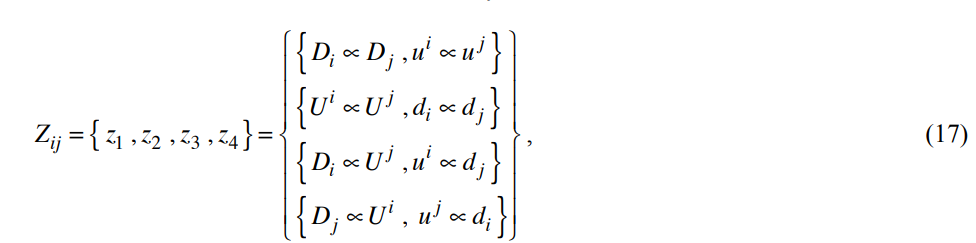
which will be written in short as:
Zij = íí C1 , c1ý , í C2 , c2 ý, í C3 , c3ý, í C4 , c4 ýý , (18)
so each zip can be written as:
zn = í Cn , cn ý with n Îí1 , 2 , 3 , 4 ý . (19)
Summarizing, the zipper is a set of four elements, containing all mathematical information about the interaction of Q-units Qi and Qj concerning one quality. Each of the four horizontal lines is one element, being zip zn. Each zip is a set of two mathematical items Cn and cn, the first is a major chain and the second is a minor chain. One of them may be empty, so a zip may consist of only a major chain, only a minor chain or both.
Note that the third and fourth zips in equation (17) are mirrored in the indices. In twin physics this has huge consequences, as it allows us for instance to describe the photovoltaic effect. We don’t know yet if it may be as important for phenomena in general.
Transformation from Mathematics into Reality
After having chosen a link operator to work the zipper out, we obtain the set of mathematical descriptions. Each resulting non-zero zip of the zipper has to be transformed into a real appearance of the phenomenon by applying a transformation operator.
The transformation of mathematical objects into physical items is a technique we owe to Schrödinger [5]. His famous equation contains an imaginary part, which disappears when the equation is applied to real physics. This so-called ‘collapse of the wave function’ is the first example of an explicit transformation of mathematics into physics, showing that a mathematical description not necessarily covers a physical phenomenon completely. Until that time, electric and magnetic fields were supposed to extend to infinity, only because an infinite coordinate system was used. We have gratefully made use of this technique, especially in reducing infinite fields to finite spaces.
The transformation operator will be indicated by square brackets, like in [x], with x being a mathematical object and [x] the belonging description in reality. This operator converts zip zn into an appearance, indicated by Ωn and written as:
with n ∈ {1, 2, 3, 4}. The symbol Ω (omega) is the Greek letter for O, being the first letter of observing.
Using equation (19), the appearance can be written as:
Wn = éë íCn , cn ýùû .
Each of the two chains will be transformed separately, so:
Wn = í[Cn ], [ cn ]ý .
If one of the two chains is empty, then this is the resulting appearance. But if both chains are non-empty, then we need one more step to obtain a single expression for the appearance of this zip. We will unite the transformed major and minor chains by applying a uniting operator, indicated by 
in such a way that the appearance can be written in one expression:

The union of two transformed chains is only possible if they are mutually coherent, in a way that makes sense for the given quality. If, for example, one chain represents an address and the other chain represents a city in which this address does not occur, then the transformed chains are not mutually coherent and so Ωn is an empty set, describing no phenomenon.
To preserve the complementary basis of the twin view, the uniting operator has to be defined in such a way that the attributes during this operation remain their determinate or indeterminate character.
For example, if Cn is a mathematical point of space P (a determinate attribute), and cn is a mathematical spherical space s (an indeterminate attribute), and P occurs inside s, then the transformations [P] and [s] will be united to [P] ∪ [s]. Note that, if only [s] would be chosen as the result, the determinate character of P would disappear.
More Qualities
According to equation (23), the set of appearances Ωij of zipper Zij for one quality of interaction Qi *Qj can be written as:
in which each element is no set anymore, but a single expression. We will consider the set of appearances if the phenomenon is characterized by three qualities, called a, b and c. For each of them a set of attributes has to be constructed, indicated by qi(a), qi(b) and qi(c). Note that the letter q in twin physics is used for ‘‘mark’ (because of a possibly appearing charge Q), whilst here it is used for a quality in general. Then the appearance of quality a is:
Wij (a) = íW1( a ) , W2( a ) , W3( a ) , W4( a )ý , (25)
for quality b:
Wij (b) = íW1( b ) , W2( b ) , W3( b ) , W4( b )ý , (26)
and for quality c:
Wij (c) = íW1( c ) , W2( c ) , W3( c ) , W4( c )ý . (27)
For a specific n, with n ∈ {1, 2, 3, 4}, one a-, one b- and one c-appearance together describe one appearance of the phenomenon in general, indicated by Ωn (Zij), so
Wn (Zij ) = íWn(a ) , Wn(b ) , Wn(c )ý , (28)
which will be called a Q-event. For clarity we will write them all out:
W1(a, b, c ) = íW1( a ) , W1( b ) , W1( c )ý , (29)
W2 (a, b, c ) = íW2( a ) , W2( b ) , W2( c )ý , (30)
W3 (a, b, c ) = íW3( a ) , W3( b ) , W1( c )ý , (31)
W4 (a, b, c ) = íW4(a ) , W4( b ) , W4( c )ý . (32)
In twin physics, in most cases only two elements are are non-zero. Sometimes it is even only one and the maximum is three Q-events. They may be collected in the set of Q-events, indicated by Ωij (a, b, c), as:
Wij (a, b, c ) = íW1(a, b, c ) , W2(a, b, c ) , W3(a, b, c ) , W4(a, b, c )ý
in which the indices i and j indicate the interacting Q-units Qi and Qj.
Defining Qualities, Attributes and Operators
After having presented the mathematical structure of twin physics in a generalized form, called the twin view for phenomena in general, we want to support the development of a complementary description. This requires a creative look upon the phenomenon you want to consider.
First you have to find the definition of a Q-unit, so a unit for your potential phenomenon. In twin physics this is potential energy, arising from the conviction that mass and space both arise from one and the same source of energy. In the commercial traffic it might be your potential equity; then it is important to make a difference between potential equity (being mathematics) and actual equity (being the reality), according to the common belief or your own conviction. For instance, in a period of economic crisis, the value of a bar of gold could be considered as determinate and the value of a house indeterminate (although the first also may change).
Next, relevant qualities of this Q-unit have to be recognized, such that we can imagine how to transform them into relevant features. Once you have chosen them, you have to search four attributes for each quality. Finding indeterminate attributes is the biggest challenge, as several ages of mainly deterministic oriented science have reduced our consciousness of this aspect considerably.
Once you have defined a complementary set of four elements, the twin view of the considered phenomenon is expected to be mastered relatively easily. Defining a link operator appropriate for the chosen attributes reflects how you want two Q-units to interact with each other. For instance, in the commercial traffic, adding up might suffice. Then the zipper can be deduced; in practice, by far not all Q-events will be non-empty. After defining a transformation operator you obtain a complementary description of the considered phenomenon, expressed in terms of certainty and uncertainty. This has to be identified with well-known phenomena in the chosen area, supplemented with aspects arising from indeterminism.
It does not seem to be possible to deduce a zipper for the interaction of more than two Q-units, but an extension of the amount of involved Q-units and so the amount of participating Q-units could be realized easily, as it is in twin physics (see [9], Chapter XV).
To support the application of the twin view to general phenomena, we will provide an elaborated example of choosing a unit, suitable qualities and attributes, by returning to the original theory. As we mentioned before, in twin physics a unit of potential energy is used to describe physical phenomena. Below we will give an impression of how we found the two sets of complementary attributes of space and time for this H-unit, including the experienced difficulties, hoping that a look at its history will inspire future users of the twin view. For the complete derivation, see Part 1 of [9].
Obviously, our first chosen quality was space. In making the first choices for space attributes, we felt supported by a publication of Von Weizsäcker [16] from 1941 (which was quoted in [7] page 94), in which he states that physical reality is either pointlike concentrated or else spread out in space; the former is described by the model of a particle, the latter by that of a field or wave.
So we started by defining a point Pi as the major determinate attribute Di , being an exact location, and called it the point of space. Next we defined a finite, three-dimensional sphere Si as the major indeterminate attribute Ui and called it the major space. Both the border and the center, being Pi , were excluded. Mind that we did not define Si as a collection of points, like in classical physics, but as a spatial area as a whole, without an exactly localized position. Together P and Si constitute space-system P ∪ Si, being an open sphere including the center, excluding each other, each alone not describing the complete system and so being complementary mathematical objects.
For the minor indeterminate attribute we defined a tiny sphere si as the minor indeterminate attribute ui (including central point P , excluding the border) and called it the minor space. Its character is similar to that of Si but this object is much less expanded. We expected that, after transformation into real space, this item could be useful to describe elementary particles, like protons and neutrons, which indeed turned out to be possible.
Contrary to these three attributes of space, the definition of the minor determinate attribute was a serious obstacle, as you cannot make a point of space smaller to create something like a ‘minor point’. Only the surface of Si qualified for a complementary object, but physical objects like that, in nature occurring incompletely as the skin of an orange, or a bubble, are totally unknown in atomic physics, so there was no reason to supply an H-unit with it. Another idea was that perhaps we could transform the complete surface into a single point, but that seemed too artificial; we tried this option anyway, but encountered unacceptable problems.
Finally we chose a collection of an arbitrary (but not infinite) amount of tiny spheres, called pellets, with an infinitesimally small radius, distributed over the surface of Si and together called pellicle pi . The fact that all pellets had the same distance to Pi supplied this composed object with a determinate character and their tiny spatial extension makes them less determinate than Pi . Moreover, we assumed that after transformation maximum two pellets could appear in the physical reality.
Together si and pi constitute a space system pi ∪ si ; they exclude each other, each alone cannot describe the complete system and so they are complementary mathematical objects. Although initially this choice seemed strange to us, we had no other choice and after all this step turned out to be very successful. Among other things, it was possible to describe the smallest particles like neutrinos and spin particles. The latter one is according to twin physics a tiny magnetized particle, moving with a very large speed across the surface of a proton and so providing it with a magnetic spin [17]. There is still no other explanation for the existence of magnetic spin in certain types of particles. In that way we obtained a set of space attributes, indicated by hi (r) as:
hi (r)=íPi , Si , pi , si ý , (34)
being point of space Pi , major space Si, pellicle pi and minor space si. We use spherical coordinates r as three of the four items are spherical. A schematic representation is given in Figure 1.
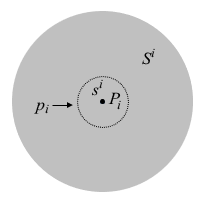
Figure 1: Two-dimensional schematic representation of the four space attributes of H-unit Hi
The second chosen quality in twin physics was time. It was obvious to define a point of time as the major determinate attribute and the future as the major indeterminate one. Next, from traditional physics, we could use an infinitesimal time difference dt as a minor attribute, but the fourth attribute was, similar to ‘space’, again a serious obstacle. For some years we were unable to solve it, until we discovered a booklet with registered lectures of Einstein between 1936 and 1950 [18]. In that booklet he suggested that, if for some reason four-dimensional spacetime had to be abandoned, one-dimensional time had to be treated mathematically exactly in the same way as three-dimensional space. We gratefully followed this suggestion by reducing the attributes of the quality ‘space’ to one dimension and replacing the space attributes in equation (34) by them, obtaining the set of time attributes as:
hi (t )=íTi , Fi , ti , f i ý . (35)
A schematic representation is given in Figure 2; mind that the horizontal line in Figure 2 indicates no time axis, but one point of time and three intervals, together representing the set of time attributes.

Figure 2: Schematic representation of the time attributes of an H-unit
Only afterwards we applied the best possible meanings to the obtained attributes. Obviously we chose point of time Ti as attribute Di(t) and future Fi as U i (t), but the latter was already slightly uncomfortable, because this future is a finite, arbitrary large, open interval, whilst in classical physics the future is endless. Nevertheless, this adaptation seemed acceptable. The flash τi (the one-dimensional version of a pellet) was defined as attribute di(t), a tiny interval during which a change can be observed, which is similar to classical physics.
The real surprise was f i (including T ) which had to take the role of u i (t). This interval is relatively small in comparison to F i, but much larger than τi. Something like this does not occur in classical physics. Because it corresponds to our everyday perception that the present ‘cannot be grasped’, we called it the flying time, providing the set with a minor uncertainty. This supplies the H-unit with a new type of uncertainty, somewhat like an elasticity of time. But we had no idea yet what this could bring us in twin physics. However, similar to the successful introduction of the pellicle, the flying time was as well successful in describing elementary physical phenomena and slowly, the surprise turned into a better understanding of the phenomenon of time.
During the flying time no change can be observed and no exact point of time can be hunted down. This reflects the physical reality better than a continous time-axis, because the notion of time is based on cyclic processes, like sunrise and sundown. Each cyclic phenomenon can be likened to a clock. By recording the moments when a cyclic process is finished, an axis of points of time can be established. By repeating the measurements more frequently and making the measurements more accurate, more points can be found in the same interval of time and so the clock will become more precise. In classical physics, by tacit consent the measurement points were extrapolated to a continuous time-axis. However, inevitably there will be a tiny interval between two subsequent measured points and so, time never will become a continuous phenomenon and so equation (35) is a more complete reflection of time. More details about the concept of time in twin physics can be found in [9], Section 5.1.
Note that the past is not represented in the set of time attributes. Mathematically, if the past would be represented, the set of time attributes could not be a one-dimensional analogue to the set of space attributes, as the radius of a sphere cannot be negative. Physically, if the past would play a role in physics, it should be observable and if it was observable, this could only be in the present or in the future, which is a contradiction and incompatible with any physical experiment.
Both unexpected successes in twin physics feed the expectation that a twin view for phenomena in general might open up new perspectives, as long as you are prepared to take unusual steps when searching for complementary attributes.
The third chosen quality in twin physics was mark, providing the H-units with potential charges and fields. In this way we introduced two types of H-units, a neutral and a charged one, by giving P a positive number, a negative one or zero. These were indicated by H i+, H i- and Hoi , each still having the same amount of potential energy. For the zipper of this quality, we refer to the textbook [9].
The number of Hi + or Hi - will be transformed into a positive or a negative charge, respectively. So H-unit H0i has to spend its potential energy only to space, whilst Hi + and Hi - have to spend their potential energy also to generate real charges and fields. This created the i i possibility to consider a neutral major space as having an astronomic size and a marked major space as having an atomic or molecular size. By allowing mixed interactions, a connection between large-scale and small-scale physical phenomena could be created.
By involving the quality ‘mark’ it was possible to find a benchmark [17] for the potential energy of H-units, by requiring that the potential energy of two coinciding, positive charged H-units transform into one actual proton. This resulted in a remarkably simple relationship between Planck’s constant and the speed of light, so a connection between theory and practice was established (see [9] Section 8.2).
After having described three physical qualities in a complementary way and having worked out the interactions of two H-units in all combinations for each quality, we obtained 7 descriptions for equally sized space interactions, 12 for mixed sized ones, 5 for time interactions and 3 for mark interactions. They are all elaborated separately in the textbook. A selection of combined space, time and mark appearances has been transformed and identified with recognizable, real physical phenomena. To give an impression of the sometimes surprising results, we will mention the description of four distinct types of electrons [19].
Two of them have mass in the form of a cap (in two sizes) with a negative charge in the center, having an associated spin particle traveling along its border. So an electron of this type is described by one zip, and the spin particle by another zip of the same zipper. Two other types of electrons have no mass, they are negatively charged pointspaces, occurring inside an associated finite magnetic field. Also an electron of this type is described by one zip, and the magnetic field by another zip of the same zipper. The associated objects, being the spin particles and the finite magnetic fields, are the surprises of twin physics. It seems that several contemporary questions in physics can be answered with this.
Conclusion
The results of twin physics are such that we felt justified in generalizing this theory to a twin view, suitable for application in phenomena in general, for instance in health care or in the commercial traffic.
We carried this out by generalizing the starting points of twin physics and applying the same method to arrive at a complementary description of phenomena in general. There doesn't seem to be any obstacle to this generalization. By way of support for future users, some initial problems and solutions in the development of twin physics are explained.
When applying a twin view to phenomena in general, you having to choose another unit and other qualities than in twin physics. We recognize that finding a suitable unit will be demanding. Moreover, defining indeterminate descriptions for phenomena in general, which traditionally have been estimated only according to their determinate merits, will presumably require a creative, open mind. But if successful, the twin view will provide a more comprehensive picture of the considered type of phenomena, as it will also include indeterminate aspects.
References
The publications of Backerra can be downloaded or viewed at www.itammagnetics.com.
- Planck, M. (2016). Planck’s radiation law. Encyclopaedia Brittannica, The Editors of, (n.d.).
- Einstein, A. (1905). Does the inertia of a body depend upon its energy-content?
- White, H. E. (1964). Introduction to atomic and nuclear physics. New York, NY: Van Nostrand Reinhold Company.
- Davisson, C. J., & Germer, L. H. (1928). Reflection of electrons by a crystal of nickel. Proceedings of the National Academy ofSciences, 14(4), 317-322.
- Schrödinger, E. (1935). The present situation in quantum mechanics, translation of John D. Trimmer, Proceedings of the American Philosophical Society, 124, 323-38.
- Heisenberg, W. (1971). Schritte über Grenzen, Erweiterte Ausgabe R Piper & Co. Verlag, München.
- Jammer, M. (1974). The Philosophy of Quantum Mechanics. New York, NY: John Wiley and Sons.
- Backerra, A. (2010). Uncertainty as a principle. Physics Essays, 23(3), 419-441.
- Backerra, A. (2025). Twin Physics: the Textbook. LAP Lambert Academic Publishing, 120 High Road, East Finchley, London, N2 9ED, United Kingdom.
- Backerra, A. C. M. (2022) Electron creation by photon annihilation according to twin physics, Nano Prog., 4(8), 6-21
- Backerra, A. C. M. (2020). The Importance of Magnetism in Understanding the Impact of the Corona Virus. J Nanomedine Biotherapeutic Discov, 10, 166.
- Backerra, A. C. M. (2022). Magnetism, the Unknown Side of Health. Acta Scientific Pharmaceutical Sciences, 6(1), 101-105.
- Backerra, A. C. M. (2023). A Conceptual Basis for Gender to Support a Balanced Emancipation of Both Sexes, Acta ScientificMedical Sciences, 7(7), 89-96.
- Von Weizsäcker, C. (1955). Komplementaritat und Logik. Naturwissenschaften, 42(20), 545-555.
- Kahn, P. J. (1967). Introduction to Linear Algebra. London: Harper & Row, Ltd.
- Weizsäcker, von, C. F. (1941) Zur Deutung der Quantenmechanik. Zeitschrift für Physik, 118, 489-509.
- Backerra, A.C.M. (2019). Relation between Planck’s constant and speed of light, predicting proton radius more accurately. Applied Physics Research, 11(5), 1-9.
- Einstein, A. (1996), The theory of relativity (and other essays). Posthumous publication of lectures between 1936 and 1950. Citadel Press Books, Carol Publishing Group edition.
- Backerra, A.C.M. (2021). Four types of electrons and their associated finite magnetic fields. Nano Progress, 3(5), 17-33.