

Space Science Journal(SSJ)
ISSN: 2997-6170 | DOI: 10.33140/SSJ


Research Article - (2025) Volume 2, Issue 1
Cauchy-Riemann Conditions for the Maxwell’s Equations of a Single-Frequency Quaternion
Received Date: Feb 03, 2025 / Accepted Date: Feb 28, 2025 / Published Date: Mar 05, 2025
Copyright: ©Â©2025 Vadim Sovetov. This is an open-access article distributed under the terms of the Creative Commons Attribution License, which permits unrestricted use, distribution, and reproduction in any medium, provided the original author and source are credited.
Citation: Sovetov, V. (2025). Cauchy
Abstract
As is known, hypercomplex numbers have both a scalar part and imaginary parts. Unlike the well-known Maxwell equations, the equations written for a quaternion in 4D hypercomplex space also have a scalar part. Since these equations are obtained mathematically by multiplying a quaternion in vector representation by a differential operator of a quaternion in matrix representation, the quaternion is a solution to this equation.
It is shown that by solving the presented equations, it is possible to obtain two types of waves: magnetic and electric, using, respectively, magnetic and electric intensities. Quaternion waves contain particles that are formed from magnetic or electric intensities through the operation of scalar multiplication by the Hamiltonian operator. Magnetic waves have charged electrons as particles, and electric waves have electron spins (rotors).
The obtained equations satisfy the Cauchy-Riemann conditions and, consequently, the requirements of conservation of energy during transformations.
Keywords
Maxwell’s Equations, Quaternion, Circulation, Rotor, Cauchy-Riemann Conditions
Introduction
In 1873, Maxwell united electric and magnetic fields into a single theory of electromagnetism based on four fundamental equations. An important conclusion of this theory was the prediction of electromagnetic waves that propagate at the speed of light. These predictions were confirmed by Hertz's experiments in 1887. The discovery of electromagnetic waves and the development of electronic devices to generate them revolutionized telecommunications in the 20th century.
However, subsequent physical experiments showed that space and time form a single system that does not satisfy the Galilean transformation for inertial systems. The unity of space and time is substantiated in the theory of relativity on the basis of the Lorentz transformation.
Maxwell's equations for electromagnetic waves, obtained in 3D space, clearly did not show the relativity of space and time. However, Maxwell's equations, obtained for a quaternion in 4D space, use 4 coordinate axes, one of which is scalar and the other 3 are imaginary. Imaginary axes in 3D space have the dimension of frequencies and, accordingly, form a connection between frequency, i.e. the time scale, and the location of a point in space [1]. Moreover, this idea is consistent with M. Planck’s hypothesis about the dependence of the energy of elementary particles on frequency.
Physical experiments have also shown the discreteness of the atomic radiation spectrum, which does not follow from Maxwell's equations. As a result, quantum theory emerged, which proves that the energy of elementary particles changes in jumps or quanta. When deriving Maxwell's equations using a quaternion in 4D space, the electron is represented as a 4D vector with one scalar part and three imaginary parts. It has been shown that when the law of conservation of energy is fulfilled, the spatial movement of electrons occurs in jumps and their movement occurs in an orbit without loss of energy and the action of gravitational forces [1].
The aim of the article is to show that Maxwell's equations for a single-frequency quaternion satisfy the Cauchy-Riemann conditions and,consequently, the law of conservation of energy.
Materials and Methods for Solving the Problem
Let us write the quaternion in algebraic representation form as
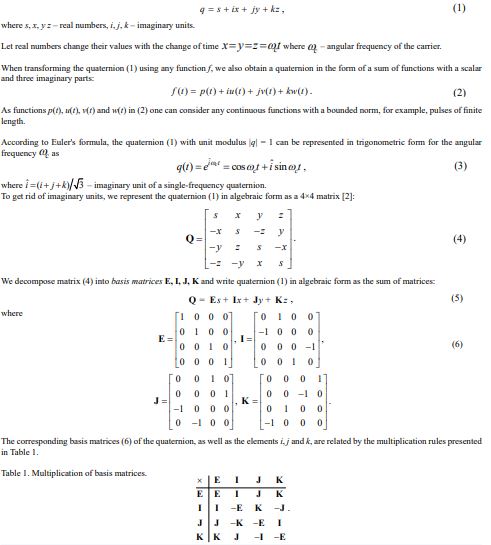
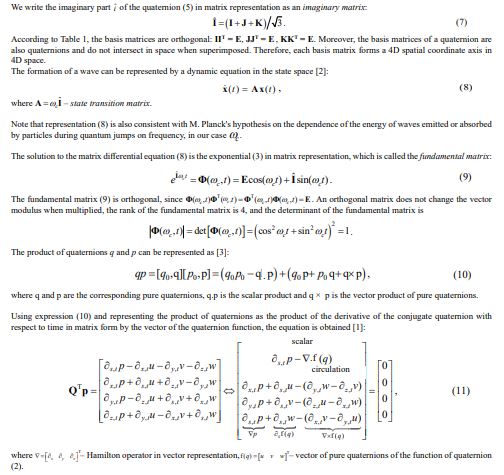
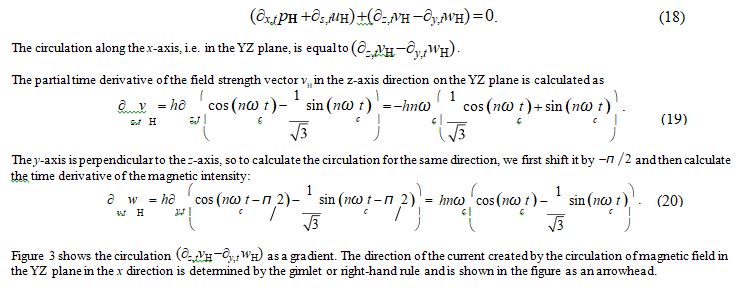
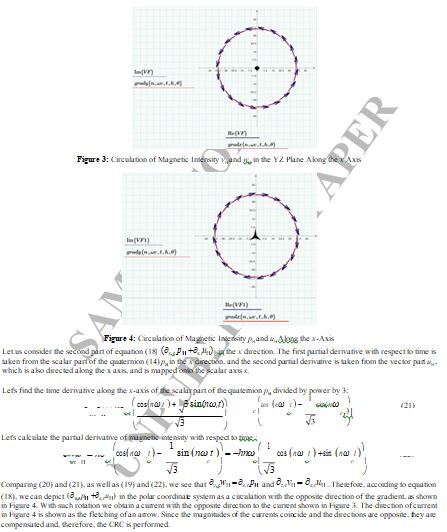
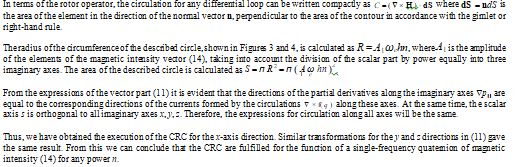
Note that each component of circulation shows a difference in the rates of change in different directions, which corresponds to the tendency of rotation in one of the coordinate planes. If there is a circulation of the field at the point of the x-component, then it means that the field has a circulation around this point in the YZ plane.
Since the derivative in (11) is taken over the conjugate quaternion, then based on the Cauchy-Riemann conditions (CRC), the elements of the resulting vector (11) must be equal to zero. Obviously, the solution to this vector equation will be a quaternion. Consequently, in the obtained vector (11), instead of a function of a quaternion f(q) and, accordingly, a pure quaternion f(q), one can use the vectors of electric E or magnetic intensity H as quaternions or as pure quaternions E and H.

(11) one can also use the electric D or magnetic B fluxes with the corresponding permeabilities.
Thus, using the operation of multiplying quaternions in vector representation and using the CRÃÃÂ?¡, a quaternion vector is obtained, the elements of which consist of a scalar part and a vector part. The ÃÃÂ?¡RÃÃÂ?¡ correspond to the law of conservation of energy, therefore, the elements of the resulting vector must be equal to zero. Using this expression, Maxwell's equations for magnetic and electric waves were obtained [1]. Since the equality to zero of vector (11) was obtained using a quaternion, the solution to the vector equation will also be a quaternion
Calculation of Cauchy-Riemann Conditions for a Single-Frequency Quaternion
Using the expressions presented above for a single-frequency quaternion, we obtain the CRC for magnetic and electric waves.
Cauchy-Riemann Conditions for Magnetic Waves of a Single-Frequency Quaternion
For magnetic intensity H, expression (11) is represented as [1]:
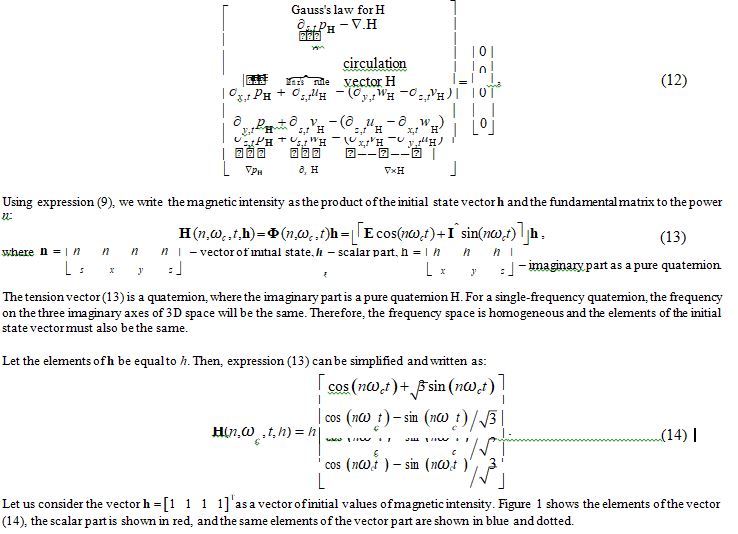
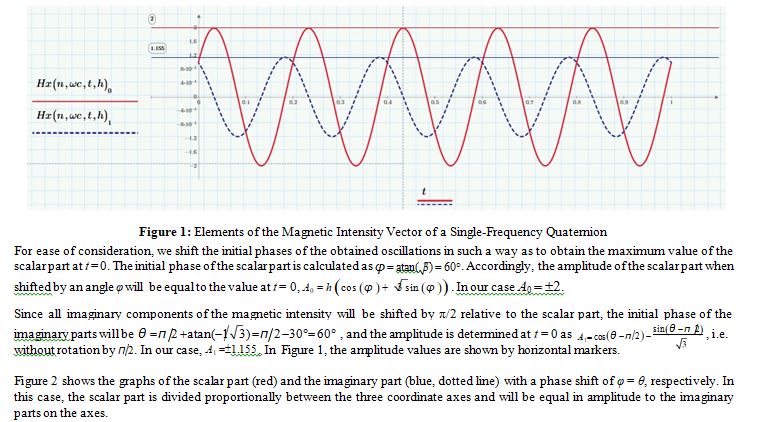
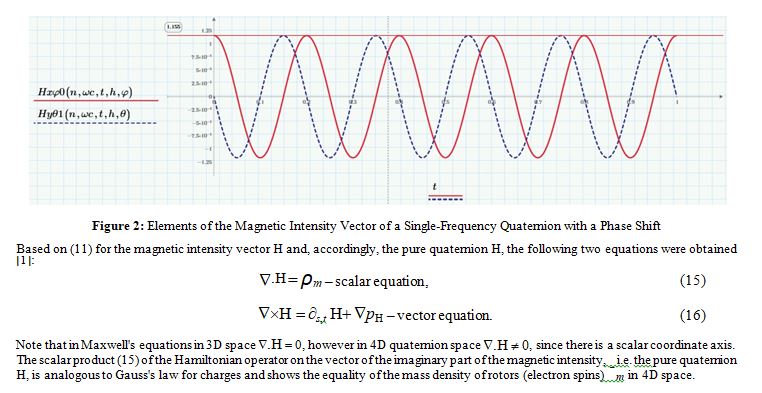
Figure 2 shows the graphs of the scalar part (red) and the imaginary part (blue, dotted line) with a phase shift of φ = θ, respectively. In this case, the scalar part is divided proportionally between the three coordinate axes and will be equal in amplitude to the imaginary parts on the axes.
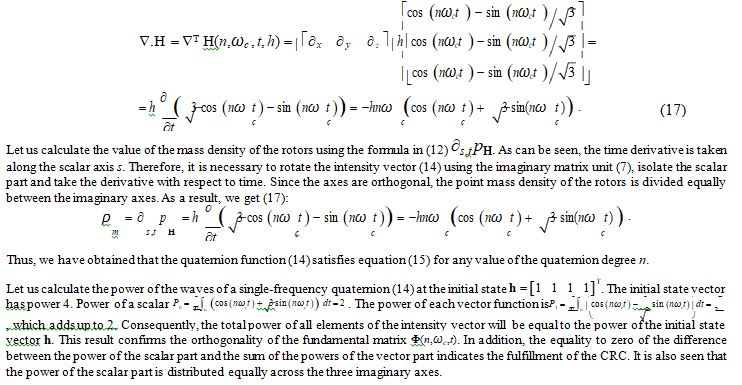
Let us calculate the values of equation (15) for the magnetic intensity function (14). It is necessary to take into account that the derivatives are taken along the orthogonal axes x, y, z and are added as vectors. We write the scalar product <.H as follows:
The vector part (16) corresponds to Maxwell's equation in 3D for the circulation of magnetic intensity. However, instead of the induced magnetic intensity (eddy) current J in the conductor, the electromotive force (EMF) ï?¶s,t that creates this current is shown. In addition, as is known, Maxwell added electric current to Ampere's equation, obtained by changing the electric flux D over time. In (16) it is
mathematically shown that electric current is formed by changing the scalar part of the magnetic intensity vector pH along all three coordinate axes x, y, z [1].
Let us calculate the execution of the CRC for the vector equation (16) in the x direction of the imaginary coordinate axis. Let us represent equation (11) for magnetic intensity in the x direction as:
Cauchy-Riemann Conditions for Electric Waves of a Single-Frequency Quaternion
For electrical intensity E, expression (11) is represented as [1]:
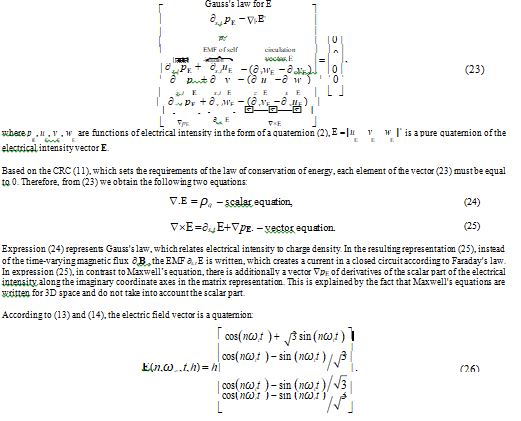
The graphs of the elements of vector (26) will be similar to the graphs shown in Figures 1 and 2 for magnetic intensity. The scalar equation (24) for the electric field strength is similar in form to equation (15) for the magnetic field strength and shows that the mass density of the electron charges ρq is equal to the scalar product of the electric field strength and the Hamiltonian operator in 4D space.
Since the quaternion of electric intensity (26) is the same as the quaternion of magnetic intensity (14), then according to (17) the quaternion function (26) also satisfies equation (24) and, consequently, the law of conservation of energy, i.e. the law of conservation of energy for any value of the degree of the quaternion n.
Similarly, according to equation (18), it can be shown that equation (25) for the electric field strength in the x-axis direction is:

The circulation of electrical intensity will have the form shown in Figures 3 and 4 for magnetic intensity. Having calculated the circulations for the y and z axis directions, we obtain that the CRC are also fulfilled for electrical intensity.
Thus, we have obtained that the electric and magnetic intensities of Maxwell's equations for a single-frequency quaternion in the form of a 4D vector satisfy the Cauchy-Riemann conditions.
Conclusion
Thus, using the quaternion multiplication operation and the Cauchy-Riemann conditions in vector representation, a quaternion vector is obtained, the elements of which include scalar and vector parts. The Cauchy-Riemann conditions correspond to the law of conservation of energy, therefore, the elements of the resulting vector must be equal to zero. It is shown that the equality of the scalar element to zero corresponds to Gauss's law for electrons and their spins. The vector elements of a quaternion create a circulation of intensities in vector space. Their equality to zero is due to the different direction of rotation of the left and right parts of the equations. Since all elements of the resulting quaternion vector are equal to zero, the solution to the vector equation will also be a quaternion.
References
1. Vadim Sovetov. Maxwell's quaterion equations.
2. Sovetov, V. (2024). The MIMO data transfer line with three-frequency quaternion carrier. Journal of Sensor Networks and Data Communications, 4(2), 01-17.
3. Morais, J. P., Georgiev, S., & Sprößig, W. (2014). Real quaternionic calculus handbook.