

Archivos de Ciencia e Investigación(ADCI)
ISSN: 3068-014X | DOI: 10.33140/ADCI


Short Communication - (2025) Volume 1, Issue 1
Candy Waste to Produce Bioplastics and Natural Pigments Using Haloarchaea From the Salt Flats of Alicante County (Spain)
2Biochemistry, Molecular Biology, Edaphology and Agricultural Chemistry Department, Faculty of Scienc, Spain
Received Date: Mar 16, 2025 / Accepted Date: Jun 17, 2025 / Published Date: Jun 27, 2025
Copyright: ©Â©2025 Rosa MarÃa MartÃnez-Espinosa. This is an open-access article distributed under the terms of the Creative Commons Attribution License, which permits unrestricted use, distribution, and reproduction in any medium, provided the original author and source are credited.
Citation: Espinosa, R. M. M. (2025). Candy Waste to Produce Bioplastics and Natural Pigments Using Haloarchaea From the Salt Flats of Alicante County (Spain). Arch Cienc Investig, 1(1), 01-04.
Abstract
The haloarchaeon Haloferax mediterranei (halophilic microorganism) has been used as a cell factory to produce the natural pigment called bacterioruberin (BR) and the biodegradable biopolymer termed poly(3-hydroxybutyrate-co-3- hydroxyvalerate) (PHBV). During the last two decades, these two biomolecules have been revealed as promising tools in different sectors due to biological activities in the case of BR, or due to biodegradable plastic properties shown by PHBV. Both molecules can be produced at the same time by the same microorganism, but modulating nutritional conditions or using engineered strains, the production of one of them can be improved at the detriment of the other. To make the upscaling of the production economically feasible, residues from candy industries have been used as nutrients for the cells to grow and to produce these two highly marketed biomolecules. Thus, a circular economy-based process has been optimised in which, thanks to the metabolic versatility of the microorganism and biotechnological approaches, residues from other industries have been valorised to produce natural compounds following eco-friendly practices.
Keywords
Haloarchaeon, Haloferax mediterranei, Bacterioruberin, Bioplastics, Poly(3-Hydroxybutyrate-Co-3-Hydroxyvalerate), Circular Economy, Candy Residues Valorisation
Introduction
Ecosystems like inland lakes, lagoons, salterns, marshes, or coastal/inland salty ponds are relatively abundant and widespread in countries such as the United States of America, Australia, Mozambique, Iran, Israel, Argelia, Spain or Canada and are classified as "hypersaline environments" because they have higher salt concentrations than seawater (around 3.5% w/v in seawater vs. up to 35% w/v in brines) [1].
Most of the knowledge about hypersaline ecosystems has been reported from Mediterranean salterns. In the case of Spain, salterns (also called salt ponds or salt flats) are mainly located in the south and southeast of Spain (Alicante, Murcia, or Huelva counties) and have favourable features for their extensive study: easy accessibility to these environments, a clear gradient from seawater to salt saturation that allows studies of the microorganisms at each location, constant salinity of each pond, etc. [2-4]. Some of these natural environments have been relevant over the centuries in terms of salt mining to extract NaCl for cooking, food storage, road maintenance in winter, or to be used in chemical formulations [3]. However, in the last few decades, those ecosystems have attracted the attention of the scientific community due to the richness of microbial diversity in brines, their molecular adaptations to high salt concentration, and their potential applications in biotechnology (as whole cells or some of their biomolecules).
Halophilic Microorganisms with Potential Applications in Industrial Processes
Saline environments are inhabited by microorganisms of the three domains of life (Archaea, Bacteria and Eukarya) [5]. The main feature characterising them is their high salt requirement to be alive (up to ten times higher than the concentration of salt in seawater); most of the species are considered polyextremophiles because they are well adapted not only to these high salt concentrations but also to other extreme environmental parameters like extremely high and low pH or high temperature values [6].
Microorganisms living in the salt crust, mud, and water column of salt mines and salt pans around the world have become an inexhaustible source of advances at the forefront of knowledge in diverse fields, including biomedicine, bioremediation technologies for contaminated water and soil, climate change, and the production of natural compounds with applications in cosmetics, pharmaceuticals, and food [7-10].
Among halophiles, the most extremophilic profiles are those shown by microorganisms of the Archaea domain, mainly the microorganisms grouped into the families Halobacteriaceae and Haloferacaceae (all together commonly termed haloarchaea). Regarding haloarchaea, perhaps the most recent and globally recognised basic research of high impact and innovation is that developed by Dr. Martínez Mojica and coworkers, which gave rise to the CRISPR-Cas technology for genetic material editing, thanks to the contribution of many other researchers worldwide [11,12]. Besides, many other applications in the fields mentioned have also been reported using haloarchaeal as model organisms due to their metabolic versatility [7-10]. However, more efforts must be made shortly to upscale the use of haloharchaeal cells (i.e. bioremediation of wastewater) or the production of some of their biomolecules. In this context, challenges associated with the corrosion of the facilities and equipment needed to grow the halophilic microorganism in the presence of high salt concentrations, or the use of low-cost sources of nutrients for cellular growth and biomolecule production, are still a limitation to fully reach time and cost-efficient processes able to be competitive in the market. These limitations are the basis for studies such as the one summarised here, based on a circular economy model.
Haloarchaea as Cellular Factories to Produce Natural Pigments and Bioplastics Through a Circular Economy-Based Process Recycling Candy Waste
The haloarchaeon Haloferax mediterranei was characterised as a halophile able to produce PHBV without the addition of precursors and the natural pigment called BR, whose antioxidant capacity is 300 times greater than that of any other natural pigment studied to date [13-16]. Considering the potential impact of the use of BR and PHBV in several industrial processes, some studies have been recently conducted to overproduce these biomolecules. On one hand, by mimicking the environmental conditions of salt marshes (which are the best for haloarchaeal growth) and optimising the nutritional conditions and parameters such as temperature, brine pH, aeration, and lighting, H. mediterranei wildtype strains have been grown optimally in the laboratory, ensuring the production of PHBV and BR all without genetic modification [3,7]. On the other hand, engineering strains have been obtained to overexpress some of the key enzymes involved in the synthesis of PHBV or BR, thus enhancing the production of PHBV, BR and even other natural pigments like lycopene [17-19]. The combination of these two strategies has made a qualitative and quantitative leap in the production of PHBV and BR using H. mediterranei in the last 5 years. Thus, the most recent objective has been to scale up the production of these natural compounds to offer the market an alternative to chemically synthesised plastic (in the case of PHBV) and a new solution for food preservation and the development of new products in cosmetics, nutraceuticals, and pharmacology (in the case of BR).
Recent results showed that efficient laboratory coproduction of PHBV and BR was possible, but at a cost that made the process uncompetitive in the natural pigment and bioplastics market. This was mainly due to the high cost of preparing the saline culture media required for the growth of the microorganism and the need to add a large amount of carbon-rich nutrients (glucose) to assure the synthesis of significant concentrations of PHBV and BR (both of which are very rich in carbon). In this context, wastes from different industrial processes have been used as raw materials for haloarchaeal growth when used as cell factories to produce biomolecules to design circular economy-based processes that can be feasible and market competitive. Regarding this concept, research carried out in 2024, incorporating waste from the candy industry as raw materials into the PHBV and BR production process, has shown that H. mediterranei can grow and optimally produce bioplastics and natural pigments [20,21]. In the design of the valorisation of candy residues, gummy candy residues provided by the company Vidal Golosinas SA (Murcia, Spain; https://www. vidalgolosinas.com/) were used (starch waste and small purple pellets (basically sugar with reddish or purple food colouring) that are used in the production of various types of gummy candy by the company, commonly known as "blackberries"). These residues have been used as part of the liquid culture media used to grow haloarchaea. Thus, these residues have been used as food to grow haloarchaea in optimal conditions to produce both types of natural compounds (Figure 1).
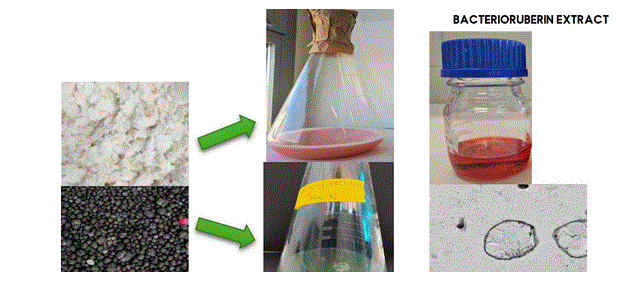
Figure 1: Graphical abstract of the circular economy-based process optimised to produce poly(3-hydroxybutyrate-co-3-hydroxyvalerate) (PHBV) and bacterioruberin (BR) using the haloarchaeon Haloferax mediterranei as a cell factory and candy residues as raw materials for cellular growth and PHBV/BR production. The electron microscopy picture displayed on the right-hand side was obtained by Dr. Yolanda Segovia Huertas (University of Alicante). The white granules inside the cells correspond to PHBV granules
The results obtained show that H. mediterranei can grow adequately and produce a PHBV at concentrations between 0.256 and 0.983 g PHBV/L, using the two gummy bear residues employed. This bioplastic is in high demand in some sectors, such as the medical sector (surgical and prosthetic materials), due to its unique physicochemical properties. Therefore, it could meet specific needs in these sectors compared to the properties offered by other chemically synthesised polymers, and all at competitive prices in the global bioplastics market [20].
Finally, concerning BR, the results obtained using candy waste as food for the pigment-producing microorganisms show that the microorganisms grew as they do in the laboratory with optimal culture media, producing the highest concentrations of BR that had been previously observed under optimised laboratory conditions for pigment synthesis (around 98 µg/mL) [21].
Conclusion
This study is the first to propose the valorisation of waste from the confectionery industry by using it as raw material for the fermentation process of a haloarchaea that enables the co- production of PHBV and BR. Thus, a circular economy process has been designed and completed that valorises a very common industrial waste product in the confectionery industry in general, and the candy industry in particular. According to recent data (annual period 2024 and early 2025) from various business platforms and statistical databases, leading Spanish companies in the sugar, confectionery, candy, and sweets sectors, both nationally and internationally, have an average annual turnover of $22 billion and involve a population of over 66,000 people in Spain. This is one of the sectors that has experienced an annual sales increase of between 12 and 18% in the last three years. Furthermore, this is a sector that has made significant efforts in recent years to advance sustainability, implementing innovative processes that reduce the water footprint and CO2 production, and minimise the loss of raw materials. In this sense, circular economy processes like the one developed here contribute to reducing the impact that the candy industries and other derivative industries can have by recovering organic solid waste generated during the production of sweets, candies, and treats.
Acknowledgement
This research has been funded by Generalitat Valenciana (PROMETEO/2021/055), European Commission (Agro2circular: Grant agreement ID: 101036838 and upPE-T: Grant agreement ID: 953214) and the University of Alicante (VIGROB 309). Collaborations have also been established with Centro Tecnológico del Plástico y el Calzado de Murcia (https://ceteccentrotecnologico. org/es/centro-tecnologico-del-calzado-y-el-plastico/) and the company Cetec Biotechnology (https://www.cetecbiotechnology. es/) to produce and characterise PHBV.
References
1. McGenity, T. J., & Oren, A. (2012). Hypersaline environments. In Life at extremes: environments, organisms and strategies for survival (pp. 402-437).
2. Casamayor, E. O., Massana, R., Benlloch, S., Øvreås, L., Díez, B., Goddard, V. J., ... & Pedrósâ?Alió, C. (2002). Changes in archaeal, bacterial and eukaryal assemblages along a salinity gradient by comparison of genetic fingerprinting methods in a multipond solar saltern. Environmental Microbiology, 4(6), 338-348..
3. Martínez, G. M., Pire, C., & Martínez-Espinosa, R. M. (2022). Hypersaline environments as natural sources of microbes with potential applications in biotechnology: The case of solar evaporation systems to produce salt in Alicante County (Spain). Current research in microbial sciences, 3, 100136..
4. Gómez-Villegas, P., Vigara, J., & León, R. (2018). Characterization of the microbial population inhabiting a solar saltern pond of the Odiel Marshlands (SW Spain). Marine
drugs, 16(9), 332.
5. Oren, A. (2002). Diversity of halophilic microorganisms: environments, phylogeny, physiology, and applications. Journal of Industrial Microbiology and Biotechnology, 28(1), 56-63.
6. Bowers, K. J., Mesbah, N. M., & Wiegel, J. (2009). Biodiversity of poly-extremophilic Bacteria: does combining the extremes of high salt, alkaline pH and elevated temperature approach a physico-chemical boundary for life?. Saline systems, 5, 1-8.
7. Moopantakath, J., Imchen, M., Anju, V. T., Busi, S., Dyavaiah, M., Martínez-Espinosa, R. M., & Kumavath, R. (2023). Bioactive molecules from haloarchaea: Scope and prospects for industrial and therapeutic applications. Frontiers in Microbiology, 14, 1113540..
8. Gaonkar, S. K., Alvares, J. J., & Furtado, I. J. (2023). Recent advances in the production, properties and applications of haloextremozymes protease and lipase from haloarchaea. World Journal of Microbiology and Biotechnology, 39(11), 322.
9. Singh, A., & Singh, A. K. (2017). Haloarchaea: worth exploring for their biotechnological potential. Biotechnology letters, 39, 1793-1800.
10. Li, J., Gao, Y., Dong, H., & Sheng, G. P. (2022). Haloarchaea, excellent candidates for removing pollutants from hypersaline wastewater. Trends in Biotechnology, 40(2), 226-239.
11. Mojica, F. J., Díez-Villaseñor, C., Soria, E., & Juez, G. (2000). MicroCorrespondence. Molecular microbiology, 36(1).
12. Mojica, F. J., Díez-Villaseñor, C., García-Martínez, J., & Almendros, C. (2009). Short motif sequences determine the targets of the prokaryotic CRISPR defence system. Microbiology, 155(3), 733-740.
13. Lu, Q., Han, J., Zhou, L., Zhou, J., & Xiang, H. (2008). Genetic and biochemical characterization of the poly (3-hydroxybutyrate-co-3-hydroxyvalerate) synthase in Haloferax mediterranei. Journal of bacteriology, 190(12), 4173-4180.
14. Longo, A., Fanelli, F., Villano, M., Montemurro, M., & Rizzello, C. G. (2024). Bioplastic Production from Agri- Food Waste through the Use of Haloferax mediterranei: A Comprehensive Initial Overview. Microorganisms, 12(6), 1038.
15. Fang, C. J., Ku, K. L., Lee, M. H., & Su, N. W. (2010). Influence of nutritive factors on C50 carotenoids production by Haloferax mediterranei ATCC 33500 with two-stage cultivation. Bioresource technology, 101(16), 6487-6493.
16. Giani, M., & Martínez-Espinosa, R. M. (2020). Carotenoids as a protection mechanism against oxidative stress in Haloferax mediterranei. Antioxidants, 9(11), 1060.
17. Zuo, Z. Q., Xue, Q., Zhou, J., Zhao, D. H., Han, J., & Xiang, H. (2018). Engineering Haloferax mediterranei as an efficient platform for high level production of lycopene. Frontiers in microbiology, 9, 2893.
18. Zhou, M., Xu, Y., Li, J., Han, Y., Yu, H., Qi, L., ... & Han, J. (2025). Promoter engineering for enhanced poly (3-hydroxybutyrate-co-3-hydroxyvalerate)(PHBV) production in Haloferax mediterranei. International Journal of Biological Macromolecules, 143237.
19. Lin, L., Chen, J., Mitra, R., Gao, Q., Cheng, F., Xu, T., ... & Han, J. (2021). Optimising PHBV biopolymer production in haloarchaea via CRISPRi-mediated redirection of carbon flux. Communications biology, 4(1), 1007.
20. Simó-Cabrera, L., García-Chumillas, S., Benitez-Benitez, S. J., Cánovas, V., Monzó, F., Pire, C., & Martínez-Espinosa, R. M. (2024). Production of poly (3-hydroxybutyrate-co-3- hydroxyvalerate)(PHBV) by Haloferax mediterranei using candy industry waste as raw materials. Bioengineering, 11(9), 870.
21. Giani, M., Pire, C., & Martínez-Espinosa, R. M. (2024). Carotenoid production by Haloferax mediterranei using starch residues from the candy industry as a carbon source. Current Research in Biotechnology, 8, 100265.