

International Journal of Orthopaedics Research(IJOR)
ISSN: 2690-9189 | DOI: 10.33140/IJOR

Impact Factor: 1.6

Short Communication - (2025) Volume 8, Issue 2
Calcaneal Evidence of Crucifixion: A Skeletal Analysis
Received Date: Mar 08, 2025 / Accepted Date: Mar 31, 2025 / Published Date: Apr 10, 2025
Copyright: ©2025 Christine Miller, This is an open-access article distributed under the terms of the Creative Commons Attribution License, which permits unrestricted use, distribution, and reproduction in any medium, provided the original author and source are credited.
Citation: Miller, C. (2025). Calcaneal Evidence of Crucifixion: A Skeletal Analysis. Int J Ortho Res, 8(2), 01-03.
Abstract
Crucifixion is an execution method which is a deliberately cruel and degrading form of punishment. This method of execution was popularized during the height of the Roman Empire and still utilized in the 20th century in concentration camps during World War II. While several historical accounts describe in detail the horrors of crucifixion, including the famed Spartacus rebellion where 6000 people were crucified along the main road from Capua to Rome, there has been little physical evidence in the way of paleopathology recovered throughout the ages to verify its existence. The few examples of evidence unearthed from excavation sites in Israel, Italy, and the United Kingdom are primarily heel bones (calcanei) with nails embedded in them provide concrete evidence to support its occurrence. Skeletal analysis of these individuals confirms what true crucifixion actually was like and the variety of methods used which differ from artistic renderings often seen in the modern era. While there remains debate regarding the true cause of death related to crucifixion practices, one constant factor is the nailing of the feet to a wooden structure. The durability of the calcaneal bones despite enduring trauma and decomposition has provided modern scholars an accurate albeit horrifying glimpse into the past. The trauma found in the calcanei along with other skeletal indications reveal the likely social status of these victims who endured crucifixion in different geographical regions throughout the Roman empire. This article explores the cross-section of history and archaeology with an emphasis on the bones of the feet.
Keywords
Foot, Calcaneus, Skeletal Analysis, Archaeology
Introduction
Crucifixion is defined as an execution method in which a person is hanged, usually by their extremities until death and has been utilized in many parts of the world since ancient times [1]. This brutal form of execution is a degrading public punishment originating in ancient Assyrian and Babylonian cultures [2]. The Roman Empire, however, adopted this practice with great zeal using it primarily against slaves, foreigners, political prisoners, common criminals, and Christians [2]. Crucifixion is specifically designed to cause severe pain hence the derivation of the word excruciating meaning “out of the cross” [2]. The body was either tied or nailed to a cross beam most probably through the wrists and feet [2]. The calcaneus (heel) is a strong and large bone that transfers most of the body weight from the lower extremity to ground and is the largest of the seven articulating bones in the tarsus [3]. For these reasons, the calcaneus was an opportune anatomic site for nail application during crucifixion to ensure a prolonged and painful demise.
Purpose
The durable structure of the calcaneus has allowed modern archaeology the opportunity to confirm the practice of crucifixion which has had a great impact on religion particularly Christianity throughout the modern world. The common identifier being bones from the feet indicate that from a paleopathology standpoint skeletal architecture of the lower extremity has great value in the realms of both forensic sciences and archaeology.
Methodology
An extensive literature review was performed regarding the medical impact of crucifixion with most sources focused on the speculated cause of death from this brutal punishment. Little was available on the actual physical evidence uncovered that confirmed this execution method actually took place. These documented sources where osseous remains with nails embedded within the bones of the foot are archaeological sources and also cite the rarity of these findings.
Results
Crucifixion though widely documented throughout antiquity has left very few physical remains, until 1968 during an excavation in Jerusalem where an ossuary of a crucified man named “Yehohanan son of Hagakol” was uncovered [4]. Skeletal analysis revealed his estimated height to be about 5 feet 6 inches and in his mid to late twenties at time of death [4]. Osseous examination demonstrated no signs of chronic illness or nutritional deficits, with the only pathology noted was that of a nail embedded in both calcanei [4]. The nail penetrated the right heel than the left, which indicated the legs were fixed together on the cross with knees likely bent to induce great suffering [4]. A slight scratch in the right radius is likely from a nail being driven between the bones in the forearm [4]. It is unknown the reason for his execution but it is assumed that Yehohanan was a political dissident who ran afoul of Roman authority [4]. He was likely not a common criminal or slave by his proper burial and overall good health at the time of death [4].
A second example in 2007 was uncovered outside of Venice, Italy although this skeleton was not as well preserved or as complete as that of Yehohanan in Israel, he was buried alone without any grave goods, or religious artifacts [5]. The skeletal remains were that of a man in his thirties with a round hole passing through his right calcaneus from the medial to the lateral aspect which was made around the time of death [5]. This type of nail pattern in the calcaneus is very similar to that of the Jerusalem crucifixion suggesting that his body was in a contorted position with feet overlapping allowing a single nail to pierce both calcanei during the fixation to the cross itself [5]. This man was believed to be a common criminal or slave due to his unceremonious and isolated internment.
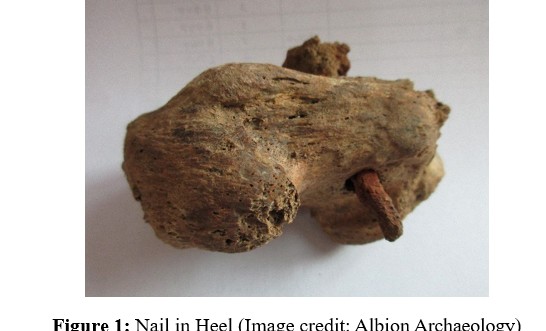
Lastly, the most recent instance of crucifixion was found in the United Kingdom in 2021, of a man in his late twenties who was given a proper burial within his community [6]. Analysis of his DNA reveals that he was a native to Britain during the time of Roman occupation, and skeletal findings indicated multiple areas of healed trauma along with thinning of the fibular cortices that suggest he was kept in bondage for a significant period of time [6]. His calcaneus shows a nail, a few inches in length, barely piercing through it, this mode of crucifixion is different than the previous two, as his legs are not bent with feet overlapped, but rather straight in orientation with each heal independently nailed to the cross in lateral to medial direction [6]. From further investigation it is most likely his arms were not nailed to the cross but rather tied with rope which was a standard modality of that time [6]. Due to the amount of trauma he endured during his lifetime while also showing signs of bondage makes him likely to have been slave who was cared for by his native community in Britain [6].
Conclusion
Crucifixion was a popular and public form of execution used throughout the Roman empire with copious amounts of historic documentation supporting its use, including the account of Flavius Josephus (37- c.100CE) who described hundreds of Jewish prisoners crucified in Jerusalem in 70 CE after an uprising [1]. Until the 20th century not much archaeological evidence had been discovered of this brutal execution method, until the three separate excavations of skeletal remains in Israel, Italy, and the United Kingdom displaying the pierced calcanei as the common identifier of crucifixion. Though there a limited example that have been unearthed, those few do provide valuable insights from an archeological perspective. The ability of the calcaneus due to its sturdy structure to withstand the test of time and provide modern scholars with a peek into the actual practice of crucifixion is enlightening and horrifying at the same.
Funding
This research did not receive any specific grant from funding agencies in the public, commercial or not-for-profit sectors.
Declaration of Interests
I have nothing to declare.
References
- Maslen, M. W., & Mitchell, P. D. (2006). Medical theories on the cause of death in crucifixion. Journal of the Royal Society of Medicine, 99(4), 185-188.
- Byard, R. W. (2016). Forensic and historical aspects of crucifixion. Forensic science, medicine, and pathology, 12, 206-208.
- Gupton, M., Özdemir, M., & Terreberry, R. R. (2018). Anatomy, bony pelvis and lower limb, calcaneus.
- Tombs, D. (1999). Crucifixion, state terror, and sexual abuse. Union Seminary Quarterly Review, 53(1-2), 89-109.
- Biz, C., Refolo, M., Zinnarello, F. D., Crimì, A., Dante, F., & Ruggieri, P. (2022). A historical review of calcaneal fractures: from the crucifixion of Jesus Christ and Don Juan injuries to the current plate osteosynthesis. International orthopaedics, 46(6), 1413-1422.
- Rare evidence for roman crucifixion found in second-century Britain. Biblical Archaeology Society,