


Review Article - (2026) Volume 4, Issue 2
Bringing Fourfold Enhancement in Water Use Efficiency by Innovative Eco-Zero Weeding Agriculture
Received Date: Mar 25, 2026 / Accepted Date: May 01, 2026 / Published Date: May 06, 2026
Copyright: ©2026 R.C.Yadav. This is an open-access article distributed under the terms of the Creative Commons Attribution License, which permits unrestricted use, distribution, and reproduction in any medium, provided the original author and source are credited.
Citation: Yadav, R. C. (2026). Bringing Fourfold Enhancement in Water Use Efficiency by Innovative Eco-Zero Weeding Agriculture. J Water Res, 4(2), 01-09.
Abstract
An innovative nature based water solution named as eco-zero weeding, free of any extra effort and budgetary requirement, was brought out that enhances yield to an unimaginable level and water use efficiency of irrigation water by over four folds. This eco zero weeding is equally applicable for rainfed agriculture as well and creation of resilience by sorptivity enhancing cation exchange capacity bringing compensatory effect in agriculture against adverse impacts of climate change. These measures produce unimaginably high yield. The zero weeding is atruely scientific advancement in agriculture.
Keywords
Crop Yield, Ecology and Ecosystems Services, Net Income, Water Use Efficiency and Weed Management.
Introduction
Water is a dominant essential element as well as requirement in highest proportion in chartering food production. All efforts culminate in surplus as well as shortage of water. Waters use efficiency is an accepted index for rating measurement of water utility in any agricultural production system. Along crops weeds also grow and rob moisture, land space per unit plant and sun light, all necessary input for green process of photosynthesis. Water use efficiency being ratio of yield to water applied to crop. Studies [1] have established that weeds lead to crop yield losses and involve huge task of weeding reducing net return to the farmers. Many human, machine and chemical controls of weeds cause pollution of air, water and soil which require tremendous cost for their treatments. Changing climate and aberrations in rainfall patterns make ground condition non operational, hence all leading to no weed control measures application possible, thereby leading to nearly complete loss of yield of rainfed agriculture, in general.
A nature based innovative management of nitrogen cycle named as eco-zero weeding science has been developed to reduce loss of crop yield and create unimaginable yield of crops, with any given amount of water, thereby meaning of enhancement in water use efficiency. With this objective field studies were conducted and results so obtained are presented here to substantiate this hypothesis of enhancing water use efficiency and creating resilience to climate change. The eco zero weeding involves practically no monetary input.
Material and methods
Irrigation and water use efficiency
Water resources remain far away of point of application of water in the fields. This involves lifting by different suitable lifting devices, conveyance in open channel by gravity or pressure pipes and to some extent by collapsible pies to the field sites. The water so lifted and conveyed is brought till the field and applied in field by different methods of application. The entire tasks involve some efficiency, which have been subjects of review, practice and improvement. At the field level the water application, water storage in root zone soil profile become matter of scientific research. Many field operations viz land leveling, grading and precision land leveling by laser leveling have been last resorts for acquiring high water application and distribution efficiencies. Yield of crops so obtained and water depth applied to the crop are used to obtain the water use efficiency. Beyond this work there were some limited way of enhancing water use efficiency by adoption of micro irrigation viz overhead irrigation ie sprinkler irrigation and drip irrigation, which facilitate efficiency of distribution and reduction of seepage losses. However, in spite of all measures at field level the water use efficiency remain low, albeit varying on types of crops. As such there has been no innovative measures to further available measure which can bring conspicuous enhancement in water use efficiency.
Still deeper insight of the situation of water use can be visualized by considering crop yield loss by weeds that grow in field with any cultivated crops. There have been long time concerns on finding suitable weed control/ management practice to eliminate crop yield losses. Since water use efficiency is ratio of crop yield as numerator and depths of water applied in field. Thus, researches which can enhance the yield , ie the numerator or reduce water application to field will mean the increase in water use efficiency of applied and rainfed water. Since there have been always efforts of growing crops with reduction of water demand, researches have benn going on since inception of practice of irrigation or even before. The other aspect of weed management to reduce crop losses and enhance in crop yield have not acquired scientific approach. The weed management has in general bee a technological aspect. This fact was pursued in detailed by previous study by the author [5]. Still more innovative developments were brought of a science based method with objective of enhancing crop yield to unimaginable level to compensate the yield loss and with high yield of crop obtain high water use efficiency. This study is devoted to this aspect of water partnerships on enhancing crop water use efficiency, enhance net income and with multiple benefits.
Experimental study.
Field experiments were conducted on establishing role of ecology in eco system. Various levels of ecology were created that produced, based on nature management of Nitrogen Fixation in any sole crops and most appropriate and effective ecology creating situations were brought in and named as eco-zero weeding. Such legume crops are green gram, black gram, and lintel as well as peas, which form nodulation and fix atmospheric nitrogen in the main crops of cereals, oil seeds and even pulse crops of any season. The yields of main crops enhanced by such N fixation created at varying level of rates were optimized. The maximum yields of main crops were optimized and eco that produces maximum yield is adopted as eco-zero weeding treatment and enhancing water productivity, water use efficiency and resilience to climate change.
The sets of experiments were:
1. Study on enhancing un imaginable yield of non tillering and precisely sown crop of garlic.
2. Study on onion as corroborative study based on trend of yield responses from the garlic crop [2]
3. Study on wheat after grown after harvest of paddy (3) Study details are for producing unimaginable yield were detailed in reference [3,4].
Study details for field experiments 3.
All field operations for cultivation including irrigation and sorptivity sequentially listed in the following Table.
|
S.No |
Date |
Activity |
Effect |
Remark |
|
1 |
June 2017 |
Previous crop wheat harvested in April |
Normal paddy cultivation due |
Eco zero established field |
|
2 |
-July, 2017 |
FYM in June before transplanting of paddy |
Good crop of paddy |
Cropping under rice wheat cultivation |
|
3 |
November2017 |
Harvest of paddy |
Field getting free from paddy and ready for wheat cropping |
Ready to be sown as usual |
|
4 |
Rotavator tilling |
Initial field preparation |
- |
Common cultivation practice |
|
5 |
Last week Nov 2017 |
Pre sowing irrigation |
Pre sowing irrigation |
Common NPK application |
|
6 |
Dec,2017 |
Field prepared for sowing |
Crop sowing by broad casting |
Improved practice of seed soaking |
|
7 |
20-12-2017 |
Wheat seed P treatment |
Germination , emergence and crop stand establishment |
Wheat crop sown but even covering done on third day of soaked sown / broadcasted |
|
8 |
,, |
Wheat variety PBW -343, seed rate 100kg/ha |
Crop growing as usual |
Germination was seen in field |
|
9 |
7-2- 2018 |
1st irrigation |
By flat bed flooding |
1 st irrigation |
|
10 |
|
Top dressing of urea |
|
|
|
11 |
15-2-2018 |
Photograph of crop in field |
Exemplary crop stand and growth |
Photographs plate 1 Plates 2 |
|
12 |
12-3-2018 |
Second irrigation at year head |
Flat bed flooding |
Photograph plate 3 |
|
13 |
13/14-3-2018 |
Top dressing of urea |
|
Crop growth progressing |
|
14 |
4-4-2018 |
Crop nearing maturity and harvest |
|
Photograph Plate 4 |
|
15 |
14-4-2018 |
Crop harvest |
Sampling |
Good enhanced yield |
Table 1: Activities on Wheat Crop Under Farmers Field Study 3
The treatments under the eco creating were not weeded and the system was named as eco-zero weeding. Several aspects of eco-zero weeding have been documented [2-10]. Aspects of water use efficiency and resilience to climate aspects are presented herein the present study.
Computation
Relation between ecolevels and yields of garlic was established by polynomial relation.
The water use efficiency WUEcomputed as;

Where water use efficiency is Kg/mm/ha
From the equation (1) it became apparent that it needs to be emphasized that plentiful researches have been done towards reducing use of water. Since there is wide spread of scarcity of water, there is wisdom in finding innovative measure to enhance productivity at given water level. In this strive eco zero weeding, which had been brought out as a science of producing multiple benefit, is dealt herewith for elaboration of enhancement in water use efficiency and creating resilience for over shadowing the stress of climate change..
Results
For evaluation of enhancement of water use efficiency, irrigation waters were applied uniformly for garlic, onion and wheat and various eco effects were created and yield response were monitored.
Eco effects
Enhancements in yields, a main contributor of water use efficiency were measured. The resulting yield variations are presented in Figure 1. This relation displays opportunity where yields increases can be harnessed. It is evident that yields increases with increase in eco and reaches up to a maximum level. After the maximum the decline in yield occurs. This trend establishes that there is a polynomial relation between eco and yield. It means an eco of this level has to be searched upon where optimum eco can be established for enhancing the crop yield water use efficiency.

Figure 1: Increase in Garlic Yield against Full Weeded and No Weeded in Relation to Eco-Established Levels
Optimization of eco effect and yield
The data trend was optimized for obtaining level of eco which produced the maximum yield (Figure 2). The optimized yields were used computing water use efficiency.
Using the data another polynomial relation was derived (Figure 2). The coefficient of determination increased to almost 90%., thereby revealing possibility of enhancing yield by better crop management with respect to fixation of nitrogen. The weeding is not being carried out as it is zero weeding agriculture, inoculation of nitrogen fixing bacterial compound would be further prospecting approach. The optimum dose of eco crop assessed was 55%, and the maximum yield of garlic corresponding to this optimum dose of eco crop through the polynomial relation was 125 q/ha. This increase fortifies that yield enhancement can be easily acquired by some better care and adverse impact of inter-competition can be shifted further to harvest higher yield. Still better crop management does indicate possibility of better prospects, which will be taken up in the subsequent part of the study.

Figure 2: Polynomial Equation for Yield of Garli
The different methods of weed management by eco-zero weeding on field having a particular water application level and their effect on yield are shown in Figure 3. The eco zero weeding agriculture with eco-agriculture practice developed in the present study show great prospects for enhancing yield of garlic, a close growing crop, for which no innovative practice could be devised. This fact reveals that the technology of eco-zero weeding agriculture is robust and effective in wide range with tolerance. It is found that lentil sown at 51% of normal seed rate of sole crop of lentil produced maximum yield 110q/ha. With slight improvement in yield of this study at per trend established in other parallel experiment the yield of garlic reaches to125q/ha, which is an exemplary yield of garlic. Further, there is scope of enhancing nitrogen fixation by inoculating phosphorus solubilising bacterial compound. Application of ultimate green irrigation to keep the surface layer at 75% of saturated moisture by sprinkler irrigation will prove boon for shallow rooted garlic crop. Thus, this study has opened new door for prospecting cultivation of garlic. The existing practice of weeding, by manual weeding in garlic, involve high cost, thereby will reduce B/C ratio for the cultivators. Treating this as a control, the LER will be 1. Other treatments enhanced the LER and Net income.
Weed management practices and their effects on yield of garlic
Some improvement in practice will further enhance the yield, which otherwise were not imagined. No weeding even increased yield. Similar effects were found by another study [1]. In the study it was found that weeds reduced yield up to 28%, against yield of fully weeded crop of wheat. The residual nutrient in soil was about 24% more than in control without weeds A summary of weed management practices and resulting yield are presented in Figure 3. Eco –zero weeding agriculture has shown enormous yield increase.. When weeds include alfalfa the loss in yield due to weed was reduced to 16%. In the densely planted garlic crop the presence of weeds increased yield instead of depletion, because of drying of surface soil in weeding induced disturbance of soil layer. It also fortified that weeding is proving ineffective and costly. Thus, these results confirm and display good approach taken up in conceptualization and experimentation that yielded promising result leading to innovative eco zero weeding agriculture technology.
This study has created new avenue for rainfed agriculture in particular and irrigated agriculture, in general. This innovative technology surpasses all innovations being developed to meet challenge of weed management in world agriculture enhancement of water use efficiency, viz weeding by robot, smart agriculture and specialized weeding machines. The adverse weather conditions make this innovative technology un applicable and ineffective, so problem of weed management and enhancement of water use efficiency remained unsolved. In this situation eco –zero weeding agriculture proves to be the best technology, as it is non monetary input practice, remain working under all adverse weather condition of creating non conducive for field operations.
ECZWEX- eco-zero weeding nitrogen cycle management under this experiment; ECZWNP-eco-zero weeding nitrogen cycle management potential effects; NWNN-No weeding no nitrogen and FWNN- fully weeded manually, but no nitrogen cycle management

Figure 3: Yield of Garlic Under Eco-Zero Weeding Agriculture Versus No Weeding No Nitrogen Management and Full Manually Weeded, But No Nitrogen Cycle Management
The foregoing results of manifolds enhancement of yield of garlic by the innovative technology culminating in eco zero weeding agriculture have been substantiated to be highly effective. These results are further discussed for their relevance, effects, efficiency, impact and sustainability.
Yield increase and water use efficiency appraisal.
Both garlic and wheat, well known efficient water users crops, were grown during winter season when their water demands are low provided assured enhanced productivity. Yield of crops and assessment of water quantity application revealed promising results [2-8]. Any degree of refinements might bring some change in values, but trend and quantum of variations will remain the same as established here with large contrast due to high productivity of garlic and wheat as a result of nitrogen fixation and phosphate solubilization. This aspect of new science was extensively dealt with article [9].
The data presented in Table 1 show the effect of nitrogen fixation in garlic grown at Dholi, Bihar where surface soil is highly fluffy, resembling condition of phosphate solubilization. The data for wheat show effect of P solubilization as no N fixation was fostered in the wheat crop due to constrains of input of pulse in wheat and farmer's reluctance to move with recommendation of the investigating scientist. This means yield levels will further improve for garlic as well as for wheat with addition of both N fixation and P solubilization in both the cases. The water sue efficiency will further improve as the yield component being numerator will increase and water use remaining as denominator will remain fixed, This will enhance the harvest index, as already known by researches. Yield will increase that will result in to increase water use efficiency. This will further increase the harvest indices of both the crops.
Data on crop productivity and water use efficiency presented in Table 2 revealed that almost four fold increase in water use efficiency of winter season crops viz garlic and wheat could be brought out by implementation of nonmonetary input involving eco-zero weeding in agriculture. This nature based water solution is the most promising innovation for water partnership mission of immense values, which can be implemented without any extra resource and budgetary requirements. This high water productivity bringing measure will go long way in enhancing water productivity and in the event of developing land limitation; it will bring sufficient food production from low hector age can be created to eliminate global hunger.
|
S.No |
Treatment |
Yield, q/ha |
Water used mm |
Water use efficiency, kg/mm/ha |
Remark |
|
|
Garlic |
||||
|
1 |
FMW (Control) |
35.5 |
480 |
7.4 |
Water use assessment was base on numbers of irrigations during winter season |
|
2 |
NW |
55.5 |
480 |
11.6 |
|
|
3 |
EZWAE |
114 |
480 |
23.8 |
|
|
4 |
EZWAEP |
125 |
480 |
26.0 |
|
|
5 |
EZWAEPPs |
137.5 |
480 |
28.6 |
|
|
|
Wheat |
||||
|
6 |
Control |
33 |
300 |
11 |
Yield increase is tremendous as evident by crop performances |
|
7 |
EZWAEPPs |
97 |
210 |
46.19 |
|
|
8 |
EZWAPPs 2.5/3. 873 |
97 |
210 |
46.19 |
|
Table 2: Water Productivity and Water Use Efficiency Scenario Appraisal for Garlic and Wheat
FMW fully manually weeded; NW no weeded; EZWAE eco-zero weeded agri experimental; EZWAEP eco-zero weeded agriculture promising; EZWAEPPs for wheat with P solubilization and N fixing treatments.
The uniformity and deep green color of wheat crop (Shown bellow Figure 3) shows good condition for continuation of photosynthesis and deposition in sink ie grain filling and enhancing weights of the grain. In this situation there occurred high speed wind causing some degree of crop lodging, hence yield response got restricted. Thus it adds to the confidence that development of such crop will lead to yield of wheat nearing 130q/ha.
Exemplary buildup of resilience
The no of wheat grains filled in early sown wheat (first week of November) was the maximum, but as sowing got delayed, the seed filling reduced. Under the similar situation sowing on 20th Dec would have reduced grain filling to 35 grains per ear head that would have lead to significant reduction in yield. The seed soaking had made up delay of about a week and P solubilization enhanced seed filling to near to normal ie close to timely sowing. This fact reveals that this treatment of seed soaking, dynamic N fixation and phosphate solubilization by simple means will bring significant vertical and lateral enhancement in wheat yield.
Example of resilience created by eco zero weeding resilience under changing climate by fostering compensatory harvest index as established by Figure 4. Grain filling made nearly equal to that with normal sowing date, the standard deviation and coefficient of variations in seed filling got reduced to the lowest level, implicating uniformity of seed filling in the earheads. A general view of crop at two stages are depicted in Figure 5 a,b.

Figure 4: Exemplary Resilience Brought Out New Measure of Climate Change Delaying Sowing Time of Wheat
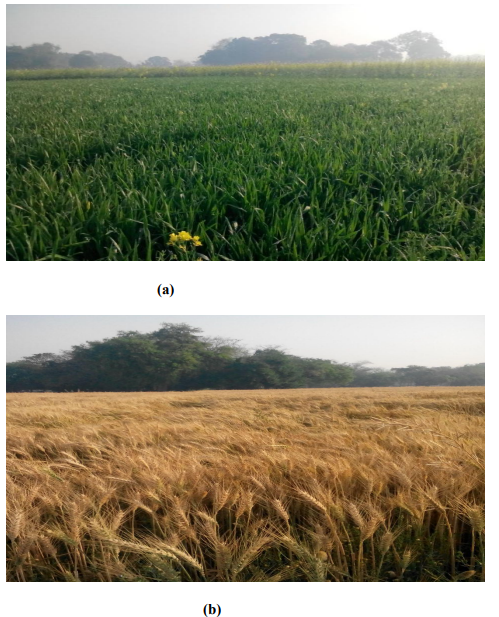
Figure 5: a,b View of Wheat Crop Under Field Experiment After First Irrigation and Nearing Harvesting (Data Presented In Table 1 and Figure 4)
Discussion
Discussion of about hypothesis, experimental procedure, results and ratification form essetial aspect in any study. These aspects have been dealt with in the following sub heads:
Eco-zero weeding
This subject is an innovative development of nitrogen cycle management, wherein it fixes dynamic N during crop growth that enhances unimaginable increase in yield of crops. The eco-zero weeding has been brought as panacea shrine for agriculture, a usable science that will produce multiple benefits, arresting degradation of land as it leaves residual nutrient in soil after harvest, it eliminates need of any operation for weeding, hence named as eco zero weeding, it saves water and enhances water use efficiency, it brings several social reformation by reducing steep rise of market price and it works as new wing in adoption of agriculture innovations [2-11]. Hence it is highly proven new science of immense values. In the development several inspiring researches and supporting research accomplishments are documented in reference covering [12-28]. Nitrogencycle management is new wisdom created by this scientist and several practices have been developed, which have been recognized as winner of three world AcademicChampionships in Chemical Research,92017) Biological Scaiences (2018) and Agricultural Sciences (2018).
Study on a given level of irrigation water experimentation
In the experiments crops are grown at a given water application. The eco-zero weeding treatments is applied that brings unimaginably high yield. High yield means high water use efficiency. As detailed aforesaid there will be multiple benefits. This is new innovation for enhancing water use efficiency. This treatment will be equally applicable. Hence it is free of any doubt or skepticism on it which is proven beyond doubt, a proven measure for enhancing water use efficiency.
Applicability of results on any other water application level
The water use efficiency brought out in the present study has revealed increase by almost four fold. On other level of enhancement in water use will maintain same efficiency, with minor change in the values.
Applicability of the eco zero weeding for utilization of available moisture under rainfed agriculture
Eco zero weeding is equally applicable for irrigated as well as for rainfed agriculture. Further, under rains water aberrations created ground condition un favourable for field operations, but eco-zero weeding continuously works irrespective situation. During rainy season water is more than required needed for crop, in general under normal rainfall distribution. Hence, eco zero weeding will continue to produce high yield, and better utilization of opportunistic water supply. This is new vision for enhancing water use efficiency of incidental rainfall. It offers immense opportunity for further research to come in future.
Relevance, effectiveness, efficiency, Impact and sustainability (REEIS)
The science of eco-zero weeding for enhancing water use efficiency is highly relevant, highly effective, efficient and sustanble. This is a unparallel innovative measure for enhancing water use efficiency and bringing resilience under changing climate.
Strength, weakness, opportunity and Threat (SWOT) analyses
The eco-zero weeding is a science of universal application, which has high strength, it is free of any unforeseen weakness, and free of any threat. As it is practically a nonmonetary measure it is ready for application for terrestrial agro eco systems.
A universally applicable science and customization by local researches
This innovative research based measure ie eco-zero weeding applicable for enhancing water use efficiency and creating resilience is applicable globally as principle and local some minor adjustment by local customized research. Thus, this Figure explicitly elaborates that think global and act local. This also implicates that role of global and local researches. Therefore, this study supports that both the approaches of global and local are highly appropriate and the central and state governmental research organizations are highly appropriate approach for finding solution for water.
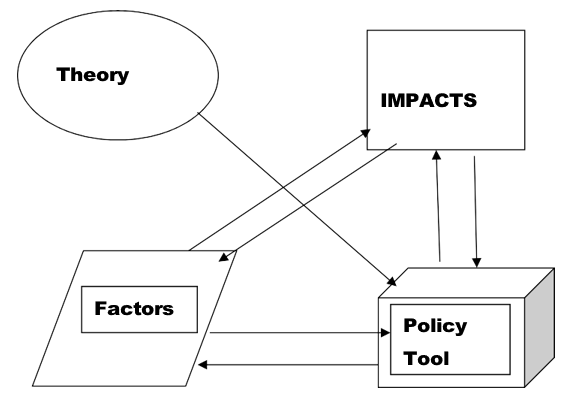
Figure 6: Link Between Theory and Policy Tool and Deriving Factors Interaction, Impact and Policy Moderation.
Conclusion
Eco-zero weeding is a science based innovative non monitory input involving measure for enhancing water use efficiency for irrigation as well as rainwater use efficiency and enhancing resilience under changing climate. Several cropping patterns have been developed based on Nitrogen cycle management that enhance water use efficiency and produce huge quantity of production for eliminating global hunger.
References
- Banik, P., Midya, A., Sarkar, B. K., & Ghose, S. S. (2006). Wheat and chickpea intercropping systems in an additive series experiment: Advantages and weed smothering. European Journal of agronomy, 24(4), 325-332.
- Rc, Y. (2014). Biological Nitrogen Harvesting From Aquatic Ecosystems-A New Scientific Vision. Fisheries and Aquaculture Journal.
- Yadav, R. C., & Yadav, L. M. (2017). New innovative technology for producing exemplary yield of garlic and onion. Innovative techniques in Agriculture Scientifica Ricerca, 1(4), 192-204.
- Yadav, R C. 2017a. Eco-zero weeding agriculture to produce exemplary yield of onion- A corroborative study. Innovative Technology in agriculture. Scientia Ricerca.-USA 1(5):234-245.
- Yadav, R.C.2017b.(2026). Practice for inter cropping and making shortfalls in pulse productivity and reduction of green house gas nitrous oxide. Archives in Chemical research USA. 1(2).
- Yadav, RC. 2018a Development of universal ultimate green chemistry and eco agric for sustainable productivity”: In. V.P. Singh.et.al (eds) “Water Resources management”, water Sci. and technology Library.78,. Springer, Germany,.
- Yadav,RC 2018b. Eco-zero weeding: a wow incredible innovation for altering things around us and India inaction. World J. Agri Research. Sci. EP, U.S.A. 6 (5): 94-104
- Yadav, Rc. 2018c.Nano bio technology for enhancing agri productivityto elimiminate global hunger.Bio-Core: International J. Bio Technology in medicine and Engineering.: 3: (4)pp
- Yadav, RC 2018d. (2026).Nature based production technology for wheat. Submitted ICAR News Letter. Directorate of publications of agriculture, KAB I, Pusa campus, New Delhi.
- Yadav, R.C.2019. (2026).Eco-zero weeding: A usable science for harnessing multiple benefits. Int n.J research and Review Ecology and Environmental Sciences
- Yadav, R.C. 2019. (2026).New wing of production function of natural resourcs:-Diversion of beneficial servicesfor fostering peoples’ voluntary adoption. Innovations and practices.. Acta Scientific Agriculturae.3(12):
- Biswas, H., Narayan, D., & Lakaria, B. L. (2012). Effect of integrated nutrient management on soil properties and performance of aonla (Emblica officinalis Gaertn) based agri-horti system in Bundelkhand region. Indian Journal of Soil Conservation, 40(2), 141-146.
- Adak, T., & Sachan, R. S. (2013). An appraisal of productivity, nutrient uptake and soil fertility status in Fenugreek (Trigonella foenum-graecum L.) under an integrated nutrient management module. Indian Journal of Soil Conservation, 41(3), 262-267.
- Chaudhary, A. K. (2013). Technological and extension yield gaps in pulse crops in Mandi district of Himachal Pradesh, India. Indian Journal of Soil Conservation, 41(1), 88-97.
- Manna, M. C., Rao, A. S., & Mandal, A. (2013). Maintenance of soil biological health under different crop production systems. Indian Journal of Soil Conservation, 41(2), 127-135.
- Sharma, P., Sharma, H. C., Singh, P., & Prasad, R. (2013). Vermicompost and biofertilizers for improved tomato productivity and soil properties in degraded soils of lower Himalayas. Indian Journal of Soil Conservation, 41(3), 274-278.
- Wuebbles, D. J. (2009). Nitrous oxide: no laughing matter. Science, 326(5949), 56-57.
- Yadav, R. C. (2012). Innovative application of scientific fact for nutrient recovery from waste water streams for sustainable agriculture and protection of environment: a review. Hydrology: Current Research, 3(5).
- Yadav, R. C. (2013). Racy nature agriculture versus other alike technologies: a'technologies' contrast.
- Yadav, R. C. (2014). Innovative application of scientific facts for arresting GHG-N2O and improvising lucrative ventures with enhanced land, water and nutrient use efficiency. Journal of Energy and Environment. Photon, 14(4), 186-220.
- Yadav, R.C. (2015)a New Ecology for Eradicating GHG- Nitrous oxide (N2O).Open international J Eco Systems.1(1):1-2.
- Yadav, R. C. (2015). The ultimate green irrigation practice by innovative application of scientific facts. World J Agron Food Sci Technol, 2(1), 1-30. (2026).
- Yadav, R. C., & Chaudhary, M. P. (2014). Racy nature—A sun technology towards quantum agriculture. World J Agri Research, 2(5), 223-227.
- Yadav, R. C., Om Parakash, O. P., & Deshwal, J. S. (2013). Biotechnology of intra-row banding of cyno-bacteria leguminous crops for raising yield plateau of cereals and oilseeds.
- Ardagh, Philip, 2000. Wow- Discoveries that changed the world. Mac Millan Children (2026).
- Hindustan (Hindi), 2017. Three rules for way of life. Hindustan (Hindi) Daily News, 20-11-2017.(2026).
- Parkinson, C . Northcote and Rustom Ji, MK..1993. Realities in management. India Book House Pvt Ltd. :80-103. (2026).
- Ramamrutham, S. 2008. Hydraulics, Fluid Mechanics, and Hydraulic Machines, Dhanpat Rai Publishing Co., New Delhi, 110002, Eigth Edition: pp 252.(2026).