

International Journal of Forensic Research(IJFR)
ISSN: 2767-2972 | DOI: 10.33140/IJFR
Impact Factor: 1.9

Research Article - (2024) Volume 5, Issue 1
Bloodstain Pattern Examined on Fabric Surfaces
2Assistant chemical Analyser, India
3Assistant Director, chemical Analyser, India
4Deputy Director, chemical Analyser, India
5Director, chemical Analyser, India
Received Date: Jan 04, 2024 / Accepted Date: Mar 02, 2024 / Published Date: Mar 15, 2024
Copyright: ©Ã?©2024 Rushikesh Pakahare, et al. This is an open-access article distributed under the terms of the Creative Commons Attribution License, which permits unrestricted use, distribution, and reproduction in any medium, provided the original author and source are credited.
Citation: Pakhare, R., Harel, V., Rasherao, A., Sabale, S., Ghumatkar, S., et al. (2024). Bloodstain Pattern Examined on Fabric Surfaces. In J Fore Res, 5(1), 01-02.
Abstract
The emergence of Bloodstain Pattern Analysis (BPA) as a vital tool for forensic investigators. It has been used in criminal investigations since the 1800s. Bloodstains are a common by-product of violent crime and analysis of the pattern of these stains. Is very important in crime scene investigation. The blood found on his clothing can be routinely analysed by DNA technique, but the analysis of bloodstain patterns can often give valuable clues as to how the blood came to be where it was found, hence the pattern might only comprise one, or a small number of stains.
Keywords
Blood Stain pattern, Scene of Crime, Evidence
Introduction
Bloodstain pattern analysis can corroborate other evidence and guide the investigators for additional clues such as position and movements of the victim. Type of injuries, In addition, the characteristics of the surface of the substrate on which the bloodstain is created, like on an absorbent fabric, gives a specific pattern, Which helps on the reconstruction of events [1]. This means that once the pattern is classified its relevance to the case investigation is considered.
Material
Sample Sources: 1) Forensic exhibits Such as Trouser, shirt, Sandow baniyan, Handkerchief etc. of deceased, Injured, received under different crime heads like Hurt (IPC323), Murder (IPC 302), Camera, Measurement Scale.
Method
The clothes of injured and deceased were first of all identified for any presence of blood on them. The blood spattered on the clothes is due to injury, as the blood comes out it they form a shape on the clothes, with the smallest area possible, due to which a specific pattern is created called BSP [2]. In order to identify different characteristics of blood stain patterns, the clothes of injured, witness, and deceased were evaluated, so following patterns such as Transfer pattern, Drip patterns, pool pattern were chosen for analysis.
Results and Discussion
In addition, the characteristics of the surface of the substrate on which the bloodstain is created, like on an absorbent fabric, gives a specific pattern, which helps on the reconstruction of events. This means that once the pattern is classified its relevance to the case investigation is considered [3].
Transfer pattern
A bloodstain resulting from contact between a blood-bearing surface and another surface. This pattern is formed when a wet, bloody surface comes in contact with another surface. Also, image of all or part of the object that caused the transfer pattern sometimes can be observed in the pattern. Like in fig (1). The transfer pattern clearly shows the finger tips of the person wet with blood.
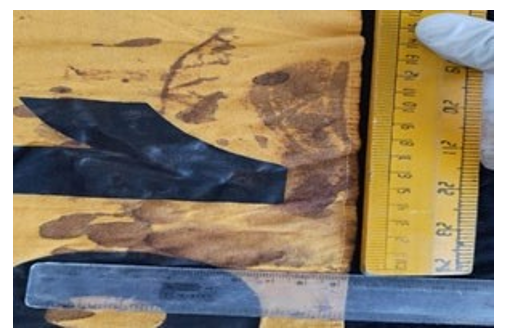
Figure 1: Transfer Pattern
Drip Patterns
Drip patterns were created by dripping consecutive drops of blood in close proximity to the, wearing clothes. When there is injury due to hard impact of Hammer, Knief, Metal Rod or gun Bullet, the blood gets splashed and the drip pattern is formed near the main injury [4].
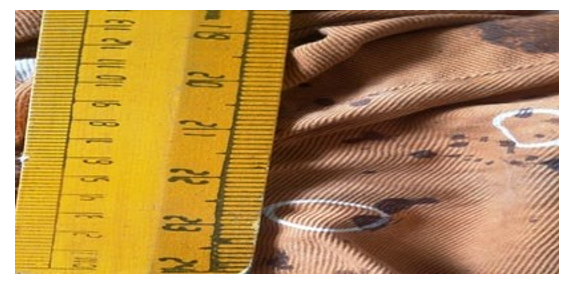
Figure 2: Drip Patterns
Pool Pattern
When a body is present for a long time on same place, then pool pattern will be formed on the cloths. In certain cases when a person is injured or murdered brutally and if the body remained there for a period of time, pool pattern is formed.
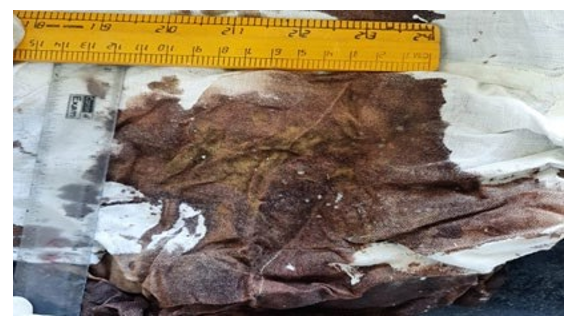
Figure 3: Pool Pattern
Conclusion Result and Discuss
Their results showed that pool pattern stains tended to impregnate the weave of the fabric whereas the drip and transfer pattern remained on the surface of the weave. Therefore, in most cases transfer stains can be differentiated. whereas pool pattern formed on clothes, when a body is present for a long time at same place.
Acknowledgement
Author thanks to Director General (Legal & Technical) Home Dept. Govt. of Maharashtra and Forensic Science Lab Laboratory, Mumbai, for the facilities to do this analysis
References
- Laber, T., Kish, P., Taylor, M., Owens, G., Osborne, N., & Curran, J. (2014). Reliability assessment of current methods in bloodstain pattern analysis. Final Report for the National Institute of Justice. US In: National Institute of Justice.
- Karger, B., Rand, S. P., & Brinkmann, B. (1997). Experimental bloodstains on fabric from contact and from droplets. International journal of legal medicine, 111, 17- 21.
- James, S. H., Kish, P. E., & Sutton, T. P. (2005). Principles of bloodstain pattern analysis: theory and practice. CRC press.
- White, B. (1986). Bloodstain patterns on fabrics: the effect of drop volume, dropping height and impact angle. Canadian Society of Forensic Science Journal, 19(1), 3-36.