

Advances in Bioengineering and Biomedical Science Research(ABBSR)
ISSN: 2640-4133 | DOI: 10.33140/ABBSR
Impact Factor: 1.7

Review Article - (2018) Volume 1, Issue 1
Biologics in Autoimmune Disease
Received Date: May 15, 2018 / Accepted Date: May 21, 2018 / Published Date: May 29, 2018
Copyright: ©Copyright: ©2018 Sandra Simic. This is an open-access article distributed under the terms of the Creative Commons Attribution License, which permits unrestricted use, distribution, and reproduction in any medium, provided the original author and source are credited.
Abstract
Biologics are the drugs whose active substance is produced or excreted from the biological sources - human, animal or microbiological. Advanced biologics are highly complex molecules.
Introduction
Biologics are the drugs whose active substance is produced or excreted from the biological sources - human, animal or microbiological.
Advanced biologics are highly complex molecules.
Development and production are very demanding - manufactured in carefully supervised and monitored conditions (including the many steps necessary to obtain a consistent product).
Biologic Drugs are: vaccines, insulin, fusion receptors, hormon growth, erythropoetin, monoclonal antibodies [1].
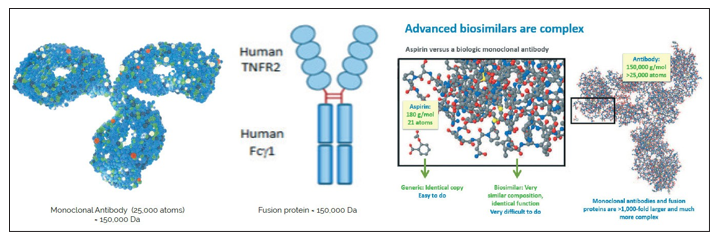
Biosimilars are biologic drugs highly similar to another EU-approved biological drugs (so-called “reference drugs”).
They are approved according to the same pharmaceutical quality, safety and efficacy standards that apply to all EU-approved biologics.
Since biosimilars are produced in living organisms, there may be fewer differences in comparation with reference drugs.
Natural variability is inherent to all biological drugs and strict controls are always present to ensure that it does not affect the way the medicine works or its safety [1,2].
Objectives
Presenting company Ewopharma as a most valuable partner in marketing biosimilars in immunology therapeutic area. In this research, there are certain findings regarding the following topics:
1. What biological drugs are and whether there is a difference between the original biologic and biosimilar.
2. If applicable, is it relevant and refers to clinical efficacy and safety in treatment of autoimmune diseases.
3. What is the mechanism of action of biological drugs in the treatment of autoimmune diseases.
4. Advantages and disadvantages of biologics introduction in these groups of patients.
Result
|
|
|||||
|
Drug |
Structure |
Target molecule |
Route of adm. |
Dose |
Frequency of application |
|
infliximab |
chimeric antibody (human mouse) |
TNF-α |
iv. |
5 mg/kg |
Week 0,2 i 6 then every 8 weeks |
|
adalimumab |
human antibody |
TNF-α |
sc. |
40 mg |
every 2 weeks |
|
etanercept |
human recombinant receptor / Fc fusion |
TNF-α and llmfotoksl n- α |
sc. |
50 mg |
weekly |
|
certolozumab-pergol |
Fab fragment of humanized antibody bound to PEG |
TNF-α |
sc. |
400 mg |
400 mg week 0,2,4 then every 4 weeks 400 mg |
|
golimumab |
human antibody |
TNF-α |
sc. |
50 mg |
monthly |


Mechanism of action (MoA): The immune response suppression mediated by cytokines (Th1 cells) causes a decrease in disease activity [3].
TNF-α inhibitors are: adalimumab, etanercept, infliximab, golimumab, certolizumabpergol.
Indications: RA, JIA, AS, axSpA, PsA, UC, CD, Pso, HS, uveitis, dactylitis and enthesitis [4,5].
Treatment Algorithm
EULAR Recommendations: TNF-α inhibitors are indicated for the treatment of autoimmune diseases after inadequate response to at least one conventional synthetic drug [6].
GRAPPA guidelines provide the possibility of introducing TNF-α inhibitors earlier.
By introducing TNF-α inhibitors in therapy, cl.studies and cl.practice data showed that CR (ACR 20) was not achieved in 40% of patients, suggesting the need for new therapeutic options.
In the Case of TNF-α Inhibitors Ineffectiveness, there is a Possibility of Switching to
1. Another drug from the group
2. Biological drug with different mechanism of action (interleukin inhibitors) or to
3. Phosphodiesterase blocker or other synthetic (chemical) drug with new MoA (apremilast, tofacitinib, barecitinib)
Switching to the biologic drug with different MoA is superior in comparation with the switching to the drug within the same group [6].
Biologics Effect
Positive: new targeted drugs, effectiveness, rare drug interactions, usage during pregnancy.
Negative: serious side effects, IV or SQ application, price, immunogenicity [7,8].
Part of Molecules which Could Cause Immunogenicity [8]
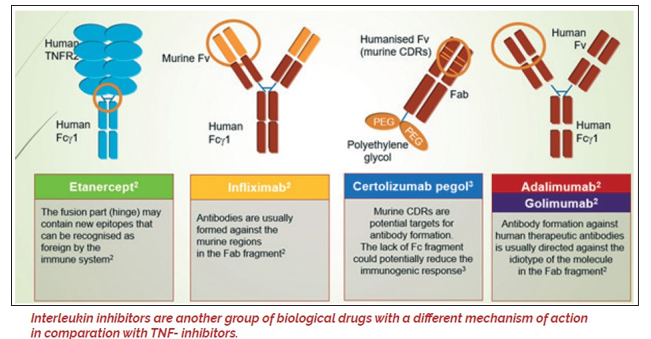
MoA: Human monoclonal antibodies that bind and neutralize (with high affinity) interleukin receptors.
Relatively safe medicines, their toxicity profile is similar to the profile of TNF-α inhibitors and other biologic drugs.
Their usage is advised as an alternative to TNF-α inhibitors in the case of their contraindications, intolerance or inefficiency [2].
Interleukin Inhibitors Include
Daclizumab (inh. IL-2 receptor T-cells, MS treatment), Canakinumab (inh.IL-1 receptor, CAPS syndrome treatment), Brodalumab (inh. IL-receptor, plaque psoriasis treatment), Sarilumab (inh. IL-6 receptor, RA treatment), Ustekinumab (inh.IL-12 and 23 receptor, PsA, psoriasis and CD treatment), Secukinumab (inh.IL-17A, SpA, PsA and psoriasis treatment), Iksekizumab (inh.IL-17A, plaque psoriasis treatment) [2].
Conclusion
There is no significant difference between biologics and their biosimilar drugs refering to cl.efficacy and safety.
Process of manufacturing could influence quality and efficacy of final biologic product (variety in manufacturing process and development of biologics and biosimilars).
The development of targeted therapy has made great progress in the treatment of all autoimmune diseases.
Despite a significant step forward, which means the introduction of TNF-α inhibitors in treating autoimmune diseases, we became aware that 40% of patients did not achieve the minimum level of therapeutic response (given by ACR20).
Therefore, the introduction of more targeted drugs over the last few years is another important step forward, which means a therapeutic alternative to patients with insufficient response to TNF-α or their intolerance [6,9].
Physicians should be careful in introducing it to patients since cl.efficacy and safety is shown in randomised cl.studies rather than in clinical practice.
It is necessery to provide efficacy and safety treatment follow-up in way to monitor pharmacovigilance and patients registers worldwide.
Discussion on estimating cost-effectiveness (when deciding on drug choice) has been re-evaluated [10-12].
References
- Fitz Gerald O, Elmamoun M (2017) Psoriatic Arthritis. In: Firestein GS, Budd RC, Gabriel SE, McInnes IB, O’Dell JR, eds. Kelley and Firestein’s textbook of rheumatology. 10th ed. Philadelphia, PA: Elsevier 1285-308.
- Ann Rheum Dis (2016) 75: 1984-1988.
- Tutuncu Z, Kavanaugh A (2017) Anti-cytokine Therapies. In: Firestein GS, Budd RC, Gabriel SE, McInnes IB, O’Dell JR, eds. Kelley and Firestein’s textbook of rheumatology. 10th ed. Philadelphia, PA: Elsevier 999-1019.
- Taylor P (2015) Tumor necrosis factor-blocking therapies. In: Hochberg MC, Silman AJ, Smolen JS, Weinblatt ME, Weisman MH, eds. Rheumatology. 6th ed. Philadelphia, PA: Mosby/ Elsevier 492-510.
- Roubille C, Richer V, Starnino T, McCourt C, McFarlane A, et al. (2015) The effects of tumour necrosis factor inhibitors, methotrexate, non-steroidal anti-inflammatory drugs and corticosteroids on cardiovascular events in rheumatoid arthritis, psoriasis and psoriatic arthritis: a systematic review and metaanalysis. Ann Rheum Dis 74: 480-489.
- Saag KG, Teng GG, Patkar NM, Anuntiyo J, Finney C, et al. (2008) American College of Rheumatology 2008 recommendations for the use of nonbiologic and biologic disease-modifying antirheumatic drugs in rheumatoid arthritis. Arthritis Rheum 59: 762-784.
- Gotestam Skorpen C, Hoeltzenbein M, Tincani A, Fischer-Betz R, Elefant E, et al. (2016) The EULAR points to consider for use of antirheumatic drugs before pregnancy, and during pregnancy and lactation. Ann Rheum Dis 75: 795-810.
- Wolbink GJ (2009) Curr Opin Reumatol 21: 211-215. VanSchouwenburg PA (2013) Nat Rev Rheumatol 9: 164-172.
- Cohen S (2017) Novel Intra-cellular Targeting Agents in Rheumatic Disease. In: Firestein GS, Budd RC, Gabriel SE, McInnes IB, O’Dell JR, eds. Kelley and Firestein’s textbook of rheumatology. 10th ed. Philadelphia, PA: Elsevier 1044-1060.
- Betts KA, Griffith J, Friedman A, Zhou ZY, Signorovitch JE, et al. (2016) An indirect comparison and cost per responder analysis of adalimumab, methotrexate and apremilast in the treatment of methotrexate-naive patients with psoriatic arthritis. Curr Med Res Opin 32: 721-729.
- Fagerli KM, Lie E, Van der Heijde D, Heiberg MS, Lexberg AS, et al. (2014) The role of methotrexate co-medication in TNF-inhibitor treatment in patients with psoriatic arthritis: results from 440 patients included in the NOR-DMARD study. Ann Rheum Dis 73: 132-137.
- Arnold G, Vulto Orlando A, Jaquez (2017) The process defines the product: what really matters in biosimilar design and production. Rheumatology 56: 14-29.