

Annals of Civil Engineering and Management(ACEM)
ISSN: 3065-9779 | DOI: 10.33140/ACEM


Research Article - (2025) Volume 2, Issue 1
Benefits and Obstacles of BIM Implementation and 4D Scheduling in Construction Projects in Egypt
2College of Engineering, Qassim University, Burayd ah, Saudi Arabia and Faculty of Engineering- Man s, Egypt
3Faculty of Engineering at Mataria, Helwan Univer sity, Egypt
Received Date: Nov 29, 2024 / Accepted Date: Dec 26, 2024 / Published Date: Jan 07, 2025
Copyright: ©©2025 Ahmed Mohammed Abdelalim, et al. This is an open-access article distributed under the terms of the Creative Commons Attribution License, which permits unrestricted use, distribution, and reproduction in any medium, provided the original author and source are credited.
Citation: Abdelalim, A. M., Elbeltagi, E. E., Radwan, H. A. (2025). Benefits and Obstacles of BIM Implementation and 4D Scheduling in Construction Projects in Egypt. Ann Civ EngManag, 2(1), 01-09.
Abstract
The progress of using Building Information Modelling (BIM) in Architecture-Engineering- Construction (AEC) has been widely witnessed; many initiatives have been documented to use this technology in many countries worldwide. Despite all the research that has been published around the world, Four-dimensional (4D) scheduling applications continue to suffer from technical, regulatory, legal and financial risks. Furthermore, the research in 4D scheduling is very limited. In this research, a preliminary study identified the obstacles that prevent the use of BIM in general and 4D scheduling, particularly in the construction industry and proposed the solutions to overcome such obstacles. The results show that a lack of experience and qualified staff are the most common causes facing BIM applications. Also, the most common technical challenge for 4D scheduling is the interoperability problems. To overcome these challenges, investment in the establishment of information technology infrastructure, and training at the level of universities, companies and consulting offices is required. At the governmental level, it is necessary to develop codes, specifications describing the level of detail required. Consequently, the integrated nature of BIM raises further concerns about liability, security, ownership of data and licensing among project participants. Thus, a new form of contract is required involving all participants to account for the use of BIM.
Introduction
Construction projects are expected to be finished within budget, on time, and with the required quality. They are getting more complex and when fast project delivery is required, it may be difficult to achieve the aims and accomplish the projects on time, within the budget with traditional methods [1-14]. So, there is an increasing demand to utilize more reliable tools for planning and scheduling [15]. Currently, there is a trend towards using BIM in the construction industry [16]. The literature highlights the limitation of BIM implementation practices in Egypt, as well as the limitation of 4D scheduling [17,18]. Elyamany discussed BIM execution within the AEC in Egypt [19]. Khodeir and Nessim investigated the BIM modelling of Energy in architectural companies [20]. Gerges et al., studied the implementation of BIM in the MENA region [21]. In these researches, surveys were developed and conducted among participants to gather data; the gap recognized was the absence of interviews to get a direct viewpoint on BIM implementation in the Egyptian construction industry [22]. Gerges et al., conducted a survey among 297 participants in the MENA region [21]. Of these participants, 200 replied with a response rate of 67.34%. 19% of the respondents who use BIM were Egyptians. The research concluded that Egypt follows the UAE for infrastructural projects in using BIM.
Elyamany carried out a survey as well; 120 contracting companies and 10 consultancy offices received the questionnaire, with a response rate of 17.2%. The low rate of response could be explained by the lack of BIM application in Egyptian construction companies [18]. Participants thought that BIM would be used in the construction industry as a tool for sustainable building practices. The survey also revealed the dearth of BIM execution metrics in the public and private domains, with 79% of respondents thinking that government engagement will improve the accreditation process and that the government is not implementing BIM. Furthermore, according to 84% of respondents, BIM objects need to be made available in order to obtain more precise data for the model's design. Additionally, 70% of participants believed that construction firms need to gain deeper knowledge of BIM. According to Khodeir and Nessim, Egypt is currently in the early phases of BIM use [20]. Also, it said that businesses adopt BIM because of its ability to coordinate, detect, and save time and money. However, the aforementioned studies guarantee that Egyptian businesses will resume using BIM in response to the expanding need for BIM in large-scale projects. Furthermore, according to the report, 62% of respondents utilize an energy modelling tool during the design phase, which is uncommon in Egyptian firms and could be related to survey. According to the study, ongoing training, research on the application of BIM for return on investment, and a lack of client demand are the main barriers to BIM adoption in Egypt. The use of BIM is significantly influenced by authorizedorganizations. As previously said, the USA, UK, and Singapore are the top BIM adopting nations; they actively work to use and improve BIM methods [16].
The primary motivator for this is the construction industry's promising strategic plans aimed at enhancing productivity, sustainability, and efficiency. The UK government was the first in the nation to require BIM in its public projects, in contrast to other natio [22]. BIM was initially recommended by public authorities in other nations like the USA, Singapore, Hong Kong, and the UAE, before being incorporated into government initiatives (a process known as middle-out diffusion) [23,24]. Other elements include the complexity of the projects and the influence of new technologies that reach out to other nations, like Qatar [4]. For the purpose of this study, a survey was developed and distributed to construction industry professionals to determine the primary barriers to using 4D BIM for streamline project scheduling and planning. The article also suggests ways to encourage the usage of 4D scheduling and BIM. Additionally, a case study was employed to illustrate the advantages of utilizing a 4D timetable.
Research Methodology
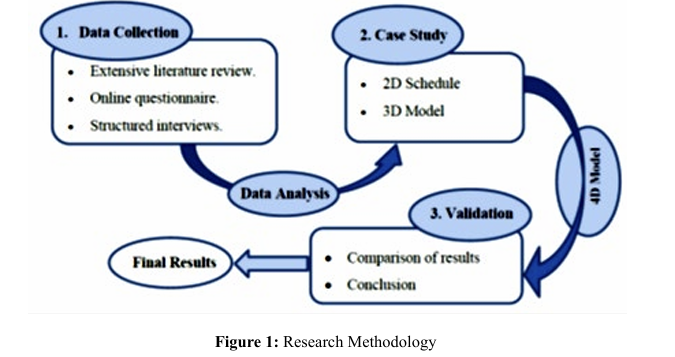
The research methodology consisted of three parts as shown below (Figure 1);
• The First part: An extensive literature review, online questionnaire and structured interviews to identify advantages and obstacles of using 4D BIM. What are the proposed methods that encourage the use of 4D scheduling in construction industry?
• The Second part: A case study of a complete 4D BIM model, to study the applicability of using the 4D scheduling.
• The Third part: Comparison of the results obtained from the questionnaire and interviews with the 4D model. Followed by a discussion of benefits that can be obtained from using 4D scheduling in the construction projects.
Challenges of 4D Scheduling
To identify the challenges of 4D scheduling, the questionnaire was distributed on to 453 individuals from around the world. However, the returned responses were 150 (33.11%), 20 responses (13%) were the total responses. As a result, 130 (87%) of the sample's total replies were complete. The sample size is determined using equation1.

n = Sample size, z = z value, taken as 1.96 for 95% confidence level, p = Percentage picking a choice, expressed as a decimal, taken as 0.5, q = 1 – p. c = margin of error, taken as 9% = 0.09.

According to the results of the questionnaire, it was found that the lack of experience, high cost and fear of change are the obstacles with the highest percentage. The lack of experience accounts for 27.10%, the cost (training and licensing) is 25.70%, and the fear of change accounts for 20.80%, as shown in the Figure 2. This confirms what is stated in the literature mentioned by Alhumayn, et al., where they reported that a lack of training, inadequate awareness of BIM processes, lack of support on managerial level, high cost of licenses and software, lack of demand from customers and governments, lack of experience in BIM, lack of practical standards, guidance and policymakers, are all key factors hindering the use of 4D scheduling [24]. Eleven respondents reported that they did not find any significant benefits from using 4D scheduling in the project, due to the nature of the project, the duration of the project implementation, and the type of project contract, all these factors affect the use of 4D scheduling. If the contract type is “implementation only”, it is not necessary to use BIM because the cost of BIM is high, in case it is not loaded on the total cost of the project. 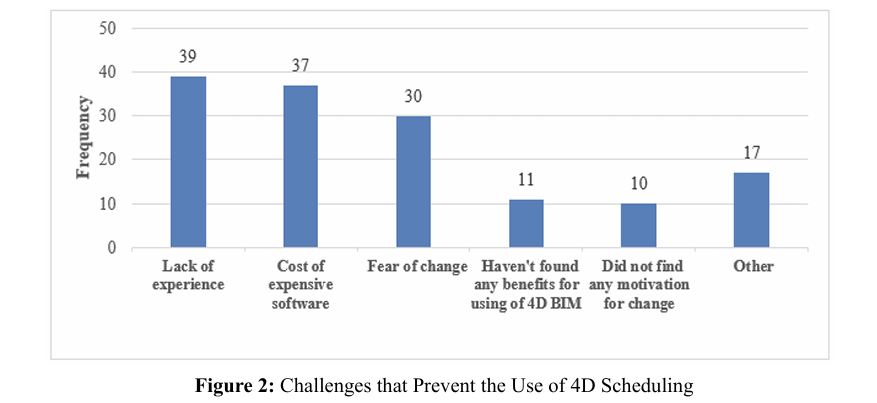
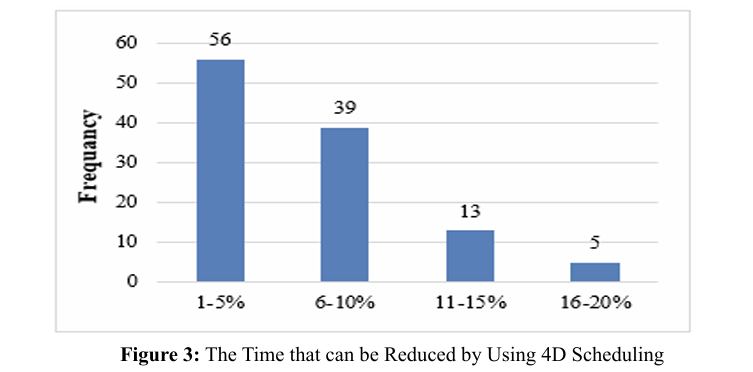
In Figure 2, seventeen respondents answered, most people don't know what 4D scheduling is and they still prefer the traditional way. Also, there is a need to change the culture of people who refuses the development.Most companies still prefer the traditional methods of planning and scheduling, if there are engineers with experience in design, planning and implementation there are no errors during execution. BIM is not a magic tool that solves all problems, it’s basically a collection of programs that depend on effective coordination, and therefore, utilizing them requires enough knowledge. It also takes a lot of time in the beginning of the project to generate a comprehensive, trustworthy model. The market still needs experienced engineers in using these programs. Therefore, most of the results that can be obtained from using BIM are flawed due to lack of experience. So, it may feel like a waste of time in the absence of experience. 2.2. Time Saving Figure 3 shows the percentage of time that could be saved in project duration in case of using BIM. Fifty-six (46.67%) of the respondents agree that, in case of using 4D scheduling, the time (from 1% to 5%) of the total project duration can be saved and is considered the highest proportion of the respondents. While 32.5% agreed that time could be saved (from 6% to 10%). Thirteen (10.83%) of the respondents said that 4D scheduling could reduce the project implementation time (from 11% to 15%). Thus, the highest proportion of respondents agree that in case of using BIM and 4D scheduling, the project time could be reduced from 1% to 10%, this confirms with what has been mentioned in previous literature. This stated that the use of BIM can be reduced from the implementation period of the project by approximately 7%.
Cost Saving The results of the questionnaire show that the use of BIM can save from 6% to10% of the total cost of the contract, which is considered the highest approved percentage, with 39.0% of total respondents agreed to this percentage. This confirms with what has been mentioned in previous literature which stated that the use of BIM savings up to 10% of contract value through clash detection [26]. As shown in Figure 4. Forty of the respondents (32.52%) agreed that the use of BIM can save from 11% to 15% of the contract value, which is considered the second highest approved percentage. The use of the traditional method may lead to errors during implementation because of a lack of clear understanding of the project, which increases the cost of the project and causes the project delay. This costs the project more than 15% of the value of the contract, while BIM may solve these problems easily. Seven (5.69%) of the respondents answered, in order to save on the cost of the project better, the project team must be fully aware of using BIM. 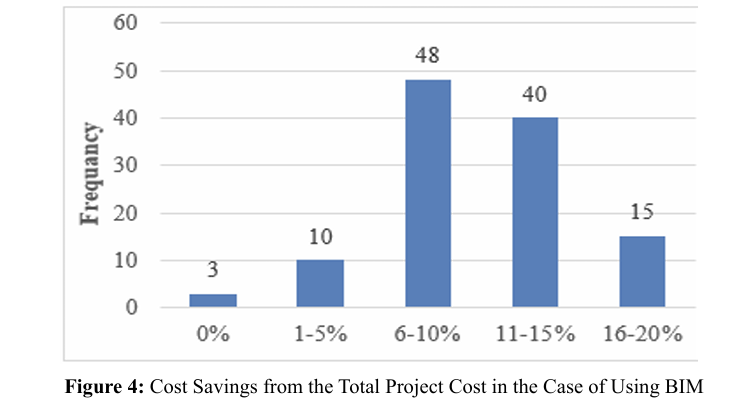
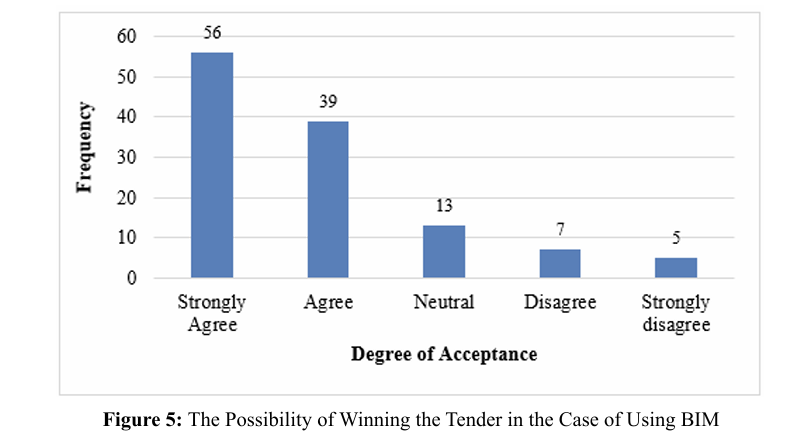
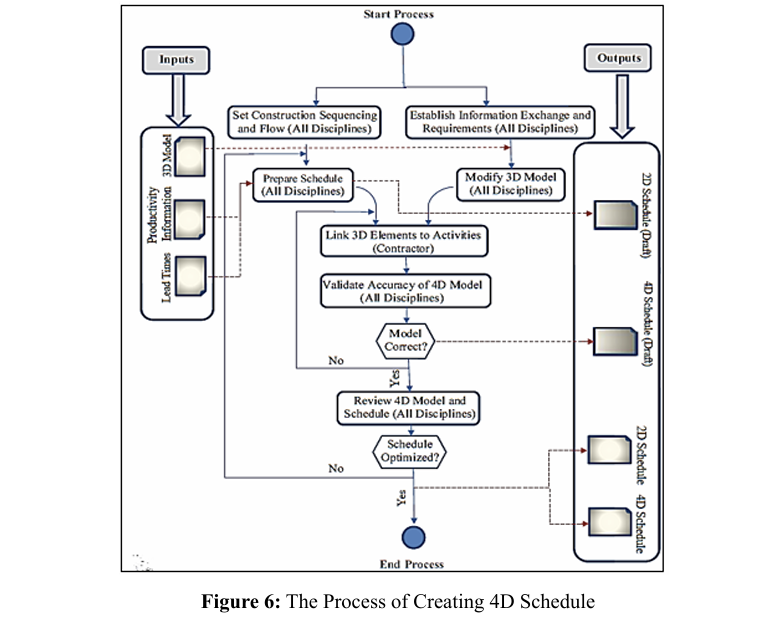
The Possibility of Winning the Tender Fifty-six (46.7%) of the total number of respondents chose “strongly agree”. While 32.5% of the respondents chose “agree”, with the total number of respondents who chose “strongly agree and agree” was 79.2% of the total number of respondents. This confirms what has been mentioned in previous literature,which stated that the accuracy of the cost estimate is within 3% of the conventional estimates and that the usage of BIM can save the time needed to generate the estimate up to 80%. Thus, it can be concluded that, as Figure 5 illustrates, a contractor who uses BIM has a higher chance of winning tenders because of the speed and accuracy of cost and time estimation [26]. Case Study The case study used is a police station project located in Cairo Egypt, within the Depot project of The Greater Cairo Metro. The selected building consisting of one floor and the total area of the building is 144 m2 and used for applying 4D scheduling. Process of Creating 4D Model The process flowchart used to connect the 3D BIM model with the project schedule and generate the 4D model is displayed in Figure 6.
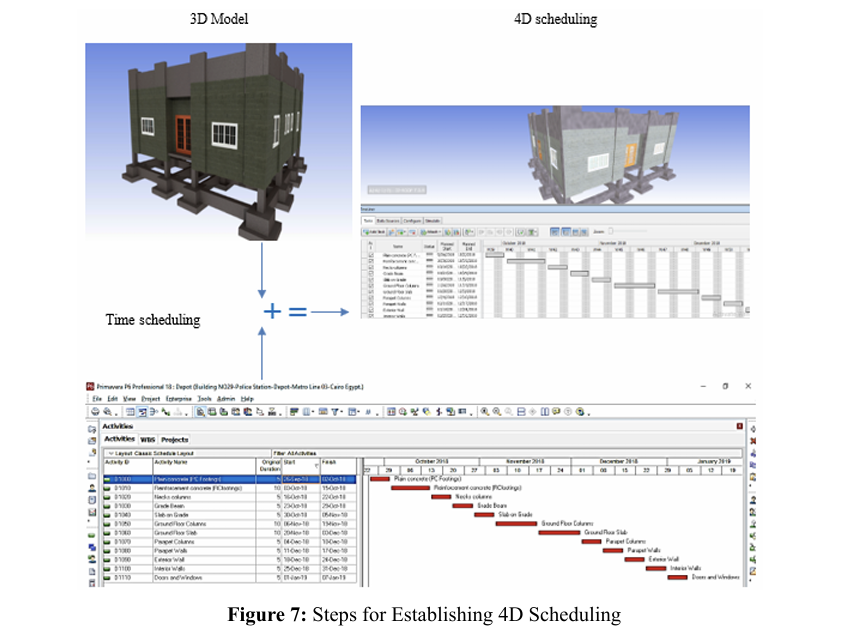
Developing the 4D Schedule Primavera P6 was used to develop a building schedule. The schedule included the durations of the activities as well as their relationships. A 3Dmodel from Autodesk Revit 2018 and the planned data from Primavera P6 were exported to Autodesk Navisworks separately. Next, by connecting the activities in the Schedule with the 3D object in the model, the 4D scheduling was created. The process for creating the 4D timetable was as follows, as illustrated in Figure 7.
Results Discussion
The utilization of 4D scheduling has numerous benefits that are not achievable with conventional planning techniques;
Time Saving
By creating a 4D model to better understand the project, the site engineer and technical office engineer were able to analyses which phases would function better than using a traditional method. Therefore, by minimizing delays, the adoption of 4D scheduling contributes to time savings and, ultimately, lower construction costs.
Estimate Resources
The accuracy of the resource estimate was achieved by closely monitoring the timeline and documenting each stage of the construction implementation through video before the implementation began. There are time and resource savings for the project, even though it is a fairly simple project utilized in the case study to demonstrate the benefits of 4D scheduling; this percentage can be enhanced with project size and degree of difficulty. According to studies conducted by the Construction Industry Institute (CII), the cost of rework can range from 0% to 25% of the installed cost of the building. However, the management team may, on average, cut down the amount of rework by 65% by using visual representations like 3D models.
Visualize and Interpret the Sequence of Construction
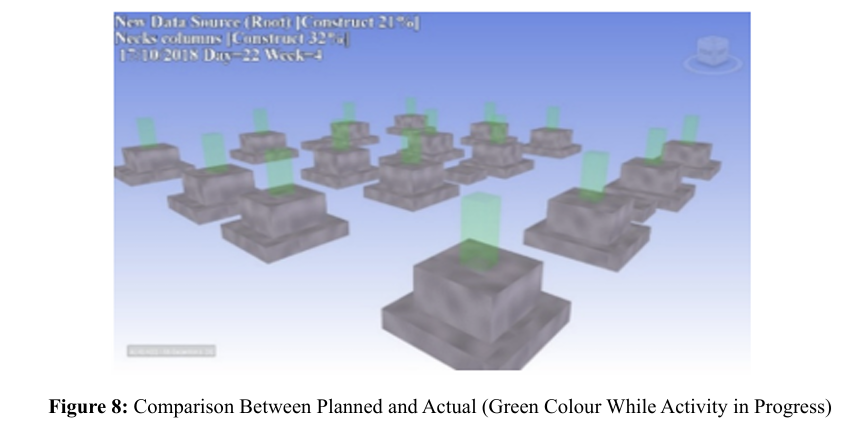
These are excellent visualization tools that offer a three-dimensional virtual image of a building's construction process. The utilization of distinct color codes for 3D components during schedule simulation results in an efficient visualization. Figure 8 illustrates this, showing green coloration for ongoing activities, including the construction of neck columns. This helps the project team gain a better understanding of daily activities and construction progress.
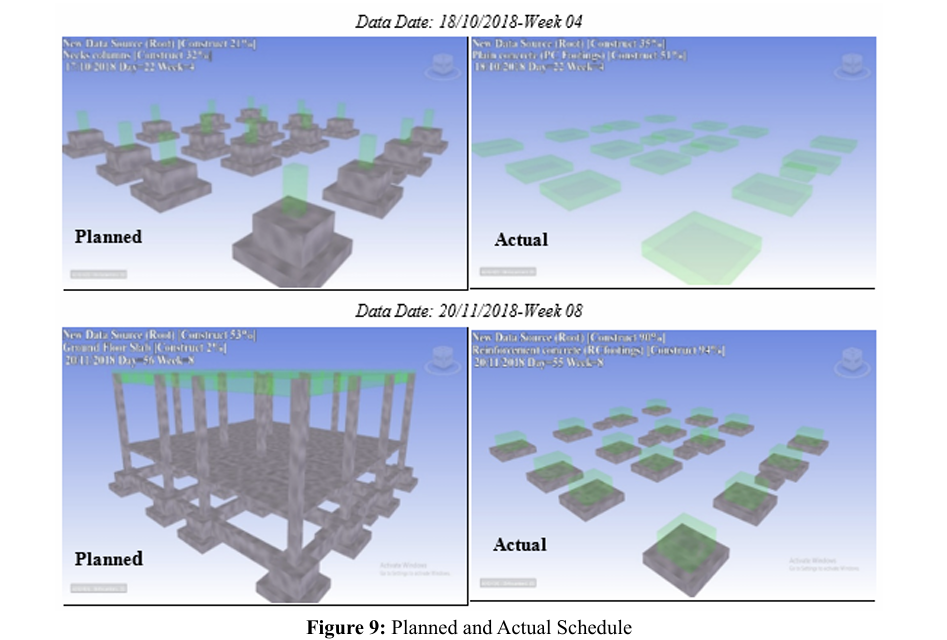
By using 4D scheduling, it can be compared between planned and actual scheduling in a simple way and understandable for all stakeholders. As shown in the Figure 9, it is noted that 51% of the plain concrete was finished in the fourth week, knowing that the planned schedule had aimed to finish the reinforced concrete. Also, in the eighth week, we note that 94% of the reinforced concrete was finished, knowing that the planned schedule started in the ground floor slab. The construction progress is showed as planned, as actual, and planned against actual allow project teams to easily distinguish between the project's planned and real states.
Better Communications
Achieving construction planning success requires effective com munication between project participants. Visualizing the progress is a frequent form of communication throughout building of any project, and 4D simulation interfaces are used to do this. All stake holders had a clear understanding of the project's general direction and progress thanks to the ability to keep information up to date. The 4D timetable is a very useful tool for comprehending how work is progressing when used in a case study. The 4D timeta ble was crucial to the participants' ability to communicate with one another. The 4D schedule provides the client with a complete overview of the project's progress. Under the simulation tab, the contractor specified a date. The simulation interface displayed the ongoing tasks along with the percentage of completed tasks on the specified date, indicating the status of the work and facilitating smooth communication between the Laboure’s, engineers, client, builder, and architect. A planned work sheet that shows the impact of a certain action makes it easier for laborers and site engineers to comprehend the task they are targeting.
Conclusion
Despite the limited researches measuring BIM implementation in the Egyptian AEC environment, this study demonstrates practical challenges of BIM in Construction Projects in Egypt, as agreed by Abdelalim&Elnaggar[6]. BIM and 4D scheduling applications continue to suffer from technical, regulatory, legal and financial risks. Furthermore, the study results show that lack of experience and lack of qualified staff are the most common risks at all levels of BIM implementation. These factors must be considered before applying BIM in the project. Also, the most common technical challenge for 4D scheduling according to questionnaire results is the shortage of interoperability among software, a large number of programs and lack of standards. The interview results conducted at some construction companies in Egypt showed that, 3D BIM has been used more in the design phase in recent years and less used during construction, but 4D BIM has not been used before in the construction phase. Furthermore, smaller companies in Egypt, due expertise. to their limited involvement in BIM projects, usually suffer more from lack of BIM technology expertise.
To overcome these challenges, especially in Egypt, it requires an investment in the establishment of information technology infrastructure, and training at the level of universities, companies, and consulting offices. At the governmental level, it is necessary to develop codes, specifications describe the level of detailing required and construction contracts that include the BIM and 4D BIM methodologies. In addition, legal and contractual issues that assist the implementation of BIM must be widely recognized. Consequently, the integrated nature of BIM raises further concerns and Project Management, Sustainable Infrastructure and Transportation for Future Cities, ICSCPM-18 (pp. 16-18). To overcome these challenges, especially in Egypt, it requires an investment in the establishment of information technology infrastructure, and training at the level of universities, companies, and consulting offices. At the governmental level, it is necessary to develop codes, specifications describe the level of detailing required and construction contracts that include the BIM and 4D BIM methodologies. In addition, legal and contractual issues that assist the implementation of 2. Abdelalim, A. M. (2018, December). IRVQM; A Conceptual Framework for Integrating Risk, Value and Quality Management for Construction Project Management. In 2nd International Conference of Sustainable Construction & Project Management (pp. 16-18). about liability, security, ownership of data and licensing among stakeholders. Thus, a new form of contract is required that involves all stakeholders engaging with BIM or those who are part of the BIM process. It was also concluded that Strategy for Implementation BIM inside the organizational scale in Egypt is a critical step, as studied by Abdelalim, &Haras [7]. Organizations should have an external party as an expert in outlining the procedures that need to be performed and policies that should be implemented to build a BIM implementation plan within the organization. This requires further researches to investigate and explore [28-54].
References
- Abdelalim, A. M. (2018, December). IRVQM, Integrated Approach for Risk, Value and Quality Management in Construction Projects; Methodology and Practice. In the 2nd International Conference of Sustainable Construction and Project Management, Sustainable Infrastructure and Transportation for Future Cities, ICSCPM-18 (pp. 16-18).
- Abdelalim, A. M. (2018, December). IRVQM; A Conceptual Framework for Integrating Risk, Value and Quality Management for Construction Project Management. In 2nd International Conference of Sustainable Construction & Project Management (pp. 16-18).
- Abdelalim, A. M. (2019). Risks Affecting the Delivery of Construction Projects in Egypt: Identifying, Assessing and Response. In Project Management and BIM for Sustainable Modern Cities: Proceedings of the 2nd GeoMEast International Congress and Exhibition on Sustainable Civil Infrastructures, Egypt 2018—The Official International Congress of the Soil-Structure Interaction Group in Egypt (SSIGE) (pp. 125-154). Springer International Publishing.
- Abdelalim, A. M., & Abo. elsaud, Y. (2019). Integrating BIM-based simulation technique for sustainable building design. In Project Management and BIM for Sustainable Modern Cities: Proceedings of the 2nd GeoMEast International Congress and Exhibition on Sustainable Civil Infrastructures, Egypt 2018—The Official International Congress of the Soil-Structure Interaction Group in Egypt (SSIGE) (pp. 209-238). Springer International Publishing.
- Abdelalim, A. M., & Eldesouky, M. A. (2021). Evaluating Contracting Companies According to Quality Management. System Requirements in Construction Projects. International Journal of Engineering, Management and Humanities (IJEMH) Volume, 2, 158-169.
- Abdelalim, A. M., &Elnaggar, A. M. E. (2024). Investigating the Role of Building Information Modeling in Risk Management of Construction Projects. Journal of Civil Engineering, 15(2), 111-135.
- Abdelalim, A. M., &Haras, K. S. (2024). The Building Information Modeling Maturity Level in the Egyptian Architecture. Engineering, and Construction Industry. Ann Civ EngManag, 1(1), 01-19.
- Abdelalim, A. M., & Said, S. O. M. (2021). Dynamic labor tracking system in construction project using bim technology. Int. J. Civ. Struct. Eng. Res, 9(20).
- Abdelalim, A. M., El Nawawy, O. A., &Bassiony, M. S. (2016). Decision supporting system for risk assessment in construction projects: AHP-simulation based. IPASJ International Journal of Computer Science (IIJCS), 4(5), 22-36.
- Abdelalim, A. M., Elbeltagi, E., &Mekky, A. A. (2019). Factors affecting productivity and improvement in building construction sites. International journal of productivity and quality management, 27(4), 464-494.
- Abdelalim, A. M., & Said, S. O. M. (2021). Theoretical Understanding of Indoor/Outdoor Tracking Systems in the Construction Industry. International Journal of Civil and Structural Engineering Research ISSN, 2348-7607.
- Abdelalim, A. M., Khalil, E. B., &Saif, A. A. (2021). The effect of using the value engineering approach in enhancing the role of consulting firms in the construction industry in Egypt. International Journal of Advanced Research in Science, Engineering and Technology, 8(2), 16531-16539.
- Abd El-Hamid, S. M., Farag, S., &Abdelalim, A. M. (2023). Construction Contracts’ Pricing according to Contractual Provisions and Risk Allocation. International Journal of Civil and Structural Engineering Research ISSN, 2348-7607 .
- Brito, D. M., & Ferreira, E. A. (2015). Strategies for representation and analyses of 4D modelling applied to construction project management. Procedia Economics and Finance, 21, 374-382.
- Balakina, A., Simankina, T., &Lukinov, V. (2018). 4D modeling in high-rise construction. In E3S Web of Conferences (Vol. 33, p. 03044). EDP Sciences.
- Hamada, H. M., Haron, A., Zakiria, Z., &Humada, A. M. (2016). Benefits and barriers of BIM adoption in the Iraqi construction firms. International Journal of Innovative Research in Advanced Engineering, 3(8), 76-84.
- Afifi, A., Elsamadony, A., &Abdelalim, A. M. (2020, a). A Proposed Methodology for Managing Risks in the Construction Industry in Egypt. International Journal of Civil and Structural Engineering Research, 8(1), 63-78.
- Afifi, A., Elsamadony, A., &Abdelalim, A. M. (2020, b). Risk response planning for top risks affecting schedule and cost of mega construction projects in Egypt. International Journal of Civil and Structural Engineering Research, 8(1), 79-93.
- Elyamany, A. H. (2016). Current practices of building information modelling in Egypt. International Journal of Engineering Management and Economics, 6(1), 59-71.
- Khodeir, L. M., &Nessim, A. A. (2018). BIM2BEM integrated approach: Examining status of the adoption of building information modelling and building energy models in Egyptian architectural firms. Ain Shams Engineering Journal, 9(4), 1781-1790.
- Gerges, M., Austin, S., Mayouf, M., Ahiakwo, O., Jaeger, M., Saad, A., & El Gohary, T. (2017). An investigation into the implementation of Building Information Modeling in the Middle East. Journal of Information Technology in Construction, 22, 1-15.
- Mohamed, A. E. (2019). The implementation of building information modeling (BIM) towards sustainable construction industry in Egypt" The pre-construction phase".
- Hassanen, M. A. H., & Abdelalim, A. M. (2022, a). A proposed approach for a balanced construction contract for mega industrial projects in Egypt. International Journal of Management and Commerce Innovations, 10(1), 217-229.
- Hassanen, M. A. H., &Abdelalim, A. M. (2022, b). Risk identification and assessment of mega industrial projects in Egypt. International Journal of Management and Commerce Innovation (IJMCI), 10(1), 187-199.
- Alhumayn, S., Chinyio, E., &Ndekugri, I. (2017). The barriers and strategies of implementing BIM in Saudi Arabia. WIT Transactions on The Built Environment, 169, 55-67.
- Singh, V., Gu, N., London, K., & Brankovic, L. (2007). Taylor, Claudelle (2007) Industry Consultation Report. CRC for Construction Innovation, Brisbane.
- Dakhil, A., Underwood, J., & Al Shawi, M. (2016, September). BIM benefits-maturity relationship awareness among UK construction clients. In Proceedings of the first international conference of the BIM academic forum, Glasgow, UK (pp. 13-15).
- Abd El, M. S. B. A., El Nawawy, O. A. M., & Abdel-Alim, Α. Μ. (2017). Identification and assessment of risk factors affecting construction projects. HBRC Journal, 13(2), 202-216.
- Abdelalim, A. M., Elhakeem, A., Omran, S., & Elsayed, A. M. Exploring the Synergy: A Scientometric Analysis and Bibliometric Review of Value Engineering and Building Information Modeling Integration in Construction Projects. International Journal of Management and Commerce Innovations, 11(2), 397-417.
- Abd-Elhamed, A., Amin, H. E., & Abdelalim, A. M. (2020). Integration of Design Optimality and Design Quality of RC buildings from the perspective of Value Engineering. International Journal of Civil and Structural Engineering Research, 8(1), 105-116.
- Al-Barghouth, K., Elsamadony, A., & Abdelalim, A. M. (2016). The Applicability of Public Private Sector Partnership (PPP) in the futuristic Reconstruction in Syria. The Engineering Sciences Magazine-Faculty of Engineering at Mataria-Helwan University, 148(1).
- Ali Mohamed, N., Mohammed Abdel-Alim, A., HamdyGhith, H., & Gamal Sherif, A. (2020). Assessment and prediction planning of RC structures using BIM technology. Engineering. Research Journal, 167, 394-403.
- Bian, T. (2016). BIM implementation maturity in Chinese construction projects: evaluation model and empirical investigation.
- Cooke-Davies, T. J., & Arzymanow, A. (2003). The maturity of project management in different industries: An investigation into variations between project management models. International Journal of Project Management, 21(6), 471-478.
- El Dean, S. M., & Abdelalim, A. M. (2021). A Proposed System for Prequalification of Construction Companies & Subcontractors for Projects in Egypt. International Journal of Management and Commerce Innovations, 9(2), 290-304.
- El-Kholy, A. M., & Abdelalim, A. M. (2ced2016). A comparative study for fuzzy ranking methods in determining economic life of equipment. International Journal of Construction Engineering and Management, 5(2), 42-54.
- Abdelalim, A. M., Elsamadony, A. A. A. Y., & Fadhel, Z. A. (2020). Studying the applicability of public private sector partnership in the reconstruction projects in Iraq. International Journal of Civil and Structural Engineering, 8(1), 137-150.
- Kassem, M., & Succar, B. (2017). Macro BIM adoption: Comparative market analysis. Automation in Construction, 81, 286-299.
- Kassem, M., Li, J., Kumar, B., Malleson, A., Gibbs, D. J., Kelly, G., & Watson, R. (2020). Building information modelling: evaluating tools for maturity and benefits measurement. Centre for Digital Built Britain: London, UK, 184.
- Kassem, M., Succar, B., & Dawood, N. (2013). A proposed approach to comparing the BIM maturity of countries. In 30th International Conference on Applications of IT in the AEC Industry.
- Khedr, R., &Abdelalim, A. M. (2021). Predictors for the success and survival of construction firms in Egypt. International Journal of Management and Commerce Innovations, 9(2), 192-201.
- Khedr, R., &Abdelalim, A. M. (2021). The impact of strategic management on projects performance of construction firms in Egypt. International Journal of Management and Commerce Innovations, 9(2), 202-211. ISSN, 2348-7585.
- Medhat, W., Abdelkhalek, H., &Abdelalim, A. M. (2023). A comparative study of the international construction contract (FIDIC Red Book 1999) and the domestic contract in Egypt (the Administrative Law 182 for the year 2018).
- RizkElimam, A. Y., Abdelkhalek, H. A., & Abdelalim, A. M. (2022). Project risk management during construction stage according to international contract (FIDIC). International Journal of Civil and Structural Engineering Research, 10(2), 76-93.
- Sacks, R., Eastman, C., Lee, G., & Teicholz, P. (2018). BIM handbook: A guide to building information modeling for owners, designers, engineers, contractors, and facility managers. John Wiley & Sons.
- Shawky, K. A., Abdelalim, A. M., & Sherif, A. G. (2024). Standardization of BIM Execution Plans (BEP's) for Mega Construction Projects: A Comparative and Scientometric Study. Trans. Mach. Learn. Artif. Intell, 12(1), 103-129.
- Shehab, A., & Abdelalim, A. M. Utilization BIM for Integrating Cost Estimation and Cost Control Using BIM in Construction Projects.
- Awad, S., Gad, S., & Abdelalim, A. M. (2023). Critical Failure of Construction Projects and Their Remedial Actions from the Perspective of Applying Total Quality Management. International Journal of Engineering, Management and Humanities (IJEMH), 4(1), 147-167.
- Sherif, A., & Abdelalim, A. M. (2023). Delay analysis techniques and claim assessment in construction projects. International Journal of Engineering, Management and Humanities (IJEMH), 10(2), 316-325.
- Succar, B. and Kassem, M. (2015) Macro-BIM Adoption: Conceptual Structures. Automation in Construction, 57, 64-79.
- Succar, B., Sher, W., & Williams, A. (2012). Measuring BIM performance: Five metrics. Architectural Engineering and Design Management, 8(2), 120-142.
- Wu, C., Xu, B., Mao, C., & Li, X. (2017). Overview of BIM maturity measurement tools. Journal of Information Technology in Construction (ITcon), 22(3), 34-62.
- Yimam, A. H. (2011). Project management maturity in the construction industry of developing countries (the case of Ethiopian contractors). University of Maryland, College Park.
- Yousri, E., Sayed, A. E. B., Farag, M. A., & Abdelalim, A. Μ. (2023). Risk identification of building construction projects in Egypt. Buildings, 13(4), 1084.