

International Journal of Forensic Research(IJFR)
ISSN: 2767-2972 | DOI: 10.33140/IJFR
Impact Factor: 1.9

Research Article - (2024) Volume 5, Issue 2
Assessment of Suicidal Tendencies Among Undergraduates in a Depressed Economy: a Cross-Sectional Study in a Nigerian University
2Department of Clinical Pharmacy and Pharmacy Management, Faculty of Pharmaceutical Sciences, Nnamdi Azikiwe University. Awka. Anambra State, Nigeria
3Department of Pharmaceutical Microbiology and Biotechnology, Faculty of Pharmaceutical Sciences, Nnamdi Azikiwe University. Awka. Anambra State, Nigeria
Received Date: Oct 28, 2024 / Accepted Date: Dec 04, 2024 / Published Date: Dec 20, 2024
Copyright: ©©2024 Chijioke Ofomata, et al. This is an open-access article distributed under the terms of the Creative Commons Attribution License, which permits unrestricted use, distribution, and reproduction in any medium, provided the original author and source are credited.
Citation: Ofomata, C., Nwokoro, C. C., Oli, A. N. (2024). Assessment of Suicidal Tendencies Among Undergraduates in a De-pressed Economy: a Cross-Sectional Study in a Nigerian University. In J Fore Res, 5(2), 01-08.
Abstract
Suicide is an act whereby an individual eliminates his own life intentionally while suicidal tendency is the likelihood of the presence of suicidal behavior. Globally, suicide ranks among the leading causes of death in young people aged 15 – 29 years. The study followed a cross-sectional research design and a cluster random sampling technique was used to select 691 undergraduates. A Multi-Attitude Suicide Tendency Scale was used to assess suicidal tendencies, and a structured research questionnaire was used to uncover potential risk factors that could predispose a student to suicide. Collected data was analyzed using Statistical Package for Social Science version 25. The research revealed that the majority of the students, involved in the study, had a high risk of suicidal tendencies. Poor academic performance, trauma from childhood and sexual abuse, low self-esteem, chronic illness, drug or substance abuse, relationship issues, and financial challenges, were identified as major risk factors.Suicidal behavior was observed to be prevalent among the students, according to the findings of the study. Poor academic performance, mental disorders, trauma from childhood and sexual abuse, low self-esteem, chronic illness, drug or substance abuse, relationship issues, cyberbullying, and financial challenges, were the major risk factors revealed by the study [1].
Keywords
Suicide, Suicidal Tendency, Risk Factors, Nnamdi Azikiwe University, Depression, Suicidal Ideation
Introduction
Globally, suicide is becoming a critical public health issue as it ranks among the leading causes of death, with more deaths due to suicide than to malaria, HIV/AIDS, breast cancer, or war and homicide. Suicide is a deliberate act by an individual to take his own life. It’s the end product of a process that begins with suicidal ideation (thoughts about suicide), which may be, followed by an attempt at suicide, and finally completed suicide if the individual succeeds in its attempt. The likelihood that someone can become suicidal is a suicidal tendency and this encompasses the development of suicidal thoughts and the ability to carry out those thoughts. As of 2019, 703,000 people die by suicide every year. Suicide is among the leading causes of death worldwide, with more deaths due to suicide than to malaria, HIV/AIDS, breast cancer, war, and homicide. According to the Centers for Disease Control and Prevention, suicide is a part of a broader class of behavior called self-directed violence. Self-directed violence refers to behavior directed at oneself that deliberately results in injury or the potential for injury. It is a complete process of a continuum that begins with suicide ideation, followed by an attempt at suicide, and finally completed suicide [1-5].
Suicide is the second leading cause of death among 15–29-year- olds globally. As of 2019, suicide accounts for the leading cause of death in young people aged 15–29 years for both sexes, after road accidents, tuberculosis, and interpersonal violence with the highest rate of suicide occurring in low-and-middle-income countries (77%), where most of the world’s population live. In Africa, Nigeria has the 13th highest suicide mortality rate above the regional (African) average. As of 2012, there were 7,238 reported suicides in the country – 5,653 males and 1,584 females – with the likelihood that the figures are under-reported. In a virtual news conference held in Lagos, at the commemoration of World Suicide Prevention Day which was on September 10, the coordinator of the Suicide Research and Prevention Initiative (SURPIN), Mr. Raphael Ogbolu, reported that over 40% of the total calls it had received since inception in 2017, came from people under the age of 30. This shows that suicide is not just
a problem that concerns the elderly now but also getting down to the youth, and mostly students. Suicidal thoughts affect the mental health of an individual. For an individual to be healthy mentally does not just involve the absence of mental disorders; it is a state of well-being in which an individual has a positive attitude towards life, can cope with the normal stressors of life, and can contribute to his or her society. Presently, the prevention of suicide and other mental health-related issues has become essential globally due to the increase in rates of suicide, depression, and other mental health disorders. Suicidal tendencies include the early and critical stages of the suicidal process, which when triggered by a combination of past traumatic experiences and current pressures, may increase the risk of inadequate response to stressors, thereby predisposing its victims to suicidal behaviors. Based on existing literature, tendencies toward suicide are mostly associated with depression which is a psychological symptom that is common among students [1,6-13].
There are many challenges faced by students within the university, ranging from peer pressure, bullying, victimization, relationship issues, poor academic performance, sexual abuse, and financial constraints amongst others. While some will successfully surmount these challenges, others may contemplate suicide as a way of escape from these challenges. However, having suicidal thoughts doesn't mean that suicide will be attempted or completed as the idea of taking one’s life is a complex process and not a singular event. Suicide among young people leads to premature death and loss of productivity, hence the need to assess for suicidal tendencies among students and for the further unraveling of the factors that cause a student to consider suicide. As a result of these identified challenges faced by students in Nigerian Universities, there is a need to assess suicidal tendencies among the students, as this will help in developing protective and preventive mental health services and interventions [14].
Material and methods
Study Design
The study was conducted at Nnamdi Azikiwe University. The University is one of the federal universities in Nigeria. It is located in Awka town, the capital of Anambra State. The Campus is located about 2.6 kilometers from the Awka city center. Nnamdi Azikiwe University was established in 1991 and currently has three campuses. The main campus (Awka campus) is a study area with 10 faculties, as follows: the faculty of Arts, Agriculture, Biosciences, Education, Engineering, Environmental Sciences, Law, Management Sciences, Physical Sciences, and Social Sciences. The second campus is located at Nnewi, with 3 Faculties: Medicine, Basic Medical Sciences, and Health Sciences and Technology; while the third campus, which is at Agulu, has only one faculty: Pharmaceutical Sciences.
Seven hundred and twenty (720) questionnaires were randomly distributed among students in the different groups. The number of questionnaires distributed was determined from the percentage calculated from the total number of students. The purpose of the study was made known to all respondents and oral consent was obtained from them. All the respondents were assured of confidentiality and anonymity. A total of 691 questionnaires were retrieved, sorted, and analyzed.
Study Population and Sample Size Determination
The study was done among undergraduate students at Nnamdi Azikiwe University Awka, in Anambra state, Nigeria. At the Awka campus, the three departments; Law, Science Biology Education, and Biochemistry; the Department of Medicine and Medical Rehabilitation was used at the Nnewi campus, and Pharmacy was used at the Agulu campus. The sample size was derived using Yamane's formula [n = N/1+N (e)2] and using an estimated attrition rate of 5%. The sample size obtained for the study was four hundred and fifteen (415) students, the minimum number of respondents that can be used for this study. Due to the sensitive nature of the study, the sample size was overshot to accommodate more responses for the statistical analysis. Seven hundred and twenty questionnaires were distributed in total.
Instrument Development and Validation
The research instrument for data collection was a structured questionnaire which was developed and validated. The instrument consists of various sections and relevant questions about the research’s aims and objectives. Section 1 contained the demographic information of the respondents. Section 2 contained the Multi-Attitude Suicidal Tendency Scale (MAST). Section 3 covered the factors that can instigate a student to consider suicide. Two lecturers validated the research instrument.
Data Collection
The questionnaires, written in English, were administered to the students with the assistance of their class representatives. Some were collected immediately while others were collected two weeks, after administration, with the help of their various class representatives.
Data Analysis
Statistical Package for Social Science (SPSS, version 25) was used for the analysis. the nominal values (demographic variables) and the continuous variables (MAST scale variables) were summarized using frequency and percentages. The risk factors of suicidal tendency were summarized using a 5-point Likert scale.
Inclusion Criteria
All students of the selected departments of Nnamdi Azikiwe University who were willing to participate after being properly informed of the nature of the research were included.
Exclusion Criteria
Students whose departments were not selected in Nnamdi Azikiwe University and students of the selected faculties, who were unwilling to participate in the study were excluded.
Limitations of Study
There is a cultural abhorrence against suicide, thus impeding accurate reporting on such behaviors. Another limitation is social desirability bias which is the tendency to underreport socially undesirable behaviors such as suicide. Also, caution should be exercised in generalizing the findings of this study to other populations, as the study focused on selecting and recruiting the study participants from just one federal university in Nigeria.
Ethical Consideration
Ethical approval for the study protocol was obtained from the Research and Ethics Committee of Chukwuemeka Odumegwu Ojukwu University Teaching Hospital (COOUTH) Awka, with approval number COOUTH/CMAC/ETH.C/VOL. 1/FN.04/159/ of 14/12/2021.
Results
Demographic Characteristics of the Respondents
Of the 720 questionnaires administered, 691 were returned with each filled, which gave a response rate of 97.2%. Out of the 691 students, 271 (39.2%) were males, 420 (60.8%) were females and the majority (56.3%) fell within the age range of 21-25 years. Among the respondents, 97.3% were Christians, 96.1% were Igbos, 96.7% were single, 30.2% were 200L students and 62.8% stayed off–campus.
From the result, risk factors with a mean Likert that is greater than 3.45 were strongly associated with suicidal tendencies while the risk factors with a mean Likert that is less than 3.45 were weakly associated with suicidal tendencies.
Figures and Tables
Assessment of Suicidal Tendencies in the Various Campuses.
|
|
Strongly Agree |
Agree |
Sometimes Disagree |
Disagree |
Strongly Disagree |
Mean |
|
Attraction to life |
||||||
|
Most of the time I feel happy. |
155(34.2%) |
196(43.3%) |
24(5.3%) |
35(7.7%) |
42(9.3%) |
1.1438 |
|
I am very hopeful. |
297(65.6%) |
131(28.9%) |
12(2.6%) |
9(2.0%) |
3(0.7%) |
0.4292 |
|
I enjoy many things in life. |
217(47.9%) |
178(39.3%) |
20(4.4%) |
27(6.0%) |
11(2.4%) |
0.7572 |
|
Repulsion by life |
||||||
|
Life seems to be one long and difficult struggle |
92(20.3%) |
197(43.5%) |
38(8.4%) |
79(17.4%) |
47(10.4%) |
1.5408 |
|
I feel that I am not important to my family. |
14(3.1%) |
16(3.5%) |
290(64.0%) |
93(20.5%) |
40(8.8%) |
2.2848 |
|
Sometimes I feel that my family will be better off without me. |
16(3.5%) |
23(5.1%) |
264(58.3%) |
106(23.4%) |
42(9.3%) |
2.2993 |
|
No one loves me. |
24(5.3%) |
18(4%) |
273(60.3%) |
99(21.9%) |
39(8.6%) |
2.245 |
|
Attraction to death |
||||||
|
Death can change things for the better. |
18(4.0%) |
35(7.7%) |
253(55.8%) |
94(20.8%) |
52(11.5%) |
2.281 |
|
Many problems can be solved by death only. |
25(5.5%) |
51(11.3%) |
247(54.5%) |
93(20.5%) |
37(8.2%) |
2.1457 |
|
In some situations, it is better to die than to go on living. |
22(4.9%) |
75(16.6%) |
215(47.5%) |
91(20.1%) |
50(11%) |
2.1589 |
|
I believe death can bring great relief for suffering. |
37(8.2%) |
78(17.2%) |
198(43.7%) |
89(19.6%) |
51(11.3%) |
2.0861 |
|
Repulsion by death |
||||||
|
The thought that one day I will die frightens me. |
95(21%) |
161(35.5%) |
76(16.8%) |
89(19.6%) |
30(6.6%) |
1.5521 |
|
Death frightens me more than anything else. |
88(19.4%) |
95(21%) |
132(29.1%) |
94(20.8%) |
44(9.7%) |
1.8035 |
Table 1: Assessment of Suicidal Tendency in Akwa Campus

Figure 1: A Line Graph Showing the Mean Mast Scales of the Respondents in Awka
Key:
AL = Attraction to life AD = Attraction to death
RL = Repulsion by life RD = Repulsion by death
The mean MAST scale for Attraction to Life is reported as 0.777 ± 1.032. In contrast, the mean MAST scale for Repulsion by Life stands at 2.092 ± 1.017, which indicates a relatively low level of attraction towards life among the respondents. The mean MAST scale for Attraction to Death is reported as 2.168 ± 0.976 which indicates a moderate level of attraction towards death among the respondents. The mean MAST scale for Repulsion by Death is 1.678 ± 1.233, reflecting a moderate level of repulsion toward death among the respondents.
|
|
Strongly Agree |
Agree |
Sometimes Disagree |
Disagree |
Strongly Disagree |
Mean |
|
Attraction to life |
||||||
|
Most of the time I feel happy. |
52(21.8%) |
63(26.5%) |
3(1.3%) |
9(3.8%) |
19(8.0%) |
1.1781 |
|
I am very hopeful. |
89(37.4%) |
50(21%) |
2(0.8%) |
1(0.4%) |
4(1.7%) |
0.5 |
|
I enjoy many things in life. |
66(27.7%) |
60(25.2%) |
9(3.8%) |
7(2.9%) |
4(1.7%) |
0.7877 |
|
Repulsion by life |
||||||
|
Life seems to be one long and difficult struggle |
25(10.5%) |
61(25.6%) |
15(6.3%) |
34(14.3%) |
11(4.6%) |
1.6233 |
|
I feel that I am not important to my family. |
7(2.9%) |
10(4.2%) |
81(34%) |
39(16.4%) |
8(3.4%) |
2.2138 |
|
Sometimes I feel that my family will be better off without me. |
6(2.5%) |
11(4.6%) |
87(36.6%) |
34(14.3%) |
8(3.4%) |
2.1849 |
|
No one really loves me. |
10(4.2%) |
6(2.5%) |
80(33.6%) |
35(14.7%) |
15(6.3%) |
2.2671 |
|
Attraction to death |
||||||
|
Death can change things for the better. |
8(3.4%) |
13(5.5%) |
75(31.5%) |
39(16.4%) |
10(4.2%) |
2.2069 |
|
Many problems can be solved by death only. |
9(3.8%) |
8(3.4%) |
80(33.6%) |
38(16%) |
9(3.8%) |
2.2083 |
|
In some situations it is better to die than to go on living. |
7(2.9%) |
22(9.2%) |
64(26.9%) |
39(16.4%) |
13(5.5%) |
2.2 |
|
I believe death can bring a great relief for suffering. |
12(5.0%) |
20(8.4%) |
66(27.7%) |
33(13.9%) |
15(6.3%) |
2.1301 |
|
Repulsion by death |
||||||
|
The thought that one day I will die frightens me. |
26(10.9%) |
50(21%) |
25(10.5%) |
35(14.7%) |
9(3.8%) |
1.6621 |
|
Death frightens me more than anything else. |
27(11.3%) |
31(13%) |
58(24.4%) |
21(8.8%) |
9(3.8%) |
1.6849 |
Table II: Assessment of Suicidal Tendency in Nnewi Campus

Figure II: A Line Graph Showing the Mean Mast Scales of the Respondents in Nnewi
|
|
Strongly Agree |
Agree |
Sometimes Disagree |
Disagree |
Strongly Disagree |
Total |
|
Attraction to life |
||||||
|
Most of the time I feel happy. |
26(28.3%) |
33(35.9%) |
3(3.3%) |
12(13%) |
18(19.6%) |
1.5978 |
|
I am very hopeful. |
46(50%) |
26(28.3%) |
9(9.8%) |
5(5.4%) |
6(6.5%) |
0.9022 |
|
I enjoy many things in life |
30(32.6%) |
43(46.7%) |
9(9.8%) |
4(4.3%) |
6(6.5%) |
1.0543 |
|
Repulsion by life |
||||||
|
Life seems to be one long and difficult struggle |
24(26.1%) |
42(45.7%) |
8(8.7%) |
9(9.8%) |
9(9.8%) |
1.3152 |
|
I feel that I am not important to my family |
1(1.1%) |
5(5.4%) |
58(63%) |
25(27.2%) |
3(3.3%) |
2.2609 |
|
Sometimes I feel that my family will be better off without me |
2(2.2%) |
7(7.6%) |
49(53.3%) |
31(33.7%) |
3(3.3%) |
2.2826 |
|
No one really loves me. |
5(5.4%) |
6(6.5%) |
45(48.9%) |
30(32.6%) |
6(6.5%) |
2.2826 |
|
Attraction to death |
||||||
|
Death can change things for the better. |
6(6.5%) |
6(6.5%) |
49(53.3%) |
25(27.2%) |
6(6.5%) |
2.2065 |
|
Many problems can be solved by death only. |
5(5.4%) |
5(5.4%) |
49(53.3%) |
27(29.3%) |
6(6.5%) |
2.2609 |
|
In some situations it is better to die than to go on living |
8(8.7%) |
12(13%) |
40(43.5%) |
25(27.2%) |
7(7.6%) |
2.1196 |
|
I believe death can bring a great relief for suffering |
11(12%) |
19(20.7%) |
35(38%) |
20(21.7%) |
7(7.6%) |
1.9239 |
|
Repulsion by death |
||||||
|
The thought that one day I will die frightens me |
18(19.6%) |
40(43.5%) |
11(12.0%) |
17(18.5%) |
6(6.5%) |
1.4891 |
|
Death frightens me more than anything else |
14(15.2%) |
24(26.1%) |
26(28.3%) |
18(19.6%) |
10(10.9%) |
1.8478 |
Table III: Assessment of Suicidal Tendency in Agulu

Figure III: A line graph showing the Mean MAST scales of the respondents in Agulu
|
MAST SCALE |
AL |
RL |
AD |
RD |
|
Mean ± SD |
0.841 ± 1.092 |
2.080 ± 1.012 |
2.166 ± 0.972 |
1.676 ± 1.215 |
Table IV: Mean Mast Scales of the Overall Respondents (Awka, Nnewi and Agulu)
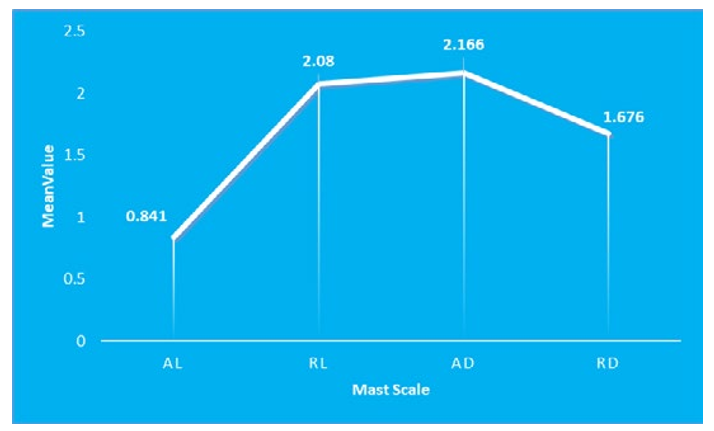
Figure Iv: A Line Graph Showing the Mean Mast Scales of the Overall Respondents
Key:
AL = Attraction to life AD = Attraction to death
RL = Repulsion by life RD = Repulsion by death
|
CAUSES |
Strongly agree |
Agree |
Neutral |
Disagree |
Strongly disagreed |
TOTAL |
MEAN LIKERT |
|
Financial challenges |
281(40.7) |
293(42.4) |
53(7.7) |
33(4.8) |
31(4.5) |
691(100) |
4.1 |
|
Poor school performance |
244(35.3) |
280(40.5) |
76(11.0) |
51(7.4) |
39(5.6) |
690(99.9) |
3.92 |
|
Psychiatric disorders |
321(46.5) |
246(35.6) |
45(6.5) |
36(5.2) |
42(6.1) |
690(99.9) |
4.11 |
|
Low self-esteem |
258(37.3) |
292(42.3) |
66(9.6) |
42(6.1) |
33(4.8) |
691(100) |
4.01 |
|
Chronic illness |
225(32.6) |
269(38.9) |
91(13.2) |
65(9.4) |
41(5.9) |
691(100) |
3.83 |
|
Drug or substance use |
255(36.9) |
265(38.4) |
72(10.4) |
56(8.1) |
43(6.2) |
691(100) |
3.92 |
|
Stressful life events |
264(38.2) |
285(41.2) |
58(8.4) |
45(6.5) |
38(5.5) |
690(99.9) |
4.0 |
|
Academic stress |
149(21.6) |
232(33.6) |
145(21.0) |
115(16.6) |
48(6.9) |
689(99.7) |
3.45 |
|
Influence of alcohol |
155(22.4) |
240(34.7) |
143(20.7) |
104(15.1) |
47(6.8) |
689(99.7) |
3.5 |
|
Anxiety |
175(25.3) |
237(34.3) |
140(20.3) |
82(11.9) |
56(8.1) |
690(99.9) |
3.56 |
|
Previous suicide attempt or completed suicide in the family. |
123(17.8) |
170(24.6) |
175(25.3) |
134(19.4) |
88(12.7) |
690(99.9) |
3.15 |
|
Relationship issues. |
157(22.7) |
287(41.5) |
108(15.6) |
87(12.6) |
50(7.2) |
689(99.7) |
3.59 |
|
Cyberbullying |
216(31.3) |
255(36.9) |
102(14.8) |
57(8.2) |
57(8.2) |
687(99.4) |
3.73 |
|
Personality traits such as impulsivity |
124(17.9) |
253(36.6) |
174(25.2) |
90(13.0) |
49(7.1) |
690(99.9) |
3.45 |
|
Trauma from childhood and sexual abuse |
309(44.7) |
272(39.4) |
48(6.9) |
28(4.1) |
34(4.9) |
691(100) |
4.15 |
Table V: Risk Factors of Suicidal Tendencies
Discussion
The key findings of this study showed that suicidal tendency is prevalent among undergraduate students with factors such as cyberbullying, relationship issues, chronic illness, anxiety, low self-esteem, sexual abuse, and family factors amongst others as the key risk factors predispose these students to suicide. The research findings revealed a high risk of suicidal tendency among the students (79.6%) and this is similar to a study done by Owusu-Ansah et al, who reported a high prevalence of suicidal tendency (suicidal ideation [15.2%] and death wishes [24.3%]) among students of Kwame Nkrumah University of Science and Technology. In contrast to this, a low suicidal tendency was reported in studies carried out among undergraduate students of Federal Universities in Southeast Nigeria, and also among Muslim Tertiary students in the Durban area, South Africa where religion was discovered to be a protective factor against suicide. Differences in results may be due to the difference in instruments and study designs used and specific features and conditions in different regions and countries. According to the findings of the study, financial challenges, poor academic performance, and use of alcohol and drugs are factors that contribute to suicidal tendencies. This is in line with a study done by Wanyoike, who reported that alcohol and drug/substance abuse by students were risk factors that affect their academic performance and could encourage suicidal tendencies. This is also consistent with studies done by. Psychiatric disorders and anxiety were also factors attributed to suicidal tendencies and this is in line with a study done by [11,14-19].
Low self-esteem has been observed to be among the leading causes of suicidal tendency and in line with this is a study done by Owusu-Ansah et al, who reported a strong connection between self-esteem difficulties and suicidal tendency among the students of Kwame Nkrumah University of Science and Technology, Kumasi, Ghana. This is in contrast to the one done by Kehinde, which reported that low self-esteem was associated with suicidal tendencies among undergraduates in South West Nigeria. However, self-esteem has been identified in the WHO 2014 report on suicide prevention as an important protective buffer against suicidal behavior among young people. According to Wanyoike 2015, students with chronic illness and terminal diseases such as HIV/AIDS, epilepsy, sickle cell anemia, and STIs, can be lethal if not effectively treated and cared for. People with these ailments need to constantly be under treatment and close monitoring as this could lead to depression due to the loneliness and pain experienced and they could consider suicide as a way out. This is consistent with our study [10,11,15,18].
Trauma from childhood abuse, sexual abuse, and cyberbullying (a form of bullying or harassment using electronic means which includes sending or posting negative, harmful, false, or mean content about someone) and stressful life events such as the loss of a loved one, rejection or discrimination are among the factors that can instigate a student to contemplate suicide. This is similar to a study done by Bilsen 2018.From this study, relationship issues such as being jilted by a boyfriend/girlfriend, or breaking up with a boyfriend/girlfriend have been identified as causes of suicidal tendencies. This is similar to a study done by Jin et al. (2011) among Chinese students, where 63% of the males and 52% of the females stated relationship issues as a major cause of suicidal tendencies.In this study, academic stress was rescinded as a predisposing factor of suicidal tendency and this is in contrast with a study carried out among Chinese students where 35.6% of the students included academic stress as one of the instigators of suicide. Personality traits such as impulsivity and previous cases of suicide attempt or completed suicide in the family were repudiated as predisposing factors and this is in contrast with studies done by, where a heightened presence of suicidal behavior has been observed among young people who have a case of completed suicide or suicide attempt in their family [15, 21-23].
Conclusion
Suicide is a public health issue that needs urgent attention as it still ranks among the leading causes of death for young people. From the findings of this study, suicidal behavior was observed to be prevalent among the students. Poor academic performance, mental disorders, trauma from childhood and sexual abuse, low self-esteem, chronic illness, drug or substance use, relationship issues, cyberbullying, and financial challenges, were the major risk factors revealed by this study and these factors are among the forces that generate depression which adversely affects the students' mental health and could lead to contemplation of suicide. Therefore, elective courses on how to cope with depression and the development of problem-solving skills should be provided for the students, those with financial challenges should be informed about scholarships, loans, and part-time job opportunities, and policies should be established to reduce the harmful use of alcohol and drugs among the students.
References
- World Health Organization. (2021). Suicide worldwide in 2019: global health estimates.
- Cole, d. E. Protinsky, H. O. and Cross, l. H. (2015). an Empirical Investigation of Adolescents Suicidal Ideation. Adolescence, 27(108) 813.
- Khan, A., Mustaffa, M. S., Hamdan, A. R., & Ahmad,R. (2014). Influence of psychological factors on suicide ideation among Malaysian and Indian adolescent. Procedia- Social and Behavioral Sciences, 143, 347-351.
- Stone, D. M., Holland, K. M., Bartholow, B. N., Crosby, A. E., Davis, S. P., & Wilkins, N. (2017). Preventing suicide: A technical package of policies, programs, and practice.
- Crosby, A., Ortega, L., & Melanson, C. (2011). Self- directed violence surveillance; uniform definitions and recommended data elements.
- World Health Organization. (2018). Global status report on alcohol and health 2018. World Health Organization.
- World Health Organization. (2018). Mental health: strengthening our response.
- World Health Organization. (2019). Suicide in the world: global health estimates (No. WHO/MSD/MER/19.3). World Health Organization.
- Iesutomi akomolafe (10 september 2021). nearly half of the suicide-related calls are from the under-30 age group – the guardian.
- World health organization (2014). Noncommunicable diseases (ncds) and mental health: challenges and solutions. Https://www.who.int/nmh/publications/ncd-infographic. pdf.
- Lawrence, K. (2022). Prevalence of suicidal tendencies and associated risk factors among Nigerian University Students: A quantitative survey. The Open Psychology Journal, 15(1).
- Onwuama, e. M., ibuot, e. J., agbo, c. And obiwulu,a. (2021). Depression and rising incidents of suicide among undergraduates in nigeria: a survey of southeast. International journal of psychosocial rehabilitation, vol. 25, issue 02.
- https://www.who.int/data/gho
- Ajibola, A. O., & Agunbiade, O. M. (2022). Suicide ideation and its correlates among university undergraduates in south western Nigeria. Community health equity research & policy, 43(1), 45-58.
- Owusu-Ansah, F. E., Addae, A. A., Peasah, B. O., Oppong Asante, K., & Osafo, J. (2020). Suicide among university students: prevalence, risks and protective factors. Health psychology and behavioral medicine, 8(1), 220-233.
- Sabina, A. PREVALENCE AND EXTENT OF SUICIDAL BEHAVIOURS AMONG UNDERGRADUATES OF UNIVERSITIES IN NORTH-EAST STATES OF NIGERIA.
- Kazi, T. B., & Naidoo, S. (2016). Does religiosity mediate suicidal tendencies? A South African study of Muslim tertiary students. Journal of religion and health, 55, 1010- 1023..
- Wanyoike, B. W. (2015). Suicide among university students in Kenya: causes, implications and interventions. Journal of Language, Technology & Entrepreneurship in Africa, 6(1), 35-53.
- Abdu, Z., Hajure, M., & Desalegn, D. (2020). Suicidal behavior and associated factors among students in Mettu University, South West Ethiopia, 2019: An institutional based cross-sectional study. Psychology research and behavior management, 233-243.
- Engin, E., Gurkan, A., Dulgerler, S., & Arabaci, L. B. (2009). University students' suicidal thoughts and influencing factors. Journal of psychiatric and mental health nursing, 16(4), 343-354.
- Bilsen, J. (2018). Suicide and youth: risk factors. Frontiers in psychiatry, 9, 540.
- Kok, J. K., Gan, C. C., & Goh, L. Y. (2011). Youths talk about death: Causes for suicide. International Journal of Social Science and Humanity, 1(2), 145.
- Santos, H. G. B. D., Marcon, S. R., Espinosa, M. M., Baptista,M. N., & Paulo, P. M. C. D. (2017). Factores asociados a la presencia de ideación suicida entre universitarios. Revista Latino-Americana de Enfermagem, 25, e2878.