

International Journal of Clinical and Medical Education Research(IJCMER)
ISSN: 2832-7705 | DOI: 10.33140/IJCMER
Impact Factor: 0.93


Research Article - (2024) Volume 3, Issue 1
Assessment of Knowledge About Accreditation of Medical Schools Among Medical Students of school of medicine at Ahfad University for women 2021
2Faculty of medicine ,Alzaiem Alazhri University, Sudan
Received Date: Dec 20, 2023 / Accepted Date: Jan 18, 2023 / Published Date: Jan 31, 2024
Copyright: ©2024: Mohammed Hammad Jaber, et al. This is an open-access article distributed under the terms of the Creative Commons Attribution License, which permits unrestricted use, distribution, and reproduction in any medium, provided the original author and source are credited.
Citation: Ahmed, F. Y. A., Jaber, M. H., FadulAllah, R. G. M., Alkheder, S. I. A., Khalid, S. K. M., et al. (2024). Assessment of Knowledge About Accreditation of Medical Schools Among Medical Students of school of medicine at Ahfad University for women 2021. Int J Clin Med Edu Res, 3(1), 01-05.
Abstract
Introduction: accreditation was defined by World Federation of Medical Education (WFME) as the certification of the suitability of medical education programs, and of the competence of medical schools in the delivery of medical education that ensures patient safety and competent practicing doctors. It’s extremely important that students understand the concept of accreditation, its nine criteria and six processes.
Method: This study was an institutional based cross-sectional study, conducted in 2021.This study was carried out in one phase among 333 medical students in the university of Ahfad school of medicine, aged <18 and >21 were enrolled in the study. The questionnaires were formed in Google form which made data easy to collect and analyze, especially considering the obstacle of the Corona pandemic. These forms were formed to evaluate the knowledge and understanding of students toward accreditation of medical schools. Statistical analysis was performed using SPSS version 20.
Result: Basically Concerning the medical students’ knowledge about accreditation, the results revealed that the majority of them (63.1%) mentioned they have information about accreditation, while the rest of them (36.9%) mentioned they have no information about accreditation. While accreditation is defined as the official approval given by an organization stating that a subject or thing has achieved a required standard. In medical education terminology, accreditation has numerous definitions. But according to the World Health Organization (WHO) accreditation is "a voluntary peer-review process designed to test the educational quality of new and established medical programs"(1).
Conclusion: From the study findings it can be concluded that; while the general knowledge on accreditation was unsatisfactory, the students’ knowledge about standard of accreditation and accreditation process and their roles in it was rather poor.
Background
Historically, the first attempts of accreditation in post-secondary education began in the USA in 1787. Throughout the nineteenth century, the accreditation movement developed through regional and professional associations in the USA until the process of accreditation in medical schools was assigned to the Liaison Committee of Medical Education (LCME). The most well-known milestone in seeking quality assurance and compliance with medical education standards was the work completed by Abraham Flexner for the Carnegie Foundation for the Advancement in Teaching. His work led to the production of Flexner's Report in 1910, which is considered a major turning point in medical education. The report described a need for improvement of the education systems in medical schools and a method to assess the quality of these institutions. Flexner visited the 155 medical schools that existed at that time in the USA and Canada and examined their standards. This report led to the reduction in the number of medical schools from 155 to 31.
Today, the accreditation process has been implemented in many countries throughout the world. Ninety-two countries are registered with the Foundation for Advancement of International Medical Education and Research (FAIMER) Directory of Organizations that Recognize/Accredit Medical Schools (DORA) [1]. The World Federation for Medical Education (WFME) developed the WFME Trilogy of Global Standards for Quality Improvement of Medical Education from 1998. The initial result was presented at the beginning of this century and the Trilogy was published in 2003 [2]. Sudan Medical Council (SMC) bylaw 1993 (amended 2004) mandated the SMC to set standards of undergraduate medical education for medical, pharmacy and dental schools and ascertain that they are comparable to regional and international standards. It also mandated SMC to monitor quality of basic medical education through implementing a well based accreditation system. A national policy for accreditation was formulated and adopted. Standards based on WFME and national standards of Ministry of Higher Education and Scientific Research (MOHE&SR), and adapted to the local context were formulated and adopted. Standard procedures for accreditation were identified and implemented [3].
In 2000, the Sudan Medical Council (SMC) started to hold the Licensing Exam as a means to verifying the quality of graduates before granting them permanent registration as doctors. Then in 2003, “The Model College” which is a document describing the educational and institutional requirements for an ideal medical college in the country was developed. It was based on international standards, published literature and local deliberations to guarantee context relevance, the document got further updated in 2012 [4]. The first round of accreditation of medical schools was conducted using the basic standards in the period 2008-2012. In 2013-2015, SMC held a series of consultative meetings and conducted a national workshop to update the standards based on acquired local and regional experiences, the national and international directions in medical education and the international guidance provided by the WFME. Medical education experts from WFME and UK were invited to attend and contribute to the national workshop as resource persons. The updated standards are based on the updated WFME standards (2012) and are compatible with the updated national standards of MOHE&SR (The model college of Medicine). These references were used and adapted to suit the local context of medical education and practice in the Sudan [3].
Ahfad University for Women was always concerned with the quality of its programs and official efforts were there since the early nineties. The School of Medicine was accredited through the National Accreditation Program First Round (2010 -2012). Accreditation is coordinated and executed by the Sudan Medical Council, and the school is now preparing for the upcoming Second Round of National Accreditation. The second round has already started and two medical faculties were accredited. The aim of this study was to assess the knowledge level of accreditation of medical education among medical students of school of medicine at Ahfad university in the year 2021.
Methodology
Study Design
It is an institutional based cross-sectional study, conducted in 2021.
Study Area
is Khartoum state, Ahfad University, school of medicine. This school give MBBS degree in medicine in 7 years of study.
Study Population
Inclusion Criteria
This study was applied among the medical students in Ahfad university among levels from 2nd to 6th level.
exclusion criteria are including the researchers of this study, External students, sick students and refuse or withdrawn students.
Sampling
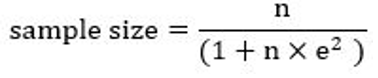
The sample size of this study is calculated using Solvin’s formula:
Whereas:
n: total population (numbers taken from examination office of college)
e: the degree of accuracy desired (0.05)

Sample techniques:
Simple random sampling method.
The randomization done by web site (Research randomizer)
Sample fracture:
10% of the sample size = 30.3
Total Samples:333
Tool
A self-administered questionnaire was used. It consisted of sociodemographic data (Age, level), 3 questions about familiarity and the source of knowledge, and rest of questions are multiple choice, designed as Questions for General Information, questions about Accreditation standards and questions about accreditation procedure. [appendix 1]. There is no similar study conducted in this manner, so a new questionnaire was formulated. This questionnaire was conducted in an electronic Google form on this link https:// www.google.com/forms/about/, and distributed to the randomized candidates through social media.
Methods of Data Analysis
The data were analyzed using IBM SPSS Statistics 20 program. It was entered with a code for each case consisting of last 4 digits of their phone number. The tables and charts were conducted by excel 2016.
Ethical Considerations
• Ethical clearance will be obtained from the higher authorities of the university, and students.
• Full explanation about the purpose of the study will be made to authorities of Ahfad university and students.
• Consent of the participants will be taken.
• Confidentiality will be assured.
• Data collection will be conducted after approval of the study by the medical student and university authorities.
• All data will be used for research purposes only.
Sample techniques:
Simple random sampling method.
The randomization done by web site (Research randomizer) Sample fracture:
10% of the sample size = 30.3
Total Samples:333
Tool
A self-administered questionnaire was used. It consisted of sociodemographic data (Age, level), 3 questions about familiarity and the source of knowledge, and rest of questions are multiple choice, designed as Questions for General Information, questions about Accreditation standards and questions about accreditation procedure. [appendix 1]. There is no similar study conducted in this manner, so a new questionnaire was formulated. This questionnaire was conducted in an electronic Google form on this link https:// www.google.com/forms/about/, and distributed to the randomized candidates through social media.
Methods of Data Analysis
The data were analyzed using IBM SPSS Statistics 20 program. It was entered with a code for each case consisting of last 4 digits of their phone number. The tables and charts were conducted by excel 2016.
Ethical Considerations
• Ethical clearance will be obtained from the higher authorities of the university, and students.
• Full explanation about the purpose of the study will be made to authorities of Ahfad university and students.
• Consent of the participants will be taken.
• Confidentiality will be assured.
• Data collection will be conducted after approval of the study by the medical student and university authorities.
• All data will be used for research purposes only.
Results
More than one third of the participants (34.5%) were over 21 years, 33% were less than 18 and 32.4% were in the age range 18-21. Concerning the university level of the respondents, respondents at third and fourth level were represented by equal portions (24.9% for each), 24% were in second level, 15% were in fifth level and 11.1% were in the sixth level. Concerning the respondents’ knowledge about accreditation, figure 4.3 illustrates that the majority of them (63.1%) mentioned they have information about accreditation, 36.9% mentioned they have no information about accreditation. the biggest portion of the respondents in this study (35.7%) mentioned they received information on accreditation from internet, 21% mentioned friends, 19% conference, 14.8% workshop, and 9.5% mentioned galleries. Depict the respondents’ views on their potential role in their own schools’ accreditation. It reveal that 47.4% of them thought that they don’t have roles, 34.2% mentioned they have roles to play in their schools’ accreditation and 18.3% mentioned they don’t know. Concerning respondents’ knowledge about the international body responsible for formulation of Accreditation standards, the results in figure 4.6 show that more than half of them (50.8%) mentioned World federation of medical Education (WFME), 25.5% mentioned United States Medical Licensing Examination (USMLE) and 23.7% mentioned World Medical Association (WMA).
The respondents’ knowledge about the responsible body for accreditation of medical schools in Sudan. It reveal that 37.2% of them mentioned Ministry of Health, 32.7% Sudan Medical Council, and 30.1% mentioned Sudan Medical Specialization Board. 35.7% of the respondents in this study stated that the accreditation program actually started accrediting medical schools in Sudan in 2010, 35.1% mentioned 1990, and the rest of them 29.1% mentioned 2000.when the respondents were asked about the main aim of the World Federation of Medical Education (WFME), 37.8% mentioned ensuring adequate medical service delivery in developing countries, 35.7% mentioned to enhance the quality of medical education worldwide and the rest of them (26.4%) mentioned to support post-graduate medical education. Educational Commission for Foreign Medical Graduates (ECFMG) in the United States state that applying physicians for their program will required to be graduated from medical school that is appropriately accredited by which year, Respondents’ knowledge about this was 36.9% mentioned 2022, 34.2% said 2023, and 28.8% mentioned 2024. 45.9% of the respondents thought that accreditation license in Sudan are valid for 5 years, 30% mentioned 3 years and 24% mentioned 7 years.
Concerning respondents’ knowledge on whether the Ahfad university school of medicine was accredited during the first round of accreditation or no, the results show that 36.3% mentioned yes, 36.3% mentioned no, and 27.3% mentioned they do not know. Concerning the benefit of accreditation for medical schools 36.3% of the respondents mentioned that accreditation ensures attained a cretin level that meets pre-specific standards, 34.8% said that accreditation ensure that every graduating student of this schools will become a successful professional, while 28.8% stated that accreditation ensures that the university will become public university.Regarding the body that medical school must give the feedback about the school program 40.8% of the respondents mentioned Sudan medical Council, 31.5% mentioned staff, and 27.6% mentioned students. Regarding the areas that the Accreditation standards cover, 38.1% of the respondents mentioned 9 areas, 35.1% said 11, and 26.7% mentioned 12 areas.the respondents’ views regarding the number of Sub-Areas that the accreditation standards cover. It reveals that 40.5% of them mentioned 36 sub-areas, 33.6% said 26, and 25.8% stated 20.Concerning the respondents’ views on the activities that students must participate in as a standard of good practice, 38.7% mentioned academic and social activities, 31.8% claimed determining specific course content, and 29.4% cited selection of the school. the respondents’ views on the first main phase in accreditation process. The results reveal that 39.9% mentioned submission of self-study report, 33% said selection of the team assessors, and 27% stated monitoring. 41.1% of the respondents supposed that team of assessors is chosen by the Ministry of Health, 30.9% assumed Sudan Medical Council and 27.9% cited Sudan Medical Specialization Board. the respondents’ views on the membership of self-study committee. It reveal that 36.6% mentioned external visitors, 34.5% said Sudan Medical Council, and 28.8% stated students.
Discussion
The accreditation of medical school programs has become widely popular in both developed and developing countries worldwide. Given the substantial investment in the education of future doctors and the potential impact of accreditation system on educational programs, it’s important to understand the perception of students toward accreditation. This study was carried out in Ahfad University for Women among medicine school students to assess the knowledge level of accreditation of medical education among medical students in Ahfad university in the year 2021. The results showed that the participating students were from different age groups ranging from less than 18 to over 21 years old. Similarly, different university levels were represented from 2nd level to sixth at comparable percentages. Concerning the medical students’ knowledge about accreditation, the results revealed that the majority of them (63.1%) mentioned they have information about accreditation, while the rest of them (36.9%) mentioned they don’t have any information about accreditation. In medical education terminology, accreditation has numerous definitions. But according to the World Health Organization (WHO) accreditation is & QUOT a voluntary peer-review process designed to test the educational quality of new and established medical programs & QUOT [1]. Although the study found that the majority of the candidates were familiar with the concept, but they were also having just a minimal information about the accreditation process in general and there role on it , reflecting that although the accreditation is a huge principle but student's involvement on it is very poor.
This might be attributed to the fact that; the principle of Accreditation is not attractive to the majority of students, as they are not open to studying such extracurricular topics. From the study findings, internet, friends, and conference were the major sources on accreditation (35.7%, 21%, 19%, respectively). While workshops and conferences are actually quite trusted sources of information, internet sites are varied and need to be assessed first as some of them cannot be taken as a good source of information. Friends and social media have the mass effect, as they are cheap, time saving and can reach a majority of students in contrast to the conferences and workshops. On the other hand, conferences and workshops nourish students with deep strong information and empower them with a contact that affects their attitude. Accordingly, this data shows a side of low effort about conferences and workshops especially as there is a great correlation between sources of knowledge and the score.
The results revealed that the biggest portion of the students participating in this study (47.4%) believed that they don’t have roles to play in their schools’ accreditation. Students should ensure that accreditation standards/elements, policies, and actions include the student perspective. Student must participate in the discussions and decision-making on accreditation matters during university meetings, including in reviews of accreditation surveys and medical school follow-up reports, and consideration of new or revised accreditation standards/elements and policies. Each student participates in one accreditation survey visit during the year of his or her service on the university [8]. The results showed that only 50.8% of the students in this study were aware that World federation of medical Education (WFME) is the International body responsible for formulation of Accreditation standards, while merely 32.7% could identify that Sudan Medical Council (SMC) is the responsible body for the same regard in Sudan. Recent advances in the establishment of standards for the accreditation of medical schools include the work led by the World Federation for Medical Education (WFME) in collaboration with the WHO, but, Sudan is among the WHO regions and countries that have adopted the WFME standards [1]. However, these standards were used and adapted to suit the local context of medical education and practice in the Sudan [3].
Only 35.7% of the participating medical students were able to identify that the accreditation program actually start accrediting medical schools in Sudan around the year 2010. The first round of accreditation of medical schools was conducted using the basic standards in the period 2008-2012 [3]. when they were asked about the main aim of the World Federation of Medical Education (WFME), only 35.7% could specify that right choice ,while 37.7% mentioned to enhance adequate medical service delivery in developing countries , that closer between this percentage mean need more technical research . on another hand, the results of the current study revealed that only 28.8% of the students could find out that 2024 is the exact medical school year of accreditation required by the Educational Commission for Foreign Medical Graduates (ECFMG) in the United States for physicians’ applying for their program. The 2024 Medical School Accreditation Requirement was established by ECFMG in 2010 to stimulate international accreditation efforts and enhance the quality of medical education worldwide [9]. Less than half of the participants (45.9%) could find out that accreditation license in Sudan are valid for 5 years. Accreditation license is authorized by Sudan Medical Council. Yet, concerning their knowledge on whether the Ahfad university school of medicine was accredited during the first round of accreditation or no, only 36.3% knew that fact, while the majority did not. Ahfad University for Women was always concerned with the quality of its programs and official efforts were there since the early nineties. The School of Medicine was accredited through the National Accreditation Program First Round (2010 -2012). Accreditation is coordinated and executed by the Sudan Medical Council, and the school is now preparing for the upcoming Second Round of National Accreditation.
Regarding the advantage of accreditation for medical schools, only 36.3% of the students gave the right answer stating that accreditation ensures attained a certain level that meets pre-specific standards. The process of accreditation is either voluntary or mandatory accreditation that aims to ensure the compliance of medical schools with preset standards in order to satisfy the consumers of the educational process [1]. In accordance with the previous findings, only 40.8% of the students participating in this study could notice that SMC is the body that medical school must give the feedback about the school program. The whole process of accreditation through many stages is held, followed, monitored and evaluated by the SMC [6]. About the areas that the Accreditation standards covers, the results of the current study proved that no more than 38.1% of the respondents were able to specify the right answer (9 areas). The WFME standards for basic medical education include nine areas with a total of 36 sub-areas. The sub-areas are defined as specific aspects of an area that correspond to performance indicators, and each sub-area has two levels [1].
Regarding the number of Sub-Areas that the accreditation standards cover. According to WFME a set of global standards in basic medical education are recommended. The standards are structured according to 9 areas with a total of 36 sub-areas [3]. from the results, only 40.5% of the participants mentioned the right answer. Concerning the students’ views on the activities that students must participate in as a standard of good practice, 38.7% mentioned academic and social activities, 31.8% claimed determining specific course content, and 29.4% cited selection of the school. The dean informs student leadership about the upcoming survey team visit soon after the LCME sets the dates for the visit. At this initial meeting, the dean and students should discuss the roles of students in the institutional self-study and survey visit processes. It will be helpful if the student leadership meets with the dean, the Facilitation Committee, or both, at the very beginning of the process to discuss how students can best organize their efforts to collect information and participate in the accreditation review Selection of the team of assessors is the first main phase in accreditation process according to WFME [6]. This was known by less than one third of our participants (33%) in another indication of poor knowledge on accreditation. Medical Education (WFME) is to enhance the quality of medical education worldwide.
Similarly, only 30.9% of the students were familiar with that the team of assessors is chosen by the Sudan Medical Council, where the composition of the team of assessors provides for a balance of knowledge and expertise, and of basic medical sciences and clinical disciplines, and an expert assessor is appointed chair of the team. Further, the majority of the participants failed to know that self-study committee actually includes students (28.8%). Yet, the medical school dean and faculty accreditation lead, in collaboration with student leadership, should appoint one or more students to the self-study task force and to appropriate self-study committee(s).
Conclusion
We concluded that; while the general knowledge on accreditation was unsatisfactory, the students’ knowledge about standard of accreditation and accreditation process and their roles in it was rather poor. The majority of the students failed to identify the criteria by which decisions and judgments can be made. Further, they were unable to state the accreditation process stages and their roles in it.
Most of the students have moderate knowledge about AME, their knowledge is better in general information and weak in accreditation procedure. The most frequent source of knowledge is friends and social media.
Limitations
The corona pandemic and the closure of the university and hospitals make everything difficult for us so the topic was changed from assessment of knowledge about acute complication of type one diabetes mellitus of parent of diabetic children to this topic and also for us to collect the data from student. Therefore, we had to change the questionnaire to Google form. There is insufficient previous researches regarding assessment of student’s knowledge about accreditation in Sudan, despite the important role of students in the process of accreditation of medical schools.
Recommendations
Based on this study, it is clear that there is a need for more education to students about accreditation of medical school and the importance of their role on it, therefore it is recommended that: Authorized bodies should provide information and knowledge on accreditation, its criteria, stages, and the roles played by different stakeholders should be through educational curriculum and workshops. Health educational institutions should be accredited periodically on as a part of its authorization of work. A list of accredited institutions should be periodically issued in medical magazines, and websites including the SMC’s. Students’ participation in accreditation process in Ahfad University for Women should be encouraged through meetings with medicine school students and through standard criteria. Most of students who have knowledge about this topic have received it from social media ,so the researcher advice those concerned with this issue such as universities ,SMC to use it to spread the largest amount of information on this topic using posts ,videos podcasts… etc. Hanging wall charts in universities with information in a simple and easy way about accreditation ,it’s benefits ,and the student’s role in it. Publish the results of our research to let other medical education know about and focus to do more work in this area
References
- Mohamed E, (Accreditation in medical Education, concept and practice), January 2012.
- Stefan L, Ducksun A, Ibrahim A, Emmanuel G., Marian E, Hans K, Otmar K, Wim VL, Madalena F, Pablo P, Rita S, Margot W, (Basic Medical Education WFME Global Standards for quality Improvement), 2012 revision, WFME Office. University of Copenhagen â?? Denmark 2012 (page 9-17).
- Zein A., M Y Sukkar, Alsheikh M, Elneel A, Elsheikh E, Ghada S, Sara M., Wafaa S, Abubaker M, Sudan Medical Council 2015 (Standards of Accreditaion of Medical Schools), June 2015.
- Sukkar, M. Y. (2008). Accreditation of medical schools in the Sudan. Khartoum Medical Journal, 1(1), 49-50.
- Omer A, Mohamed E, Mohamed E, Osman T, Ali B, Sayed M, Ahmed A, Hashim E, Abdul Rahman A, Mohamed E, (Accreditation of Faculty of Medicine university of Gazira), Pilot Study, January 2005.
- Zein A., M Y Sukkar, Alsheikh M, Elneel A, Elsheikh E, Ghada S, Sara M., Wafaa S, Abubaker M, Sudan Medical Council 2017 (Policy for Accreditation of Medical, Dental and pharmacy school), April 2017.
- Greenfield, D., & Braithwaite, J. (2008). Health sector accreditation research: a systematic review. International journal for quality in health care, 20(3), 172-183.
- Zein A., M Y Sukkar, Alsheikh M, Elneel A, Elsheikh E, Ghada S, Sara M., Wafaa S, Abubaker M, Sudan Medical Council 2017 (Procedure for Accreditation of Medical, Dental and pharmacy school), April 2017.
- Van Zanten, M., Norcini, J. J., Boulet, J. R., & Simon, F. (2008). Overview of accreditation of undergraduate medical education programmes worldwide. Medical education, 42(9), 930-937.
- Alrebish, S. A., Jolly, B. C., & Molloy, E. K. (2017). Accreditation of medical schools in Saudi Arabia: A qualitative study. Medical Teacher, 39(sup1), S1-S7.
- Halah I, Sawsan A, Satish c, (Medical Students perception of International Accreditation), October 03, 2015
- Brahimi, T., Sarirete, A., & Ibrahim, R. M. (2016). The Impact of Accreditation on Student Learning Outcomes. International Journal of Knowledge Society Research (IJKSR), 7(4), 51-62.
- Barzansky, B., Hunt, D., Moineau, G., Ahn, D., Lai, C. W., Humphrey, H., & Peterson, L. (2015). Continuous quality improvement in an accreditation system for undergraduate medical education: benefits and challenges. Medical teacher, 37(11), 1032-1038.
- Blouin, D., Tekian, A., Kamin, C., & Harris, I. B. (2018). The impact of accreditation on medical schools’ processes. Medical education, 52(2), 182-191.
- Al Mohaimeed, A., Midhet, F., Barrimah, I., & Saleh, M. N.E. D. (2012). Academic accreditation process: experience of a medical college in Saudi Arabia. International journal of health sciences, 6(1), 23.