

Archives of Epidemiology & Public Health Research(AEPHR)
ISSN: 2833-4353 | DOI: 10.33140/AEPHR
Impact Factor: 1.98


Research Article - (2026) Volume 5, Issue 1
Assessment of Helmet Utilization Among Commercial Motorcyclists and Passengers in Zanzibar Town
2Department of Allied Health Sciences, School of Health and Medical Sciences, tate University of Zanzibar, Tanzania
Received Date: Dec 01, 2025 / Accepted Date: Jan 03, 2026 / Published Date: Jan 19, 2026
Copyright: ©2026 Said Suleiman Bakari. This is an open-access article distributed under the terms of the Creative Commons Attribution License, which permits unrestricted use, distribution, and reproduction in any medium, provided the original author and source are credited.
Citation: Bakari, S. S., Haji, A. A. (2026). Assessment of Helmet Utilization Among Commercial Motorcyclists and Passengers in Zanzibar Town. Arch Epidemiol Pub Health Res, 5(1), 01-06.
Abstract
Motorcycle-related traffic accidents present a serious public health concern in Zanzibar, intensified by low helmet use among commercial riders and their passengers. Although helmet wearing is legally mandated and widely recognized as protective, compliance remains inconsistent, particularly among passengers. This study examined helmet use prevalence, knowledge, attitudes, and determinants in Zanzibar Town through a cross-sectional survey of 132 participants, analyzed using SPSS with chi-square tests. Results indicated that while all respondents acknowledged helmets’ protective role and 98.5% were aware of legal requirements, only 87.9% of riders and fewer than 10% of passengers consistently wore helmets. Usage was significantly associated with education, motorcycle ownership, and gender (p < 0.05). Cultural misconceptions and weak enforcement further limited adherence. The findings emphasize the importance of awareness campaigns, stronger enforcement, and accessible helmet distribution to improve road safety outcomes.
Keywords
Commercial Motorcyclists and Passengers, Road Traffic Injury, Helmet Use, Knowledge And Attitude
Introduction
Commercial motorcycle transport has become a defining feature of mobility in many low and middle-income countries, offering both economic opportunity and public safety challenges. In Zanzibar Town, motorcycles provide affordable access to congested urban areas and serve as a source of income for young men who carry an average of 25 passengers daily. While this mode of transport has improved accessibility and livelihoods, it has also contributed to a growing burden of road traffic accidents (RTAs). Globally, RTAs are the ninth leading cause of death, projected to become the fifth by 2030 [1]. Motorcyclists are disproportionately vulnerable, being 34 times more likely to die and eight times more likely to be injured than drivers of other vehicles [2]. Helmet use is widely recognized as the most effective protective measure against motorcycle-related head injuries. In the United States, head injuries accounted for 53% of 28,744 motorcycle deaths between 1979 and 1984, with non-helmeted riders suffering the highest mortality [3]. In Kenya, motorcycle accidents doubled between 2004 and 2009, rising at 29% annually [4]. Countries such as Uganda, Ghana, and India have demonstrated that compulsory helmet laws significantly reduce fatalities and disabilities [5]. Yet across sub- Saharan Africa, compliance remains inconsistent, particularly among passengers. Studies in Tanzania and Thailand show that while positive attitudes toward helmet effectiveness predict higher compliance, knowledge of helmet laws alone does not guarantee regular use [6,7]. Weak enforcement, limited institutional support, and cultural perceptions of passenger safety are repeatedly cited as barriers [8].
Despite helmet use being legally mandated in Zanzibar, there is a notable absence of empirical data documenting the prevalence, attitudes, and knowledge surrounding its utilization among commercial motorcyclists and passengers. Much of the existing information remains anecdotal, with media reports, such as those by IPP Media (2016), noting that Zanzibar enforces helmet laws more strictly than the Tanzania mainland, where motorcycle riders—popularly known as Boda Boda—often ride without helmets [9]. While these accounts provide useful insights into government initiatives, including amendments to the Road Safety Act and enforcement campaigns, they fall short of offering systematic, peer-reviewed evidence that could guide public health interventions. This lack of scholarly research limits policymakers and stakeholders in designing targeted strategies to address passenger compliance, enforcement challenges, and cultural perceptions of safety. The rationale for this study, therefore, lies in bridging the rider–passenger gap, which leaves a significant proportion of daily commuters unprotected and vulnerable to severe injuries. By systematically examining the knowledge, attitudes, and prevalence of helmet use in Zanzibar Town, the study seeks to generate evidence that can inform interventions integrating regulation, education, and behavioral change strategies.
Methods
Research Design
This study utilized a cross-sectional survey design with both descriptive and analytical components. The design enabled the collection of quantitative data on helmet utilization behaviors, attitudes, and knowledge among commercial motorcyclists and passengers in Zanzibar Town.
Study Area and Population
The research was conducted in Zanzibar Town, specifically at three major motorcycle pick-up points: Darajani, Michenzani, and Pinda-mgongo. These locations were selected due to their high traffic volume and diverse commuter profiles. The study population included commercial motorcyclists and regular passengers aged 18 years and above who frequently use motorcycles for commuting or income-generating activities.
Sampling Technique and Sample Size
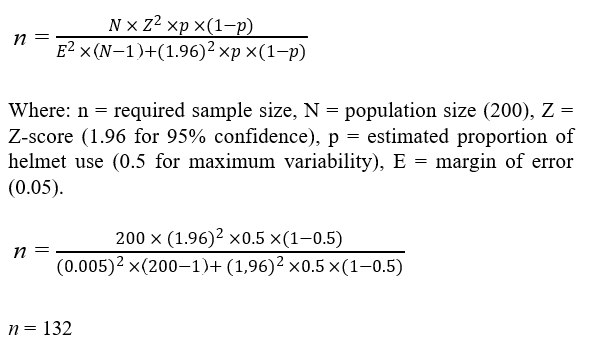
A stratified random sampling method was applied to ensure proportional representation across the three selected sites. The sample size was calculated using Cochran’s formula, based on a population of 200, a 95% confidence level, and a 5% margin of error, resulting in a final sample of 132 respondents.
Instruments and Tools for Data Collection
Data were gathered through a face-to-face structured questionnaire with closed-ended items on demographics, helmet ownership, legal awareness, safety perception, and usage. The tool was pre-tested with 20 participants for clarity and reliability. Responses were digitized in Kobo Toolbox, cleaned in Excel, and anonymized for confidentiality.
Data Analysis Method
Data were analyzed in SPSS using descriptive statistics to summarize demographics and helmet use. Chi-square tests assessed links between factors such as age, gender, experience, and awareness with helmet use and safety perception.
Results
Socio-Demographic Characteristics of Respondents A total of 132 respondents participated in the study, comprising 66 commercial motorcyclists (riders) and 66 passengers. Among passengers, 57.6% were female, and the most common age group was 36-45 years (33.3%). More than half (56.1%) had attained a college or university education. All motorcyclists were male and licensed, with the majority aged 26-35% years (48.5%). Most riders (80.3%) had completed secondary education, and nearly half (45.5%) had 4-6 years of riding experience. On average, riders reported carrying 25 passengers per day. Respondents were evenly distributed across the three study locations (Darajani, Michenzani, and Pinda-mgongo) as illustrated in Table 1 and Table 2.
Table 1: Summary of Demographic Information for Passengers
|
Survey Item |
Category |
Count (n) |
Column (%) |
|
Role |
Passenger |
66 |
100 |
|
Gender |
Female |
38 |
57.6 |
|
|
Male |
28 |
42.4 |
|
Age Group |
18–25 years |
12 |
18.2 |
|
|
26–35 years |
19 |
28.8 |
|
|
36–45 years |
22 |
33.3 |
|
|
46+ years |
13 |
19.7 |
|
Education Level |
College/University |
37 |
56.1 |
|
|
Secondary School |
26 |
39.4 |
|
|
Primary School |
2 |
3 |
|
|
No Formal Education |
1 |
1.5 |
|
Interview Location |
Darajani |
22 |
33.3 |
|
|
Michenzani |
22 |
33.3 |
|
|
Pinda-mgongo |
22 |
33.3 |
Table 2: Summary of Demographic Information for Motorcyclists (riders)
|
Variable |
Category |
Frequency (n) |
Percentage (%) |
|
Role |
Motorcyclist (rider) |
66 |
100 |
|
Gender |
Male |
66 |
100 |
|
Age Group |
18–25 years |
4 |
6.1 |
|
|
26–35 years |
32 |
48.5 |
|
|
36–45 years |
23 |
34.8 |
|
|
46+ years |
7 |
10.6 |
|
Education Level |
Primary School |
9 |
13.6 |
|
|
Secondary School |
53 |
80.3 |
|
|
No Formal Education |
4 |
6.1 |
|
Location of Data Collection |
Darajani |
22 |
33.3 |
|
|
Michenzani |
22 |
33.3 |
|
|
Pinda-mgongo |
22 |
33.3 |
|
Valid Driving License |
Yes |
66 |
100 |
|
Years of Experience as Commercial Rider |
Less than 1 year |
3 |
4.5 |
|
|
1–3 years |
15 |
22.7 |
|
|
4–6 years |
30 |
45.5 |
|
|
7+ years |
18 |
27.3 |
|
Mean Daily Passenger Load |
|
66 |
100 |
|
|
Mean = |
|
25 passengers/day |
Objective 1: Attitudes Toward Helmet Use
Both riders and passengers demonstrated positive attitudes toward helmet use. All respondents agreed that helmets reduce the risk of head injury. However, a higher proportion of riders (89.4%) strongly agreed with this statement compared to passengers (51.5%), indicating stronger conviction among riders. A Chi-square test showed a significant association between the respondent category and belief in helmet effectiveness (χ² = 22.746, p < .001), suggesting the riders held stronger attitudes toward helmet protection than passengers as illustrated in Table 3 and Table 4.
Table 3: Belief in Helmet Effectiveness by Type of Road User
|
Belief Statement |
Passenger (n) |
Passenger (%) |
Motorcyclist (n) |
Motorcyclist (%) |
Total (n) |
Total (%) |
|
Agree |
32 |
48.5 |
7 |
10.6 |
39 |
29.5 |
|
Strongly Agree |
34 |
51.5 |
59 |
89.4 |
93 |
70.5 |
|
Total |
66 |
100 |
66 |
100 |
132 |
100 |
Table 4: Crosstab of Helmet Attitude Analysis (Belief in Helmet Effectiveness)
|
Role |
Agree |
Strongly Agree |
Total |
|
Passenger |
32 |
34 |
66 |
|
Motorcyclist (rider) |
7 |
59 |
66 |
|
Total |
39 |
93 |
132 |
Objective 2: Knowledge of Helmet Use Legislation
Awareness of helmet legislation was high among respondents. All riders (100%) and most passengers (97.0%) reported being aware that helmet use is legally required. Statistical analysis showed no significant association between respondent category and legal awareness (χ² = 2.031, p = .154), indicating similar levels of knowledge among riders and passengers as shown in Figure 1 and Table 5.

Figure 1: Legal Awareness of Helmet Mandate by User Category
Table 5: Crosstab of Helmet Knowledge Analysis (Awareness of Helmet Legal Requirement)
|
Role |
Not Aware (No) |
Aware (Yes) |
Total |
|
Passenger |
2 |
64 |
66 |
|
Motorcyclist (rider) |
0 |
66 |
66 |
|
Total |
2 |
130 |
132 |
Objective 3: Prevalence of Helmet Utilization
Helmet utilization differed markedly between riders and passengers. Most riders (87.9%) reported always wearing a helmet, while a small proportion reported wearing helmets most of the time or occasionally. In contrast, helmet use among passengers was inconsistent: 69.7% were wore helmets only occasionally, 19.7% never wore helmets, and none reported always wearing helmets.
The difference in helmet-wearing frequency between riders and passengers was statistically significant (χ² = 107.098, p < .001), highlighting a substantial utilization gap between the two groups as shown in Figure 2 and Table 6.

Figure 2: Helmet Usage Frequency Patterns Among Road Users
Table 6: Crosstabulation of Role and Frequency of Helmet Use (N = 132)
|
Role |
Always |
Most of the Time |
Never |
Occasionally |
Total |
|
Passenger |
0 |
7 |
13 |
46 |
66 |
|
Motorcyclist (rider) |
58 |
4 |
0 |
4 |
66 |
|
Total |
58 |
11 |
13 |
50 |
132 |
Discussions
This study assessed helmet utilization, knowledge, and attitudes among commercial motorcyclists and passengers in Zanzibar Town and revealed a marked disparity between high awareness and actual helmet-wearing behavior, particularly among passengers. While both groups demonstrated strong knowledge of helmet legislation and positive attitudes toward helmet effectiveness, consistent helmet use remained substantially higher among riders than passengers.
The findings showed that commercial motorcyclists exhibited significantly stronger attitudes toward helmet effectiveness compared to passengers. Nearly all riders strongly believed in the protective role of helmets, likely reflecting their greater exposure to road traffic risks, frequent enforcement encounters, and personal riding experience. Passengers, although acknowledging helmet effectiveness, demonstrated comparatively weaker conviction. Similar patterns have been reported in studies from Kenya and Ethiopia, where riders consistently displayed stronger safety attitudes than passengers due to direct risk perception and enforcement pressure [10,11]. This attitudinal gap suggests that safety messaging and enforcement strategies in Zanzibar may disproportionately target riders while overlooking passengers.
Knowledge of helmet legislation was almost universal among both riders and passengers, yet no significant association was observed between legal awareness and helmet-wearing behavior. This finding reinforces evidence from Tanzania and other East African countries indicating that knowledge alone does not guarantee compliance [6]. Behavioral factors such as perceived discomfort, inconvenience, peer norms, and weak enforcement appear to play a more influential role in determining helmet use. The lack of association also suggests that current public awareness efforts, while effective in disseminating information, may not sufficiently address the behavioral and structural barriers to helmet utilization.
Helmet-wearing prevalence differed substantially between the two groups. Riders demonstrated high compliance, with most reporting consistent helmet use, whereas passenger compliance was notably low, with the majority wearing helmets only occasionally or not at all. This disparity mirrors findings across sub-Saharan Africa, where helmet use among passengers remains consistently lower than among riders [12]. Limited availability of passenger helmets, unclear responsibility for helmet provision, and social acceptance of riding without helmets likely contribute to this pattern. In Zanzibar Town, although many riders reportedly own spare helmets, these are not consistently offered to passengers, further exacerbating passenger vulnerability.
The implications of these findings are significant for road safety policy and public health interventions. The persistence of low passenger helmet use despite high awareness highlights the need for strategies that go beyond education. Enforcement mechanisms should explicitly include passengers, and regulations should clearly mandate helmet provision for both riders and passengers. Additionally, targeted behavior change campaigns focusing on passenger risk perception and shared responsibility for safety could help normalize helmet use among all motorcycle users.
This study has some limitations. The reliance on self-reported data may have introduced social desirability bias, potentially overestimating helmet use among riders. The cross-sectional design limits causal inference, and the study was confined to Zanzibar Town, which may restrict generalizability to other regions. Nonetheless, the study provides valuable empirical evidence addressing a critical gap in passenger helmet utilization in Zanzibar. In conclusion, the study demonstrates that while knowledge and attitudes toward helmet use are high among both riders and passengers, actual utilization—especially among passengers—remains inadequate. Bridging this gap requires integrated interventions combining enforcement, policy reform, helmet accessibility, and targeted behavioral change initiatives to improve road safety outcomes in Zanzibar Town.
Conclusion
The study revealed a clear gap between helmet law awareness and actual use in Zanzibar Town. While knowledge of helmet safety was high, passenger compliance remained low, driven by misconceptions, weak enforcement, and concerns about comfort. Although many riders owned spare helmets, they rarely provided them to passengers, increasing risk. Addressing this issue requires more than awareness campaigns; stricter regulations mandating passenger helmets, consistent enforcement, and targeted public education are essential. Future research should explore cultural perceptions and develop strategies to promote lasting behavioral change and improve road safety.
References
- Kalemile, D. M., & Kimario, H. F. (2023). Factors Contributing to Motorcycle (BodaBoda) Accidents in East Africa: An Empirical Literature Review.
- Kwalar, G. I., Verla, V. S., Tanue, E. A., Assob, J. N., & Nsagha,D. S. (2022). Road safety regulations among commercial motorcyclists in Douala, Cameroon. Special J Public Heatlh Nutr Dietetics, 2(2), 1-12.
- Obst, M., Rzepczyk, S., GÅ?owiÅ?ski, S., & Å»aba, C. (2023). Motorbike protective helmets, construction, testing and its influence on the type and severity of injuries of motorbike accident casualties: a literature review. Vibrations in Physical Systems, 34(1).
- Eryx, M. E. D., Brieux, E. M. H., Cervely, M., Prefina, M., Peya, E., Ndzaba, B., ... & Jean-Rosaire, I. (2020). Helmet Wearing among Commercial Motorcyclist in Brazzaville (Congo): Knowledge, Attitude and Prevalence. World, 5(3), 60-65.
- Afolabi, A. O. (2021). Perception and Compliance with Use of Safety Helmet as a Preventive Measure among Commercial Motorcyclists in Yoruba Ethnic-Dominated South-West Nigeria. PERCEPTION, 1(2), 35-49.
- Mosha, I., Ezekiel, M., Shayo, D., & Akyoo, W. (2021). Association_Between_Knowledge_Attitudes (1). Research Journal.
- Suwannaporn, S., Hongsranagon, P., & Havanond, P. (2013). Knowledge, Attitude, And Practice Towards Helmet Use Among Motorcycle Riders And Passengers In Ratchaburi Province, Thailand. J Health Res vol, 27(1).
- Rwebangira, G. (2021). Helmet Wearing As A Safety Tool: An Analysis Of The Law And Practice In Tanzania.
- Kandoya, J. (2016). legacy.ippmedia.com-Zanzibar strict onhelmet-wearing rule for bodaboda rides.
- Bachani, A. M., Hung, Y. W., Mogere, S., Akunga, D., Nyamari, J., & Hyder, A. A. (2017). Helmet wearing in Kenya: prevalence, knowledge, attitude, practice and implications. Public health, 144, S23-S31.
- Bedru, D., Teshome, F., Kebede, Y., & Birhanu, Z. (2022). Helmet wearing behavior where people often ride motorcycle in Ethiopia: A cross-sectional study. PLoS one, 17(1), e0262683.
- Abdi, N., Robertson, T., Petrucka, P., & Crizzle, A. M. (2022). Do motorcycle helmets reduce road traffic injuries, hospitalizations and mortalities in low and lower-middle income countries in Africa? A systematic review and meta- analysis. BMC public health, 22(1), 824.