

Archivos de Ciencia e Investigación(ADCI)
ISSN: 3068-014X | DOI: 10.33140/ADCI


Research Article - (2025) Volume 1, Issue 2
Analysis and Control of a Neurodynamic Model
Received Date: Aug 06, 2025 / Accepted Date: Sep 23, 2025 / Published Date: Sep 20, 2025
Copyright: ©©2025 Lakshmi N. Sridhar. This is an open-access article distributed under the terms of the Creative Commons Attribution License, which permits unrestricted use, distribution, and reproduction in any medium, provided the original author and source are credited.
Citation: Sridhar, L. N. (2025). Analysis and Control of a Neurodynamic Model. Arch Cienc Investig, 1(2), 01-07.
Abstract
The dynamic interaction between Serotonin, Dopamine and Norepinephrine is very complex and nonlinear, and it is important to understand the nonlinearity and develop strategies to control the interactions effectively. In this work, bifurcation analysis and multiobjective nonlinear model predictive control are performed on a neurondynamic model involving Serotonin, Dopamine, and Norepinephrine. Bifurcation analysis is a powerful mathematical tool used to deal with the nonlinear dynamics of any process. Several factors must be considered, and multiple objectives must be met simultaneously. The MATLAB program MATCONT was used to perform the bifurcation analysis. The MNLMPC calculations were performed using the optimization language PYOMO in conjunction with the state-of-the-art global optimization solvers IPOPT and BARON. The bifurcation analysis revealed the existence of a Hopf bifurcation point. The Hopf bifurcation point, which causes an unwanted limit cycle, is eliminated using an activation factor involving the tanh function.
Keywords
Bifurcation, Optimization, Control, Serotonin, Dopamine, Norepinephrine
Background
Blier studied the crosstalk between the norepinephrine and serotonin systems and its role in the antidepressant response. Monteiro et al, developed analytical results for a Wilson-Cowan neuronal network model. Brown et al, investigated the influence of spike rate and stimulus duration on noradrenergic neurons. Savic et al, developed a mathematical model of the hypothalamo-pituitary- adrenocortical system and its stability analysis. Best et al, studied homeostatic mechanisms in dopamine synthesis and release. Best et al, researched Serotonin synthesis, release, and reuptake in terminals: a mathematical model. Bowen studied the relationship between mood instability and depression [1-7]. Hamon et al, investigated monoamine neurocircuitry in depression and strategies for new treatments. Akar et al, performed a nonlinear analysis of EEGs of patients with major depression during different emotional states. Bowen et al, showed that moods in clinical depression are more unstable than severe normal sadness. Bangsgaard et al, performed patient-specific modeling of the HPA axis related to the clinical diagnosis of depression. Bachmann et al, studied the various methods for classifying depression in single-channel EEG using linear and nonlinear signal analysis. Liu et al, investigated the emotional roles of mono-aminergic neurotransmitters in major depressive disorder and anxiety disorders. Perez-Caballero researched the monoaminergic system and depression. Menke et al, investigated the role of the HPA axis as a target for depression [8- 15]. Loula et al, produced an individual-based model for predicting the prevalence of depression. Loula et al, developed a game theory-based model for predicting depression due to frustration in competitive environments [16,17]. Shao et al discovered the associations among monoamine neurotransmitter pathways, personality traits, and major depressive disorders [18]. Xu et al, performed a mental health informatics study on the mediating effect of the regulatory emotional self-efficacy. Nemesure et al, developed a predictive model of depression and anxiety using electronic health records and a novel machine learning approach with artificial intelligence. Lu, et al developed a semi-supervised random forest regression model based on co-training and grouping with information entropy for evaluation of depression symptoms severity. Loula et al used a dynamical systems approach to investigate the relationship between monoamine neurotransmitters and mood swings.
In this work, bifurcation analysis and multiobjective nonlinear model predictive control are performed on the neurondynamic model involving Serotonin, Dopamine, and Norepinephrine the paper is organized as follows. First, the model equations are presented, followed by a discussion of the numerical techniques involving bifurcation analysis and multiobjective nonlinear model predictive control (MNLMPC). The results and discussion are then presented, followed by the conclusions [19-22].
Model Equations
In this model, sv, dv, nv, represent the serotonin, dopamine, and norepinephrine in the blood plasma. The model equations are
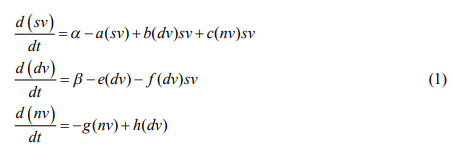
The base parameter value are a = 20; b = 0.001; c = 0.04; e = 3; f = 0.1; g = 2;h = 80; α = 50; β = 200;
More details are found in [22].
Bifurcation Analysis
The MATLAB software MATCONT is used to perform the bifurcation calculations. Bifurcation analysis deals with multiple steady-states and limit cycles. Multiple steady states occur because of the existence of branch and limit points. Hopf bifurcation points cause limit cycles . A commonly used MATLAB program that locates limit points, branch points, and Hopf bifurcation points is MATCONT [23,24]. This program detects Limit points(LP), branch points(BP), and Hopf bifurcation points(H) for an ODE system
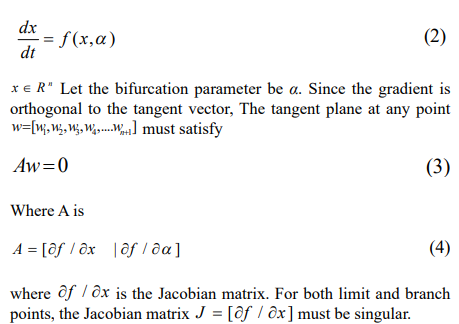
For a limit point, there is only one tangent at the point of singularity. At this singular point, there is a single non-zero vector,
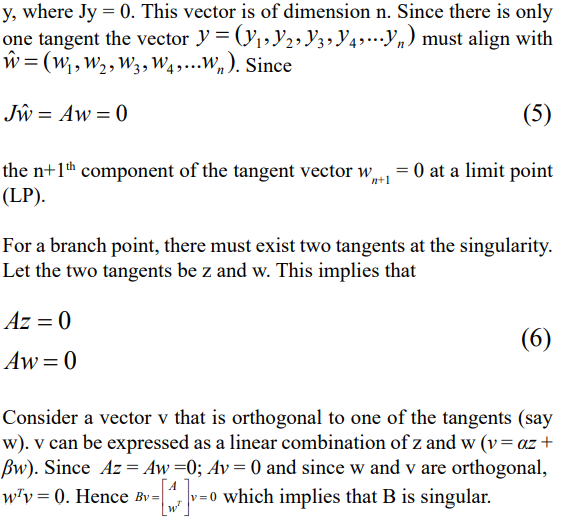
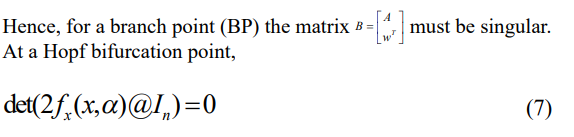
Since @ indicates the bialternate product whileis In the n-square identity matrix. Hopf bifurcations cause limit cycles and should be eliminated because limit cycles make optimization and control tasks very difficult. More details can be found in Kuznetsov [25- 27].
Hopf bifurcations cause limit cycles. The tanh activation function (where a control value u is replaced by) ( u tanh u/€) is used to eliminate spikes in the optimal control profiles [28-31]. Sridhar (2024)[32] explained with several examples how the activation factor involving the tanh function also eliminates the Hopf bifurcation points. This was because the tanh function increases the oscillation time period in the limit cycle.
Multiobjective Nonlinear Model Predictive Control (MNLMPC)
The rigorous multiobjective nonlinear model predictive control (MNLMPC) method developed by Flores Tlacuahuaz et al (2012) [33] was used.
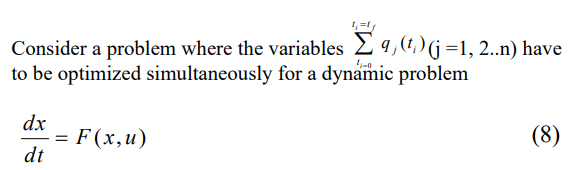
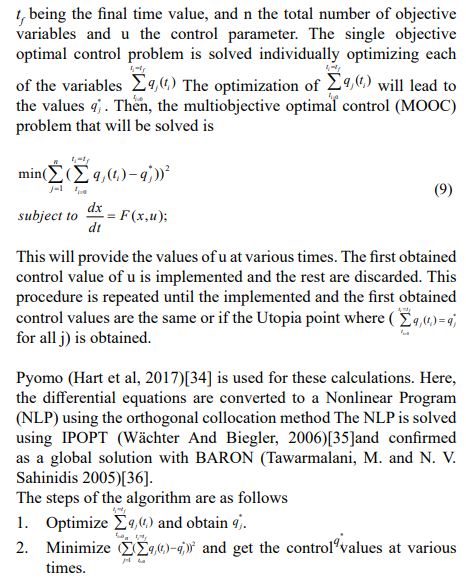
3. Implement the first obtained control values
4. Repeat steps 1 to 3 until there is an insignificant difference between the implemented and the first obtained value of the control variables or if the Utopia point is achieved. The Utopia 
Results & Discussion
When bifurcation analysis is performed with a as the bifurcation parameter, a Hopf bifurcation point appears at (sv, dv, nv, a) values of ( 96.593811, 15.79856, 631.942427, 25.811127 ). This is seen on curve AB in Figure 1a. When a is modified to a(tanh(a)), the Hopf bifurcation point disappears as seen in curve CD in Figure 1a. The limit cycle caused by this Hopf bifurcation is shown in Figure 1b. The tanh activation factor causes the Hopf bifurcation to disappear, validating the analysis of [32].
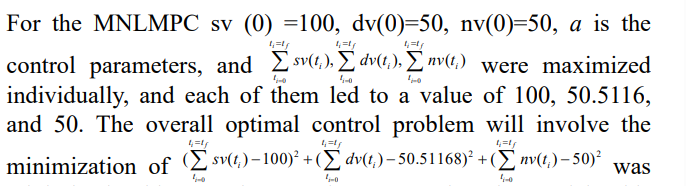
minimized subject to the equations governing the model. This led to a value of 5473.68. The MNLMPC values of the control variable, a was 16.17225. The MNLMPC profiles are shown in Figures 2a-2d. The control profiles of a exhibits noise and this was remedied using the Savitzky-Golay filter to produce the smooth profile asg.
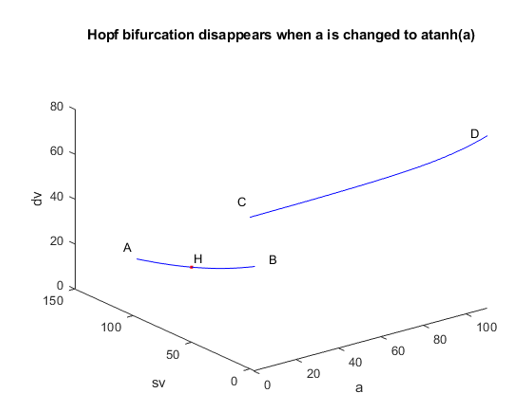
Figure: 1a Hopf on AB disappears when a is modified to atanh(a)(CD)

Figure: 1b limit cycle caused by Hopf bifurcation point
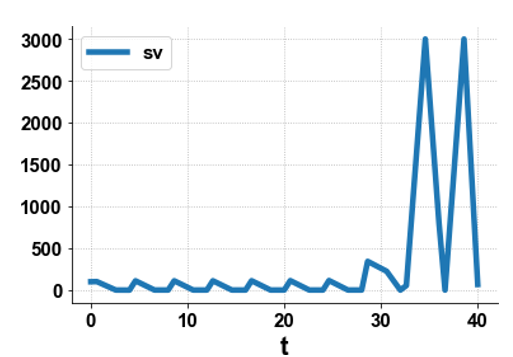
Figure: 2a MNLMPC (sv vs t)
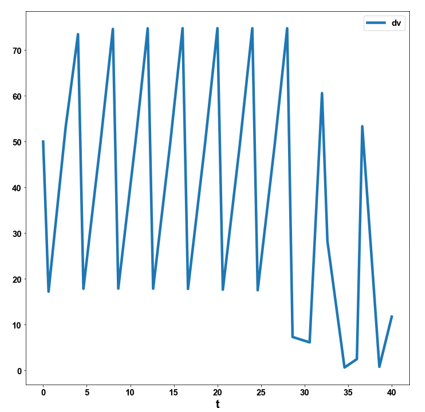
Figure: 2b MNLMPC (dv vs t)

Figure: 2c MNLMPC (nv vs t)
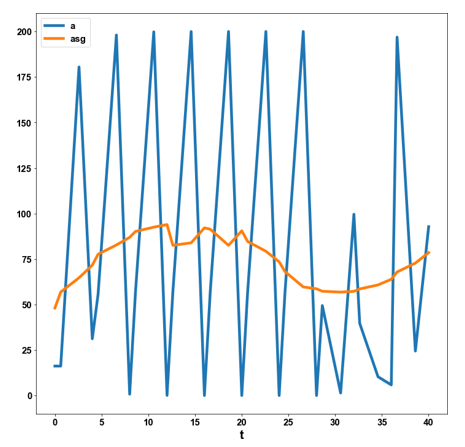
Figure: 2d a,asg vs t.
Conclusion
Bifurcation analysis and multiobjective nonlinear control (MN- LMPC) studies on a Neurodynamic model involving Serotonin, Dopamine and Norepinephrine. The bifurcation analysis revealed the existence of a Hopf bifurcation point The Hopf bifurcation point, which causes an unwanted limit cycle, is eliminated using an activation factor involving the tanh function. A combination of bifurcation analysis and Multiobjective Nonlinear Model Predic- tive Control(MNLMPC) for a Neurodynamic model involving Se- rotonin, Dopamine, and Norepinephrine is the main contribution of this paper.
References
- Blier, P. (2001). Crosstalk between the norepinephrine and serotonin systems and its role in the antidepressant response. Journal of Psychiatry & Neuroscience, 26(Suppl 1), S3–S10.
- Monteiro, L. H. A., Bussab, M. A., & Berlinck, J. G. C. (2002). Analytical results on a Wilson-Cowan neuronal network modified model. Journal of Theoretical Biology, 219(1), 83–91.
- Brown, E., Moehlis, J., Holmes, P., Clayton, E., Rajkowski, J., & Aston-Jones, G. (2004). The influence of spike rate and stimulus duration on noradrenergic neurons. Journal ofComputational Neuroscience, 17(1), 13–29.
- Savic, D., & Jelic, S. (2005). A mathematical model of the hypothalamo-pituitary-adrenocortical system and its stability analysis. Chaos, Solitons & Fractals, 26(2), 427–436.
- Best, J. A., Nijhout, H. F., & Reed, R. C. (2009). Homeostatic mechanisms in dopamine synthesis and release:Amathematical model. Theoretical Biology and Medical Modelling, 6, 21.
- Best, J. A., Nijhout, H. F., & Reed, R. C. (2010). Serotonin synthesis, release and reuptake in terminals: A mathematical model. Theoretical Biology and Medical Modelling, 7, 34.
- Bowen, R. C., Wang, Y., Balbuena, L., Houmphan, A., & Baetz, M. (2013). The relationship between mood instability and depression: Implications for studying and treating depression. Medical Hypotheses, 81(3), 459–462.
- Hamon, M., & Blier, P. (2013). Monoamine neurocircuitry in depression and strategies for new treatments. Progress in Neuro-Psychopharmacology & Biological Psychiatry, 45, 54–63.
- Akar, S. A., Kara, S., Agambayev, S., & Bilgiç, V. (2015). Nonlinear analysis of EEGs of patients with major depression during different emotional states. Computers in Biology and Medicine, 67, 49–60.
- Bowen, R., Peters, E., Marwaha, S., Baetz, M., & Balbuena,L. (2017). Moods in clinical depression are more unstable than severe normal sadness. Frontiers in Psychiatry, 8, 56.
- Bangsgaard, E. O., & Ottesen, J. T. (2017). Patient-specific modeling of the HPA axis related to clinical diagnosis of depression. Mathematical Biosciences, 287, 24–35.
- Bachmann, B., Peske, L., Kalev, K., Aarma, K., Lehtmets, A., Õöpik, P., et al. (2018). Methods for classifying depression in single channel EEG using linear and nonlinear signal analysis. Computer Methods and Programs in Biomedicine, 155, 11– 17.
- Liu, Y., Zhao, J. P., & Guo, W. B. (2018). Emotional roles of monoaminergic neurotransmitters in major depressive disorder and anxiety disorders. Frontiers in Psychology, 9, 2201.
- Perez-Caballero, L., Torres-Sanchez, S., Romero-López- Alberca, C., Gonzalez-Saiz, F., Mico, J. A., & Berrocoso,E. (2019). Monoaminergic system and depression. Cell and Tissue Research, 377, 107–113.
- Menke, A. (2019). Is the HPA axis as target for depression outdated, or is there a new hope? Frontiers in Psychiatry, 10, 101.
- Loula, R., & Monteiro, L. H. A. (2019). An individual-based model for predicting the prevalence of depression. Ecological Complexity, 38, 168–172.
- Loula, R., & Monteiro, L. H. A. (2020). A game theory- based model for predicting depression due to frustration in competitive environments. Computational and Mathematical Methods in Medicine, 2020, 3573267.
- Shao, X. J., & Zhu, G. (2020). Associations among monoamine neurotransmitter pathways, personality traits, and major depressive disorder. Frontiers in Psychiatry, 11, 381.
- Xu, Z. H., & Du, J. (2021). A mental health informatics study on the mediating effect of the regulatory emotional self-efficacy. Mathematical Biosciences and Engineering, 18(3),2775–2788.
- Nemesure, M. D., Heinz, M. V., Huang, R., & Jacobson, N.C. (2021). Predictive modeling of depression and anxiety using electronic health records and a novel machine learning approach with artificial intelligence. Scientific Reports, 11, 1980.
- Lu, S. F., Shi, X., Li, M., Jiao, J. A., Feng, L., & Wang, G.(2021). Semi-supervised random forest regression model based on co-training and grouping with information entropy for evaluation of depression symptoms severity. Mathematical Biosciences and Engineering, 18(4), 4586–4602.
- Loula, R., & Monteiro, L. H. A. (2022). Monoamine neurotransmitters and mood swings: A dynamical systems approach. Mathematical Biosciences and Engineering, 19(4), 4075–4083.
- Dhooge, A., Govaerts, W., & Kuznetsov, A. Y. (2003). MATCONT: A Matlab package for numerical bifurcation analysis of ODEs. ACM Transactions on Mathematical Software, 29(2), 141–164.
- Dhooge, A., Govaerts, W., Kuznetsov, Y. A., Mestrom, W., & Riet, A. M. (2004). CL_MATCONT: A continuation toolbox in Matlab.
- Kuznetsov, Y. A. (1998). Elements of applied bifurcation theory. Springer.
- Kuznetsov, Y. A. (2009). Five lectures on numerical bifurcation analysis. Utrecht University.
- Govaerts, W. J. F. (2000). Numerical methods for bifurcations of dynamical equilibria. SIAM.
- Dubey, S. R., Singh, S. K., & Chaudhuri, B. B. (2022). Activation functions in deep learning: A comprehensive survey and benchmark. Neurocomputing, 503, 92–108.
- Kamalov, A. F., Nazir, M., Safaraliev, A. K., Cherukuri, A., & Zgheib, R. (2021). Comparative analysis of activation functions in neural networks. In Proceedings of the 28th IEEE International Conference on Electronics, Circuits, and Systems (ICECS) (pp. 1–6). IEEE.
- Szandala, T. (2020). Review and comparison of commonly used activation functions for deep neural networks. ArXiv Preprint.
- Sridhar, L. N. (2023). Bifurcation analysis and optimal control of the tumor–macrophage interactions. Biomedical Journal of Scientific & Technical Research, 53(5).
- Sridhar, L. N. (2024). Elimination of oscillation causing Hopf bifurcations in engineering problems. Journal of Applied Mathematics, 2(4), 1826.
- Flores-Tlacuahuac, A., Morales, P., & Rivera Toledo, M. (2012). Multiobjective nonlinear model predictive control of a class of chemical reactors. Industrial & Engineering Chemistry Research, 51(16), 5891–5899.
- Hart, W. E., Laird, C. D., Watson, J. P., Woodruff, D. L., Hackebeil, G. A., Nicholson, B. L., & Siirola, J. D. (2017). Pyomo: Optimization modeling in Python (2nd ed., Vol. 67). Springer.
- Wächter, A., & Biegler, L. (2006). On the implementation ofan interior-point filter line-search algorithm for large-scale nonlinear programming. Mathematical Programming, 106(1), 25–57.
- Tawarmalani, M., & Sahinidis, N. V. (2005). polyhedral branch-and-cut approach to global optimization. Mathematical Programming, 103(2), 225–249.